ICT (CS)
Network Devices
Hardware devices that are used to connect
computers, printers, fax machines and other
electronic devices to a network are
called network devices.
These devices transfer data in a fast, secure
and correct way over same or different
networks.
Internet Access Devices
Modem
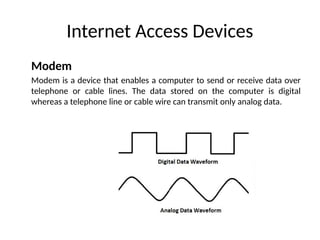
Modem is a device that enables a computer to send or receive data over
telephone or cable lines. The data stored on the computer is digital
whereas a telephone line or cable wire can transmit only analog data.
Internet Access Devices
The main function of the modem is to convert digital
signal into analog and vice versa. Modem is a
combination of two devices
− modulator and demodulator.
The modulator converts digital data into analog data
when the data is being sent by the computer.
The demodulator converts analog data signals into
digital data when it is being received by the
computer.
Internet Access Devices
Types of Modem
Modem can be categorized in several ways like direction in which it can
transmit data, type of connection to the transmission line, transmission mode,
etc.
Depending on direction of data transmission, modem can be of these types −
• Simplex − A simplex modem can transfer data in only one direction, from
digital device to network (modulator) or network to digital device
(demodulator).
• Half duplex − A half-duplex modem has the capacity to transfer data in both
the directions but only one at a time.
• Full duplex − A full duplex modem can transmit data in both the directions
simultaneously.
Internet Access Devices
RJ45 Connector
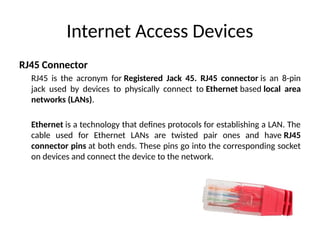
RJ45 is the acronym for Registered Jack 45. RJ45 connector is an 8-pin
jack used by devices to physically connect to Ethernet based local area
networks (LANs).
Ethernet is a technology that defines protocols for establishing a LAN. The
cable used for Ethernet LANs are twisted pair ones and have RJ45
connector pins at both ends. These pins go into the corresponding socket
on devices and connect the device to the network.
Internet Access Devices
Ethernet Card
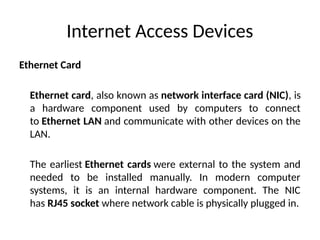
Ethernet card, also known as network interface card (NIC), is
a hardware component used by computers to connect
to Ethernet LAN and communicate with other devices on the
LAN.
The earliest Ethernet cards were external to the system and
needed to be installed manually. In modern computer
systems, it is an internal hardware component. The NIC
has RJ45 socket where network cable is physically plugged in.
Internet Access Devices
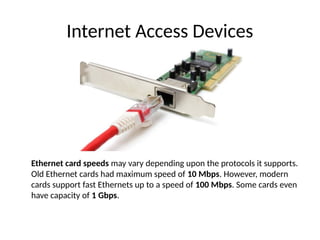
Ethernet card speeds may vary depending upon the protocols it supports.
Old Ethernet cards had maximum speed of 10 Mbps. However, modern
cards support fast Ethernets up to a speed of 100 Mbps. Some cards even
have capacity of 1 Gbps.
Internet Access Devices
Hubs
Hubs are used to connect multiple network devices
together. They can be used to transmit both digital and
analog information. Digital information is transmitted as
packets, whereas analog information is transmitted as a
signal.
Hubs also act as a repeater, which amplifies signals that
have weakened after being transmitted across a long
distance. Hubs operate at the Physical layer of the Open
Systems Interconnection (OSI) model.
Internet Access Devices
Switch
A switch is a multiport network device whose
purpose is to improve network efficiency and
improve communication between hubs,
routers, and other network devices. Switches
are intelligent devices that gather information
from incoming packets in order to forward
them to the appropriate destination.
Internet Access Devices
Router
The main role of the router is to forward packets of
information to their destinations. Routers are more
intelligent than hubs or switches as they store information
about the other network devices they are connected to.
Routers can play an important role in network security, as
they can be configured to serve as packet-filtering firewalls
and reference access control lists (ACLs) when forwarding
packets. In addition to filtering authorized network traffic,
they also are used to divide networks into subnetworks.
Internet Access Devices
Bridge
A bridge is used to connect hosts or network
segments together. As with routers, they can
be used to divide larger networks into smaller
ones, by sitting between network devices and
regulating the flow of traffic. A bridge also has
the ability to filter packets of data, known as
frames, before they are forwarded.
Internet Access Devices
Gateway
A gateway device is used to facilitate
interoperability between different
technologies such as Open System
Interconnection (OSI) and Transmission
Control Protocol/Internet Protocol (TCP/IP). In
other words, they translate each other’s
messages.
Internet Access Devices
Modem
A modem, which is short for “modulators-
demodulators”, is a piece of network hardware
that is used to convert digital signals into
analog signals, in order to transmit them over
analog telephone lines. When the signals
arrive at the destination, another modem will
convert the analog signals back to a digital
format.
Internet Access Devices
Repeater
A repeater is a relatively simple network device that
amplifies the signal it receives in order to allow it to cover a
longer distance. Repeaters work on the Physical layer of the
OSI model.
Access Point
An access point (AP) is a network device that is similar to a
router, only it has its own built-in antenna, transmitter and
adapter. An AP can be used to connect a variety of network
devices together, including both wired and wireless devices.

Internet Access Devices and Connecting Medias.pptx

  • 1.
  • 2.
    Network Devices Hardware devicesthat are used to connect computers, printers, fax machines and other electronic devices to a network are called network devices. These devices transfer data in a fast, secure and correct way over same or different networks.
  • 3.
    Internet Access Devices Modem Modemis a device that enables a computer to send or receive data over telephone or cable lines. The data stored on the computer is digital whereas a telephone line or cable wire can transmit only analog data.
  • 4.
    Internet Access Devices Themain function of the modem is to convert digital signal into analog and vice versa. Modem is a combination of two devices − modulator and demodulator. The modulator converts digital data into analog data when the data is being sent by the computer. The demodulator converts analog data signals into digital data when it is being received by the computer.
  • 5.
    Internet Access Devices Typesof Modem Modem can be categorized in several ways like direction in which it can transmit data, type of connection to the transmission line, transmission mode, etc. Depending on direction of data transmission, modem can be of these types − • Simplex − A simplex modem can transfer data in only one direction, from digital device to network (modulator) or network to digital device (demodulator). • Half duplex − A half-duplex modem has the capacity to transfer data in both the directions but only one at a time. • Full duplex − A full duplex modem can transmit data in both the directions simultaneously.
  • 6.
    Internet Access Devices RJ45Connector RJ45 is the acronym for Registered Jack 45. RJ45 connector is an 8-pin jack used by devices to physically connect to Ethernet based local area networks (LANs). Ethernet is a technology that defines protocols for establishing a LAN. The cable used for Ethernet LANs are twisted pair ones and have RJ45 connector pins at both ends. These pins go into the corresponding socket on devices and connect the device to the network.
  • 7.
    Internet Access Devices EthernetCard Ethernet card, also known as network interface card (NIC), is a hardware component used by computers to connect to Ethernet LAN and communicate with other devices on the LAN. The earliest Ethernet cards were external to the system and needed to be installed manually. In modern computer systems, it is an internal hardware component. The NIC has RJ45 socket where network cable is physically plugged in.
  • 8.
    Internet Access Devices Ethernetcard speeds may vary depending upon the protocols it supports. Old Ethernet cards had maximum speed of 10 Mbps. However, modern cards support fast Ethernets up to a speed of 100 Mbps. Some cards even have capacity of 1 Gbps.
  • 9.
    Internet Access Devices Hubs Hubsare used to connect multiple network devices together. They can be used to transmit both digital and analog information. Digital information is transmitted as packets, whereas analog information is transmitted as a signal. Hubs also act as a repeater, which amplifies signals that have weakened after being transmitted across a long distance. Hubs operate at the Physical layer of the Open Systems Interconnection (OSI) model.
  • 10.
    Internet Access Devices Switch Aswitch is a multiport network device whose purpose is to improve network efficiency and improve communication between hubs, routers, and other network devices. Switches are intelligent devices that gather information from incoming packets in order to forward them to the appropriate destination.
  • 11.
    Internet Access Devices Router Themain role of the router is to forward packets of information to their destinations. Routers are more intelligent than hubs or switches as they store information about the other network devices they are connected to. Routers can play an important role in network security, as they can be configured to serve as packet-filtering firewalls and reference access control lists (ACLs) when forwarding packets. In addition to filtering authorized network traffic, they also are used to divide networks into subnetworks.
  • 12.
    Internet Access Devices Bridge Abridge is used to connect hosts or network segments together. As with routers, they can be used to divide larger networks into smaller ones, by sitting between network devices and regulating the flow of traffic. A bridge also has the ability to filter packets of data, known as frames, before they are forwarded.
  • 13.
    Internet Access Devices Gateway Agateway device is used to facilitate interoperability between different technologies such as Open System Interconnection (OSI) and Transmission Control Protocol/Internet Protocol (TCP/IP). In other words, they translate each other’s messages.
  • 14.
    Internet Access Devices Modem Amodem, which is short for “modulators- demodulators”, is a piece of network hardware that is used to convert digital signals into analog signals, in order to transmit them over analog telephone lines. When the signals arrive at the destination, another modem will convert the analog signals back to a digital format.
  • 15.
    Internet Access Devices Repeater Arepeater is a relatively simple network device that amplifies the signal it receives in order to allow it to cover a longer distance. Repeaters work on the Physical layer of the OSI model. Access Point An access point (AP) is a network device that is similar to a router, only it has its own built-in antenna, transmitter and adapter. An AP can be used to connect a variety of network devices together, including both wired and wireless devices.