Understanding
the For Loop in
C++: Principles
and
Applications
Introduction to For Loops
In C++, the is a fundamental control
structure that allows for over a sequence. It
is essential for executing a block of code
multiple times, making it a powerful tool for
. Understanding its structure and
application is crucial for .
Structure of a For Loop
A consists of three
main components:
initialization, condition, and
increment. The syntax is:
for(initialization;
condition; increment). This
structure allows for and
code, facilitating easy
comprehension and debugging.
Initialization Phase
The sets up the
loop
control variable. It is executed only
once
at the beginning. Proper initialization is
crucial for ensuring that the
loop operates correctly and
avoids
.
Condition Evaluation
The is evaluated before
each iteration of the loop. If it
evaluates to
, the loop body executes;
otherwise, the loop terminates. This
phase is essential for controlling the
number of iterations.
Increment Phase
The updates the loop
control variable after each iteration.
This phase is crucial for ensuring that
the loop progresses towards
termination, preventing endless
execution and facilitating proper
.
Nested For Loops
A occurs when a loop
is placed within another loop.
This
structure is useful for
handling
and performing
complex iterations. Understanding
how to manage nested loops is vital
for advanced programming tasks.
Common Applications
For loops are widely used in
various programming scenarios,
including ,
and
,
. Their
versatility
makes them an essential tool for
any
C++ programmer.
Performance Considerations
While for loops are efficient, it's important to
consider their . Factors such as loop
complexity and the number of iterations can
impact execution time. Optimizing loops is
crucial for enhancing overall program
performance.
Best Practices
Adhering to when using for loops
can significantly improve code quality.
This includes clear variable naming,
avoiding complex conditions, and
minimizing nested loops to
enhance and
maintainability
.
Common Mistakes
Common mistakes in for loops
include incorrect initialization,
improper condition checks, and
failing to update the loop variable.
Recognizing these pitfalls is essential
for debugging and ensuring that
loops function as intended.
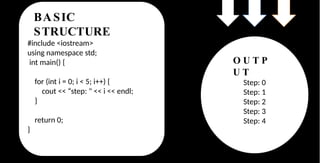
BASIC
STRUCTURE
#include <iostream>
using namespace std;
int main() {
for (int i = 0; i < 5; i++) {
cout << “step: " << i << endl;
}
return 0;
}
O U T P
U T
Step: 0
Step: 1
Step: 2
Step: 3
Step: 4
020304
1
2
3
4
Examples
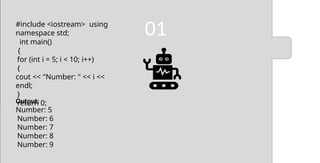
01
#include <iostream> using
namespace std;
int main()
{
for (int i = 5; i < 10; i++)
{
cout << "Number: " << i <<
endl;
}
return 0;
Output:
Number: 5
Number: 6
Number: 7
Number: 8
Number: 9
1
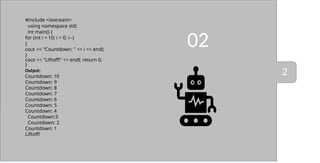
02
#include <iostream>
using namespace std;
int main() {
for (int i = 10; i > 0; i--)
{
cout << "Countdown: " << i << endl;
}
cout << "Liftoff!" << endl; return 0;
}
Output:
Countdown: 10
Countdown: 9
Countdown: 8
Countdown: 7
Countdown: 6
Countdown: 5
Countdown: 4
Countdown:3
Countdown: 2
Countdown: 1
Liftoff!
2
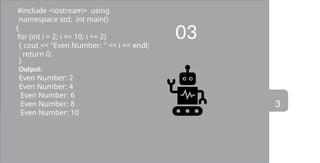
03
#include <iostream> using
namespace std; int main()
{
for (int i = 2; i <= 10; i += 2)
{ cout << "Even Number: " << i << endl;
return 0;
}
Output:
Even Number: 2
Even Number: 4
Even Number: 6
Even Number: 8
Even Number: 10
3
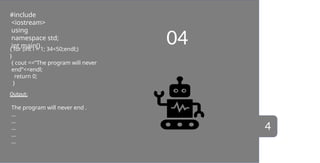
04
#include
<iostream>
using
namespace std;
int main()
{ for (int i = 1; 34<50;endl;)
}
{ cout <<“The program will never
end”<<endl;
return 0;
}
Output:
The program will never end .
…
…
…
…
…
4
Conclusion
In conclusion, understanding the in C++ is vital for
effective programming. Its structure, applications, and
best practices enable developers to write efficient and
maintainable code. Mastery of loops is a key skill for any
programmer.
Thanks!
Do you have any questions?

ilovepdf_merged useful knowledge[1].pptx

  • 1.
    Understanding the For Loopin C++: Principles and Applications
  • 2.
    Introduction to ForLoops In C++, the is a fundamental control structure that allows for over a sequence. It is essential for executing a block of code multiple times, making it a powerful tool for . Understanding its structure and application is crucial for .
  • 3.
    Structure of aFor Loop A consists of three main components: initialization, condition, and increment. The syntax is: for(initialization; condition; increment). This structure allows for and code, facilitating easy comprehension and debugging.
  • 4.
    Initialization Phase The setsup the loop control variable. It is executed only once at the beginning. Proper initialization is crucial for ensuring that the loop operates correctly and avoids .
  • 5.
    Condition Evaluation The isevaluated before each iteration of the loop. If it evaluates to , the loop body executes; otherwise, the loop terminates. This phase is essential for controlling the number of iterations.
  • 6.
    Increment Phase The updatesthe loop control variable after each iteration. This phase is crucial for ensuring that the loop progresses towards termination, preventing endless execution and facilitating proper .
  • 7.
    Nested For Loops Aoccurs when a loop is placed within another loop. This structure is useful for handling and performing complex iterations. Understanding how to manage nested loops is vital for advanced programming tasks.
  • 8.
    Common Applications For loopsare widely used in various programming scenarios, including , and , . Their versatility makes them an essential tool for any C++ programmer.
  • 9.
    Performance Considerations While forloops are efficient, it's important to consider their . Factors such as loop complexity and the number of iterations can impact execution time. Optimizing loops is crucial for enhancing overall program performance.
  • 10.
    Best Practices Adhering towhen using for loops can significantly improve code quality. This includes clear variable naming, avoiding complex conditions, and minimizing nested loops to enhance and maintainability .
  • 11.
    Common Mistakes Common mistakesin for loops include incorrect initialization, improper condition checks, and failing to update the loop variable. Recognizing these pitfalls is essential for debugging and ensuring that loops function as intended.
  • 12.
    BASIC STRUCTURE #include <iostream> using namespacestd; int main() { for (int i = 0; i < 5; i++) { cout << “step: " << i << endl; } return 0; } O U T P U T Step: 0 Step: 1 Step: 2 Step: 3 Step: 4
  • 13.
  • 14.
    01 #include <iostream> using namespacestd; int main() { for (int i = 5; i < 10; i++) { cout << "Number: " << i << endl; } return 0; Output: Number: 5 Number: 6 Number: 7 Number: 8 Number: 9 1
  • 15.
    02 #include <iostream> using namespacestd; int main() { for (int i = 10; i > 0; i--) { cout << "Countdown: " << i << endl; } cout << "Liftoff!" << endl; return 0; } Output: Countdown: 10 Countdown: 9 Countdown: 8 Countdown: 7 Countdown: 6 Countdown: 5 Countdown: 4 Countdown:3 Countdown: 2 Countdown: 1 Liftoff! 2
  • 16.
    03 #include <iostream> using namespacestd; int main() { for (int i = 2; i <= 10; i += 2) { cout << "Even Number: " << i << endl; return 0; } Output: Even Number: 2 Even Number: 4 Even Number: 6 Even Number: 8 Even Number: 10 3
  • 17.
    04 #include <iostream> using namespace std; int main() {for (int i = 1; 34<50;endl;) } { cout <<“The program will never end”<<endl; return 0; } Output: The program will never end . … … … … … 4
  • 18.
    Conclusion In conclusion, understandingthe in C++ is vital for effective programming. Its structure, applications, and best practices enable developers to write efficient and maintainable code. Mastery of loops is a key skill for any programmer.
  • 19.
    Thanks! Do you haveany questions?