An Evaluation of CAMELS Rating System as a Measure of Bank Performance
1
1.1 Preludes
Financial sector of an economy plays an important role in its economic development and
prosperity of the country. Banking industry serves as the backbone of the financial sector
that accumulates savings from surplus economic units in the form of deposits and provides it
to deficit economic units in the form of advances. Banking industry provides support to
economy and industries specifically at the time of recessions and economic crisis. But when
banks are at the heart of economic recession or banks are the cause of financial crisis like the
recent past financial crisis 2007-09, it makes the situation worst for economic recovery. So it
is of great importance to keenly observe the performance of the banks and their compliance
with the regulatory requirements.
Performance of the banks is measured at two levels, one is at the management and
regulatory level of the banks and another is at external rating agencies. Purpose of regulatory
and supervisory rating systems is to measure the bank performance at internal level and its
compliance with regulatory requirements to keep the bank on right track. These ratings are
highly confidential and are only available to the bank management. External credit rating
agencies examine and evaluate the banks and issue ratings for the general public and
investors in particulars. It is great importance that both these ratings present the same
results about the condition of the banks to provide clear information to investors and
management. In past several banks suffer from bankruptcy that was the failure of both
internal rating systems and credit rating agencies.
CAMELS is a rating system generally used by the government policy circle, regulating bodies
regulating commercial banks, that is, central banks and non-governmental policy research
centers for the purpose of assessing the soundness of a savings association or a bank. In
Bangladesh CAMELS rating system is implemented by Bangladesh Bank. It takes into
account six important components of a bank when it evaluates performance of the bank.
These components are Capital, Assets, Management, Earning, Liquidity and Sensitivity to
market risk. Ratings is assigned to these components on the scale of 1 to 5 and that is a base
for composite rating that also ranged from 1 to 5. The application of CAMELS has spread up
dramatically in respect of examining the financial strengths of one of the basic constituents
of money market i.e. commercial banks. Currently financial ratios are often used to measure
the overall soundness of a bank and the quality of bank management. Thus, bank regulators
may use financial ratios to help evaluate a bank’s performance as part of CAMELS rating
system.
An Evaluation of CAMELS Rating System as a Measure of Bank Performance
2
1.2 Literature review
The applications of CAMELS rating system for evaluating financial strengths of commercial
banks have been growing both locally and internationally. At international level, several
academic studies examined whether and to what extent private supervisory information is
useful in supervisory monitoring of banks. With respect to predicting banks failure, Barker
and Holdsworth (1993) find evidence that CAMELS ratings are useful, even after controlling
a wide range of publicly available information about the condition and performance of
banks.
Cole and Gunther (1998) examined a similar question and found that CAMELS ratings
contain useful information. Hirtle and Lopez (1999) also inquired into the worth of CAMELS
ratings in assessing banks current condition. While comparing to past CAMELS ratings to
current CAMELS ratings, they found that the private supervisory information contained in
the past CAMELS ratings provides further insight into bank current conditions, as
summarized by current CAMELS ratings and that for the period from 1989 to 1995, the
private supervisory information gathered during the last on-site exam remains useful with
respect to current condition of a bank for 6 to 12 quarters.
In Bangladesh, Bangladesh Bank as a regulatory body has been calculating this rating till
now. Apart from the prime regulator of commercial banks, academicians are also found
taking interest in utilizing CAMELS ratings to assess the financial soundness of commercial
banks. Purohit and Mazumder (2003) in a recent research paper used this technique to
measure the performance of BASIC; a government owned commercial bank promoting
basically small and medium enterprises. All of the above mentioned academic studies made
an overall conclusion that private supervisory information, as summarized by CAMEL
ratings, is clearly useful in the supervisory monitoring of bank conditions.
Hirtle and Lopez (1999) studied the predictability of past CAMELS ratings in examining
financial institutions' current performance. They find the usefulness of CAMELS rating as
measure of summarizing the banks soundness.
Recently, the case of Lehman Brothers is being examined by analyzing its financial
particulars of the last five years (2003-2007) using the CAMELS ratios. Lehman Brothers is
the largest investment bank in USA and is declared as bankrupt forever during the recent
An Evaluation of CAMELS Rating System as a Measure of Bank Performance
3
economic recession. The impact of its bankruptcy is huge on the world economy. Research
results from the case study showed that" its credits were found as bad and doubtful while its
management appeared to be unwilling and unable to reverse its declining course. Also, the
management was not complying with the rules based on CAMELS ratio set by the
supervisory authorities and the risk management procedures of Lehman and Brothers is 8
regarded as unsatisfactory proportionally to its size. Finally, the bank also seems to be in
danger against risks or unstable conditions".
So, it has been proved that the predictability of CAMELS rating is still beyond question. The
Supervisory or regulatory authority should give due importance while rating the banks and
financial institutions At the same time, the Supervisory or regulatory authority has to be
more prudent in making bound the banks and financial institutions to follow the rules and
regulations set by the CAMELS rating prediction.
1.3 Statement of the problem
Banks serve as backbone to the financial sector, which facilitate the proper utilization of
financial resources of a country. The banking sector is increasingly growing and it has
witnessed a huge flow of investment. A single bank is highly connected with other banks for
payment system and other functions of bank. The failure of a single bank not only affects its
shareholders and depositors rather it affects rest other banks and even all rest other
business. The failure of a single bank creates an economic turmoil situation and is regarded
as a disaster for the economy. The recent global recession is also an example of economic
disaster that occurred for the failure of banking business. So, the government of any country
must have a high concern about the performance of all banks. There are various measures to
supervise and evaluate performance of a bank specifically First security Islami Bank Limited
(FSIBL). One of such measures of supervisory information is the CAMELS rating system
which was put into effect firstly in the U.S. in 1979.
CAMELS ratios mainly indicate the adequacy of the risk based capital, credit growth, credit
concentration, single borrower exposure, non-performing loan position, liquidity gap
analysis, liquidity ratio, inter-bank dependency, Return on Assets (ROA), return on equity
(ROE), net interest margin (NIM), foreignexchange exposure, market risk and management
questionnaire, etc. This study will help to evaluate various components of CAMELS rating on
First Security Islami Bank (FSIBL), composite rating and actual financial performance of
FSIBL.
An Evaluation of CAMELS Rating System as a Measure of Bank Performance
4
1.4 Objective of the study
The principle objective of the study is to evaluate the performance of First Security Islami
Bank (FSIBL) on the bases of CAMELS rating system. Specifically this study will look into:
a) To understand the literature of CAMELS rating system.
b) To know about First Security Islami Bank Ltd.
c) To evaluate CAMELS components on FSIBL.
d) To evaluate composite rating on FSIBL.
e) To suggest some policy measures for financial improvement of FSIBL.
1.5 Scope of the study
This report is a part of the academic curriculum of the MBA (accounting), university of
Chittagong. The report is all about the CAMELS rating system of Bangladesh Bank in
accordance with First Security Islami Bank Ltd. The report has been prepared using highest
concern, but the complexity of CAMELS rating system is very well known. It is a report
which can be easy for all that a primary reader do not face any problem to know about the
banking industry or about regulatory requirement or about the CAMELS rating system. This
report can be absolute alternative for anyone who wants to know the ins and outs of
CAMELS rating system of FSIBL and common rules and regulation of BB about CAMELS
rating system. The report covers the financial performance of FSIBL for five years from 2011
to 2015. The collected data and information has been tabulated, processed and analyzed
carefully. Graphical analysis and different chart of this report makes it easier and more
acceptable to all.
An Evaluation of CAMELS Rating System as a Measure of Bank Performance
5
1.6 Methodology of the study
Sampling:
First Security Islami Bank Limited and its annual report from 2011 to 2015 are used as a
sample for the study.
Collection of primary data:
The researcher has conducted face to face interview to particular branch manager and
principle officer of FSIBL. Also has conducted General discussion with reporting unit
officers.
Collection of secondary data:
The researcher has collected secondary data from various sources as follows:
o Bangladesh Bank capital adequacy guideline
o Bangladesh Bank CAMELS rating system guideline
o Websites
o Articles
o First Security Islami Bank Ltd. Annual Report from 2011 to 2015
o Many Research Report on CAMELS rating system
o Journal
o Magazine
Analysis of data:
Technique:
 Ratio analysis.
Graph:
 Line graph.
1.7 Limitation of the study
The report is not free from error and limitation because of scarcity of resources and
constraint.
The limitation of the study at glance-
 Lack of sufficient funds to make the report more accurate and informative.
 Only five years annual reports of FSIBL are used as a sample.
 Secondary data are limited to a specific source.
An Evaluation of CAMELS Rating System as a Measure of Bank Performance
6
 There some information which are confidential for collecting the data. So, some data
could not been collected for confidentiality or secrecy of management
 Lack of researcher personal skill to make a report properly.
 Use few parameters for analysis of the data.
 Limited time for preparing the paper.
 Because of Lack of necessary information, the report may not give a true indication of
the analysis.
 A lot of information may not be valid any longer at the present date.
1.8 Organization of the study
The study has been segmented into five chapters.
 The first chapter includes preludes, review of literature, a statement of the problem,
objective of the study, the scope of the study, the methodology of the study, limitation
of the study and organization of the study.
 Second chapter includes origin of camels rating system, camel rating framework,
process of camels reporting, limitations of the camel rating system, camels rating
system of Bangladesh, CAMELS composite ratings description and rating base of
CAMELS components.
 Third chapter includes overview of FSIBL, vision of FSIBL, mission of FSIBL,
strategies of FSIBL, corporate profile of FSIBL, products and services of FSIBL, board
of director’s profile, profile of shariah board, management & head of division and
financial performance at a glance.
 Fourth chapter includes evaluation of the capital adequacy, evaluation of assets
quality, evaluation of management efficiency, evaluation of earnings and profitability,
evaluation of liquidity, evaluation of sensitivity to market risk and composite CAMELS
rating of FSIBL.
 Fifth chapter includes findings of the analysis, suggestion and conclusion.
An Evaluation of CAMELS Rating System as a Measure of Bank Performance
7
2.1 Originof CAMELS Rating System
There are many banks rating system available in the world. However, CAMELS rating system
is the most successful bank rating system in the world. The ‘Uniform Financial Institutions
Rating System (UFIRS)’ was created in 1979 by the bank regulatory agencies. Under the
original UFIRS a bank was assigned ratings based on performance in five areas: the
adequacy of Capital, the quality of Assets, the capability of Management, the quality and
level of Earnings and the adequacy of Liquidity. Bank supervisors assigned a 1 through 5
rating for each of these components and a composite rating for the bank. This 1 through 5
composite rating was known primarily by the short form CAMEL.
A bank received the CAMEL rate 1 or 2 for their sound or good performance in every respect
of criteria. The bank which exhibited unsafe and unsound practices or conditions, critically
deficient performance received the CAMEL rate 5 and that bank was of the greatest
supervisory concern.
While the CAMEL rating normally bore close relation to the five component ratings, it was
not the result of averaging those five grades. Supervisors consider each institution’s specific
situation when weighing component ratings and review all relevant factors when assigning
ratings to a certain extent. The process and component and composite system exist similar
for all banking companies.
In 1996, the UFIRS was revised and CAMEL became CAMELS with the addition of a
component grade for the Sensitivity of the bank to market risk. Sensitivity is the degree to
which changes in market prices such as interest rates adversely affect a financial institution.
The communication policy for bank ratings was also changed at end of 1996. Starting in
1997, the supervisors were to report the component rating to the bank. Prior to that,
supervisors only reported the numeric composite rating to the bank.
CAMELS ratings in the Ninth District as of the third quarter of 1998 reflect the excellent
banking conditions and performance over the last several years. Comparison between the
distribution of ratings in the most recent quarter and 10 years ago during the height of the
national banking crisis is illustrative (221 banks failed nationally in 1988while 3 banks failed
in 1998). Nearly 100 percent of Ninth District banks currently fall into the top two ratings
with 40 percent receiving the top grade. Ten years ago one-third of Ninth District banks fell
into the bottom three ratings and only about one of 10 banks received the highest grade.
An Evaluation of CAMELS Rating System as a Measure of Bank Performance
8
2.2 CAMELS Rating Framework
Capital Adequacy
Capital adequacy focuses on the total position of bank capital. It assures the depositors that
they are protected from the potential shocks of losses that a bank incurs. Financial managers
maintain company’s adequate level of capitalization by following it. It is the key parameter of
maintaining adequate levels of capitalization.
Asset Quality
Asset quality determines the robustness of financial institutions against loss of value in the
assets. All commercial banks show the concentration of loans and advances in total assets.
The high concentration of loans and advances indicates vulnerability of assets to credit risk,
especially since the portion of non-performing assets is significant.
Management Soundness
Management quality of any financial institution is evaluated in terms of Capital Adequacy,
Asset Quality, Management, Earnings, Liquidity and Sensitivity to market risk. Moreover, it
is also depended on compliance with set norm, planning ability; react to changing situation,
technical competence, leadership and administrative quality. A Sound management is the
most important pre-requisite for the strength and growth of any financial institution.
Earnings and Profitability
Earning and profitability is the prime sources of increasing capital of any financial
institution. Strong earnings and profitability profile of a bank reflect its ability to support
present and future operations. Increased earning ensure adequate capital and adequate
capital can absorb all loses and give shareholder adequate dividends.
Liquidity
An adequate liquidity position refers to a situation, where an institution can obtain sufficient
funds, either by increasing liabilities or by converting its assets quickly at a reasonable cost.
It access in terms of asset and liability management. Liquidity indicators measured as
percentage of demand and time liabilities (excluding interbank items) of the banks. It means
that the percentage of demand and time liabilities gets a bank as per its liquid assets.
An Evaluation of CAMELS Rating System as a Measure of Bank Performance
9
Sensitivity to Market Risk
The sensitivity to market risk is evaluated from changes in market prices, notably interest
rates; exchange rates, commodity prices, and equity prices adversely affect a bank’s earnings
and capital.
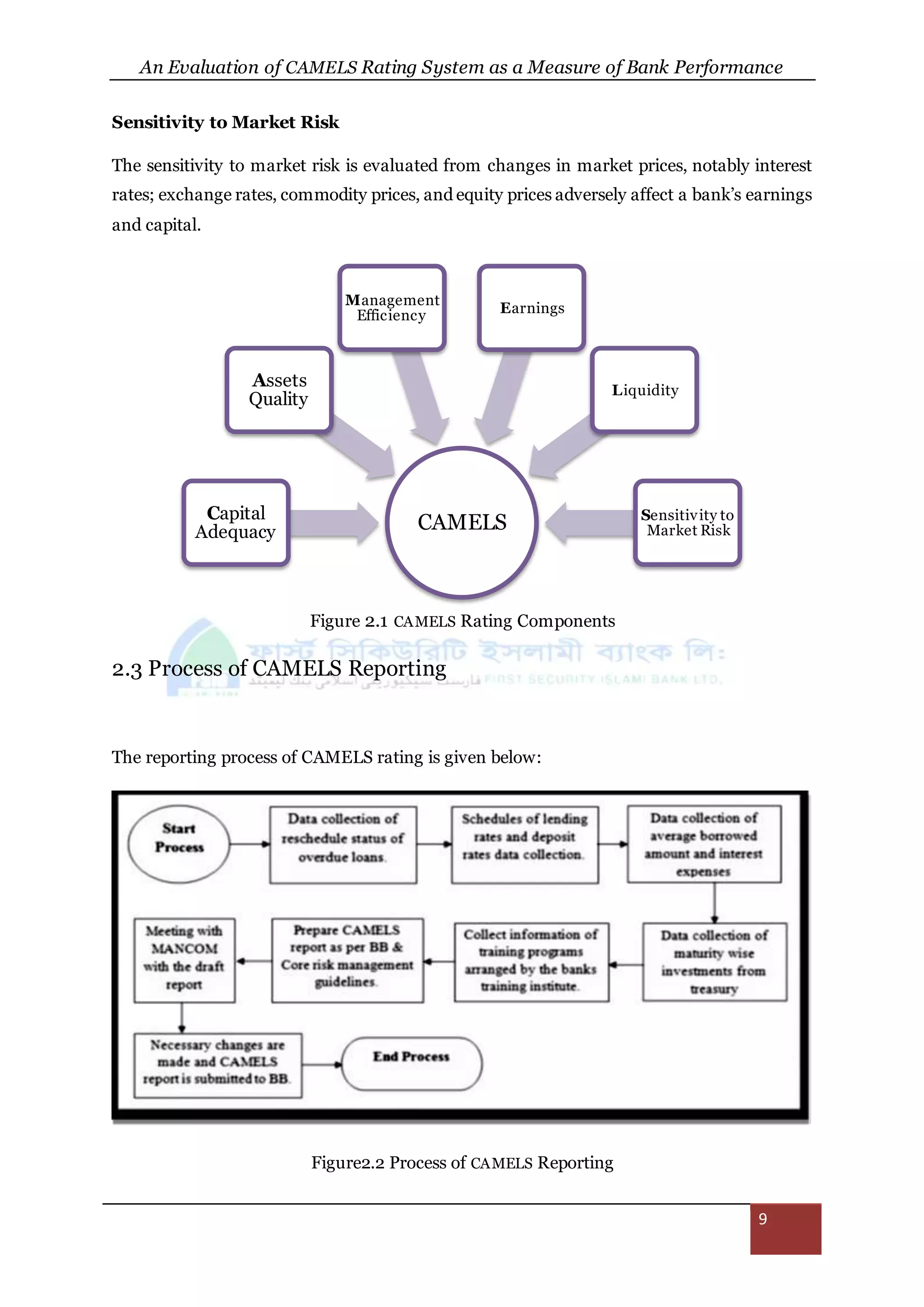
Figure 2.1 CAMELS Rating Components
2.3 Process of CAMELS Reporting
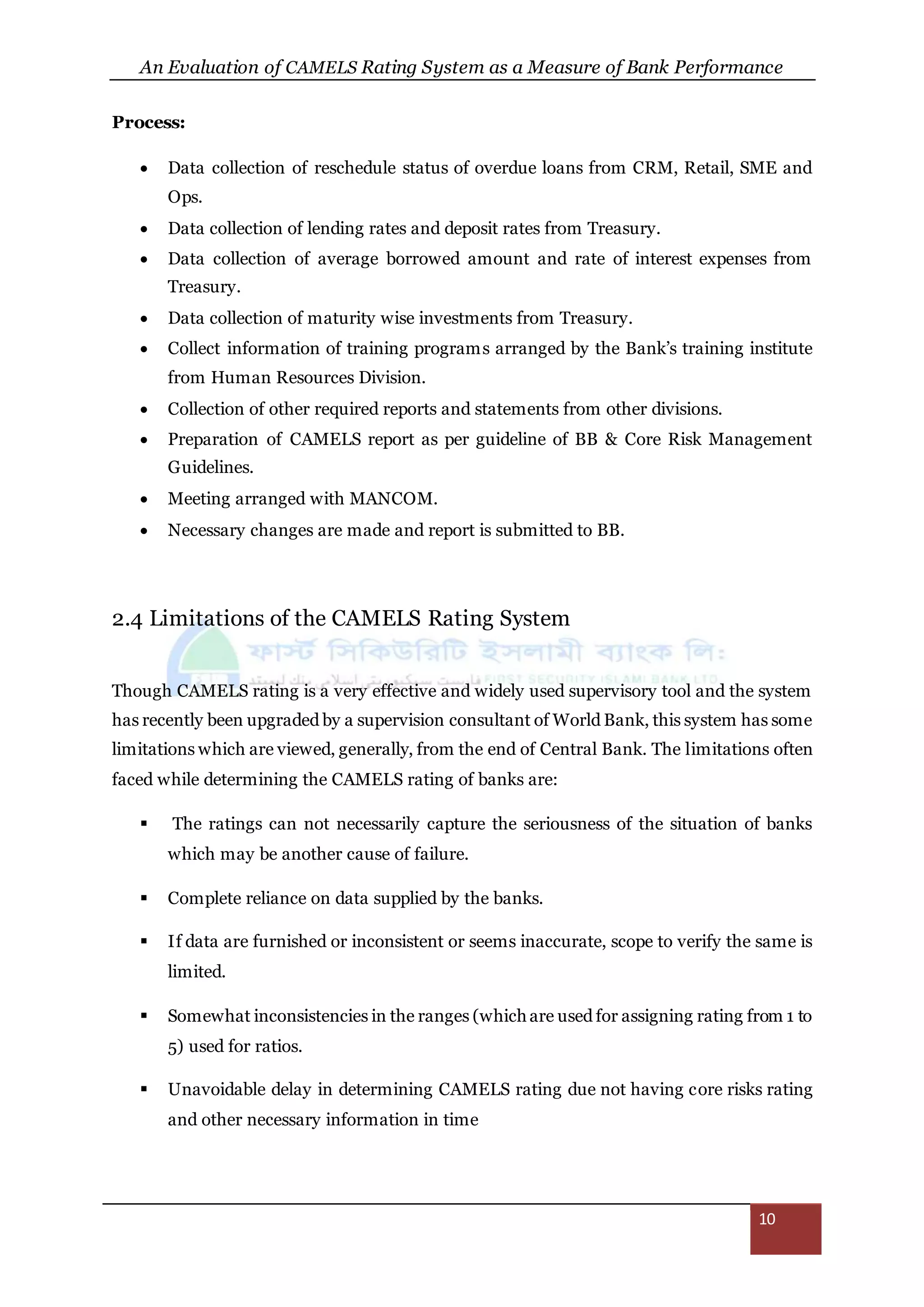
The reporting process of CAMELS rating is given below:
Figure2.2 Process of CAMELS Reporting
CAMELSCapital
Adequacy
Assets
Quality
Management
Efficiency Earnings
Liquidity
Sensitivity to
Market Risk
An Evaluation of CAMELS Rating System as a Measure of Bank Performance
10
Process:
 Data collection of reschedule status of overdue loans from CRM, Retail, SME and
Ops.
 Data collection of lending rates and deposit rates from Treasury.
 Data collection of average borrowed amount and rate of interest expenses from
Treasury.
 Data collection of maturity wise investments from Treasury.
 Collect information of training programs arranged by the Bank’s training institute
from Human Resources Division.
 Collection of other required reports and statements from other divisions.
 Preparation of CAMELS report as per guideline of BB & Core Risk Management
Guidelines.
 Meeting arranged with MANCOM.
 Necessary changes are made and report is submitted to BB.
2.4 Limitations of the CAMELS Rating System
Though CAMELS rating is a very effective and widely used supervisory tool and the system
has recently been upgraded by a supervision consultant of World Bank, this system has some
limitations which are viewed, generally, from the end of Central Bank. The limitations often
faced while determining the CAMELS rating of banks are:
 The ratings can not necessarily capture the seriousness of the situation of banks
which may be another cause of failure.
 Complete reliance on data supplied by the banks.
 If data are furnished or inconsistent or seems inaccurate, scope to verify the same is
limited.
 Somewhat inconsistencies in the ranges (which are used for assigning rating from 1 to
5) used for ratios.
 Unavoidable delay in determining CAMELS rating due not having core risks rating
and other necessary information in time
An Evaluation of CAMELS Rating System as a Measure of Bank Performance
11
 CAMELS ratings only consider the internal operations. They measure only the
current financial condition of a bank. They do not consider regional or local economic
developments that may pose future problems which CAMELS rating fail to reflect as
bank’s condition.
 CAMELS ratings are not forward looking and do not systematically track long-term
risk factors that may cause losses several years later. For example, many banks
during the period under review engaged in risky behaviors that in the past had been
associated with failures, like excessive asset growth, high ratios of commercial real
estate loans and total loans to total assets, or a heavy dependence upon volatile
deposit liabilities, yet if the bank was performing satisfactorily, these risk factors were
generally not captured or weighted in the current examination ratings.
 Lack Of seriousness of the bank situation, considering only internal operation not
external operation and having no forward looking ability, it causes a great problem
for bank. Unexpected problem from this limitation, sometimes a bank have to pay a
lot of money to solve this problem. Not only wastage of money but also giving wrong
path to the bank causes wastage of time.
2.5 CAMELS Rating For Banking Companies
CAMELS rating system is encountered by six components named capital adequacy, asset
quality, management competence, earnings, liquidity and sensitivity to market risk. It is used
for banking companies to know about their financial condition, overall soundness of the
banks, and predict different risk factors that may contribute to turn the bank into a problem.
To review the different aspects of the banks such as adequacy of risk-based capital, future
sources of capital and dividend payment ratio, asset growth rate, loan growth rate, non-
performing loan trends, provision for loan loss and bad assets, maturity profile of assets,
their classification-wise weight age, performance of off balance sheet items, return on assets,
level and composition of earnings, volatility of deposits base and reliance position on the
borrowed funds and its sources, technical competence in the rise of financial globalization
and deregulation, uses of financial innovations, leadership ability, administrative and control
ability, compliance with the rules and regulations and standard management information
system etc. CAMELS rating system is very important. It also recommends on which sector it
should improve.
An Evaluation of CAMELS Rating System as a Measure of Bank Performance
12
2.6 CAMELS Rating System of Bangladesh
All over the world, CAMELS rating is a commonfigure to all banking industry. Like all other
countries, it is also used in Bangladesh. In Bangladesh, the five components of CAMEL have
been used for evaluating the five crucial dimensions of a bank’s operations that reflect in a
complete institution’s financial condition, compliance with banking regulations and statutes
and overall operating soundness since the early nineties. In 2006, Bangladesh Bank has
upgraded the CAMEL into CAMELS. ‘Sensitivity to market risk’ or ‘S’ is the new rating
component which is included in CAMEL and make it into CAMELS. The new rating
component makes the system more effective and efficient. The new system needs bank’s
regular condition and performance according to predetermined stress testing on asset and
liability and foreign exchange exposures, procedures, rules and criteria and on the basis of
the results obtained through risk-based audits under core risk management guidelines. A
bank’s single CAMELS rating has come from off-site monitoring, which uses monthly
financial statement information, and an on-site examination, from which bank supervisors
gather further “private information” not reflected in the financial reports. The development
of "credit points" examination result is ranging from 0 to 100. The six key performance
dimensions – capital adequacy, asset quality, management, earnings, liquidity and
sensitivity to market risk – are to be evaluated on a scale of 1 to 5 in ascending order.
Following is a description of the graduations of rating:
o Rating 1 - indicates strong performance: BEST rating.
o Rating 2 - indicates above average performance that adequately provides for the
safe and sound operations of the banking company.
o Rating 3 - represents performance that is flawed to some degree.
o Rating 4- refers to marginal performance and is significantly below average and
o Rating 5- indicates very unsatisfactory performance in need of immediate remedial
attention for the sake of the banking company’s survival: WORST rating.
An Evaluation of CAMELS Rating System as a Measure of Bank Performance
13
2.7 CAMELS Composite Ratings Description
Composite ratings are based on a careful evaluation of an institution’s managerial,
operational, financial, and compliance performance. The six key components used to assess
an institution’s financial condition and operations are: capital adequacy, asset quality,
management capability, earnings quantity and quality, the adequacy of liquidity, and
sensitivity to market risk. The rating scale ranges from 1 to 5, with a rating of 1 indicating:
the strongest performance and risk management practices relative to the institution’s size,
complexity, and risk profile; and the level of least supervisory concern. A 5 rating indicates:
the most critically deficient level of performance; inadequate risk management practices
relative to the institution’s size, complexity, and risk profile; and the greatest supervisory
concern. The composite ratings are defined as follows:
Composite 1 [Strong]
Financial institutions in this group are sound in every respect and generally have
components rated 1 or 2. Any weaknesses are minor and can be handled in a routine manner
by the board of directors and management. These financial institutions are the most capable
of withstanding the vagaries of business conditions and are resistant to outside influences
such as economic instability in their trade area. These financial institutions are in substantial
compliance with laws and regulations. As a result, these financial institutions exhibit the
strongest performance and risk management practices relative to the institution’s size,
complexity, and risk profile, and give no cause for supervisory concern.
Composite 2 [Satisfactory]
Financial institutions in this group are fundamentally sound. For a financial institution to
receive this rating, generally no component rating should be more severe than 3. Only
moderate weaknesses are present and are well within the board of directors’ and
management’s capabilities and willingness to correct. These financial institutions are stable
and are capable of withstanding business fluctuations. These financial institutions are in
substantial compliance with laws and regulations. Overall risk management practices are
satisfactory relative to the institution’s size, complexity, and risk profile. There are no
material supervisory concerns and, as a result, the supervisory response is informal and
limited.
An Evaluation of CAMELS Rating System as a Measure of Bank Performance
14
Composite 3 [Fair]
Financial institutions in this group exhibit some degree of supervisory concern in one or
more of the component areas. These financial institutions exhibit a combination of
weaknesses that may range from moderate to severe; however, the magnitude of the
deficiencies generally will not cause a component to be rated more severely than 4.
Management may lack the ability or willingness to effectively address weaknesses within
appropriate time frames. Financial institutions in this group generally are less capable of
Comptroller’s Handbook 46 Bank Supervision Process withstanding business fluctuations
and are more vulnerable to outside influences than those institutions rated a composite 1 or
2. Additionally, these financial institutions may be in significant noncompliance with laws
and regulations. Risk management practices may be less than satisfactory relative to the
institution’s size, complexity, and risk profile. These financial institutions require more than
normal supervision, which may include formal or informal enforcement actions. Failure
appears unlikely, however, given the overall strength and financial capacity of these
institutions.
Composite 4 [Marginal]
Financial institutions in this group generally exhibit unsafe and unsound practices or
conditions. There are serious financial or managerial deficiencies that result in
unsatisfactory performance. The problems range from severe to critically deficient. The
weaknesses and problems are not being satisfactorily addressed or resolved by the board of
directors and management. Financial institutions in this group generally are not capable of
withstanding business fluctuations. There may be significant noncompliance with laws and
regulations. Risk management practices are generally unacceptable relative to the
institution’s size, complexity, and risk profile. Close supervisory attention is required, which
means, in most cases, formal enforcement action is necessary to address the problems.
Institutions in this group pose a risk to the deposit insurance fund. Failure is a distinct
possibility if the problems and weaknesses are not satisfactorily addressed and resolved.
Composite 5 [Unsatisfactory]
Financial institutions in this group exhibit extremely unsafe and unsound practices or
conditions; exhibit a critically deficient performance; often demonstrate inadequate risk
management practices relative to the institution’s size, complexity, and risk profile; and are
of the greatest supervisory concern. The volume and severity of problems are beyond
An Evaluation of CAMELS Rating System as a Measure of Bank Performance
15
management’s ability or willingness to control or correct. Immediate outside financial or
other assistance is needed in order for the financial institution to be viable. Ongoing
supervisory attention is necessary. Institutions in this group pose a significant risk to the
deposit insurance fund and failure is highly probable.
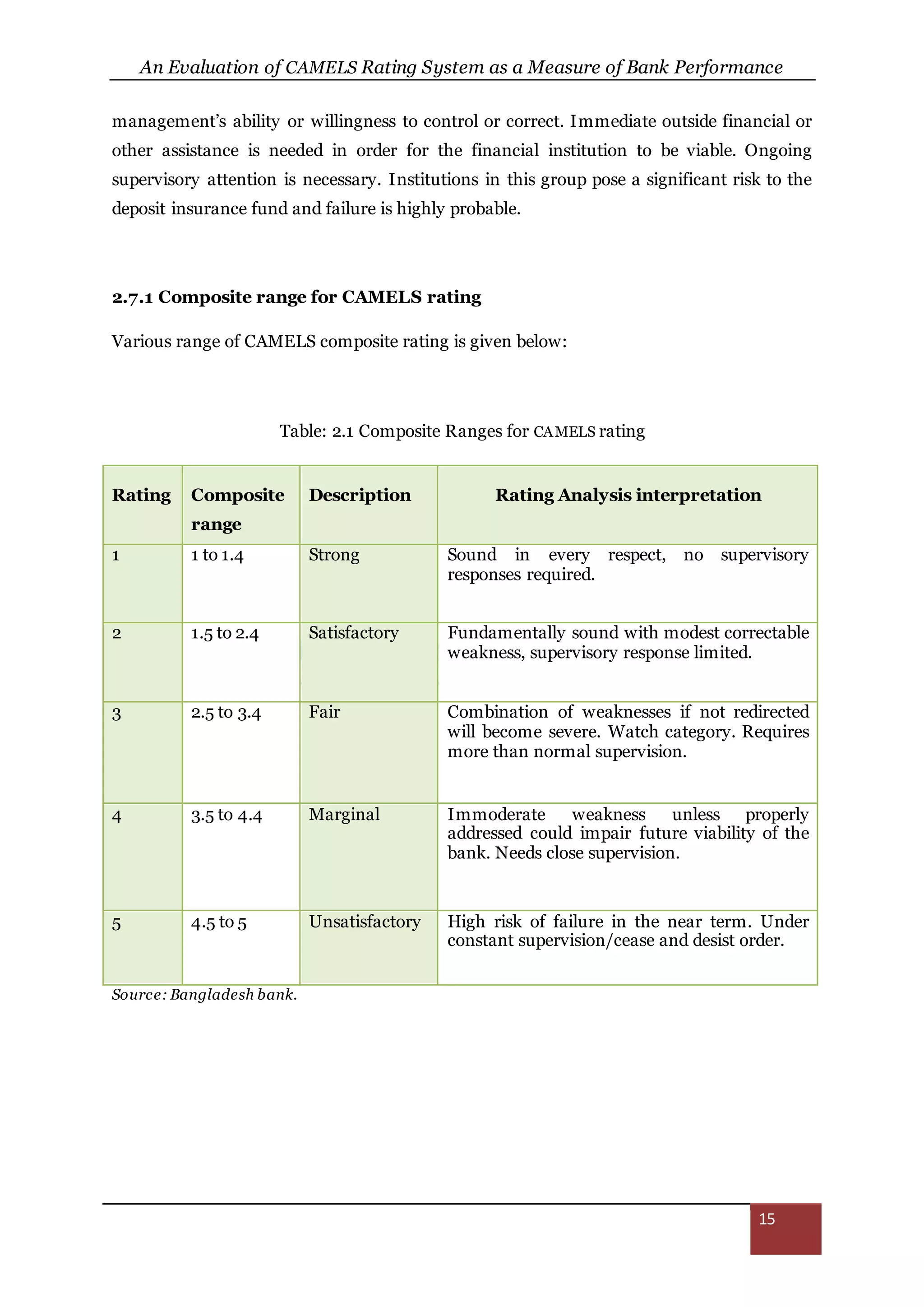
2.7.1 Composite range for CAMELS rating
Various range of CAMELS composite rating is given below:
Table: 2.1 Composite Ranges for CAMELS rating
Rating Composite
range
Description Rating Analysis interpretation
1 1 to 1.4 Strong Sound in every respect, no supervisory
responses required.
2 1.5 to 2.4 Satisfactory Fundamentally sound with modest correctable
weakness, supervisory response limited.
3 2.5 to 3.4 Fair Combination of weaknesses if not redirected
will become severe. Watch category. Requires
more than normal supervision.
4 3.5 to 4.4 Marginal Immoderate weakness unless properly
addressed could impair future viability of the
bank. Needs close supervision.
5 4.5 to 5 Unsatisfactory High risk of failure in the near term. Under
constant supervision/cease and desist order.
Source: Bangladesh bank.
An Evaluation of CAMELS Rating System as a Measure of Bank Performance
16
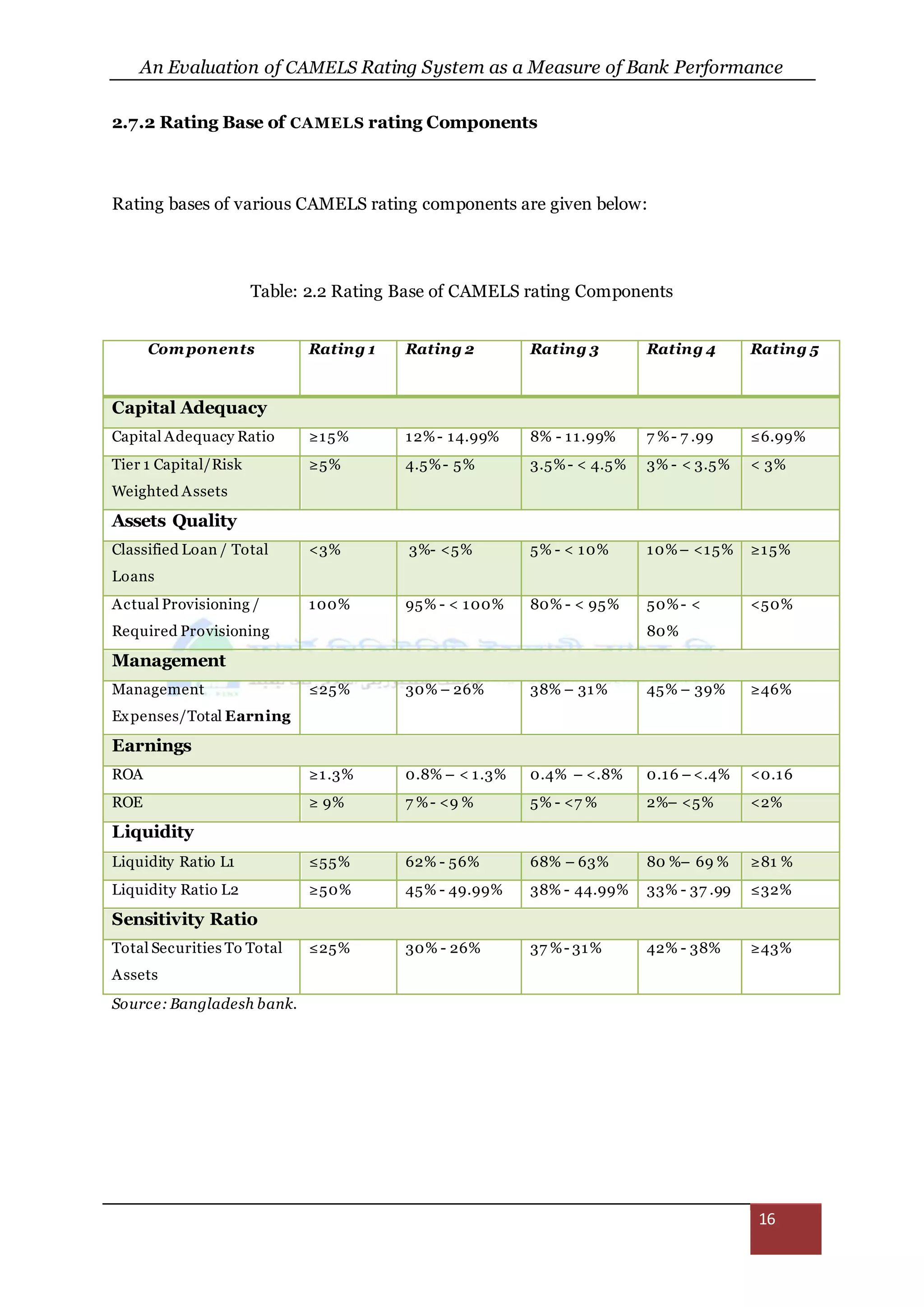
2.7.2 Rating Base of CAMELS rating Components
Rating bases of various CAMELS rating components are given below:
Table: 2.2 Rating Base of CAMELS rating Components
Com ponents Rating 1 Rating 2 Rating 3 Rating 4 Rating 5
Capital Adequacy
Capital Adequacy Ratio ≥15% 12%- 14.99% 8% - 11.99% 7 %- 7 .99 ≤6.99%
Tier 1 Capital/Risk
Weighted Assets
≥5% 4.5%- 5% 3.5%- < 4.5% 3% - < 3.5% < 3%
Assets Quality
Classified Loan / Total
Loans
<3% 3%- <5% 5% - < 10% 10%– <15% ≥15%
Actual Provisioning /
Required Provisioning
100% 95% - < 100% 80% - < 95% 50%- <
80%
<50%
Management
Management
Expenses/Total Earning
≤25% 30% – 26% 38% – 31% 45% – 39% ≥46%
Earnings
ROA ≥1.3% 0.8% – < 1.3% 0.4% – <.8% 0.16 –<.4% <0.16
ROE ≥ 9% 7 %- <9 % 5% - <7 % 2%– <5% <2%
Liquidity
Liquidity Ratio L1 ≤55% 62% - 56% 68% – 63% 80 %– 69 % ≥81 %
Liquidity Ratio L2 ≥50% 45% - 49.99% 38% - 44.99% 33% - 37 .99 ≤32%
Sensitivity Ratio
Total Securities To Total
Assets
≤25% 30% - 26% 37 %- 31% 42% - 38% ≥43%
Source: Bangladesh bank.
An Evaluation of CAMELS Rating System as a Measure of Bank Performance
17
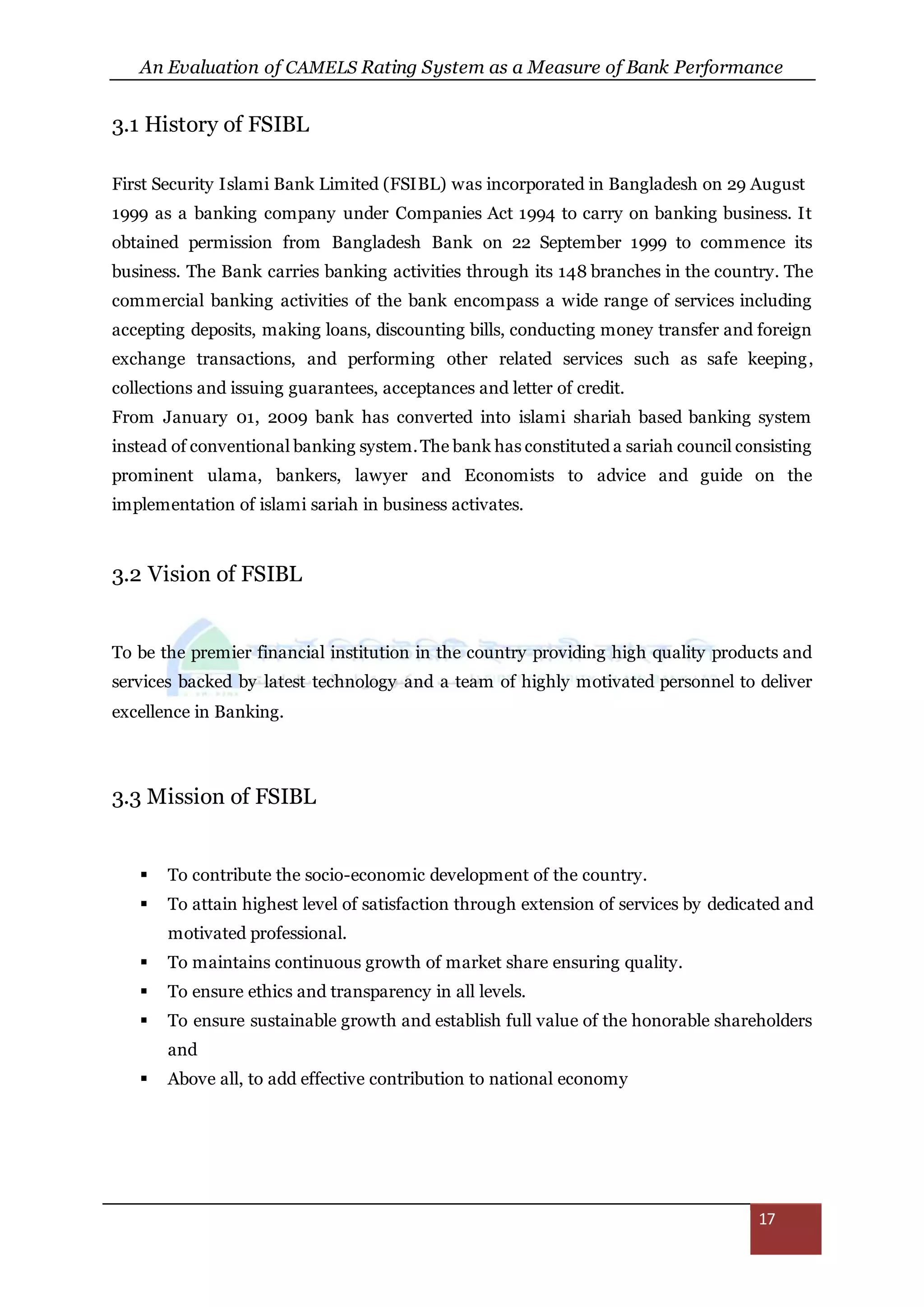
3.1 History of FSIBL
First Security Islami Bank Limited (FSIBL) was incorporated in Bangladesh on 29 August
1999 as a banking company under Companies Act 1994 to carry on banking business. It
obtained permission from Bangladesh Bank on 22 September 1999 to commence its
business. The Bank carries banking activities through its 148 branches in the country. The
commercial banking activities of the bank encompass a wide range of services including
accepting deposits, making loans, discounting bills, conducting money transfer and foreign
exchange transactions, and performing other related services such as safe keeping,
collections and issuing guarantees, acceptances and letter of credit.
From January 01, 2009 bank has converted into islami shariah based banking system
instead of conventional banking system.The bank has constituted a sariah council consisting
prominent ulama, bankers, lawyer and Economists to advice and guide on the
implementation of islami sariah in business activates.
3.2 Vision of FSIBL
To be the premier financial institution in the country providing high quality products and
services backed by latest technology and a team of highly motivated personnel to deliver
excellence in Banking.
3.3 Mission of FSIBL
 To contribute the socio-economic development of the country.
 To attain highest level of satisfaction through extension of services by dedicated and
motivated professional.
 To maintains continuous growth of market share ensuring quality.
 To ensure ethics and transparency in all levels.
 To ensure sustainable growth and establish full value of the honorable shareholders
and
 Above all, to add effective contribution to national economy
An Evaluation of CAMELS Rating System as a Measure of Bank Performance
18
3.4 Strategies of FSIBL
 To strive our customers best satisfaction & win their confidence.
 To manage & operate the bank in the most effective manner.
 To identify customers’ needs & monitor their perception towards meeting those
requirements.
 To review & updated policies, procedures & practices to enhance the ability to extend
better customer services.
 To train & develop all employees & provide them adequate resources so that the
customers’ needs reasonably addressed.
 To promote organizational efficiency by communicating company plans policies &
procedures openly to the employees in a timely fashion.
 To ensure a congenial working environment.
 To diversify portfolio in both retail & wholesale markets.
3.5 Corporate profile of FSIBL
Table: 3.1 Corporate Profile of FSIBL
Name of the Company First Security Islami Bank Ltd.
Chairman Mohammad Saiful Alam
Vice Chairman Alhaj Mohammad Abdul Maleque
Managing Director Mr. Syed Waseque Md. Ali
Company Secretary Abdul Hannan Khan
Legal Status Public Limited Company
Date of Incorporation August 29, 1999
Date of Commencement of Business August 29, 1999
Date of Permission from Bangladesh
Bank
September 22, 1999
Date of Opening of First Branch October 25, 1999
Corporate Head Office House- SW(I) 1/A, Road-8, Gulshan-1, Dhaka-
1212, Bangladesh.
Registered Office 23, Dilkusha, Dhaka-1000, Bangladesh
Line of Business Banking
Authorized Capital Tk.1,000 Million
Paid up Capital Tk.6,7 88.7 4 Million
An Evaluation of CAMELS Rating System as a Measure of Bank Performance
19
Date of consent of IPO 04 June 2008
Listing date with DSE & CSE 22 September 2008
Commencement of trading date with
DSE & CSE
22 September 2008
Phone 88-02-9888446(Hunting), 9565594/9554208
(ICT Division).
Fax 880-02-9891915
E-mail bcs@fsiblbd.com , info@fsiblbd.com
SWIFT FSEBBDDH
Auditors Shafiq Basak & Co., Chartered Accountants,
Shatabdi Center (6th floor), 292 Inner Circular
Road, Fakirapool Motijheel, Dhaka-1000.
Legal Advisor The Law Counsel, Barrister & Advocates, City
Heart (7 th Floor), Suit No. 8/8, 67 , Naya Paltan,
Dhaka-1000. Phone: 9349647 -8, Fax: 9349866,
9567 029,
E-mail: l.counsel@bdonline.com.
T ax Consultant K.M. Hasan FCA, K.M. Hasan & Co. Chartered
Accountants, Dhaka Office
Home Tower Apartment (8 th & 9 th Floor), 87 ,
New Eskaton Road, Dhaka - 1000, Phone:
9351457 ,9351564, Fax: 93457 92-112.
Source: www.fsiblbd.com.
3.6 Products and services of FSIBL
To suit the needs of clients of different strata in the society so as to tap resources for use in
the banking channel for accelerating the pace of economic operation, mobilization of fund is
one of the functions of banking business. With the view of above, FSIBLhas been operating a
number of popular and innovative financial products from time to time considering the
benefit of depositors, clients and Bank.
Present deposit products of the Bank are:
 Bandhan  Niramoy  Alo  Ankur  Prapti
 Probin  Shomman  Hajj  Jakat  Morjada
 Agrashor  Abosor  Aroba  Ghoroni  Swadesh
 Shuvechha  Unnoti  Proyash  Triple Benefit  Projonmo
 Uddipon  Cash Waqfa  Mehonoty
An Evaluation of CAMELS Rating System as a Measure of Bank Performance
20
Moreover, other principal deposit products of the Bank are as follows:
 Al-Wadiah Current Deposit Account  Mudaraba Savings Account
 Mudaraba Team Deposit Receipt  Mudaraba Special Notice Deposit
 Mudaraba Monthly Deposit Scheme  Mudaraba Monthly Profit Savings Scheme
 Mudaraba Deposit Double Scheme  Foreign Currency Deposit
Investment Products:
 Corporate Finance  Commercial Finance
 Lease Finance  Syndicate Finance
 Industrial Finance  Hire Purchase Finance
 Real Estate Finance  Small & Medium Enterprise
 Women Entrepreneur Investment Project  Agriculture Investment Project
Services:
 ATM Card  Internet Banking
 Locker Services  Remittance Service
 SMS Banking  Mobile Banking
 Collections of Utility Bills  Student Mobile Banking
ICT Division’s detail activities & performance:
Tier-III Data Center Implementation Core Banking System
ATM service Implementation Credit Card
FAST CASH Card Service SMS Banking
Mobile Financial Service Internet Banking
Agent Banking Green Banking
Disaster Recovery Site Government e-tender service
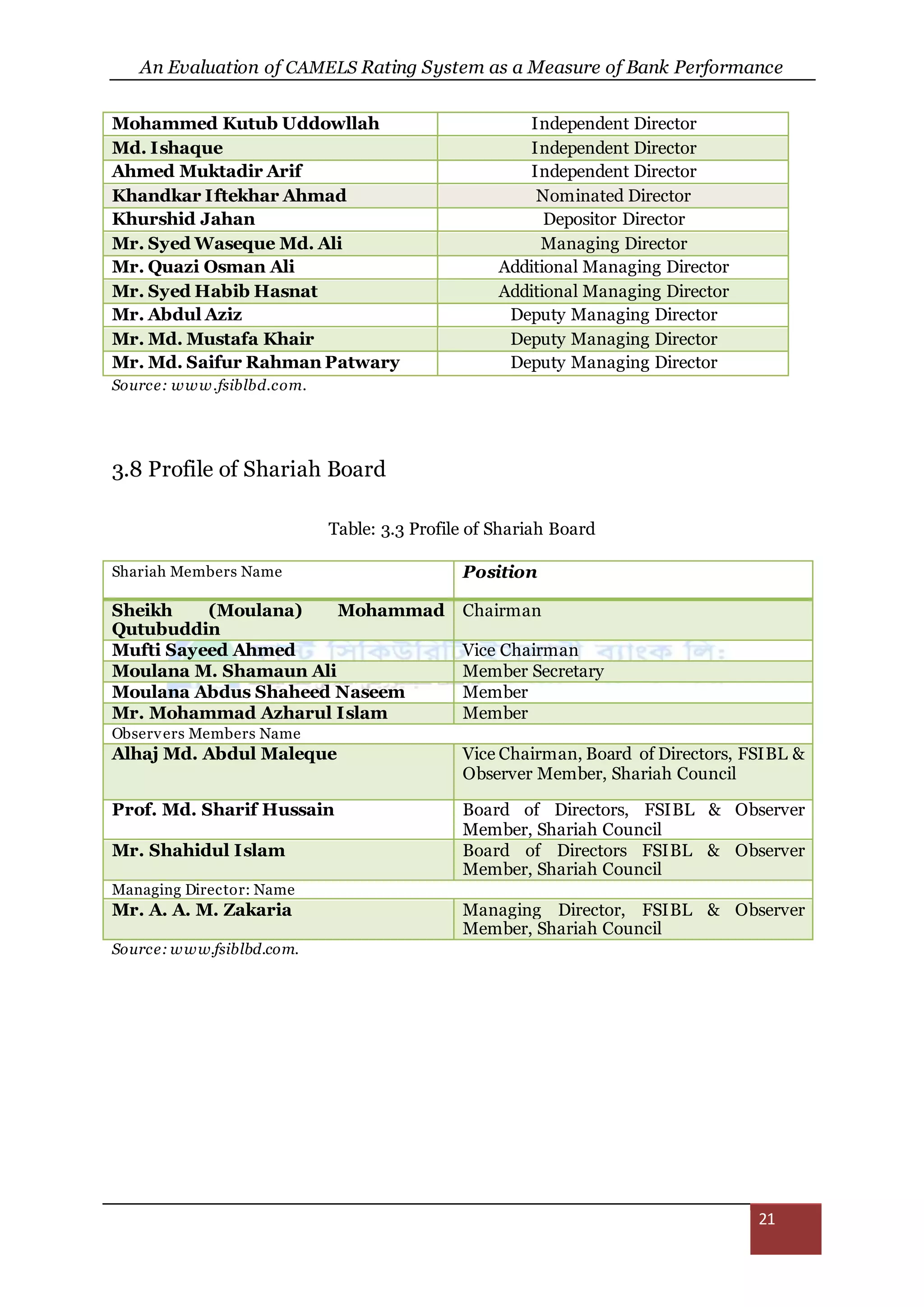
3.7 Board of Director’s Profile
Table: 3.2 Board of Director’s Profile
Name Designation
Mohammed Saiful Alam Chairman
Alhaj Mohammed Abdul Maleque Vice Chairman
Ms. Farzana Parveen Director
Ms. Rahima Khatun Director
Ms. Atiqur Nesa Director
Md. Wahidul Alam Seth Director
Shahidul Islam Director
Mohammed Oheidul Alam Director
An Evaluation of CAMELS Rating System as a Measure of Bank Performance
21
Mohammed Kutub Uddowllah Independent Director
Md. Ishaque Independent Director
Ahmed Muktadir Arif Independent Director
Khandkar Iftekhar Ahmad Nominated Director
Khurshid Jahan Depositor Director
Mr. Syed Waseque Md. Ali Managing Director
Mr. Quazi Osman Ali Additional Managing Director
Mr. Syed Habib Hasnat Additional Managing Director
Mr. Abdul Aziz Deputy Managing Director
Mr. Md. Mustafa Khair Deputy Managing Director
Mr. Md. Saifur Rahman Patwary Deputy Managing Director
Source: www.fsiblbd.com.
3.8 Profile of Shariah Board
Table: 3.3 Profile of Shariah Board
Shariah Members Name Position
Sheikh (Moulana) Mohammad
Qutubuddin
Chairman
Mufti Sayeed Ahmed Vice Chairman
Moulana M. Shamaun Ali Member Secretary
Moulana Abdus Shaheed Naseem Member
Mr. Mohammad Azharul Islam Member
Observers Members Name
Alhaj Md. Abdul Maleque Vice Chairman, Board of Directors, FSIBL &
Observer Member, Shariah Council
Prof. Md. Sharif Hussain Board of Directors, FSIBL & Observer
Member, Shariah Council
Mr. Shahidul Islam Board of Directors FSIBL & Observer
Member, Shariah Council
Managing Director: Name
Mr. A. A. M. Zakaria Managing Director, FSIBL & Observer
Member, Shariah Council
Source: www.fsiblbd.com.
An Evaluation of CAMELS Rating System as a Measure of Bank Performance
22
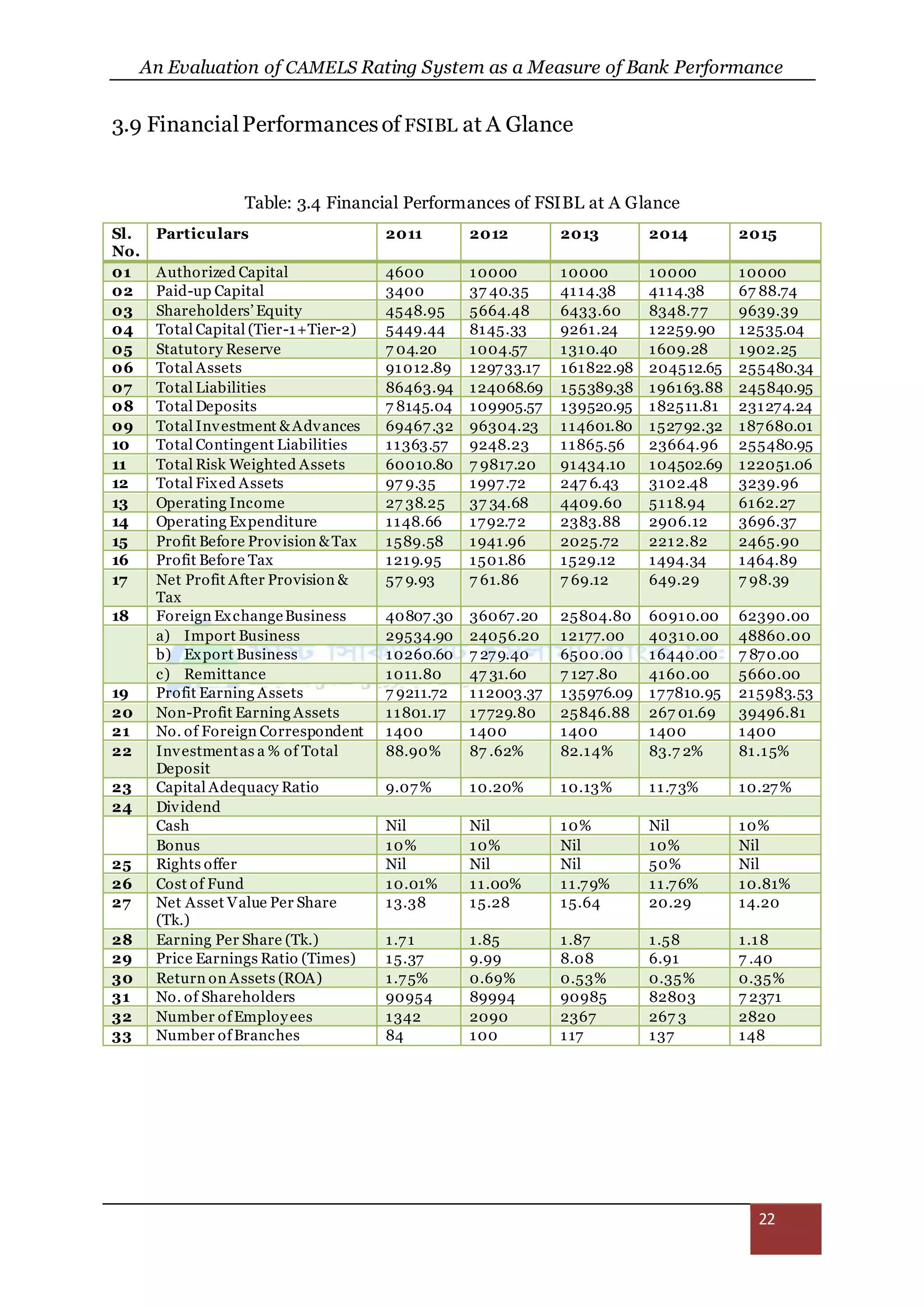
3.9 FinancialPerformancesof FSIBL at A Glance
Table: 3.4 Financial Performances of FSIBL at A Glance
Sl.
No.
Particulars 2011 2012 2013 2014 2015
01 Authorized Capital 4600 10000 10000 10000 10000
02 Paid-up Capital 3400 37 40.35 4114.38 4114.38 67 88.74
03 Shareholders’ Equity 4548.95 5664.48 6433.60 8348.77 9639.39
04 Total Capital (Tier-1+Tier-2) 5449.44 8145.33 9261.24 12259.90 12535.04
05 Statutory Reserve 7 04.20 1004.57 1310.40 1609.28 1902.25
06 Total Assets 91012.89 129733.17 161822.98 204512.65 255480.34
07 Total Liabilities 86463.94 124068.69 155389.38 196163.88 245840.95
08 Total Deposits 7 8145.04 109905.57 139520.95 182511.81 231274.24
09 Total Investment &Advances 69467.32 96304.23 114601.80 152792.32 187680.01
10 Total Contingent Liabilities 11363.57 9248.23 11865.56 23664.96 255480.95
11 Total Risk Weighted Assets 60010.80 7 9817.20 91434.10 104502.69 122051.06
12 Total Fixed Assets 97 9.35 1997.72 247 6.43 3102.48 3239.96
13 Operating Income 27 38.25 37 34.68 4409.60 5118.94 6162.27
14 Operating Expenditure 1148.66 1792.72 2383.88 2906.12 3696.37
15 Profit Before Provision &Tax 1589.58 1941.96 2025.72 2212.82 2465.90
16 Profit Before Tax 1219.95 1501.86 1529.12 1494.34 1464.89
17 Net Profit After Provision &
Tax
57 9.93 7 61.86 7 69.12 649.29 7 98.39
18 Foreign ExchangeBusiness 40807.30 36067.20 25804.80 60910.00 62390.00
a) Import Business 29534.90 24056.20 12177.00 40310.00 48860.00
b) Export Business 10260.60 7 279.40 6500.00 16440.00 7 870.00
c) Remittance 1011.80 47 31.60 7 127.80 4160.00 5660.00
19 Profit Earning Assets 7 9211.72 112003.37 135976.09 177810.95 215983.53
20 Non-Profit Earning Assets 11801.17 17729.80 25846.88 267 01.69 39496.81
21 No. of Foreign Correspondent 1400 1400 1400 1400 1400
22 Investmentas a % of Total
Deposit
88.90% 87 .62% 82.14% 83.7 2% 81.15%
23 Capital Adequacy Ratio 9.07% 10.20% 10.13% 11.73% 10.27%
24 Dividend
Cash Nil Nil 10% Nil 10%
Bonus 10% 10% Nil 10% Nil
25 Rights offer Nil Nil Nil 50% Nil
26 Cost of Fund 10.01% 11.00% 11.79% 11.76% 10.81%
27 Net Asset Value Per Share
(Tk.)
13.38 15.28 15.64 20.29 14.20
28 Earning Per Share (Tk.) 1.71 1.85 1.87 1.58 1.18
29 Price Earnings Ratio (Times) 15.37 9.99 8.08 6.91 7 .40
30 Return on Assets (ROA) 1.75% 0.69% 0.53% 0.35% 0.35%
31 No. of Shareholders 90954 89994 90985 82803 7 2371
32 Number ofEmployees 1342 2090 2367 267 3 2820
33 Number ofBranches 84 100 117 137 148
An Evaluation of CAMELS Rating System as a Measure of Bank Performance
23
4.1 Evaluationof CapitalAdequacy
The difference between total assets and total liabilities is called capital. It shows ability of the
firm that liability could be privileged. It assumes that if all the assets of the bank take as a
loans and deposits as liability. If there is any loss from loans it will be a great risk for banks
to meet the demand of their depositors. Therefore to prevent the bank from failure it is
necessary to maintain a significant level of capital adequacy.
Basel capital accord set the rules for the Capital requirements. It represents the capital
standard for banks which applied to banks in G10 countries. The Basel capital has two parts.
These are, Tier one, and Tier two. The capital adequacy for banking institutions the ratio
should be superior to 8% or we can say that the total capital must be over 8% of its risk
weighted assets. The formula for Capital Adequacy Ratio is; CAR= (Tier I + Tier II)/Risk-
Weighted Assets.
This ratio determines the ability of the bank to meet with obligation on time and other risk
such as operational risk and credit risk etc.
Tier I:
Tier one is a type of capital, it is a composed core capital or we can say own capital which
consist primarily of common stock, preferred stock, convertible bonds and retain earning.
Tier II:
It is a supplementary form of banks capital. Tier II also known as hybrid because it includes
that amount which is derived from issued bonds by the banks. These amounts reduced
guarantees to buyers because these are of long-term in nature. Tier I should be at least half of
the total amount the numerator. There is a great chance of better bank’s capital adequacy if
there is a higher value of index, because of this institution can totally rely on self-financing.
4.1.1 Capital adequacy Rating factors:
 Nature and volume of problem assets in relation to total capital and adequacy of LLR
and other reserves
 Balance sheet structure including off balance sheet items, market and concentration
risk
 Nature of business activities and risks to the bank
 Asset and capital growth experience and prospects
 Earnings performance and distribution of dividends
 Capital requirements and compliance with regulatory requirements
 Access to capital markets and sources of capital
 Ability of management to deal with above factors
An Evaluation of CAMELS Rating System as a Measure of Bank Performance
24
Capital rating 1
Rating “1” is characterized by:
 Capital levels and ratios exceed all regulatory requirements
 Strong earnings performance
 Well managed and controlled growth
 Competent management able to analyze the risks associated with the activities in
determining appropriate capital levels
 Reasonable dividends and ability to raise new capital
 Low volume of problem assets
Capital rating 2
Rating “2” is characterized by similar criteria as “1”, but experiences weaknesses is one or
more of the factors. For example:
 Capital and solvency ratios exceed regulatory requirements, but: Problem assets
relatively high
 Management inability to maintain sufficient capital to support risks
Capital rating 3
Rating”3”indicates that the bank complies with capital adequacy and solvency regulatory
requirements, but has major weaknesses in one or more factors:
 High level of problem assets in excess of 25% of total capital
 Bank fails to comply with regulatory regulations
 Poor earnings
 Inability to raise new capital to meet regulatory requirements and correct deficiencies
 It requires regulatory oversight to ensure management and shareholders address the
issues of concern
Capital rating 4
Rating “4” means that the bank is experiencing severe problems resulting in inadequate
capital to support risks associated with the business and operations:
 High level of problems generating losses in all area of activities
 Problem loans in excess of 50% of total capital
 Insufficient capital
 Non-compliance with regulatory requirements
 Management needs to take immediate action to correct deficiencies to avoid going
into bankruptcy
Capital rating 5
Rating”5” indicates that the bank is insolvent:
 Strong regulatory oversight is needed to mitigate the loss to depositors and creditors
 Very slight possibility that actions from management will prevent the demise of the
bank
 Only shareholders may be able to prevent the failure
An Evaluation of CAMELS Rating System as a Measure of Bank Performance
25
4.1.2 Capital adequacy of FSIBL
Capital adequacy can be measured by various financial and mathematical tools and
techniques. In the report two components are used by researcher for CAMELS rating. They
are calculating below with their individual rating bases:
Table: 4.1 Bases of Capital Adequacy Components
Components Rating 1 Rating 2 Rating 3 Rating 4 Rating 5
Capital Adequacy
Capital Adequacy
Ratio
≥15% 12% - 14.99% 8% - 11.99% 7 % - 7 .99 ≤6.99%
Tier 1 capital to risk
weighted assets ratio
≥5% 4.5% - 5% 3.5% - <4.5% 3% - < 3.5% < 3%
Source: Bangladesh bank.
A. Capital Adequacy Ratio
Table: 4.2 Calculation of Capital Adequacy Ratio
Figures showin TK(Crore )
Years Tier I Tier II Total
Regulatory
Capital base
Total
Risk
Weighted
CAR Rating
2011 450.90 94.04 544.94 6001.08 9.08% 3
2012 526.21 288.32 814.53 7981.72 10.20% 3
2013 595.51 330.61 926.12 9143.41 10.13% 3
2014 796.65 429.35 1226.00 10450.27 11.73% 3
2015 907.98 345.53 1253.51 12205.11 10.27% 3
Source: annual report (2011 - 2015), FSIBL.
From the above table it shown that capital adequacy ratio from 2011 to 2015 is lies in rating
3. During the observed period the percentage of CAR shows mix trend. Lowest ratio is 9.07%
for 2014 and highest ratio is 10.91% for 2015.
B. Tier 1 Capital to Risk Weighted Assets Ratio
Table: 4.3 Calculation of Tier 1 Capital to Risk Weighted Assets Ratio
Figures showin TK(Crore )
Years Tier I Total Risk Weighted % of ratio Rating
2011 450.90 6001.08 7.51% 1
2012 526.21 7981.72 6.59% 1
2013 595.51 9143.41 6.51% 1
2014 796.65 10450.27 7.62% 1
2015 907.98 12205.11 7.44% 1
Source: annual report (2011 - 2015), FSIBL.
An Evaluation of CAMELS Rating System as a Measure of Bank Performance
26
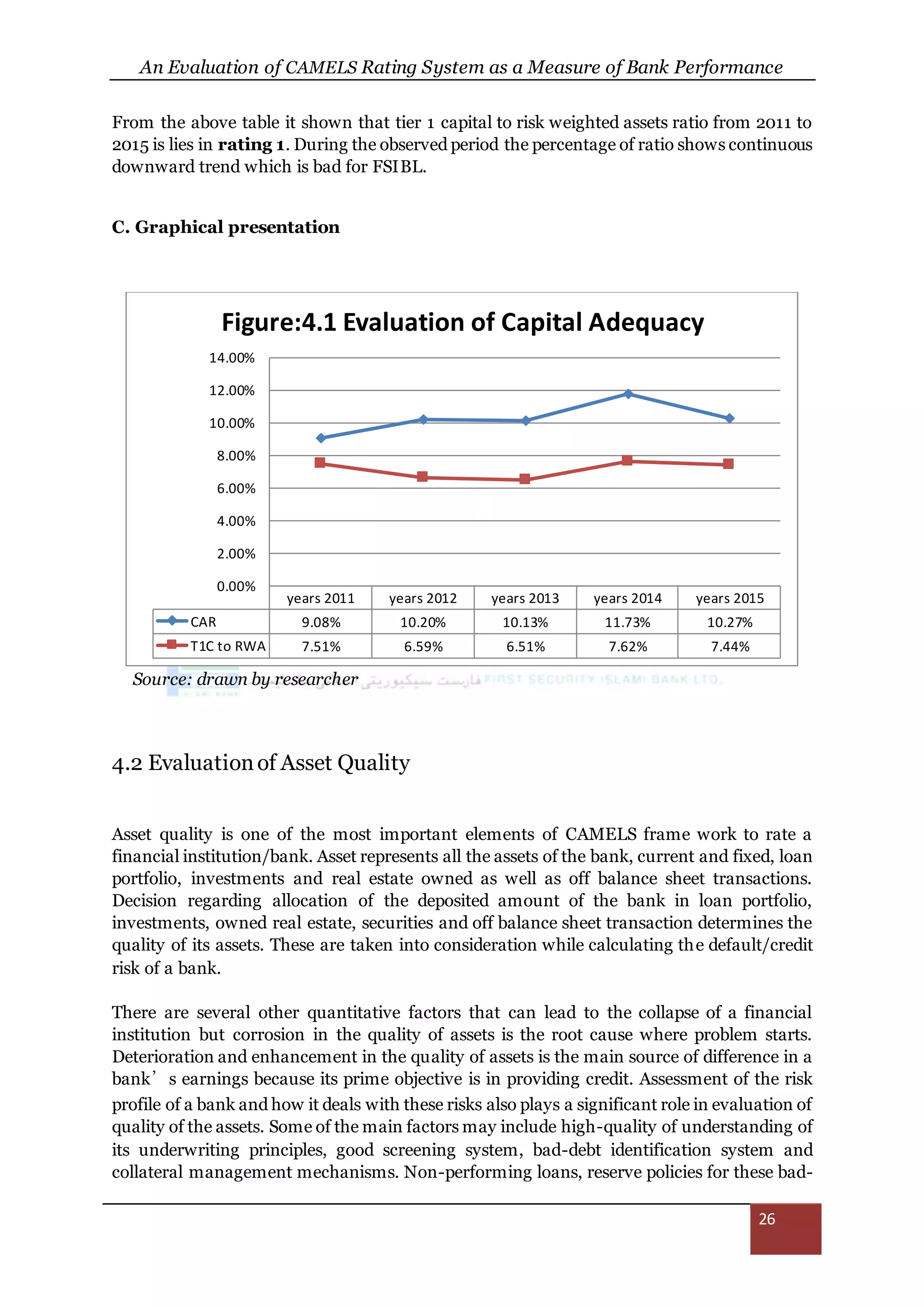
From the above table it shown that tier 1 capital to risk weighted assets ratio from 2011 to
2015 is lies in rating 1. During the observed period the percentage of ratio shows continuous
downward trend which is bad for FSIBL.
C. Graphical presentation
Source: drawn by researcher
4.2 Evaluationof Asset Quality
Asset quality is one of the most important elements of CAMELS frame work to rate a
financial institution/bank. Asset represents all the assets of the bank, current and fixed, loan
portfolio, investments and real estate owned as well as off balance sheet transactions.
Decision regarding allocation of the deposited amount of the bank in loan portfolio,
investments, owned real estate, securities and off balance sheet transaction determines the
quality of its assets. These are taken into consideration while calculating the default/credit
risk of a bank.
There are several other quantitative factors that can lead to the collapse of a financial
institution but corrosion in the quality of assets is the root cause where problem starts.
Deterioration and enhancement in the quality of assets is the main source of difference in a
bank’s earnings because its prime objective is in providing credit. Assessment of the risk
profile of a bank and how it deals with these risks also plays a significant role in evaluation of
quality of the assets. Some of the main factors may include high-quality of understanding of
its underwriting principles, good screening system, bad-debt identification system and
collateral management mechanisms. Non-performing loans, reserve policies for these bad-
years 2011 years 2012 years 2013 years 2014 years 2015
CAR 9.08% 10.20% 10.13% 11.73% 10.27%
T1C to RWA 7.51% 6.59% 6.51% 7.62% 7.44%
0.00%
2.00%
4.00%
6.00%
8.00%
10.00%
12.00%
14.00%
Figure:4.1 Evaluation of Capital Adequacy
An Evaluation of CAMELS Rating System as a Measure of Bank Performance
27
debt and coverage for these non-performing loans of a bank is also an important factor in the
assessment of assets quality. Off balance sheet activities of the banks are increasing with a
rapid pace so it is of great importance to measure these activities such as derivatives and
swaps.
Evaluation of quality of the assets is primarily based upon assessment of the bank portfolio
and the credit risk associated to it. Capabilities of a bank to identify, quantify, observe and
control credit risk and judged whereas provisions against these bad and non performing
debts are also taken into account.
4.2.1 Assets quality rating factors
Asset quality is based on the following considerations:
 Volume of problem of all assets
 Volume of overdue or rescheduled loans
 Ability of management to administer all the assets of the bank and to collect problem
loans
 Large concentrations of loans and insiders loans, diversification of investments
 Loan portfolio management, written policies, procedures internal control,
Management Information System
 Loan Loss Reserves in relation to problem credits and other assets
 Growth of loans volume in relation to the bank’s capacity
Asset quality rating 1
Asset quality rating “1” is characterized by:
 Ratio of troubled assets to capital is less than 2% or 3%
 Past due and extended loans kept under control by a specific unit, in accordance with
the law
 Concentrations of credits and loans to insiders provide minimal risk
 Efficient loan portfolio management, close monitoring of problem loans
 Adequate Loan Loss Reserves in accordance with CBI’s regulations
 Non-credit assets pose no loss threat
Asset quality rating 2
Asset quality rating “2” is assigned to banks that display similar characteristics as “1”, but are
experiencing non-significant weaknesses, and the management is able to address these
issues without close regulatory oversight. Problem assets do not exceed 10 % of total capital,
but:
 The bank is experiencing negative trends in the level of overdue and prolonged
credits and of LLR
 There are weaknesses in the management underwriting standards and control
procedures
 Loans to insider pose some regulatory concern, but can be easily corrected
 Return on non-credit assets is low and they display more than normal risk without
posing a threat of loss
An Evaluation of CAMELS Rating System as a Measure of Bank Performance
28
Asset quality rating 3
Asset quality rating “3” indicates that a bank displays weaknesses in one or more of the “2”
factors. Regulatory oversight is required to ensure that management is able to address the
problems. Other characteristics are:
 Bank is experiencing high level of past due and rescheduled credits
 Inadequate LLR
 Poor underwriting standards
 Policies and procedures are not properly implemented
 Inappropriate loans to insiders
 Non-credit assets display abnormal risks and may pose a threat of loss
Asset quality rating 4
Asset quality rating “4” indicates a bank with severe problems resulting in inadequate capital
to support risks associated with the bank business and operations.
 High volume of loss making loans, and;
 Level of problem credits continues to increase and could result in insolvency
 Doubtful and loss credits exceed LLR and pose a threat to capital
 Non-credit assets pose major threat of loss of capital and may result in bank’s
insolvency
 Lack of proper policies and procedures
Asset quality rating 5
Asset quality rating”5” displays a high level of problem assets credit and non-credit that
impairs the capital or results in a negative capital.
 Problem assets to capital ratio above 50%
 Slight possibility that management actions can improve the quality of the bank
 Strong regulatory oversight is needed to prevent further capital erosion and protect
depositors and creditors
 Law authorize CBI to send an custodian for assessment and recommendations
4.2.2 Assets Quality of FSIBL
Assets quality can be measured by various financial and mathematical tools and techniques.
In the report two components are used by researcher for CAMELS rating. They are
calculating below with their individual rating bases:
An Evaluation of CAMELS Rating System as a Measure of Bank Performance
29
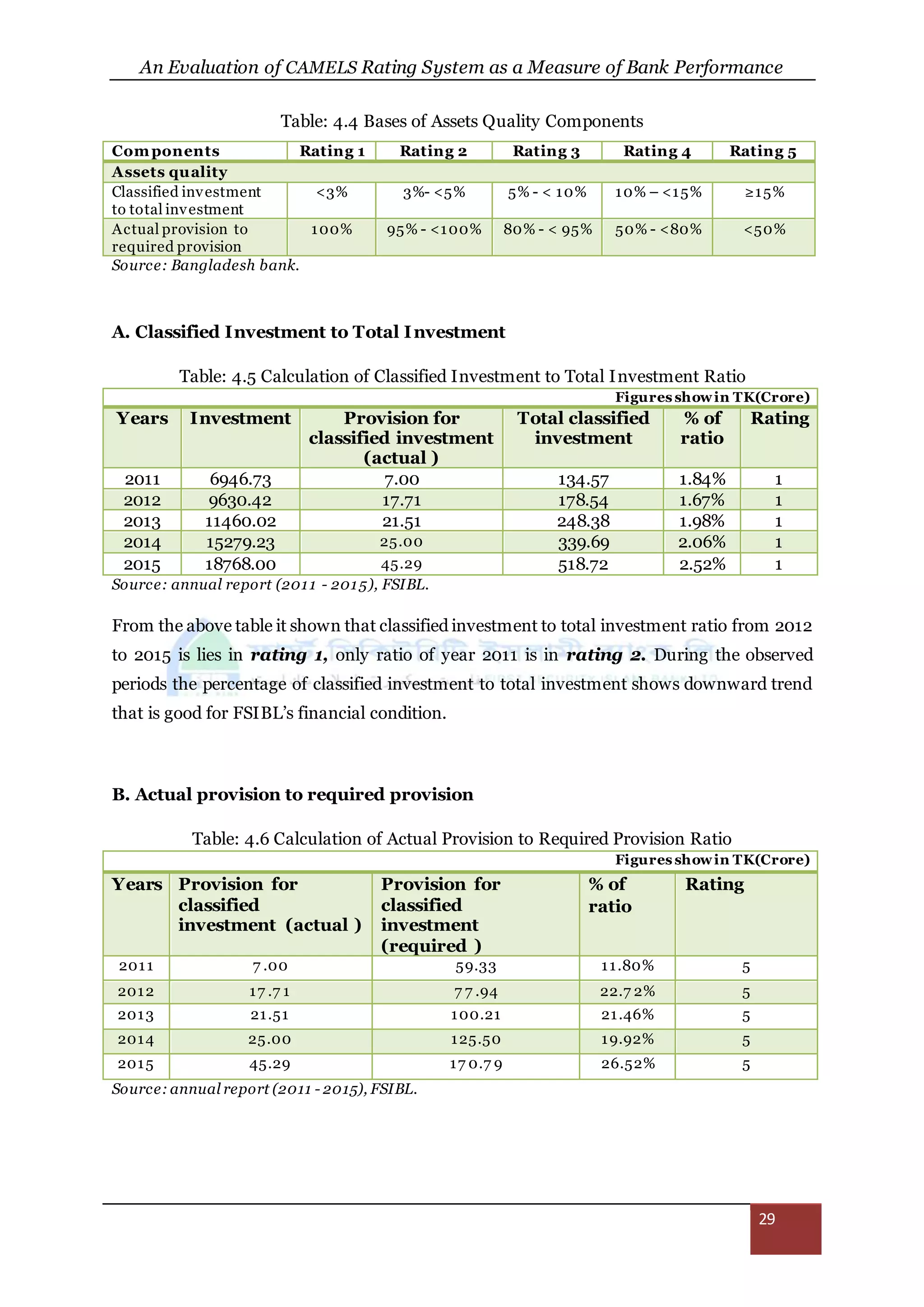
Table: 4.4 Bases of Assets Quality Components
Components Rating 1 Rating 2 Rating 3 Rating 4 Rating 5
Assets quality
Classified investment
to total investment
<3% 3%- <5% 5% - < 10% 10% – <15% ≥15%
Actual provision to
required provision
100% 95% - <100% 80% - < 95% 50% - <80% <50%
Source: Bangladesh bank.
A. Classified Investment to Total Investment
Table: 4.5 Calculation of Classified Investment to Total Investment Ratio
Figures showin TK(Crore)
Years Investment Provision for
classified investment
(actual )
Total classified
investment
% of
ratio
Rating
2011 6946.73 7.00 134.57 1.84% 1
2012 9630.42 17.71 178.54 1.67% 1
2013 11460.02 21.51 248.38 1.98% 1
2014 15279.23 25.00 339.69 2.06% 1
2015 18768.00 45.29 518.72 2.52% 1
Source: annual report (2011 - 2015), FSIBL.
From the above table it shown that classified investment to total investment ratio from 2012
to 2015 is lies in rating 1, only ratio of year 2011 is in rating 2. During the observed
periods the percentage of classified investment to total investment shows downward trend
that is good for FSIBL’s financial condition.
B. Actual provision to required provision
Table: 4.6 Calculation of Actual Provision to Required Provision Ratio
Figures showin TK(Crore)
Years Provision for
classified
investment (actual )
Provision for
classified
investment
(required )
% of
ratio
Rating
2011 7 .00 59.33 11.80% 5
2012 17 .7 1 7 7 .94 22.7 2% 5
2013 21.51 100.21 21.46% 5
2014 25.00 125.50 19.92% 5
2015 45.29 17 0.7 9 26.52% 5
Source: annual report (2011 - 2015), FSIBL.
An Evaluation of CAMELS Rating System as a Measure of Bank Performance
30
From the above table it shown that classified investment to total investment ratio from 2011
to 2015 is lies in rating 5. During the observed periods the percentage of actual provision to
required provision shows upward trend that is worst for FSIBL’s financial condition.
C. Graphical presentation
Source: drawn by researcher
4.3 Evaluation of Management efficiency
Management includes all key managers and the Board of Directors. It is difficult to
determine the sound performance of management of the bank. For individual institution
it is not a quantitative factor it is primarily qualitative factor. How to measure the
soundness of the management? However there are quite a few indicators to assess the
soundness of the management these are: earning per employee, cost per loan, cost per
unit of money lent and average loan size, expense ratio, these indicators can be used to
measure the management quality.
Management can be evaluated in the CAMELS framework according to:
 Leadership, administration ability, and competency in technical work
 Bank’s management has the ability to deal with changing situations
 Obedient to banking law and regulations
 Agree on internal policies
 To show keenness in fulfilling the legal need of the community.
year 2011 year 2012 year 2013 year 2014 year 2015
CI to TI 1.84% 1.67% 1.98% 2.06% 2.52%
AP to RP 11.80% 22.72% 21.46% 19.92% 26.52%
0.00%
5.00%
10.00%
15.00%
20.00%
25.00%
30.00%
Figure:4.2 Evaluation of Assets Quality
An Evaluation of CAMELS Rating System as a Measure of Bank Performance
31
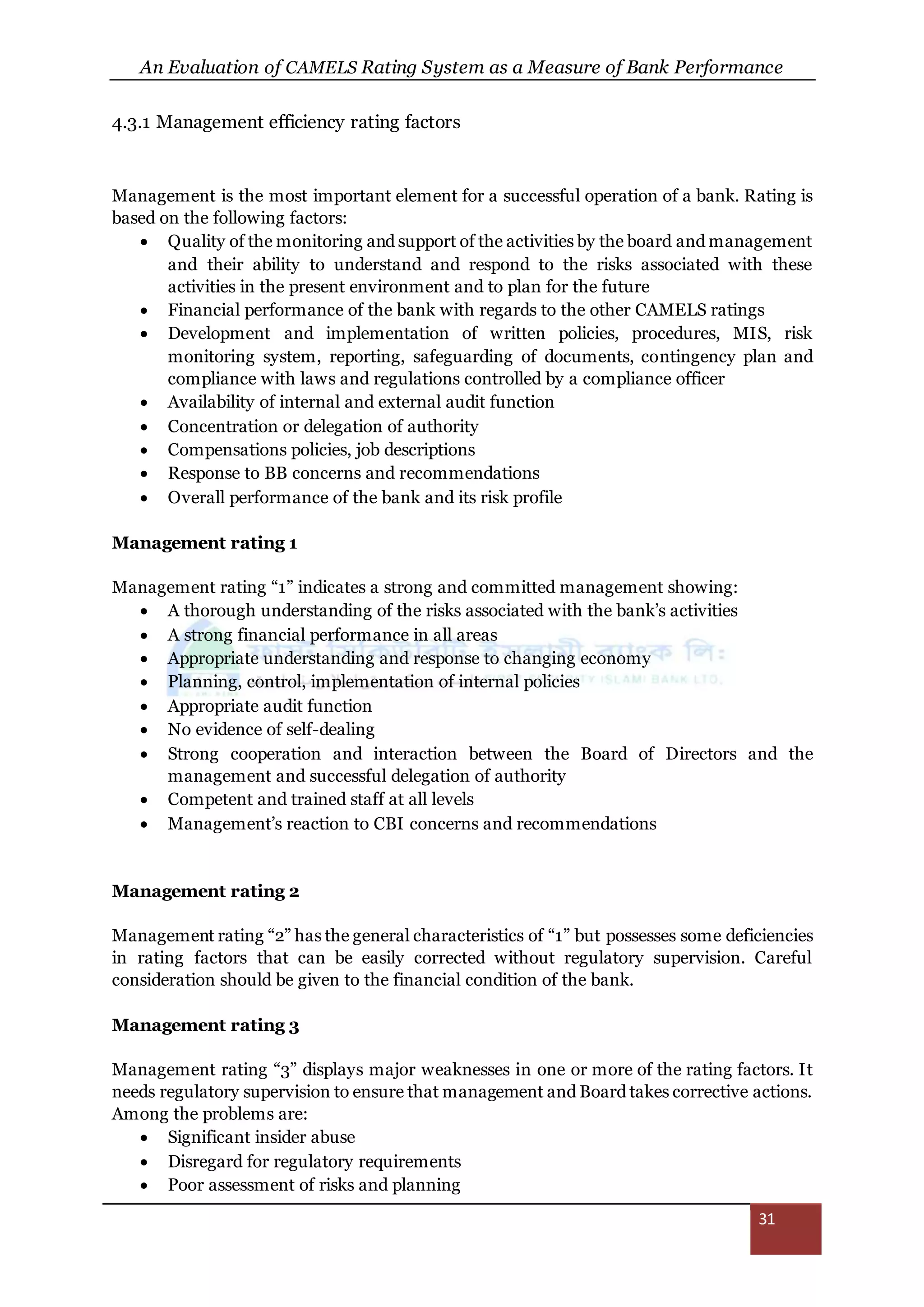
4.3.1 Management efficiency rating factors
Management is the most important element for a successful operation of a bank. Rating is
based on the following factors:
 Quality of the monitoring and support of the activities by the board and management
and their ability to understand and respond to the risks associated with these
activities in the present environment and to plan for the future
 Financial performance of the bank with regards to the other CAMELS ratings
 Development and implementation of written policies, procedures, MIS, risk
monitoring system, reporting, safeguarding of documents, contingency plan and
compliance with laws and regulations controlled by a compliance officer
 Availability of internal and external audit function
 Concentration or delegation of authority
 Compensations policies, job descriptions
 Response to BB concerns and recommendations
 Overall performance of the bank and its risk profile
Management rating 1
Management rating “1” indicates a strong and committed management showing:
 A thorough understanding of the risks associated with the bank’s activities
 A strong financial performance in all areas
 Appropriate understanding and response to changing economy
 Planning, control, implementation of internal policies
 Appropriate audit function
 No evidence of self-dealing
 Strong cooperation and interaction between the Board of Directors and the
management and successful delegation of authority
 Competent and trained staff at all levels
 Management’s reaction to CBI concerns and recommendations
Management rating 2
Management rating “2” has the general characteristics of “1” but possesses some deficiencies
in rating factors that can be easily corrected without regulatory supervision. Careful
consideration should be given to the financial condition of the bank.
Management rating 3
Management rating “3” displays major weaknesses in one or more of the rating factors. It
needs regulatory supervision to ensure that management and Board takes corrective actions.
Among the problems are:
 Significant insider abuse
 Disregard for regulatory requirements
 Poor assessment of risks and planning
An Evaluation of CAMELS Rating System as a Measure of Bank Performance
32
 Inappropriate reactions to economic adversities and corrective actions
 Poor financial performance
 Lack of proper written policies and procedures
Management rating 4
Management rating “4” indicates major weaknesses in several areas.
 Strong regulatory action is needed
 Board of Directors should consider replacing or strengthen management due to:
 Insider abuse
 Disregard for regulatory requirements
 Lack of proper policies
 Damaging actions
 Poor financial performance may lead to insolvency
Management rating 5
Management rating “5” requires immediate and strong supervisory actions:
 Bank displays strong weaknesses in all areas
 Poor financial performance
 Insolvency very likely
 Consider replacing management
 Board of directors to consider receivership
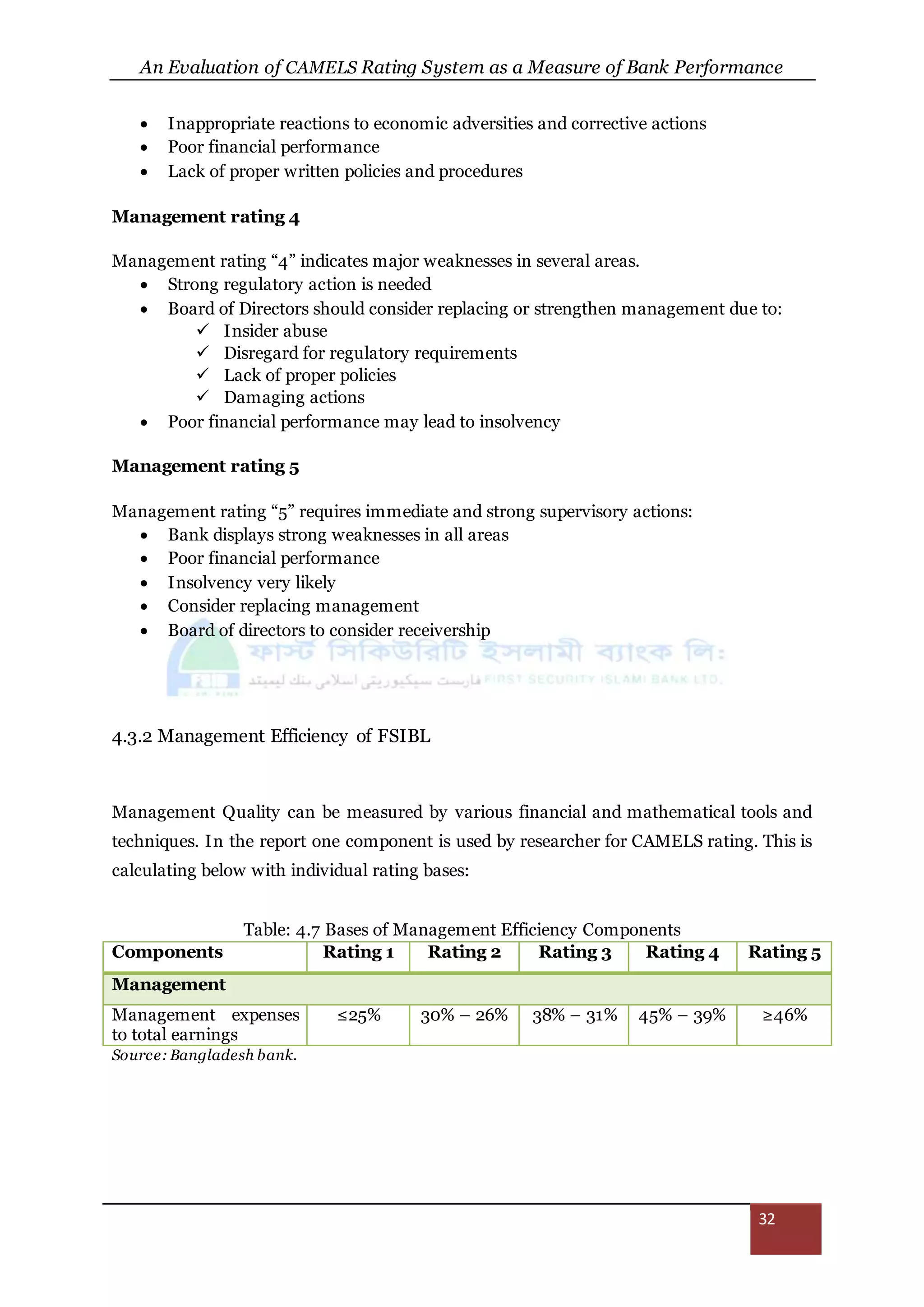
4.3.2 Management Efficiency of FSIBL
Management Quality can be measured by various financial and mathematical tools and
techniques. In the report one component is used by researcher for CAMELS rating. This is
calculating below with individual rating bases:
Table: 4.7 Bases of Management Efficiency Components
Components Rating 1 Rating 2 Rating 3 Rating 4 Rating 5
Management
Management expenses
to total earnings
≤25% 30% – 26% 38% – 31% 45% – 39% ≥46%
Source: Bangladesh bank.
An Evaluation of CAMELS Rating System as a Measure of Bank Performance
33
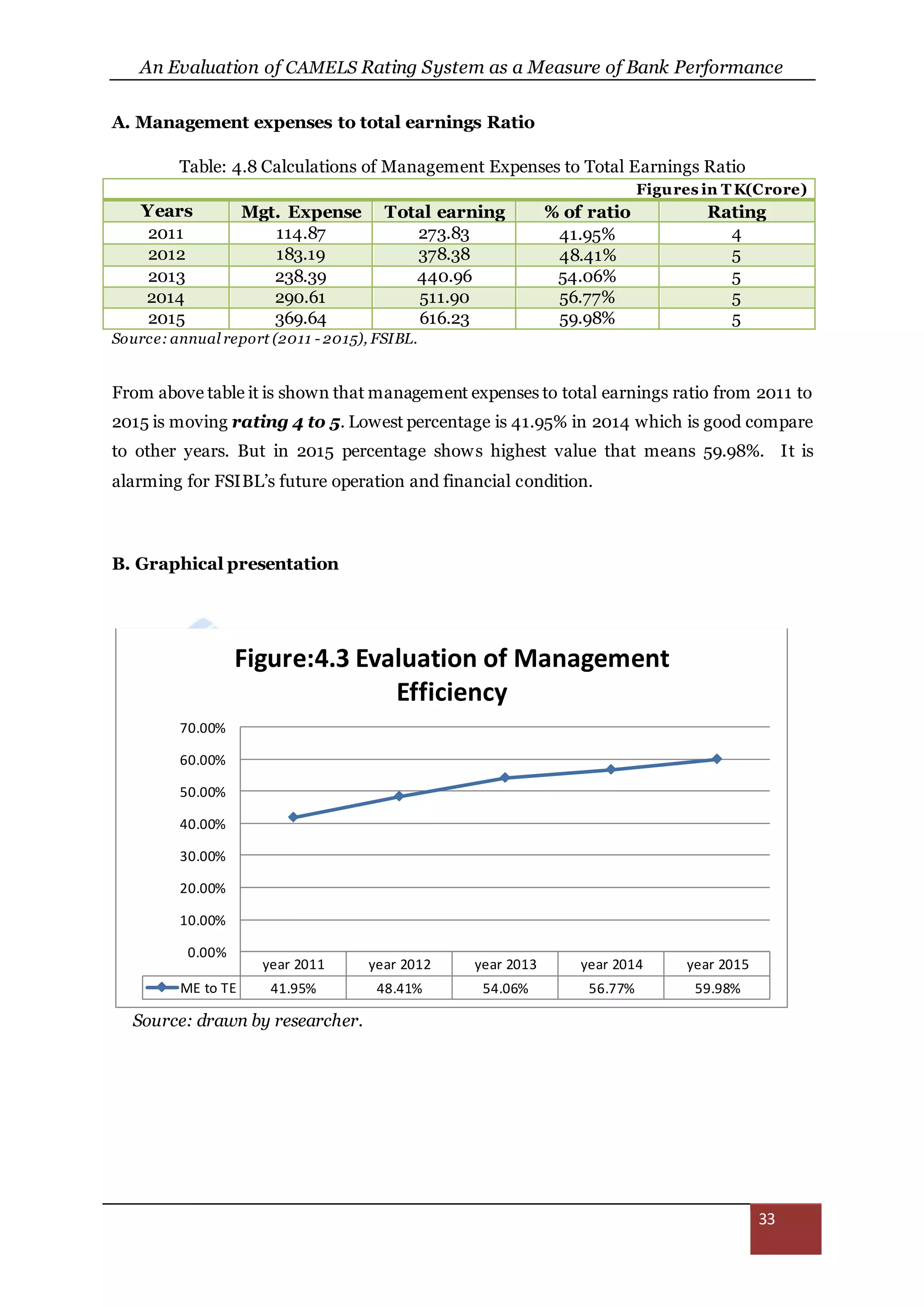
A. Management expenses to total earnings Ratio
Table: 4.8 Calculations of Management Expenses to Total Earnings Ratio
Figures in T K(Crore)
Years Mgt. Expense Total earning % of ratio Rating
2011 114.87 273.83 41.95% 4
2012 183.19 378.38 48.41% 5
2013 238.39 440.96 54.06% 5
2014 290.61 511.90 56.77% 5
2015 369.64 616.23 59.98% 5
Source: annual report (2011 - 2015), FSIBL.
From above table it is shown that management expenses to total earnings ratio from 2011 to
2015 is moving rating 4 to 5. Lowest percentage is 41.95% in 2014 which is good compare
to other years. But in 2015 percentage shows highest value that means 59.98%. It is
alarming for FSIBL’s future operation and financial condition.
B. Graphical presentation
Source: drawn by researcher.
year 2011 year 2012 year 2013 year 2014 year 2015
ME to TE 41.95% 48.41% 54.06% 56.77% 59.98%
0.00%
10.00%
20.00%
30.00%
40.00%
50.00%
60.00%
70.00%
Figure:4.3 Evaluation of Management
Efficiency
An Evaluation of CAMELS Rating System as a Measure of Bank Performance
34
4.4 Evaluation of Earnings and profitability
To stay in the market for a long term, banks are totally dependent upon generation of
adequate earnings, rewards to be paid back to its shareholders, protect and improve its
capital. To be accepted publically totally depends upon sufficient earnings if there are losses
it reduce the capital and liquidity.
Earning of a bank is a significant gauge to analyze its financial strength. As we know that
money it-self is a merchandise of the banks, for a longer period of time banks can maintain
losses before they get out of cash. Supervisor must take action whenever they realize that the
bank’s earnings are decreasing or the bank may goes into bankruptcy. It is difficult for the
supervisor to look into the earnings record of the bank and simply form an opinion about
earning position. Past earning performances have its effects on the bank’s balance sheet
but if conclusion of the supervisor is based upon the results which have taken from the
earning records and will used for timely action, it is suggested that supervisors should be
concerned with the indicators that reflect bank’s future financial positions and future
result. To measure bank earning several variables are used. The ratios used are, ROA = Net
profit/total assets. This ratio avoids the volatility of earnings linked with unusual items, and
the profitability of the bank. The higher of the ratio greater the profitability and has a
positive connection with CAMELS. It also compares the total assets with net profit and
shows that assets management is well-organized to make profit or not. Second ratio which is
used to measure earnings of bank is ROE = net profit/own capital. This ratio shows the
efficiency of the bank, that how the bank uses its own capital in an efficient manner. It is very
easy for the efficient bank to produce money using its own capital.
4.4.1 Earnings rating factors
Earnings are rated according to the following factors:
 Sufficient earnings to cover potential losses, provide adequate capital and pay
reasonable dividends
 Composition of net income. Volume and stability of the components
 Level of expenses in relation to operations
 Reliance on extraordinary items, securities transactions, high risk activities
 Nontraditional or operational sources
 Adequacy of budgeting, forecasting, control MIS of income and expenses
 Adequacy of provisions
 Earnings exposure to market risks, such as interest rate variations, foreign exchange
fluctuations and price risk
An Evaluation of CAMELS Rating System as a Measure of Bank Performance
35
Earnings rating 1
Rating “1” indicates:
 Sufficient income to meet reserve requirements, provide capital growth and pay
reasonable dividends to shareholders
 Strong budgeting, planning and control of income and expenses
 Positive trends in major income and expenses categories
 Minimal reliance on extraordinary items and non-traditional sources of income
Earnings rating 2
Rating “2” indicates that the bank generates sufficient income to meet reserve requirements,
provide capital growth and pay dividends. Nevertheless there may be some negative trends
such as:
 Relying somehow on nontraditional income
 Need to improve budget, planning and control process
Management should be able to deal with the problems without regulatory supervision.
Earnings rating 3
Earnings rating “3” shows that the bank has major weaknesses in several of the rating
factors.
 Regulatory supervision is needed to ensure management takes appropriate measures
to improve earnings performance
 Insufficient earnings retention may impair capital position
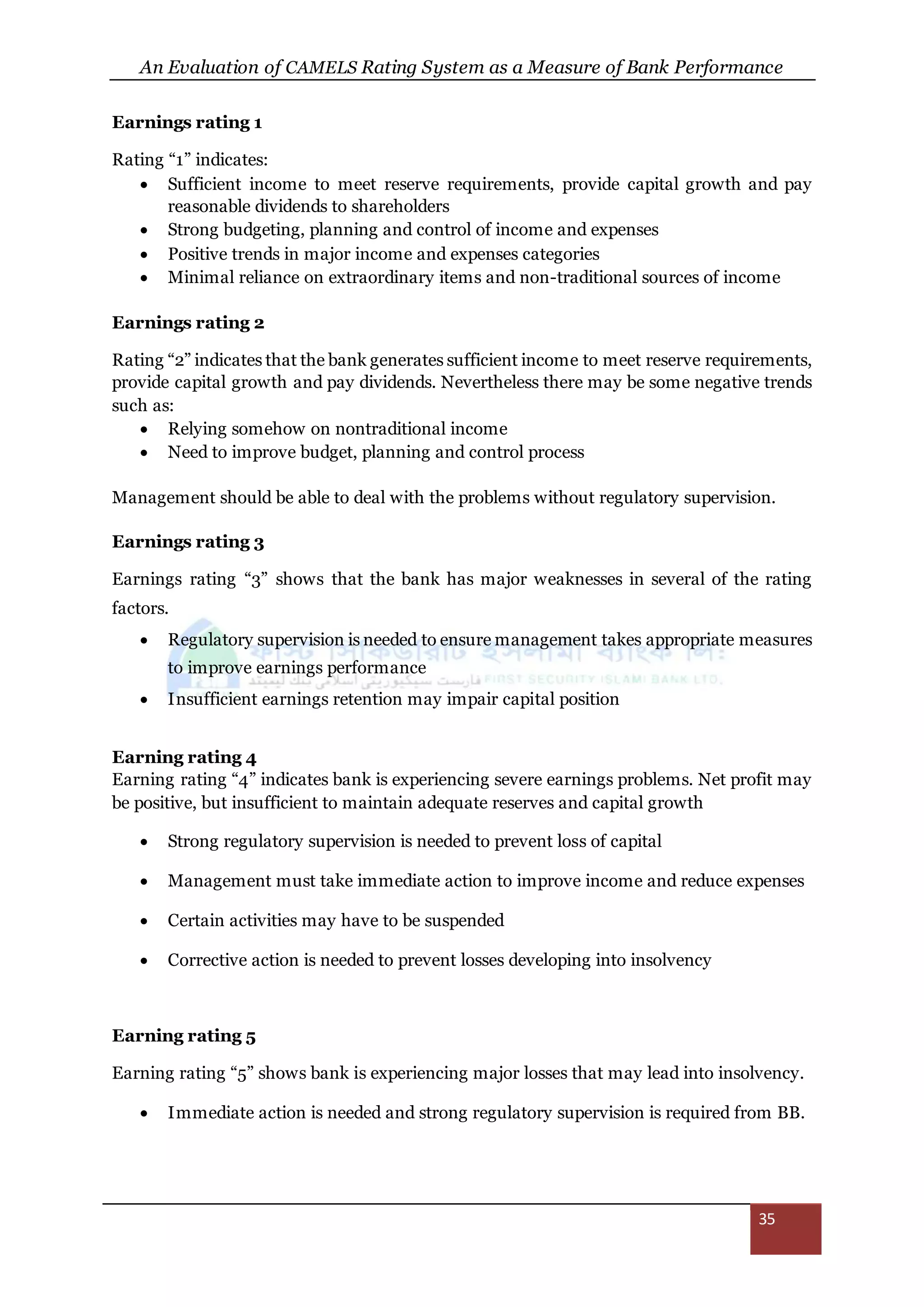
Earning rating 4
Earning rating “4” indicates bank is experiencing severe earnings problems. Net profit may
be positive, but insufficient to maintain adequate reserves and capital growth
 Strong regulatory supervision is needed to prevent loss of capital
 Management must take immediate action to improve income and reduce expenses
 Certain activities may have to be suspended
 Corrective action is needed to prevent losses developing into insolvency
Earning rating 5
Earning rating “5” shows bank is experiencing major losses that may lead into insolvency.
 Immediate action is needed and strong regulatory supervision is required from BB.
An Evaluation of CAMELS Rating System as a Measure of Bank Performance
36
4.4.2 Earnings and Profitability of FSIBL
Earning and profitability can be measured by various financial and mathematical tools and
techniques. In the report two components are used by researcher for CAMELS rating. They
are calculating below with their individual rating bases:
Table: 4.9 Bases of Earnings Components
Components Rating 1 Rating 2 Rating 3 Rating 4 Rating 5
Earnings
ROA ≥1.3% 0.8% – < 1.3% 0.4% – <.8% 0.16% – <.4% <0.16%
ROE ≥ 9% 7 % - <9 % 5% - <7 % 2%– <5% <2%
Source: Bangladesh bank.
A. Return on Assets (ROA)
Table: 4.10 Calculation of Return on Assets (ROA)
Figures in TK(Crore)
Years Average
Assets
Net Profit After Tax % of ROA Rating
2011 7734.64 58.00 0.75% 3
2012 11037.31 76.19 0.69% 3
2013 14577.81 76.91 0.53% 3
2014 18316.79 64.93 0.35% 4
2015 22999.65 79.84 0.35% 4
Source: annual report (2011 - 2015), FSIBL
From the above table it shown that ROA from 2011 to 2015 is in decreasing trend. The lowest
percentage of ROA is 0.35% in 2015 and the highest percentage of ROA is 0.75%. In 2011
ROA gets rating 4 which is comparatively bad position for FSIBL’s earning and
profitability.
An Evaluation of CAMELS Rating System as a Measure of Bank Performance
37
B. Return on Equity (ROE)
Table: 4.11 Calculation of Return on Equity (ROE)
Figures in TK(Crore)
Years Shareholder’s
Equity
Net Profit After Tax % of ROE Rating
2011 454.90 58.00 12.75% 1
2012 566.45 76.19 13.45% 1
2013 643.36 76.91 11.95% 1
2014 834.88 64.93 7.78% 2
2015 963.94 79.84 8.28% 2
Source: annual report (2011 - 2015), FSIBL.
From the above table it shown that ROE from 2011 to 2013 get rating 1 which are in
increasing trend unless 2013 and from 2013 to 2014 is in decreasing trend. The lowest
percentage of ROE is 7.78% in 2014. In 2015 ROA gets rating 2 which is comparatively bad
position. The highest percentage of ROA in 2011 is 13.45% and gets rating 1 which is best
position for FSIBL’s earning and profitability.
C. Graphical presentation
Source: drawn by researcher
year 2011 year 2012 year 2013 year 2014 year 2015
ROA 0.75% 0.69% 0.53% 0.35% 0.35%
ROE 12.75% 13.45% 11.95% 7.78% 8.28%
0.00%
2.00%
4.00%
6.00%
8.00%
10.00%
12.00%
14.00%
16.00%
Figure:4.4 Evaluation of Earnings
An Evaluation of CAMELS Rating System as a Measure of Bank Performance
38
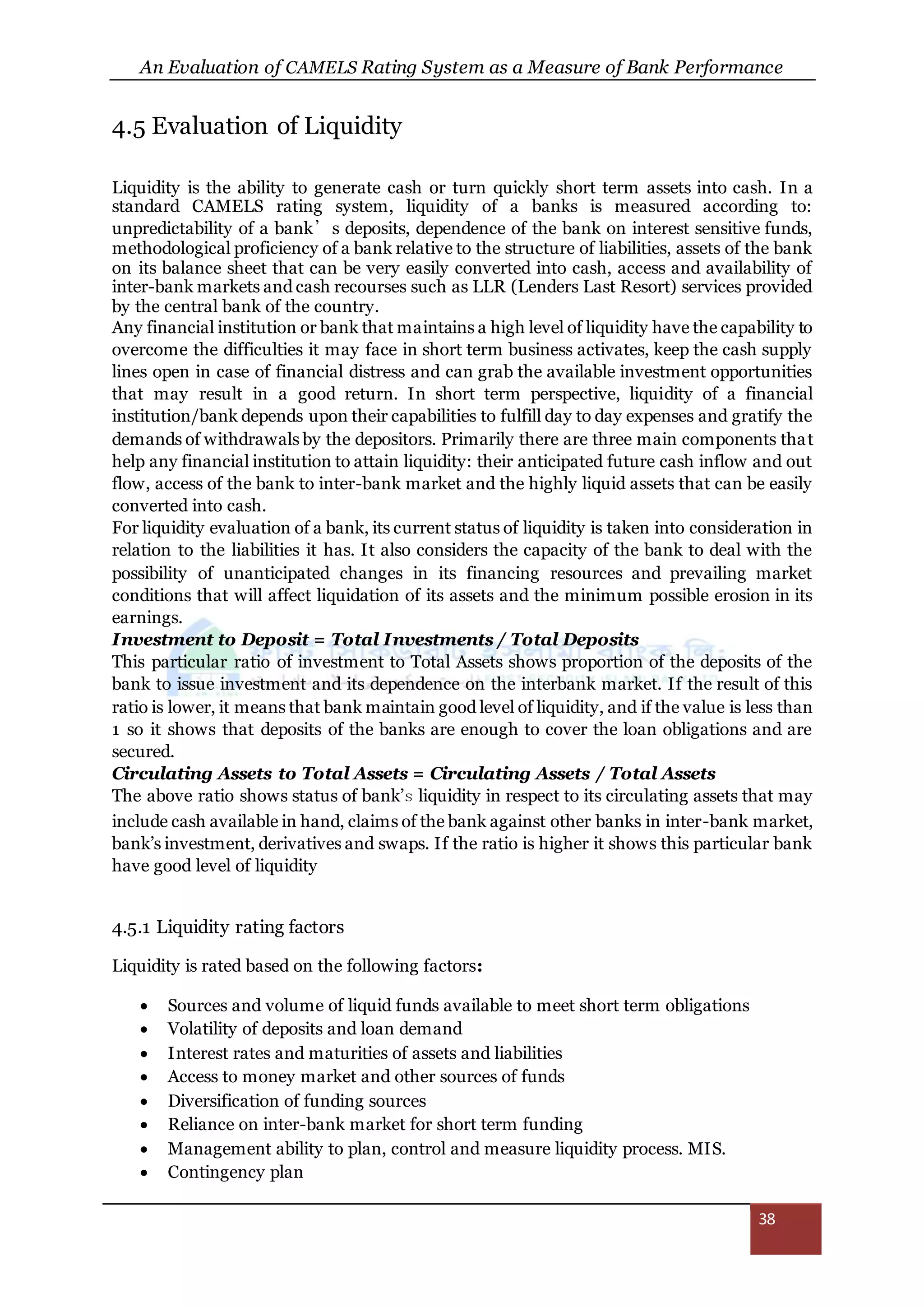
4.5 Evaluation of Liquidity
Liquidity is the ability to generate cash or turn quickly short term assets into cash. In a
standard CAMELS rating system, liquidity of a banks is measured according to:
unpredictability of a bank’s deposits, dependence of the bank on interest sensitive funds,
methodological proficiency of a bank relative to the structure of liabilities, assets of the bank
on its balance sheet that can be very easily converted into cash, access and availability of
inter-bank markets and cash recourses such as LLR (Lenders Last Resort) services provided
by the central bank of the country.
Any financial institution or bank that maintains a high level of liquidity have the capability to
overcome the difficulties it may face in short term business activates, keep the cash supply
lines open in case of financial distress and can grab the available investment opportunities
that may result in a good return. In short term perspective, liquidity of a financial
institution/bank depends upon their capabilities to fulfill day to day expenses and gratify the
demands of withdrawals by the depositors. Primarily there are three main components that
help any financial institution to attain liquidity: their anticipated future cash inflow and out
flow, access of the bank to inter-bank market and the highly liquid assets that can be easily
converted into cash.
For liquidity evaluation of a bank, its current status of liquidity is taken into consideration in
relation to the liabilities it has. It also considers the capacity of the bank to deal with the
possibility of unanticipated changes in its financing resources and prevailing market
conditions that will affect liquidation of its assets and the minimum possible erosion in its
earnings.
Investment to Deposit = Total Investments / Total Deposits
This particular ratio of investment to Total Assets shows proportion of the deposits of the
bank to issue investment and its dependence on the interbank market. If the result of this
ratio is lower, it means that bank maintain good level of liquidity, and if the value is less than
1 so it shows that deposits of the banks are enough to cover the loan obligations and are
secured.
Circulating Assets to Total Assets = Circulating Assets / Total Assets
The above ratio shows status of bank’s liquidity in respect to its circulating assets that may
include cash available in hand, claims of the bank against other banks in inter-bank market,
bank’s investment, derivatives and swaps. If the ratio is higher it shows this particular bank
have good level of liquidity
4.5.1 Liquidity rating factors
Liquidity is rated based on the following factors:
 Sources and volume of liquid funds available to meet short term obligations
 Volatility of deposits and loan demand
 Interest rates and maturities of assets and liabilities
 Access to money market and other sources of funds
 Diversification of funding sources
 Reliance on inter-bank market for short term funding
 Management ability to plan, control and measure liquidity process. MIS.
 Contingency plan
An Evaluation of CAMELS Rating System as a Measure of Bank Performance
39
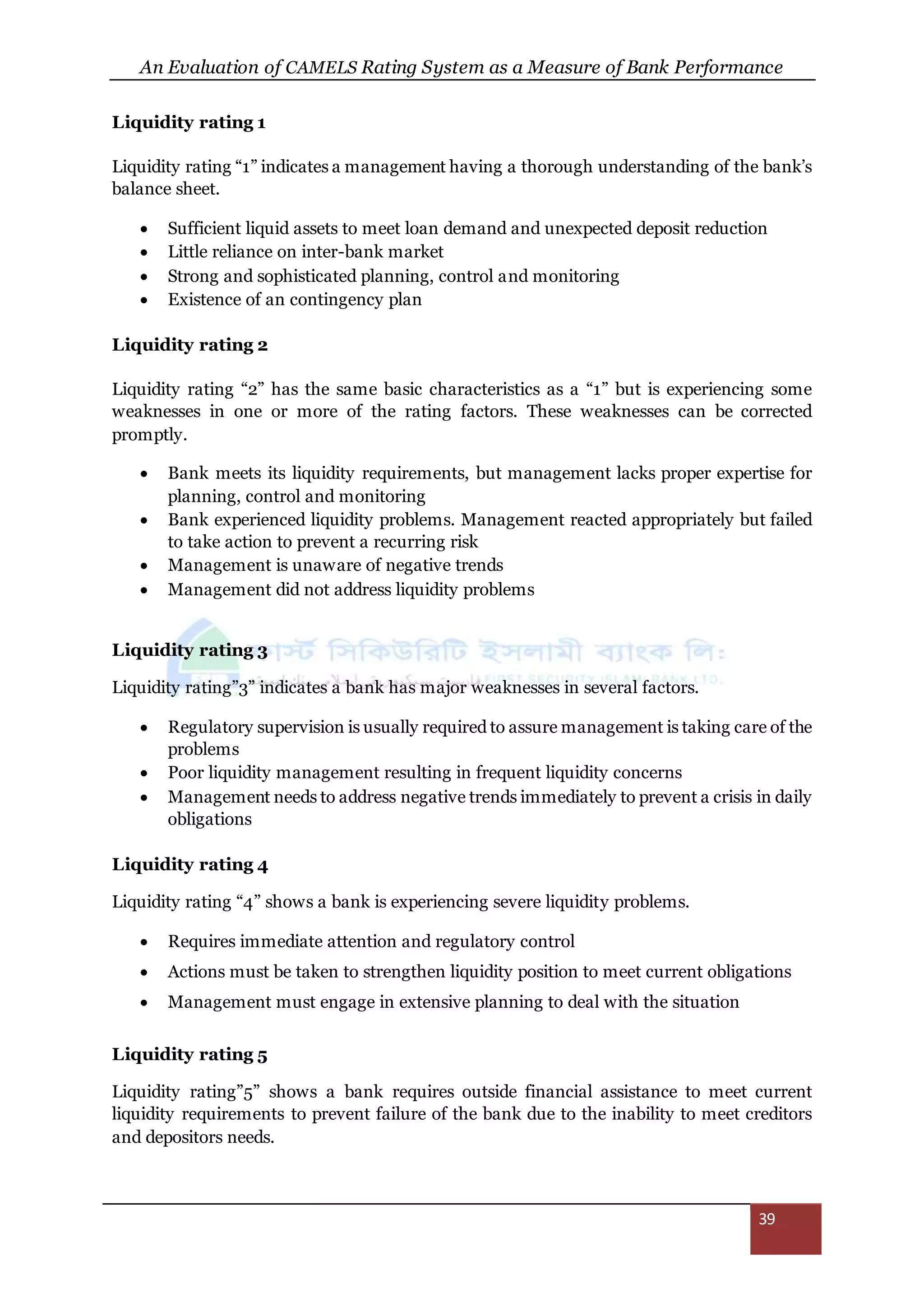
Liquidity rating 1
Liquidity rating “1” indicates a management having a thorough understanding of the bank’s
balance sheet.
 Sufficient liquid assets to meet loan demand and unexpected deposit reduction
 Little reliance on inter-bank market
 Strong and sophisticated planning, control and monitoring
 Existence of an contingency plan
Liquidity rating 2
Liquidity rating “2” has the same basic characteristics as a “1” but is experiencing some
weaknesses in one or more of the rating factors. These weaknesses can be corrected
promptly.
 Bank meets its liquidity requirements, but management lacks proper expertise for
planning, control and monitoring
 Bank experienced liquidity problems. Management reacted appropriately but failed
to take action to prevent a recurring risk
 Management is unaware of negative trends
 Management did not address liquidity problems
Liquidity rating 3
Liquidity rating”3” indicates a bank has major weaknesses in several factors.
 Regulatory supervision is usually required to assure management is taking care of the
problems
 Poor liquidity management resulting in frequent liquidity concerns
 Management needs to address negative trends immediately to prevent a crisis in daily
obligations
Liquidity rating 4
Liquidity rating “4” shows a bank is experiencing severe liquidity problems.
 Requires immediate attention and regulatory control
 Actions must be taken to strengthen liquidity position to meet current obligations
 Management must engage in extensive planning to deal with the situation
Liquidity rating 5
Liquidity rating”5” shows a bank requires outside financial assistance to meet current
liquidity requirements to prevent failure of the bank due to the inability to meet creditors
and depositors needs.
An Evaluation of CAMELS Rating System as a Measure of Bank Performance
40
4.5.2 Liquidity of FSIBL
Liquidity can be measured by various financial and mathematical tools and techniques. In
the report two components are used by researcher for CAMELS rating. They are calculating
below with their individual rating bases:
Table: 4.12 Bases of Liquidity Components
Components Rating 1 Rating 2 Rating 3 Rating 4 Rating 5
Liquidity
Investment to Deposit ≤55% 62% - 56% 68% – 63% 80 %– 69 % ≥81 %
Circulating Assets to
Total Assets
≥50% 45% - 49.99% 38% -44.99% 33% - 37 .99% ≤32%
Source: Bangladesh bank.
A. Investment to Deposit
Table: 4.13 Calculation of Investment to Deposit Ratio
Figures in TK(Crore)
Years Investment Deposit Ratio (%) Rating
2011 6946.73 7814.50 88.90% 5
2012 9630.42 10990.56 87.62% 5
2013 11460.18 13952.10 82.14% 5
2014 15279.23 18251.18 83.72% 5
2015 18768.00 23127.42 81.15% 5
Source: annual report (2011 - 2015), FSIBL.
From the above table it shown that investment to deposit ratio is in decreasing trend which is
good for the liquidity condition of FSIBL. But each and every observed years FSIBL gets
rating 5.
B. Circulating Assets to Total Assets:
Table: 4.14 Calculation of Circulating Assets to Total Assets Ratio
Figures in TK(Crore)
Years Circulating
Assets
Total Assets Ratio (%) Rating
2011 2180.67 9101.29 23.96% 5
2012 2703.80 12973.32 20.84% 5
2013 3736.53 16182.30 23.09% 5
2014 4137.90 20451.27 20.23% 5
2015 5298.66 25548.03 20.74% 5
Source: annual report (2011 - 2015), FSIBL.
An Evaluation of CAMELS Rating System as a Measure of Bank Performance
41
From the above table it shown that circulating assets to total assets ratio is in mixed trend
and each and every observed years FSIBL gets rating 5 which indicates worst condition of
liquidity management of FSIBL.
C. Graphical presentation
Source: drawn by researcher
4.6 Evaluationof SensitivitytoMarket Risk
Earning and capital of financial institutions can be adversely affected by changes in exchange
rate, interest rate, equity price or commodity price. Many financial institutions consider
changes in interest rates as market risk. This S component of the CAMELS rating system
mainly focuses on the ability of the bank to recognize, monitor, manage and control the
market risk and give indication to management for the supervision in the problematic area.
Sensitivity to the market risk is an extension of the Liquidity or we can say to focus on stock
ratios whether bank has sufficient liquidity. To know that bank position is secure or not the
management and credit analyst should thoroughly approach and make analysis of liquidity.
Sensitivity of the market risk are examined by the banks to assess the changes in foreign
currency, interest rate, product purchase and selling prices which totally effects the bank´s
assets values and profits.
year 2011 year 2012 year 2013 year 2014
IN to DP 88.90% 87.62% 82.14% 83.72%
CS to TA 23.96% 20.84% 23.09% 20.23%
0.00%
10.00%
20.00%
30.00%
40.00%
50.00%
60.00%
70.00%
80.00%
90.00%
100.00%
Figure:4.5 Evaluation of Liquidity
An Evaluation of CAMELS Rating System as a Measure of Bank Performance
42
The ratio used to measure the sensitivity of the market risk is Total securities to total
assets = Total securities/Total assets. Banks now a day’s have to changes their self
because of market demands. Portfolio may boost the bank’s profit if the price movement is
in favor of banks, and if it is not then it may create big problems for the bank. The ratio tells
the correlation of banks securities with total assets and provides us the percentage change of
its portfolio with respect to alteration in interest rates or other issues associated with the
issuer of the securities. The higher the value of this ratio is more risky, that the bank´s
portfolio is subjected to market risk. The lower the ratio is good for the bank since it shows
the response towards market risk is appropriate.
4.6.1 Sensitivity to market risk rating factors
Evaluation of the market risk is primarily dependent upon the following factors:
 Sensitivity to unfavorable changes in price of the commodities, foreign exchange
rate, interest rate and fixed assets
 Bank´s nature of its operations
 Changes in worth of bank total fixed assets
 Real estate assets impotence because of loans write off
 Tendency of the bank foreign currency exposure
 Capabilities of the bank management to recognize quantify and control over the
market risk with respect to the bank’s exposure to these risk.
4.6.2 Sensitivity toMarket Risk of FSIBL
Sensitivity to market risk can be measured by various financial and mathematical tools and
techniques. In the report one component is used by researcher for CAMELS rating. This is
calculating below with individual rating bases:
Table: 4.15 Bases of Sensitivity to Market Risk Components
Components Rating 1 Rating 2 Rating 3 Rating 4 Rating 5
Sensitivity Ratio
Total Securities to
Total Assets
≤25% 30% - 26% 37% - 31% 42% - 38% ≥43%
Source: Bangladesh bank.
An Evaluation of CAMELS Rating System as a Measure of Bank Performance
43
A. Total Securities to Total Assets
Table: 4.16 Calculation of Total Securities to Total Assets Ratio
Figures in TK(Crore)
Years Total
Securities
Total Assets Ratio in % Rating
2011 397.70 9101.29 4.37% 1
2012 491.34 12973.32 3.79% 1
2013 699.52 16182.30 4.32% 1
2014 1032.75 20451.27 5.05% 1
2015 1306.41 25548.03 5.11% 1
Source: annual report (2011 - 2015), FSIBL.
From the above table it shown that total securities to total assets ratio from 2011 to 2015 is in
mixed trend. Each and every observed years FSIBL gets rating 1 in sensitivity to market
risk. This indicates FSIBL’s best position and efficient management of risk.
C. Graphical presentation
Source: drawn by researcher
year 2011 year 2012 year 2013 year 2014 year 2015
TS to TA 4.37% 3.79% 4.32% 5.05% 5.11%
0.00%
1.00%
2.00%
3.00%
4.00%
5.00%
6.00%
Figure:4.6 Evaluation of Sensitivity to Market
Risk
An Evaluation of CAMELS Rating System as a Measure of Bank Performance
44
4.7 CompositeCAMELS rating ofFSIBL
According to CAMELS components’ rating composite CAMELS rating of FSIBL is given
below:
Table: 4.17 Composite CAMELS rating of FSIBL
Year
Capital
Adequacy
AssetsQuality
Management
Earnings
Liquidity
Sensitivityto
marketrisk
Compositerating
CAR T1C
to
RWA
CI
to
TI
AP
To
RP
ME
to
TE
ROA ROE IN
to
DP
CS
to
TA
TS
to
TA
2011 3 1 1 5 4 3 1 5 5 1 3(2.9)
2012 3 1 1 5 5 3 1 5 5 1 3(3.0)
2013 3 1 1 5 5 3 1 5 5 1 3(3.0)
2014 3 1 1 5 5 4 2 5 5 1 3(3.2)
2015 3 1 1 5 5 4 2 5 5 1 3(3.2)
4.7.1 Analysis of composite camels rating of FSIBL
Table: 4.18 Analysis of Composite Camels Rating
Year Composite
rating
Description Rating Analysis interpretation
2011
3(3.2) Fair Immoderate weakness unless properly addressed
could impair future viability of the bank. Needs close
supervision
2012 3(3.0) Fair Combination of weaknesses if not redirected will
become severe. Watch category. Requires more than
normal supervision.
2013 3(3.0) Fair Combination of weaknesses if not redirected will
become severe. Watch category. Requires more than
normal supervision.
2014 3(3.2) Fair Combination of weaknesses if not redirected will
become severe. Watch category. Requires more than
normal supervision.
2015 3(3.2) Fair Combination of weaknesses if not redirected will
become severe. Watch category. Requires more than
normal supervision.
An Evaluation of CAMELS Rating System as a Measure of Bank Performance
45
5.1 Findings of analysis
On the bases of so far analysis some findings are given below according to CAMRLS rating
component:
 From analysis of capital adequacy ratio has found that the bank complies with capital
adequacy and solvency regulatory requirements, but has major weaknesses in one or
more factors. CAR ratio indicates a less than satisfactory level of capital that does not
fully support the bank’s risk profile. It indicates a need for improvement, even if the
bank’s capital level exceeds minimum regulatory and statutory requirements. FSIBL
has High level of problem assets compare to total capital. Earnings of FSIBL are
poor. Though tier I capital to risk weighted assets ratio shows rating 1 but
continuously decreases during the observed period that indicates FSIBL’s total
capital is not sufficient to cover the risk weighted assets.
 From analysis of classified investment to total investment has found that FSIBL keep
control on past due and extended investment by a specific unit in accordance with the
law. Assets quality rating indicates strong asset quality and credit administration
practices. Identified weaknesses are minor in nature and risk exposure is modest in
relation to capital protection and management’s abilities. Asset quality of bank is of
minimal supervisory concern. Bank’s troubled non performing investments are
decreasing in proportion to the investment during the observed years. Bank’s bad
debts and non performing investments are kept under good control. Investment
portfolio of the bank is managed efficiently and closes monitoring of problem
investments. But actual provision to required provision ratio shows worst condition
of credit risk management. FSIBL is not keeping necessary provision for classified
investment especially doubtful and bad debt investment.
 After evaluating management efficiency of FSIBL, it has shown that banks
management quality is in worst position. It indicates deficient management and
board performance or risk management practices that are inadequate considering the
nature of bank’s activities. The level of problems and risk exposure is excessive.
Major portion of bank’s earnings spend as operating expenses or management
expenses. Poor financial performance may lead to insolvency of bank. Management
has not demonstrated the ability to correct problems and implement appropriate risk
management practices. Problems and significant risks are inadequately identified,
measured, monitored, or controlled and now threaten the continued viability of the
bank.
An Evaluation of CAMELS Rating System as a Measure of Bank Performance
46
 As a component of earnings ROA is rated around 4 or 5 during the observed years. It
indicates earnings that are deficient. Earnings may not fully support operations and
provide for the accretion of capital and allowance levels in relation to the bank’s
overall condition, growth, and other factors affecting the quality, quantity, and trend
of earnings. Insufficient earnings retention may impair capital position. Bank is
relying somehow on nontraditional income. Banks so rated may be characterized by
erratic fluctuations in net income or net interest margin, the development of
significant negative trends, nominal or unsustainable earnings, intermittent losses, or
a substantive drop in earnings from the previous years. But the scenario of ROE is
different compare to ROA. It shows sufficient income to meet reserve requirements,
provide capital growth and pay reasonable dividends to shareholders.
 Investment to deposit ratio is rated 5 that indicates deficient liquidity levels or
inadequate funds management practices so critically deficient that the continued
viability of the bank is threatened. Bank may not have or be able to obtain a sufficient
volume of funds on reasonable terms to meet liquidity needs. Bank invests its major
portion of deposit without keeping required level of cash reserved according to BB
guidelines. But good sign is that this ratio is continuously decreasing during the
observed years. Circulating Assets to Total Assets ratio also shows same position as
investment to deposit ratio. Bank keeps inadequate percentage of total assets as
circulating assets or current assets. It means majority of total assets are invested in
long term sources which may create liquidity crisis for bank in near future.
 Sensitivity to market risk measured only bases on total security holding or
investment in securities of FSIBL’s. Total security to total assets ratio is rated 1 which
indicates that market risk sensitivity is well controlled and that there is minimal
potential that the earnings performance or capital position will be adversely affected.
Risk management practices are strong for the size, sophistication, and market risk
accepted by the bank. The level of earnings and capital provide substantial support
for the amount of market risk taken by the bank. Bank has still chance to invest in
securities with consideration of market risk because of low percentage of total
security to total assets ratio.
5.2 Suggestions
On the bases of various findings of analysis researcher suggested some measures that will
help FSIBL to improve its financial performance as well as improve its CAMRLS rating rank.
They are given below:-
An Evaluation of CAMELS Rating System as a Measure of Bank Performance
47
 FSIBL should increase and improve its capital at satisfactory level to support its risk
weighted assets and other risk profile though bank’s capital level exceeds minimum
regulatory and statutory requirements. Bank should reduce problem assets by strong
recovery policies. Bank should increase its earning by investing its assets in various
profitable and safe sectors. It requires regulatory oversight to ensure management
and shareholders address the issues of concern.
 To maintain strong asset quality and credit administration practices FSIBL should
monitor assets continuously and take necessary measures to the solve weakness if
any. FSIBL also should identify and manage problem assets on regular basis. Bank
need to arrange various training program for ALCO to address new rules and
regulation about assets liability management. FSIBL should keep adequate provision
for classified investment according to BB guideline. It helps bank to reduce credit risk
and increase asset quality.
 FSIBL needs Strong regulatory action because of poor management performance.
Problems and significant risks should adequately identify, measure, monitor, or
control and require immediate action by the board and management to preserve the
soundness of the bank. Board of Directors should consider replacing or strengthen
management due to Insider abuse, Disregard for regulatory requirements, Lack of
proper policies and Damaging actions.
 FSIBL requires Strong regulatory supervision to prevent loss of capital because of
poor earning condition. Management of FSIBL must take immediate action to
improve income and reduce expenses. Certain activities may have to be suspended
which are not important and necessary for bank. Corrective action is needed to
prevent losses developing into insolvency. Bank needs to improve budget, planning
and control process. Bank should identify various profitable investment
opportunities with minimum risk to increase overall earning scenario. ROE shows
good rating because of inadequate capital. When capital needs to be increased,
earnings also need to be increased by proper use of capital to generate income for
bank.
 Regulatory authority needs to take immediate attention and control of FSIBL’s
liquidity management. Various Actions must be taken to strengthen liquidity position
to meet current obligations of bank. Bank must be maintained adequate level of cash
reserve to fulfill liquidity demand. Bank should increase deposit to get more liquid
fund or withdraw its investment to minimize the liquidity risk. Bank should invest
more in current or short term assets to maintain a balance liquidity position.
Management must engage in extensive planning to deal with the situation.
An Evaluation of CAMELS Rating System as a Measure of Bank Performance
48
 FSIB’s sensitivity to market risk is well controlled but it has a negative impact on
bank earnings. Bank should increase its investment in securities especially in
government bond as risk free instrument. Bank can invest in various securities with
their risk factors as current or short term investment source. It will help to solve
liquidity crisis of bank. Bank should improve Capabilities of the bank management to
recognize, quantify and control over the market risk with respect to the bank’s
exposure to these risk.
5.3 Conclusion
Economic activity of a country strongly depends on banks. Financial strength and
performance of banks can accelerate the economic growth a country. The main objective of
the study is evaluating the performance of FSIBL as a schedule bank of Bangladesh bank by
using CAMELS rating system. Analysis on CAMELS rating of FSIBL shows the overall
financial scenario of bank. Capital adequate ratio indicates a less than satisfactory level of
capital that does not fully support the bank’s risk profile. Assets quality rating indicates
strong asset quality and credit administration practices. Actual provision to required
provision ratio shows poor condition of credit risk management. Management efficiency
indicates deficient management and board performance or risk management practices that
are inadequate considering the nature of an institution’s activities. Return on assets indicates
earnings are deficient that may not fully support operations and provide for the accretion of
capital and allowance levels in relation to the institution’s overall condition, growth, and
other factors affecting the quality, quantity, and trend of earnings. Return on equity shows
sufficient income to meet reserve requirements, provide capital growth and pay reasonable
dividends to shareholders. Liquidity condition shows inadequate funds management
practices so critically deficient that the continued viability of the bank is threatened.
Sensitivity to market risk shows bank is less sensitive with the change of market condition.
After analysis of overall camels components of FSIBL researcher suggests some guideline
and policies. FSIBL should adopt those guideline and policies to overcome weaknesses and
hold the current financial strength. Bank should consult with Bangladesh Bank as regulatory
authority of banking system.
An Evaluation of CAMELS Rating System as a Measure of Bank Performance
49
REFERENCES
 Ahmad, A., Malik, M.I., & Hamayoun, A.A. (2010). Banking Developments in Pakistan:
A Journey from Conventional to Islamic Banking. European Journal of Social Sciences,
17 (1), 12-17.
 Allen, F., & Santomero, A.M., (1996). The theory of financial intermediation. Journal
of banking & finance. 21, 1461-1485.
 Chen, J. (2003). Capital adequacy of Chinese banks: Evaluation and enhancement.
Journal of international banking regulation, 4 (4), 320-327.
 Babar& Zeb (2011), Camels Rating System For Banking Industry In Pakistan: Does
Camels System Provide Similar Rating As Pacra System In Assessing The Performance
Of Banks In Pakistan?, Umea University, 1-90
 Baral, K.J. (2005). Health Check-up of Commercial Banks in the Framework of CAMEL:
A Case Study of Joint Venture Banks in Nepal. Journal of Nepalese Business Studies, II
(1), 41-55.
 Bryman, A. & Bell, E. (2007). Business Research Methods. 2nd edition. New York,
USA: Oxford University Press
 Chen, J. (2003). Capital adequacy of Chinese banks: Evaluation and enhancement.
Journal of international banking regulation, 4 (4), 320-327.
 Christopoulos, A.G., Mylonakis, J., & Diktapanidis, P. (2011). Could Lehman Brothers‟
Collapse Be Anticipated? An Examination Using CAMELS Rating System. International
Business Research, 4 (2), 11-19 doi:10.5539/ibr.v4n2p11, Canadian Center of Science
& Education.
 Consulate General of Switzerland (CGS). (2011). Pakistan Banking Sector. OSEC
Business Network Switzerland, Karachi, 1-28. Downloaded from www.osec.ch
 Comptroller’s Handbook, (2007). Bank Supervision Process. Occ website
<http://www.occ.gov/static/publications/handbook/banksup.pdf>
An Evaluation of CAMELS Rating System as a Measure of Bank Performance
50
 Couto, R.L.R., & Brasil, B.C. (2002). Framework for the Assessment of Bank Earnings.
Bank for international settlement, FSI award 2002 winning paper, ISSN 1684-7180, 1-
38.
 Dang (2011), The Camel Rating System In Banking Supervision A Case Study,
International Business , Arcada University, 1-47
 Eriksson, P., & Kovalainen, A. (2008). Qualitative Methods in Business Research. 1st
edition. SAGE Publications Ltd, London
 Feldman R. J. & Schmidt J. (1999), what are CAMELS and who should know? Available
at: www.minneapolisfed.org/publications_papers/pub_display.cfm?id=2518
 First Security Islami Bank, annual report.
 Gasbarro, D., Sadguna, G.M. & Zumwalt. (2002). The Changing Relationship Between
CAMEL Ratings and Bank Soundness during the Indonesian Banking crisis. Kluwer
academic Publishers, 19 (3) 247-260
 Ghauri, P. and Gronhaug, K. (2005). Research methods in business studies: a practical
guide. 3rd Edition. New Jersey: Prentice Hall
 Grier, W.A. (2007). Credit Analysis of Financial Institutions. [e-book.] London:
Euromoney Institutional Investor.
 Hassan. M & Kalhoefer. C. (2011). Regulation of Credit Rating Agencies - Evidence
from Recent Crisis, German University in Cairo, Egypt. Working Paper. 1 – 13
 Iqbal ( 2012), Banking Sector's Performance In Bangladesh- An Application Of
Selected Camels Ratio, Asian Institute Of Technology, School Of Management,
Thailand, 1-63.
 Kabir & Dey (2012), Performance Analysis through CAMEL Rating: A Comparative
Study of Selected Private Commercial Banks in Bangladesh, Journal of Politics &
Governance, Vol. 1, No. 2/3, pp. 16-25.
 Pajutagana (1999), Camels Rating System, Supervision And Examination Sector,
Department Of Rural Banks,1-50.
An Evaluation of CAMELS Rating System as a Measure of Bank Performance
51
 Procedure of computing camels rating by Bangladesh bank, available at
www.bb.org.bd.
 Purohit, K.K., & Mazumder, B.C. (2006). Performance Measurement of Banks: An
Application of Balance Scorecard. The cost and management, 34 (6), 21-30.
 Rani, P. (2009). To Study the strength of using CAMELS framework as a tool of
performance evaluation for banking institutions: Master thesis, jalandhar: Punjab
technical university, India.
 Sahajwala, R and P. V. D. Bergh (2000). Supervisory Risk Assessment and Early
Warning Systems. Basel Committee on Banking Supervision Working Papers No. 4,
Bank for International Settlements (BIS). Basel, Switzerland, December
 Sarker, A.A. (2005). CAMELS Rating System in the Context of Islamic Banking: A
Proposed „S‟ for Shariah Framework, Bangladesh Bank Dhaka Bangladesh, p. 1-26
 Saltzman, S.B., & Salinger, D. (1998). The ACCION Camel: Technical note. ACCION
International, Microenterprise Best practices, Development alternative Inc.
Woodmont Avenue Bethesda, USA. 1-106
 Shabul (2000), An Evaluation Of Camel Rating System As A Measure Of Bank
Performance: A Study Of Selected Banks, Ahmadu Bello University, Zaria 1-84.
 Sundarajan, V. and L. Errico (2002). Islamic Financial Institutions and Products in the
Global Financial System: Key Issues in Risk Management and Challenges Ahead. IMF
Working Paper No. WP/02/192, November.
 Trautmann, P.Y., (2006). Camels Ratings, Bearing Point Management and technology
consultants, USAID/IRAQ, 1-49.

An Evaluation of Camels Rating System as a Measure of Bank Performance

  • 1.
    An Evaluation ofCAMELS Rating System as a Measure of Bank Performance 1 1.1 Preludes Financial sector of an economy plays an important role in its economic development and prosperity of the country. Banking industry serves as the backbone of the financial sector that accumulates savings from surplus economic units in the form of deposits and provides it to deficit economic units in the form of advances. Banking industry provides support to economy and industries specifically at the time of recessions and economic crisis. But when banks are at the heart of economic recession or banks are the cause of financial crisis like the recent past financial crisis 2007-09, it makes the situation worst for economic recovery. So it is of great importance to keenly observe the performance of the banks and their compliance with the regulatory requirements. Performance of the banks is measured at two levels, one is at the management and regulatory level of the banks and another is at external rating agencies. Purpose of regulatory and supervisory rating systems is to measure the bank performance at internal level and its compliance with regulatory requirements to keep the bank on right track. These ratings are highly confidential and are only available to the bank management. External credit rating agencies examine and evaluate the banks and issue ratings for the general public and investors in particulars. It is great importance that both these ratings present the same results about the condition of the banks to provide clear information to investors and management. In past several banks suffer from bankruptcy that was the failure of both internal rating systems and credit rating agencies. CAMELS is a rating system generally used by the government policy circle, regulating bodies regulating commercial banks, that is, central banks and non-governmental policy research centers for the purpose of assessing the soundness of a savings association or a bank. In Bangladesh CAMELS rating system is implemented by Bangladesh Bank. It takes into account six important components of a bank when it evaluates performance of the bank. These components are Capital, Assets, Management, Earning, Liquidity and Sensitivity to market risk. Ratings is assigned to these components on the scale of 1 to 5 and that is a base for composite rating that also ranged from 1 to 5. The application of CAMELS has spread up dramatically in respect of examining the financial strengths of one of the basic constituents of money market i.e. commercial banks. Currently financial ratios are often used to measure the overall soundness of a bank and the quality of bank management. Thus, bank regulators may use financial ratios to help evaluate a bank’s performance as part of CAMELS rating system.
  • 2.
    An Evaluation ofCAMELS Rating System as a Measure of Bank Performance 2 1.2 Literature review The applications of CAMELS rating system for evaluating financial strengths of commercial banks have been growing both locally and internationally. At international level, several academic studies examined whether and to what extent private supervisory information is useful in supervisory monitoring of banks. With respect to predicting banks failure, Barker and Holdsworth (1993) find evidence that CAMELS ratings are useful, even after controlling a wide range of publicly available information about the condition and performance of banks. Cole and Gunther (1998) examined a similar question and found that CAMELS ratings contain useful information. Hirtle and Lopez (1999) also inquired into the worth of CAMELS ratings in assessing banks current condition. While comparing to past CAMELS ratings to current CAMELS ratings, they found that the private supervisory information contained in the past CAMELS ratings provides further insight into bank current conditions, as summarized by current CAMELS ratings and that for the period from 1989 to 1995, the private supervisory information gathered during the last on-site exam remains useful with respect to current condition of a bank for 6 to 12 quarters. In Bangladesh, Bangladesh Bank as a regulatory body has been calculating this rating till now. Apart from the prime regulator of commercial banks, academicians are also found taking interest in utilizing CAMELS ratings to assess the financial soundness of commercial banks. Purohit and Mazumder (2003) in a recent research paper used this technique to measure the performance of BASIC; a government owned commercial bank promoting basically small and medium enterprises. All of the above mentioned academic studies made an overall conclusion that private supervisory information, as summarized by CAMEL ratings, is clearly useful in the supervisory monitoring of bank conditions. Hirtle and Lopez (1999) studied the predictability of past CAMELS ratings in examining financial institutions' current performance. They find the usefulness of CAMELS rating as measure of summarizing the banks soundness. Recently, the case of Lehman Brothers is being examined by analyzing its financial particulars of the last five years (2003-2007) using the CAMELS ratios. Lehman Brothers is the largest investment bank in USA and is declared as bankrupt forever during the recent
  • 3.
    An Evaluation ofCAMELS Rating System as a Measure of Bank Performance 3 economic recession. The impact of its bankruptcy is huge on the world economy. Research results from the case study showed that" its credits were found as bad and doubtful while its management appeared to be unwilling and unable to reverse its declining course. Also, the management was not complying with the rules based on CAMELS ratio set by the supervisory authorities and the risk management procedures of Lehman and Brothers is 8 regarded as unsatisfactory proportionally to its size. Finally, the bank also seems to be in danger against risks or unstable conditions". So, it has been proved that the predictability of CAMELS rating is still beyond question. The Supervisory or regulatory authority should give due importance while rating the banks and financial institutions At the same time, the Supervisory or regulatory authority has to be more prudent in making bound the banks and financial institutions to follow the rules and regulations set by the CAMELS rating prediction. 1.3 Statement of the problem Banks serve as backbone to the financial sector, which facilitate the proper utilization of financial resources of a country. The banking sector is increasingly growing and it has witnessed a huge flow of investment. A single bank is highly connected with other banks for payment system and other functions of bank. The failure of a single bank not only affects its shareholders and depositors rather it affects rest other banks and even all rest other business. The failure of a single bank creates an economic turmoil situation and is regarded as a disaster for the economy. The recent global recession is also an example of economic disaster that occurred for the failure of banking business. So, the government of any country must have a high concern about the performance of all banks. There are various measures to supervise and evaluate performance of a bank specifically First security Islami Bank Limited (FSIBL). One of such measures of supervisory information is the CAMELS rating system which was put into effect firstly in the U.S. in 1979. CAMELS ratios mainly indicate the adequacy of the risk based capital, credit growth, credit concentration, single borrower exposure, non-performing loan position, liquidity gap analysis, liquidity ratio, inter-bank dependency, Return on Assets (ROA), return on equity (ROE), net interest margin (NIM), foreignexchange exposure, market risk and management questionnaire, etc. This study will help to evaluate various components of CAMELS rating on First Security Islami Bank (FSIBL), composite rating and actual financial performance of FSIBL.
  • 4.
    An Evaluation ofCAMELS Rating System as a Measure of Bank Performance 4 1.4 Objective of the study The principle objective of the study is to evaluate the performance of First Security Islami Bank (FSIBL) on the bases of CAMELS rating system. Specifically this study will look into: a) To understand the literature of CAMELS rating system. b) To know about First Security Islami Bank Ltd. c) To evaluate CAMELS components on FSIBL. d) To evaluate composite rating on FSIBL. e) To suggest some policy measures for financial improvement of FSIBL. 1.5 Scope of the study This report is a part of the academic curriculum of the MBA (accounting), university of Chittagong. The report is all about the CAMELS rating system of Bangladesh Bank in accordance with First Security Islami Bank Ltd. The report has been prepared using highest concern, but the complexity of CAMELS rating system is very well known. It is a report which can be easy for all that a primary reader do not face any problem to know about the banking industry or about regulatory requirement or about the CAMELS rating system. This report can be absolute alternative for anyone who wants to know the ins and outs of CAMELS rating system of FSIBL and common rules and regulation of BB about CAMELS rating system. The report covers the financial performance of FSIBL for five years from 2011 to 2015. The collected data and information has been tabulated, processed and analyzed carefully. Graphical analysis and different chart of this report makes it easier and more acceptable to all.
  • 5.
    An Evaluation ofCAMELS Rating System as a Measure of Bank Performance 5 1.6 Methodology of the study Sampling: First Security Islami Bank Limited and its annual report from 2011 to 2015 are used as a sample for the study. Collection of primary data: The researcher has conducted face to face interview to particular branch manager and principle officer of FSIBL. Also has conducted General discussion with reporting unit officers. Collection of secondary data: The researcher has collected secondary data from various sources as follows: o Bangladesh Bank capital adequacy guideline o Bangladesh Bank CAMELS rating system guideline o Websites o Articles o First Security Islami Bank Ltd. Annual Report from 2011 to 2015 o Many Research Report on CAMELS rating system o Journal o Magazine Analysis of data: Technique:  Ratio analysis. Graph:  Line graph. 1.7 Limitation of the study The report is not free from error and limitation because of scarcity of resources and constraint. The limitation of the study at glance-  Lack of sufficient funds to make the report more accurate and informative.  Only five years annual reports of FSIBL are used as a sample.  Secondary data are limited to a specific source.
  • 6.
    An Evaluation ofCAMELS Rating System as a Measure of Bank Performance 6  There some information which are confidential for collecting the data. So, some data could not been collected for confidentiality or secrecy of management  Lack of researcher personal skill to make a report properly.  Use few parameters for analysis of the data.  Limited time for preparing the paper.  Because of Lack of necessary information, the report may not give a true indication of the analysis.  A lot of information may not be valid any longer at the present date. 1.8 Organization of the study The study has been segmented into five chapters.  The first chapter includes preludes, review of literature, a statement of the problem, objective of the study, the scope of the study, the methodology of the study, limitation of the study and organization of the study.  Second chapter includes origin of camels rating system, camel rating framework, process of camels reporting, limitations of the camel rating system, camels rating system of Bangladesh, CAMELS composite ratings description and rating base of CAMELS components.  Third chapter includes overview of FSIBL, vision of FSIBL, mission of FSIBL, strategies of FSIBL, corporate profile of FSIBL, products and services of FSIBL, board of director’s profile, profile of shariah board, management & head of division and financial performance at a glance.  Fourth chapter includes evaluation of the capital adequacy, evaluation of assets quality, evaluation of management efficiency, evaluation of earnings and profitability, evaluation of liquidity, evaluation of sensitivity to market risk and composite CAMELS rating of FSIBL.  Fifth chapter includes findings of the analysis, suggestion and conclusion.
  • 7.
    An Evaluation ofCAMELS Rating System as a Measure of Bank Performance 7 2.1 Originof CAMELS Rating System There are many banks rating system available in the world. However, CAMELS rating system is the most successful bank rating system in the world. The ‘Uniform Financial Institutions Rating System (UFIRS)’ was created in 1979 by the bank regulatory agencies. Under the original UFIRS a bank was assigned ratings based on performance in five areas: the adequacy of Capital, the quality of Assets, the capability of Management, the quality and level of Earnings and the adequacy of Liquidity. Bank supervisors assigned a 1 through 5 rating for each of these components and a composite rating for the bank. This 1 through 5 composite rating was known primarily by the short form CAMEL. A bank received the CAMEL rate 1 or 2 for their sound or good performance in every respect of criteria. The bank which exhibited unsafe and unsound practices or conditions, critically deficient performance received the CAMEL rate 5 and that bank was of the greatest supervisory concern. While the CAMEL rating normally bore close relation to the five component ratings, it was not the result of averaging those five grades. Supervisors consider each institution’s specific situation when weighing component ratings and review all relevant factors when assigning ratings to a certain extent. The process and component and composite system exist similar for all banking companies. In 1996, the UFIRS was revised and CAMEL became CAMELS with the addition of a component grade for the Sensitivity of the bank to market risk. Sensitivity is the degree to which changes in market prices such as interest rates adversely affect a financial institution. The communication policy for bank ratings was also changed at end of 1996. Starting in 1997, the supervisors were to report the component rating to the bank. Prior to that, supervisors only reported the numeric composite rating to the bank. CAMELS ratings in the Ninth District as of the third quarter of 1998 reflect the excellent banking conditions and performance over the last several years. Comparison between the distribution of ratings in the most recent quarter and 10 years ago during the height of the national banking crisis is illustrative (221 banks failed nationally in 1988while 3 banks failed in 1998). Nearly 100 percent of Ninth District banks currently fall into the top two ratings with 40 percent receiving the top grade. Ten years ago one-third of Ninth District banks fell into the bottom three ratings and only about one of 10 banks received the highest grade.
  • 8.
    An Evaluation ofCAMELS Rating System as a Measure of Bank Performance 8 2.2 CAMELS Rating Framework Capital Adequacy Capital adequacy focuses on the total position of bank capital. It assures the depositors that they are protected from the potential shocks of losses that a bank incurs. Financial managers maintain company’s adequate level of capitalization by following it. It is the key parameter of maintaining adequate levels of capitalization. Asset Quality Asset quality determines the robustness of financial institutions against loss of value in the assets. All commercial banks show the concentration of loans and advances in total assets. The high concentration of loans and advances indicates vulnerability of assets to credit risk, especially since the portion of non-performing assets is significant. Management Soundness Management quality of any financial institution is evaluated in terms of Capital Adequacy, Asset Quality, Management, Earnings, Liquidity and Sensitivity to market risk. Moreover, it is also depended on compliance with set norm, planning ability; react to changing situation, technical competence, leadership and administrative quality. A Sound management is the most important pre-requisite for the strength and growth of any financial institution. Earnings and Profitability Earning and profitability is the prime sources of increasing capital of any financial institution. Strong earnings and profitability profile of a bank reflect its ability to support present and future operations. Increased earning ensure adequate capital and adequate capital can absorb all loses and give shareholder adequate dividends. Liquidity An adequate liquidity position refers to a situation, where an institution can obtain sufficient funds, either by increasing liabilities or by converting its assets quickly at a reasonable cost. It access in terms of asset and liability management. Liquidity indicators measured as percentage of demand and time liabilities (excluding interbank items) of the banks. It means that the percentage of demand and time liabilities gets a bank as per its liquid assets.
  • 9.
    An Evaluation ofCAMELS Rating System as a Measure of Bank Performance 9 Sensitivity to Market Risk The sensitivity to market risk is evaluated from changes in market prices, notably interest rates; exchange rates, commodity prices, and equity prices adversely affect a bank’s earnings and capital. Figure 2.1 CAMELS Rating Components 2.3 Process of CAMELS Reporting The reporting process of CAMELS rating is given below: Figure2.2 Process of CAMELS Reporting CAMELSCapital Adequacy Assets Quality Management Efficiency Earnings Liquidity Sensitivity to Market Risk
  • 10.
    An Evaluation ofCAMELS Rating System as a Measure of Bank Performance 10 Process:  Data collection of reschedule status of overdue loans from CRM, Retail, SME and Ops.  Data collection of lending rates and deposit rates from Treasury.  Data collection of average borrowed amount and rate of interest expenses from Treasury.  Data collection of maturity wise investments from Treasury.  Collect information of training programs arranged by the Bank’s training institute from Human Resources Division.  Collection of other required reports and statements from other divisions.  Preparation of CAMELS report as per guideline of BB & Core Risk Management Guidelines.  Meeting arranged with MANCOM.  Necessary changes are made and report is submitted to BB. 2.4 Limitations of the CAMELS Rating System Though CAMELS rating is a very effective and widely used supervisory tool and the system has recently been upgraded by a supervision consultant of World Bank, this system has some limitations which are viewed, generally, from the end of Central Bank. The limitations often faced while determining the CAMELS rating of banks are:  The ratings can not necessarily capture the seriousness of the situation of banks which may be another cause of failure.  Complete reliance on data supplied by the banks.  If data are furnished or inconsistent or seems inaccurate, scope to verify the same is limited.  Somewhat inconsistencies in the ranges (which are used for assigning rating from 1 to 5) used for ratios.  Unavoidable delay in determining CAMELS rating due not having core risks rating and other necessary information in time
  • 11.
    An Evaluation ofCAMELS Rating System as a Measure of Bank Performance 11  CAMELS ratings only consider the internal operations. They measure only the current financial condition of a bank. They do not consider regional or local economic developments that may pose future problems which CAMELS rating fail to reflect as bank’s condition.  CAMELS ratings are not forward looking and do not systematically track long-term risk factors that may cause losses several years later. For example, many banks during the period under review engaged in risky behaviors that in the past had been associated with failures, like excessive asset growth, high ratios of commercial real estate loans and total loans to total assets, or a heavy dependence upon volatile deposit liabilities, yet if the bank was performing satisfactorily, these risk factors were generally not captured or weighted in the current examination ratings.  Lack Of seriousness of the bank situation, considering only internal operation not external operation and having no forward looking ability, it causes a great problem for bank. Unexpected problem from this limitation, sometimes a bank have to pay a lot of money to solve this problem. Not only wastage of money but also giving wrong path to the bank causes wastage of time. 2.5 CAMELS Rating For Banking Companies CAMELS rating system is encountered by six components named capital adequacy, asset quality, management competence, earnings, liquidity and sensitivity to market risk. It is used for banking companies to know about their financial condition, overall soundness of the banks, and predict different risk factors that may contribute to turn the bank into a problem. To review the different aspects of the banks such as adequacy of risk-based capital, future sources of capital and dividend payment ratio, asset growth rate, loan growth rate, non- performing loan trends, provision for loan loss and bad assets, maturity profile of assets, their classification-wise weight age, performance of off balance sheet items, return on assets, level and composition of earnings, volatility of deposits base and reliance position on the borrowed funds and its sources, technical competence in the rise of financial globalization and deregulation, uses of financial innovations, leadership ability, administrative and control ability, compliance with the rules and regulations and standard management information system etc. CAMELS rating system is very important. It also recommends on which sector it should improve.
  • 12.
    An Evaluation ofCAMELS Rating System as a Measure of Bank Performance 12 2.6 CAMELS Rating System of Bangladesh All over the world, CAMELS rating is a commonfigure to all banking industry. Like all other countries, it is also used in Bangladesh. In Bangladesh, the five components of CAMEL have been used for evaluating the five crucial dimensions of a bank’s operations that reflect in a complete institution’s financial condition, compliance with banking regulations and statutes and overall operating soundness since the early nineties. In 2006, Bangladesh Bank has upgraded the CAMEL into CAMELS. ‘Sensitivity to market risk’ or ‘S’ is the new rating component which is included in CAMEL and make it into CAMELS. The new rating component makes the system more effective and efficient. The new system needs bank’s regular condition and performance according to predetermined stress testing on asset and liability and foreign exchange exposures, procedures, rules and criteria and on the basis of the results obtained through risk-based audits under core risk management guidelines. A bank’s single CAMELS rating has come from off-site monitoring, which uses monthly financial statement information, and an on-site examination, from which bank supervisors gather further “private information” not reflected in the financial reports. The development of "credit points" examination result is ranging from 0 to 100. The six key performance dimensions – capital adequacy, asset quality, management, earnings, liquidity and sensitivity to market risk – are to be evaluated on a scale of 1 to 5 in ascending order. Following is a description of the graduations of rating: o Rating 1 - indicates strong performance: BEST rating. o Rating 2 - indicates above average performance that adequately provides for the safe and sound operations of the banking company. o Rating 3 - represents performance that is flawed to some degree. o Rating 4- refers to marginal performance and is significantly below average and o Rating 5- indicates very unsatisfactory performance in need of immediate remedial attention for the sake of the banking company’s survival: WORST rating.
  • 13.
    An Evaluation ofCAMELS Rating System as a Measure of Bank Performance 13 2.7 CAMELS Composite Ratings Description Composite ratings are based on a careful evaluation of an institution’s managerial, operational, financial, and compliance performance. The six key components used to assess an institution’s financial condition and operations are: capital adequacy, asset quality, management capability, earnings quantity and quality, the adequacy of liquidity, and sensitivity to market risk. The rating scale ranges from 1 to 5, with a rating of 1 indicating: the strongest performance and risk management practices relative to the institution’s size, complexity, and risk profile; and the level of least supervisory concern. A 5 rating indicates: the most critically deficient level of performance; inadequate risk management practices relative to the institution’s size, complexity, and risk profile; and the greatest supervisory concern. The composite ratings are defined as follows: Composite 1 [Strong] Financial institutions in this group are sound in every respect and generally have components rated 1 or 2. Any weaknesses are minor and can be handled in a routine manner by the board of directors and management. These financial institutions are the most capable of withstanding the vagaries of business conditions and are resistant to outside influences such as economic instability in their trade area. These financial institutions are in substantial compliance with laws and regulations. As a result, these financial institutions exhibit the strongest performance and risk management practices relative to the institution’s size, complexity, and risk profile, and give no cause for supervisory concern. Composite 2 [Satisfactory] Financial institutions in this group are fundamentally sound. For a financial institution to receive this rating, generally no component rating should be more severe than 3. Only moderate weaknesses are present and are well within the board of directors’ and management’s capabilities and willingness to correct. These financial institutions are stable and are capable of withstanding business fluctuations. These financial institutions are in substantial compliance with laws and regulations. Overall risk management practices are satisfactory relative to the institution’s size, complexity, and risk profile. There are no material supervisory concerns and, as a result, the supervisory response is informal and limited.
  • 14.
    An Evaluation ofCAMELS Rating System as a Measure of Bank Performance 14 Composite 3 [Fair] Financial institutions in this group exhibit some degree of supervisory concern in one or more of the component areas. These financial institutions exhibit a combination of weaknesses that may range from moderate to severe; however, the magnitude of the deficiencies generally will not cause a component to be rated more severely than 4. Management may lack the ability or willingness to effectively address weaknesses within appropriate time frames. Financial institutions in this group generally are less capable of Comptroller’s Handbook 46 Bank Supervision Process withstanding business fluctuations and are more vulnerable to outside influences than those institutions rated a composite 1 or 2. Additionally, these financial institutions may be in significant noncompliance with laws and regulations. Risk management practices may be less than satisfactory relative to the institution’s size, complexity, and risk profile. These financial institutions require more than normal supervision, which may include formal or informal enforcement actions. Failure appears unlikely, however, given the overall strength and financial capacity of these institutions. Composite 4 [Marginal] Financial institutions in this group generally exhibit unsafe and unsound practices or conditions. There are serious financial or managerial deficiencies that result in unsatisfactory performance. The problems range from severe to critically deficient. The weaknesses and problems are not being satisfactorily addressed or resolved by the board of directors and management. Financial institutions in this group generally are not capable of withstanding business fluctuations. There may be significant noncompliance with laws and regulations. Risk management practices are generally unacceptable relative to the institution’s size, complexity, and risk profile. Close supervisory attention is required, which means, in most cases, formal enforcement action is necessary to address the problems. Institutions in this group pose a risk to the deposit insurance fund. Failure is a distinct possibility if the problems and weaknesses are not satisfactorily addressed and resolved. Composite 5 [Unsatisfactory] Financial institutions in this group exhibit extremely unsafe and unsound practices or conditions; exhibit a critically deficient performance; often demonstrate inadequate risk management practices relative to the institution’s size, complexity, and risk profile; and are of the greatest supervisory concern. The volume and severity of problems are beyond
  • 15.
    An Evaluation ofCAMELS Rating System as a Measure of Bank Performance 15 management’s ability or willingness to control or correct. Immediate outside financial or other assistance is needed in order for the financial institution to be viable. Ongoing supervisory attention is necessary. Institutions in this group pose a significant risk to the deposit insurance fund and failure is highly probable. 2.7.1 Composite range for CAMELS rating Various range of CAMELS composite rating is given below: Table: 2.1 Composite Ranges for CAMELS rating Rating Composite range Description Rating Analysis interpretation 1 1 to 1.4 Strong Sound in every respect, no supervisory responses required. 2 1.5 to 2.4 Satisfactory Fundamentally sound with modest correctable weakness, supervisory response limited. 3 2.5 to 3.4 Fair Combination of weaknesses if not redirected will become severe. Watch category. Requires more than normal supervision. 4 3.5 to 4.4 Marginal Immoderate weakness unless properly addressed could impair future viability of the bank. Needs close supervision. 5 4.5 to 5 Unsatisfactory High risk of failure in the near term. Under constant supervision/cease and desist order. Source: Bangladesh bank.
  • 16.
    An Evaluation ofCAMELS Rating System as a Measure of Bank Performance 16 2.7.2 Rating Base of CAMELS rating Components Rating bases of various CAMELS rating components are given below: Table: 2.2 Rating Base of CAMELS rating Components Com ponents Rating 1 Rating 2 Rating 3 Rating 4 Rating 5 Capital Adequacy Capital Adequacy Ratio ≥15% 12%- 14.99% 8% - 11.99% 7 %- 7 .99 ≤6.99% Tier 1 Capital/Risk Weighted Assets ≥5% 4.5%- 5% 3.5%- < 4.5% 3% - < 3.5% < 3% Assets Quality Classified Loan / Total Loans <3% 3%- <5% 5% - < 10% 10%– <15% ≥15% Actual Provisioning / Required Provisioning 100% 95% - < 100% 80% - < 95% 50%- < 80% <50% Management Management Expenses/Total Earning ≤25% 30% – 26% 38% – 31% 45% – 39% ≥46% Earnings ROA ≥1.3% 0.8% – < 1.3% 0.4% – <.8% 0.16 –<.4% <0.16 ROE ≥ 9% 7 %- <9 % 5% - <7 % 2%– <5% <2% Liquidity Liquidity Ratio L1 ≤55% 62% - 56% 68% – 63% 80 %– 69 % ≥81 % Liquidity Ratio L2 ≥50% 45% - 49.99% 38% - 44.99% 33% - 37 .99 ≤32% Sensitivity Ratio Total Securities To Total Assets ≤25% 30% - 26% 37 %- 31% 42% - 38% ≥43% Source: Bangladesh bank.
  • 17.
    An Evaluation ofCAMELS Rating System as a Measure of Bank Performance 17 3.1 History of FSIBL First Security Islami Bank Limited (FSIBL) was incorporated in Bangladesh on 29 August 1999 as a banking company under Companies Act 1994 to carry on banking business. It obtained permission from Bangladesh Bank on 22 September 1999 to commence its business. The Bank carries banking activities through its 148 branches in the country. The commercial banking activities of the bank encompass a wide range of services including accepting deposits, making loans, discounting bills, conducting money transfer and foreign exchange transactions, and performing other related services such as safe keeping, collections and issuing guarantees, acceptances and letter of credit. From January 01, 2009 bank has converted into islami shariah based banking system instead of conventional banking system.The bank has constituted a sariah council consisting prominent ulama, bankers, lawyer and Economists to advice and guide on the implementation of islami sariah in business activates. 3.2 Vision of FSIBL To be the premier financial institution in the country providing high quality products and services backed by latest technology and a team of highly motivated personnel to deliver excellence in Banking. 3.3 Mission of FSIBL  To contribute the socio-economic development of the country.  To attain highest level of satisfaction through extension of services by dedicated and motivated professional.  To maintains continuous growth of market share ensuring quality.  To ensure ethics and transparency in all levels.  To ensure sustainable growth and establish full value of the honorable shareholders and  Above all, to add effective contribution to national economy
  • 18.
    An Evaluation ofCAMELS Rating System as a Measure of Bank Performance 18 3.4 Strategies of FSIBL  To strive our customers best satisfaction & win their confidence.  To manage & operate the bank in the most effective manner.  To identify customers’ needs & monitor their perception towards meeting those requirements.  To review & updated policies, procedures & practices to enhance the ability to extend better customer services.  To train & develop all employees & provide them adequate resources so that the customers’ needs reasonably addressed.  To promote organizational efficiency by communicating company plans policies & procedures openly to the employees in a timely fashion.  To ensure a congenial working environment.  To diversify portfolio in both retail & wholesale markets. 3.5 Corporate profile of FSIBL Table: 3.1 Corporate Profile of FSIBL Name of the Company First Security Islami Bank Ltd. Chairman Mohammad Saiful Alam Vice Chairman Alhaj Mohammad Abdul Maleque Managing Director Mr. Syed Waseque Md. Ali Company Secretary Abdul Hannan Khan Legal Status Public Limited Company Date of Incorporation August 29, 1999 Date of Commencement of Business August 29, 1999 Date of Permission from Bangladesh Bank September 22, 1999 Date of Opening of First Branch October 25, 1999 Corporate Head Office House- SW(I) 1/A, Road-8, Gulshan-1, Dhaka- 1212, Bangladesh. Registered Office 23, Dilkusha, Dhaka-1000, Bangladesh Line of Business Banking Authorized Capital Tk.1,000 Million Paid up Capital Tk.6,7 88.7 4 Million
  • 19.
    An Evaluation ofCAMELS Rating System as a Measure of Bank Performance 19 Date of consent of IPO 04 June 2008 Listing date with DSE & CSE 22 September 2008 Commencement of trading date with DSE & CSE 22 September 2008 Phone 88-02-9888446(Hunting), 9565594/9554208 (ICT Division). Fax 880-02-9891915 E-mail bcs@fsiblbd.com , info@fsiblbd.com SWIFT FSEBBDDH Auditors Shafiq Basak & Co., Chartered Accountants, Shatabdi Center (6th floor), 292 Inner Circular Road, Fakirapool Motijheel, Dhaka-1000. Legal Advisor The Law Counsel, Barrister & Advocates, City Heart (7 th Floor), Suit No. 8/8, 67 , Naya Paltan, Dhaka-1000. Phone: 9349647 -8, Fax: 9349866, 9567 029, E-mail: l.counsel@bdonline.com. T ax Consultant K.M. Hasan FCA, K.M. Hasan & Co. Chartered Accountants, Dhaka Office Home Tower Apartment (8 th & 9 th Floor), 87 , New Eskaton Road, Dhaka - 1000, Phone: 9351457 ,9351564, Fax: 93457 92-112. Source: www.fsiblbd.com. 3.6 Products and services of FSIBL To suit the needs of clients of different strata in the society so as to tap resources for use in the banking channel for accelerating the pace of economic operation, mobilization of fund is one of the functions of banking business. With the view of above, FSIBLhas been operating a number of popular and innovative financial products from time to time considering the benefit of depositors, clients and Bank. Present deposit products of the Bank are:  Bandhan  Niramoy  Alo  Ankur  Prapti  Probin  Shomman  Hajj  Jakat  Morjada  Agrashor  Abosor  Aroba  Ghoroni  Swadesh  Shuvechha  Unnoti  Proyash  Triple Benefit  Projonmo  Uddipon  Cash Waqfa  Mehonoty
  • 20.
    An Evaluation ofCAMELS Rating System as a Measure of Bank Performance 20 Moreover, other principal deposit products of the Bank are as follows:  Al-Wadiah Current Deposit Account  Mudaraba Savings Account  Mudaraba Team Deposit Receipt  Mudaraba Special Notice Deposit  Mudaraba Monthly Deposit Scheme  Mudaraba Monthly Profit Savings Scheme  Mudaraba Deposit Double Scheme  Foreign Currency Deposit Investment Products:  Corporate Finance  Commercial Finance  Lease Finance  Syndicate Finance  Industrial Finance  Hire Purchase Finance  Real Estate Finance  Small & Medium Enterprise  Women Entrepreneur Investment Project  Agriculture Investment Project Services:  ATM Card  Internet Banking  Locker Services  Remittance Service  SMS Banking  Mobile Banking  Collections of Utility Bills  Student Mobile Banking ICT Division’s detail activities & performance: Tier-III Data Center Implementation Core Banking System ATM service Implementation Credit Card FAST CASH Card Service SMS Banking Mobile Financial Service Internet Banking Agent Banking Green Banking Disaster Recovery Site Government e-tender service 3.7 Board of Director’s Profile Table: 3.2 Board of Director’s Profile Name Designation Mohammed Saiful Alam Chairman Alhaj Mohammed Abdul Maleque Vice Chairman Ms. Farzana Parveen Director Ms. Rahima Khatun Director Ms. Atiqur Nesa Director Md. Wahidul Alam Seth Director Shahidul Islam Director Mohammed Oheidul Alam Director
  • 21.
    An Evaluation ofCAMELS Rating System as a Measure of Bank Performance 21 Mohammed Kutub Uddowllah Independent Director Md. Ishaque Independent Director Ahmed Muktadir Arif Independent Director Khandkar Iftekhar Ahmad Nominated Director Khurshid Jahan Depositor Director Mr. Syed Waseque Md. Ali Managing Director Mr. Quazi Osman Ali Additional Managing Director Mr. Syed Habib Hasnat Additional Managing Director Mr. Abdul Aziz Deputy Managing Director Mr. Md. Mustafa Khair Deputy Managing Director Mr. Md. Saifur Rahman Patwary Deputy Managing Director Source: www.fsiblbd.com. 3.8 Profile of Shariah Board Table: 3.3 Profile of Shariah Board Shariah Members Name Position Sheikh (Moulana) Mohammad Qutubuddin Chairman Mufti Sayeed Ahmed Vice Chairman Moulana M. Shamaun Ali Member Secretary Moulana Abdus Shaheed Naseem Member Mr. Mohammad Azharul Islam Member Observers Members Name Alhaj Md. Abdul Maleque Vice Chairman, Board of Directors, FSIBL & Observer Member, Shariah Council Prof. Md. Sharif Hussain Board of Directors, FSIBL & Observer Member, Shariah Council Mr. Shahidul Islam Board of Directors FSIBL & Observer Member, Shariah Council Managing Director: Name Mr. A. A. M. Zakaria Managing Director, FSIBL & Observer Member, Shariah Council Source: www.fsiblbd.com.
  • 22.
    An Evaluation ofCAMELS Rating System as a Measure of Bank Performance 22 3.9 FinancialPerformancesof FSIBL at A Glance Table: 3.4 Financial Performances of FSIBL at A Glance Sl. No. Particulars 2011 2012 2013 2014 2015 01 Authorized Capital 4600 10000 10000 10000 10000 02 Paid-up Capital 3400 37 40.35 4114.38 4114.38 67 88.74 03 Shareholders’ Equity 4548.95 5664.48 6433.60 8348.77 9639.39 04 Total Capital (Tier-1+Tier-2) 5449.44 8145.33 9261.24 12259.90 12535.04 05 Statutory Reserve 7 04.20 1004.57 1310.40 1609.28 1902.25 06 Total Assets 91012.89 129733.17 161822.98 204512.65 255480.34 07 Total Liabilities 86463.94 124068.69 155389.38 196163.88 245840.95 08 Total Deposits 7 8145.04 109905.57 139520.95 182511.81 231274.24 09 Total Investment &Advances 69467.32 96304.23 114601.80 152792.32 187680.01 10 Total Contingent Liabilities 11363.57 9248.23 11865.56 23664.96 255480.95 11 Total Risk Weighted Assets 60010.80 7 9817.20 91434.10 104502.69 122051.06 12 Total Fixed Assets 97 9.35 1997.72 247 6.43 3102.48 3239.96 13 Operating Income 27 38.25 37 34.68 4409.60 5118.94 6162.27 14 Operating Expenditure 1148.66 1792.72 2383.88 2906.12 3696.37 15 Profit Before Provision &Tax 1589.58 1941.96 2025.72 2212.82 2465.90 16 Profit Before Tax 1219.95 1501.86 1529.12 1494.34 1464.89 17 Net Profit After Provision & Tax 57 9.93 7 61.86 7 69.12 649.29 7 98.39 18 Foreign ExchangeBusiness 40807.30 36067.20 25804.80 60910.00 62390.00 a) Import Business 29534.90 24056.20 12177.00 40310.00 48860.00 b) Export Business 10260.60 7 279.40 6500.00 16440.00 7 870.00 c) Remittance 1011.80 47 31.60 7 127.80 4160.00 5660.00 19 Profit Earning Assets 7 9211.72 112003.37 135976.09 177810.95 215983.53 20 Non-Profit Earning Assets 11801.17 17729.80 25846.88 267 01.69 39496.81 21 No. of Foreign Correspondent 1400 1400 1400 1400 1400 22 Investmentas a % of Total Deposit 88.90% 87 .62% 82.14% 83.7 2% 81.15% 23 Capital Adequacy Ratio 9.07% 10.20% 10.13% 11.73% 10.27% 24 Dividend Cash Nil Nil 10% Nil 10% Bonus 10% 10% Nil 10% Nil 25 Rights offer Nil Nil Nil 50% Nil 26 Cost of Fund 10.01% 11.00% 11.79% 11.76% 10.81% 27 Net Asset Value Per Share (Tk.) 13.38 15.28 15.64 20.29 14.20 28 Earning Per Share (Tk.) 1.71 1.85 1.87 1.58 1.18 29 Price Earnings Ratio (Times) 15.37 9.99 8.08 6.91 7 .40 30 Return on Assets (ROA) 1.75% 0.69% 0.53% 0.35% 0.35% 31 No. of Shareholders 90954 89994 90985 82803 7 2371 32 Number ofEmployees 1342 2090 2367 267 3 2820 33 Number ofBranches 84 100 117 137 148
  • 23.
    An Evaluation ofCAMELS Rating System as a Measure of Bank Performance 23 4.1 Evaluationof CapitalAdequacy The difference between total assets and total liabilities is called capital. It shows ability of the firm that liability could be privileged. It assumes that if all the assets of the bank take as a loans and deposits as liability. If there is any loss from loans it will be a great risk for banks to meet the demand of their depositors. Therefore to prevent the bank from failure it is necessary to maintain a significant level of capital adequacy. Basel capital accord set the rules for the Capital requirements. It represents the capital standard for banks which applied to banks in G10 countries. The Basel capital has two parts. These are, Tier one, and Tier two. The capital adequacy for banking institutions the ratio should be superior to 8% or we can say that the total capital must be over 8% of its risk weighted assets. The formula for Capital Adequacy Ratio is; CAR= (Tier I + Tier II)/Risk- Weighted Assets. This ratio determines the ability of the bank to meet with obligation on time and other risk such as operational risk and credit risk etc. Tier I: Tier one is a type of capital, it is a composed core capital or we can say own capital which consist primarily of common stock, preferred stock, convertible bonds and retain earning. Tier II: It is a supplementary form of banks capital. Tier II also known as hybrid because it includes that amount which is derived from issued bonds by the banks. These amounts reduced guarantees to buyers because these are of long-term in nature. Tier I should be at least half of the total amount the numerator. There is a great chance of better bank’s capital adequacy if there is a higher value of index, because of this institution can totally rely on self-financing. 4.1.1 Capital adequacy Rating factors:  Nature and volume of problem assets in relation to total capital and adequacy of LLR and other reserves  Balance sheet structure including off balance sheet items, market and concentration risk  Nature of business activities and risks to the bank  Asset and capital growth experience and prospects  Earnings performance and distribution of dividends  Capital requirements and compliance with regulatory requirements  Access to capital markets and sources of capital  Ability of management to deal with above factors
  • 24.
    An Evaluation ofCAMELS Rating System as a Measure of Bank Performance 24 Capital rating 1 Rating “1” is characterized by:  Capital levels and ratios exceed all regulatory requirements  Strong earnings performance  Well managed and controlled growth  Competent management able to analyze the risks associated with the activities in determining appropriate capital levels  Reasonable dividends and ability to raise new capital  Low volume of problem assets Capital rating 2 Rating “2” is characterized by similar criteria as “1”, but experiences weaknesses is one or more of the factors. For example:  Capital and solvency ratios exceed regulatory requirements, but: Problem assets relatively high  Management inability to maintain sufficient capital to support risks Capital rating 3 Rating”3”indicates that the bank complies with capital adequacy and solvency regulatory requirements, but has major weaknesses in one or more factors:  High level of problem assets in excess of 25% of total capital  Bank fails to comply with regulatory regulations  Poor earnings  Inability to raise new capital to meet regulatory requirements and correct deficiencies  It requires regulatory oversight to ensure management and shareholders address the issues of concern Capital rating 4 Rating “4” means that the bank is experiencing severe problems resulting in inadequate capital to support risks associated with the business and operations:  High level of problems generating losses in all area of activities  Problem loans in excess of 50% of total capital  Insufficient capital  Non-compliance with regulatory requirements  Management needs to take immediate action to correct deficiencies to avoid going into bankruptcy Capital rating 5 Rating”5” indicates that the bank is insolvent:  Strong regulatory oversight is needed to mitigate the loss to depositors and creditors  Very slight possibility that actions from management will prevent the demise of the bank  Only shareholders may be able to prevent the failure
  • 25.
    An Evaluation ofCAMELS Rating System as a Measure of Bank Performance 25 4.1.2 Capital adequacy of FSIBL Capital adequacy can be measured by various financial and mathematical tools and techniques. In the report two components are used by researcher for CAMELS rating. They are calculating below with their individual rating bases: Table: 4.1 Bases of Capital Adequacy Components Components Rating 1 Rating 2 Rating 3 Rating 4 Rating 5 Capital Adequacy Capital Adequacy Ratio ≥15% 12% - 14.99% 8% - 11.99% 7 % - 7 .99 ≤6.99% Tier 1 capital to risk weighted assets ratio ≥5% 4.5% - 5% 3.5% - <4.5% 3% - < 3.5% < 3% Source: Bangladesh bank. A. Capital Adequacy Ratio Table: 4.2 Calculation of Capital Adequacy Ratio Figures showin TK(Crore ) Years Tier I Tier II Total Regulatory Capital base Total Risk Weighted CAR Rating 2011 450.90 94.04 544.94 6001.08 9.08% 3 2012 526.21 288.32 814.53 7981.72 10.20% 3 2013 595.51 330.61 926.12 9143.41 10.13% 3 2014 796.65 429.35 1226.00 10450.27 11.73% 3 2015 907.98 345.53 1253.51 12205.11 10.27% 3 Source: annual report (2011 - 2015), FSIBL. From the above table it shown that capital adequacy ratio from 2011 to 2015 is lies in rating 3. During the observed period the percentage of CAR shows mix trend. Lowest ratio is 9.07% for 2014 and highest ratio is 10.91% for 2015. B. Tier 1 Capital to Risk Weighted Assets Ratio Table: 4.3 Calculation of Tier 1 Capital to Risk Weighted Assets Ratio Figures showin TK(Crore ) Years Tier I Total Risk Weighted % of ratio Rating 2011 450.90 6001.08 7.51% 1 2012 526.21 7981.72 6.59% 1 2013 595.51 9143.41 6.51% 1 2014 796.65 10450.27 7.62% 1 2015 907.98 12205.11 7.44% 1 Source: annual report (2011 - 2015), FSIBL.
  • 26.
    An Evaluation ofCAMELS Rating System as a Measure of Bank Performance 26 From the above table it shown that tier 1 capital to risk weighted assets ratio from 2011 to 2015 is lies in rating 1. During the observed period the percentage of ratio shows continuous downward trend which is bad for FSIBL. C. Graphical presentation Source: drawn by researcher 4.2 Evaluationof Asset Quality Asset quality is one of the most important elements of CAMELS frame work to rate a financial institution/bank. Asset represents all the assets of the bank, current and fixed, loan portfolio, investments and real estate owned as well as off balance sheet transactions. Decision regarding allocation of the deposited amount of the bank in loan portfolio, investments, owned real estate, securities and off balance sheet transaction determines the quality of its assets. These are taken into consideration while calculating the default/credit risk of a bank. There are several other quantitative factors that can lead to the collapse of a financial institution but corrosion in the quality of assets is the root cause where problem starts. Deterioration and enhancement in the quality of assets is the main source of difference in a bank’s earnings because its prime objective is in providing credit. Assessment of the risk profile of a bank and how it deals with these risks also plays a significant role in evaluation of quality of the assets. Some of the main factors may include high-quality of understanding of its underwriting principles, good screening system, bad-debt identification system and collateral management mechanisms. Non-performing loans, reserve policies for these bad- years 2011 years 2012 years 2013 years 2014 years 2015 CAR 9.08% 10.20% 10.13% 11.73% 10.27% T1C to RWA 7.51% 6.59% 6.51% 7.62% 7.44% 0.00% 2.00% 4.00% 6.00% 8.00% 10.00% 12.00% 14.00% Figure:4.1 Evaluation of Capital Adequacy
  • 27.
    An Evaluation ofCAMELS Rating System as a Measure of Bank Performance 27 debt and coverage for these non-performing loans of a bank is also an important factor in the assessment of assets quality. Off balance sheet activities of the banks are increasing with a rapid pace so it is of great importance to measure these activities such as derivatives and swaps. Evaluation of quality of the assets is primarily based upon assessment of the bank portfolio and the credit risk associated to it. Capabilities of a bank to identify, quantify, observe and control credit risk and judged whereas provisions against these bad and non performing debts are also taken into account. 4.2.1 Assets quality rating factors Asset quality is based on the following considerations:  Volume of problem of all assets  Volume of overdue or rescheduled loans  Ability of management to administer all the assets of the bank and to collect problem loans  Large concentrations of loans and insiders loans, diversification of investments  Loan portfolio management, written policies, procedures internal control, Management Information System  Loan Loss Reserves in relation to problem credits and other assets  Growth of loans volume in relation to the bank’s capacity Asset quality rating 1 Asset quality rating “1” is characterized by:  Ratio of troubled assets to capital is less than 2% or 3%  Past due and extended loans kept under control by a specific unit, in accordance with the law  Concentrations of credits and loans to insiders provide minimal risk  Efficient loan portfolio management, close monitoring of problem loans  Adequate Loan Loss Reserves in accordance with CBI’s regulations  Non-credit assets pose no loss threat Asset quality rating 2 Asset quality rating “2” is assigned to banks that display similar characteristics as “1”, but are experiencing non-significant weaknesses, and the management is able to address these issues without close regulatory oversight. Problem assets do not exceed 10 % of total capital, but:  The bank is experiencing negative trends in the level of overdue and prolonged credits and of LLR  There are weaknesses in the management underwriting standards and control procedures  Loans to insider pose some regulatory concern, but can be easily corrected  Return on non-credit assets is low and they display more than normal risk without posing a threat of loss
  • 28.
    An Evaluation ofCAMELS Rating System as a Measure of Bank Performance 28 Asset quality rating 3 Asset quality rating “3” indicates that a bank displays weaknesses in one or more of the “2” factors. Regulatory oversight is required to ensure that management is able to address the problems. Other characteristics are:  Bank is experiencing high level of past due and rescheduled credits  Inadequate LLR  Poor underwriting standards  Policies and procedures are not properly implemented  Inappropriate loans to insiders  Non-credit assets display abnormal risks and may pose a threat of loss Asset quality rating 4 Asset quality rating “4” indicates a bank with severe problems resulting in inadequate capital to support risks associated with the bank business and operations.  High volume of loss making loans, and;  Level of problem credits continues to increase and could result in insolvency  Doubtful and loss credits exceed LLR and pose a threat to capital  Non-credit assets pose major threat of loss of capital and may result in bank’s insolvency  Lack of proper policies and procedures Asset quality rating 5 Asset quality rating”5” displays a high level of problem assets credit and non-credit that impairs the capital or results in a negative capital.  Problem assets to capital ratio above 50%  Slight possibility that management actions can improve the quality of the bank  Strong regulatory oversight is needed to prevent further capital erosion and protect depositors and creditors  Law authorize CBI to send an custodian for assessment and recommendations 4.2.2 Assets Quality of FSIBL Assets quality can be measured by various financial and mathematical tools and techniques. In the report two components are used by researcher for CAMELS rating. They are calculating below with their individual rating bases:
  • 29.
    An Evaluation ofCAMELS Rating System as a Measure of Bank Performance 29 Table: 4.4 Bases of Assets Quality Components Components Rating 1 Rating 2 Rating 3 Rating 4 Rating 5 Assets quality Classified investment to total investment <3% 3%- <5% 5% - < 10% 10% – <15% ≥15% Actual provision to required provision 100% 95% - <100% 80% - < 95% 50% - <80% <50% Source: Bangladesh bank. A. Classified Investment to Total Investment Table: 4.5 Calculation of Classified Investment to Total Investment Ratio Figures showin TK(Crore) Years Investment Provision for classified investment (actual ) Total classified investment % of ratio Rating 2011 6946.73 7.00 134.57 1.84% 1 2012 9630.42 17.71 178.54 1.67% 1 2013 11460.02 21.51 248.38 1.98% 1 2014 15279.23 25.00 339.69 2.06% 1 2015 18768.00 45.29 518.72 2.52% 1 Source: annual report (2011 - 2015), FSIBL. From the above table it shown that classified investment to total investment ratio from 2012 to 2015 is lies in rating 1, only ratio of year 2011 is in rating 2. During the observed periods the percentage of classified investment to total investment shows downward trend that is good for FSIBL’s financial condition. B. Actual provision to required provision Table: 4.6 Calculation of Actual Provision to Required Provision Ratio Figures showin TK(Crore) Years Provision for classified investment (actual ) Provision for classified investment (required ) % of ratio Rating 2011 7 .00 59.33 11.80% 5 2012 17 .7 1 7 7 .94 22.7 2% 5 2013 21.51 100.21 21.46% 5 2014 25.00 125.50 19.92% 5 2015 45.29 17 0.7 9 26.52% 5 Source: annual report (2011 - 2015), FSIBL.
  • 30.
    An Evaluation ofCAMELS Rating System as a Measure of Bank Performance 30 From the above table it shown that classified investment to total investment ratio from 2011 to 2015 is lies in rating 5. During the observed periods the percentage of actual provision to required provision shows upward trend that is worst for FSIBL’s financial condition. C. Graphical presentation Source: drawn by researcher 4.3 Evaluation of Management efficiency Management includes all key managers and the Board of Directors. It is difficult to determine the sound performance of management of the bank. For individual institution it is not a quantitative factor it is primarily qualitative factor. How to measure the soundness of the management? However there are quite a few indicators to assess the soundness of the management these are: earning per employee, cost per loan, cost per unit of money lent and average loan size, expense ratio, these indicators can be used to measure the management quality. Management can be evaluated in the CAMELS framework according to:  Leadership, administration ability, and competency in technical work  Bank’s management has the ability to deal with changing situations  Obedient to banking law and regulations  Agree on internal policies  To show keenness in fulfilling the legal need of the community. year 2011 year 2012 year 2013 year 2014 year 2015 CI to TI 1.84% 1.67% 1.98% 2.06% 2.52% AP to RP 11.80% 22.72% 21.46% 19.92% 26.52% 0.00% 5.00% 10.00% 15.00% 20.00% 25.00% 30.00% Figure:4.2 Evaluation of Assets Quality
  • 31.
    An Evaluation ofCAMELS Rating System as a Measure of Bank Performance 31 4.3.1 Management efficiency rating factors Management is the most important element for a successful operation of a bank. Rating is based on the following factors:  Quality of the monitoring and support of the activities by the board and management and their ability to understand and respond to the risks associated with these activities in the present environment and to plan for the future  Financial performance of the bank with regards to the other CAMELS ratings  Development and implementation of written policies, procedures, MIS, risk monitoring system, reporting, safeguarding of documents, contingency plan and compliance with laws and regulations controlled by a compliance officer  Availability of internal and external audit function  Concentration or delegation of authority  Compensations policies, job descriptions  Response to BB concerns and recommendations  Overall performance of the bank and its risk profile Management rating 1 Management rating “1” indicates a strong and committed management showing:  A thorough understanding of the risks associated with the bank’s activities  A strong financial performance in all areas  Appropriate understanding and response to changing economy  Planning, control, implementation of internal policies  Appropriate audit function  No evidence of self-dealing  Strong cooperation and interaction between the Board of Directors and the management and successful delegation of authority  Competent and trained staff at all levels  Management’s reaction to CBI concerns and recommendations Management rating 2 Management rating “2” has the general characteristics of “1” but possesses some deficiencies in rating factors that can be easily corrected without regulatory supervision. Careful consideration should be given to the financial condition of the bank. Management rating 3 Management rating “3” displays major weaknesses in one or more of the rating factors. It needs regulatory supervision to ensure that management and Board takes corrective actions. Among the problems are:  Significant insider abuse  Disregard for regulatory requirements  Poor assessment of risks and planning
  • 32.
    An Evaluation ofCAMELS Rating System as a Measure of Bank Performance 32  Inappropriate reactions to economic adversities and corrective actions  Poor financial performance  Lack of proper written policies and procedures Management rating 4 Management rating “4” indicates major weaknesses in several areas.  Strong regulatory action is needed  Board of Directors should consider replacing or strengthen management due to:  Insider abuse  Disregard for regulatory requirements  Lack of proper policies  Damaging actions  Poor financial performance may lead to insolvency Management rating 5 Management rating “5” requires immediate and strong supervisory actions:  Bank displays strong weaknesses in all areas  Poor financial performance  Insolvency very likely  Consider replacing management  Board of directors to consider receivership 4.3.2 Management Efficiency of FSIBL Management Quality can be measured by various financial and mathematical tools and techniques. In the report one component is used by researcher for CAMELS rating. This is calculating below with individual rating bases: Table: 4.7 Bases of Management Efficiency Components Components Rating 1 Rating 2 Rating 3 Rating 4 Rating 5 Management Management expenses to total earnings ≤25% 30% – 26% 38% – 31% 45% – 39% ≥46% Source: Bangladesh bank.
  • 33.
    An Evaluation ofCAMELS Rating System as a Measure of Bank Performance 33 A. Management expenses to total earnings Ratio Table: 4.8 Calculations of Management Expenses to Total Earnings Ratio Figures in T K(Crore) Years Mgt. Expense Total earning % of ratio Rating 2011 114.87 273.83 41.95% 4 2012 183.19 378.38 48.41% 5 2013 238.39 440.96 54.06% 5 2014 290.61 511.90 56.77% 5 2015 369.64 616.23 59.98% 5 Source: annual report (2011 - 2015), FSIBL. From above table it is shown that management expenses to total earnings ratio from 2011 to 2015 is moving rating 4 to 5. Lowest percentage is 41.95% in 2014 which is good compare to other years. But in 2015 percentage shows highest value that means 59.98%. It is alarming for FSIBL’s future operation and financial condition. B. Graphical presentation Source: drawn by researcher. year 2011 year 2012 year 2013 year 2014 year 2015 ME to TE 41.95% 48.41% 54.06% 56.77% 59.98% 0.00% 10.00% 20.00% 30.00% 40.00% 50.00% 60.00% 70.00% Figure:4.3 Evaluation of Management Efficiency
  • 34.
    An Evaluation ofCAMELS Rating System as a Measure of Bank Performance 34 4.4 Evaluation of Earnings and profitability To stay in the market for a long term, banks are totally dependent upon generation of adequate earnings, rewards to be paid back to its shareholders, protect and improve its capital. To be accepted publically totally depends upon sufficient earnings if there are losses it reduce the capital and liquidity. Earning of a bank is a significant gauge to analyze its financial strength. As we know that money it-self is a merchandise of the banks, for a longer period of time banks can maintain losses before they get out of cash. Supervisor must take action whenever they realize that the bank’s earnings are decreasing or the bank may goes into bankruptcy. It is difficult for the supervisor to look into the earnings record of the bank and simply form an opinion about earning position. Past earning performances have its effects on the bank’s balance sheet but if conclusion of the supervisor is based upon the results which have taken from the earning records and will used for timely action, it is suggested that supervisors should be concerned with the indicators that reflect bank’s future financial positions and future result. To measure bank earning several variables are used. The ratios used are, ROA = Net profit/total assets. This ratio avoids the volatility of earnings linked with unusual items, and the profitability of the bank. The higher of the ratio greater the profitability and has a positive connection with CAMELS. It also compares the total assets with net profit and shows that assets management is well-organized to make profit or not. Second ratio which is used to measure earnings of bank is ROE = net profit/own capital. This ratio shows the efficiency of the bank, that how the bank uses its own capital in an efficient manner. It is very easy for the efficient bank to produce money using its own capital. 4.4.1 Earnings rating factors Earnings are rated according to the following factors:  Sufficient earnings to cover potential losses, provide adequate capital and pay reasonable dividends  Composition of net income. Volume and stability of the components  Level of expenses in relation to operations  Reliance on extraordinary items, securities transactions, high risk activities  Nontraditional or operational sources  Adequacy of budgeting, forecasting, control MIS of income and expenses  Adequacy of provisions  Earnings exposure to market risks, such as interest rate variations, foreign exchange fluctuations and price risk
  • 35.
    An Evaluation ofCAMELS Rating System as a Measure of Bank Performance 35 Earnings rating 1 Rating “1” indicates:  Sufficient income to meet reserve requirements, provide capital growth and pay reasonable dividends to shareholders  Strong budgeting, planning and control of income and expenses  Positive trends in major income and expenses categories  Minimal reliance on extraordinary items and non-traditional sources of income Earnings rating 2 Rating “2” indicates that the bank generates sufficient income to meet reserve requirements, provide capital growth and pay dividends. Nevertheless there may be some negative trends such as:  Relying somehow on nontraditional income  Need to improve budget, planning and control process Management should be able to deal with the problems without regulatory supervision. Earnings rating 3 Earnings rating “3” shows that the bank has major weaknesses in several of the rating factors.  Regulatory supervision is needed to ensure management takes appropriate measures to improve earnings performance  Insufficient earnings retention may impair capital position Earning rating 4 Earning rating “4” indicates bank is experiencing severe earnings problems. Net profit may be positive, but insufficient to maintain adequate reserves and capital growth  Strong regulatory supervision is needed to prevent loss of capital  Management must take immediate action to improve income and reduce expenses  Certain activities may have to be suspended  Corrective action is needed to prevent losses developing into insolvency Earning rating 5 Earning rating “5” shows bank is experiencing major losses that may lead into insolvency.  Immediate action is needed and strong regulatory supervision is required from BB.
  • 36.
    An Evaluation ofCAMELS Rating System as a Measure of Bank Performance 36 4.4.2 Earnings and Profitability of FSIBL Earning and profitability can be measured by various financial and mathematical tools and techniques. In the report two components are used by researcher for CAMELS rating. They are calculating below with their individual rating bases: Table: 4.9 Bases of Earnings Components Components Rating 1 Rating 2 Rating 3 Rating 4 Rating 5 Earnings ROA ≥1.3% 0.8% – < 1.3% 0.4% – <.8% 0.16% – <.4% <0.16% ROE ≥ 9% 7 % - <9 % 5% - <7 % 2%– <5% <2% Source: Bangladesh bank. A. Return on Assets (ROA) Table: 4.10 Calculation of Return on Assets (ROA) Figures in TK(Crore) Years Average Assets Net Profit After Tax % of ROA Rating 2011 7734.64 58.00 0.75% 3 2012 11037.31 76.19 0.69% 3 2013 14577.81 76.91 0.53% 3 2014 18316.79 64.93 0.35% 4 2015 22999.65 79.84 0.35% 4 Source: annual report (2011 - 2015), FSIBL From the above table it shown that ROA from 2011 to 2015 is in decreasing trend. The lowest percentage of ROA is 0.35% in 2015 and the highest percentage of ROA is 0.75%. In 2011 ROA gets rating 4 which is comparatively bad position for FSIBL’s earning and profitability.
  • 37.
    An Evaluation ofCAMELS Rating System as a Measure of Bank Performance 37 B. Return on Equity (ROE) Table: 4.11 Calculation of Return on Equity (ROE) Figures in TK(Crore) Years Shareholder’s Equity Net Profit After Tax % of ROE Rating 2011 454.90 58.00 12.75% 1 2012 566.45 76.19 13.45% 1 2013 643.36 76.91 11.95% 1 2014 834.88 64.93 7.78% 2 2015 963.94 79.84 8.28% 2 Source: annual report (2011 - 2015), FSIBL. From the above table it shown that ROE from 2011 to 2013 get rating 1 which are in increasing trend unless 2013 and from 2013 to 2014 is in decreasing trend. The lowest percentage of ROE is 7.78% in 2014. In 2015 ROA gets rating 2 which is comparatively bad position. The highest percentage of ROA in 2011 is 13.45% and gets rating 1 which is best position for FSIBL’s earning and profitability. C. Graphical presentation Source: drawn by researcher year 2011 year 2012 year 2013 year 2014 year 2015 ROA 0.75% 0.69% 0.53% 0.35% 0.35% ROE 12.75% 13.45% 11.95% 7.78% 8.28% 0.00% 2.00% 4.00% 6.00% 8.00% 10.00% 12.00% 14.00% 16.00% Figure:4.4 Evaluation of Earnings
  • 38.
    An Evaluation ofCAMELS Rating System as a Measure of Bank Performance 38 4.5 Evaluation of Liquidity Liquidity is the ability to generate cash or turn quickly short term assets into cash. In a standard CAMELS rating system, liquidity of a banks is measured according to: unpredictability of a bank’s deposits, dependence of the bank on interest sensitive funds, methodological proficiency of a bank relative to the structure of liabilities, assets of the bank on its balance sheet that can be very easily converted into cash, access and availability of inter-bank markets and cash recourses such as LLR (Lenders Last Resort) services provided by the central bank of the country. Any financial institution or bank that maintains a high level of liquidity have the capability to overcome the difficulties it may face in short term business activates, keep the cash supply lines open in case of financial distress and can grab the available investment opportunities that may result in a good return. In short term perspective, liquidity of a financial institution/bank depends upon their capabilities to fulfill day to day expenses and gratify the demands of withdrawals by the depositors. Primarily there are three main components that help any financial institution to attain liquidity: their anticipated future cash inflow and out flow, access of the bank to inter-bank market and the highly liquid assets that can be easily converted into cash. For liquidity evaluation of a bank, its current status of liquidity is taken into consideration in relation to the liabilities it has. It also considers the capacity of the bank to deal with the possibility of unanticipated changes in its financing resources and prevailing market conditions that will affect liquidation of its assets and the minimum possible erosion in its earnings. Investment to Deposit = Total Investments / Total Deposits This particular ratio of investment to Total Assets shows proportion of the deposits of the bank to issue investment and its dependence on the interbank market. If the result of this ratio is lower, it means that bank maintain good level of liquidity, and if the value is less than 1 so it shows that deposits of the banks are enough to cover the loan obligations and are secured. Circulating Assets to Total Assets = Circulating Assets / Total Assets The above ratio shows status of bank’s liquidity in respect to its circulating assets that may include cash available in hand, claims of the bank against other banks in inter-bank market, bank’s investment, derivatives and swaps. If the ratio is higher it shows this particular bank have good level of liquidity 4.5.1 Liquidity rating factors Liquidity is rated based on the following factors:  Sources and volume of liquid funds available to meet short term obligations  Volatility of deposits and loan demand  Interest rates and maturities of assets and liabilities  Access to money market and other sources of funds  Diversification of funding sources  Reliance on inter-bank market for short term funding  Management ability to plan, control and measure liquidity process. MIS.  Contingency plan
  • 39.
    An Evaluation ofCAMELS Rating System as a Measure of Bank Performance 39 Liquidity rating 1 Liquidity rating “1” indicates a management having a thorough understanding of the bank’s balance sheet.  Sufficient liquid assets to meet loan demand and unexpected deposit reduction  Little reliance on inter-bank market  Strong and sophisticated planning, control and monitoring  Existence of an contingency plan Liquidity rating 2 Liquidity rating “2” has the same basic characteristics as a “1” but is experiencing some weaknesses in one or more of the rating factors. These weaknesses can be corrected promptly.  Bank meets its liquidity requirements, but management lacks proper expertise for planning, control and monitoring  Bank experienced liquidity problems. Management reacted appropriately but failed to take action to prevent a recurring risk  Management is unaware of negative trends  Management did not address liquidity problems Liquidity rating 3 Liquidity rating”3” indicates a bank has major weaknesses in several factors.  Regulatory supervision is usually required to assure management is taking care of the problems  Poor liquidity management resulting in frequent liquidity concerns  Management needs to address negative trends immediately to prevent a crisis in daily obligations Liquidity rating 4 Liquidity rating “4” shows a bank is experiencing severe liquidity problems.  Requires immediate attention and regulatory control  Actions must be taken to strengthen liquidity position to meet current obligations  Management must engage in extensive planning to deal with the situation Liquidity rating 5 Liquidity rating”5” shows a bank requires outside financial assistance to meet current liquidity requirements to prevent failure of the bank due to the inability to meet creditors and depositors needs.
  • 40.
    An Evaluation ofCAMELS Rating System as a Measure of Bank Performance 40 4.5.2 Liquidity of FSIBL Liquidity can be measured by various financial and mathematical tools and techniques. In the report two components are used by researcher for CAMELS rating. They are calculating below with their individual rating bases: Table: 4.12 Bases of Liquidity Components Components Rating 1 Rating 2 Rating 3 Rating 4 Rating 5 Liquidity Investment to Deposit ≤55% 62% - 56% 68% – 63% 80 %– 69 % ≥81 % Circulating Assets to Total Assets ≥50% 45% - 49.99% 38% -44.99% 33% - 37 .99% ≤32% Source: Bangladesh bank. A. Investment to Deposit Table: 4.13 Calculation of Investment to Deposit Ratio Figures in TK(Crore) Years Investment Deposit Ratio (%) Rating 2011 6946.73 7814.50 88.90% 5 2012 9630.42 10990.56 87.62% 5 2013 11460.18 13952.10 82.14% 5 2014 15279.23 18251.18 83.72% 5 2015 18768.00 23127.42 81.15% 5 Source: annual report (2011 - 2015), FSIBL. From the above table it shown that investment to deposit ratio is in decreasing trend which is good for the liquidity condition of FSIBL. But each and every observed years FSIBL gets rating 5. B. Circulating Assets to Total Assets: Table: 4.14 Calculation of Circulating Assets to Total Assets Ratio Figures in TK(Crore) Years Circulating Assets Total Assets Ratio (%) Rating 2011 2180.67 9101.29 23.96% 5 2012 2703.80 12973.32 20.84% 5 2013 3736.53 16182.30 23.09% 5 2014 4137.90 20451.27 20.23% 5 2015 5298.66 25548.03 20.74% 5 Source: annual report (2011 - 2015), FSIBL.
  • 41.
    An Evaluation ofCAMELS Rating System as a Measure of Bank Performance 41 From the above table it shown that circulating assets to total assets ratio is in mixed trend and each and every observed years FSIBL gets rating 5 which indicates worst condition of liquidity management of FSIBL. C. Graphical presentation Source: drawn by researcher 4.6 Evaluationof SensitivitytoMarket Risk Earning and capital of financial institutions can be adversely affected by changes in exchange rate, interest rate, equity price or commodity price. Many financial institutions consider changes in interest rates as market risk. This S component of the CAMELS rating system mainly focuses on the ability of the bank to recognize, monitor, manage and control the market risk and give indication to management for the supervision in the problematic area. Sensitivity to the market risk is an extension of the Liquidity or we can say to focus on stock ratios whether bank has sufficient liquidity. To know that bank position is secure or not the management and credit analyst should thoroughly approach and make analysis of liquidity. Sensitivity of the market risk are examined by the banks to assess the changes in foreign currency, interest rate, product purchase and selling prices which totally effects the bank´s assets values and profits. year 2011 year 2012 year 2013 year 2014 IN to DP 88.90% 87.62% 82.14% 83.72% CS to TA 23.96% 20.84% 23.09% 20.23% 0.00% 10.00% 20.00% 30.00% 40.00% 50.00% 60.00% 70.00% 80.00% 90.00% 100.00% Figure:4.5 Evaluation of Liquidity
  • 42.
    An Evaluation ofCAMELS Rating System as a Measure of Bank Performance 42 The ratio used to measure the sensitivity of the market risk is Total securities to total assets = Total securities/Total assets. Banks now a day’s have to changes their self because of market demands. Portfolio may boost the bank’s profit if the price movement is in favor of banks, and if it is not then it may create big problems for the bank. The ratio tells the correlation of banks securities with total assets and provides us the percentage change of its portfolio with respect to alteration in interest rates or other issues associated with the issuer of the securities. The higher the value of this ratio is more risky, that the bank´s portfolio is subjected to market risk. The lower the ratio is good for the bank since it shows the response towards market risk is appropriate. 4.6.1 Sensitivity to market risk rating factors Evaluation of the market risk is primarily dependent upon the following factors:  Sensitivity to unfavorable changes in price of the commodities, foreign exchange rate, interest rate and fixed assets  Bank´s nature of its operations  Changes in worth of bank total fixed assets  Real estate assets impotence because of loans write off  Tendency of the bank foreign currency exposure  Capabilities of the bank management to recognize quantify and control over the market risk with respect to the bank’s exposure to these risk. 4.6.2 Sensitivity toMarket Risk of FSIBL Sensitivity to market risk can be measured by various financial and mathematical tools and techniques. In the report one component is used by researcher for CAMELS rating. This is calculating below with individual rating bases: Table: 4.15 Bases of Sensitivity to Market Risk Components Components Rating 1 Rating 2 Rating 3 Rating 4 Rating 5 Sensitivity Ratio Total Securities to Total Assets ≤25% 30% - 26% 37% - 31% 42% - 38% ≥43% Source: Bangladesh bank.
  • 43.
    An Evaluation ofCAMELS Rating System as a Measure of Bank Performance 43 A. Total Securities to Total Assets Table: 4.16 Calculation of Total Securities to Total Assets Ratio Figures in TK(Crore) Years Total Securities Total Assets Ratio in % Rating 2011 397.70 9101.29 4.37% 1 2012 491.34 12973.32 3.79% 1 2013 699.52 16182.30 4.32% 1 2014 1032.75 20451.27 5.05% 1 2015 1306.41 25548.03 5.11% 1 Source: annual report (2011 - 2015), FSIBL. From the above table it shown that total securities to total assets ratio from 2011 to 2015 is in mixed trend. Each and every observed years FSIBL gets rating 1 in sensitivity to market risk. This indicates FSIBL’s best position and efficient management of risk. C. Graphical presentation Source: drawn by researcher year 2011 year 2012 year 2013 year 2014 year 2015 TS to TA 4.37% 3.79% 4.32% 5.05% 5.11% 0.00% 1.00% 2.00% 3.00% 4.00% 5.00% 6.00% Figure:4.6 Evaluation of Sensitivity to Market Risk
  • 44.
    An Evaluation ofCAMELS Rating System as a Measure of Bank Performance 44 4.7 CompositeCAMELS rating ofFSIBL According to CAMELS components’ rating composite CAMELS rating of FSIBL is given below: Table: 4.17 Composite CAMELS rating of FSIBL Year Capital Adequacy AssetsQuality Management Earnings Liquidity Sensitivityto marketrisk Compositerating CAR T1C to RWA CI to TI AP To RP ME to TE ROA ROE IN to DP CS to TA TS to TA 2011 3 1 1 5 4 3 1 5 5 1 3(2.9) 2012 3 1 1 5 5 3 1 5 5 1 3(3.0) 2013 3 1 1 5 5 3 1 5 5 1 3(3.0) 2014 3 1 1 5 5 4 2 5 5 1 3(3.2) 2015 3 1 1 5 5 4 2 5 5 1 3(3.2) 4.7.1 Analysis of composite camels rating of FSIBL Table: 4.18 Analysis of Composite Camels Rating Year Composite rating Description Rating Analysis interpretation 2011 3(3.2) Fair Immoderate weakness unless properly addressed could impair future viability of the bank. Needs close supervision 2012 3(3.0) Fair Combination of weaknesses if not redirected will become severe. Watch category. Requires more than normal supervision. 2013 3(3.0) Fair Combination of weaknesses if not redirected will become severe. Watch category. Requires more than normal supervision. 2014 3(3.2) Fair Combination of weaknesses if not redirected will become severe. Watch category. Requires more than normal supervision. 2015 3(3.2) Fair Combination of weaknesses if not redirected will become severe. Watch category. Requires more than normal supervision.
  • 45.
    An Evaluation ofCAMELS Rating System as a Measure of Bank Performance 45 5.1 Findings of analysis On the bases of so far analysis some findings are given below according to CAMRLS rating component:  From analysis of capital adequacy ratio has found that the bank complies with capital adequacy and solvency regulatory requirements, but has major weaknesses in one or more factors. CAR ratio indicates a less than satisfactory level of capital that does not fully support the bank’s risk profile. It indicates a need for improvement, even if the bank’s capital level exceeds minimum regulatory and statutory requirements. FSIBL has High level of problem assets compare to total capital. Earnings of FSIBL are poor. Though tier I capital to risk weighted assets ratio shows rating 1 but continuously decreases during the observed period that indicates FSIBL’s total capital is not sufficient to cover the risk weighted assets.  From analysis of classified investment to total investment has found that FSIBL keep control on past due and extended investment by a specific unit in accordance with the law. Assets quality rating indicates strong asset quality and credit administration practices. Identified weaknesses are minor in nature and risk exposure is modest in relation to capital protection and management’s abilities. Asset quality of bank is of minimal supervisory concern. Bank’s troubled non performing investments are decreasing in proportion to the investment during the observed years. Bank’s bad debts and non performing investments are kept under good control. Investment portfolio of the bank is managed efficiently and closes monitoring of problem investments. But actual provision to required provision ratio shows worst condition of credit risk management. FSIBL is not keeping necessary provision for classified investment especially doubtful and bad debt investment.  After evaluating management efficiency of FSIBL, it has shown that banks management quality is in worst position. It indicates deficient management and board performance or risk management practices that are inadequate considering the nature of bank’s activities. The level of problems and risk exposure is excessive. Major portion of bank’s earnings spend as operating expenses or management expenses. Poor financial performance may lead to insolvency of bank. Management has not demonstrated the ability to correct problems and implement appropriate risk management practices. Problems and significant risks are inadequately identified, measured, monitored, or controlled and now threaten the continued viability of the bank.
  • 46.
    An Evaluation ofCAMELS Rating System as a Measure of Bank Performance 46  As a component of earnings ROA is rated around 4 or 5 during the observed years. It indicates earnings that are deficient. Earnings may not fully support operations and provide for the accretion of capital and allowance levels in relation to the bank’s overall condition, growth, and other factors affecting the quality, quantity, and trend of earnings. Insufficient earnings retention may impair capital position. Bank is relying somehow on nontraditional income. Banks so rated may be characterized by erratic fluctuations in net income or net interest margin, the development of significant negative trends, nominal or unsustainable earnings, intermittent losses, or a substantive drop in earnings from the previous years. But the scenario of ROE is different compare to ROA. It shows sufficient income to meet reserve requirements, provide capital growth and pay reasonable dividends to shareholders.  Investment to deposit ratio is rated 5 that indicates deficient liquidity levels or inadequate funds management practices so critically deficient that the continued viability of the bank is threatened. Bank may not have or be able to obtain a sufficient volume of funds on reasonable terms to meet liquidity needs. Bank invests its major portion of deposit without keeping required level of cash reserved according to BB guidelines. But good sign is that this ratio is continuously decreasing during the observed years. Circulating Assets to Total Assets ratio also shows same position as investment to deposit ratio. Bank keeps inadequate percentage of total assets as circulating assets or current assets. It means majority of total assets are invested in long term sources which may create liquidity crisis for bank in near future.  Sensitivity to market risk measured only bases on total security holding or investment in securities of FSIBL’s. Total security to total assets ratio is rated 1 which indicates that market risk sensitivity is well controlled and that there is minimal potential that the earnings performance or capital position will be adversely affected. Risk management practices are strong for the size, sophistication, and market risk accepted by the bank. The level of earnings and capital provide substantial support for the amount of market risk taken by the bank. Bank has still chance to invest in securities with consideration of market risk because of low percentage of total security to total assets ratio. 5.2 Suggestions On the bases of various findings of analysis researcher suggested some measures that will help FSIBL to improve its financial performance as well as improve its CAMRLS rating rank. They are given below:-
  • 47.
    An Evaluation ofCAMELS Rating System as a Measure of Bank Performance 47  FSIBL should increase and improve its capital at satisfactory level to support its risk weighted assets and other risk profile though bank’s capital level exceeds minimum regulatory and statutory requirements. Bank should reduce problem assets by strong recovery policies. Bank should increase its earning by investing its assets in various profitable and safe sectors. It requires regulatory oversight to ensure management and shareholders address the issues of concern.  To maintain strong asset quality and credit administration practices FSIBL should monitor assets continuously and take necessary measures to the solve weakness if any. FSIBL also should identify and manage problem assets on regular basis. Bank need to arrange various training program for ALCO to address new rules and regulation about assets liability management. FSIBL should keep adequate provision for classified investment according to BB guideline. It helps bank to reduce credit risk and increase asset quality.  FSIBL needs Strong regulatory action because of poor management performance. Problems and significant risks should adequately identify, measure, monitor, or control and require immediate action by the board and management to preserve the soundness of the bank. Board of Directors should consider replacing or strengthen management due to Insider abuse, Disregard for regulatory requirements, Lack of proper policies and Damaging actions.  FSIBL requires Strong regulatory supervision to prevent loss of capital because of poor earning condition. Management of FSIBL must take immediate action to improve income and reduce expenses. Certain activities may have to be suspended which are not important and necessary for bank. Corrective action is needed to prevent losses developing into insolvency. Bank needs to improve budget, planning and control process. Bank should identify various profitable investment opportunities with minimum risk to increase overall earning scenario. ROE shows good rating because of inadequate capital. When capital needs to be increased, earnings also need to be increased by proper use of capital to generate income for bank.  Regulatory authority needs to take immediate attention and control of FSIBL’s liquidity management. Various Actions must be taken to strengthen liquidity position to meet current obligations of bank. Bank must be maintained adequate level of cash reserve to fulfill liquidity demand. Bank should increase deposit to get more liquid fund or withdraw its investment to minimize the liquidity risk. Bank should invest more in current or short term assets to maintain a balance liquidity position. Management must engage in extensive planning to deal with the situation.
  • 48.
    An Evaluation ofCAMELS Rating System as a Measure of Bank Performance 48  FSIB’s sensitivity to market risk is well controlled but it has a negative impact on bank earnings. Bank should increase its investment in securities especially in government bond as risk free instrument. Bank can invest in various securities with their risk factors as current or short term investment source. It will help to solve liquidity crisis of bank. Bank should improve Capabilities of the bank management to recognize, quantify and control over the market risk with respect to the bank’s exposure to these risk. 5.3 Conclusion Economic activity of a country strongly depends on banks. Financial strength and performance of banks can accelerate the economic growth a country. The main objective of the study is evaluating the performance of FSIBL as a schedule bank of Bangladesh bank by using CAMELS rating system. Analysis on CAMELS rating of FSIBL shows the overall financial scenario of bank. Capital adequate ratio indicates a less than satisfactory level of capital that does not fully support the bank’s risk profile. Assets quality rating indicates strong asset quality and credit administration practices. Actual provision to required provision ratio shows poor condition of credit risk management. Management efficiency indicates deficient management and board performance or risk management practices that are inadequate considering the nature of an institution’s activities. Return on assets indicates earnings are deficient that may not fully support operations and provide for the accretion of capital and allowance levels in relation to the institution’s overall condition, growth, and other factors affecting the quality, quantity, and trend of earnings. Return on equity shows sufficient income to meet reserve requirements, provide capital growth and pay reasonable dividends to shareholders. Liquidity condition shows inadequate funds management practices so critically deficient that the continued viability of the bank is threatened. Sensitivity to market risk shows bank is less sensitive with the change of market condition. After analysis of overall camels components of FSIBL researcher suggests some guideline and policies. FSIBL should adopt those guideline and policies to overcome weaknesses and hold the current financial strength. Bank should consult with Bangladesh Bank as regulatory authority of banking system.
  • 49.
    An Evaluation ofCAMELS Rating System as a Measure of Bank Performance 49 REFERENCES  Ahmad, A., Malik, M.I., & Hamayoun, A.A. (2010). Banking Developments in Pakistan: A Journey from Conventional to Islamic Banking. European Journal of Social Sciences, 17 (1), 12-17.  Allen, F., & Santomero, A.M., (1996). The theory of financial intermediation. Journal of banking & finance. 21, 1461-1485.  Chen, J. (2003). Capital adequacy of Chinese banks: Evaluation and enhancement. Journal of international banking regulation, 4 (4), 320-327.  Babar& Zeb (2011), Camels Rating System For Banking Industry In Pakistan: Does Camels System Provide Similar Rating As Pacra System In Assessing The Performance Of Banks In Pakistan?, Umea University, 1-90  Baral, K.J. (2005). Health Check-up of Commercial Banks in the Framework of CAMEL: A Case Study of Joint Venture Banks in Nepal. Journal of Nepalese Business Studies, II (1), 41-55.  Bryman, A. & Bell, E. (2007). Business Research Methods. 2nd edition. New York, USA: Oxford University Press  Chen, J. (2003). Capital adequacy of Chinese banks: Evaluation and enhancement. Journal of international banking regulation, 4 (4), 320-327.  Christopoulos, A.G., Mylonakis, J., & Diktapanidis, P. (2011). Could Lehman Brothers‟ Collapse Be Anticipated? An Examination Using CAMELS Rating System. International Business Research, 4 (2), 11-19 doi:10.5539/ibr.v4n2p11, Canadian Center of Science & Education.  Consulate General of Switzerland (CGS). (2011). Pakistan Banking Sector. OSEC Business Network Switzerland, Karachi, 1-28. Downloaded from www.osec.ch  Comptroller’s Handbook, (2007). Bank Supervision Process. Occ website <http://www.occ.gov/static/publications/handbook/banksup.pdf>
  • 50.
    An Evaluation ofCAMELS Rating System as a Measure of Bank Performance 50  Couto, R.L.R., & Brasil, B.C. (2002). Framework for the Assessment of Bank Earnings. Bank for international settlement, FSI award 2002 winning paper, ISSN 1684-7180, 1- 38.  Dang (2011), The Camel Rating System In Banking Supervision A Case Study, International Business , Arcada University, 1-47  Eriksson, P., & Kovalainen, A. (2008). Qualitative Methods in Business Research. 1st edition. SAGE Publications Ltd, London  Feldman R. J. & Schmidt J. (1999), what are CAMELS and who should know? Available at: www.minneapolisfed.org/publications_papers/pub_display.cfm?id=2518  First Security Islami Bank, annual report.  Gasbarro, D., Sadguna, G.M. & Zumwalt. (2002). The Changing Relationship Between CAMEL Ratings and Bank Soundness during the Indonesian Banking crisis. Kluwer academic Publishers, 19 (3) 247-260  Ghauri, P. and Gronhaug, K. (2005). Research methods in business studies: a practical guide. 3rd Edition. New Jersey: Prentice Hall  Grier, W.A. (2007). Credit Analysis of Financial Institutions. [e-book.] London: Euromoney Institutional Investor.  Hassan. M & Kalhoefer. C. (2011). Regulation of Credit Rating Agencies - Evidence from Recent Crisis, German University in Cairo, Egypt. Working Paper. 1 – 13  Iqbal ( 2012), Banking Sector's Performance In Bangladesh- An Application Of Selected Camels Ratio, Asian Institute Of Technology, School Of Management, Thailand, 1-63.  Kabir & Dey (2012), Performance Analysis through CAMEL Rating: A Comparative Study of Selected Private Commercial Banks in Bangladesh, Journal of Politics & Governance, Vol. 1, No. 2/3, pp. 16-25.  Pajutagana (1999), Camels Rating System, Supervision And Examination Sector, Department Of Rural Banks,1-50.
  • 51.
    An Evaluation ofCAMELS Rating System as a Measure of Bank Performance 51  Procedure of computing camels rating by Bangladesh bank, available at www.bb.org.bd.  Purohit, K.K., & Mazumder, B.C. (2006). Performance Measurement of Banks: An Application of Balance Scorecard. The cost and management, 34 (6), 21-30.  Rani, P. (2009). To Study the strength of using CAMELS framework as a tool of performance evaluation for banking institutions: Master thesis, jalandhar: Punjab technical university, India.  Sahajwala, R and P. V. D. Bergh (2000). Supervisory Risk Assessment and Early Warning Systems. Basel Committee on Banking Supervision Working Papers No. 4, Bank for International Settlements (BIS). Basel, Switzerland, December  Sarker, A.A. (2005). CAMELS Rating System in the Context of Islamic Banking: A Proposed „S‟ for Shariah Framework, Bangladesh Bank Dhaka Bangladesh, p. 1-26  Saltzman, S.B., & Salinger, D. (1998). The ACCION Camel: Technical note. ACCION International, Microenterprise Best practices, Development alternative Inc. Woodmont Avenue Bethesda, USA. 1-106  Shabul (2000), An Evaluation Of Camel Rating System As A Measure Of Bank Performance: A Study Of Selected Banks, Ahmadu Bello University, Zaria 1-84.  Sundarajan, V. and L. Errico (2002). Islamic Financial Institutions and Products in the Global Financial System: Key Issues in Risk Management and Challenges Ahead. IMF Working Paper No. WP/02/192, November.  Trautmann, P.Y., (2006). Camels Ratings, Bearing Point Management and technology consultants, USAID/IRAQ, 1-49.