International Pricing Decisions
Learning Objectives
1. Components of pricing as competitive tools in
international marketing
2. The pricing pitfalls directly related to international
marketing
3. How to control pricing in parallel imports or gray markets
Chapter Learning Objectives
4. Price escalation and how to minimize its effect
5. Countertrading and its place in international marketing
practice
6. The mechanics of price quotations
Introduction
 Pricing strategy forms another cornerstone of a global marketing
program–it represents one of the most critical and complex issues in
global marketing (due to economic, financial, and mathematical
implications)
 Price is the only marketing mix element that generates revenues. All
other elements entail costs
 Need to devote special care in pricing products to market products at a
profit
 A company’s global pricing policy may make or break its overseas
expansion efforts (due to foreign exchange complications)
 Firms also face significant challenges in coordinating (standardizing
or adapting) their pricing strategies across various countries they
operate in
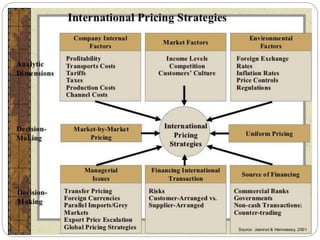
 This topic reviews the plethora of international pricing strategy issues
Pricing Objectives
 In general, price decisions are viewed in
two ways:
 Pricing as an active instrument of
accomplishing marketing objectives, or
 Pricing as a static element in a business
decision
• The more control a company has over the final selling price of a
product, the better it is able to achieve its marketing goals
• It is not always possible to control end prices
• Broader product lines and the larger the number of countries involved,
the more complex the process of controlling prices charged to the end
user
Parallel Importation or Gray Markets
 On account of competition, firms may have to charge
different prices from country to country
 In international marketing, this causes a vexing
problem: Parallel Importation or Gray Markets
 Parallel imports develop when importers buy
products from distributors in one country and sell
them in another to distributors who are not part of
the manufacturer’s regular distribution system
 The possibility of a parallel market occurs whenever
price differences are greater than the cost of
transportation between two markets
Parallel Importation or Gray Markets
 For example, the ulcer drug Losec sells for only $18 in
Spain but goes for $39 in Germany; and the heart
drug Plavix costs $55 in France and sells for $79 in
London
 Thus, it is possible for an intermediary to buy products
in countries where it is less expensive and divert it to
countries where the price is higher and make a profit
 Exclusive distribution, a practice often used by
companies to maintain high retail margins encourage
retailers to stock large assortments, or to maintain the
exclusive-quality image of a product, can create a
favorable condition for parallel importing
Effects of Parallel Importation
 Parallel imports can do long-term damage in the
market for trademarked products
 Customers who unknowingly buy unauthorized
imports have no assurance of the quality of the item
they buy, of warranty support, or of authorized service
or replacement parts
 If a product fails, the consumer blames the owner of
the trademark
 Companies can restrict the gray market by policing
distribution channels
 In some countries firms get help from the legal system
Approaches to International Pricing
1. Full-Cost Pricing: no unit of a similar product is different from any other
unit in terms of cost, which must bear its full share of the total fixed and
variable cost.
• There are several approaches to pricing in international markets, which
include:
2. Variable-Cost Pricing: firms regard foreign sales as bonus sales
and assume that any return over their variable cost makes a
contribution to net profit
• Prices are often set on a cost-plus basis, i.e., total costs plus a profit margin
• This is a practical approach to pricing when a company has high fixed costs
and unused production capacity
Approaches to International Pricing
3. Skimming Pricing: This is used to reach a segment of the market
that is relatively price insensitive and thus willing to pay a premium
price for a product
4. Penetration Pricing: This is used to stimulate market growth
and capture market share by deliberately offering products at low
prices
• It is used to acquire and hold share of market
Price Escalation
1. Costs of Exporting: the term relates to
situations in which ultimate prices are
raised by shipping costs, insurance,
packing, tariffs, longer channels of
distribution, larger middlemen margins,
special taxes, administrative costs, and
exchange rate fluctuations
• Price escalation refers to the added costs incurred as
a result of exporting products from one country to
another
There are several factors that lead to higher prices:
Price Escalation (contd ..)
2. Taxes, Tariffs, and Administrative
Costs: These costs results in higher
prices, which are generally passed on to
the buyer of the product
3. Inflation: Inflation causes consumer prices
to escalate and the consumer is faced with
rising prices that eventually exclude many
consumers from the market
Price Escalation (contd ..)
4. Middleman and Transportation
Costs: Longer channel length,
performance of marketing functions
and higher margins may make it
necessary to increase prices
5. Exchange Rate Fluctuations and
Varying Currency Values:
Currency values swing vis-à-vis
other currencies on a daily basis,
which may make it necessary to
increase prices
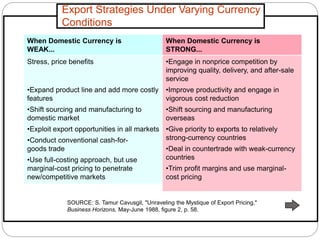
Export Strategies Under Varying Currency
Conditions
Stress, price benefits
•Expand product line and add more costly
features
•Shift sourcing and manufacturing to
domestic market
•Exploit export opportunities in all markets
•Conduct conventional cash-for-
goods trade
•Use full-costing approach, but use
marginal-cost pricing to penetrate
new/competitive markets
When Domestic Currency is
WEAK...
•Engage in nonprice competition by
improving quality, delivery, and after-sale
service
•Improve productivity and engage in
vigorous cost reduction
•Shift sourcing and manufacturing
overseas
•Give priority to exports to relatively
strong-currency countries
•Deal in countertrade with weak-currency
countries
•Trim profit margins and use marginal-
cost pricing
When Domestic Currency is
STRONG...
SOURCE: S. Tamur Cavusgil, "Unraveling the Mystique of Export Pricing,"
Business Horizons, May-June 1988, figure 2, p. 58.
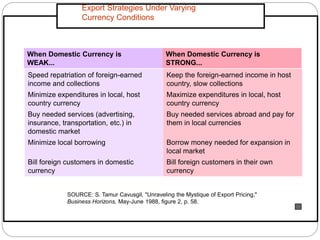
Export Strategies Under Varying
Currency Conditions
SOURCE: S. Tamur Cavusgil, "Unraveling the Mystique of Export Pricing,"
Business Horizons, May-June 1988, figure 2, p. 58.
Speed repatriation of foreign-earned
income and collections
Minimize expenditures in local, host
country currency
Buy needed services (advertising,
insurance, transportation, etc.) in
domestic market
Minimize local borrowing
Bill foreign customers in domestic
currency
Keep the foreign-earned income in host
country, slow collections
Maximize expenditures in local, host
country currency
Buy needed services abroad and pay for
them in local currencies
Borrow money needed for expansion in
local market
Bill foreign customers in their own
currency
When Domestic Currency is
WEAK...
When Domestic Currency is
STRONG...
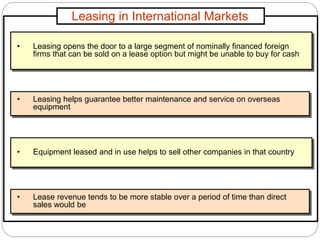
Leasing in International Markets
• Leasing opens the door to a large segment of nominally financed foreign
firms that can be sold on a lease option but might be unable to buy for cash
• Lease revenue tends to be more stable over a period of time than direct
sales would be
• Equipment leased and in use helps to sell other companies in that country
• Leasing helps guarantee better maintenance and service on overseas
equipment
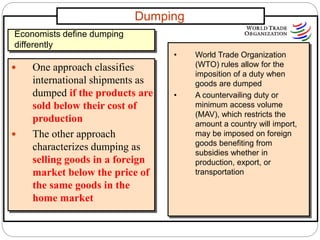
Dumping
 One approach classifies
international shipments as
dumped if the products are
sold below their cost of
production
 The other approach
characterizes dumping as
selling goods in a foreign
market below the price of
the same goods in the
home market
Economists define dumping
differently
• World Trade Organization
(WTO) rules allow for the
imposition of a duty when
goods are dumped
• A countervailing duty or
minimum access volume
(MAV), which restricts the
amount a country will import,
may be imposed on foreign
goods benefiting from
subsidies whether in
production, export, or
transportation
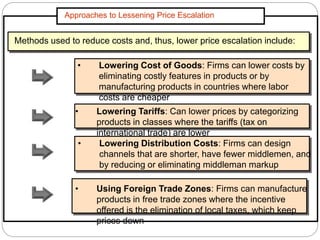
Approaches to Lessening Price Escalation
Methods used to reduce costs and, thus, lower price escalation include:
• Lowering Cost of Goods: Firms can lower costs by
eliminating costly features in products or by
manufacturing products in countries where labor
costs are cheaper
• Lowering Tariffs: Can lower prices by categorizing
products in classes where the tariffs (tax on
international trade) are lower
• Lowering Distribution Costs: Firms can design
channels that are shorter, have fewer middlemen, and
by reducing or eliminating middleman markup
• Using Foreign Trade Zones: Firms can manufacture
products in free trade zones where the incentive
offered is the elimination of local taxes, which keep
prices down
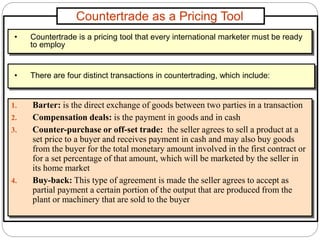
Countertrade as a Pricing Tool
1. Barter: is the direct exchange of goods between two parties in a transaction
2. Compensation deals: is the payment in goods and in cash
3. Counter-purchase or off-set trade: the seller agrees to sell a product at a
set price to a buyer and receives payment in cash and may also buy goods
from the buyer for the total monetary amount involved in the first contract or
for a set percentage of that amount, which will be marketed by the seller in
its home market
4. Buy-back: This type of agreement is made the seller agrees to accept as
partial payment a certain portion of the output that are produced from the
plant or machinery that are sold to the buyer
• Countertrade is a pricing tool that every international marketer must be ready
to employ
• There are four distinct transactions in countertrading, which include:
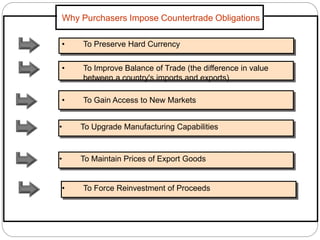
Why Purchasers Impose Countertrade Obligations
• To Preserve Hard Currency
• To Improve Balance of Trade (the difference in value
between a country's imports and exports)
• To Gain Access to New Markets
• To Upgrade Manufacturing Capabilities
• To Maintain Prices of Export Goods
• To Force Reinvestment of Proceeds
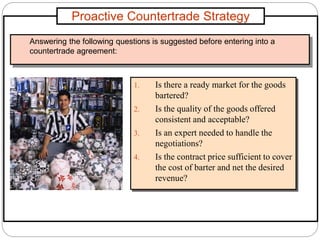
Proactive Countertrade Strategy
1. Is there a ready market for the goods
bartered?
2. Is the quality of the goods offered
consistent and acceptable?
3. Is an expert needed to handle the
negotiations?
4. Is the contract price sufficient to cover
the cost of barter and net the desired
revenue?
Answering the following questions is suggested before entering into a
countertrade agreement:
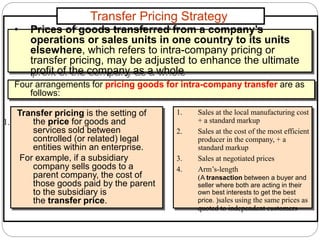
Transfer Pricing Strategy
1. Sales at the local manufacturing cost
+ a standard markup
2. Sales at the cost of the most efficient
producer in the company, + a
standard markup
3. Sales at negotiated prices
4. Arm’s-length
(A transaction between a buyer and
seller where both are acting in their
own best interests to get the best
price. )sales using the same prices as
quoted to independent customers
• Prices of goods transferred from a company’s
operations or sales units in one country to its units
elsewhere, which refers to intra-company pricing or
transfer pricing, may be adjusted to enhance the ultimate
profit of the company as a whole
Four arrangements for pricing goods for intra-company transfer are as
follows:
1.
Transfer pricing is the setting of
the price for goods and
services sold between
controlled (or related) legal
entities within an enterprise.
For example, if a subsidiary
company sells goods to a
parent company, the cost of
those goods paid by the parent
to the subsidiary is
the transfer price.
international pricing decisions

international pricing decisions

  • 1.
  • 2.
    Learning Objectives 1. Componentsof pricing as competitive tools in international marketing 2. The pricing pitfalls directly related to international marketing 3. How to control pricing in parallel imports or gray markets
  • 3.
    Chapter Learning Objectives 4.Price escalation and how to minimize its effect 5. Countertrading and its place in international marketing practice 6. The mechanics of price quotations
  • 4.
    Introduction  Pricing strategyforms another cornerstone of a global marketing program–it represents one of the most critical and complex issues in global marketing (due to economic, financial, and mathematical implications)  Price is the only marketing mix element that generates revenues. All other elements entail costs  Need to devote special care in pricing products to market products at a profit  A company’s global pricing policy may make or break its overseas expansion efforts (due to foreign exchange complications)  Firms also face significant challenges in coordinating (standardizing or adapting) their pricing strategies across various countries they operate in  This topic reviews the plethora of international pricing strategy issues
  • 5.
    Pricing Objectives  Ingeneral, price decisions are viewed in two ways:  Pricing as an active instrument of accomplishing marketing objectives, or  Pricing as a static element in a business decision • The more control a company has over the final selling price of a product, the better it is able to achieve its marketing goals • It is not always possible to control end prices • Broader product lines and the larger the number of countries involved, the more complex the process of controlling prices charged to the end user
  • 6.
    Parallel Importation orGray Markets  On account of competition, firms may have to charge different prices from country to country  In international marketing, this causes a vexing problem: Parallel Importation or Gray Markets  Parallel imports develop when importers buy products from distributors in one country and sell them in another to distributors who are not part of the manufacturer’s regular distribution system  The possibility of a parallel market occurs whenever price differences are greater than the cost of transportation between two markets
  • 7.
    Parallel Importation orGray Markets  For example, the ulcer drug Losec sells for only $18 in Spain but goes for $39 in Germany; and the heart drug Plavix costs $55 in France and sells for $79 in London  Thus, it is possible for an intermediary to buy products in countries where it is less expensive and divert it to countries where the price is higher and make a profit  Exclusive distribution, a practice often used by companies to maintain high retail margins encourage retailers to stock large assortments, or to maintain the exclusive-quality image of a product, can create a favorable condition for parallel importing
  • 8.
    Effects of ParallelImportation  Parallel imports can do long-term damage in the market for trademarked products  Customers who unknowingly buy unauthorized imports have no assurance of the quality of the item they buy, of warranty support, or of authorized service or replacement parts  If a product fails, the consumer blames the owner of the trademark  Companies can restrict the gray market by policing distribution channels  In some countries firms get help from the legal system
  • 9.
    Approaches to InternationalPricing 1. Full-Cost Pricing: no unit of a similar product is different from any other unit in terms of cost, which must bear its full share of the total fixed and variable cost. • There are several approaches to pricing in international markets, which include: 2. Variable-Cost Pricing: firms regard foreign sales as bonus sales and assume that any return over their variable cost makes a contribution to net profit • Prices are often set on a cost-plus basis, i.e., total costs plus a profit margin • This is a practical approach to pricing when a company has high fixed costs and unused production capacity
  • 10.
    Approaches to InternationalPricing 3. Skimming Pricing: This is used to reach a segment of the market that is relatively price insensitive and thus willing to pay a premium price for a product 4. Penetration Pricing: This is used to stimulate market growth and capture market share by deliberately offering products at low prices • It is used to acquire and hold share of market
  • 11.
    Price Escalation 1. Costsof Exporting: the term relates to situations in which ultimate prices are raised by shipping costs, insurance, packing, tariffs, longer channels of distribution, larger middlemen margins, special taxes, administrative costs, and exchange rate fluctuations • Price escalation refers to the added costs incurred as a result of exporting products from one country to another There are several factors that lead to higher prices:
  • 12.
    Price Escalation (contd..) 2. Taxes, Tariffs, and Administrative Costs: These costs results in higher prices, which are generally passed on to the buyer of the product 3. Inflation: Inflation causes consumer prices to escalate and the consumer is faced with rising prices that eventually exclude many consumers from the market
  • 13.
    Price Escalation (contd..) 4. Middleman and Transportation Costs: Longer channel length, performance of marketing functions and higher margins may make it necessary to increase prices 5. Exchange Rate Fluctuations and Varying Currency Values: Currency values swing vis-à-vis other currencies on a daily basis, which may make it necessary to increase prices
  • 14.
    Export Strategies UnderVarying Currency Conditions Stress, price benefits •Expand product line and add more costly features •Shift sourcing and manufacturing to domestic market •Exploit export opportunities in all markets •Conduct conventional cash-for- goods trade •Use full-costing approach, but use marginal-cost pricing to penetrate new/competitive markets When Domestic Currency is WEAK... •Engage in nonprice competition by improving quality, delivery, and after-sale service •Improve productivity and engage in vigorous cost reduction •Shift sourcing and manufacturing overseas •Give priority to exports to relatively strong-currency countries •Deal in countertrade with weak-currency countries •Trim profit margins and use marginal- cost pricing When Domestic Currency is STRONG... SOURCE: S. Tamur Cavusgil, "Unraveling the Mystique of Export Pricing," Business Horizons, May-June 1988, figure 2, p. 58.
  • 15.
    Export Strategies UnderVarying Currency Conditions SOURCE: S. Tamur Cavusgil, "Unraveling the Mystique of Export Pricing," Business Horizons, May-June 1988, figure 2, p. 58. Speed repatriation of foreign-earned income and collections Minimize expenditures in local, host country currency Buy needed services (advertising, insurance, transportation, etc.) in domestic market Minimize local borrowing Bill foreign customers in domestic currency Keep the foreign-earned income in host country, slow collections Maximize expenditures in local, host country currency Buy needed services abroad and pay for them in local currencies Borrow money needed for expansion in local market Bill foreign customers in their own currency When Domestic Currency is WEAK... When Domestic Currency is STRONG...
  • 18.
    Leasing in InternationalMarkets • Leasing opens the door to a large segment of nominally financed foreign firms that can be sold on a lease option but might be unable to buy for cash • Lease revenue tends to be more stable over a period of time than direct sales would be • Equipment leased and in use helps to sell other companies in that country • Leasing helps guarantee better maintenance and service on overseas equipment
  • 19.
    Dumping  One approachclassifies international shipments as dumped if the products are sold below their cost of production  The other approach characterizes dumping as selling goods in a foreign market below the price of the same goods in the home market Economists define dumping differently • World Trade Organization (WTO) rules allow for the imposition of a duty when goods are dumped • A countervailing duty or minimum access volume (MAV), which restricts the amount a country will import, may be imposed on foreign goods benefiting from subsidies whether in production, export, or transportation
  • 20.
    Approaches to LesseningPrice Escalation Methods used to reduce costs and, thus, lower price escalation include: • Lowering Cost of Goods: Firms can lower costs by eliminating costly features in products or by manufacturing products in countries where labor costs are cheaper • Lowering Tariffs: Can lower prices by categorizing products in classes where the tariffs (tax on international trade) are lower • Lowering Distribution Costs: Firms can design channels that are shorter, have fewer middlemen, and by reducing or eliminating middleman markup • Using Foreign Trade Zones: Firms can manufacture products in free trade zones where the incentive offered is the elimination of local taxes, which keep prices down
  • 21.
    Countertrade as aPricing Tool 1. Barter: is the direct exchange of goods between two parties in a transaction 2. Compensation deals: is the payment in goods and in cash 3. Counter-purchase or off-set trade: the seller agrees to sell a product at a set price to a buyer and receives payment in cash and may also buy goods from the buyer for the total monetary amount involved in the first contract or for a set percentage of that amount, which will be marketed by the seller in its home market 4. Buy-back: This type of agreement is made the seller agrees to accept as partial payment a certain portion of the output that are produced from the plant or machinery that are sold to the buyer • Countertrade is a pricing tool that every international marketer must be ready to employ • There are four distinct transactions in countertrading, which include:
  • 22.
    Why Purchasers ImposeCountertrade Obligations • To Preserve Hard Currency • To Improve Balance of Trade (the difference in value between a country's imports and exports) • To Gain Access to New Markets • To Upgrade Manufacturing Capabilities • To Maintain Prices of Export Goods • To Force Reinvestment of Proceeds
  • 23.
    Proactive Countertrade Strategy 1.Is there a ready market for the goods bartered? 2. Is the quality of the goods offered consistent and acceptable? 3. Is an expert needed to handle the negotiations? 4. Is the contract price sufficient to cover the cost of barter and net the desired revenue? Answering the following questions is suggested before entering into a countertrade agreement:
  • 24.
    Transfer Pricing Strategy 1.Sales at the local manufacturing cost + a standard markup 2. Sales at the cost of the most efficient producer in the company, + a standard markup 3. Sales at negotiated prices 4. Arm’s-length (A transaction between a buyer and seller where both are acting in their own best interests to get the best price. )sales using the same prices as quoted to independent customers • Prices of goods transferred from a company’s operations or sales units in one country to its units elsewhere, which refers to intra-company pricing or transfer pricing, may be adjusted to enhance the ultimate profit of the company as a whole Four arrangements for pricing goods for intra-company transfer are as follows: 1. Transfer pricing is the setting of the price for goods and services sold between controlled (or related) legal entities within an enterprise. For example, if a subsidiary company sells goods to a parent company, the cost of those goods paid by the parent to the subsidiary is the transfer price.