1   Industry & Competitor Analysis
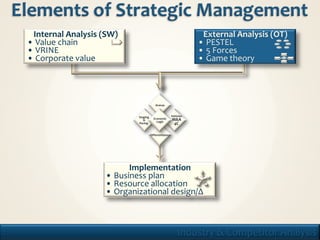
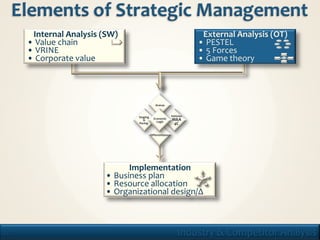
Internal Analysis (SW)                                            External Analysis (OT)
    • Value chain                                                     • PESTEL
    • VRINE                                                           • 5 Forces
    • Corporate value                                                 • Game theory


                                            Arenas


                               Staging                     Vehicles
                                  &        Economic        M&A
                                             Logic
                               Pacing                       4C

                                         Differentiators


                             Implementation
                       • Business plan
                                                                                           Strategy


                                                                      People                                      Structure


                       • Resource allocation
                                                                                         Symbols


                                                                               Rewards                Processes


                       • Organizational design/∆


2                                                              Industry & Competitor Analysis
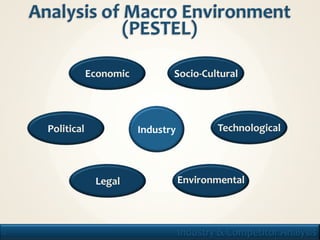
 PESTEL framework for analyzing the macro
      environment (beyond the industry).
     Industry Analysis: What determines the
      overall profitability of an industry?
       How will it change over time?
       How can firms use this information to formulate
        strategy?
     Competitor analysis & game theory. How do
      we predict our rivals actions?


3                                 Industry & Competitor Analysis
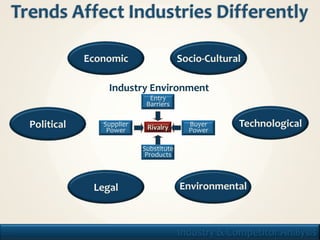
Economic          Socio-Cultural


    Political              Industry           Technological


                 Legal                Environmental


4                                     Industry & Competitor Analysis
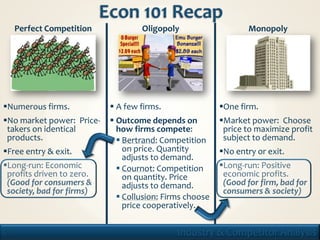
Perfect Competition            Oligopoly                     Monopoly


Numerous firms.            A few firms.                One firm.
No market power: Price-    Outcome depends on          Market power: Choose
 takers on identical         how firms compete:           price to maximize profit
 products.                    Bertrand: Competition      subject to demand.
Free entry & exit.            on price. Quantity        No entry or exit.
                               adjusts to demand.
Long-run: Economic           Cournot: Competition      Long-run: Positive
 profits driven to zero.       on quantity. Price         economic profits.
 (Good for consumers &         adjusts to demand.         (Good for firm, bad for
 society, bad for firms)                                  consumers & society)
                              Collusion: Firms choose
                               price cooperatively.


6                                            Industry & Competitor Analysis
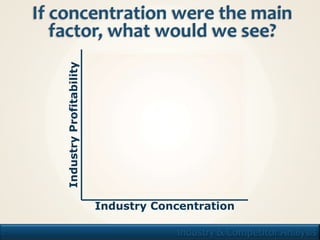
Industry Profitability


                             Industry Concentration

7                                        Industry & Competitor Analysis
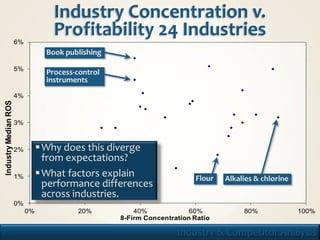
Industry Concentration v.
                      6%
                                    Profitability 24 Industries
                                  Book publishing

                      5%
                                  Process-control
                                  instruments
                      4%
Industry Median ROS


                      3%


                      2%         Why does this diverge
                                  from expectations?
                      1%         What factors explain                   Flour   Alkalies & chlorine
                                  performance differences
                                  across industries.
                      0%
                           0%             20%           40%             60%           80%              100%
                                                    8-Firm Concentration Ratio

8                                                                   Industry & Competitor Analysis
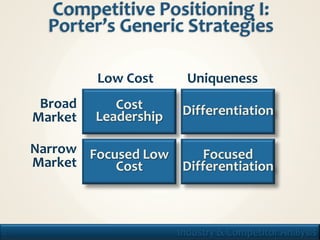
Low Cost       Uniqueness
     Broad      Cost       Differentiation
    Market   Leadership

    Narrow Focused Low     Focused
    Market     Cost    Differentiation


9                         Industry & Competitor Analysis
Economic                   Socio-Cultural

                     Industry Environment
                                 Entry
                                Barriers


     Political      Supplier    Rivalry       Buyer      Technological
                     Power                    Power

                               Substitute
                                Products


                  Legal                     Environmental


10                                          Industry & Competitor Analysis
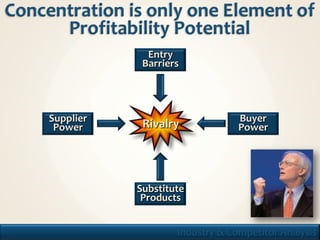
Entry
                 Barriers


     Supplier                        Buyer
      Power      Rivalry             Power


                Substitute
                 Products


11                      Industry & Competitor Analysis
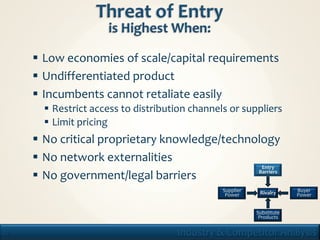
 Low economies of scale/capital requirements
      Undifferentiated product
      Incumbents cannot retaliate easily
        Restrict access to distribution channels or suppliers
        Limit pricing
      No critical proprietary knowledge/technology
      No network externalities
                                                Entry
      No government/legal barriers            Barriers


                                                Supplier    Rivalry     Buyer
                                                 Power                  Power


                                                           Substitute
                                                            Products


12                                   Industry & Competitor Analysis
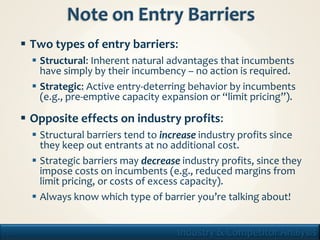
 Two types of entry barriers:
        Structural: Inherent natural advantages that incumbents
         have simply by their incumbency – no action is required.
        Strategic: Active entry-deterring behavior by incumbents
         (e.g., pre-emptive capacity expansion or “limit pricing”).

      Opposite effects on industry profits:
        Structural barriers tend to increase industry profits since
         they keep out entrants at no additional cost.
        Strategic barriers may decrease industry profits, since they
         impose costs on incumbents (e.g., reduced margins from
         limit pricing, or costs of excess capacity).
        Always know which type of barrier you’re talking about!


13                                      Industry & Competitor Analysis
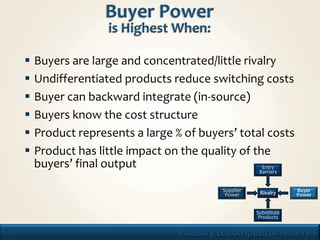
   Buyers are large and concentrated/little rivalry
        Undifferentiated products reduce switching costs
        Buyer can backward integrate (in-source)
        Buyers know the cost structure
        Product represents a large % of buyers’ total costs
        Product has little impact on the quality of the
         buyers’ final output                          Entry
                                                      Barriers


                                               Supplier    Rivalry     Buyer
                                                Power                  Power


                                                          Substitute
                                                           Products


14                                    Industry & Competitor Analysis
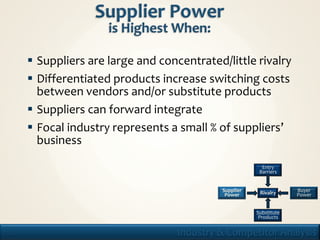
 Suppliers are large and concentrated/little rivalry
      Differentiated products increase switching costs
       between vendors and/or substitute products
      Suppliers can forward integrate
      Focal industry represents a small % of suppliers’
       business

                                                         Entry
                                                        Barriers


                                            Supplier    Rivalry     Buyer
                                             Power                  Power


                                                       Substitute
                                                        Products


15                                 Industry & Competitor Analysis
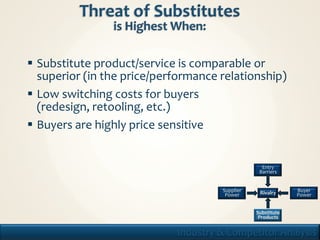
 Substitute product/service is comparable or
       superior (in the price/performance relationship)
      Low switching costs for buyers
       (redesign, retooling, etc.)
      Buyers are highly price sensitive


                                                       Entry
                                                      Barriers


                                          Supplier    Rivalry     Buyer
                                           Power                  Power


                                                     Substitute
                                                      Products


16                               Industry & Competitor Analysis
17   Industry & Competitor Analysis
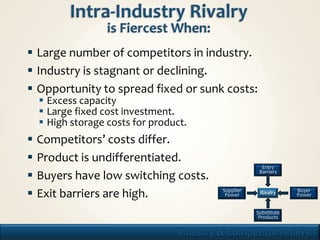
 Large number of competitors in industry.
      Industry is stagnant or declining.
      Opportunity to spread fixed or sunk costs:
          Excess capacity
          Large fixed cost investment.
          High storage costs for product.
        Competitors’ costs differ.
        Product is undifferentiated.
                                                             Entry
        Buyers have low switching costs.                   Barriers


        Exit barriers are high.                Supplier
                                                 Power      Rivalry     Buyer
                                                                        Power


                                                           Substitute
                                                            Products


18                                     Industry & Competitor Analysis
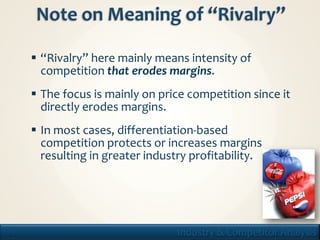
 “Rivalry” here mainly means intensity of
       competition that erodes margins.
      The focus is mainly on price competition since it
       directly erodes margins.
      In most cases, differentiation-based
       competition protects or increases margins
       resulting in greater industry profitability.


19                                Industry & Competitor Analysis
 Market entry/exit based on forecasts of prices,
       costs, & profits.
      Positioning: Find ways to mitigate the greatest
       threats among the 5 forces (supply chain,
       switching costs, entry barriers, etc.)
      Industry evolution: Anticipate & prepare for
       changes in the 5 forces.
      Industry transformation: Find ways to change
       the 5 forces to your advantage (new business
       models, etc.).


20                               Industry & Competitor Analysis
 PESTEL framework for analyzing the macro
       environment (beyond the industry).
      Industry Analysis: What determines the
       overall profitability of an industry?
        How will it change over time?
        How can firms use this information to formulate
         strategy?
      Competitor analysis & game theory. How do
       we predict our rivals actions?


22                                 Industry & Competitor Analysis
23   Industry & Competitor Analysis
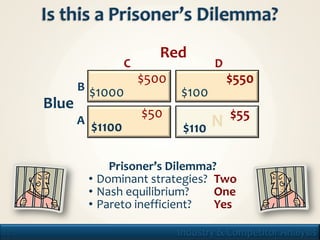
Red
                        C                  D
                            $500               $550
            B $1000                $100
     Blue
                            $50                $55
            A
                $1100               $110   N

                    Prisoner’s Dilemma?
                • Dominant strategies? Two
                • Nash equilibrium?    One
                • Pareto inefficient?  Yes

24                                 Industry & Competitor Analysis
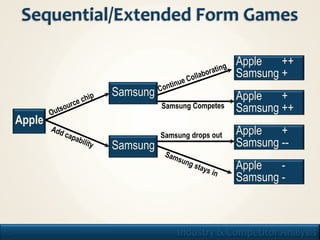
Apple   100
                                           ++
                                   Samsung +50
             Samsung               Apple   + 50
                                   Samsung ++75
     Apple
                                   Apple   + 50
             Samsung               Samsung ---50
                                   Apple   - 25
                                   Samsung - -25


25                     Industry & Competitor Analysis
26   Industry & Competitor Analysis
Awareness
      of Rival


     Motivation       Rival’s
     /Perceived      Response
       Threat      (e.g., lag, order,
                     magnitude)


     Ability to
     Respond


27                Industry & Competitor Analysis
IsResource
       firm in same
       Similarity
         league?
                      Awareness
                       of Rival
       Market
      Do the mkts
     Commonality
       overlap?
                      Motivation            Rival’s
                      /Perceived           Response
                        Threat           (e.g., lag, order,
           Rival
     Is firm viewed                        magnitude)
       Cognition
       as a threat?


      Resource        Ability to
      Strength        Respond


28                        Industry & Competitor Analysis
Internal Analysis (SW)                                            External Analysis (OT)
     • Value chain                                                     • PESTEL
     • VRINE                                                           • 5 Forces
     • Corporate value                                                 • Game theory


                                             Arenas


                                Staging                     Vehicles
                                   &        Economic        M&A
                                              Logic
                                Pacing                       4C

                                          Differentiators


                              Implementation
                        • Business plan
                                                                                            Strategy


                                                                       People                                      Structure


                        • Resource allocation
                                                                                          Symbols


                                                                                Rewards                Processes


                        • Organizational design/∆


30                                                              Industry & Competitor Analysis

Ii 1 externalanalysistools

  • 1.
    1 Industry & Competitor Analysis
  • 2.
    Internal Analysis (SW) External Analysis (OT) • Value chain • PESTEL • VRINE • 5 Forces • Corporate value • Game theory Arenas Staging Vehicles & Economic M&A Logic Pacing 4C Differentiators Implementation • Business plan Strategy People Structure • Resource allocation Symbols Rewards Processes • Organizational design/∆ 2 Industry & Competitor Analysis
  • 3.
     PESTEL frameworkfor analyzing the macro environment (beyond the industry).  Industry Analysis: What determines the overall profitability of an industry?  How will it change over time?  How can firms use this information to formulate strategy?  Competitor analysis & game theory. How do we predict our rivals actions? 3 Industry & Competitor Analysis
  • 4.
    Economic Socio-Cultural Political Industry Technological Legal Environmental 4 Industry & Competitor Analysis
  • 5.
    Perfect Competition Oligopoly Monopoly Numerous firms.  A few firms. One firm. No market power: Price-  Outcome depends on Market power: Choose takers on identical how firms compete: price to maximize profit products.  Bertrand: Competition subject to demand. Free entry & exit. on price. Quantity No entry or exit. adjusts to demand. Long-run: Economic  Cournot: Competition Long-run: Positive profits driven to zero. on quantity. Price economic profits. (Good for consumers & adjusts to demand. (Good for firm, bad for society, bad for firms) consumers & society)  Collusion: Firms choose price cooperatively. 6 Industry & Competitor Analysis
  • 6.
    Industry Profitability Industry Concentration 7 Industry & Competitor Analysis
  • 7.
    Industry Concentration v. 6% Profitability 24 Industries Book publishing 5% Process-control instruments 4% Industry Median ROS 3% 2%  Why does this diverge from expectations? 1%  What factors explain Flour Alkalies & chlorine performance differences across industries. 0% 0% 20% 40% 60% 80% 100% 8-Firm Concentration Ratio 8 Industry & Competitor Analysis
  • 8.
    Low Cost Uniqueness Broad Cost Differentiation Market Leadership Narrow Focused Low Focused Market Cost Differentiation 9 Industry & Competitor Analysis
  • 9.
    Economic Socio-Cultural Industry Environment Entry Barriers Political Supplier Rivalry Buyer Technological Power Power Substitute Products Legal Environmental 10 Industry & Competitor Analysis
  • 10.
    Entry Barriers Supplier Buyer Power Rivalry Power Substitute Products 11 Industry & Competitor Analysis
  • 11.
     Low economiesof scale/capital requirements  Undifferentiated product  Incumbents cannot retaliate easily  Restrict access to distribution channels or suppliers  Limit pricing  No critical proprietary knowledge/technology  No network externalities Entry  No government/legal barriers Barriers Supplier Rivalry Buyer Power Power Substitute Products 12 Industry & Competitor Analysis
  • 12.
     Two typesof entry barriers:  Structural: Inherent natural advantages that incumbents have simply by their incumbency – no action is required.  Strategic: Active entry-deterring behavior by incumbents (e.g., pre-emptive capacity expansion or “limit pricing”).  Opposite effects on industry profits:  Structural barriers tend to increase industry profits since they keep out entrants at no additional cost.  Strategic barriers may decrease industry profits, since they impose costs on incumbents (e.g., reduced margins from limit pricing, or costs of excess capacity).  Always know which type of barrier you’re talking about! 13 Industry & Competitor Analysis
  • 13.
    Buyers are large and concentrated/little rivalry  Undifferentiated products reduce switching costs  Buyer can backward integrate (in-source)  Buyers know the cost structure  Product represents a large % of buyers’ total costs  Product has little impact on the quality of the buyers’ final output Entry Barriers Supplier Rivalry Buyer Power Power Substitute Products 14 Industry & Competitor Analysis
  • 14.
     Suppliers arelarge and concentrated/little rivalry  Differentiated products increase switching costs between vendors and/or substitute products  Suppliers can forward integrate  Focal industry represents a small % of suppliers’ business Entry Barriers Supplier Rivalry Buyer Power Power Substitute Products 15 Industry & Competitor Analysis
  • 15.
     Substitute product/serviceis comparable or superior (in the price/performance relationship)  Low switching costs for buyers (redesign, retooling, etc.)  Buyers are highly price sensitive Entry Barriers Supplier Rivalry Buyer Power Power Substitute Products 16 Industry & Competitor Analysis
  • 16.
    17 Industry & Competitor Analysis
  • 17.
     Large numberof competitors in industry.  Industry is stagnant or declining.  Opportunity to spread fixed or sunk costs:  Excess capacity  Large fixed cost investment.  High storage costs for product.  Competitors’ costs differ.  Product is undifferentiated. Entry  Buyers have low switching costs. Barriers  Exit barriers are high. Supplier Power Rivalry Buyer Power Substitute Products 18 Industry & Competitor Analysis
  • 18.
     “Rivalry” heremainly means intensity of competition that erodes margins.  The focus is mainly on price competition since it directly erodes margins.  In most cases, differentiation-based competition protects or increases margins resulting in greater industry profitability. 19 Industry & Competitor Analysis
  • 19.
     Market entry/exitbased on forecasts of prices, costs, & profits.  Positioning: Find ways to mitigate the greatest threats among the 5 forces (supply chain, switching costs, entry barriers, etc.)  Industry evolution: Anticipate & prepare for changes in the 5 forces.  Industry transformation: Find ways to change the 5 forces to your advantage (new business models, etc.). 20 Industry & Competitor Analysis
  • 20.
     PESTEL frameworkfor analyzing the macro environment (beyond the industry).  Industry Analysis: What determines the overall profitability of an industry?  How will it change over time?  How can firms use this information to formulate strategy?  Competitor analysis & game theory. How do we predict our rivals actions? 22 Industry & Competitor Analysis
  • 21.
    23 Industry & Competitor Analysis
  • 22.
    Red C D $500 $550 B $1000 $100 Blue $50 $55 A $1100 $110 N Prisoner’s Dilemma? • Dominant strategies? Two • Nash equilibrium? One • Pareto inefficient? Yes 24 Industry & Competitor Analysis
  • 23.
    Apple 100 ++ Samsung +50 Samsung Apple + 50 Samsung ++75 Apple Apple + 50 Samsung Samsung ---50 Apple - 25 Samsung - -25 25 Industry & Competitor Analysis
  • 24.
    26 Industry & Competitor Analysis
  • 25.
    Awareness of Rival Motivation Rival’s /Perceived Response Threat (e.g., lag, order, magnitude) Ability to Respond 27 Industry & Competitor Analysis
  • 26.
    IsResource firm in same Similarity league? Awareness of Rival Market Do the mkts Commonality overlap? Motivation Rival’s /Perceived Response Threat (e.g., lag, order, Rival Is firm viewed magnitude) Cognition as a threat? Resource Ability to Strength Respond 28 Industry & Competitor Analysis
  • 27.
    Internal Analysis (SW) External Analysis (OT) • Value chain • PESTEL • VRINE • 5 Forces • Corporate value • Game theory Arenas Staging Vehicles & Economic M&A Logic Pacing 4C Differentiators Implementation • Business plan Strategy People Structure • Resource allocation Symbols Rewards Processes • Organizational design/∆ 30 Industry & Competitor Analysis