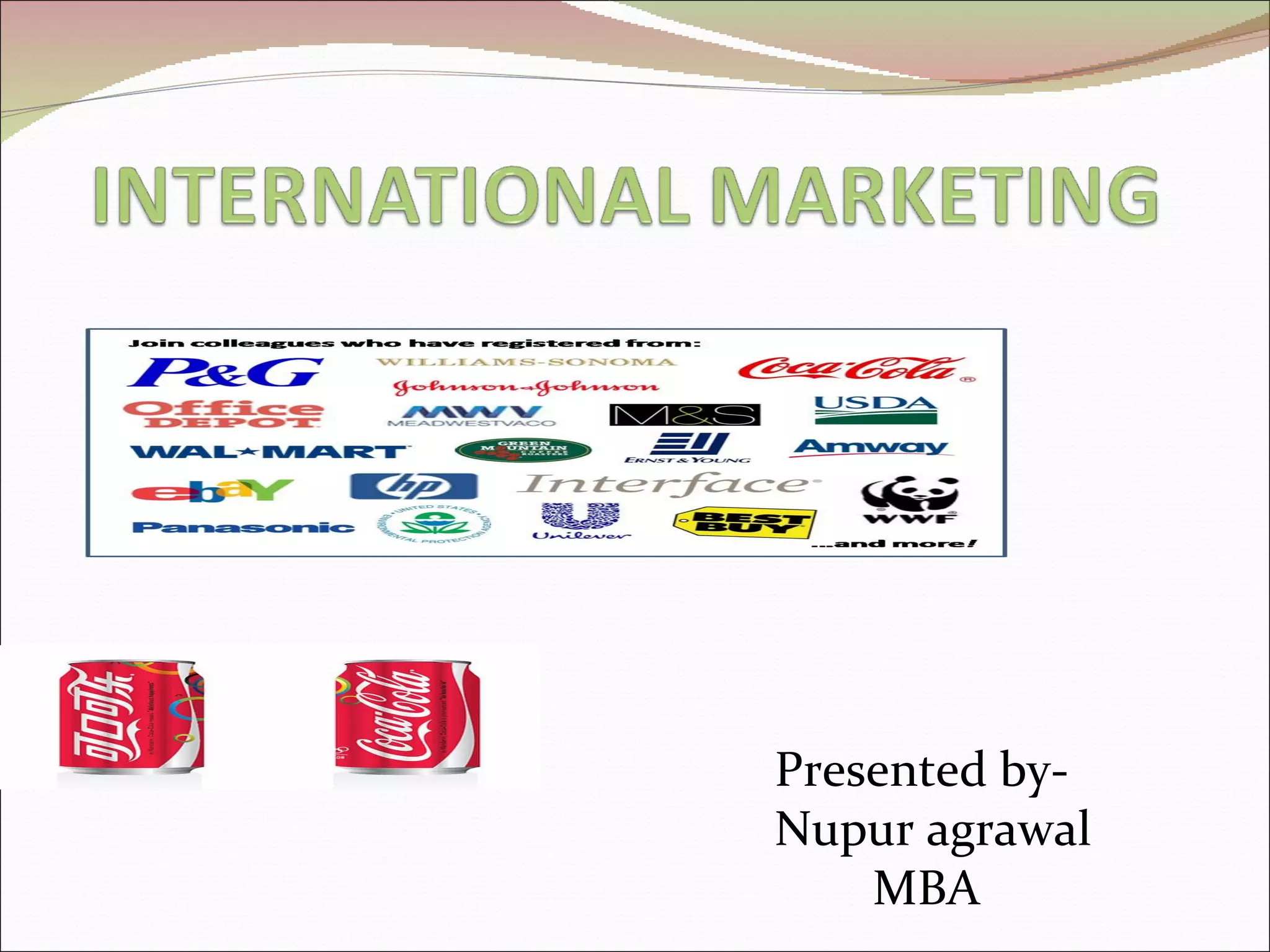

Presented by- Nupur agrawal MBA
 
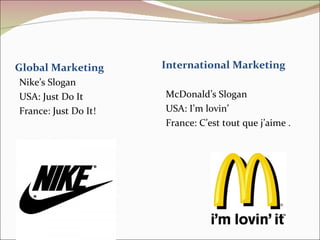
Global Marketing International Marketing Nike’s Slogan USA: Just Do It France: Just Do It! McDonald’s Slogan USA: I’m lovin’ France: C’est tout que j’aime .
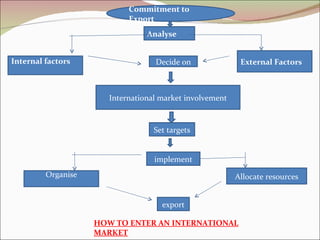
Commitment to Export Analyse Internal factors External Factors Decide on International market involvement Set targets implement Organise Allocate resources export HOW TO ENTER AN INTERNATIONAL MARKET
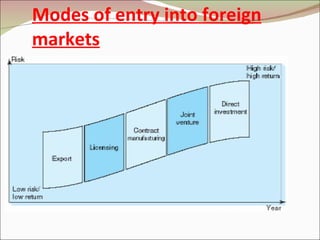
Modes of entry into foreign markets
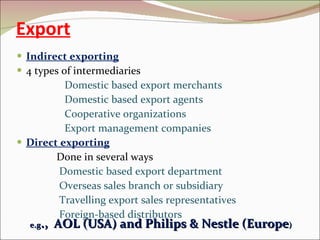
Export Indirect exporting 4 types of intermediaries Domestic based export merchants Domestic based export agents Cooperative organizations Export management companies Direct exporting Done in several ways Domestic based export department Overseas sales branch or subsidiary Travelling export sales representatives Foreign-based distributors e.g .,  AOL (USA) and Philips & Nestle (Europe )
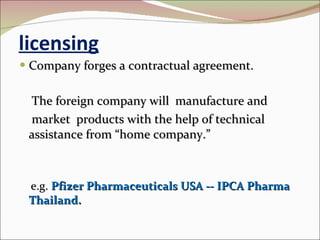
licensing Company forges a contractual agreement. The foreign company will  manufacture and  market  products with the help of technical assistance from “home company.” e.g.  Pfizer Pharmaceuticals USA -- IPCA Pharma Thailand.
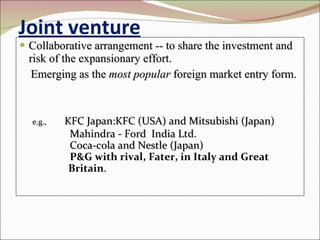
Joint venture Collaborative arrangement -- to share the investment and risk of the expansionary effort. Emerging as the  most popular  foreign market entry form. e.g., KFC Japan:KFC (USA) and Mitsubishi (Japan) Mahindra - Ford  India Ltd. Coca-cola and Nestle (Japan) P&G with rival, Fater, in Italy and Great  Britain .
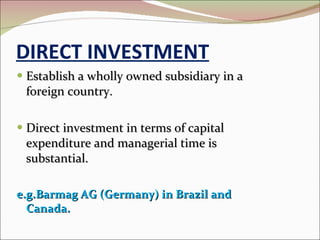
DIRECT INVESTMENT Establish a wholly owned subsidiary in a foreign country. Direct investment in terms of capital expenditure and managerial time is substantial. e.g.Barmag AG (Germany) in Brazil and Canada.
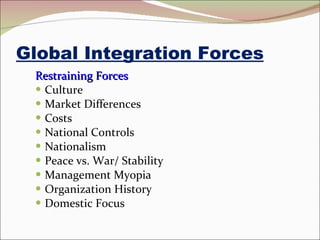
Global Integration Forces Restraining Forces Culture Market Differences Costs National Controls Nationalism Peace vs. War/ Stability Management Myopia Organization History Domestic Focus
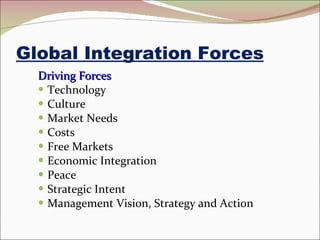
Global Integration Forces Driving Forces Technology Culture Market Needs Costs Free Markets Economic Integration Peace Strategic Intent Management Vision, Strategy and Action
Self-Reference Criterion The Self-Reference Criterion (SRC) is when you as the marketer unconsciously expect that everyone is like you. You expect that they have: The same cultural values Experiences Knowledge
Ethnocentrism This is the idea that things done in your culture is the correct or best way of doing things. You tend not to look through the eyes of the foreign consumer.
The Problem with SRC and Ethnocentrism Letting these two issues cloud your judgment can cause you to not understand the other culture. This in turn will make it so you cannot provide the product that the consumer wants.
MARKETING MIX-PRODUCT Product Types •  Buyer orientation –  Amount of effort expended on purchase –  Convenience –  Preference –  Shopping –  Specialty
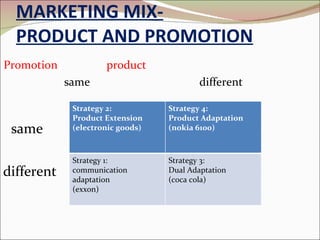
MARKETING MIX- PRODUCT AND PROMOTION Promotion  product same  different same different Strategy 2: Product Extension (electronic goods) Strategy 4: Product Adaptation (nokia 6100) Strategy 1: communication adaptation (exxon) Strategy 3: Dual Adaptation (coca cola)
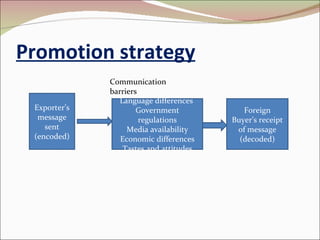
Promotion strategy Exporter’s message sent (encoded) Language differences  Government regulations Media availability Economic differences Tastes and attitudes Foreign Buyer’s receipt of message (decoded) Communication barriers
PRICE Setting an uniform price everywhere. Setting a market based price in each country. Setting a cost based price in each country. Transfer price. Gray market. Internet.
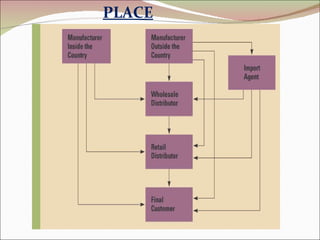
PLACE
International Marketing is simply marketing to people or companies outside of your own domestic market . CONCLUSION
Thanks

International marketing

  • 1.
  • 2.
  • 3.
    Global Marketing InternationalMarketing Nike’s Slogan USA: Just Do It France: Just Do It! McDonald’s Slogan USA: I’m lovin’ France: C’est tout que j’aime .
  • 4.
    Commitment to ExportAnalyse Internal factors External Factors Decide on International market involvement Set targets implement Organise Allocate resources export HOW TO ENTER AN INTERNATIONAL MARKET
  • 5.
    Modes of entryinto foreign markets
  • 6.
    Export Indirect exporting4 types of intermediaries Domestic based export merchants Domestic based export agents Cooperative organizations Export management companies Direct exporting Done in several ways Domestic based export department Overseas sales branch or subsidiary Travelling export sales representatives Foreign-based distributors e.g ., AOL (USA) and Philips & Nestle (Europe )
  • 7.
    licensing Company forgesa contractual agreement. The foreign company will manufacture and market products with the help of technical assistance from “home company.” e.g. Pfizer Pharmaceuticals USA -- IPCA Pharma Thailand.
  • 8.
    Joint venture Collaborativearrangement -- to share the investment and risk of the expansionary effort. Emerging as the most popular foreign market entry form. e.g., KFC Japan:KFC (USA) and Mitsubishi (Japan) Mahindra - Ford India Ltd. Coca-cola and Nestle (Japan) P&G with rival, Fater, in Italy and Great Britain .
  • 9.
    DIRECT INVESTMENT Establisha wholly owned subsidiary in a foreign country. Direct investment in terms of capital expenditure and managerial time is substantial. e.g.Barmag AG (Germany) in Brazil and Canada.
  • 10.
    Global Integration ForcesRestraining Forces Culture Market Differences Costs National Controls Nationalism Peace vs. War/ Stability Management Myopia Organization History Domestic Focus
  • 11.
    Global Integration ForcesDriving Forces Technology Culture Market Needs Costs Free Markets Economic Integration Peace Strategic Intent Management Vision, Strategy and Action
  • 12.
    Self-Reference Criterion TheSelf-Reference Criterion (SRC) is when you as the marketer unconsciously expect that everyone is like you. You expect that they have: The same cultural values Experiences Knowledge
  • 13.
    Ethnocentrism This isthe idea that things done in your culture is the correct or best way of doing things. You tend not to look through the eyes of the foreign consumer.
  • 14.
    The Problem withSRC and Ethnocentrism Letting these two issues cloud your judgment can cause you to not understand the other culture. This in turn will make it so you cannot provide the product that the consumer wants.
  • 15.
    MARKETING MIX-PRODUCT ProductTypes • Buyer orientation – Amount of effort expended on purchase – Convenience – Preference – Shopping – Specialty
  • 16.
    MARKETING MIX- PRODUCTAND PROMOTION Promotion product same different same different Strategy 2: Product Extension (electronic goods) Strategy 4: Product Adaptation (nokia 6100) Strategy 1: communication adaptation (exxon) Strategy 3: Dual Adaptation (coca cola)
  • 17.
    Promotion strategy Exporter’smessage sent (encoded) Language differences Government regulations Media availability Economic differences Tastes and attitudes Foreign Buyer’s receipt of message (decoded) Communication barriers
  • 18.
    PRICE Setting anuniform price everywhere. Setting a market based price in each country. Setting a cost based price in each country. Transfer price. Gray market. Internet.
  • 19.
  • 20.
    International Marketing issimply marketing to people or companies outside of your own domestic market . CONCLUSION
  • 21.