Vikas kumar
1st m.com
An action a company takes to attain
superior performance by allocation of
resources.
The determination of the long run goals
and objectives of an enterprise , and
the adoption of courses of action and
the allocation of resources necessary
for carrying out these goals
 Increase market size and share
- domestic market may lack the size to
support efficient scale manufacturing
facilities.
Return on investment
-large investment project may require global
market to justify the capital outlays
 Economies of scale or learning
- expanding size or scope of market helps to
achieve economies of scale in manufacturing as
well as marketing , R & D or distribution .
- can spread costs over a larger sales’ base
- increase profit per unit
Location advantages
- low cost market may aid in developing
competitive advantage
- may achieve better access to:
1. raw materials
2. lower cost labor
3. key customers
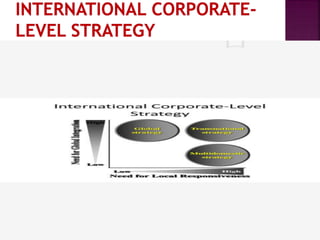
 Strategy and operating decisions are
decentralized to strategic business units
(SBU) in each country
 Products and service are tailored to local
markets
 Business units in one country are
independent of each other
 Assumes markets differ by country or regions
 Focus on competition in each market
 Products are standardized across national
markets
 Decisions regarding business – level strategies
are centralized in the home office
 Strategic business units (SBU) are assumed to
be interdependent
 Often lacks responsiveness to local markets .
 Seeks to achieve both global efficiency and
local responsiveness
 Difficult to achieve because of simultaneous
requirement
- strong central control and coordination to
achieve efficiently
- decentralization to achieve local market
responsiveness
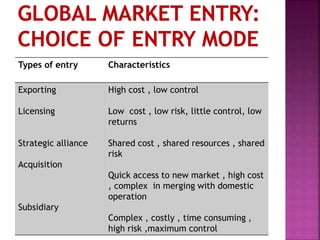
Types of entry Characteristics
Exporting
Licensing
Strategic alliance
Acquisition
Subsidiary
High cost , low control
Low cost , low risk, little control, low
returns
Shared cost , shared resources , shared
risk
Quick access to new market , high cost
, complex in merging with domestic
operation
Complex , costly , time consuming ,
high risk ,maximum control
 International diversification and returns: firm
expand the sales of its goods or service
across the borders of global regions and
countries into different geographic location
or markets
- may increase a firm’s returns
- such firms usually achieve the most
positive stock returns
 International diversification and innovation:
firm expands the sales of its goods or service
across the border of global regions and
countries into different geographic location.
- potentially greater returns on
innovation (larger market)
- generate additional resource for
investment in innovation
- exposed to new products and process in
international markets, generates additional
knowledge leading to innovations
 Political risks include
-instability in national government
- war, both civil and international
- potential nationalization of a firm’s
resources
Economic risks are interdependent with
political risks and include
 Differences and fluctuation in the value of
different currencies
 Differences in prevailing wage rates
 Difficulties in enforcing property rights
 unemployment
 Cost of coordination across diverse geographical
business units
 Institutional and cultural barriers
 Understanding strategic internet of competitors
 The overall complexity of competition
international level strategy

international level strategy

  • 1.
  • 2.
    An action acompany takes to attain superior performance by allocation of resources. The determination of the long run goals and objectives of an enterprise , and the adoption of courses of action and the allocation of resources necessary for carrying out these goals
  • 3.
     Increase marketsize and share - domestic market may lack the size to support efficient scale manufacturing facilities. Return on investment -large investment project may require global market to justify the capital outlays
  • 4.
     Economies ofscale or learning - expanding size or scope of market helps to achieve economies of scale in manufacturing as well as marketing , R & D or distribution . - can spread costs over a larger sales’ base - increase profit per unit Location advantages - low cost market may aid in developing competitive advantage - may achieve better access to: 1. raw materials 2. lower cost labor 3. key customers
  • 6.
     Strategy andoperating decisions are decentralized to strategic business units (SBU) in each country  Products and service are tailored to local markets  Business units in one country are independent of each other  Assumes markets differ by country or regions  Focus on competition in each market
  • 7.
     Products arestandardized across national markets  Decisions regarding business – level strategies are centralized in the home office  Strategic business units (SBU) are assumed to be interdependent  Often lacks responsiveness to local markets .
  • 8.
     Seeks toachieve both global efficiency and local responsiveness  Difficult to achieve because of simultaneous requirement - strong central control and coordination to achieve efficiently - decentralization to achieve local market responsiveness
  • 10.
    Types of entryCharacteristics Exporting Licensing Strategic alliance Acquisition Subsidiary High cost , low control Low cost , low risk, little control, low returns Shared cost , shared resources , shared risk Quick access to new market , high cost , complex in merging with domestic operation Complex , costly , time consuming , high risk ,maximum control
  • 11.
     International diversificationand returns: firm expand the sales of its goods or service across the borders of global regions and countries into different geographic location or markets - may increase a firm’s returns - such firms usually achieve the most positive stock returns
  • 12.
     International diversificationand innovation: firm expands the sales of its goods or service across the border of global regions and countries into different geographic location. - potentially greater returns on innovation (larger market) - generate additional resource for investment in innovation - exposed to new products and process in international markets, generates additional knowledge leading to innovations
  • 13.
     Political risksinclude -instability in national government - war, both civil and international - potential nationalization of a firm’s resources
  • 14.
    Economic risks areinterdependent with political risks and include  Differences and fluctuation in the value of different currencies  Differences in prevailing wage rates  Difficulties in enforcing property rights  unemployment
  • 15.
     Cost ofcoordination across diverse geographical business units  Institutional and cultural barriers  Understanding strategic internet of competitors  The overall complexity of competition