Module 2
Managing
differences: The
central challenge
of global strategy
Dr Sandeep S
IIM Raipur
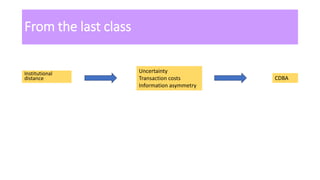
From the last class
Institutional
distance
Uncertainty
Transaction costs
Information asymmetry
CDBA
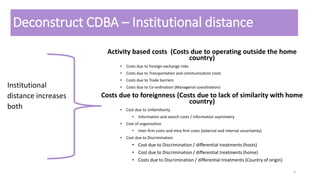
Deconstruct CDBA – Institutional distance
Activity based costs (Costs due to operating outside the home
country)
• Costs due to Foreign exchange risks
• Costs due to Transportation and communication costs
• Costs due to Trade barriers
• Costs due to Co-ordination (Managerial coordination)
Costs due to foreignness (Costs due to lack of similarity with home
country)
• Cost due to Unfamiliarity
• Information and search costs / Information asymmetry
• Cost of organisation
• Inter firm costs and intra firm costs (external and internal uncertainty)
• Cost due to Discrimination
• Cost due to Discrimination / differential treatments (hosts)
• Cost due to Discrimination / differential treatments (home)
• Costs due to Discrimination / differential treatments (Country of origin)
3
Institutional
distance increases
both
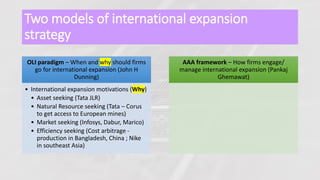
Two models of international expansion
strategy
OLI paradigm – When and why should firms
go for international expansion (John H
Dunning)
• International expansion motivations (Why)
• Asset seeking (Tata JLR)
• Natural Resource seeking (Tata – Corus
to get access to European mines)
• Market seeking (Infosys, Dabur, Marico)
• Efficiency seeking (Cost arbitrage -
production in Bangladesh, China ; Nike
in southeast Asia)
AAA framework – How firms engage/
manage international expansion (Pankaj
Ghemawat)
OLI paradigm (Ownership, Location,
Internalization)
Ownership advantages (Do I have the resources for international
expansion)
• The firm's unique assets, capabilities, or advantages that make it
competitive in the global market..
• Tangible or intangible
• O advantages are rooted in the resources a specific firm controls or
accesses (technological expertise, brand names, or access to
resources). These are not easily replicable by foreign competitors.
Location advantages (Should I expand into this country)
• The advantages offered by the specific location or host country where the firm intends to invest.
• Properties of specific country (CSA – Country specific advantages)
• Natural resources, market size, Labour costs, other various economic, political and other
institutional factors.
• It is in tandem with firms' motivation of international expansion
Natural Resource seeking
Market seeking
Efficiency seeking
Asset seeking
Internalisation advantages (Should I open my subsidiary here)
• The basic question is to outsource or to internalize a process.
• It would be efficient for a firm to exploit their resources through their
own organisation than renting, selling or franchising it to anyone.
Generally, internationalisation means a firm have its own subsidiaries in a country (FDI) than
exporting or licencing to other firms or franchising
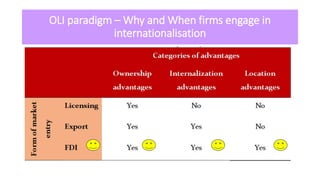
OLI paradigm – Why and When firms engage in
internationalisation
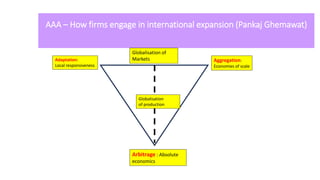
AAA – How firms engage in international expansion (Pankaj Ghemawat)
Globalisation
of production
Adaptation:
Local responsiveness
Aggregation:
Economies of scale
Arbitrage : Absolute
economics
Globalisation of
Markets
Two problematic assumptions of global
managers
• The central challenge in international expansion is to strike the right
balance between economies of scale and responsiveness to local
conditions.
• Focusing only on scale economies in world- wide operations will make
an organization more global.
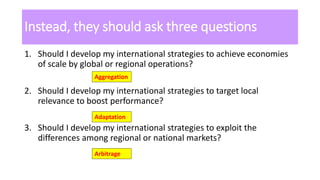
Instead, they should ask three questions
1. Should I develop my international strategies to achieve economies
of scale by global or regional operations?
2. Should I develop my international strategies to target local
relevance to boost performance?
3. Should I develop my international strategies to exploit the
differences among regional or national markets?
Adaptation
Aggregation
Arbitrage
Managing the differences –
managing the distances
• Global strategy  managing the differences at the
borders or managing the distance  as countries are
different in their respective institutional environments.
• Global strategy is not just managing the Local adaptation
vs global integration it is also about managing the
differences by using arbitrage opportunities wisely.
• Adjusting to differences  exploiting the differences →
Arbitrage
• 60,000 manufacturing plant  World’s factory – China
(2000-2003)
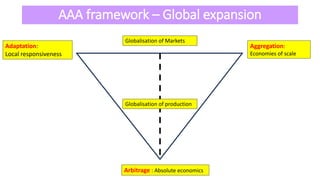
AAA framework – Global expansion
Globalisation of production
Adaptation:
Local responsiveness
Aggregation:
Economies of scale
Arbitrage : Absolute economics
Globalisation of Markets
Local responsiveness
VS global integration
• McDonalds
• Starbucks in Australia
• McDonald's CEO mentioned
streamlining offerings by reducing
redundancies.
• What might be the benefits and
drawbacks of this approach for a
global fast-food chain like
McDonald’s?
• What was wrong about Starbucks?
INB 2023 14
What if companies follow single strategy? (Arbitrage)
Benefits of Focusing Solely on Arbitrage:
• Cost Savings: By taking advantage of differences in labor costs, tax regimes, or other factors,
companies can achieve significant cost savings.
• Quick Gains: Arbitrage opportunities can often lead to quick financial gains, especially when there
are significant disparities between markets.
What if companies follow single strategy? (Arbitrage)
Limitations and Risks:
Temporary Advantage: As markets become more integrated and information flows
more freely, the differences that allow for arbitrage can erode. For example, wage
differences between countries might narrow over time, reducing the cost-saving
advantage.
Reputational Risks: If a company is perceived as exploiting differences in labor
standards or environmental regulations, it might face backlash from consumers,
activists, or the media.
Missed Local Opportunities: By focusing on exploiting differences between markets, a
company might overlook opportunities to adapt to local market conditions or achieve
economies of scale.
May not move-up the value chain: By focusing on exploiting differences between
markets, a company might overlook opportunities for innovation and moving up the
value chain
e.g., IT companies focusing on BPO services may miss the opportunity for moving to
higher place in the value chain such as Technology consulting etc.
What if companies follow single strategy? (adaptation)
Benefits:
• Local Market Fit: By tailoring products and processes to local
preferences and conditions, companies can achieve a better fit with
the local market, leading to potentially higher market share and
customer loyalty.
What if companies follow single strategy? (adaptation)
Limitations and Risks:
Increased Costs: Customizing products or services for different markets can lead to increased
production and operational costs. This is because the company might not be able to leverage
economies of scale.
Complexity: Managing variations in products, services, or processes across different markets can
introduce operational and managerial complexity.
Diluted Brand Identity: Too much localization might lead to a diluted or inconsistent global brand
identity. Customers in different markets might have a varied perception of the brand.
Missed Economies of Scale: By not standardizing products or processes, companies might miss out
on the cost advantages associated with large-scale production.
What if companies follow single strategy? (Aggregation)
Benefits of Focusing Solely on Aggregation :
Economies of Scale: By standardizing products and processes across markets, companies can achieve significant cost
savings due to economies of scale.
Limitations and Risks:
Potential Mismatch with Local Preferences: A one-size-fits-all approach might not resonate with local
customers, leading to potential mismatches with local market preferences and needs.
Vulnerability to Competitive Threats: A standardized offering might become vulnerable to local competitors
who adapt their products or services to better fit the local market.
Cultural Insensitivity: A lack of localization might lead to cultural insensitivity, potentially offending customers
in certain markets. For instance, marketing campaigns that are not adapted to local cultures can backfire.
Regulatory Challenges: Different markets have different regulatory environments. A standardized approach
might not always comply with local regulations, leading to potential legal and operational challenges.
Missed Opportunities: By not adapting to local markets, companies might miss out on opportunities that arise
from local trends, preferences, or needs.
Challenges with AAA
• Lack of managerial bandwidth
• Internal cultural conflicts
• Competitive moves can affect the balance between AAA
• External pressures can affect the balance between AAA
Simultaneous pursuit of AAA is possible only if
1. Tensions among AAA are weak
2. Tensions among AAA can be overridden by large scale economies or
structural advantages
3. Competitors are also resource constrained (managerial bandwidth,
financial resources)
E.g. Case of GEH in the case of digital imaging industry.
• GEH is an outlier, generally a firm can pursue AA strategies (compared to
single A or AAA)
• AA strategies requires establishment of hard and soft resources.
• Hard resources refers to the structures and systems. Soft resources refers
to management styles, socialisation
Netflix Rapid expansion strategy - Balancing the
AAA
1. What are the different phases of the
internationalization of Netflix? What were
the market selection criteria?
2. How does Netflix manage the pressures of
AAA in an industry in which local adaptation
(consumption of local content) is a key
factor of success and distance plays a role in
international strategies?
First phase - Canada
• Phased approach / Did not try to enter
all markets at once
• In the first phase, selected locations
based on Geographic, cultural, and
Psychic distance
• 2010 Canada
• Markets in which the challenges of
foreignness are less (learned how to
expand capabilities beyond Home)
Second phase
• Adaptation (moderately risky)
• 50 countries
• Choices influenced by cultural similarity,
economical advantage, telecommunication
infrastructure.
• Investments in content and technological
investments in big data and analytics (for
generating more insights to local preference by
dicing the customer usage data)
Third phase
• Advantage of having knowledge about
• content people prefer
• marketing strategies
• How to organise companies (partnerships, joint ventures)
• Focus on
• adding more languages (for subtitles too)
• Algorithmic global library content for arbitrage
• Support for range of devices, operation and payment partnerships
• Partnering with device manufacturers, Cell phone and cable network
operators
• Local for global content (Adaptation – Arbitrage ) strategy
• Global licencing deals (Sort of aggregation)
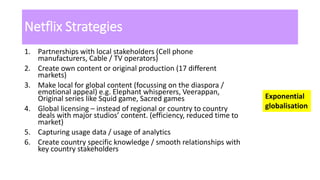
Netflix Strategies
1. Partnerships with local stakeholders (Cell phone
manufacturers, Cable / TV operators)
2. Create own content or original production (17 different
markets)
3. Make local for global content (focussing on the diaspora /
emotional appeal) e.g. Elephant whisperers, Veerappan,
Original series like Squid game, Sacred games
4. Global licensing – instead of regional or country to country
deals with major studios’ content. (efficiency, reduced time to
market)
5. Capturing usage data / usage of analytics
6. Create country specific knowledge / smooth relationships with
key country stakeholders
Exponential
globalisation
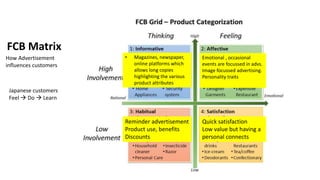
Japanese customers
Feel  Do  Learn
FCB Matrix
How Advertisement
influences customers
• Magazines, newspaper,
online platforms which
allows long copies
highlighting the various
product attributes
Emotional , occasional
events are focussed in advs.
Image focussed advertising.
Personality traits
Reminder advertisement
Product use, benefits
Discounts
Quick satisfaction
Low value but having a
personal connects
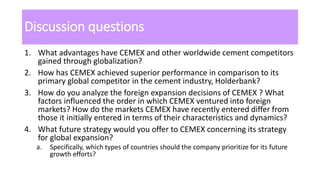
Discussion questions
1. What advantages have CEMEX and other worldwide cement competitors
gained through globalization?
2. How has CEMEX achieved superior performance in comparison to its
primary global competitor in the cement industry, Holderbank?
3. How do you analyze the foreign expansion decisions of CEMEX ? What
factors influenced the order in which CEMEX ventured into foreign
markets? How do the markets CEMEX have recently entered differ from
those it initially entered in terms of their characteristics and dynamics?
4. What future strategy would you offer to CEMEX concerning its strategy
for global expansion?
a. Specifically, which types of countries should the company prioritize for its future
growth efforts?

Moduel 2 Readings.pptx

  • 1.
    Module 2 Managing differences: The centralchallenge of global strategy Dr Sandeep S IIM Raipur
  • 2.
    From the lastclass Institutional distance Uncertainty Transaction costs Information asymmetry CDBA
  • 3.
    Deconstruct CDBA –Institutional distance Activity based costs (Costs due to operating outside the home country) • Costs due to Foreign exchange risks • Costs due to Transportation and communication costs • Costs due to Trade barriers • Costs due to Co-ordination (Managerial coordination) Costs due to foreignness (Costs due to lack of similarity with home country) • Cost due to Unfamiliarity • Information and search costs / Information asymmetry • Cost of organisation • Inter firm costs and intra firm costs (external and internal uncertainty) • Cost due to Discrimination • Cost due to Discrimination / differential treatments (hosts) • Cost due to Discrimination / differential treatments (home) • Costs due to Discrimination / differential treatments (Country of origin) 3 Institutional distance increases both
  • 4.
    Two models ofinternational expansion strategy OLI paradigm – When and why should firms go for international expansion (John H Dunning) • International expansion motivations (Why) • Asset seeking (Tata JLR) • Natural Resource seeking (Tata – Corus to get access to European mines) • Market seeking (Infosys, Dabur, Marico) • Efficiency seeking (Cost arbitrage - production in Bangladesh, China ; Nike in southeast Asia) AAA framework – How firms engage/ manage international expansion (Pankaj Ghemawat)
  • 5.
    OLI paradigm (Ownership,Location, Internalization) Ownership advantages (Do I have the resources for international expansion) • The firm's unique assets, capabilities, or advantages that make it competitive in the global market.. • Tangible or intangible • O advantages are rooted in the resources a specific firm controls or accesses (technological expertise, brand names, or access to resources). These are not easily replicable by foreign competitors.
  • 6.
    Location advantages (ShouldI expand into this country) • The advantages offered by the specific location or host country where the firm intends to invest. • Properties of specific country (CSA – Country specific advantages) • Natural resources, market size, Labour costs, other various economic, political and other institutional factors. • It is in tandem with firms' motivation of international expansion Natural Resource seeking Market seeking Efficiency seeking Asset seeking
  • 7.
    Internalisation advantages (ShouldI open my subsidiary here) • The basic question is to outsource or to internalize a process. • It would be efficient for a firm to exploit their resources through their own organisation than renting, selling or franchising it to anyone. Generally, internationalisation means a firm have its own subsidiaries in a country (FDI) than exporting or licencing to other firms or franchising
  • 8.
    OLI paradigm –Why and When firms engage in internationalisation
  • 9.
    AAA – Howfirms engage in international expansion (Pankaj Ghemawat) Globalisation of production Adaptation: Local responsiveness Aggregation: Economies of scale Arbitrage : Absolute economics Globalisation of Markets
  • 10.
    Two problematic assumptionsof global managers • The central challenge in international expansion is to strike the right balance between economies of scale and responsiveness to local conditions. • Focusing only on scale economies in world- wide operations will make an organization more global.
  • 11.
    Instead, they shouldask three questions 1. Should I develop my international strategies to achieve economies of scale by global or regional operations? 2. Should I develop my international strategies to target local relevance to boost performance? 3. Should I develop my international strategies to exploit the differences among regional or national markets? Adaptation Aggregation Arbitrage
  • 12.
    Managing the differences– managing the distances • Global strategy  managing the differences at the borders or managing the distance  as countries are different in their respective institutional environments. • Global strategy is not just managing the Local adaptation vs global integration it is also about managing the differences by using arbitrage opportunities wisely. • Adjusting to differences  exploiting the differences → Arbitrage • 60,000 manufacturing plant  World’s factory – China (2000-2003)
  • 13.
    AAA framework –Global expansion Globalisation of production Adaptation: Local responsiveness Aggregation: Economies of scale Arbitrage : Absolute economics Globalisation of Markets
  • 14.
    Local responsiveness VS globalintegration • McDonalds • Starbucks in Australia • McDonald's CEO mentioned streamlining offerings by reducing redundancies. • What might be the benefits and drawbacks of this approach for a global fast-food chain like McDonald’s? • What was wrong about Starbucks? INB 2023 14
  • 15.
    What if companiesfollow single strategy? (Arbitrage) Benefits of Focusing Solely on Arbitrage: • Cost Savings: By taking advantage of differences in labor costs, tax regimes, or other factors, companies can achieve significant cost savings. • Quick Gains: Arbitrage opportunities can often lead to quick financial gains, especially when there are significant disparities between markets.
  • 16.
    What if companiesfollow single strategy? (Arbitrage) Limitations and Risks: Temporary Advantage: As markets become more integrated and information flows more freely, the differences that allow for arbitrage can erode. For example, wage differences between countries might narrow over time, reducing the cost-saving advantage. Reputational Risks: If a company is perceived as exploiting differences in labor standards or environmental regulations, it might face backlash from consumers, activists, or the media. Missed Local Opportunities: By focusing on exploiting differences between markets, a company might overlook opportunities to adapt to local market conditions or achieve economies of scale. May not move-up the value chain: By focusing on exploiting differences between markets, a company might overlook opportunities for innovation and moving up the value chain e.g., IT companies focusing on BPO services may miss the opportunity for moving to higher place in the value chain such as Technology consulting etc.
  • 17.
    What if companiesfollow single strategy? (adaptation) Benefits: • Local Market Fit: By tailoring products and processes to local preferences and conditions, companies can achieve a better fit with the local market, leading to potentially higher market share and customer loyalty.
  • 18.
    What if companiesfollow single strategy? (adaptation) Limitations and Risks: Increased Costs: Customizing products or services for different markets can lead to increased production and operational costs. This is because the company might not be able to leverage economies of scale. Complexity: Managing variations in products, services, or processes across different markets can introduce operational and managerial complexity. Diluted Brand Identity: Too much localization might lead to a diluted or inconsistent global brand identity. Customers in different markets might have a varied perception of the brand. Missed Economies of Scale: By not standardizing products or processes, companies might miss out on the cost advantages associated with large-scale production.
  • 19.
    What if companiesfollow single strategy? (Aggregation) Benefits of Focusing Solely on Aggregation : Economies of Scale: By standardizing products and processes across markets, companies can achieve significant cost savings due to economies of scale. Limitations and Risks: Potential Mismatch with Local Preferences: A one-size-fits-all approach might not resonate with local customers, leading to potential mismatches with local market preferences and needs. Vulnerability to Competitive Threats: A standardized offering might become vulnerable to local competitors who adapt their products or services to better fit the local market. Cultural Insensitivity: A lack of localization might lead to cultural insensitivity, potentially offending customers in certain markets. For instance, marketing campaigns that are not adapted to local cultures can backfire. Regulatory Challenges: Different markets have different regulatory environments. A standardized approach might not always comply with local regulations, leading to potential legal and operational challenges. Missed Opportunities: By not adapting to local markets, companies might miss out on opportunities that arise from local trends, preferences, or needs.
  • 20.
    Challenges with AAA •Lack of managerial bandwidth • Internal cultural conflicts • Competitive moves can affect the balance between AAA • External pressures can affect the balance between AAA
  • 21.
    Simultaneous pursuit ofAAA is possible only if 1. Tensions among AAA are weak 2. Tensions among AAA can be overridden by large scale economies or structural advantages 3. Competitors are also resource constrained (managerial bandwidth, financial resources) E.g. Case of GEH in the case of digital imaging industry. • GEH is an outlier, generally a firm can pursue AA strategies (compared to single A or AAA) • AA strategies requires establishment of hard and soft resources. • Hard resources refers to the structures and systems. Soft resources refers to management styles, socialisation
  • 22.
    Netflix Rapid expansionstrategy - Balancing the AAA 1. What are the different phases of the internationalization of Netflix? What were the market selection criteria? 2. How does Netflix manage the pressures of AAA in an industry in which local adaptation (consumption of local content) is a key factor of success and distance plays a role in international strategies?
  • 23.
    First phase -Canada • Phased approach / Did not try to enter all markets at once • In the first phase, selected locations based on Geographic, cultural, and Psychic distance • 2010 Canada • Markets in which the challenges of foreignness are less (learned how to expand capabilities beyond Home)
  • 24.
    Second phase • Adaptation(moderately risky) • 50 countries • Choices influenced by cultural similarity, economical advantage, telecommunication infrastructure. • Investments in content and technological investments in big data and analytics (for generating more insights to local preference by dicing the customer usage data)
  • 25.
    Third phase • Advantageof having knowledge about • content people prefer • marketing strategies • How to organise companies (partnerships, joint ventures) • Focus on • adding more languages (for subtitles too) • Algorithmic global library content for arbitrage • Support for range of devices, operation and payment partnerships • Partnering with device manufacturers, Cell phone and cable network operators • Local for global content (Adaptation – Arbitrage ) strategy • Global licencing deals (Sort of aggregation)
  • 26.
    Netflix Strategies 1. Partnershipswith local stakeholders (Cell phone manufacturers, Cable / TV operators) 2. Create own content or original production (17 different markets) 3. Make local for global content (focussing on the diaspora / emotional appeal) e.g. Elephant whisperers, Veerappan, Original series like Squid game, Sacred games 4. Global licensing – instead of regional or country to country deals with major studios’ content. (efficiency, reduced time to market) 5. Capturing usage data / usage of analytics 6. Create country specific knowledge / smooth relationships with key country stakeholders Exponential globalisation
  • 27.
    Japanese customers Feel Do  Learn FCB Matrix How Advertisement influences customers • Magazines, newspaper, online platforms which allows long copies highlighting the various product attributes Emotional , occasional events are focussed in advs. Image focussed advertising. Personality traits Reminder advertisement Product use, benefits Discounts Quick satisfaction Low value but having a personal connects
  • 28.
    Discussion questions 1. Whatadvantages have CEMEX and other worldwide cement competitors gained through globalization? 2. How has CEMEX achieved superior performance in comparison to its primary global competitor in the cement industry, Holderbank? 3. How do you analyze the foreign expansion decisions of CEMEX ? What factors influenced the order in which CEMEX ventured into foreign markets? How do the markets CEMEX have recently entered differ from those it initially entered in terms of their characteristics and dynamics? 4. What future strategy would you offer to CEMEX concerning its strategy for global expansion? a. Specifically, which types of countries should the company prioritize for its future growth efforts?

Editor's Notes

  • #5 Tata motors to various BRIC country