International Financial
Reporting Standard (IFRS)
Presented by
Mr. S. B. Bansode
Introduction
• International Financial Reporting Standards (IFRS) set common
rules so that financial statements can be consistent,
transparent, and comparable around the world.
• IFRS are issued by the International Accounting Standards
Board (IASB) and address record keeping, account reporting,
and other aspects of financial reporting.
• The downside of IFRS are that they are not universal, with the
United States using GAAP accounting, and a number of other
countries using other methods.
Objectives of IFRS
• To bring uniformity in accounting practices followed.
• To Accelerate the globalization of finance
• To expand the capital Market globally.
• To boost the growth of service sector
• To enhance the brand value of the companies.
• To reduce related reporting cost by developing common reporting
system and ensure consistency in statutory reporting.
• To ensure more transparency in the financial statement.
• To facilitate the companies of financial data with international
competitors.
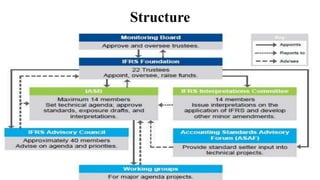
Structure
IFRS Based Financial Statement
• A Statement of Financial position.
• A statement of comprehensive income.
• A statement of change in equity.
• A Cash flow statement or statement cash flow.
Evolution of IFRS
• IAS were issued between 1973 and 2001 by the Board of the International
Accounting Standards Committee(IASC).
• On 1 April 2001, the new International Accounting Standards Board took over from
the IASC the responsibility for setting International Accounting Standards.
• The IASB has continued to develop standards calling the new standards
International Financial Reporting Standards (IFRS).
• IFRS are used in many parts of the world, including the European Union, India,
Hong Kong, Australia, Malaysia, Pakistan, GCC countries, Russia, Chile, South
Africa, Singapore and Turkey.
Thank You…

International Financial Reporting Standard (IFRS)

  • 1.
    International Financial Reporting Standard(IFRS) Presented by Mr. S. B. Bansode
  • 2.
    Introduction • International FinancialReporting Standards (IFRS) set common rules so that financial statements can be consistent, transparent, and comparable around the world. • IFRS are issued by the International Accounting Standards Board (IASB) and address record keeping, account reporting, and other aspects of financial reporting. • The downside of IFRS are that they are not universal, with the United States using GAAP accounting, and a number of other countries using other methods.
  • 3.
    Objectives of IFRS •To bring uniformity in accounting practices followed. • To Accelerate the globalization of finance • To expand the capital Market globally. • To boost the growth of service sector • To enhance the brand value of the companies. • To reduce related reporting cost by developing common reporting system and ensure consistency in statutory reporting. • To ensure more transparency in the financial statement. • To facilitate the companies of financial data with international competitors.
  • 4.
  • 6.
    IFRS Based FinancialStatement • A Statement of Financial position. • A statement of comprehensive income. • A statement of change in equity. • A Cash flow statement or statement cash flow.
  • 7.
    Evolution of IFRS •IAS were issued between 1973 and 2001 by the Board of the International Accounting Standards Committee(IASC). • On 1 April 2001, the new International Accounting Standards Board took over from the IASC the responsibility for setting International Accounting Standards. • The IASB has continued to develop standards calling the new standards International Financial Reporting Standards (IFRS). • IFRS are used in many parts of the world, including the European Union, India, Hong Kong, Australia, Malaysia, Pakistan, GCC countries, Russia, Chile, South Africa, Singapore and Turkey.
  • 8.