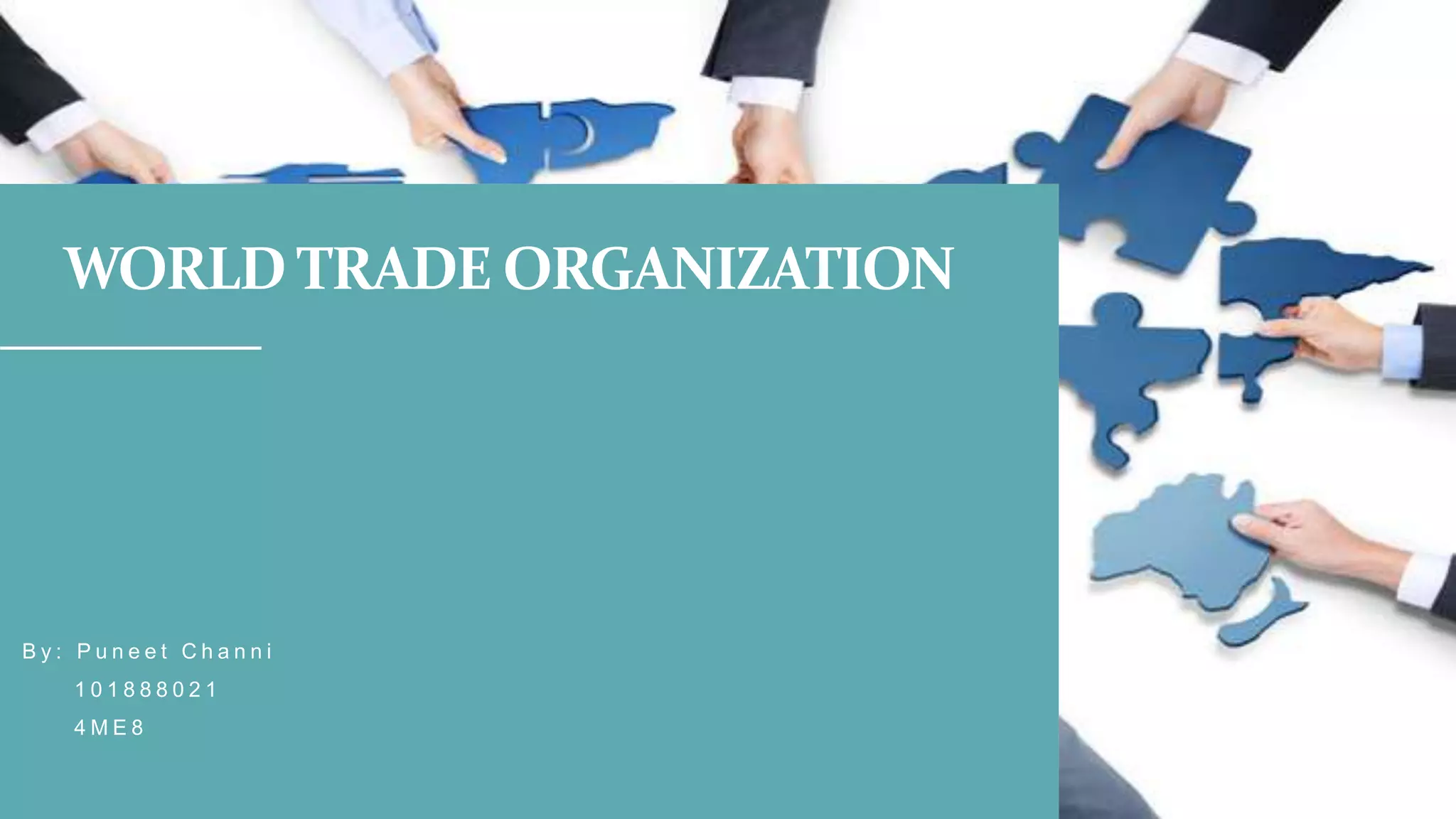
WORLDTRADE ORGANIZATION
B y : P u n e e t C h a n n i
1 0 1 8 8 8 0 2 1
4 M E 8
What isWTO?
• T h e W o r l d T r a d e O r g a n i z a t i o n ( W T O ) i s a
I n t e r g o v e r n m e n t a l O r g a n i z a t i o n t h a t r e g u l a t e s a n d
f a c i l i t a t e s I n t e r n a t i o n a l T r a d e b e t w e e n N a t i o n s .
• W o r l d ' s l a r g e s t I n t e r n a t i o n a l E c o n o m i c O r g a n i z a t i o n w i t h
1 6 4 M e m b e r N a t i o n s & c o m p r i s e s 9 6 % o f g l o b a l t r a d e .
• W T O f a c i l i t a t e s t r a d e i n :
• Goods (Agriculture, Banking, Industrial etc)
• Services And Intellectual Property.
• I t p r o v i d e s a f r a m e w o r k f o r n e g o t i a t i n g t r a d e a g r e e m e n t s ,
w h i c h u s u a l l y a i m t o r e d u c e o r e l i m i n a t e t a r i f f s , q u o t a s ,
a n d o t h e r r e s t r i c t i o n s .
History
F r o m t h e e a r l y d a y s o f t h e S i l k R o a d t o t h e c r e a t i o n o f t h e
G e n e r a l A g r e e m e n t o n Ta r i f f s a n d Tr a d e ( G AT T ) a n d t h e b i r t h
o f t h e W T O , t r a d e h a s p l a y e d a n i m p o r t a n t r o l e i n s u p p o r t i n g
e c o n o m i c d e v e l o p m e n t a n d p r o m o t i n g p e a c e f u l r e l a t i o n s
a m o n g n a t i o n s .
G AT T N e g o t i a t i o n s :
• General Agreement on Tariffs and Trade (GATT), was established by a
multilateral treaty of 23 countries in 1947 after World War II.
• The purpose of the General Agreement on Tariffs and Trade (GATT)
was to make international trade easier.
• The General Agreement on Tariffs and Trade (GATT) held eight rounds
in total from April 1947 to December 1993, each with significant
achievements and outcomes.
• The Tokyo Round during the seventies represented the first major
attempt to tackle trade barriers that do not take the form of tariffs, and to
improve the system, adopting a series of agreements on non-tariff
barriers.
History
U r u g u a y R o u n d : 1 9 8 6 – 1 9 9 4
T h e U r u g u a y R o u n d w a s t h e 8 t h r o u n d o f m u l t i l a t e r a l
t r a d e n e g o t i a t i o n s ( M T N ) c o n d u c t e d w i t h i n t h e
f r a m e w o r k o f t h e G e n e r a l A g r e e m e n t o n Ta r i f f s a n d
Tr a d e ( G AT T ) , s p a n n i n g f r o m 1 9 8 6 t o 1 9 9 3 a n d
e m b r a c i n g 1 2 3 c o u n t r i e s .
T h e m a i n o b j e c t i v e s o f t h e U r u g u a y R o u n d w e r e :
• To reduce Agricultural Subsidies
• To lift restrictions on foreign investment
• To begin the process of opening trade in services
like banking and insurance.
• to include the protection of intellectual property
T h e R o u n d l e d t o t h e c r e a t i o n o f t h e W o r l d Tr a d e
O r g a n i z a t i o n o n 1 J a n u a r y 1 9 9 5 .
Fact File
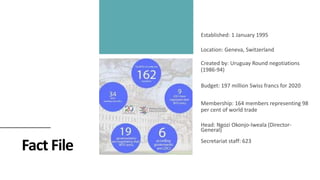
Established: 1 January 1995
Head: Ngozi Okonjo-Iweala (Director-
General)
Location: Geneva, Switzerland
Secretariat staff: 623
Created by: Uruguay Round negotiations
(1986-94)
Budget: 197 million Swiss francs for 2020
Membership: 164 members representing 98
per cent of world trade
Pictures
Pictures
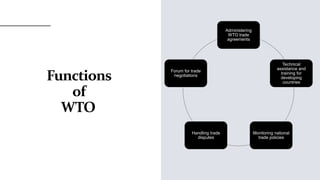
Functions
of
WTO
Administering
WTO trade
agreements
Technical
assistance and
training for
developing
countries
Monitoring national
trade policies
Handling trade
disputes
Forum for trade
negotiations
Principlesof the
Trading System
The WTO establishes a framework for trade policies; it does
not define or specify outcomes. That is, it is concerned with
setting the rules of "trade policy." Five principles are of
particular importance in understanding both the pre-1994
GATT and the WTO:
• Non-discrimination
• Reciprocity
• Binding and enforceable commitments
• Transparency
• Safety values
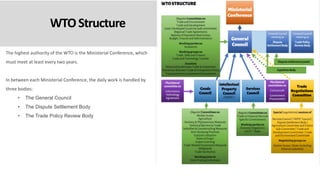
WTOStructure
The highest authority of the WTO is the Ministerial Conference, which
must meet at least every two years.
In between each Ministerial Conference, the daily work is handled by
three bodies:
• The General Council
• The Dispute Settlement Body
• The Trade Policy Review Body
WTOStructure
The General Council has the following subsidiary bodies which oversee committees in different
areas:
• Council for Trade in Goods: There are 11 committees under the jurisdiction of the Goods Council
each with a specific task. All members of the WTO participate in the committees. The Textiles
Monitoring Body is separate from the other committees but still under the jurisdiction of the Goods
Council.
• Council for Trade-Related Aspects of Intellectual Property Right: Information on intellectual
property in the WTO, news and official records of the activities of the TRIPS Council, and details of
the WTO's work with other international organizations in the field.
• Council for Trade in Services: The Council for Trade in Services operates under the guidance of
the General Council and is responsible for overseeing the functioning of the General Agreement on
Trade in Services (GATS). It is open to all WTO members and can create subsidiary bodies as
required.
• Trade Negotiations Committee: The Trade Negotiations Committee (TNC) is the committee that
deals with the current trade talks round
Advantagesof
PromotingFree
Trade
Lower prices for consumers. Removing tariffs
enables us to buy cheaper imports
Free trade encourages greater competitiveness.
Through free trade, firms face a higher incentive to
cut costs. For example, a domestic monopoly may
now face competition from foreign firms
The law of comparative advantage states that
free trade will enable an increase in economic
welfare. This is because countries can
specialise in producing goods where they have
a lower opportunity cost
Economies of scale . By encouraging free trade,
firms can specialise and produce a higher quantity.
This enables more economies of scale, this is
important for industries with high fixed costs
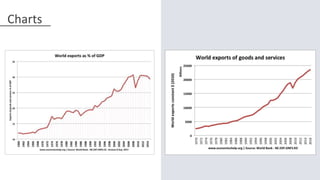
Charts
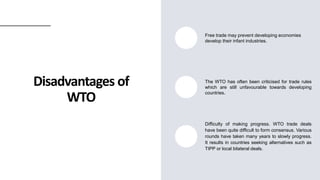
Disadvantages of
WTO
Free trade may prevent developing economies
develop their infant industries.
The WTO has often been criticised for trade rules
which are still unfavourable towards developing
countries.
Difficulty of making progress. WTO trade deals
have been quite difficult to form consensus. Various
rounds have taken many years to slowly progress.
It results in countries seeking alternatives such as
TIPP or local bilateral deals.
Reference
• https://www.wto.org
• https://en.wikipedia.org
• https://econ.economicshelp.org
• https://www.britannica.com
• Investopedia: Sharper insight, better investing
Thank You

World trade organization

  • 1.
    WORLDTRADE ORGANIZATION B y: P u n e e t C h a n n i 1 0 1 8 8 8 0 2 1 4 M E 8
  • 2.
    What isWTO? • Th e W o r l d T r a d e O r g a n i z a t i o n ( W T O ) i s a I n t e r g o v e r n m e n t a l O r g a n i z a t i o n t h a t r e g u l a t e s a n d f a c i l i t a t e s I n t e r n a t i o n a l T r a d e b e t w e e n N a t i o n s . • W o r l d ' s l a r g e s t I n t e r n a t i o n a l E c o n o m i c O r g a n i z a t i o n w i t h 1 6 4 M e m b e r N a t i o n s & c o m p r i s e s 9 6 % o f g l o b a l t r a d e . • W T O f a c i l i t a t e s t r a d e i n : • Goods (Agriculture, Banking, Industrial etc) • Services And Intellectual Property. • I t p r o v i d e s a f r a m e w o r k f o r n e g o t i a t i n g t r a d e a g r e e m e n t s , w h i c h u s u a l l y a i m t o r e d u c e o r e l i m i n a t e t a r i f f s , q u o t a s , a n d o t h e r r e s t r i c t i o n s .
  • 3.
    History F r om t h e e a r l y d a y s o f t h e S i l k R o a d t o t h e c r e a t i o n o f t h e G e n e r a l A g r e e m e n t o n Ta r i f f s a n d Tr a d e ( G AT T ) a n d t h e b i r t h o f t h e W T O , t r a d e h a s p l a y e d a n i m p o r t a n t r o l e i n s u p p o r t i n g e c o n o m i c d e v e l o p m e n t a n d p r o m o t i n g p e a c e f u l r e l a t i o n s a m o n g n a t i o n s . G AT T N e g o t i a t i o n s : • General Agreement on Tariffs and Trade (GATT), was established by a multilateral treaty of 23 countries in 1947 after World War II. • The purpose of the General Agreement on Tariffs and Trade (GATT) was to make international trade easier. • The General Agreement on Tariffs and Trade (GATT) held eight rounds in total from April 1947 to December 1993, each with significant achievements and outcomes. • The Tokyo Round during the seventies represented the first major attempt to tackle trade barriers that do not take the form of tariffs, and to improve the system, adopting a series of agreements on non-tariff barriers.
  • 4.
    History U r ug u a y R o u n d : 1 9 8 6 – 1 9 9 4 T h e U r u g u a y R o u n d w a s t h e 8 t h r o u n d o f m u l t i l a t e r a l t r a d e n e g o t i a t i o n s ( M T N ) c o n d u c t e d w i t h i n t h e f r a m e w o r k o f t h e G e n e r a l A g r e e m e n t o n Ta r i f f s a n d Tr a d e ( G AT T ) , s p a n n i n g f r o m 1 9 8 6 t o 1 9 9 3 a n d e m b r a c i n g 1 2 3 c o u n t r i e s . T h e m a i n o b j e c t i v e s o f t h e U r u g u a y R o u n d w e r e : • To reduce Agricultural Subsidies • To lift restrictions on foreign investment • To begin the process of opening trade in services like banking and insurance. • to include the protection of intellectual property T h e R o u n d l e d t o t h e c r e a t i o n o f t h e W o r l d Tr a d e O r g a n i z a t i o n o n 1 J a n u a r y 1 9 9 5 .
  • 5.
    Fact File Established: 1January 1995 Head: Ngozi Okonjo-Iweala (Director- General) Location: Geneva, Switzerland Secretariat staff: 623 Created by: Uruguay Round negotiations (1986-94) Budget: 197 million Swiss francs for 2020 Membership: 164 members representing 98 per cent of world trade
  • 6.
  • 7.
  • 8.
    Functions of WTO Administering WTO trade agreements Technical assistance and trainingfor developing countries Monitoring national trade policies Handling trade disputes Forum for trade negotiations
  • 9.
    Principlesof the Trading System TheWTO establishes a framework for trade policies; it does not define or specify outcomes. That is, it is concerned with setting the rules of "trade policy." Five principles are of particular importance in understanding both the pre-1994 GATT and the WTO: • Non-discrimination • Reciprocity • Binding and enforceable commitments • Transparency • Safety values
  • 10.
    WTOStructure The highest authorityof the WTO is the Ministerial Conference, which must meet at least every two years. In between each Ministerial Conference, the daily work is handled by three bodies: • The General Council • The Dispute Settlement Body • The Trade Policy Review Body
  • 11.
    WTOStructure The General Councilhas the following subsidiary bodies which oversee committees in different areas: • Council for Trade in Goods: There are 11 committees under the jurisdiction of the Goods Council each with a specific task. All members of the WTO participate in the committees. The Textiles Monitoring Body is separate from the other committees but still under the jurisdiction of the Goods Council. • Council for Trade-Related Aspects of Intellectual Property Right: Information on intellectual property in the WTO, news and official records of the activities of the TRIPS Council, and details of the WTO's work with other international organizations in the field. • Council for Trade in Services: The Council for Trade in Services operates under the guidance of the General Council and is responsible for overseeing the functioning of the General Agreement on Trade in Services (GATS). It is open to all WTO members and can create subsidiary bodies as required. • Trade Negotiations Committee: The Trade Negotiations Committee (TNC) is the committee that deals with the current trade talks round
  • 12.
    Advantagesof PromotingFree Trade Lower prices forconsumers. Removing tariffs enables us to buy cheaper imports Free trade encourages greater competitiveness. Through free trade, firms face a higher incentive to cut costs. For example, a domestic monopoly may now face competition from foreign firms The law of comparative advantage states that free trade will enable an increase in economic welfare. This is because countries can specialise in producing goods where they have a lower opportunity cost Economies of scale . By encouraging free trade, firms can specialise and produce a higher quantity. This enables more economies of scale, this is important for industries with high fixed costs
  • 13.
  • 14.
    Disadvantages of WTO Free trademay prevent developing economies develop their infant industries. The WTO has often been criticised for trade rules which are still unfavourable towards developing countries. Difficulty of making progress. WTO trade deals have been quite difficult to form consensus. Various rounds have taken many years to slowly progress. It results in countries seeking alternatives such as TIPP or local bilateral deals.
  • 15.
    Reference • https://www.wto.org • https://en.wikipedia.org •https://econ.economicshelp.org • https://www.britannica.com • Investopedia: Sharper insight, better investing
  • 16.