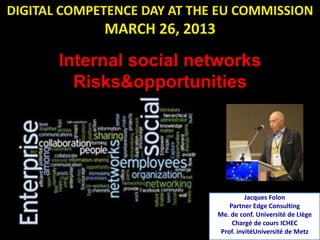









DIGITAL COMPETENCE DAY AT THE EU COMMISSION
             MARCH 26, 2013

       Internal social networks
         Risks&opportunities


                                        Jacques Folon
                                  Partner Edge Consulting
                              Me. de conf. Université de LIège
                                   Chargé de cours ICHEC
                               Prof. invitéUniversité de Metz
Cette présentation est sur
www.slideshare.net/folon

elle est à votre disposition
MY DIGITAL IDENTITY
http://jacquesfolon.tel
First part :Risks

1.   Data privacy
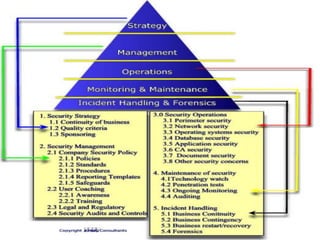
2.   Data security
3.   Intellectualproperty
4.   What about an
     internalcommunity
     manager?
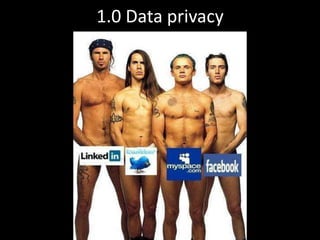
1.0 Data privacy
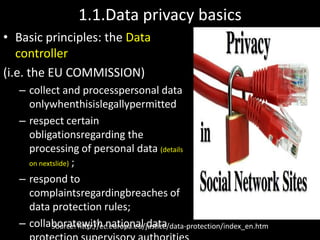
1.1.Data privacy basics
• Basic principles: the Data
   controller
(i.e. the EU COMMISSION)
   – collect and processpersonal data
     onlywhenthisislegallypermitted
   – respect certain
     obligationsregarding the
     processing of personal data (details
     on nextslide) ;

   – respond to
     complaintsregardingbreaches of
     data protection rules;
   – collaboratewith national data
            Source: http://ec.europa.eu/justice/data-protection/index_en.htm
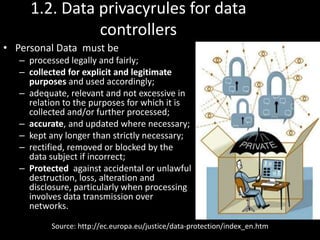
1.2. Data privacyrules for data
               controllers
• Personal Data must be
   – processed legally and fairly;
   – collected for explicit and legitimate
     purposes and used accordingly;
   – adequate, relevant and not excessive in
     relation to the purposes for which it is
     collected and/or further processed;
   – accurate, and updated where necessary;
   – kept any longer than strictly necessary;
   – rectified, removed or blocked by the
     data subject if incorrect;
   – Protected against accidental or unlawful
     destruction, loss, alteration and
     disclosure, particularly when processing
     involves data transmission over
     networks.

          Source: http://ec.europa.eu/justice/data-protection/index_en.htm
1.3. Data privacy&
    internal social media questions

•   Whichprecisepurpose ?
•   Whatkind of personal data willbestored?
•   Are data stored in Europe ?
•   Are they in the « Cloud »?
•   Data privacy commission adviceneeded?
•   Whatwillbe the securitypolicy?
•   What about the content of ex-employees?
•   Is a code of conductenough?

             SO IT ’S AN IMPORTANT ISSUE !!!
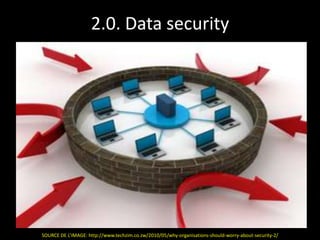
2.0. Data security


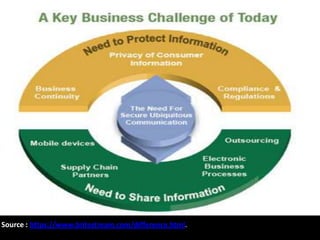
SOURCE DE L’IMAGE: http://www.techzim.co.zw/2010/05/why-organisations-should-worry-about-security-2/
Source : https://www.britestream.com/difference.html.
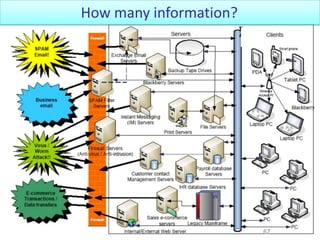
How many information?


                        67
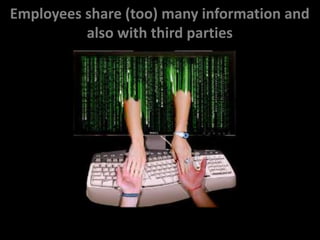
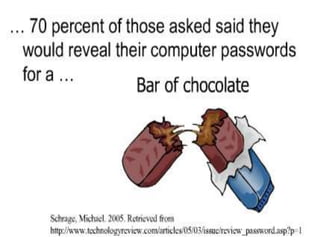
Employees share (too) many information and
          also with third parties
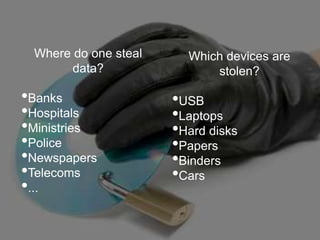
Where do one steal     Which devices are
       data?                stolen?

•Banks                •USB
•Hospitals            •Laptops
•Ministries           •Hard disks
•Police               •Papers
•Newspapers           •Binders
•Telecoms             •Cars
•...
TELEWORKING
What are Control limitations?
3.0. INTELLECTUAL PROPERTY


  Source de l’image: http://www.maniacworld.com/copy-and-paste-babies.html
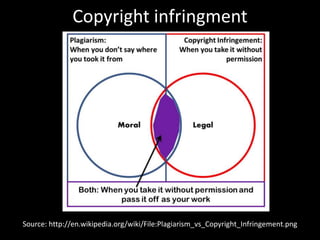
Copyright infringment


Source: http://en.wikipedia.org/wiki/File:Plagiarism_vs_Copyright_Infringement.png
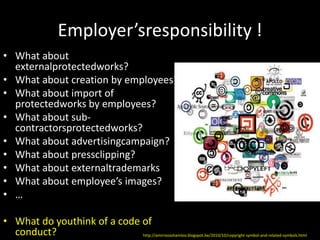
Employer’sresponsibility !
• What about
  externalprotectedworks?
• What about creation by employees?
• What about import of
  protectedworks by employees?
• What about sub-
  contractorsprotectedworks?
• What about advertisingcampaign?
• What about pressclipping?
• What about externaltrademarks
• What about employee’s images?
• …

• What do youthink of a code of
  conduct?                   http://amirrezashamloo.blogspot.be/2010/10/copyright-symbol-and-related-symbols.html
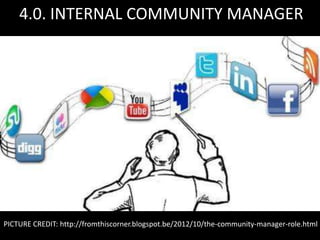
4.0. INTERNAL COMMUNITY MANAGER


PICTURE CREDIT: http://fromthiscorner.blogspot.be/2012/10/the-community-manager-role.html
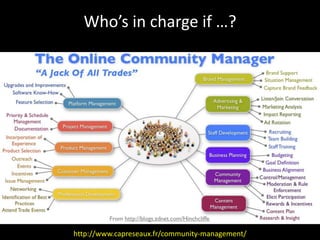
Who’s in charge if …?


http://www.capreseaux.fr/community-management/
Second part: Added value


http://www.mckinsey.com/insights/mgi/research/technology_and_innovation/the_social_economy
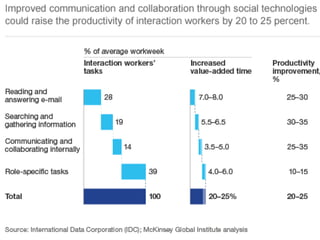
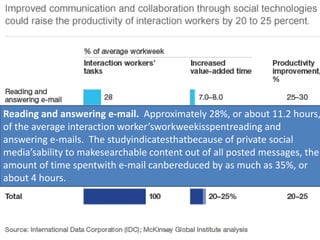
Reading and answering e-mail. Approximately 28%, or about 11.2 hours,
of the average interaction worker’sworkweekisspentreading and
answering e-mails. The studyindicatesthatbecause of private social
media’sability to makesearchable content out of all posted messages, the
amount of time spentwith e-mail canbereduced by as much as 35%, or
about 4 hours.
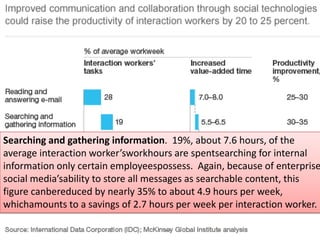
Searching and gathering information. 19%, about 7.6 hours, of the
average interaction worker’sworkhours are spentsearching for internal
information only certain employeespossess. Again, because of enterprise
social media’sability to store all messages as searchable content, this
figure canbereduced by nearly 35% to about 4.9 hours per week,
whichamounts to a savings of 2.7 hours per week per interaction worker.
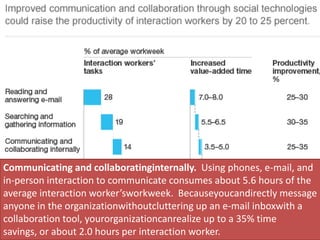
Communicating and collaboratinginternally. Using phones, e-mail, and
in-person interaction to communicate consumes about 5.6 hours of the
average interaction worker’sworkweek. Becauseyoucandirectly message
anyone in the organizationwithoutcluttering up an e-mail inboxwith a
collaboration tool, yourorganizationcanrealize up to a 35% time
savings, or about 2.0 hours per interaction worker.
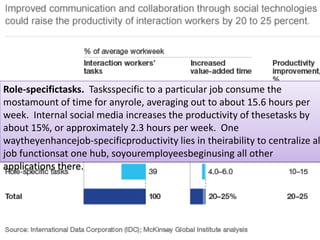
Role-specifictasks. Tasksspecific to a particular job consume the
mostamount of time for anyrole, averaging out to about 15.6 hours per
week. Internal social media increases the productivity of thesetasks by
about 15%, or approximately 2.3 hours per week. One
waytheyenhancejob-specificproductivity lies in theirability to centralize al
job functionsat one hub, soyouremployeesbeginusing all other
applications there.
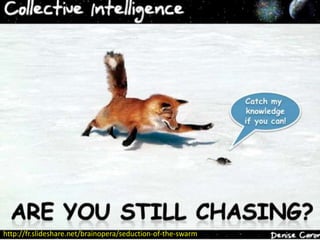
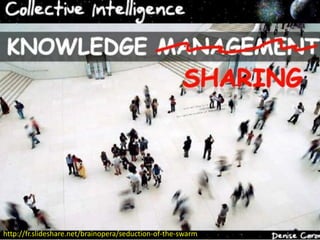
http://fr.slideshare.net/brainopera/seduction-of-the-swarm
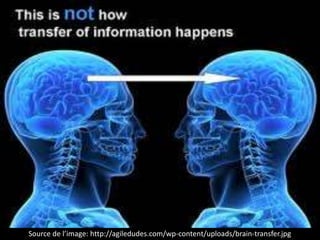
Source de l’image: http://agiledudes.com/wp-content/uploads/brain-transfer.jpg
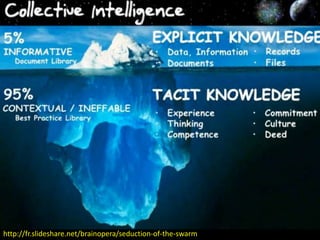
http://fr.slideshare.net/brainopera/seduction-of-the-swarm
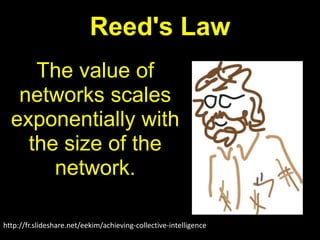
Reed's Law
     The value of
   networks scales
  exponentially with
    the size of the
       network.

http://fr.slideshare.net/eekim/achieving-collective-intelligence
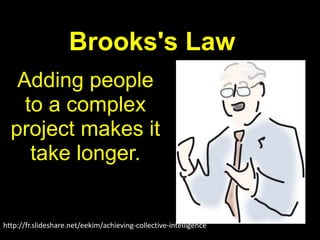
Brooks's Law
   Adding people
    to a complex
  project makes it
     take longer.


http://fr.slideshare.net/eekim/achieving-collective-intelligence
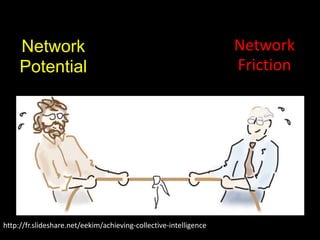
Network                                                       Network
     Potential                                                     Friction


http://fr.slideshare.net/eekim/achieving-collective-intelligence
We Want Reed to Win!


http://fr.slideshare.net/eekim/achieving-collective-intelligence
http://fr.slideshare.net/brainopera/seduction-of-the-swarm
Otheradded value
•   KM
•   Collective intelligence
•   Co-working
•   Network management

• BUT

• The vendorsalreadytoldyou, is ‘nt it?
Conclusion
•   Do not forgetprivacy issues
•   CC/CO 81
•   Control or not control
•   IPR regulation s/b reminded
•   Internal code of conduct
•   BUT
•   There are some important added value
Internal code of conduct main
                 rules
•   Define the internal and external social media
•   Intellectualpropertyrules
•   Data privacyexplanations
•   Confidential information
•   Anonimityisforbidden
•   Penalties
•   And
•   Which communication for the code of conduct?
•   How to have itapproved?
Any questions ?


Crédit image: http://jillsbooks.wordpress.com/2010/09/15/hellooooo-anybody-out-there/raise-your-hand-2/
                                                                                         45
Internal social networks

Internal social networks

  • 1.
    DIGITAL COMPETENCE DAYAT THE EU COMMISSION MARCH 26, 2013 Internal social networks Risks&opportunities Jacques Folon Partner Edge Consulting Me. de conf. Université de LIège Chargé de cours ICHEC Prof. invitéUniversité de Metz
  • 2.
    Cette présentation estsur www.slideshare.net/folon elle est à votre disposition
  • 3.
  • 4.
    First part :Risks 1. Data privacy 2. Data security 3. Intellectualproperty 4. What about an internalcommunity manager?
  • 5.
  • 6.
    1.1.Data privacy basics •Basic principles: the Data controller (i.e. the EU COMMISSION) – collect and processpersonal data onlywhenthisislegallypermitted – respect certain obligationsregarding the processing of personal data (details on nextslide) ; – respond to complaintsregardingbreaches of data protection rules; – collaboratewith national data Source: http://ec.europa.eu/justice/data-protection/index_en.htm
  • 7.
    1.2. Data privacyrulesfor data controllers • Personal Data must be – processed legally and fairly; – collected for explicit and legitimate purposes and used accordingly; – adequate, relevant and not excessive in relation to the purposes for which it is collected and/or further processed; – accurate, and updated where necessary; – kept any longer than strictly necessary; – rectified, removed or blocked by the data subject if incorrect; – Protected against accidental or unlawful destruction, loss, alteration and disclosure, particularly when processing involves data transmission over networks. Source: http://ec.europa.eu/justice/data-protection/index_en.htm
  • 8.
    1.3. Data privacy& internal social media questions • Whichprecisepurpose ? • Whatkind of personal data willbestored? • Are data stored in Europe ? • Are they in the « Cloud »? • Data privacy commission adviceneeded? • Whatwillbe the securitypolicy? • What about the content of ex-employees? • Is a code of conductenough? SO IT ’S AN IMPORTANT ISSUE !!!
  • 9.
    2.0. Data security SOURCEDE L’IMAGE: http://www.techzim.co.zw/2010/05/why-organisations-should-worry-about-security-2/
  • 10.
  • 11.
  • 12.
    Employees share (too)many information and also with third parties
  • 15.
    Where do onesteal Which devices are data? stolen? •Banks •USB •Hospitals •Laptops •Ministries •Hard disks •Police •Papers •Newspapers •Binders •Telecoms •Cars •...
  • 16.
  • 17.
    What are Controllimitations?
  • 18.
    3.0. INTELLECTUAL PROPERTY Source de l’image: http://www.maniacworld.com/copy-and-paste-babies.html
  • 19.
  • 20.
    Employer’sresponsibility ! • Whatabout externalprotectedworks? • What about creation by employees? • What about import of protectedworks by employees? • What about sub- contractorsprotectedworks? • What about advertisingcampaign? • What about pressclipping? • What about externaltrademarks • What about employee’s images? • … • What do youthink of a code of conduct? http://amirrezashamloo.blogspot.be/2010/10/copyright-symbol-and-related-symbols.html
  • 21.
    4.0. INTERNAL COMMUNITYMANAGER PICTURE CREDIT: http://fromthiscorner.blogspot.be/2012/10/the-community-manager-role.html
  • 22.
    Who’s in chargeif …? http://www.capreseaux.fr/community-management/
  • 23.
    Second part: Addedvalue http://www.mckinsey.com/insights/mgi/research/technology_and_innovation/the_social_economy
  • 25.
    Reading and answeringe-mail. Approximately 28%, or about 11.2 hours, of the average interaction worker’sworkweekisspentreading and answering e-mails. The studyindicatesthatbecause of private social media’sability to makesearchable content out of all posted messages, the amount of time spentwith e-mail canbereduced by as much as 35%, or about 4 hours.
  • 26.
    Searching and gatheringinformation. 19%, about 7.6 hours, of the average interaction worker’sworkhours are spentsearching for internal information only certain employeespossess. Again, because of enterprise social media’sability to store all messages as searchable content, this figure canbereduced by nearly 35% to about 4.9 hours per week, whichamounts to a savings of 2.7 hours per week per interaction worker.
  • 27.
    Communicating and collaboratinginternally.Using phones, e-mail, and in-person interaction to communicate consumes about 5.6 hours of the average interaction worker’sworkweek. Becauseyoucandirectly message anyone in the organizationwithoutcluttering up an e-mail inboxwith a collaboration tool, yourorganizationcanrealize up to a 35% time savings, or about 2.0 hours per interaction worker.
  • 28.
    Role-specifictasks. Tasksspecific toa particular job consume the mostamount of time for anyrole, averaging out to about 15.6 hours per week. Internal social media increases the productivity of thesetasks by about 15%, or approximately 2.3 hours per week. One waytheyenhancejob-specificproductivity lies in theirability to centralize al job functionsat one hub, soyouremployeesbeginusing all other applications there.
  • 29.
  • 30.
  • 31.
    Source de l’image:http://agiledudes.com/wp-content/uploads/brain-transfer.jpg
  • 32.
  • 33.
  • 34.
  • 35.
    Reed's Law The value of networks scales exponentially with the size of the network. http://fr.slideshare.net/eekim/achieving-collective-intelligence
  • 36.
    Brooks's Law Adding people to a complex project makes it take longer. http://fr.slideshare.net/eekim/achieving-collective-intelligence
  • 37.
    Network Network Potential Friction http://fr.slideshare.net/eekim/achieving-collective-intelligence
  • 38.
    We Want Reedto Win! http://fr.slideshare.net/eekim/achieving-collective-intelligence
  • 39.
  • 40.
    Otheradded value • KM • Collective intelligence • Co-working • Network management • BUT • The vendorsalreadytoldyou, is ‘nt it?
  • 41.
    Conclusion • Do not forgetprivacy issues • CC/CO 81 • Control or not control • IPR regulation s/b reminded • Internal code of conduct • BUT • There are some important added value
  • 42.
    Internal code ofconduct main rules • Define the internal and external social media • Intellectualpropertyrules • Data privacyexplanations • Confidential information • Anonimityisforbidden • Penalties • And • Which communication for the code of conduct? • How to have itapproved?
  • 45.
    Any questions ? Créditimage: http://jillsbooks.wordpress.com/2010/09/15/hellooooo-anybody-out-there/raise-your-hand-2/ 45