Internal Marketing: The
     Missing Link in Strategy
         Implementation

                Paul Busch
Texas A&M University System Regents Professor
           Professor of Marketing
               July 14, 2012
Overview


 1. Internal Marketing: What is It?
 2. Meet my friend Howard Downer
 3. Reading: “Don’t Neglect Internal
    Branding”
 4. Application Exercise: Internal
    Marketing Mini-Audit
 5. Discussion/Conclusion
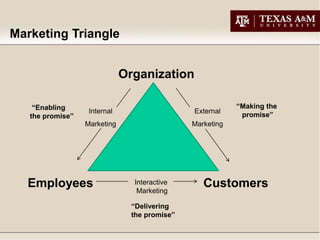
Marketing Triangle


                              Organization

    “Enabling                                              “Making the
                   Internal                    External
   the promise”                                             promise”
                  Marketing                    Marketing


  Employees                     Interactive
                                 Marketing
                                                  Customers
                                “Delivering
                                the promise”
Definitions

Internal Marketing is defined as:


 “The ongoing process whereby an organization aligns, motivates,
    and empowers employees at all levels to consistently deliver a
    positive customer experience that helps achieve business
    objectives.” Forum for People Performance Management and Measurement, Research Study,
     “Internal Marketing Best Practice Study,” 3, www.performanceforum.org as found in Stershic 2007 page 11.
Meet My Friend Howard Downer


ABT Brand Experience Commercial
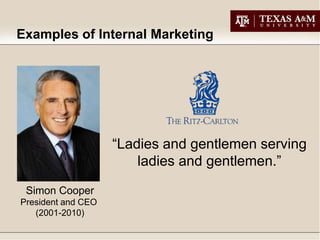
Examples of Internal Marketing


                    “Ladies and gentlemen serving
                        ladies and gentlemen.”
 Simon Cooper
President and CEO
   (2001-2010)
Examples of Internal Marketing


    Employees as
   “cast members”
Examples of Internal Marketing


• Do you have any examples from
  your own experience of good or
  bad internal marketing?
Handout


• Reading: “Don’t Neglect Internal Branding”
• Internal Marketing Mini-Audit
• Internal Marketing Resources
Reading


  “Don’t Neglect Internal Branding”
          by Steve McKee
Internal Marketing Mini Audit


                 Taking Care of the
               People who Matter Most.
                   A Guide to Customer Care.


     By Sybil F. Stershic
Internal Marketing Mini-Audit


 Instructions:
    To see how your organization stacks up, complete the following
    internal marketing mini-audit. Circle the number that best
    applies to each statement, and be as candid as possible. (For
    best results, I recommend you conduct and review this audit
    with others in your organization ranging from front-line staff to
    executive management. This will provide you with different
    perspectives on the need for internal marketing within your
    organization.)
Internal Marketing Mini-Audit


 Please Note:
    To make your answers to the mini-audit more meaningful, you
    may want to consider the specific unit (department, division, or
    branch) within your organization in which you have the most
    experience.
Internal Marketing Mini-Audit


Based on the scale outlined above, to what extent:

 1. Do employees know what is expected of them in helping your
    organization achieve its goals?
 2. Do employees really know and understand your customers?
 3. Are employees given the tools they need to perform
    effectively (information, training, equipment, etc.)?
 4. Does management proactively reinforce the importance of
    customers?
Internal Marketing Mini-Audit


5. Do all employees (not just those with direct customer
   contact) understand their impact on customers?
6. Is customer information shared throughout your
   organization (customer wants, needs, expectations,
   and perceptions)?
7. Are employees involved in improving customer
   satisfaction?
Internal Marketing Mini-Audit


8. Are employee’s efforts to take care of customer
   recognized?
9. Does your organization recognized “internal” customers
   (i.e., employees)?
10. Does communication flow openly throughout your
   organization (top-down, bottom-up, laterally)?
Conclusion


 1. Use internal marketing to improve
    external marketing
 2. Recognize the cost effectiveness of
    internal marketing
 3. Treat employees as customers
Final Thought on Internal Marketing


                    Everybody

                          Somebody
        Anybody

                          Nobody

Internal Marketing: The Missing Link in Strategy Implementation

  • 2.
    Internal Marketing: The Missing Link in Strategy Implementation Paul Busch Texas A&M University System Regents Professor Professor of Marketing July 14, 2012
  • 3.
    Overview 1. InternalMarketing: What is It? 2. Meet my friend Howard Downer 3. Reading: “Don’t Neglect Internal Branding” 4. Application Exercise: Internal Marketing Mini-Audit 5. Discussion/Conclusion
  • 4.
    Marketing Triangle Organization “Enabling “Making the Internal External the promise” promise” Marketing Marketing Employees Interactive Marketing Customers “Delivering the promise”
  • 6.
    Definitions Internal Marketing isdefined as: “The ongoing process whereby an organization aligns, motivates, and empowers employees at all levels to consistently deliver a positive customer experience that helps achieve business objectives.” Forum for People Performance Management and Measurement, Research Study, “Internal Marketing Best Practice Study,” 3, www.performanceforum.org as found in Stershic 2007 page 11.
  • 7.
    Meet My FriendHoward Downer ABT Brand Experience Commercial
  • 8.
    Examples of InternalMarketing “Ladies and gentlemen serving ladies and gentlemen.” Simon Cooper President and CEO (2001-2010)
  • 9.
    Examples of InternalMarketing Employees as “cast members”
  • 10.
    Examples of InternalMarketing • Do you have any examples from your own experience of good or bad internal marketing?
  • 11.
    Handout • Reading: “Don’tNeglect Internal Branding” • Internal Marketing Mini-Audit • Internal Marketing Resources
  • 12.
    Reading “Don’tNeglect Internal Branding” by Steve McKee
  • 13.
    Internal Marketing MiniAudit Taking Care of the People who Matter Most. A Guide to Customer Care. By Sybil F. Stershic
  • 14.
    Internal Marketing Mini-Audit Instructions: To see how your organization stacks up, complete the following internal marketing mini-audit. Circle the number that best applies to each statement, and be as candid as possible. (For best results, I recommend you conduct and review this audit with others in your organization ranging from front-line staff to executive management. This will provide you with different perspectives on the need for internal marketing within your organization.)
  • 15.
    Internal Marketing Mini-Audit Please Note: To make your answers to the mini-audit more meaningful, you may want to consider the specific unit (department, division, or branch) within your organization in which you have the most experience.
  • 16.
    Internal Marketing Mini-Audit Basedon the scale outlined above, to what extent: 1. Do employees know what is expected of them in helping your organization achieve its goals? 2. Do employees really know and understand your customers? 3. Are employees given the tools they need to perform effectively (information, training, equipment, etc.)? 4. Does management proactively reinforce the importance of customers?
  • 17.
    Internal Marketing Mini-Audit 5.Do all employees (not just those with direct customer contact) understand their impact on customers? 6. Is customer information shared throughout your organization (customer wants, needs, expectations, and perceptions)? 7. Are employees involved in improving customer satisfaction?
  • 18.
    Internal Marketing Mini-Audit 8.Are employee’s efforts to take care of customer recognized? 9. Does your organization recognized “internal” customers (i.e., employees)? 10. Does communication flow openly throughout your organization (top-down, bottom-up, laterally)?
  • 19.
    Conclusion 1. Useinternal marketing to improve external marketing 2. Recognize the cost effectiveness of internal marketing 3. Treat employees as customers
  • 20.
    Final Thought onInternal Marketing Everybody Somebody Anybody Nobody