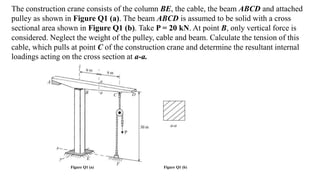
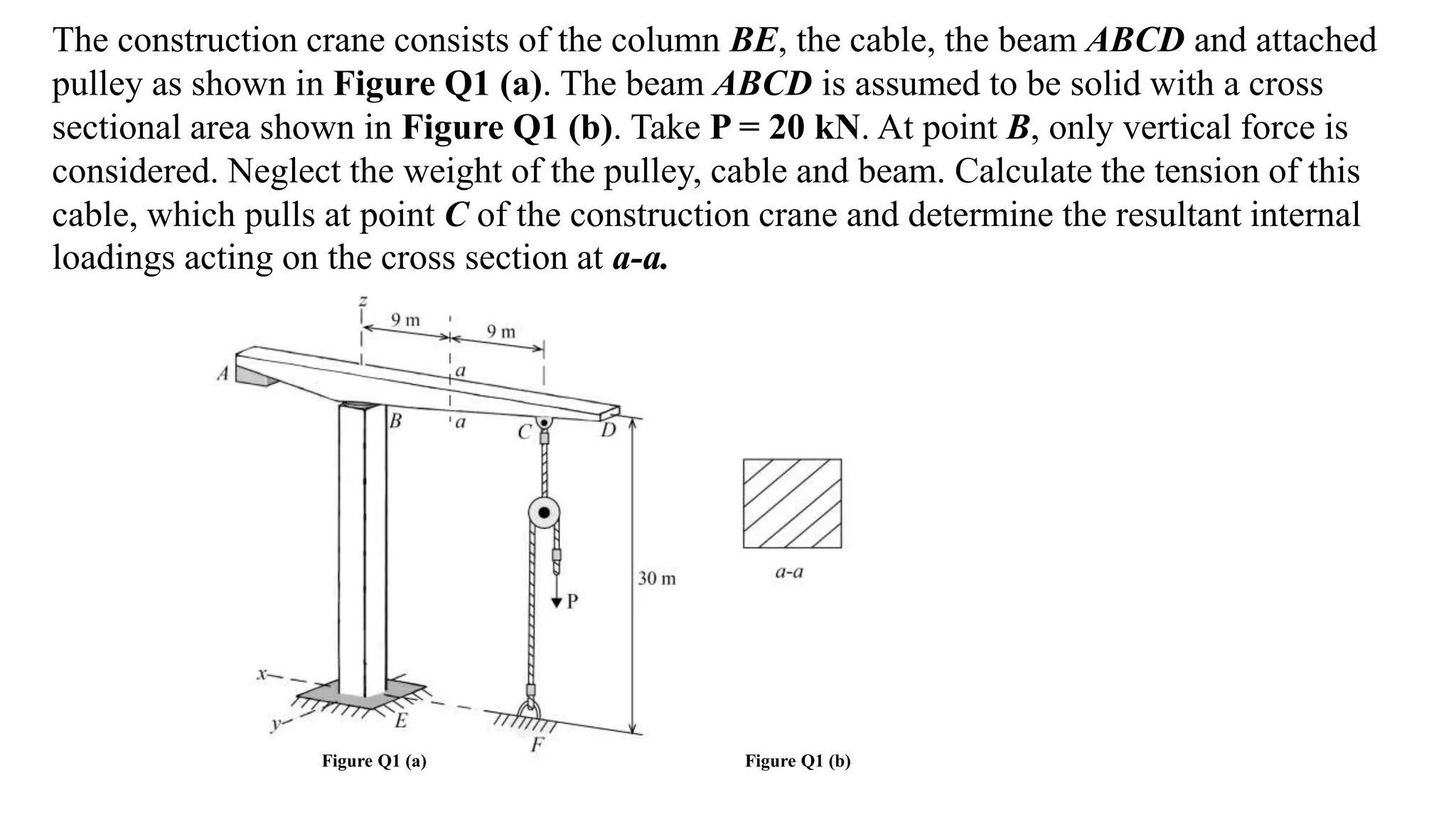
The construction crane consists of the column BE, the cable, the beam ABCD and attached
pulley as shown in Figure Q1 (a). The beam ABCD is assumed to be solid with a cross
sectional area shown in Figure Q1 (b). Take P = 20 kN. At point B, only vertical force is
considered. Neglect the weight of the pulley, cable and beam. Calculate the tension of this
cable, which pulls at point C of the construction crane and determine the resultant internal
loadings acting on the cross section at a-a.
Figure Q1 (a) Figure Q1 (b)
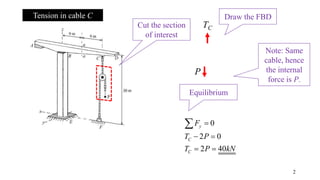
Cut the section
of interest
0
2 0
2 40
y
C
C
F
T P
T P kN

 
 

Draw the FBD
Equilibrium
TC
P
2
Note: Same
cable, hence
the internal
force is P.
Tension in cable C
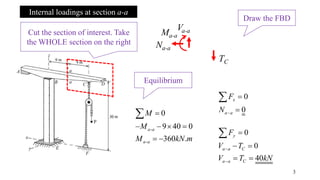
Cut the section of interest. Take
the WHOLE section on the right
0
0
40
y
a a C
a a C
F
V T
V T kN



 
 

Draw the FBD
Equilibrium
Va-a
Na-a
Ma-a
-
-
0
9 40 0
360 .
a a
a a
M
M
M kN m

   
 

TC
0
0
x
a a
F
N 



3
Internal loadings at section a-a
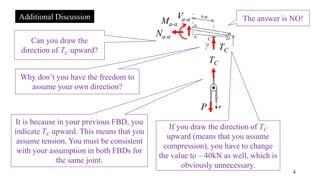
Can you draw the
direction of TC upward?
The answer is NO!
Why don’t you have the freedom to
assume your own direction?
Va-a
Na-a
Ma-a
TC
4
It is because in your previous FBD, you
indicate TC upward. This means that you
assume tension. You must be consistent
with your assumption in both FBDs for
the same joint.
TC
P
If you draw the direction of TC
upward (means that you assume
compression), you have to change
the value to – 40kN as well, which is
obviously unnecessary.
Additional Discussion
?
5
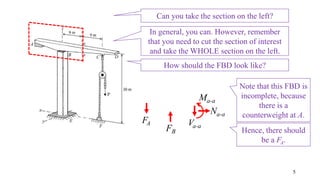
Can you take the section on the left?
In general, you can. However, remember
that you need to cut the section of interest
and take the WHOLE section on the left.
How should the FBD look like?
Va-a
Na-a
Ma-a
FB
Note that this FBD is
incomplete, because
there is a
counterweight at A.
Hence, there should
be a FA.
FA
6
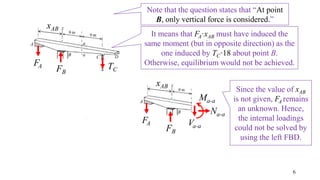
Note that the question states that “At point
B, only vertical force is considered.”
It means that FA·xAB must have induced the
same moment (but in opposite direction) as the
one induced by TC·18 about point B.
Otherwise, equilibrium would not be achieved.
Since the value of xAB
is not given, FA remains
an unknown. Hence,
the internal loadings
could not be solved by
using the left FBD.
Va-a
Na-a
Ma-a
FB
FA
TC
FA
FA
FB
xAB
xAB

Internal loadings

  • 1.
    The construction craneconsists of the column BE, the cable, the beam ABCD and attached pulley as shown in Figure Q1 (a). The beam ABCD is assumed to be solid with a cross sectional area shown in Figure Q1 (b). Take P = 20 kN. At point B, only vertical force is considered. Neglect the weight of the pulley, cable and beam. Calculate the tension of this cable, which pulls at point C of the construction crane and determine the resultant internal loadings acting on the cross section at a-a. Figure Q1 (a) Figure Q1 (b)
  • 2.
    Cut the section ofinterest 0 2 0 2 40 y C C F T P T P kN       Draw the FBD Equilibrium TC P 2 Note: Same cable, hence the internal force is P. Tension in cable C
  • 3.
    Cut the sectionof interest. Take the WHOLE section on the right 0 0 40 y a a C a a C F V T V T kN         Draw the FBD Equilibrium Va-a Na-a Ma-a - - 0 9 40 0 360 . a a a a M M M kN m         TC 0 0 x a a F N     3 Internal loadings at section a-a
  • 4.
    Can you drawthe direction of TC upward? The answer is NO! Why don’t you have the freedom to assume your own direction? Va-a Na-a Ma-a TC 4 It is because in your previous FBD, you indicate TC upward. This means that you assume tension. You must be consistent with your assumption in both FBDs for the same joint. TC P If you draw the direction of TC upward (means that you assume compression), you have to change the value to – 40kN as well, which is obviously unnecessary. Additional Discussion ?
  • 5.
    5 Can you takethe section on the left? In general, you can. However, remember that you need to cut the section of interest and take the WHOLE section on the left. How should the FBD look like? Va-a Na-a Ma-a FB Note that this FBD is incomplete, because there is a counterweight at A. Hence, there should be a FA. FA
  • 6.
    6 Note that thequestion states that “At point B, only vertical force is considered.” It means that FA·xAB must have induced the same moment (but in opposite direction) as the one induced by TC·18 about point B. Otherwise, equilibrium would not be achieved. Since the value of xAB is not given, FA remains an unknown. Hence, the internal loadings could not be solved by using the left FBD. Va-a Na-a Ma-a FB FA TC FA FA FB xAB xAB