Intermittent exotropia
By
Dr Indeevar Mishra
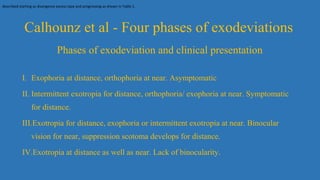
Calhounz et al - Four phases of exodeviations
Phases of exodeviation and clinical presentation
I. Exophoria at distance, orthophoria at near. Asymptomatic
II. Intermittent exotropia for distance, orthophoria/ exophoria at near. Symptomatic
for distance.
III.Exotropia for distance, exophoria or intermittent exotropia at near. Binocular
vision for near, suppression scotoma develops for distance.
IV.Exotropia at distance as well as near. Lack of binocularity.
described starting as divergence excess type and progressing as shown in Table 1.
Classification Systems
• Intermittent exotropia has been divided into four
groups*
1.Basic Intermittent exotropia
2.Divergence Excess
3.Convergence Insufficiency
4.Simulated or Pseudo-divergence Excess
Burian HM, Spivey BE. The surgical management of exodeviations. Am J
Ophthalmol 1965;59:603-620
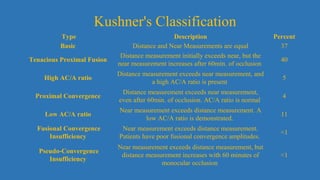
Kushner's Classification
Type Description Percent
Basic Distance and Near Measurements are equal 37
Tenacious Proximal Fusion
Distance measurement initially exceeds near, but the
near measurement increases after 60min. of occlusion
40
High AC/A ratio
Distance measurement exceeds near measurement, and
a high AC/A ratio is present
5
Proximal Convergence
Distance measurement exceeds near measurement,
even after 60min. of occlusion. AC/A ratio is normal
4
Low AC/A ratio
Near measurement exceeds distance measurement. A
low AC/A ratio is demonstrated.
11
Fusional Convergence
Insufficiency
Near measurement exceeds distance measurement.
Patients have poor fusional convergence amplitudes.
<1
Pseudo-Convergence
Insufficiency
Near measurement exceeds distance measurement, but
distance measurement increases with 60 minutes of
monocular occlusion
<1
• Positive family history*
• Maternal smoking#
• Low birth weight#
• Craniofacial anomalies and neurologic
defects
* Burian HM, Spivey BE. The surgical management of
exodeviations. Am J Ophthalmol 1965;59:603-620
# Chew E, Remaley NA, Tamboli A, et al: Risk factors for
esotropia and exotropia. Arch Ophthalmol 1994;112:1349-
1355.
Genetics and Risk factors
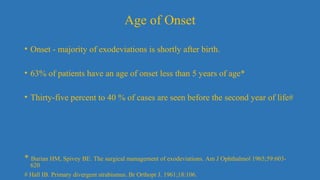
Age of Onset
• Onset - majority of exodeviations is shortly after birth.
• 63% of patients have an age of onset less than 5 years of age*
• Thirty-five percent to 40 % of cases are seen before the second year of life#
* Burian HM, Spivey BE. The surgical management of exodeviations. Am J Ophthalmol 1965;59:603-
620
# Hall IB. Primary divergent strabismus. Br Orthopt J. 1961;18:106.
Sex Distribution
• A preponderance of female
patients.
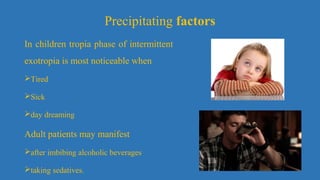
Precipitating factors
In children tropia phase of intermittent
exotropia is most noticeable when
Tired
Sick
day dreaming
Adult patients may manifest
after imbibing alcoholic beverages
taking sedatives.
Symptoms
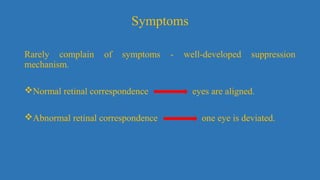
Rarely complain of symptoms - well-developed suppression
mechanism.
Normal retinal correspondence eyes are aligned.
Abnormal retinal correspondence one eye is deviated.
I. Transient Diplopia
II. Asthenopic symptoms (eyestrain, blurring, headache and difficulty
with prolonged periods of reading)
III. Micropsia:
IV. Diplophotophobia
Thank you!!!

Intermittent exotropia

  • 1.
  • 2.
    Calhounz et al- Four phases of exodeviations Phases of exodeviation and clinical presentation I. Exophoria at distance, orthophoria at near. Asymptomatic II. Intermittent exotropia for distance, orthophoria/ exophoria at near. Symptomatic for distance. III.Exotropia for distance, exophoria or intermittent exotropia at near. Binocular vision for near, suppression scotoma develops for distance. IV.Exotropia at distance as well as near. Lack of binocularity. described starting as divergence excess type and progressing as shown in Table 1.
  • 3.
    Classification Systems • Intermittentexotropia has been divided into four groups* 1.Basic Intermittent exotropia 2.Divergence Excess 3.Convergence Insufficiency 4.Simulated or Pseudo-divergence Excess Burian HM, Spivey BE. The surgical management of exodeviations. Am J Ophthalmol 1965;59:603-620
  • 4.
    Kushner's Classification Type DescriptionPercent Basic Distance and Near Measurements are equal 37 Tenacious Proximal Fusion Distance measurement initially exceeds near, but the near measurement increases after 60min. of occlusion 40 High AC/A ratio Distance measurement exceeds near measurement, and a high AC/A ratio is present 5 Proximal Convergence Distance measurement exceeds near measurement, even after 60min. of occlusion. AC/A ratio is normal 4 Low AC/A ratio Near measurement exceeds distance measurement. A low AC/A ratio is demonstrated. 11 Fusional Convergence Insufficiency Near measurement exceeds distance measurement. Patients have poor fusional convergence amplitudes. <1 Pseudo-Convergence Insufficiency Near measurement exceeds distance measurement, but distance measurement increases with 60 minutes of monocular occlusion <1
  • 5.
    • Positive familyhistory* • Maternal smoking# • Low birth weight# • Craniofacial anomalies and neurologic defects * Burian HM, Spivey BE. The surgical management of exodeviations. Am J Ophthalmol 1965;59:603-620 # Chew E, Remaley NA, Tamboli A, et al: Risk factors for esotropia and exotropia. Arch Ophthalmol 1994;112:1349- 1355. Genetics and Risk factors
  • 6.
    Age of Onset •Onset - majority of exodeviations is shortly after birth. • 63% of patients have an age of onset less than 5 years of age* • Thirty-five percent to 40 % of cases are seen before the second year of life# * Burian HM, Spivey BE. The surgical management of exodeviations. Am J Ophthalmol 1965;59:603- 620 # Hall IB. Primary divergent strabismus. Br Orthopt J. 1961;18:106.
  • 7.
    Sex Distribution • Apreponderance of female patients.
  • 8.
    Precipitating factors In childrentropia phase of intermittent exotropia is most noticeable when Tired Sick day dreaming Adult patients may manifest after imbibing alcoholic beverages taking sedatives.
  • 9.
    Symptoms Rarely complain ofsymptoms - well-developed suppression mechanism. Normal retinal correspondence eyes are aligned. Abnormal retinal correspondence one eye is deviated.
  • 10.
    I. Transient Diplopia II.Asthenopic symptoms (eyestrain, blurring, headache and difficulty with prolonged periods of reading) III. Micropsia: IV. Diplophotophobia
  • 13.