a > b
.
perfect Compte -
.
MRTX . ,×z=maxamt
Strictly preferred merits :
fixed ratios of good Zthatcan
a Ib
U=mih(
ax , ,bXz ) purchase WII unit
weakly preferred
.
perfect subs :
reduction in
good 't ,
a is atleast as good total amount negslopeof budget
as b
U=aX
,
tbxz line ,
Px .
/p× a
a~b
.
MRS , , ,×z= the .
Optimal bundle :
indifferent Max amount of MRSAPEMRTAB .
Or
.
Complete : either Good 2 to be given at kink ,
or corner
xdyoryhorbothupfor1moreof.HU/p,7V2/pz-s
.
Symmetric :
similar good 1. the
neg . of Spend more on X ,
to indifference the derivative of -
diminishing MRS :
-
transitive :ifXdy indifference curve
strictly convex ,
more
E.
yd 2. then Xd 2 Xz=fCX ,
) ,
'/MRS×a,×,
Of
good compared to
.
locally nonsatiated : =
U , 102 other ,
less
"
Valuable
"
no bliss point
.
Utility Function :
.
Lagrangian :
.
Monotonicity :
more X1yiff UNRULY ) 1. L= UH . ,xzHXLgCx ) )
is preferred DUIDHLO →
decreasing
2942×942×2,24×3=0
.
Strict convexity : dUldH70→ increasing 3. Solve for X
X 12,412 ,
then monotonic 4. X. =
f C Xz )
XX t LI -
a) y
> 2
.
Monotonic Trans -
5.
Plug into Mx
.
rational :
complete formations : same 6. Solve for Xz
and transitive preferences L derma -
Complements
.
indifference curve :
five must be positive )
equally desirable
.
Cobb -
douglas :
( w/ rational ,
mono -
U= X.
a
Xz
' -
a
tonic ,
E convex pref -
MRSx.x.FM/u.asxzerencesmustbethin.Asa-
1. x. →
important Substitutes
non -
increasing ,
non -
.
Budget Line :
set of
crossing , preferred all bundles that causes
farther from origin , an individual to
convex E. everywhere ) spend all income
-
Individual demand curve :
the graphical 3. To find EV ,
.
Steps to determine optimal decision under
relationship btw p ,
EX ,
when
optimizing
i. Calculate Utility of new bundle Wnew ) uncertainty
When U ( X )=XFXzLl
-
a )
Over
budget set x.
= a.
¥.
×z=u -
as .
¥ ii. Solve for X.
equiv
and Xzequiv I. Determine the possible States of the world
L= ULXITXCI -
pix ,
-
pzxz ) ( Mlk , 1MHz ) =
Pxilpxz 2. Under each state , determine the
-
Law of demand : If p.lv ,
then X. T Uncw =
ULX , ,
Xz )
t
Use Old prices wealth the individual would have
If ¥170 ,
Law of demand holds iii. Solve for compensated income 3. Setup expected utility
.
Engle Curve :
function that shows an
I
equiv =p ,
orig
X.
equivtpzxzequivEU-p.ULX.lt/2zULXzlti..tpnULXn
)
individual 's demand fora good at diff .
iv. EV= I equiv
-
long 4. Take first order conditions ) of EU
Levels of income 3. TO find CV ,
function wrtthevariablels ) the individual
-
Elasticity A. B
:
EA ,
, , elasticity of A Wrt
i. Calc .
Orig utility ( Uorig ) can choose
B ,
B elasticity of A. the f.
change in
ii. Solve for Xsubsdaysubs 5. Solve for variables ) to determine the
A that results from a I 't
change in B t.MU//MUy)=px1py choice that would maximize EU
Uorig =
ULX , y )
-
Risk Adverse : avoid an even bet , dislike
EA ,B=fF3 .
Ben = -
BF iii. Solve for compensated income risk 's would
pay to avoid it ,
ULX ) is strictly
.
magnitude Of Ea , B
→
whether effect Of
lump =
phew Xsubtpyysub concave ,
U'
'
LN LO
B becomes
"
magnified
"
( IEA ,
13171 ) or iv. C ✓ =/ orig
-
lamp
.
Risk Neutral : indifferent to even bet .
"
dampened
"
( IEA ,
BILL ) as it Changes A
CVEEV can be used to evaluate policies .
indifferent to risk da wouldn't pay to
.
sign of EA.rs →
A moves in same l t ) Or Ex :
subsidy cost SIX E. est . sum of society 's avoid it .
UCX ) is linear ,
U'
'
C XI=0
opposite ( -
) direction as B CVIEV is Sly →
inefficient if $4 > SIX
.
Risk Loving : would take an even bet ,
like
-
Demand Elasticity :
Ex , ,
.
Marginal Rate of Time Preference :
risk 's would pay for a gamble ,
ULX ) is
-
Own Price Demand Elasticity :E x. p
1. The rate at which a consumer is willing to concave ,
U'
'
LX ) > O
If law of demand holds ,
Ex ,pL0 substitute current consumption for future
.
Risk Premium : the amount Less than EV
If IEx.pl > I →
elastic ,
< I →
inelastic ,
=l→ consumption a consumer would accept in exchange
unit elastic ( where rev . Maximized ) 2. MRS x. ixz When X ,
is con .
today and for the lottery
Cobb -
Douglas :
-
I Xz is con .
tomorrow 2. the
' '
fee
"
paid to avoid risk inherent
.
Cross Price Elasticity of Demand :
Ex ; ,pj
Usually MRSX . ,xz
> I ( impatient ) to the lottery
Exi , pj
LO →
complements
↳ U=X9 '
XYZ Where a ,
> Az 3. The value ,
r ,
such that ULEV -
r )=EU
Exi , pj > O → substitutes
* Need Units of money insametimeper .
where EU is the expected utility of the
-
Income Demand Elasticity :E x. I
lntom .
's $
, budget constraint :
lottery
E x. I
> O →
normal
( Iti )IitIz= L Iti )XitX2 .
To solve for risk premium :
Ex ,
ISO →
inferior
'
Marginal Rate of Intertemporal Trans :
I. solve for Ev
MRT× , ,×z= Iti (
"
luz =
Iti ) 2. Solve for EU.
Substitution Effect :
the Change in an
.
L=UL× , ,×z)t×uHilI ,
+
Iz
-
Lltilx ,
-
Xz ) 3. plug into equation ,
ULEV -
r )=EU .
E
individual 'S consumption Of a
good due
.
Human capital production Function : a
solve for r
to the fact the relative prices have Changed math function describing how consumption
U , Uz ) U ,
s -
s -
-
= -
good I
pm,
) ¥22 Purchase more
today affects future income .
1. Find optimal bundle before
.
z Draw new
budget line
p , pz
becomes of good 1
price change
cheaper -
Intertemporal Utility Maximization with
" -
" -
.
Income Effect :
change in consumption -
-
human capital development 's access to s -
s -
Of a good due to
change in budget set ,
n n
controlling for substitution effect
financial markets :
go , go ,
-1€,
-
Compensated budget line : shows all
1. Maximize Lifetime Income subject to
,
:
y
, .
,
:
y
↳
bundles an individual can afford at new
human cap . constraint .
, .
.
2. Max lifetime Utility subject to
making
. i . . i . . .
orig . .
. i . . i . .
loris. .
I 2 3 4 S I 2 3 4 S
prices assuming they were compensated SO rig good , rig Good '
Max amount Of lifetime income s -
3. Find optimal bundle after s -
4. To calc . W .
shift new
they can afford Orig . level Of happiness
Ex : constraint :
zoo -2×12×22 ,
i 10%0=+1213×2113
-
price change
-
budget line until it is
Any changes in optimal bundle must be
4 -
4 -
tangent to original
L =
( 1. 1) X. t Xztx ( 300-2×12 -
X } ) -
- indifference curve
due to
change in prices C Sub .
effect ) s -
s -
X. =
7.52×2=13.67 N
N
.
Giffen Good :
a good that is inferior 's o
-
o
-
f- X ,
"3Xz"3tX( ( 1.174.523+13.67 -
I. IX ,
-
Xz )
802! 802-•
ewtiescincmmag
.EE#Es9Fwdo:tYumsan3nx.=issoxz=isi
.
.
Lottery : Bundle of goods ( X , ,Xz ,
. . .
,
Xn )
-
I
-
• -
Bhim
.
I I I I l
-
l l
toricI I
, , , ,
I, ,
I
, orig , ,
-
Compensating Variation :
amount Of
w/ a lottery ( p , , pz ,
. . .
, pm ) rig
' Z
gig?
" s
n
.ge#ebcti3eIIgIEIew3
4 s
income someone would be willing to give
s -
s -
Good '
I .
p ,
t
pzt
. . .
t
pm =/ -
5. Label intersection
.
4. To calc EV ,
shift Blorig
Up ( need ) after a price reduction ( increase
,
z .
pizo
4 -
Of BLUEY -
axis ,
4 .
until itistangenttolnew
.
"
Xznew
"
G Blcompda
to maintain Utility before change y-axis as
"
xzcomp
"
-
3.
pi is the prob . of receiving bundle Xi , -
6.
CV=p{
Xznew
-
Xzcomp ) 3
-
new price ,
Old utility Level .
Degenerate lottery : all prob .
on I outcome
o -
512-1.25=3.75 -
-
.
equivalent variation : amount of income
.
expected value :p ,×,+pz×z+
. . .
+
pn× ,
I÷÷u¥•§↳;§o,
.§ ,a consumer would need ( be willing to give
.
Mixing :
Given 2 lotteries Lp , , Pz ,
. . .
. pm ) E =
i -
a
-
•
I Blcoymp
-
IBLequiv
I new
Up ) before a price reduction ( increase ) to ( t , ,tz ,
. .
.tn ) and OLXLI ,
a MIX Of . . . . . .
Kris. .
, , .
Kori. ,
iorig.
?rig
I
Zxcompxnew
} 4 S
I 2
=
3 4 S
give the same level of utility as after the these 2 lotteries is the new
lottery
:
good ,
rig
yoga,
S -
5. Label intersection of
> rice
change
( AP .tl/-X)ti,XPztll-X)t2 ,
. . .
, April ' -
d) th )
n
-
Blom .gg y-axis
"
xzorig
"
's Sub .
Effect :X sub
-
Xorig/
Old prices ,
new utility
.
Independence : If lottery PI lottery q E I
" -
Bleauivday -
axis as Income Effect :X new
-
Xsubs
or -
"
Xz equiv
' '
CV=pz( Xznew
-
Xzcomp ) both are Mixed with lottery tither lottery
xzeausi-6.eu-pzlxzeauiu-xzon.gl
s I
2178
p is still preferred to lottery q
- Scs -23 .
-
s
EV =
Pz (
Xzequiv
-
Xzorig ) xzorig -
Find CVEEV mathematically
.
Expected Utility Theorem : VNM Can be
2
,
;
¥
,
Yg ,
1. Use Lagrangian to find optimal bundle interpreted as the cardinal Utility received .
Iaea
"
s
>
i i ,
Phon, ,
Iorio, , ( giffen
before price change
→ X
orig
from good I such that ( p , , Pz ,
. . .
, Pm ) I
rig
, z
Inns4 s
I
ICO
2. Use Lagrangian to find optimal bundle ( q , ,qz ,
. . .
, qn ) Iff p . U , tpzuzt
. . .
tpnun
Good '
III > 151
after price change → Knew Iq ,
U , tqzuzt
. . .
tqnvn
Production Fundamentals
'
Cost minimizing input blend :
f '
Az =
W'
lwz
'
Production Function :
y
= f CX . , Xz ,
. . .
,
Xn ) is the ( if using both goods )
amount of output , y ,
that can be
efficiently .tk/Wk=f4WL L
marginal productivity per
produced using X . . Xz ,
. . .
,
Xn dollar spent )
.
Efficient Production :
given inputs ,
firm produces Cost Minimization
largest amount of output possible
.
L =
W , X ,
t
Wz Xz t X ( q
-
f- LX , ,
Xz )
.
NO free lunch :
impossible to produce output
-
Factor Demand Function :
specifies
w/o using inputs relationship btw
prices of input goods ,
'
Possibility of inaction :
Xi 20 quantity of output produced . E amount
'
Free disposal :
inputs can be disposed of at no Of an input good a firm will select
cost ; dfldxi O for every input
.
Total Cost =
w , X , t Wzxz
.
Decreasing Returns to scale :
a production set
.
Cost Function :
Clq ,
w , , wz ) =
displays decreasing returns to scale if fctxlctfcx ) W , X ,
( q .
W , ,
Wz ) t Wz Xz ( q ,
w , ,
Wz )
for all t 71 Where Xn ( q . W .
,
Wz ) are the firm 'S
.
Increasing Returns to Scale :
f Ctx ) > tf Cx ) factor demand functions
.
Constant Returns to Scale : f Lt X ) =
tf Cx )
.
Market Demand Function :
sum of
'
Cobb -
Douglas Production Function : FCK ,
L ) = aka L
's
individual demand functions ( be
↳
If a t BC I →
decreasing careful of corner solutions ! )
↳ If a t B > I →
increasing Profit Maximization
-
Fixed Proportions Production Function :
.
IT L p ) =p Dcp ) -
C L Dcp ) )
f Lk ,
L ) =
min Lak ,
BL )
.
IT ( q )
=p L q ) q
-
C Cq )
.
Linear Production Function :
perfect subs ,
'
IT =p ( q )
q
-
C Cq ) Marginal
f- C K ,
L ) =
a K t
BL
=
Req ) -
C C q ) Revenue =
.
No monotonic transformations for production R
'
( q ) -
C
'
( 91=0 Marginal
functions ! R
'
( q ) =
C
'
(
q ) Cost
.
15090 ants :
graphical set of bundles that allow
.
DIT 1dg =p C q ) t
p
'
( q )
q
-
C
'
( q ) =
O
a firm to produce the same level of output
.
Marginal Rate of Technical substitution
'
lE÷pI=
-
¥
-
To =
=L
( MRTS × , , xz ) :
Max amount of input 2 firm .
p =
MC ( Markup
=
¥ )
would be willing to give up to get one more of
input I while
keeping total output the same ;
.
Profit w/ Fixed Prices :
(
negative of ) derivative of
isoquant Xz=fCx ,
) ; IT L q ) =
pq
-
C Cq )
MRTS a , B
=
fa
HB Lfa:
marginal productivity Wrt
Al p = MR = MC
.
ISO cost Line :
graphical set of input good
'
Market Supply Function Scp ) :
sum of
bundles that cost the same amount individual supply functions
.
Factor Price Ratio btw Input I da Input 2 :
.
Market Price in PC
amount of input 2 the firm must give up
1
.
Solve for each consumer 's demand
to
get one more of input I I maintain function for the specified good
the same cost level ; L
negative of ) the slope 2 .
Find market demand
of the boost line w/ input I on x
-
axis ;
if 3. Solve for q each firm will produce at
prices are fixed da
nothing is
being given a given price
away for free =
w '
lwz 4 . Find market supply
5 . Find p where Qs =
QD
.
Der feet Price Discrimination : firm 1. Determine firm 's profit function
sells each unit at maximum amount as function of quantity Cor price ) .
Cournot game ex
each customer is willing to pay IT =
q , p ,
t
qzpz
-
C ( q ,
t
ga )
-
producers get all surplus ,
more units 2. Take first order condition Wrt
MC for each firm :
$2
sold than w/o price disc rim .
,
more both quantity L price ) variables
p ( Q ) = 10 -
Q
total surplus generated ,
MR re pre
- 3 .
Solve for profit maximizing prices
sent ed by demand curve L quantities ) IT ,
= ( 10 -
q ,
-
q z
) q ,
-
29 ,
.
Non -
linear price discrimination :
price
4 .
Plug into market demand to
IT z
=
( 10 -
q ,
-
q z
) q z
-
Zqz
varies w/ quantity purchased but all determine profit maximizing prices
consumers purchasing the same low anti ties ) DIT , 1dg ,
=
8 -
of z
-
2g ,
= O
quantity pay the same price
5 . Plug into profit function to find
q ,
*
= ( q .
q y , 2
-
used when it is difficult to identify profit Level 2
or illegal to
charge different prices
'
Dominant Strategy :
an action that ditz ldqz = 8 -
q ,
-
292=0
to groups w/ highest WTP provides a higher payoff regardless
qz* , L q -
q ,
) , z
-
Block Pricing : firms choose one
price
Of how an opponent plays
→ if any
for the first few units E another price player has a dominant strategy , a
q ,
=
( 8 -
L 8 -
q ,
) 12 ) 12
for subsequent units
dominant strategy solution exists
zq ,
=
q -
4 +I q ,
=
4+ I q ,
1. Determine firm 's profit function as
.
l Strictly ) Dominated Strategy :
an
function of quantity 2 block a action that always provides a lower 3/2 q ,
T
4
IT pl of ,
) q ,
t
plqz ) ( q z
-
q ,
) -
C ( q z
) payoff than another possible action
q ,
= 4 .
I =
8/3
2. Take first order condition Wrt both regardless of how the player 's
quantity variables opponents play q z
= 8/3
3. Solve for quantity variables
.
Nash Equilibrium : set of
strategies .
Subscription G unit price EX
4. Plug into market demand to find Such that no
player has an incentive
profit maximizing prices to unilaterally deviate 9 ,
=
6 -
p
S .
Plug into profit function to find
.
Prisoner 's Dilemma :
players have a
q z
=3 -
O . 5 p no MC
profit level dominant Strategy to cheat , preventing
-
firms must be able to prevent beneficial cooperation
lower demander :
q z
resale G must have market power ,
.
Coordination Games :
multiple Nash p
PS increases ,
CS decreases .
more Equilibria exist ,
each corresponding 6 -
units sold than w/o price disc rim ,
to each player doing what the other
more total surplus ,
W/ more blocks players are doing p
-
p
can approach efficient outcome -
"
pushing
"
a coordination game into D
.
2 Part Tariff :
charge lump sum a
' '
good
"
equilibrium can be achieved 3- .
's p
Q ,
subscription fee ,
S ,
for the
right to through costless expectations ; however ,
buy all ; unit prices ,
u ,
are uniform
players must believe
you are willing to
CS z
= I ( 6 -
p ) ( 3
-
.
5
p )1. Calculate consumer surplus as a
pay if the equilibrium doesn't occur
function of u for the lower -
Hawk I Dove Games :
multiple Nash IT =
25 t
pg .
t
pqz
-
C Cq , tqz )
demanding customer .
Set this
Equilibria exist ,
each corresponding to
equal to s .
one player being
"
strong
"
and the
=
L 6 -
p ) ( 3- .
Sp ) t
p ( 6 -
D )
2. Determine profit function as a
other being
' '
weak
"
( opposite actions ) t
p ( 3- . Sp )
-
O
function of U -
To be a hawk ,
commit irreversibly to
IT = 25 t
09 ,
t
Uqz
-
C Cq ,
t
q z
) the
strong position
=
I 8 t 3 p
-
P2
3. Take the first order condition -
if the
game is repeated L both d IT Idp =3 -
213=0Wrt U
players are stubborn ,
consider a
4. Solve for profit -
maximizing u p = 3/2
5. Plug U into demand functions to
compromise
.
Steps to solve for the NE of a 2
q ,
= 6 -
I .
5 = 4 .
5
determine profit -
maximizing quantities
player continuous
game
6. Plug into profit function to find
qz =3 -
.
5 ( I .
S ) =
2 .
25
I .
For player I ,
derive player I 's best
profit level
response LBR ) for each possible S =
.
5 ( 6 -
I .
S ) L 3- .
SLI .
S ) ) = 5-
firms must be able to prevent resale .
strategy of
player 2
must have market power E identify 1000 of each type →
customer WTP types ,
firms charge
2 .
For
player 2 .
derive player 2 's BR for
user fee equal to consumer surplus
each possible strategy of player I Max fixed cost ?
of lower demander ,
When demand
3 .
Find the set of
Strategies that Sim Ulta -
1000 ( g + 1. g ( 4. s ) ) +
types are similar firms
charge low newly solves the BR functions
U and high S ,
when demand types
-
Cournot Game :
firms produce identical 1000 ( S t I .
S L 2 .
25 ) ) =
20125
are different firms
charge high u goods ,
firms commit irreversibly to a
and low S , producer doesn't certain quantity level ,
when qt pt ,
extract all surplus
each firm is profit maximizing
.
Tie in Sales : in order to buy one
.
Bertrand game
:
each firm sets prices ;
item ,
customer must buy another the firm that has the lowest price gets
.
Group Price Discrimination :
price all customers ; if they have identical
varies by group ,
used when difficult
prices, they share customers 50150
to price on individual WTP but can
determine avg WTP for a group

Intermediate Microeconomics Cheat Sheets

  • 1.
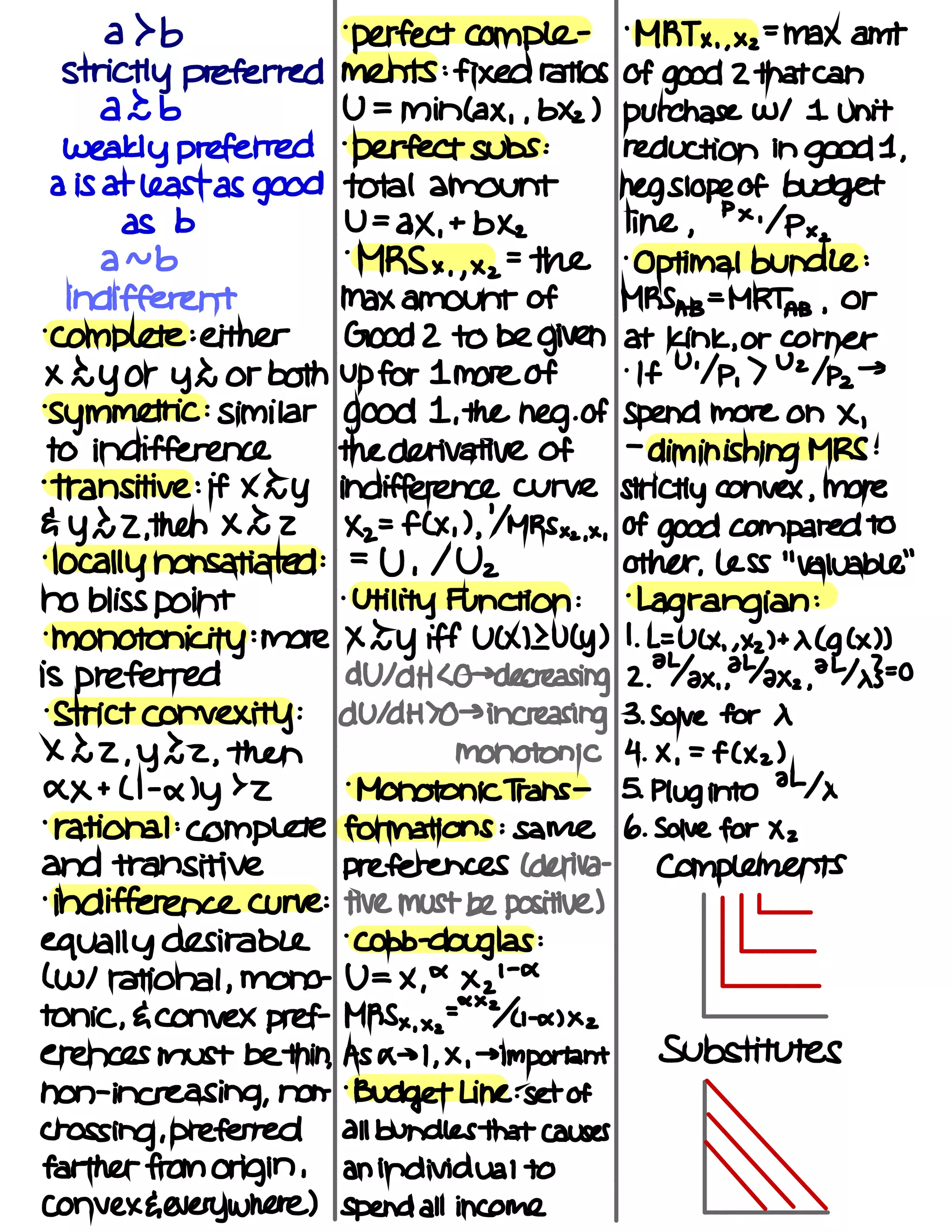
    a > b . perfectCompte - . MRTX . ,×z=maxamt Strictly preferred merits : fixed ratios of good Zthatcan a Ib U=mih( ax , ,bXz ) purchase WII unit weakly preferred . perfect subs : reduction in good 't , a is atleast as good total amount negslopeof budget as b U=aX , tbxz line , Px . /p× a a~b . MRS , , ,×z= the . Optimal bundle : indifferent Max amount of MRSAPEMRTAB . Or . Complete : either Good 2 to be given at kink , or corner xdyoryhorbothupfor1moreof.HU/p,7V2/pz-s . Symmetric : similar good 1. the neg . of Spend more on X , to indifference the derivative of - diminishing MRS : - transitive :ifXdy indifference curve strictly convex , more E. yd 2. then Xd 2 Xz=fCX , ) , '/MRS×a,×, Of good compared to . locally nonsatiated : = U , 102 other , less " Valuable " no bliss point . Utility Function : . Lagrangian : . Monotonicity : more X1yiff UNRULY ) 1. L= UH . ,xzHXLgCx ) ) is preferred DUIDHLO → decreasing 2942×942×2,24×3=0 . Strict convexity : dUldH70→ increasing 3. Solve for X X 12,412 , then monotonic 4. X. = f C Xz ) XX t LI - a) y > 2 . Monotonic Trans - 5. Plug into Mx . rational : complete formations : same 6. Solve for Xz and transitive preferences L derma - Complements . indifference curve : five must be positive ) equally desirable . Cobb - douglas : ( w/ rational , mono - U= X. a Xz ' - a tonic , E convex pref - MRSx.x.FM/u.asxzerencesmustbethin.Asa- 1. x. → important Substitutes non - increasing , non - . Budget Line : set of crossing , preferred all bundles that causes farther from origin , an individual to convex E. everywhere ) spend all income
  • 2.
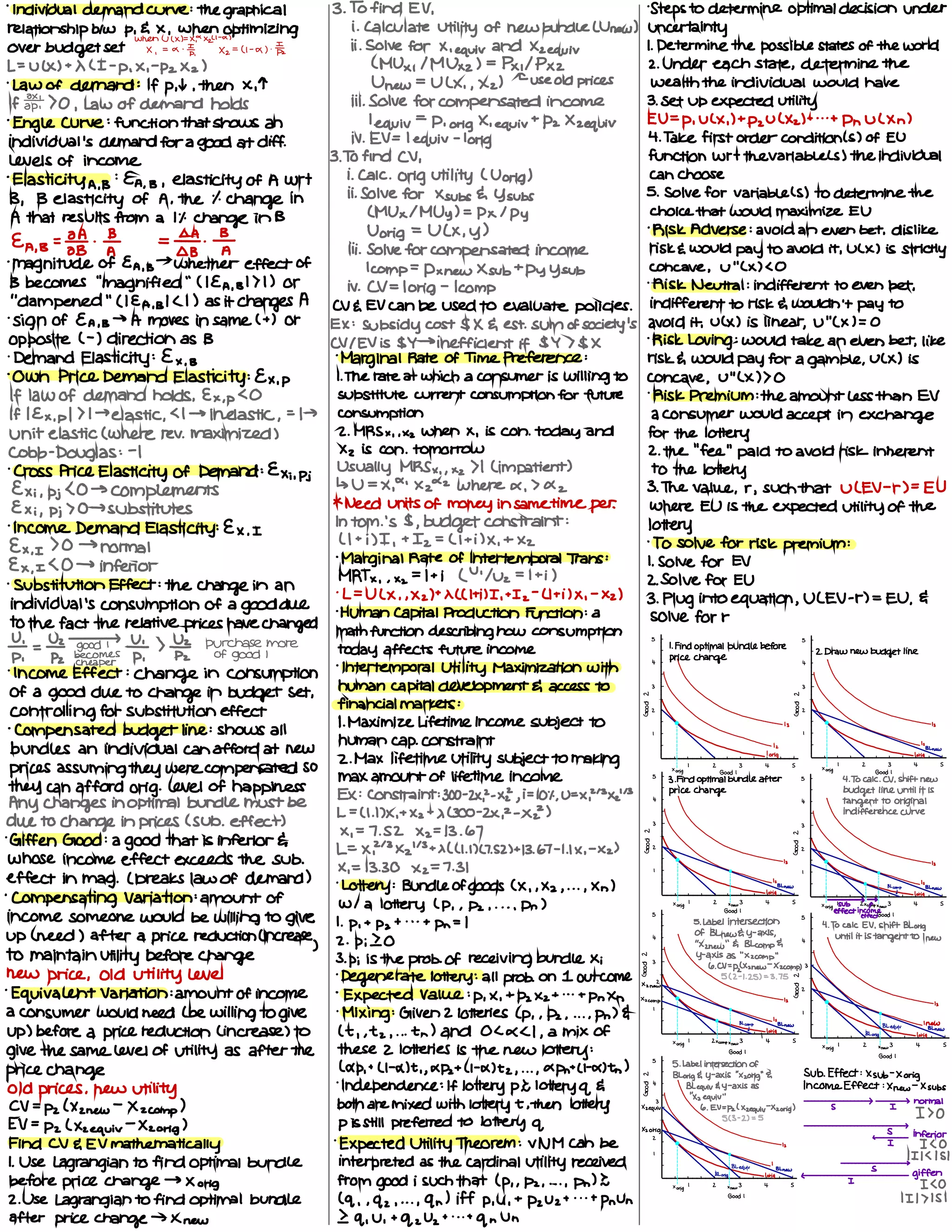
    - Individual demand curve: the graphical 3. To find EV , . Steps to determine optimal decision under relationship btw p , EX , when optimizing i. Calculate Utility of new bundle Wnew ) uncertainty When U ( X )=XFXzLl - a ) Over budget set x. = a. ¥. ×z=u - as . ¥ ii. Solve for X. equiv and Xzequiv I. Determine the possible States of the world L= ULXITXCI - pix , - pzxz ) ( Mlk , 1MHz ) = Pxilpxz 2. Under each state , determine the - Law of demand : If p.lv , then X. T Uncw = ULX , , Xz ) t Use Old prices wealth the individual would have If ¥170 , Law of demand holds iii. Solve for compensated income 3. Setup expected utility . Engle Curve : function that shows an I equiv =p , orig X. equivtpzxzequivEU-p.ULX.lt/2zULXzlti..tpnULXn ) individual 's demand fora good at diff . iv. EV= I equiv - long 4. Take first order conditions ) of EU Levels of income 3. TO find CV , function wrtthevariablels ) the individual - Elasticity A. B : EA , , , elasticity of A Wrt i. Calc . Orig utility ( Uorig ) can choose B , B elasticity of A. the f. change in ii. Solve for Xsubsdaysubs 5. Solve for variables ) to determine the A that results from a I 't change in B t.MU//MUy)=px1py choice that would maximize EU Uorig = ULX , y ) - Risk Adverse : avoid an even bet , dislike EA ,B=fF3 . Ben = - BF iii. Solve for compensated income risk 's would pay to avoid it , ULX ) is strictly . magnitude Of Ea , B → whether effect Of lump = phew Xsubtpyysub concave , U' ' LN LO B becomes " magnified " ( IEA , 13171 ) or iv. C ✓ =/ orig - lamp . Risk Neutral : indifferent to even bet . " dampened " ( IEA , BILL ) as it Changes A CVEEV can be used to evaluate policies . indifferent to risk da wouldn't pay to . sign of EA.rs → A moves in same l t ) Or Ex : subsidy cost SIX E. est . sum of society 's avoid it . UCX ) is linear , U' ' C XI=0 opposite ( - ) direction as B CVIEV is Sly → inefficient if $4 > SIX . Risk Loving : would take an even bet , like - Demand Elasticity : Ex , , . Marginal Rate of Time Preference : risk 's would pay for a gamble , ULX ) is - Own Price Demand Elasticity :E x. p 1. The rate at which a consumer is willing to concave , U' ' LX ) > O If law of demand holds , Ex ,pL0 substitute current consumption for future . Risk Premium : the amount Less than EV If IEx.pl > I → elastic , < I → inelastic , =l→ consumption a consumer would accept in exchange unit elastic ( where rev . Maximized ) 2. MRS x. ixz When X , is con . today and for the lottery Cobb - Douglas : - I Xz is con . tomorrow 2. the ' ' fee " paid to avoid risk inherent . Cross Price Elasticity of Demand : Ex ; ,pj Usually MRSX . ,xz > I ( impatient ) to the lottery Exi , pj LO → complements ↳ U=X9 ' XYZ Where a , > Az 3. The value , r , such that ULEV - r )=EU Exi , pj > O → substitutes * Need Units of money insametimeper . where EU is the expected utility of the - Income Demand Elasticity :E x. I lntom . 's $ , budget constraint : lottery E x. I > O → normal ( Iti )IitIz= L Iti )XitX2 . To solve for risk premium : Ex , ISO → inferior ' Marginal Rate of Intertemporal Trans : I. solve for Ev MRT× , ,×z= Iti ( " luz = Iti ) 2. Solve for EU. Substitution Effect : the Change in an . L=UL× , ,×z)t×uHilI , + Iz - Lltilx , - Xz ) 3. plug into equation , ULEV - r )=EU . E individual 'S consumption Of a good due . Human capital production Function : a solve for r to the fact the relative prices have Changed math function describing how consumption U , Uz ) U , s - s - - = - good I pm, ) ¥22 Purchase more today affects future income . 1. Find optimal bundle before . z Draw new budget line p , pz becomes of good 1 price change cheaper - Intertemporal Utility Maximization with " - " - . Income Effect : change in consumption - - human capital development 's access to s - s - Of a good due to change in budget set , n n controlling for substitution effect financial markets : go , go , -1€, - Compensated budget line : shows all 1. Maximize Lifetime Income subject to , : y , . , : y ↳ bundles an individual can afford at new human cap . constraint . , . . 2. Max lifetime Utility subject to making . i . . i . . . orig . . . i . . i . . loris. . I 2 3 4 S I 2 3 4 S prices assuming they were compensated SO rig good , rig Good ' Max amount Of lifetime income s - 3. Find optimal bundle after s - 4. To calc . W . shift new they can afford Orig . level Of happiness Ex : constraint : zoo -2×12×22 , i 10%0=+1213×2113 - price change - budget line until it is Any changes in optimal bundle must be 4 - 4 - tangent to original L = ( 1. 1) X. t Xztx ( 300-2×12 - X } ) - - indifference curve due to change in prices C Sub . effect ) s - s - X. = 7.52×2=13.67 N N . Giffen Good : a good that is inferior 's o - o - f- X , "3Xz"3tX( ( 1.174.523+13.67 - I. IX , - Xz ) 802! 802-• ewtiescincmmag .EE#Es9Fwdo:tYumsan3nx.=issoxz=isi . . Lottery : Bundle of goods ( X , ,Xz , . . . , Xn ) - I - • - Bhim . I I I I l - l l toricI I , , , , I, , I , orig , , - Compensating Variation : amount Of w/ a lottery ( p , , pz , . . . , pm ) rig ' Z gig? " s n .ge#ebcti3eIIgIEIew3 4 s income someone would be willing to give s - s - Good ' I . p , t pzt . . . t pm =/ - 5. Label intersection . 4. To calc EV , shift Blorig Up ( need ) after a price reduction ( increase , z . pizo 4 - Of BLUEY - axis , 4 . until itistangenttolnew . " Xznew " G Blcompda to maintain Utility before change y-axis as " xzcomp " - 3. pi is the prob . of receiving bundle Xi , - 6. CV=p{ Xznew - Xzcomp ) 3 - new price , Old utility Level . Degenerate lottery : all prob . on I outcome o - 512-1.25=3.75 - - . equivalent variation : amount of income . expected value :p ,×,+pz×z+ . . . + pn× , I÷÷u¥•§↳;§o, .§ ,a consumer would need ( be willing to give . Mixing : Given 2 lotteries Lp , , Pz , . . . . pm ) E = i - a - • I Blcoymp - IBLequiv I new Up ) before a price reduction ( increase ) to ( t , ,tz , . . .tn ) and OLXLI , a MIX Of . . . . . . Kris. . , , . Kori. , iorig. ?rig I Zxcompxnew } 4 S I 2 = 3 4 S give the same level of utility as after the these 2 lotteries is the new lottery : good , rig yoga, S - 5. Label intersection of > rice change ( AP .tl/-X)ti,XPztll-X)t2 , . . . , April ' - d) th ) n - Blom .gg y-axis " xzorig " 's Sub . Effect :X sub - Xorig/ Old prices , new utility . Independence : If lottery PI lottery q E I " - Bleauivday - axis as Income Effect :X new - Xsubs or - " Xz equiv ' ' CV=pz( Xznew - Xzcomp ) both are Mixed with lottery tither lottery xzeausi-6.eu-pzlxzeauiu-xzon.gl s I 2178 p is still preferred to lottery q - Scs -23 . - s EV = Pz ( Xzequiv - Xzorig ) xzorig - Find CVEEV mathematically . Expected Utility Theorem : VNM Can be 2 , ; ¥ , Yg , 1. Use Lagrangian to find optimal bundle interpreted as the cardinal Utility received . Iaea " s > i i , Phon, , Iorio, , ( giffen before price change → X orig from good I such that ( p , , Pz , . . . , Pm ) I rig , z Inns4 s I ICO 2. Use Lagrangian to find optimal bundle ( q , ,qz , . . . , qn ) Iff p . U , tpzuzt . . . tpnun Good ' III > 151 after price change → Knew Iq , U , tqzuzt . . . tqnvn
  • 3.
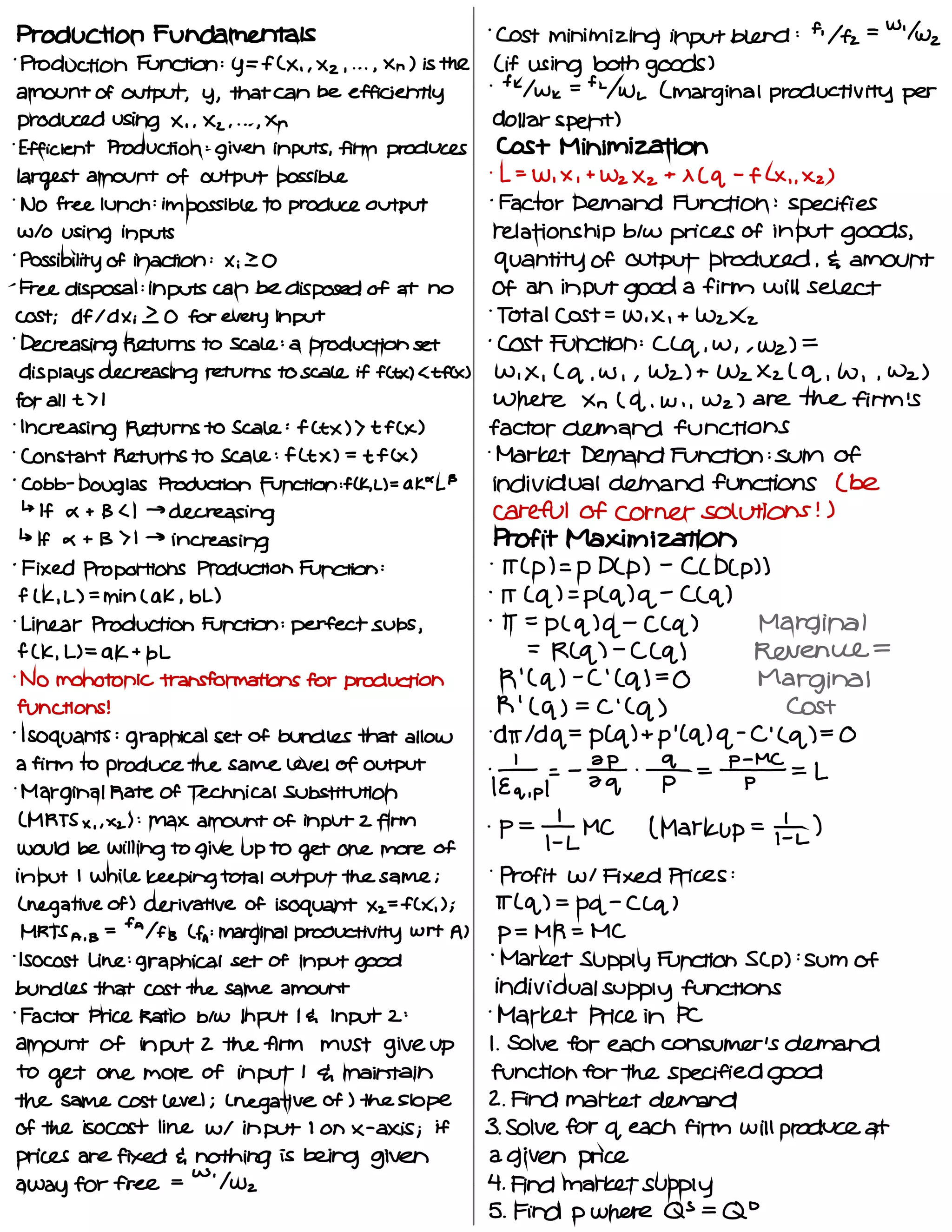
    Production Fundamentals ' Cost minimizinginput blend : f ' Az = W' lwz ' Production Function : y = f CX . , Xz , . . . , Xn ) is the ( if using both goods ) amount of output , y , that can be efficiently .tk/Wk=f4WL L marginal productivity per produced using X . . Xz , . . . , Xn dollar spent ) . Efficient Production : given inputs , firm produces Cost Minimization largest amount of output possible . L = W , X , t Wz Xz t X ( q - f- LX , , Xz ) . NO free lunch : impossible to produce output - Factor Demand Function : specifies w/o using inputs relationship btw prices of input goods , ' Possibility of inaction : Xi 20 quantity of output produced . E amount ' Free disposal : inputs can be disposed of at no Of an input good a firm will select cost ; dfldxi O for every input . Total Cost = w , X , t Wzxz . Decreasing Returns to scale : a production set . Cost Function : Clq , w , , wz ) = displays decreasing returns to scale if fctxlctfcx ) W , X , ( q . W , , Wz ) t Wz Xz ( q , w , , Wz ) for all t 71 Where Xn ( q . W . , Wz ) are the firm 'S . Increasing Returns to Scale : f Ctx ) > tf Cx ) factor demand functions . Constant Returns to Scale : f Lt X ) = tf Cx ) . Market Demand Function : sum of ' Cobb - Douglas Production Function : FCK , L ) = aka L 's individual demand functions ( be ↳ If a t BC I → decreasing careful of corner solutions ! ) ↳ If a t B > I → increasing Profit Maximization - Fixed Proportions Production Function : . IT L p ) =p Dcp ) - C L Dcp ) ) f Lk , L ) = min Lak , BL ) . IT ( q ) =p L q ) q - C Cq ) . Linear Production Function : perfect subs , ' IT =p ( q ) q - C Cq ) Marginal f- C K , L ) = a K t BL = Req ) - C C q ) Revenue = . No monotonic transformations for production R ' ( q ) - C ' ( 91=0 Marginal functions ! R ' ( q ) = C ' ( q ) Cost . 15090 ants : graphical set of bundles that allow . DIT 1dg =p C q ) t p ' ( q ) q - C ' ( q ) = O a firm to produce the same level of output . Marginal Rate of Technical substitution ' lE÷pI= - ¥ - To = =L ( MRTS × , , xz ) : Max amount of input 2 firm . p = MC ( Markup = ¥ ) would be willing to give up to get one more of input I while keeping total output the same ; . Profit w/ Fixed Prices : ( negative of ) derivative of isoquant Xz=fCx , ) ; IT L q ) = pq - C Cq ) MRTS a , B = fa HB Lfa: marginal productivity Wrt Al p = MR = MC . ISO cost Line : graphical set of input good ' Market Supply Function Scp ) : sum of bundles that cost the same amount individual supply functions . Factor Price Ratio btw Input I da Input 2 : . Market Price in PC amount of input 2 the firm must give up 1 . Solve for each consumer 's demand to get one more of input I I maintain function for the specified good the same cost level ; L negative of ) the slope 2 . Find market demand of the boost line w/ input I on x - axis ; if 3. Solve for q each firm will produce at prices are fixed da nothing is being given a given price away for free = w ' lwz 4 . Find market supply 5 . Find p where Qs = QD
  • 4.
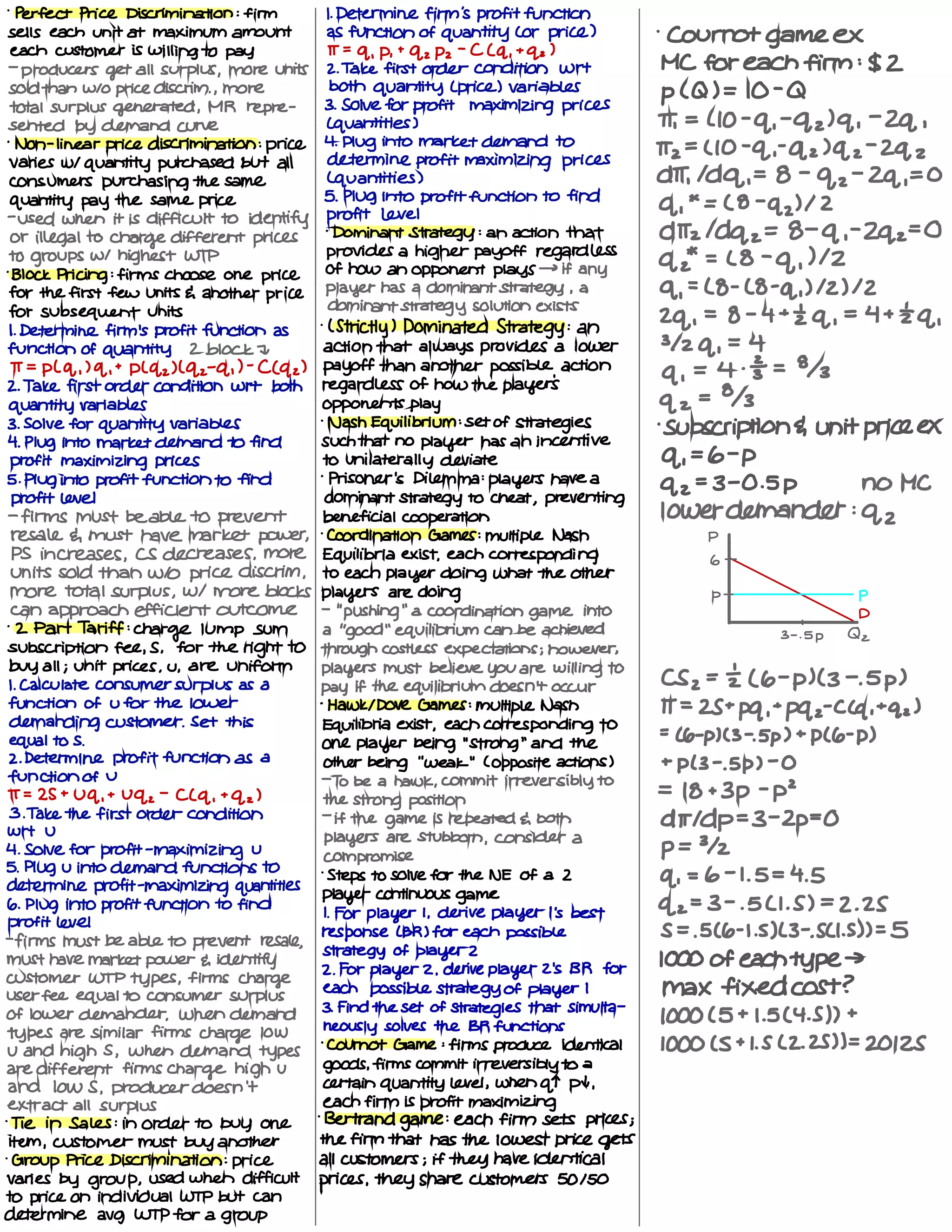
    . Der feet PriceDiscrimination : firm 1. Determine firm 's profit function sells each unit at maximum amount as function of quantity Cor price ) . Cournot game ex each customer is willing to pay IT = q , p , t qzpz - C ( q , t ga ) - producers get all surplus , more units 2. Take first order condition Wrt MC for each firm : $2 sold than w/o price disc rim . , more both quantity L price ) variables p ( Q ) = 10 - Q total surplus generated , MR re pre - 3 . Solve for profit maximizing prices sent ed by demand curve L quantities ) IT , = ( 10 - q , - q z ) q , - 29 , . Non - linear price discrimination : price 4 . Plug into market demand to IT z = ( 10 - q , - q z ) q z - Zqz varies w/ quantity purchased but all determine profit maximizing prices consumers purchasing the same low anti ties ) DIT , 1dg , = 8 - of z - 2g , = O quantity pay the same price 5 . Plug into profit function to find q , * = ( q . q y , 2 - used when it is difficult to identify profit Level 2 or illegal to charge different prices ' Dominant Strategy : an action that ditz ldqz = 8 - q , - 292=0 to groups w/ highest WTP provides a higher payoff regardless qz* , L q - q , ) , z - Block Pricing : firms choose one price Of how an opponent plays → if any for the first few units E another price player has a dominant strategy , a q , = ( 8 - L 8 - q , ) 12 ) 12 for subsequent units dominant strategy solution exists zq , = q - 4 +I q , = 4+ I q , 1. Determine firm 's profit function as . l Strictly ) Dominated Strategy : an function of quantity 2 block a action that always provides a lower 3/2 q , T 4 IT pl of , ) q , t plqz ) ( q z - q , ) - C ( q z ) payoff than another possible action q , = 4 . I = 8/3 2. Take first order condition Wrt both regardless of how the player 's quantity variables opponents play q z = 8/3 3. Solve for quantity variables . Nash Equilibrium : set of strategies . Subscription G unit price EX 4. Plug into market demand to find Such that no player has an incentive profit maximizing prices to unilaterally deviate 9 , = 6 - p S . Plug into profit function to find . Prisoner 's Dilemma : players have a q z =3 - O . 5 p no MC profit level dominant Strategy to cheat , preventing - firms must be able to prevent beneficial cooperation lower demander : q z resale G must have market power , . Coordination Games : multiple Nash p PS increases , CS decreases . more Equilibria exist , each corresponding 6 - units sold than w/o price disc rim , to each player doing what the other more total surplus , W/ more blocks players are doing p - p can approach efficient outcome - " pushing " a coordination game into D . 2 Part Tariff : charge lump sum a ' ' good " equilibrium can be achieved 3- . 's p Q , subscription fee , S , for the right to through costless expectations ; however , buy all ; unit prices , u , are uniform players must believe you are willing to CS z = I ( 6 - p ) ( 3 - . 5 p )1. Calculate consumer surplus as a pay if the equilibrium doesn't occur function of u for the lower - Hawk I Dove Games : multiple Nash IT = 25 t pg . t pqz - C Cq , tqz ) demanding customer . Set this Equilibria exist , each corresponding to equal to s . one player being " strong " and the = L 6 - p ) ( 3- . Sp ) t p ( 6 - D ) 2. Determine profit function as a other being ' ' weak " ( opposite actions ) t p ( 3- . Sp ) - O function of U - To be a hawk , commit irreversibly to IT = 25 t 09 , t Uqz - C Cq , t q z ) the strong position = I 8 t 3 p - P2 3. Take the first order condition - if the game is repeated L both d IT Idp =3 - 213=0Wrt U players are stubborn , consider a 4. Solve for profit - maximizing u p = 3/2 5. Plug U into demand functions to compromise . Steps to solve for the NE of a 2 q , = 6 - I . 5 = 4 . 5 determine profit - maximizing quantities player continuous game 6. Plug into profit function to find qz =3 - . 5 ( I . S ) = 2 . 25 I . For player I , derive player I 's best profit level response LBR ) for each possible S = . 5 ( 6 - I . S ) L 3- . SLI . S ) ) = 5- firms must be able to prevent resale . strategy of player 2 must have market power E identify 1000 of each type → customer WTP types , firms charge 2 . For player 2 . derive player 2 's BR for user fee equal to consumer surplus each possible strategy of player I Max fixed cost ? of lower demander , When demand 3 . Find the set of Strategies that Sim Ulta - 1000 ( g + 1. g ( 4. s ) ) + types are similar firms charge low newly solves the BR functions U and high S , when demand types - Cournot Game : firms produce identical 1000 ( S t I . S L 2 . 25 ) ) = 20125 are different firms charge high u goods , firms commit irreversibly to a and low S , producer doesn't certain quantity level , when qt pt , extract all surplus each firm is profit maximizing . Tie in Sales : in order to buy one . Bertrand game : each firm sets prices ; item , customer must buy another the firm that has the lowest price gets . Group Price Discrimination : price all customers ; if they have identical varies by group , used when difficult prices, they share customers 50150 to price on individual WTP but can determine avg WTP for a group