Chapter 4
UTILITY MAXIMIZATION
AND CHOICE
Copyright ©2002 by South-Western, a division of Thomson Learning. All rights reserved.
MICROECONOMIC THEORY
BASIC PRINCIPLES AND EXTENSIONS
EIGHTH EDITION
WALTER NICHOLSON
Complaints about Economic
Approach
• No real individuals make the kinds of
“lightning calculations” required for utility
maximization
• The utility-maximization model predicts
many aspects of behavior even though
no one carries around a computer with
his utility function programmed into it
Complaints about Economic
Approach
• The economic model of choice is
extremely selfish because no one has
solely self-centered goals
• Nothing in the utility-maximization
model prevents individuals from deriving
satisfaction from “doing good”
Optimization Principle
• To maximize utility, given a fixed amount
of income to spend, an individual will buy
the goods and services:
– that exhaust his or her total income
– for which the psychic rate of trade-off
between any goods (the MRS) is equal to
the rate at which goods can be traded for
one another in the marketplace
A Numerical Illustration
• Assume that the individual’s MRS = 1
– He is willing to trade one unit of X for one
unit of Y
• Suppose the price of X = $2 and the
price of Y = $1
• The individual can be made better off
– Trade 1 unit of X for 2 units of Y in the
marketplace
The Budget Constraint
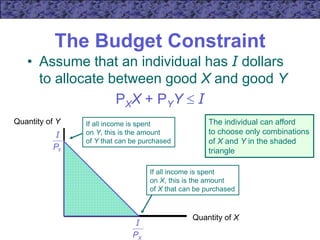
• Assume that an individual has I dollars
to allocate between good X and good Y
PXX + PYY  I
Quantity of X
Quantity of Y The individual can afford
to choose only combinations
of X and Y in the shaded
triangle
Y
P
I
If all income is spent
on Y, this is the amount
of Y that can be purchased
X
P
I
If all income is spent
on X, this is the amount
of X that can be purchased
First-Order Conditions for a
Maximum
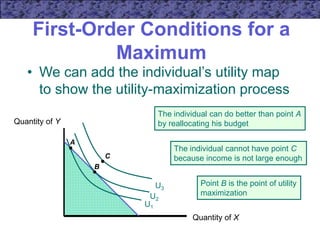
• We can add the individual’s utility map
to show the utility-maximization process
Quantity of X
Quantity of Y
U1
A
The individual can do better than point A
by reallocating his budget
U3
C
The individual cannot have point C
because income is not large enough
U2
B
Point B is the point of utility
maximization
First-Order Conditions for a
Maximum
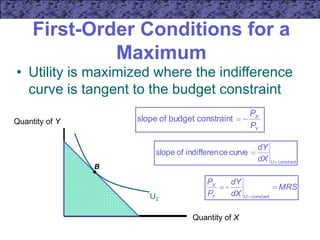
• Utility is maximized where the indifference
curve is tangent to the budget constraint
Quantity of X
Quantity of Y
U2
B
constraint
budget
of
slope
Y
X
P
P


constant
curve
ce
indifferen
of
slope


U
dX
dY
MRS
dX
dY
P
P
U
Y
X


 constant
-
Second-Order Conditions for a
Maximum
• The tangency rule is only necessary but
not sufficient unless we assume that MRS
is diminishing
– if MRS is diminishing, then indifference curves
are strictly convex
• If MRS is not diminishing, then we must
check second-order conditions to ensure
that we are at a maximum
Second-Order Conditions for a
Maximum
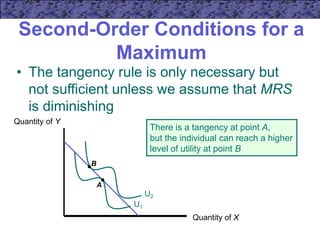
• The tangency rule is only necessary but
not sufficient unless we assume that MRS
is diminishing
Quantity of X
Quantity of Y
U1
B
U2
A
There is a tangency at point A,
but the individual can reach a higher
level of utility at point B
Corner Solutions
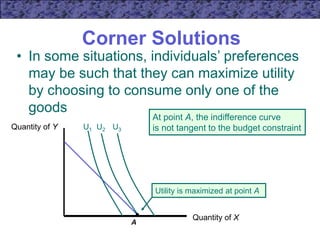
• In some situations, individuals’ preferences
may be such that they can maximize utility
by choosing to consume only one of the
goods
Quantity of X
Quantity of Y U2
U1 U3
A
Utility is maximized at point A
At point A, the indifference curve
is not tangent to the budget constraint
The n-Good Case
• The individual’s objective is to maximize
utility = U(X1,X2,…,Xn)
subject to the budget constraint
I = P1X1 + P2X2 +…+ PnXn
• Set up the Lagrangian:
L = U(X1,X2,…,Xn) + (I-P1X1- P2X2-…-PnXn)
The n-Good Case
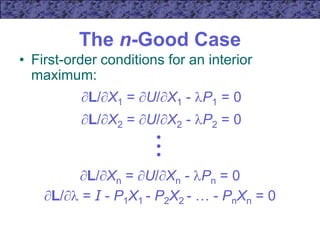
• First-order conditions for an interior
maximum:
L/X1 = U/X1 - P1 = 0
L/X2 = U/X2 - P2 = 0
•
•
•
L/Xn = U/Xn - Pn = 0
L/ = I - P1X1 - P2X2 - … - PnXn = 0
Implications of First-Order
Conditions
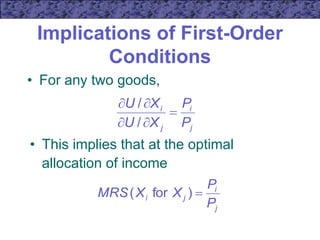
• For any two goods,
j
i
j
i
P
P
X
U
X
U





/
/
• This implies that at the optimal
allocation of income
j
i
j
i
P
P
X
X
MRS 
)
for
(
Interpreting the Lagrangian
Multiplier
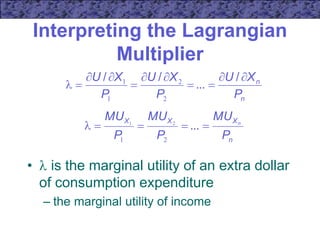
•  is the marginal utility of an extra dollar
of consumption expenditure
– the marginal utility of income
n
n
P
X
U
P
X
U
P
X
U 










/
...
/
/
2
2
1
1
n
X
X
X
P
MU
P
MU
P
MU n




 ...
2
1
2
1
Interpreting the Lagrangian
Multiplier
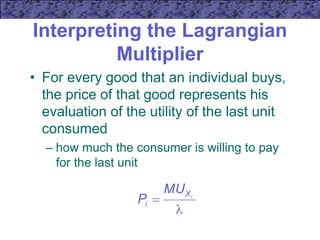
• For every good that an individual buys,
the price of that good represents his
evaluation of the utility of the last unit
consumed
– how much the consumer is willing to pay
for the last unit

 i
X
i
MU
P
Corner Solutions
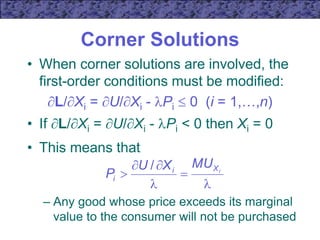
• When corner solutions are involved, the
first-order conditions must be modified:
L/Xi = U/Xi - Pi  0 (i = 1,…,n)
• If L/Xi = U/Xi - Pi < 0 then Xi = 0
• This means that





 i
X
i
i
MU
X
U
P
/
– Any good whose price exceeds its marginal
value to the consumer will not be purchased
Cobb-Douglas Demand
Functions
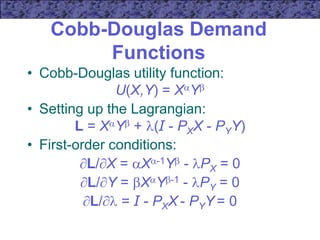
• Cobb-Douglas utility function:
U(X,Y) = XY
• Setting up the Lagrangian:
L = XY + (I - PXX - PYY)
• First-order conditions:
L/X = X-1Y - PX = 0
L/Y = XY-1 - PY = 0
L/ = I - PXX - PYY = 0
Cobb-Douglas Demand
Functions
• First-order conditions imply:
Y/X = PX/PY
• Since  +  = 1:
PYY = (/)PXX = [(1- )/]PXX
• Substituting into the budget constraint:
I = PXX + [(1- )/]PXX = (1/)PXX
Cobb-Douglas Demand
Functions
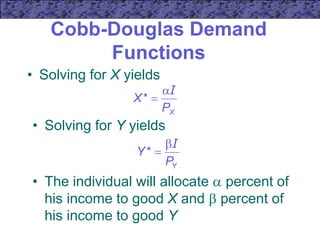
• Solving for X yields
• Solving for Y yields
X
P
X
I


*
Y
P
Y
I


*
• The individual will allocate  percent of
his income to good X and  percent of
his income to good Y
Cobb-Douglas Demand
Functions
• The Cobb-Douglas utility function is
limited in its ability to explain actual
consumption behavior
– the share of income devoted to particular
goods often changes in response to
changing economic conditions
• A more general functional form might be
more useful in explaining consumption
decisions
CES Demand
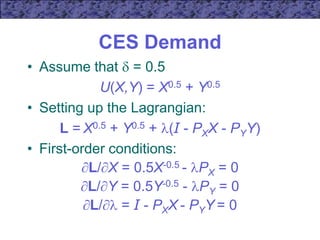
• Assume that  = 0.5
U(X,Y) = X0.5 + Y0.5
• Setting up the Lagrangian:
L = X0.5 + Y0.5 + (I - PXX - PYY)
• First-order conditions:
L/X = 0.5X-0.5 - PX = 0
L/Y = 0.5Y-0.5 - PY = 0
L/ = I - PXX - PYY = 0
CES Demand
• This means that
(Y/X)0.5 = Px/PY
• Substituting into the budget constraint,
we can solve for the demand functions:
]
1
[
*
Y
X
X
P
P
P
X


I
]
1
[
*
X
Y
Y
P
P
P
Y


I
CES Demand
• In these demand functions, the share of
income spent on either X or Y is not a
constant
– depends on the ratio of the two prices
• The higher is the relative price of X (or
Y), the smaller will be the share of
income spent on X (or Y)
CES Demand
• If  = -1,
U(X,Y) = X-1 + Y-1
• First-order conditions imply that
Y/X = (PX/PY)0.5
• The demand functions are
]
1
[
* 5
.
0










X
Y
X
P
P
P
X
I
]
1
[
* 5
.
0










Y
X
Y
P
P
P
Y
I
CES Demand
• The elasticity of substitution () is equal
to 1/(1-)
– when  = 0.5,  = 2
– when  = -1,  = 0.5
• Because substitutability has declined,
these demand functions are less
responsive to changes in relative prices
• The CES allows us to illustrate a wide
variety of possible relationships
Indirect Utility Function
• It is often possible to manipulate first-
order conditions to solve for optimal
values of X1,X2,…,Xn
• These optimal values will depend on the
prices of all goods and income
•
•
•
X*n = Xn(P1,P2,…,Pn, I)
X*1 = X1(P1,P2,…,Pn,I)
X*2 = X2(P1,P2,…,Pn,I)
Indirect Utility Function
• We can use the optimal values of the Xs
to find the indirect utility function
maximum utility = U(X*1,X*2,…,X*n)
• Substituting for each X*i we get
maximum utility = V(P1,P2,…,Pn,I)
• The optimal level of utility will depend
indirectly on prices and income
– If either prices or income were to change,
the maximum possible utility will change
Indirect Utility in the Cobb-
Douglas
• If U = X0.5Y0.5, we know that
x
P
X
2
I

*
Y
P
Y
2
I

*
• Substituting into the utility function, we get
5
0
5
0
5
0
5
0
2
2
2 .
.
.
.
utility
maximum
Y
X
Y
X P
P
P
P
I
I
I


















Expenditure Minimization
• Dual minimization problem for utility
maximization
– allocating income in such a way as to achieve
a given level of utility with the minimal
expenditure
– this means that the goal and the constraint
have been reversed
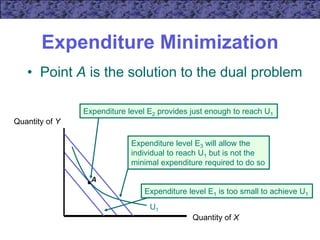
Expenditure level E2 provides just enough to reach U1
Expenditure Minimization
Quantity of X
Quantity of Y
U1
Expenditure level E1 is too small to achieve U1
Expenditure level E3 will allow the
individual to reach U1 but is not the
minimal expenditure required to do so
A
• Point A is the solution to the dual problem
Expenditure Minimization
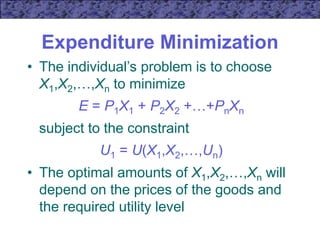
• The individual’s problem is to choose
X1,X2,…,Xn to minimize
E = P1X1 + P2X2 +…+PnXn
subject to the constraint
U1 = U(X1,X2,…,Un)
• The optimal amounts of X1,X2,…,Xn will
depend on the prices of the goods and
the required utility level
Expenditure Function
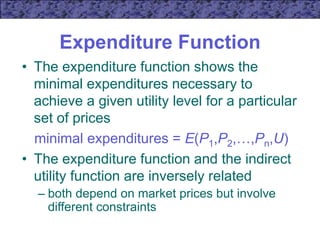
• The expenditure function shows the
minimal expenditures necessary to
achieve a given utility level for a particular
set of prices
minimal expenditures = E(P1,P2,…,Pn,U)
• The expenditure function and the indirect
utility function are inversely related
– both depend on market prices but involve
different constraints
Expenditure Function from
the Cobb-Douglas
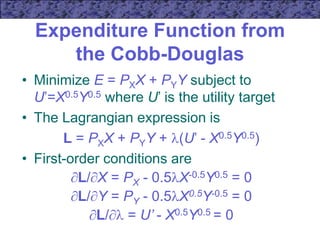
• Minimize E = PXX + PYY subject to
U’=X0.5Y0.5 where U’ is the utility target
• The Lagrangian expression is
L = PXX + PYY + (U’ - X0.5Y0.5)
• First-order conditions are
L/X = PX - 0.5X-0.5Y0.5 = 0
L/Y = PY - 0.5X0.5Y-0.5 = 0
L/ = U’ - X0.5Y0.5 = 0
Expenditure Function from
the Cobb-Douglas
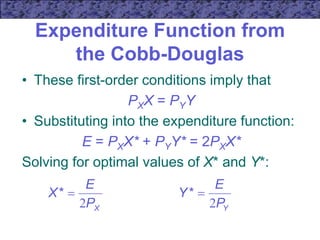
• These first-order conditions imply that
PXX = PYY
• Substituting into the expenditure function:
E = PXX* + PYY* = 2PXX*
Solving for optimal values of X* and Y*:
X
P
E
X
2

*
Y
P
E
Y
2

*
Expenditure Function from
the Cobb-Douglas
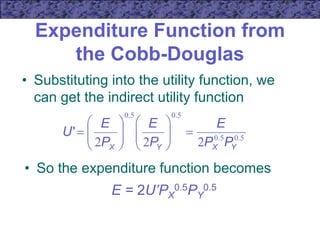
• Substituting into the utility function, we
can get the indirect utility function
5
0
5
0
5
0
5
0
2
2
2 .
.
.
.
'
Y
X
Y
X P
P
E
P
E
P
E
U 

















• So the expenditure function becomes
E = 2U’PX
0.5PY
0.5
Important Points to Note:
• To reach a constrained maximum, an
individual should:
– spend all available income
– choose a commodity bundle such that the
MRS between any two goods is equal to the
ratio of the goods’ prices
• the individual will equate the ratios of marginal utility
to price for every good that is actually consumed
Important Points to Note:
• Tangency conditions are only first-order
conditions
– the individual’s indifference map must exhibit
diminishing MRS
– the utility function must be strictly quasi-
concave
• Tangency conditions must also be modified
to allow for corner solutions
– ratio of marginal utility to price will be lower for
goods that are not purchased
Important Points to Note:
• The individual’s optimal choices implicitly
depend on the parameters of his budget
constraint
– choices observed will be implicit functions of
prices and income
– utility will also be an indirect function of prices
and income
Important Points to Note:
• The dual problem to the constrained utility-
maximization problem is to minimize the
expenditure required to reach a given utility
target
– yields the same optimal solution as the primary
problem
– leads to expenditure functions in which
spending is a function of the utility target and
prices

MICROECONOMIC THEORY

  • 1.
    Chapter 4 UTILITY MAXIMIZATION ANDCHOICE Copyright ©2002 by South-Western, a division of Thomson Learning. All rights reserved. MICROECONOMIC THEORY BASIC PRINCIPLES AND EXTENSIONS EIGHTH EDITION WALTER NICHOLSON
  • 2.
    Complaints about Economic Approach •No real individuals make the kinds of “lightning calculations” required for utility maximization • The utility-maximization model predicts many aspects of behavior even though no one carries around a computer with his utility function programmed into it
  • 3.
    Complaints about Economic Approach •The economic model of choice is extremely selfish because no one has solely self-centered goals • Nothing in the utility-maximization model prevents individuals from deriving satisfaction from “doing good”
  • 4.
    Optimization Principle • Tomaximize utility, given a fixed amount of income to spend, an individual will buy the goods and services: – that exhaust his or her total income – for which the psychic rate of trade-off between any goods (the MRS) is equal to the rate at which goods can be traded for one another in the marketplace
  • 5.
    A Numerical Illustration •Assume that the individual’s MRS = 1 – He is willing to trade one unit of X for one unit of Y • Suppose the price of X = $2 and the price of Y = $1 • The individual can be made better off – Trade 1 unit of X for 2 units of Y in the marketplace
  • 6.
    The Budget Constraint •Assume that an individual has I dollars to allocate between good X and good Y PXX + PYY  I Quantity of X Quantity of Y The individual can afford to choose only combinations of X and Y in the shaded triangle Y P I If all income is spent on Y, this is the amount of Y that can be purchased X P I If all income is spent on X, this is the amount of X that can be purchased
  • 7.
    First-Order Conditions fora Maximum • We can add the individual’s utility map to show the utility-maximization process Quantity of X Quantity of Y U1 A The individual can do better than point A by reallocating his budget U3 C The individual cannot have point C because income is not large enough U2 B Point B is the point of utility maximization
  • 8.
    First-Order Conditions fora Maximum • Utility is maximized where the indifference curve is tangent to the budget constraint Quantity of X Quantity of Y U2 B constraint budget of slope Y X P P   constant curve ce indifferen of slope   U dX dY MRS dX dY P P U Y X    constant -
  • 9.
    Second-Order Conditions fora Maximum • The tangency rule is only necessary but not sufficient unless we assume that MRS is diminishing – if MRS is diminishing, then indifference curves are strictly convex • If MRS is not diminishing, then we must check second-order conditions to ensure that we are at a maximum
  • 10.
    Second-Order Conditions fora Maximum • The tangency rule is only necessary but not sufficient unless we assume that MRS is diminishing Quantity of X Quantity of Y U1 B U2 A There is a tangency at point A, but the individual can reach a higher level of utility at point B
  • 11.
    Corner Solutions • Insome situations, individuals’ preferences may be such that they can maximize utility by choosing to consume only one of the goods Quantity of X Quantity of Y U2 U1 U3 A Utility is maximized at point A At point A, the indifference curve is not tangent to the budget constraint
  • 12.
    The n-Good Case •The individual’s objective is to maximize utility = U(X1,X2,…,Xn) subject to the budget constraint I = P1X1 + P2X2 +…+ PnXn • Set up the Lagrangian: L = U(X1,X2,…,Xn) + (I-P1X1- P2X2-…-PnXn)
  • 13.
    The n-Good Case •First-order conditions for an interior maximum: L/X1 = U/X1 - P1 = 0 L/X2 = U/X2 - P2 = 0 • • • L/Xn = U/Xn - Pn = 0 L/ = I - P1X1 - P2X2 - … - PnXn = 0
  • 14.
    Implications of First-Order Conditions •For any two goods, j i j i P P X U X U      / / • This implies that at the optimal allocation of income j i j i P P X X MRS  ) for (
  • 15.
    Interpreting the Lagrangian Multiplier • is the marginal utility of an extra dollar of consumption expenditure – the marginal utility of income n n P X U P X U P X U            / ... / / 2 2 1 1 n X X X P MU P MU P MU n      ... 2 1 2 1
  • 16.
    Interpreting the Lagrangian Multiplier •For every good that an individual buys, the price of that good represents his evaluation of the utility of the last unit consumed – how much the consumer is willing to pay for the last unit   i X i MU P
  • 17.
    Corner Solutions • Whencorner solutions are involved, the first-order conditions must be modified: L/Xi = U/Xi - Pi  0 (i = 1,…,n) • If L/Xi = U/Xi - Pi < 0 then Xi = 0 • This means that       i X i i MU X U P / – Any good whose price exceeds its marginal value to the consumer will not be purchased
  • 18.
    Cobb-Douglas Demand Functions • Cobb-Douglasutility function: U(X,Y) = XY • Setting up the Lagrangian: L = XY + (I - PXX - PYY) • First-order conditions: L/X = X-1Y - PX = 0 L/Y = XY-1 - PY = 0 L/ = I - PXX - PYY = 0
  • 19.
    Cobb-Douglas Demand Functions • First-orderconditions imply: Y/X = PX/PY • Since  +  = 1: PYY = (/)PXX = [(1- )/]PXX • Substituting into the budget constraint: I = PXX + [(1- )/]PXX = (1/)PXX
  • 20.
    Cobb-Douglas Demand Functions • Solvingfor X yields • Solving for Y yields X P X I   * Y P Y I   * • The individual will allocate  percent of his income to good X and  percent of his income to good Y
  • 21.
    Cobb-Douglas Demand Functions • TheCobb-Douglas utility function is limited in its ability to explain actual consumption behavior – the share of income devoted to particular goods often changes in response to changing economic conditions • A more general functional form might be more useful in explaining consumption decisions
  • 22.
    CES Demand • Assumethat  = 0.5 U(X,Y) = X0.5 + Y0.5 • Setting up the Lagrangian: L = X0.5 + Y0.5 + (I - PXX - PYY) • First-order conditions: L/X = 0.5X-0.5 - PX = 0 L/Y = 0.5Y-0.5 - PY = 0 L/ = I - PXX - PYY = 0
  • 23.
    CES Demand • Thismeans that (Y/X)0.5 = Px/PY • Substituting into the budget constraint, we can solve for the demand functions: ] 1 [ * Y X X P P P X   I ] 1 [ * X Y Y P P P Y   I
  • 24.
    CES Demand • Inthese demand functions, the share of income spent on either X or Y is not a constant – depends on the ratio of the two prices • The higher is the relative price of X (or Y), the smaller will be the share of income spent on X (or Y)
  • 25.
    CES Demand • If = -1, U(X,Y) = X-1 + Y-1 • First-order conditions imply that Y/X = (PX/PY)0.5 • The demand functions are ] 1 [ * 5 . 0           X Y X P P P X I ] 1 [ * 5 . 0           Y X Y P P P Y I
  • 26.
    CES Demand • Theelasticity of substitution () is equal to 1/(1-) – when  = 0.5,  = 2 – when  = -1,  = 0.5 • Because substitutability has declined, these demand functions are less responsive to changes in relative prices • The CES allows us to illustrate a wide variety of possible relationships
  • 27.
    Indirect Utility Function •It is often possible to manipulate first- order conditions to solve for optimal values of X1,X2,…,Xn • These optimal values will depend on the prices of all goods and income • • • X*n = Xn(P1,P2,…,Pn, I) X*1 = X1(P1,P2,…,Pn,I) X*2 = X2(P1,P2,…,Pn,I)
  • 28.
    Indirect Utility Function •We can use the optimal values of the Xs to find the indirect utility function maximum utility = U(X*1,X*2,…,X*n) • Substituting for each X*i we get maximum utility = V(P1,P2,…,Pn,I) • The optimal level of utility will depend indirectly on prices and income – If either prices or income were to change, the maximum possible utility will change
  • 29.
    Indirect Utility inthe Cobb- Douglas • If U = X0.5Y0.5, we know that x P X 2 I  * Y P Y 2 I  * • Substituting into the utility function, we get 5 0 5 0 5 0 5 0 2 2 2 . . . . utility maximum Y X Y X P P P P I I I                  
  • 30.
    Expenditure Minimization • Dualminimization problem for utility maximization – allocating income in such a way as to achieve a given level of utility with the minimal expenditure – this means that the goal and the constraint have been reversed
  • 31.
    Expenditure level E2provides just enough to reach U1 Expenditure Minimization Quantity of X Quantity of Y U1 Expenditure level E1 is too small to achieve U1 Expenditure level E3 will allow the individual to reach U1 but is not the minimal expenditure required to do so A • Point A is the solution to the dual problem
  • 32.
    Expenditure Minimization • Theindividual’s problem is to choose X1,X2,…,Xn to minimize E = P1X1 + P2X2 +…+PnXn subject to the constraint U1 = U(X1,X2,…,Un) • The optimal amounts of X1,X2,…,Xn will depend on the prices of the goods and the required utility level
  • 33.
    Expenditure Function • Theexpenditure function shows the minimal expenditures necessary to achieve a given utility level for a particular set of prices minimal expenditures = E(P1,P2,…,Pn,U) • The expenditure function and the indirect utility function are inversely related – both depend on market prices but involve different constraints
  • 34.
    Expenditure Function from theCobb-Douglas • Minimize E = PXX + PYY subject to U’=X0.5Y0.5 where U’ is the utility target • The Lagrangian expression is L = PXX + PYY + (U’ - X0.5Y0.5) • First-order conditions are L/X = PX - 0.5X-0.5Y0.5 = 0 L/Y = PY - 0.5X0.5Y-0.5 = 0 L/ = U’ - X0.5Y0.5 = 0
  • 35.
    Expenditure Function from theCobb-Douglas • These first-order conditions imply that PXX = PYY • Substituting into the expenditure function: E = PXX* + PYY* = 2PXX* Solving for optimal values of X* and Y*: X P E X 2  * Y P E Y 2  *
  • 36.
    Expenditure Function from theCobb-Douglas • Substituting into the utility function, we can get the indirect utility function 5 0 5 0 5 0 5 0 2 2 2 . . . . ' Y X Y X P P E P E P E U                   • So the expenditure function becomes E = 2U’PX 0.5PY 0.5
  • 37.
    Important Points toNote: • To reach a constrained maximum, an individual should: – spend all available income – choose a commodity bundle such that the MRS between any two goods is equal to the ratio of the goods’ prices • the individual will equate the ratios of marginal utility to price for every good that is actually consumed
  • 38.
    Important Points toNote: • Tangency conditions are only first-order conditions – the individual’s indifference map must exhibit diminishing MRS – the utility function must be strictly quasi- concave • Tangency conditions must also be modified to allow for corner solutions – ratio of marginal utility to price will be lower for goods that are not purchased
  • 39.
    Important Points toNote: • The individual’s optimal choices implicitly depend on the parameters of his budget constraint – choices observed will be implicit functions of prices and income – utility will also be an indirect function of prices and income
  • 40.
    Important Points toNote: • The dual problem to the constrained utility- maximization problem is to minimize the expenditure required to reach a given utility target – yields the same optimal solution as the primary problem – leads to expenditure functions in which spending is a function of the utility target and prices