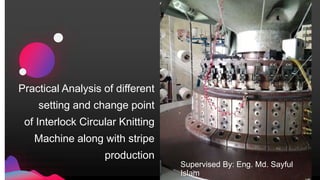
Practical Analysis of different
setting and change point
of Interlock Circular Knitting
Machine along with stripe
production
Supervised By: Eng. Md. Sayful
Islam
JensMartensson
2
Group
Members
Name Student ID
MD. INJAMAMUL ISLAM Z2015-1-2025
MD. FAYSAL AMIN Z2015-1-2009
NAZMUS SAKIB Z2015-1-2002
MD. JOYNAL ABEDIN Z2015-1-2014
MD. MIJANUR RAHMAN Z2015-1-2015
ABU SALEH MOHAMMAD NASIM Z2015-1-2016
Name of the Topics
1. Introduction
2. Objective
3. Specifications
4. Machine Description
5. Machine Parts
6. Machine parameters
7. Stripe Fabric
8. Needle Arrangement
9. Cam Arrangement
10. Construction Of Interlock
Stitch
11. Result
12. Summary
Outlines
JensMartensson
Subtitle lorem ipsum
dolor
Introduction
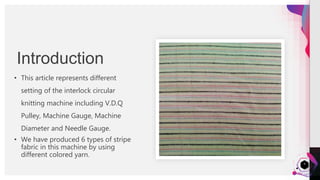
• This article represents different
setting of the interlock circular
knitting machine including V.D.Q
Pulley, Machine Gauge, Machine
Diameter and Needle Gauge.
• We have produced 6 types of stripe
fabric in this machine by using
different colored yarn.
4
JensMartensson
Objectives
.
• To know different setting of circular knitting machine.
• To know the functions of VDQ Pulley.
• To know how to produce stripe effect.
5
JensMartensson
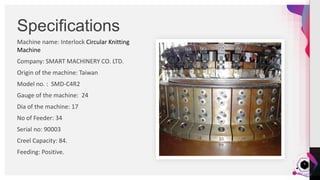
Machine name: Interlock Circular Knitting
Machine
Company: SMART MACHINERY CO. LTD.
Origin of the machine: Taiwan
Model no. : SMD-C4R2
Gauge of the machine: 24
Dia of the machine: 17
No of Feeder: 34
Serial no: 90003
Creel Capacity: 84.
Feeding: Positive.
Specifications
6
JensMartensson
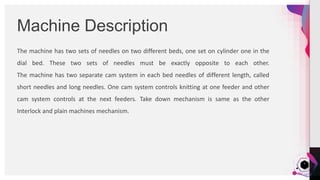
The machine has two sets of needles on two different beds, one set on cylinder one in the
dial bed. These two sets of needles must be exactly opposite to each other.
The machine has two separate cam system in each bed needles of different length, called
short needles and long needles. One cam system controls knitting at one feeder and other
cam system controls at the next feeders. Take down mechanism is same as the other
Interlock and plain machines mechanism.
Machine Description
7
MD. FAYSAL AMIN
JensMartensson
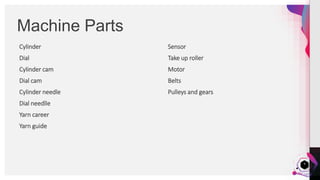
Cylinder
Dial
Cylinder cam
Dial cam
Cylinder needle
Dial needlle
Yarn career
Yarn guide
Machine Parts
9
Sensor
Take up roller
Motor
Belts
Pulleys and gears
JensMartensson
V.D.Q Pulley
Machine Gauge
Machine Diameter
Needle Gauge
Machine Parameters:
10
JensMartensson
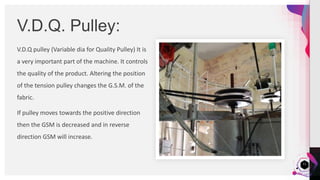
V.D.Q pulley (Variable dia for Quality Pulley) It is
a very important part of the machine. It controls
the quality of the product. Altering the position
of the tension pulley changes the G.S.M. of the
fabric.
If pulley moves towards the positive direction
then the GSM is decreased and in reverse
direction GSM will increase.
V.D.Q. Pulley:
11
JensMartensson
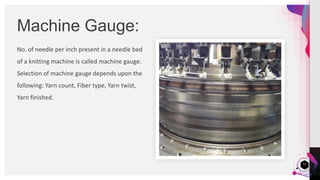
No. of needle per inch present in a needle bed
of a knitting machine is called machine gauge.
Selection of machine gauge depends upon the
following: Yarn count, Fiber type, Yarn twist,
Yarn finished.
Machine Gauge:
12
JensMartensson
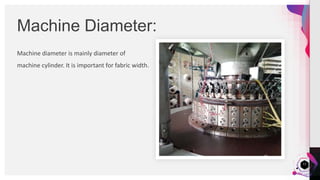
Machine diameter is mainly diameter of
machine cylinder. It is important for fabric width.
Machine Diameter:
13
JensMartensson
Thickness of needle express by the needle gauge. It is important for selection of
machine gauge.
Needle Gauge:
14
MD. JOYNAL ABEDIN
JensMartensson
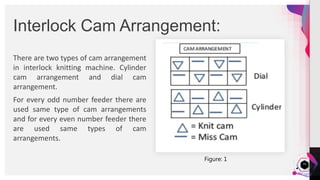
There are two types of cam arrangement
in interlock knitting machine. Cylinder
cam arrangement and dial cam
arrangement.
For every odd number feeder there are
used same type of cam arrangements
and for every even number feeder there
are used same types of cam
arrangements.
Interlock Cam Arrangement:
16
Figure: 1
JensMartensson
For following this cam track there are
used two butt needles, short butt
needles and long butt needles.
Short butt needle follow the first cam
track and long butt needle follow the
second cam track.
17
Interlock Needle Arrangement:
Figure: 2
MD. MIJANUR RAHMAN
JensMartensson
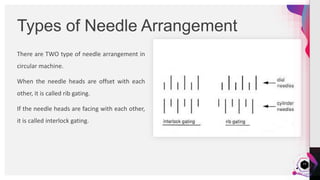
There are TWO type of needle arrangement in
circular machine.
When the needle heads are offset with each
other, it is called rib gating.
If the needle heads are facing with each other,
it is called interlock gating.
Types of Needle Arrangement
19
JensMartensson
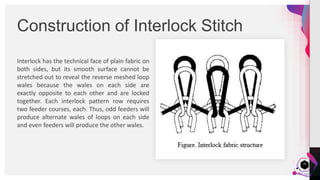
Interlock has the technical face of plain fabric on
both sides, but its smooth surface cannot be
stretched out to reveal the reverse meshed loop
wales because the wales on each side are
exactly opposite to each other and are locked
together. Each interlock pattern row requires
two feeder courses, each. Thus, odd feeders will
produce alternate wales of loops on each side
and even feeders will produce the other wales.
Construction of Interlock Stitch
20
NAZMUS SAKIB
JensMartensson
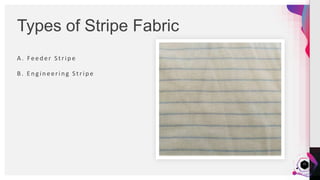
A . Feeder Stripe
B . E n g in eerin g S trip e
Types of Stripe Fabric
22
JensMartensson
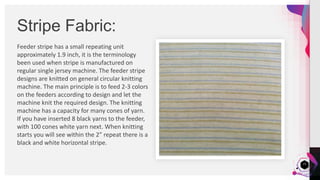
Feeder stripe has a small repeating unit
approximately 1.9 inch, it is the terminology
been used when stripe is manufactured on
regular single jersey machine. The feeder stripe
designs are knitted on general circular knitting
machine. The main principle is to feed 2-3 colors
on the feeders according to design and let the
machine knit the required design. The knitting
machine has a capacity for many cones of yarn.
If you have inserted 8 black yarns to the feeder,
with 100 cones white yarn next. When knitting
starts you will see within the 2” repeat there is a
black and white horizontal stripe.
Stripe Fabric:
23
JensMartensson
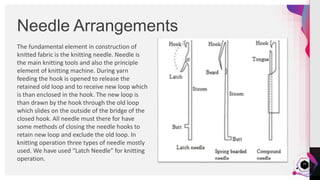
The fundamental element in construction of
knitted fabric is the knitting needle. Needle is
the main knitting tools and also the principle
element of knitting machine. During yarn
feeding the hook is opened to release the
retained old loop and to receive new loop which
is than enclosed in the hook. The new loop is
than drawn by the hook through the old loop
which slides on the outside of the bridge of the
closed hook. All needle must there for have
some methods of closing the needle hooks to
retain new loop and exclude the old loop. In
knitting operation three types of needle mostly
used. We have used “Latch Needle” for knitting
operation.
Needle Arrangements
24
ABU SALEH
MOHAMMAD NASIM
JensMartensson
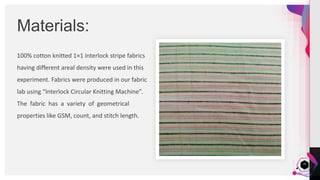
100% cotton knitted 1×1 interlock stripe fabrics
having different areal density were used in this
experiment. Fabrics were produced in our fabric
lab using “Interlock Circular Knitting Machine”.
The fabric has a variety of geometrical
properties like GSM, count, and stitch length.
Materials:
26
JensMartensson
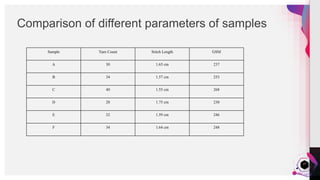
Comparison of different parameters of samples
27
Sample Yarn Count Stitch Length GSM
A 30 1.65 cm 237
B 34 1.57 cm 253
C 40 1.55 cm 268
D 28 1.75 cm 230
E 32 1.59 cm 246
F 34 1.64 cm 248
JensMartensson
HATRA Course Length Tester (SDL Atlas, England) were used for measuring stitch
length
Determination of Stitch Length:
28
JensMartensson
The effect of yarn count and stitch length on
fabric weight normally termed as GSM at
different processing stages. It is clearly seen from
the above table that with the increasing of the
yarn count and stitch length, the fabric GSM also
increased. The GSM were increased as different
percentages for the samples of A, B,C,D,E and F
respectively. Conversely, the GSM were
decreased as different percentages for the
samples A, B,C,D,E and F correspondingly. It is
also obviously noticeable from the above table
that with the increasing of the yarn count, the
fabric GSM also increased in dyeing and washing
state and finished state compared to grey state
when stitch length was fixed.
Fabric GSM:
29
Thank You

Interlock Circular Knitting Machine along with stripe production

  • 1.
    Practical Analysis ofdifferent setting and change point of Interlock Circular Knitting Machine along with stripe production Supervised By: Eng. Md. Sayful Islam
  • 2.
    JensMartensson 2 Group Members Name Student ID MD.INJAMAMUL ISLAM Z2015-1-2025 MD. FAYSAL AMIN Z2015-1-2009 NAZMUS SAKIB Z2015-1-2002 MD. JOYNAL ABEDIN Z2015-1-2014 MD. MIJANUR RAHMAN Z2015-1-2015 ABU SALEH MOHAMMAD NASIM Z2015-1-2016
  • 3.
    Name of theTopics 1. Introduction 2. Objective 3. Specifications 4. Machine Description 5. Machine Parts 6. Machine parameters 7. Stripe Fabric 8. Needle Arrangement 9. Cam Arrangement 10. Construction Of Interlock Stitch 11. Result 12. Summary Outlines
  • 4.
    JensMartensson Subtitle lorem ipsum dolor Introduction •This article represents different setting of the interlock circular knitting machine including V.D.Q Pulley, Machine Gauge, Machine Diameter and Needle Gauge. • We have produced 6 types of stripe fabric in this machine by using different colored yarn. 4
  • 5.
    JensMartensson Objectives . • To knowdifferent setting of circular knitting machine. • To know the functions of VDQ Pulley. • To know how to produce stripe effect. 5
  • 6.
    JensMartensson Machine name: InterlockCircular Knitting Machine Company: SMART MACHINERY CO. LTD. Origin of the machine: Taiwan Model no. : SMD-C4R2 Gauge of the machine: 24 Dia of the machine: 17 No of Feeder: 34 Serial no: 90003 Creel Capacity: 84. Feeding: Positive. Specifications 6
  • 7.
    JensMartensson The machine hastwo sets of needles on two different beds, one set on cylinder one in the dial bed. These two sets of needles must be exactly opposite to each other. The machine has two separate cam system in each bed needles of different length, called short needles and long needles. One cam system controls knitting at one feeder and other cam system controls at the next feeders. Take down mechanism is same as the other Interlock and plain machines mechanism. Machine Description 7
  • 8.
  • 9.
    JensMartensson Cylinder Dial Cylinder cam Dial cam Cylinderneedle Dial needlle Yarn career Yarn guide Machine Parts 9 Sensor Take up roller Motor Belts Pulleys and gears
  • 10.
    JensMartensson V.D.Q Pulley Machine Gauge MachineDiameter Needle Gauge Machine Parameters: 10
  • 11.
    JensMartensson V.D.Q pulley (Variabledia for Quality Pulley) It is a very important part of the machine. It controls the quality of the product. Altering the position of the tension pulley changes the G.S.M. of the fabric. If pulley moves towards the positive direction then the GSM is decreased and in reverse direction GSM will increase. V.D.Q. Pulley: 11
  • 12.
    JensMartensson No. of needleper inch present in a needle bed of a knitting machine is called machine gauge. Selection of machine gauge depends upon the following: Yarn count, Fiber type, Yarn twist, Yarn finished. Machine Gauge: 12
  • 13.
    JensMartensson Machine diameter ismainly diameter of machine cylinder. It is important for fabric width. Machine Diameter: 13
  • 14.
    JensMartensson Thickness of needleexpress by the needle gauge. It is important for selection of machine gauge. Needle Gauge: 14
  • 15.
  • 16.
    JensMartensson There are twotypes of cam arrangement in interlock knitting machine. Cylinder cam arrangement and dial cam arrangement. For every odd number feeder there are used same type of cam arrangements and for every even number feeder there are used same types of cam arrangements. Interlock Cam Arrangement: 16 Figure: 1
  • 17.
    JensMartensson For following thiscam track there are used two butt needles, short butt needles and long butt needles. Short butt needle follow the first cam track and long butt needle follow the second cam track. 17 Interlock Needle Arrangement: Figure: 2
  • 18.
  • 19.
    JensMartensson There are TWOtype of needle arrangement in circular machine. When the needle heads are offset with each other, it is called rib gating. If the needle heads are facing with each other, it is called interlock gating. Types of Needle Arrangement 19
  • 20.
    JensMartensson Interlock has thetechnical face of plain fabric on both sides, but its smooth surface cannot be stretched out to reveal the reverse meshed loop wales because the wales on each side are exactly opposite to each other and are locked together. Each interlock pattern row requires two feeder courses, each. Thus, odd feeders will produce alternate wales of loops on each side and even feeders will produce the other wales. Construction of Interlock Stitch 20
  • 21.
  • 22.
    JensMartensson A . FeederStripe B . E n g in eerin g S trip e Types of Stripe Fabric 22
  • 23.
    JensMartensson Feeder stripe hasa small repeating unit approximately 1.9 inch, it is the terminology been used when stripe is manufactured on regular single jersey machine. The feeder stripe designs are knitted on general circular knitting machine. The main principle is to feed 2-3 colors on the feeders according to design and let the machine knit the required design. The knitting machine has a capacity for many cones of yarn. If you have inserted 8 black yarns to the feeder, with 100 cones white yarn next. When knitting starts you will see within the 2” repeat there is a black and white horizontal stripe. Stripe Fabric: 23
  • 24.
    JensMartensson The fundamental elementin construction of knitted fabric is the knitting needle. Needle is the main knitting tools and also the principle element of knitting machine. During yarn feeding the hook is opened to release the retained old loop and to receive new loop which is than enclosed in the hook. The new loop is than drawn by the hook through the old loop which slides on the outside of the bridge of the closed hook. All needle must there for have some methods of closing the needle hooks to retain new loop and exclude the old loop. In knitting operation three types of needle mostly used. We have used “Latch Needle” for knitting operation. Needle Arrangements 24
  • 25.
  • 26.
    JensMartensson 100% cotton knitted1×1 interlock stripe fabrics having different areal density were used in this experiment. Fabrics were produced in our fabric lab using “Interlock Circular Knitting Machine”. The fabric has a variety of geometrical properties like GSM, count, and stitch length. Materials: 26
  • 27.
    JensMartensson Comparison of differentparameters of samples 27 Sample Yarn Count Stitch Length GSM A 30 1.65 cm 237 B 34 1.57 cm 253 C 40 1.55 cm 268 D 28 1.75 cm 230 E 32 1.59 cm 246 F 34 1.64 cm 248
  • 28.
    JensMartensson HATRA Course LengthTester (SDL Atlas, England) were used for measuring stitch length Determination of Stitch Length: 28
  • 29.
    JensMartensson The effect ofyarn count and stitch length on fabric weight normally termed as GSM at different processing stages. It is clearly seen from the above table that with the increasing of the yarn count and stitch length, the fabric GSM also increased. The GSM were increased as different percentages for the samples of A, B,C,D,E and F respectively. Conversely, the GSM were decreased as different percentages for the samples A, B,C,D,E and F correspondingly. It is also obviously noticeable from the above table that with the increasing of the yarn count, the fabric GSM also increased in dyeing and washing state and finished state compared to grey state when stitch length was fixed. Fabric GSM: 29
  • 30.