Interdisciplinary simulation training
for obstetric and neonatal
emergency conditions
Victor Petrov
Mother&Child Institute,
Chişinău
Міжнародна конференція
«Симуляційне навчання в медицині»
Popn 3.5 M
*Moldova GDP per capita PPP
4520.56 US dollars in 2013
Births 38,000
* International human development indicators.
(http://hdrstats.undp.org/en/indicators/62006.html)
Phases of Perinatal health system reform
• 3 major phases:
– creation and strengthening (1998-2002)
– optimization (2003-2007)
– modernization (2006-2014)
• having prominently contributed to the reduction of
IM on account of ENM (by 50%).
Strengthening perinatal health Governmental Program
Promoting Quality Services in Perinatal Care Project
Moldovan-Swiss Modernising perinatal system Project
Health and system interventions implemented in
different stages of the system reform
Interventions
Phases of reform
I II III
Regionalized / referral system in 3 levels 
National policies in perinatal health  
Endowment maternities with equipment  
Monitoring system of MNH using Babies matrix 
EB cost-effective interventions implementation  
Assessment of maternities using WHO questionnaires: 2003-7 
Clinical protocols in Obstetrics & Neonatology  
Community mobilisation: 2 national campaigns, Family Clubs  
Improvement QoC: regionalization, collaborative work in elaboration of clinical protocol, strategic
partnerships

QM: capacity building for QM teams, QI projects, translation of CPG into locally procedures, clinical
audit, benchmarking

Health Technology Management 
The QoC training portfolio within the PGE education programme:
simulation courses in Obs.&Neon. EmCare

Post-NICU Follow-up service 
Infant mortality rate, 1990-2013
18,5
16,3
13,2
2006. 2010. 2015.
•1990-1994 •2000-2004 •2013
•MDG
19
19,8
18,4
21,5
22,6
21,2
20,2 19,8
17,5 18,2
18,3
16,3
14,7 14,4
12,2
12,4
11,8
11,3
12,1
11,3
12,1
11,8
9,8
9,5
1990. 1991. 1992. 1993. 1994. 1995. 1996. 1997. 1998. 1999. 2000. 2001. 2002. 2003 2004. 2005. 2006. 2007. 2008. 2009. 2010. 2011. 2012. 2013.
Survival of neonates according to the birth weight:
2000 vs. 2013
0,814
0,841
0,919
0,945
0,96 0,959 0,956
0,934 0,947
0,961
0,98 0,985 0,988 0,991
0,0164
0,0538
0,317
0,369
0,399
0,437
0,504
0,522 0,601
0,777
85%
0,863
0,806
0,88
0
0,2
0,4
0,6
0,8
1
2000. 2005. 2009. 2010 2011. 2012. 2013.
1500-1999 2000-2499 500-999 1000-1499
4 stages of medical simulation implementation in the
fields of Obstetrics and Neonatology
1. Planning
2. Preparation
3. Training of Ts
4. Step down trainings
1. Planning stage
Simulation training course in ObstEmCare, Simulation Centre, Basel University Hospital, 2011
Simulation training course in NeonEmCare,
Medical University, Iasi, Romania, 2012
Simulation training course in Obst&NeonEmCare, Federal Centre of
Obstetrics, Gynecology&Perinatology, “V.Culakov”, Moscow, 2012
2. Preparatory stage: creation of SimLab at
Mother&Child Institute, 1
2. Preparatory stage: technical trainings, 2
2. Preparatory stage, 3
3. Trainings of Trainers stage, 1
Simulation training on Newborn Resuscitation,
with Dr. R. Pfister, HUG, Switzerland
Simulation training on Obstetrical Emergency Care,
with team of CESIMED, Porto, Portugal
3. TofTs stage. Training of bioengineer
in SimulHUG, 2
• 3,5 days training in SimulHUG units: obstetrics, neonatology,
pediatrics and adults, getting acquainted with the mannequins
functioning, participation at 2 simulation trainings, scenarios
analysis.
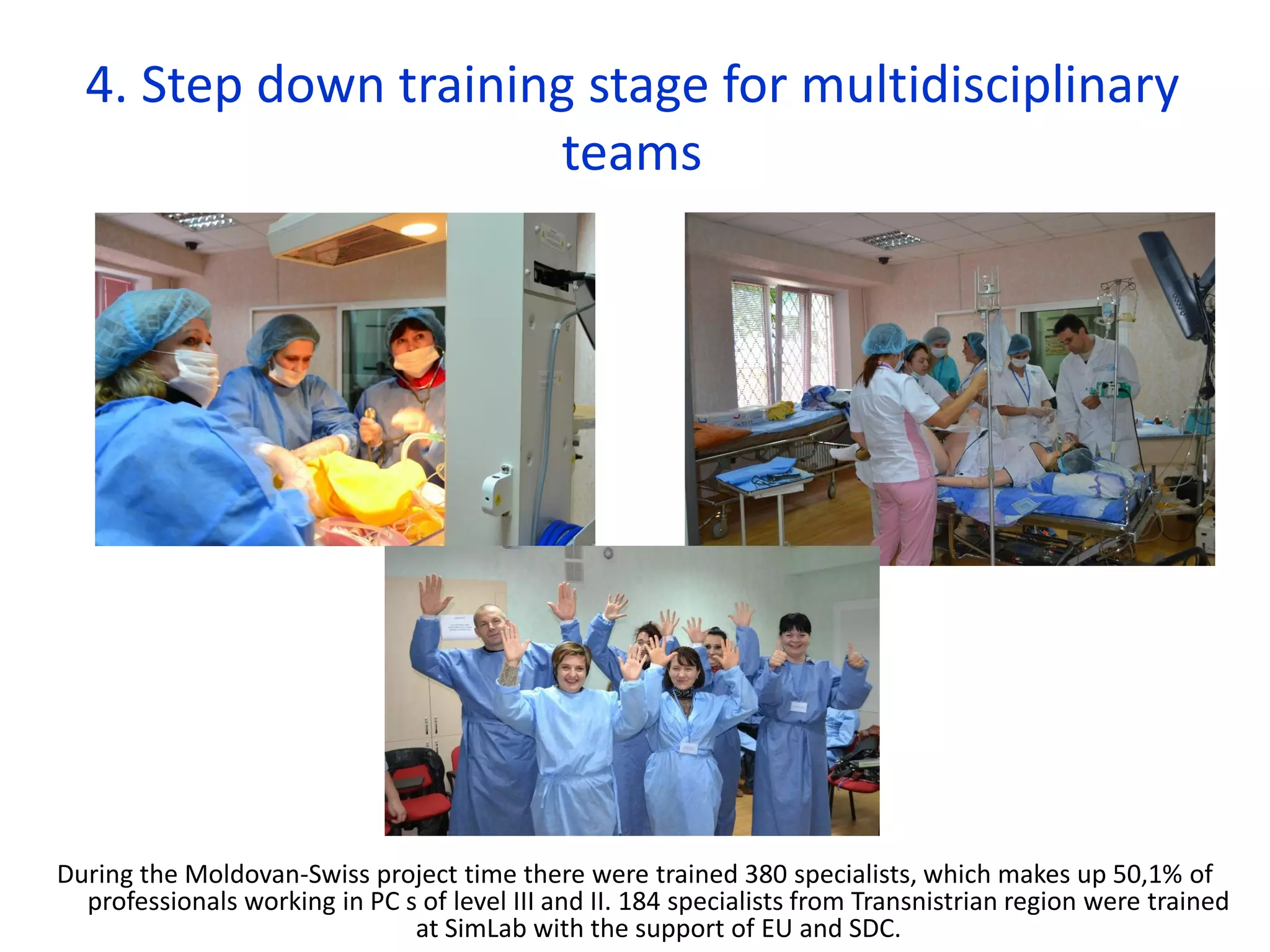
4. Step down training stage for multidisciplinary
teams
During the Moldovan-Swiss project time there were trained 380 specialists, which makes up 50,1% of
professionals working in PC s of level III and II. 184 specialists from Transnistrian region were trained
at SimLab with the support of EU and SDC.
4. Step down mobile trainings in Newborn
resuscitation
• Benefits: a greater access for the staff from peripheral
maternities.
• The courses take place in conditions in which specialists from
peripheral maternities activate.
Simulation course in Newborn resuscitation
Course agenda
• 09:00 Registration of participants
• 09:10-09.30 Theoretical presentation
• 09:30-10:00 Presentation of mannequin’s functions
• 10.00-10.30 Use of a simple mannequin to practice
resuscitation maneuvers
• 10.30-11.30 Scenario with debriefing
• 11:30-12.00 Break
• 12:00-13:00 Scenario with debriefing
• 13:00-14:00 Lunch break
• 14:00-15:00 Scenario with debriefing
• 15:00-15:30 Break
• 15:30-16:30 Scenario with debriefing
• 16:30-17:00 Plenary discussion: what to improve.
Closure. Handing of certificates
16 specialists:
per a multidisciplinary
team of 4 specialists from
a maternity
composed of a
neonatologist,
obstetrician, midwife and
nurse.
Simulation course in Obstetrical emergencies
10-12 specialists:
per a multidisciplinary team
of 3-6 specialists from a
maternity
composed of a
anesthesiologist, medical
assistant, 1-2 obstetricians,
1-2 midwifes and nurse.
Course agenda (2,5 days)
• 09:00 Registration of participants
• 09:10-09.30 Introduction in simulation course
• 09:30-10:30 Presentation of mannequin’s functions
• 10.00-10.30 Use of a simple mannequin to practice
resuscitation maneuvers
• 10.30-11.30 Scenario with debriefing
• 11:30-12.00 Break
• 12:00-13:00 Scenario with debriefing
• 13:00-14:00 Lunch break
• 14:00-15:00 Scenario with debriefing
• 15:00-15:30 Break
• 15:30-16:30 Scenario with debriefing
• 16:30-17:00 Plenary discussion: what to improve.
Closure. Handing of certificates
Simulation course in Obstetrical emergencies
• Day 3
• 09:00 – 09:05 ->>> FILM Mannequin;
• 09:10 – 09:40 ->>> REVIEW (Petrov V.);
• 09:45 – 09:10 ->>> ECLAMPSIA, Scenario 1 (Coşpormac V., Bejenaru S., Stasiuc V.);
• 09:15 – 09:45 ->>> ECLAMPSIA, Theory (Coşpormac V.);
• 09:50 – 10:30 ->>> ECLAMPSIE, Debriefing 1 (Coşpormac V., Bejenaru S., Stasiuc V.);
• 10:35 – 11:00 ->>> COURSE. Leader (Iliadi C.);
• 11:00 – 11:15 ->>> Coffee Break ;
• 11:20 – 11:30 ->>> FILM Orchestra;
• 11:35 – 12:00 –>>> ECLAMPSIA, Scenario 2 (Coşpormac V., Bejenaru S., Stasiuc V.);
• 12:05 – 12:30 ->>> ECLAMPSIA Debriefing 2 (Coşpormac V., Bejenaru S., Stasiuc V.);
• 12:35 – 12:50 ->>> ECLAMPSIA, Scenariul 3 (Coşpormac V., Bejenaru S., Stasiuc V.);
• 12:55 – 13:00 ->>> ECLAMPSIA Debrifieng 3 (Coşpormac V., Bejenaru S., Stasiuc V.);
• 13:00 – 14:00 ->>> Lunch break;
• 14:00 – 14:15 ->>> COURSE 6 , Hat (Iliadi C.);
• 14:20 – 14:40 ->>> HPP, Scenario 1 (Diug V., Iliadi C.);
• 14:45 – 15:15 - >>> HPP, Theory (Diug V.);
• 15:20 – 16:00 ->>> HPP, Debriefing 1 (Coşpormac V., Iliadi C., Diug V.);
• 16:00 – 16:15 ->>> Coffee Break ;
• 16:20 – 16:40 –>>> HPP, Scenario 2 (Iliadi C., Coşpormac V., Diug V.);
• 16:45 – 16:55 ->>> HPP 2, Debriefing 2 (Iliadi C., Coşpormac V., Diug V.);
• 16:55 – 17:00 ->>> Conclusions
Teamwork, communication
Strengthening knowledge and
practical skills
More practice, less theory
Self-assessment of own actions
Eclampsia
Eclampsia
PPH
PPH
PPH
Neonatal CPR
Neonatal CPR
Benefits of simulation cources
• strengthening practical skills of participants,
• discussion of each action with team and trainers,
• self-evaluation of own actions,
• good knowledge of managing algorithms in
frequently met emergencies,
• cultivation of decision making skills in participants,
• opportunity to participate in rare clinical cases.
Main challenges
For trainers
• lack of work experience in
this field and lack of a
standard methodology of
teaching, which has been
improved in time;
• related to the elaboration of
scenarios for
multidisciplinary teams by
including compartments
from different disciplines;
For participants
• initially skeptical
participants’ attitude
towards the course;
• perception of mannequin as
a real patient;
• insufficient involvement in
the course of decision
making persons.
The learned lessons
- Partner support
- Good collaboration with bioengineers
- Adaptation of different styles of working /
approaches of trainers taking into account their
speciality
- Strengthening of knowledge and practical skills
- Internal motivation of trainees for further
improvement of knowledge
- Minimising stress in real situation
- Reorganisation of working activity
Initial skeptical attitude of the participants
• The organizers had to overcome the initial
skeptical attitude towards participants during
the simulation itself.
• However, after the training course,
participants shared opinion that "... positive
experience should be repeated at least once
a year".
Future Steps in SimLab
• to train multidisciplinary teams from the first
level maternities, inclusively through mobile
simulation courses;
• to develop and implement new scenarios;
• to train new trainers;
• to accredit the existing training courses and
modules for CME;
• to develop courses and scenarios for
paramedics.
Special acknowledgments!
Adriani M. Hilbert & Georgette Bruchez Ana Reynolds
Petru Stratulat Riccardo Pfister
Thank you for your attention!

Interdisciplinary simulation training for obstetric and neonatal emergency conditions

  • 1.
    Interdisciplinary simulation training forobstetric and neonatal emergency conditions Victor Petrov Mother&Child Institute, Chişinău Міжнародна конференція «Симуляційне навчання в медицині»
  • 2.
    Popn 3.5 M *MoldovaGDP per capita PPP 4520.56 US dollars in 2013 Births 38,000 * International human development indicators. (http://hdrstats.undp.org/en/indicators/62006.html)
  • 3.
    Phases of Perinatalhealth system reform • 3 major phases: – creation and strengthening (1998-2002) – optimization (2003-2007) – modernization (2006-2014) • having prominently contributed to the reduction of IM on account of ENM (by 50%). Strengthening perinatal health Governmental Program Promoting Quality Services in Perinatal Care Project Moldovan-Swiss Modernising perinatal system Project
  • 4.
    Health and systeminterventions implemented in different stages of the system reform Interventions Phases of reform I II III Regionalized / referral system in 3 levels  National policies in perinatal health   Endowment maternities with equipment   Monitoring system of MNH using Babies matrix  EB cost-effective interventions implementation   Assessment of maternities using WHO questionnaires: 2003-7  Clinical protocols in Obstetrics & Neonatology   Community mobilisation: 2 national campaigns, Family Clubs   Improvement QoC: regionalization, collaborative work in elaboration of clinical protocol, strategic partnerships  QM: capacity building for QM teams, QI projects, translation of CPG into locally procedures, clinical audit, benchmarking  Health Technology Management  The QoC training portfolio within the PGE education programme: simulation courses in Obs.&Neon. EmCare  Post-NICU Follow-up service 
  • 5.
    Infant mortality rate,1990-2013 18,5 16,3 13,2 2006. 2010. 2015. •1990-1994 •2000-2004 •2013 •MDG 19 19,8 18,4 21,5 22,6 21,2 20,2 19,8 17,5 18,2 18,3 16,3 14,7 14,4 12,2 12,4 11,8 11,3 12,1 11,3 12,1 11,8 9,8 9,5 1990. 1991. 1992. 1993. 1994. 1995. 1996. 1997. 1998. 1999. 2000. 2001. 2002. 2003 2004. 2005. 2006. 2007. 2008. 2009. 2010. 2011. 2012. 2013.
  • 6.
    Survival of neonatesaccording to the birth weight: 2000 vs. 2013 0,814 0,841 0,919 0,945 0,96 0,959 0,956 0,934 0,947 0,961 0,98 0,985 0,988 0,991 0,0164 0,0538 0,317 0,369 0,399 0,437 0,504 0,522 0,601 0,777 85% 0,863 0,806 0,88 0 0,2 0,4 0,6 0,8 1 2000. 2005. 2009. 2010 2011. 2012. 2013. 1500-1999 2000-2499 500-999 1000-1499
  • 7.
    4 stages ofmedical simulation implementation in the fields of Obstetrics and Neonatology 1. Planning 2. Preparation 3. Training of Ts 4. Step down trainings
  • 8.
    1. Planning stage Simulationtraining course in ObstEmCare, Simulation Centre, Basel University Hospital, 2011 Simulation training course in NeonEmCare, Medical University, Iasi, Romania, 2012 Simulation training course in Obst&NeonEmCare, Federal Centre of Obstetrics, Gynecology&Perinatology, “V.Culakov”, Moscow, 2012
  • 9.
    2. Preparatory stage:creation of SimLab at Mother&Child Institute, 1
  • 10.
    2. Preparatory stage:technical trainings, 2
  • 11.
  • 12.
    3. Trainings ofTrainers stage, 1 Simulation training on Newborn Resuscitation, with Dr. R. Pfister, HUG, Switzerland Simulation training on Obstetrical Emergency Care, with team of CESIMED, Porto, Portugal
  • 13.
    3. TofTs stage.Training of bioengineer in SimulHUG, 2 • 3,5 days training in SimulHUG units: obstetrics, neonatology, pediatrics and adults, getting acquainted with the mannequins functioning, participation at 2 simulation trainings, scenarios analysis.
  • 14.
    4. Step downtraining stage for multidisciplinary teams During the Moldovan-Swiss project time there were trained 380 specialists, which makes up 50,1% of professionals working in PC s of level III and II. 184 specialists from Transnistrian region were trained at SimLab with the support of EU and SDC.
  • 15.
    4. Step downmobile trainings in Newborn resuscitation • Benefits: a greater access for the staff from peripheral maternities. • The courses take place in conditions in which specialists from peripheral maternities activate.
  • 16.
    Simulation course inNewborn resuscitation Course agenda • 09:00 Registration of participants • 09:10-09.30 Theoretical presentation • 09:30-10:00 Presentation of mannequin’s functions • 10.00-10.30 Use of a simple mannequin to practice resuscitation maneuvers • 10.30-11.30 Scenario with debriefing • 11:30-12.00 Break • 12:00-13:00 Scenario with debriefing • 13:00-14:00 Lunch break • 14:00-15:00 Scenario with debriefing • 15:00-15:30 Break • 15:30-16:30 Scenario with debriefing • 16:30-17:00 Plenary discussion: what to improve. Closure. Handing of certificates 16 specialists: per a multidisciplinary team of 4 specialists from a maternity composed of a neonatologist, obstetrician, midwife and nurse.
  • 17.
    Simulation course inObstetrical emergencies 10-12 specialists: per a multidisciplinary team of 3-6 specialists from a maternity composed of a anesthesiologist, medical assistant, 1-2 obstetricians, 1-2 midwifes and nurse. Course agenda (2,5 days) • 09:00 Registration of participants • 09:10-09.30 Introduction in simulation course • 09:30-10:30 Presentation of mannequin’s functions • 10.00-10.30 Use of a simple mannequin to practice resuscitation maneuvers • 10.30-11.30 Scenario with debriefing • 11:30-12.00 Break • 12:00-13:00 Scenario with debriefing • 13:00-14:00 Lunch break • 14:00-15:00 Scenario with debriefing • 15:00-15:30 Break • 15:30-16:30 Scenario with debriefing • 16:30-17:00 Plenary discussion: what to improve. Closure. Handing of certificates
  • 18.
    Simulation course inObstetrical emergencies • Day 3 • 09:00 – 09:05 ->>> FILM Mannequin; • 09:10 – 09:40 ->>> REVIEW (Petrov V.); • 09:45 – 09:10 ->>> ECLAMPSIA, Scenario 1 (Coşpormac V., Bejenaru S., Stasiuc V.); • 09:15 – 09:45 ->>> ECLAMPSIA, Theory (Coşpormac V.); • 09:50 – 10:30 ->>> ECLAMPSIE, Debriefing 1 (Coşpormac V., Bejenaru S., Stasiuc V.); • 10:35 – 11:00 ->>> COURSE. Leader (Iliadi C.); • 11:00 – 11:15 ->>> Coffee Break ; • 11:20 – 11:30 ->>> FILM Orchestra; • 11:35 – 12:00 –>>> ECLAMPSIA, Scenario 2 (Coşpormac V., Bejenaru S., Stasiuc V.); • 12:05 – 12:30 ->>> ECLAMPSIA Debriefing 2 (Coşpormac V., Bejenaru S., Stasiuc V.); • 12:35 – 12:50 ->>> ECLAMPSIA, Scenariul 3 (Coşpormac V., Bejenaru S., Stasiuc V.); • 12:55 – 13:00 ->>> ECLAMPSIA Debrifieng 3 (Coşpormac V., Bejenaru S., Stasiuc V.); • 13:00 – 14:00 ->>> Lunch break; • 14:00 – 14:15 ->>> COURSE 6 , Hat (Iliadi C.); • 14:20 – 14:40 ->>> HPP, Scenario 1 (Diug V., Iliadi C.); • 14:45 – 15:15 - >>> HPP, Theory (Diug V.); • 15:20 – 16:00 ->>> HPP, Debriefing 1 (Coşpormac V., Iliadi C., Diug V.); • 16:00 – 16:15 ->>> Coffee Break ; • 16:20 – 16:40 –>>> HPP, Scenario 2 (Iliadi C., Coşpormac V., Diug V.); • 16:45 – 16:55 ->>> HPP 2, Debriefing 2 (Iliadi C., Coşpormac V., Diug V.); • 16:55 – 17:00 ->>> Conclusions
  • 19.
  • 20.
  • 21.
  • 22.
  • 23.
  • 24.
  • 25.
  • 26.
  • 27.
  • 28.
  • 29.
  • 30.
    Benefits of simulationcources • strengthening practical skills of participants, • discussion of each action with team and trainers, • self-evaluation of own actions, • good knowledge of managing algorithms in frequently met emergencies, • cultivation of decision making skills in participants, • opportunity to participate in rare clinical cases.
  • 31.
    Main challenges For trainers •lack of work experience in this field and lack of a standard methodology of teaching, which has been improved in time; • related to the elaboration of scenarios for multidisciplinary teams by including compartments from different disciplines; For participants • initially skeptical participants’ attitude towards the course; • perception of mannequin as a real patient; • insufficient involvement in the course of decision making persons.
  • 33.
    The learned lessons -Partner support - Good collaboration with bioengineers - Adaptation of different styles of working / approaches of trainers taking into account their speciality - Strengthening of knowledge and practical skills - Internal motivation of trainees for further improvement of knowledge - Minimising stress in real situation - Reorganisation of working activity
  • 34.
    Initial skeptical attitudeof the participants • The organizers had to overcome the initial skeptical attitude towards participants during the simulation itself. • However, after the training course, participants shared opinion that "... positive experience should be repeated at least once a year".
  • 35.
    Future Steps inSimLab • to train multidisciplinary teams from the first level maternities, inclusively through mobile simulation courses; • to develop and implement new scenarios; • to train new trainers; • to accredit the existing training courses and modules for CME; • to develop courses and scenarios for paramedics.
  • 36.
    Special acknowledgments! Adriani M.Hilbert & Georgette Bruchez Ana Reynolds Petru Stratulat Riccardo Pfister
  • 37.
    Thank you foryour attention!