THE INTERACTIVE
NOTEBOOK
Michelle Alspaugh
Amy Cooper
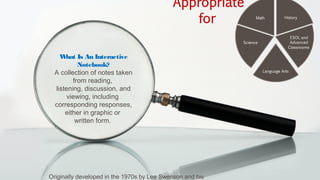
What Is An Interactive
Notebook?
A collection of notes taken
from reading,
listening, discussion, and
viewing, including
corresponding responses,
either in graphic or
written form.
Originally developed in the 1970s by Lee Swenson and his
1.Cover (personalized)
2.Table of contents
3.Unit—cover page
4.Pages are numbered and labeled
5.Handouts fit neatly and do not hang
out
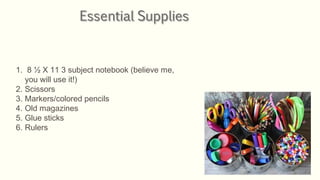
1. 8 ½ X 11 3 subject notebook (believe me,
you will use it!)
2. Scissors
3. Markers/colored pencils
4. Old magazines
5. Glue sticks
6. Rulers
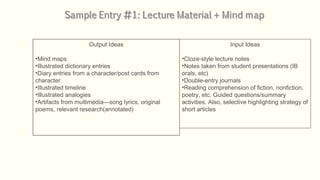
Input Ideas
•Cloze-style lecture notes
•Notes taken from student presentations (IB
orals, etc)
•Double-entry journals
•Reading comprehension of fiction, nonfiction,
poetry, etc. Guided questions/summary
activities. Also, selective highlighting strategy of
short articles
Output Ideas
•Mind maps
•Illustrated dictionary entries
•Diary entries from a character/post cards from
character
•Illustrated timeline
•Illustrated analogies
•Artifacts from multimedia—song lyrics, original
poems, relevant research(annotated)
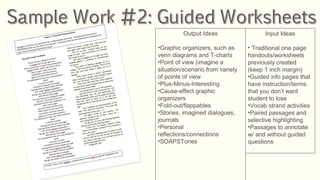
Input Ideas
• Traditional one page
handouts/worksheets
previously created
(keep 1 inch margin)
•Guided info pages that
have instruction/terms
that you don’t want
student to lose
•Vocab strand activities
•Paired passages and
selective highlighting
•Passages to annotate
w/ and without guided
questions
Output Ideas
•Graphic organizers, such as
venn diagrams and T-charts
•Point of view (imagine a
situation/scenario from variety
of points of view
•Plus-Minus-Interesting
•Cause-effect graphic
organizers
•Fold-out/flappables
•Stories, imagined dialogues,
journals
•Personal
reflections/connections
•SOAPSTones
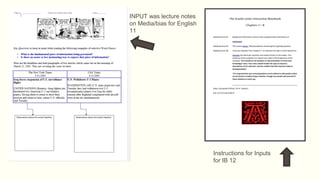
INPUT was lecture notes
on Media/bias for English
11
Instructions for Inputs
for IB 12
Sample Student WorkSample Student Work
http://tinyurl.com/interactivenotebook

Interactive notebook presentation 2014 compatible version

  • 1.
  • 2.
    What Is AnInteractive Notebook? A collection of notes taken from reading, listening, discussion, and viewing, including corresponding responses, either in graphic or written form. Originally developed in the 1970s by Lee Swenson and his
  • 3.
    1.Cover (personalized) 2.Table ofcontents 3.Unit—cover page 4.Pages are numbered and labeled 5.Handouts fit neatly and do not hang out
  • 4.
    1. 8 ½X 11 3 subject notebook (believe me, you will use it!) 2. Scissors 3. Markers/colored pencils 4. Old magazines 5. Glue sticks 6. Rulers
  • 5.
    Input Ideas •Cloze-style lecturenotes •Notes taken from student presentations (IB orals, etc) •Double-entry journals •Reading comprehension of fiction, nonfiction, poetry, etc. Guided questions/summary activities. Also, selective highlighting strategy of short articles Output Ideas •Mind maps •Illustrated dictionary entries •Diary entries from a character/post cards from character •Illustrated timeline •Illustrated analogies •Artifacts from multimedia—song lyrics, original poems, relevant research(annotated)
  • 6.
    Input Ideas • Traditionalone page handouts/worksheets previously created (keep 1 inch margin) •Guided info pages that have instruction/terms that you don’t want student to lose •Vocab strand activities •Paired passages and selective highlighting •Passages to annotate w/ and without guided questions Output Ideas •Graphic organizers, such as venn diagrams and T-charts •Point of view (imagine a situation/scenario from variety of points of view •Plus-Minus-Interesting •Cause-effect graphic organizers •Fold-out/flappables •Stories, imagined dialogues, journals •Personal reflections/connections •SOAPSTones
  • 7.
    INPUT was lecturenotes on Media/bias for English 11 Instructions for Inputs for IB 12
  • 8.
  • 9.
  • 10.