Interactive
Editing
Island
West Coast Literacy Conference
March 14-15, 2008
By Diane Jensen
ExLL Element:
Interactive
Editing
Introductory Level
Diane Jensen
Classroom Teacher: 26 years
Literacy Coach: 3 years
ExLL Literacy Coordinator-in-Training
Billings, Montana
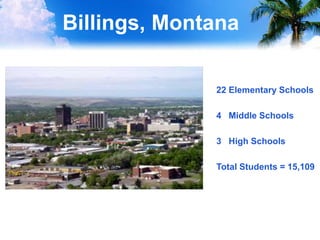
Billings, Montana
22 Elementary Schools
4 Middle Schools
3 High Schools
Total Students = 15,109
Description of Interactive Editing
A teaching method
where the teacher and
students collaborate to
edit familiar, error-free
text into a new format.
And …
Interactive Editing
is not
editing for
conventions.
Instructional Purpose
• Helps students understand
the reciprocity of reading and
writing
• Promotes meaningful
discussions in content areas
• Builds oral language structure
and vocabulary
Instructional Purpose
(continued)
• Develops comprehension
strategies for determining
importance
• Models construction and
revision of expository text
• Provides opportunities to
write informational text using
specific text features
Types of Interactive Editing
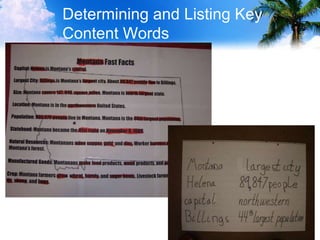
1. Determining and Listing Key Content
Words
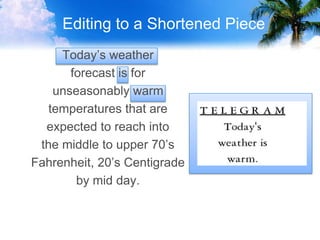
2. Editing to a Shortened Piece
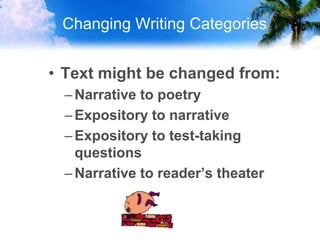
3. Changing Writing Categories
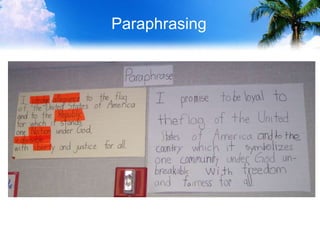
4. Paraphrasing
5. Summarizing
Determining and Listing Key
Content Words
Editing to a Shortened Piece
Today’s weather
forecast is for
unseasonably warm
temperatures that are
expected to reach into
the middle to upper 70’s
Fahrenheit, 20’s Centigrade
by mid day.
Changing Writing Categories
• Text might be changed from:
–Narrative to poetry
–Expository to narrative
–Expository to test-taking
questions
–Narrative to reader’s theater
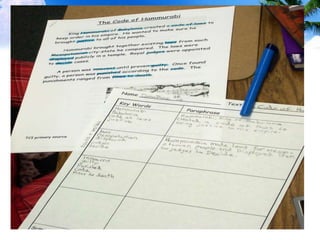
Paraphrasing
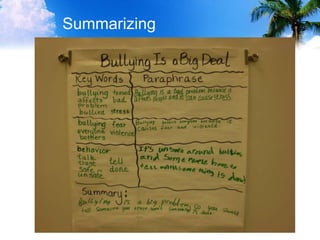
Summarizing
Materials:
• Short piece of error-free text
• Overhead, Elmo or large chart
• A duplicated copy of text
• Optional
–graphic organizer
–highlighter
–highlighting tape
Procedure:
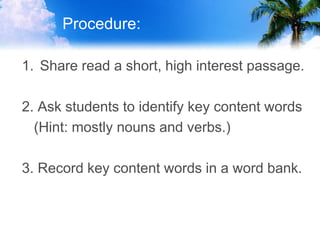
1. Share read a short, high interest passage.
2. Ask students to identify key content words
(Hint: mostly nouns and verbs.)
3. Record key content words in a word bank.
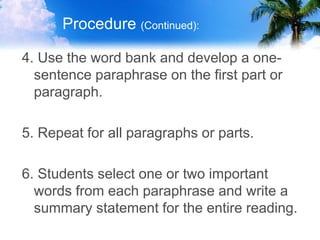
Procedure (Continued):
4. Use the word bank and develop a one-
sentence paraphrase on the first part or
paragraph.
5. Repeat for all paragraphs or parts.
6. Students select one or two important
words from each paraphrase and write a
summary statement for the entire reading.
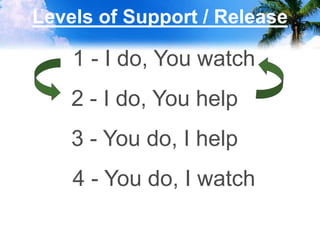
Levels of Support / Release
1 - I do, You watch
2 - I do, You help
3 - You do, I help
4 - You do, I watch
Modeling Key Words and
Paraphrasing
Fish
Fish are animals that live in
water. All fish have fins. Fins
help fish swim. Fish have gills
for breathing in the water.
Taken from:
Fish
Text by Stanley L. Swartz,
Photography by Robert Yin
Let’s try it together!
Fish (continued)
Fish swim in groups called schools.
Schools are made up of many of the same
kind of fish swimming in schools. Fish
spend a lot of time swimming in schools.
One school had more than three billion
fish.
Taken from:
Fish
Text by Stanley L. Swartz,
Photography by Robert Yin
Work with a partner.
Fish (continued)
Fish come in many shapes. Some fish
are big and some are small. Some fish
have many colors. The colors help protect
them.
Taken from:
Fish
Text by Stanley L. Swartz,
Photography by Robert Yin
Work on your own.
Fish (continued)
Many fish live on coral reefs. There is
plenty of food on these reefs. Fish eat
plants and other fish. They swim and hide
in the coral.
Taken from:
Fish
Text by Stanley L. Swartz,
Photography by Robert Yin
Summary Statement
• Select one or two important words
from each paraphrase and write a
summary statement for the entire
reading.
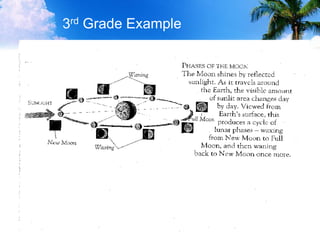
3rd Grade Example
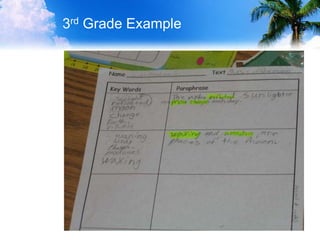
3rd Grade Example
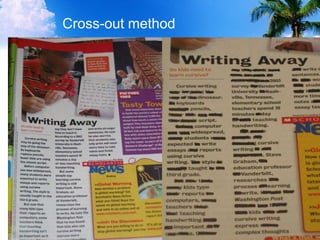
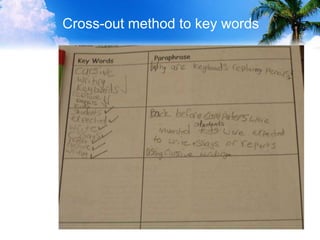
Cross-out method
Cross-out method to key words
What’s important?
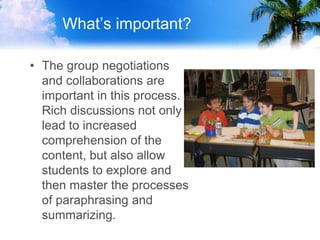
• The group negotiations
and collaborations are
important in this process.
Rich discussions not only
lead to increased
comprehension of the
content, but also allow
students to explore and
then master the processes
of paraphrasing and
summarizing.
After Interactive Editing
• Reread the edited work.
• Discuss the impact of the work.
• Students work in small groups.
• Extend the writing into other activities.
• Apply learning to independent writing.
In Sum…
Interactive Editing is a
valuable tool through
which you can teach key
content vocabulary,
paraphrasing, and
summarizing.
Interactive
Editing
Island
West Coast Literacy Conference
March 14-15, 2008
By Diane Jensen

Interactive Editing

  • 1.
    Interactive Editing Island West Coast LiteracyConference March 14-15, 2008 By Diane Jensen
  • 2.
    ExLL Element: Interactive Editing Introductory Level DianeJensen Classroom Teacher: 26 years Literacy Coach: 3 years ExLL Literacy Coordinator-in-Training Billings, Montana
  • 3.
    Billings, Montana 22 ElementarySchools 4 Middle Schools 3 High Schools Total Students = 15,109
  • 4.
    Description of InteractiveEditing A teaching method where the teacher and students collaborate to edit familiar, error-free text into a new format.
  • 5.
    And … Interactive Editing isnot editing for conventions.
  • 6.
    Instructional Purpose • Helpsstudents understand the reciprocity of reading and writing • Promotes meaningful discussions in content areas • Builds oral language structure and vocabulary
  • 7.
    Instructional Purpose (continued) • Developscomprehension strategies for determining importance • Models construction and revision of expository text • Provides opportunities to write informational text using specific text features
  • 8.
    Types of InteractiveEditing 1. Determining and Listing Key Content Words 2. Editing to a Shortened Piece 3. Changing Writing Categories 4. Paraphrasing 5. Summarizing
  • 9.
    Determining and ListingKey Content Words
  • 10.
    Editing to aShortened Piece Today’s weather forecast is for unseasonably warm temperatures that are expected to reach into the middle to upper 70’s Fahrenheit, 20’s Centigrade by mid day.
  • 11.
    Changing Writing Categories •Text might be changed from: –Narrative to poetry –Expository to narrative –Expository to test-taking questions –Narrative to reader’s theater
  • 12.
  • 13.
  • 14.
    Materials: • Short pieceof error-free text • Overhead, Elmo or large chart • A duplicated copy of text • Optional –graphic organizer –highlighter –highlighting tape
  • 18.
    Procedure: 1. Share reada short, high interest passage. 2. Ask students to identify key content words (Hint: mostly nouns and verbs.) 3. Record key content words in a word bank.
  • 19.
    Procedure (Continued): 4. Usethe word bank and develop a one- sentence paraphrase on the first part or paragraph. 5. Repeat for all paragraphs or parts. 6. Students select one or two important words from each paraphrase and write a summary statement for the entire reading.
  • 20.
    Levels of Support/ Release 1 - I do, You watch 2 - I do, You help 3 - You do, I help 4 - You do, I watch
  • 21.
    Modeling Key Wordsand Paraphrasing Fish Fish are animals that live in water. All fish have fins. Fins help fish swim. Fish have gills for breathing in the water. Taken from: Fish Text by Stanley L. Swartz, Photography by Robert Yin
  • 22.
    Let’s try ittogether! Fish (continued) Fish swim in groups called schools. Schools are made up of many of the same kind of fish swimming in schools. Fish spend a lot of time swimming in schools. One school had more than three billion fish. Taken from: Fish Text by Stanley L. Swartz, Photography by Robert Yin
  • 23.
    Work with apartner. Fish (continued) Fish come in many shapes. Some fish are big and some are small. Some fish have many colors. The colors help protect them. Taken from: Fish Text by Stanley L. Swartz, Photography by Robert Yin
  • 24.
    Work on yourown. Fish (continued) Many fish live on coral reefs. There is plenty of food on these reefs. Fish eat plants and other fish. They swim and hide in the coral. Taken from: Fish Text by Stanley L. Swartz, Photography by Robert Yin
  • 25.
    Summary Statement • Selectone or two important words from each paraphrase and write a summary statement for the entire reading.
  • 26.
  • 27.
  • 28.
  • 29.
  • 30.
    What’s important? • Thegroup negotiations and collaborations are important in this process. Rich discussions not only lead to increased comprehension of the content, but also allow students to explore and then master the processes of paraphrasing and summarizing.
  • 31.
    After Interactive Editing •Reread the edited work. • Discuss the impact of the work. • Students work in small groups. • Extend the writing into other activities. • Apply learning to independent writing.
  • 32.
    In Sum… Interactive Editingis a valuable tool through which you can teach key content vocabulary, paraphrasing, and summarizing.
  • 33.
    Interactive Editing Island West Coast LiteracyConference March 14-15, 2008 By Diane Jensen