



BASIC READING
RUTH BUNGA OKTAULI
    2215115474
   11 DIK B MDR
   Title       :

     Practical Guide to the Teaching of English
                    as a Foreign Language
   Author                 : Robert J. Dixson
   Publisher              : Simon and Schuster
   Year of Publication    : 1960
   Place of Publication   : United States of America
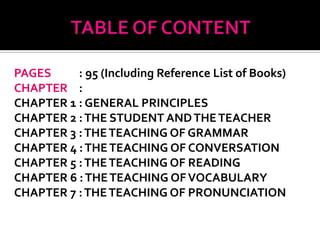
PAGES     : 95 (Including Reference List of Books)
CHAPTER :
CHAPTER 1 : GENERAL PRINCIPLES
CHAPTER 2 : THE STUDENT AND THE TEACHER
CHAPTER 3 : THE TEACHING OF GRAMMAR
CHAPTER 4 : THE TEACHING OF CONVERSATION
CHAPTER 5 : THE TEACHING OF READING
CHAPTER 6 : THE TEACHING OF VOCABULARY
CHAPTER 7 : THE TEACHING OF PRONUNCIATION
 Grammar which forms the real basis of the
  language. Grammar structure, primarily, that serves
  to distinguish one language from another.
 This book examines some of the more common
  points of view about grammar such as Old and New
  Conceptions of Grammar. In short, the grammar
  which the foreign student studies and the grammar
  which the native speaker studies are two different
  things. The foreign student studies about functional
  grammar or grammar as language; and the native
  speaker studies about formalized grammar.
   In foreign language teaching, when we speak of
    teaching conversation, we don’t refer to the kind of
    social conversation that goes on around the family
    dinner table or when friends gathering. This kind of
    conversation is rarely achieved in any language
    classroom. The classroom, as previously mentioned, is a
    very artificial situation.
   Conversation provides students the time to expressing
    themselves. Teachers should teach about conversation
    with the same attention or even greater attention than
    when they teach grammar, reading, pronunciation, or
    any other phase of language.
 In any modern language course where chief
  emphasis is placed upon teaching students to speak
  and understand English, reading is positioned in
  secondary position. But this doesn’t mean that
  reading by itself is not important to the foreign
  student.
 Students must naturally learn how to read English.
  In developing students in learning of reading, the
  teacher can ask various questions based on the
  reading material. So, the questions will lead the
  students into different avenues of simple
  conversation.
   Theoretical or philosophical discussion of
    vocabulary and related matters, although
    sometimes interesting in teaching of vocabulary but
    rarely help a teacher to teach any better.

   Like the teaching of any other phase of
    language, the teaching of new vocabulary is difficult
    and complicated task. There are no sure and easy
    ways of teaching new word. So, we need to practice
    more and more. New words should be both heard
    and seen, they should also be repeated aloud in
    written form by the students as many times as
    possible.
 The teaching of English pronunciation is both a simple and a
  complicated procedure. The teacher need to remember all of good
  pronunciation. Ear training is extremely important in the teaching
  of any foreign language.
 The teacher should never jump from one exercise to another but
  should continue working on each individual sound until the sound
  is heard clearly by the students and the proper ear and hearing
  habits have been established.
 However, as already said, there is nothing difficult about teaching.
  This book also give information about some of the aspects of
  English speech which relate directly to the correction of foreign
  accent such as Phonetics, Classification of Speech Sounds, Stress
  and Rhythm, Aspiration, Voicing and Invoicing of Final
  Consonants, and General Suggestions and Remarks.
Practical Guide to the Teaching of English as a Foreign
Language is a book good for every teacher. This book
suggesting to teachers simple, everyday techniques
which may serve to make their work more interesting
and at the same time more effective.
The purpose of this book is to provide teachers with suggestions
as to actual classroom procedure. Although, in the course of the
writing, some theory may be touched upon, the book lays principal
emphasis upon the practical side of English teaching. It deals, in other
words, with the “how” of teaching rather than the “why”. Recently there
has been a great flood of books and articles are often written in such
elevated language and are so obscure in composition that they merely
succeed in bewildering the reader. It seems time, therefore, that
something of a more realistic and practical nature be offered to guide
teachers in the everyday task of actual classroom teaching.
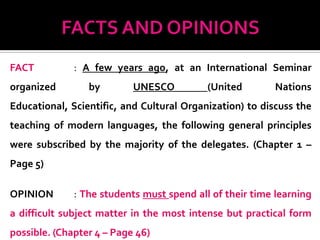
FACT          : A few years ago, at an International Seminar
organized        by        UNESCO          (United        Nations
Educational, Scientific, and Cultural Organization) to discuss the
teaching of modern languages, the following general principles
were subscribed by the majority of the delegates. (Chapter 1 –
Page 5)

OPINION       : The students must spend all of their time learning
a difficult subject matter in the most intense but practical form
possible. (Chapter 4 – Page 46)
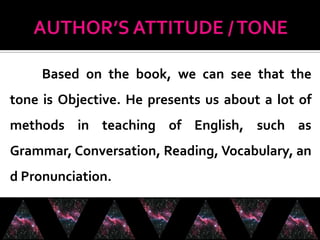
Based on the book, we can see that the
tone is Objective. He presents us about a lot of
methods in teaching of English, such as
Grammar, Conversation, Reading, Vocabulary, an
d Pronunciation.
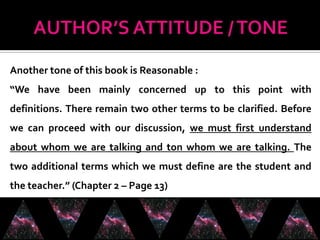
Another tone of this book is Reasonable :
“We have been mainly concerned up to this point with
definitions. There remain two other terms to be clarified. Before
we can proceed with our discussion, we must first understand
about whom we are talking and ton whom we are talking. The
two additional terms which we must define are the student and
the teacher.” (Chapter 2 – Page 13)
Basic Reading : Practical Guide to teaching of English as a Foreign Language

Basic Reading : Practical Guide to teaching of English as a Foreign Language

  • 1.
  • 2.
    RUTH BUNGA OKTAULI 2215115474 11 DIK B MDR
  • 3.
    Title : Practical Guide to the Teaching of English as a Foreign Language  Author : Robert J. Dixson  Publisher : Simon and Schuster  Year of Publication : 1960  Place of Publication : United States of America
  • 4.
    PAGES : 95 (Including Reference List of Books) CHAPTER : CHAPTER 1 : GENERAL PRINCIPLES CHAPTER 2 : THE STUDENT AND THE TEACHER CHAPTER 3 : THE TEACHING OF GRAMMAR CHAPTER 4 : THE TEACHING OF CONVERSATION CHAPTER 5 : THE TEACHING OF READING CHAPTER 6 : THE TEACHING OF VOCABULARY CHAPTER 7 : THE TEACHING OF PRONUNCIATION
  • 5.
     Grammar whichforms the real basis of the language. Grammar structure, primarily, that serves to distinguish one language from another.  This book examines some of the more common points of view about grammar such as Old and New Conceptions of Grammar. In short, the grammar which the foreign student studies and the grammar which the native speaker studies are two different things. The foreign student studies about functional grammar or grammar as language; and the native speaker studies about formalized grammar.
  • 6.
    In foreign language teaching, when we speak of teaching conversation, we don’t refer to the kind of social conversation that goes on around the family dinner table or when friends gathering. This kind of conversation is rarely achieved in any language classroom. The classroom, as previously mentioned, is a very artificial situation.  Conversation provides students the time to expressing themselves. Teachers should teach about conversation with the same attention or even greater attention than when they teach grammar, reading, pronunciation, or any other phase of language.
  • 7.
     In anymodern language course where chief emphasis is placed upon teaching students to speak and understand English, reading is positioned in secondary position. But this doesn’t mean that reading by itself is not important to the foreign student.  Students must naturally learn how to read English. In developing students in learning of reading, the teacher can ask various questions based on the reading material. So, the questions will lead the students into different avenues of simple conversation.
  • 8.
    Theoretical or philosophical discussion of vocabulary and related matters, although sometimes interesting in teaching of vocabulary but rarely help a teacher to teach any better.  Like the teaching of any other phase of language, the teaching of new vocabulary is difficult and complicated task. There are no sure and easy ways of teaching new word. So, we need to practice more and more. New words should be both heard and seen, they should also be repeated aloud in written form by the students as many times as possible.
  • 9.
     The teachingof English pronunciation is both a simple and a complicated procedure. The teacher need to remember all of good pronunciation. Ear training is extremely important in the teaching of any foreign language.  The teacher should never jump from one exercise to another but should continue working on each individual sound until the sound is heard clearly by the students and the proper ear and hearing habits have been established.  However, as already said, there is nothing difficult about teaching. This book also give information about some of the aspects of English speech which relate directly to the correction of foreign accent such as Phonetics, Classification of Speech Sounds, Stress and Rhythm, Aspiration, Voicing and Invoicing of Final Consonants, and General Suggestions and Remarks.
  • 10.
    Practical Guide tothe Teaching of English as a Foreign Language is a book good for every teacher. This book suggesting to teachers simple, everyday techniques which may serve to make their work more interesting and at the same time more effective.
  • 11.
    The purpose ofthis book is to provide teachers with suggestions as to actual classroom procedure. Although, in the course of the writing, some theory may be touched upon, the book lays principal emphasis upon the practical side of English teaching. It deals, in other words, with the “how” of teaching rather than the “why”. Recently there has been a great flood of books and articles are often written in such elevated language and are so obscure in composition that they merely succeed in bewildering the reader. It seems time, therefore, that something of a more realistic and practical nature be offered to guide teachers in the everyday task of actual classroom teaching.
  • 12.
    FACT : A few years ago, at an International Seminar organized by UNESCO (United Nations Educational, Scientific, and Cultural Organization) to discuss the teaching of modern languages, the following general principles were subscribed by the majority of the delegates. (Chapter 1 – Page 5) OPINION : The students must spend all of their time learning a difficult subject matter in the most intense but practical form possible. (Chapter 4 – Page 46)
  • 13.
    Based on thebook, we can see that the tone is Objective. He presents us about a lot of methods in teaching of English, such as Grammar, Conversation, Reading, Vocabulary, an d Pronunciation.
  • 14.
    Another tone ofthis book is Reasonable : “We have been mainly concerned up to this point with definitions. There remain two other terms to be clarified. Before we can proceed with our discussion, we must first understand about whom we are talking and ton whom we are talking. The two additional terms which we must define are the student and the teacher.” (Chapter 2 – Page 13)