
DEVOTION
Helping readers build vocabularyAnna Gruen   --  3/1/10   --   Reading Strategies
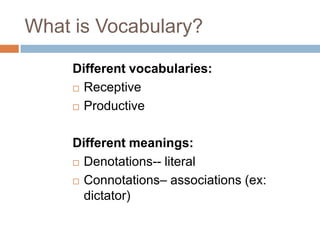
What is Vocabulary?Different vocabularies:ReceptiveProductiveDifferent meanings:Denotations-- literalConnotations– associations (ex: dictator)
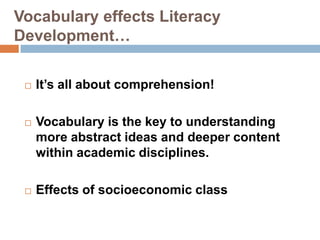
Vocabulary effects Literacy Development…It’s all about comprehension!Vocabulary is the key to understanding more abstract ideas and deeper content within academic disciplines.  Effects of socioeconomic class
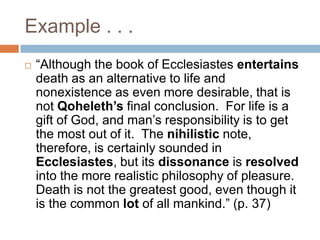
Example . . .“Although the book of Ecclesiastes entertains death as an alternative to life and nonexistence as even more desirable, that is not Qoheleth’s final conclusion.  For life is a gift of God, and man’s responsibility is to get the most out of it.  The nihilistic note, therefore, is certainly sounded in Ecclesiastes, but its dissonance is resolved into the more realistic philosophy of pleasure.  Death is not the greatest good, even though it is the common lot of all mankind.” (p. 37)
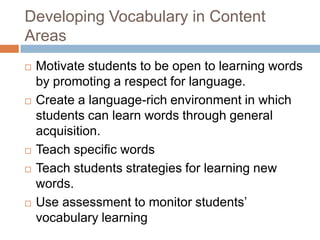
Developing Vocabulary in Content AreasMotivate students to be open to learning words by promoting a respect for language.Create a language-rich environment in which students can learn words through general acquisition.Teach specific wordsTeach students strategies for learning new words.Use assessment to monitor students’ vocabulary learning
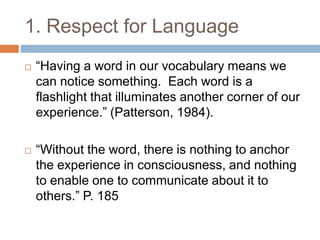
1. Respect for Language“Having a word in our vocabulary means we can notice something.  Each word is a flashlight that illuminates another corner of our experience.” (Patterson, 1984).“Without the word, there is nothing to anchor the experience in consciousness, and nothing to enable one to communicate about it to others.” P. 185
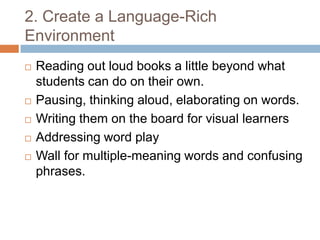
2. Create a Language-Rich EnvironmentReading out loud books a little beyond what students can do on their own.Pausing, thinking aloud, elaborating on words. Writing them on the board for visual learnersAddressing word playWall for multiple-meaning words and confusing phrases.
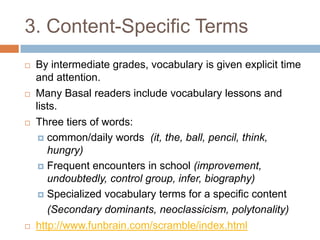
3. Content-Specific TermsBy intermediate grades, vocabulary is given explicit time and attention.Many Basal readers include vocabulary lessons and lists.Three tiers of words:common/daily words  (it, the, ball, pencil, think, hungry)Frequent encounters in school (improvement, undoubtedly, control group, infer, biography) Specialized vocabulary terms for a specific content(Secondary dominants, neoclassicism, polytonality) http://www.funbrain.com/scramble/index.html
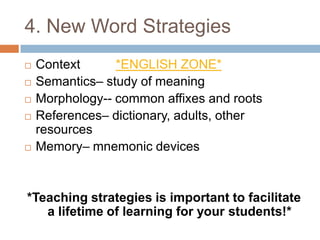
4. New Word StrategiesContext*ENGLISH ZONE*Semantics– study of meaningMorphology-- common affixes and rootsReferences– dictionary, adults, other resourcesMemory– mnemonic devices*Teaching strategies is important to facilitate a lifetime of learning for your students!*
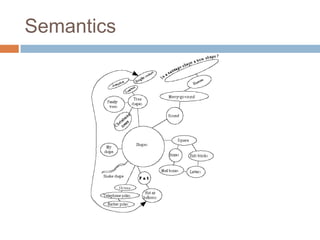
Semantics
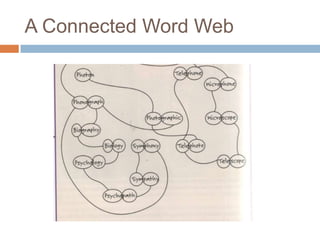
A Connected Word Web
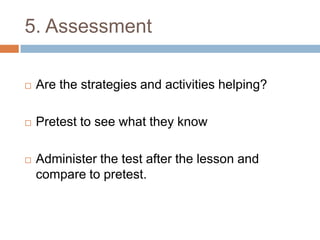
5. AssessmentAre the strategies and activities helping?Pretest to see what they knowAdminister the test after the lesson and compare to pretest.
Language Arts Explicit Vocabulary InstructionWord wall???
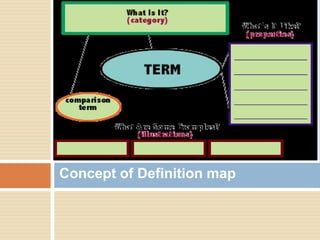
Concept of Definition map
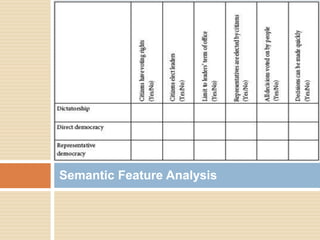
Semantic Feature Analysis

Reading Strategies Vocabulary

  • 1.
  • 2.
    Helping readers buildvocabularyAnna Gruen -- 3/1/10 -- Reading Strategies
  • 3.
    What is Vocabulary?Differentvocabularies:ReceptiveProductiveDifferent meanings:Denotations-- literalConnotations– associations (ex: dictator)
  • 4.
    Vocabulary effects LiteracyDevelopment…It’s all about comprehension!Vocabulary is the key to understanding more abstract ideas and deeper content within academic disciplines. Effects of socioeconomic class
  • 5.
    Example . ..“Although the book of Ecclesiastes entertains death as an alternative to life and nonexistence as even more desirable, that is not Qoheleth’s final conclusion. For life is a gift of God, and man’s responsibility is to get the most out of it. The nihilistic note, therefore, is certainly sounded in Ecclesiastes, but its dissonance is resolved into the more realistic philosophy of pleasure. Death is not the greatest good, even though it is the common lot of all mankind.” (p. 37)
  • 6.
    Developing Vocabulary inContent AreasMotivate students to be open to learning words by promoting a respect for language.Create a language-rich environment in which students can learn words through general acquisition.Teach specific wordsTeach students strategies for learning new words.Use assessment to monitor students’ vocabulary learning
  • 7.
    1. Respect forLanguage“Having a word in our vocabulary means we can notice something. Each word is a flashlight that illuminates another corner of our experience.” (Patterson, 1984).“Without the word, there is nothing to anchor the experience in consciousness, and nothing to enable one to communicate about it to others.” P. 185
  • 8.
    2. Create aLanguage-Rich EnvironmentReading out loud books a little beyond what students can do on their own.Pausing, thinking aloud, elaborating on words. Writing them on the board for visual learnersAddressing word playWall for multiple-meaning words and confusing phrases.
  • 9.
    3. Content-Specific TermsByintermediate grades, vocabulary is given explicit time and attention.Many Basal readers include vocabulary lessons and lists.Three tiers of words:common/daily words (it, the, ball, pencil, think, hungry)Frequent encounters in school (improvement, undoubtedly, control group, infer, biography) Specialized vocabulary terms for a specific content(Secondary dominants, neoclassicism, polytonality) http://www.funbrain.com/scramble/index.html
  • 10.
    4. New WordStrategiesContext*ENGLISH ZONE*Semantics– study of meaningMorphology-- common affixes and rootsReferences– dictionary, adults, other resourcesMemory– mnemonic devices*Teaching strategies is important to facilitate a lifetime of learning for your students!*
  • 11.
  • 12.
  • 13.
    5. AssessmentAre thestrategies and activities helping?Pretest to see what they knowAdminister the test after the lesson and compare to pretest.
  • 14.
    Language Arts ExplicitVocabulary InstructionWord wall???
  • 15.
  • 16.