Date : 24.12.2013
Prepared by : Pavana H
Department : ECE
Engineered for Tomorrow
Subject Name: Digital Communication
Subject Code: 10EC61
Prepared By: Lakshmi C R, Pallavi
Department: ECE
Date: 1.4.15
UNIT 4
Intersymbol Interference in Baseband
Communication
• ISI
• Nyquist’s criterion for distortion less base-band binary
transmission
• Correlative coding
• Eye pattern
• Base-band m-array PAM system
• Adaptive equalization for data transmission
Contents
Inter symbol Interference
• If we transmit digital data which demands more bandwidth
which exceeds channel bandwidth, spreading will occur and
cause signal pulses to overlap. This overlapping is called Inter
Symbol Interference. In short it is called ISI
• ISI causes degradations of signal if left uncontrolled. This
problem of ISI exists strongly in Telephone channels like
coaxial cables and optical fibers.
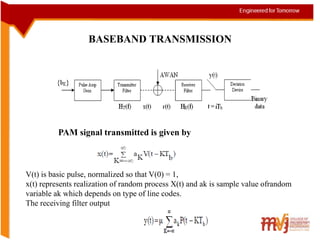
BASEBAND TRANSMISSION
PAM signal transmitted is given by
V(t) is basic pulse, normalized so that V(0) = 1,
x(t) represents realization of random process X(t) and ak is sample value ofrandom
variable ak which depends on type of line codes.
The receiving filter output
• The output pulse μ P(t) is obtained because input signal ak
.V(t) is passed through series of systems with transfer
functions HT(f), HC(f), HR(f).
Therefore μ P(f) = V(f). HT(f).HC(f).HR(f)
• The receiving filter output y(t) is sampled at ti = iTb. where i
takes intervals i = ±1, ±2 . .
Nyquist Pulse Shaping Criterion
• In detection process received pulse stream is detected by
sampling at intervals ±KTb, then in detection process we will
get desired output. This demands sample of ith transmitted
pulse in pulse stream at Kth sampling interval should be
If received pulse P(t) satisfy this condition in time domain,
then y(ti) = μai
• Ideal Solution
• Ideal Nyquist filter that achieves best spectral efficiency and
avoids ISI is designed to have bandwidth as suggested
B0 = 1/2Tb (Nyquist bandwidth) = Rb/2
ISI is minimized by controlling P(t) in time domain or P(f) to be rectangular
function in frequency domain.
Practical solution
• To design raised cosine filter which has transfer function
consists of a flat portion and a roll off portion which is of
sinusoidal form.
• Bandwidth Bo=1/2Tb is an adjustable value between Bo and
2Bo.
• The frequency f1 and bandwidth Bo are related by
Transmission bandwidth required can be obtained from the relation
B = 2Bo- f1
Correlative coding
• By adding ISI to the transmitted signal in a controlled manner,
it is possible to achieve a bit rate of 2Bo bits per second in a
channel of bandwidth Bo Hz. Such a scheme is correlative
coding or partial- response signaling scheme
Duo binary coding
Duo implies doubling of the transmission capacity of a straight binary system
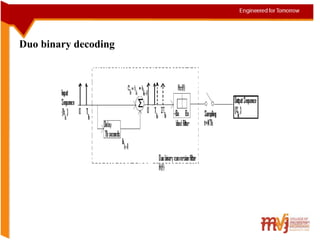
Duo binary decoding
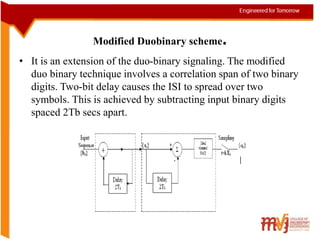
Modified Duobinary scheme.
• It is an extension of the duo-binary signaling. The modified
duo binary technique involves a correlation span of two binary
digits. Two-bit delay causes the ISI to spread over two
symbols. This is achieved by subtracting input binary digits
spaced 2Tb secs apart.
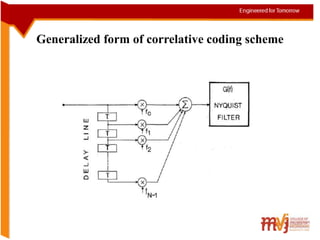
Generalized form of correlative coding scheme
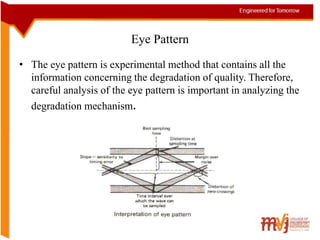
Eye Pattern
• The eye pattern is experimental method that contains all the
information concerning the degradation of quality. Therefore,
careful analysis of the eye pattern is important in analyzing the
degradation mechanism.
• The width of the eye opening defines the time interval over
which the received wave can be sampled without error from
ISI
• The optimum sampling time corresponds to the maximum eye
opening
• The height of the eye opening at a specified sampling time is a
measure of the margin over channel noise.
Base band Transmission of M-ary data
• In base band M-ary PAM, output of the pulse generator may
take on any one of the Mpossible amplitude levels with M>2
for each symbol
• The blocks of n- message bits are represented by M-level
waveforms with
T= 2Tb is termed symbol duration .
In general symbol duration T = Tb log 2M.
Adaptive equalization for data transmission
• This technique is another approach to minimize signal
distortion in the base band data transmission. This is Nyquist
third method for controlling ISI.
• Adaptive equalization: An equalizer is a filter that
compensates for the dispersion effects of a channel.Adaptive
equalizer can adjust its coefficients continuously during the
transmission of data
It consists of tapped delay line filter with set of delay elements, set of adjustable
multipliers connected to the delay line taps and a summer for adding multiplier
outputs.
The output of the Adaptive equalizer is given by
• Two modes of operation
1. Training mode 2 . Decision directed mode
Methods of implementing adaptive equalizer
i) Analog
ii) Hard wired digital
iii) Programmable digital
Unit 4:
1. Derive Nyquist criterion for distortionless baseband binary
transmission.
2. What is eye pattern? Explain in detail.
3. With a neat filter structure, explain the concept of adaptive
equalization process.
4. Explain basic elements of a baseband binary PAM system.
Assignment Question

Inter symboluc interference in base.pptx

  • 1.
    Date : 24.12.2013 Preparedby : Pavana H Department : ECE Engineered for Tomorrow Subject Name: Digital Communication Subject Code: 10EC61 Prepared By: Lakshmi C R, Pallavi Department: ECE Date: 1.4.15
  • 2.
    UNIT 4 Intersymbol Interferencein Baseband Communication
  • 3.
    • ISI • Nyquist’scriterion for distortion less base-band binary transmission • Correlative coding • Eye pattern • Base-band m-array PAM system • Adaptive equalization for data transmission Contents
  • 4.
    Inter symbol Interference •If we transmit digital data which demands more bandwidth which exceeds channel bandwidth, spreading will occur and cause signal pulses to overlap. This overlapping is called Inter Symbol Interference. In short it is called ISI • ISI causes degradations of signal if left uncontrolled. This problem of ISI exists strongly in Telephone channels like coaxial cables and optical fibers.
  • 5.
    BASEBAND TRANSMISSION PAM signaltransmitted is given by V(t) is basic pulse, normalized so that V(0) = 1, x(t) represents realization of random process X(t) and ak is sample value ofrandom variable ak which depends on type of line codes. The receiving filter output
  • 6.
    • The outputpulse μ P(t) is obtained because input signal ak .V(t) is passed through series of systems with transfer functions HT(f), HC(f), HR(f). Therefore μ P(f) = V(f). HT(f).HC(f).HR(f) • The receiving filter output y(t) is sampled at ti = iTb. where i takes intervals i = ±1, ±2 . .
  • 7.
    Nyquist Pulse ShapingCriterion • In detection process received pulse stream is detected by sampling at intervals ±KTb, then in detection process we will get desired output. This demands sample of ith transmitted pulse in pulse stream at Kth sampling interval should be If received pulse P(t) satisfy this condition in time domain, then y(ti) = μai
  • 8.
    • Ideal Solution •Ideal Nyquist filter that achieves best spectral efficiency and avoids ISI is designed to have bandwidth as suggested B0 = 1/2Tb (Nyquist bandwidth) = Rb/2 ISI is minimized by controlling P(t) in time domain or P(f) to be rectangular function in frequency domain.
  • 9.
    Practical solution • Todesign raised cosine filter which has transfer function consists of a flat portion and a roll off portion which is of sinusoidal form. • Bandwidth Bo=1/2Tb is an adjustable value between Bo and 2Bo. • The frequency f1 and bandwidth Bo are related by Transmission bandwidth required can be obtained from the relation B = 2Bo- f1
  • 10.
    Correlative coding • Byadding ISI to the transmitted signal in a controlled manner, it is possible to achieve a bit rate of 2Bo bits per second in a channel of bandwidth Bo Hz. Such a scheme is correlative coding or partial- response signaling scheme
  • 11.
    Duo binary coding Duoimplies doubling of the transmission capacity of a straight binary system
  • 12.
  • 13.
    Modified Duobinary scheme. •It is an extension of the duo-binary signaling. The modified duo binary technique involves a correlation span of two binary digits. Two-bit delay causes the ISI to spread over two symbols. This is achieved by subtracting input binary digits spaced 2Tb secs apart.
  • 14.
    Generalized form ofcorrelative coding scheme
  • 15.
    Eye Pattern • Theeye pattern is experimental method that contains all the information concerning the degradation of quality. Therefore, careful analysis of the eye pattern is important in analyzing the degradation mechanism.
  • 16.
    • The widthof the eye opening defines the time interval over which the received wave can be sampled without error from ISI • The optimum sampling time corresponds to the maximum eye opening • The height of the eye opening at a specified sampling time is a measure of the margin over channel noise.
  • 17.
    Base band Transmissionof M-ary data • In base band M-ary PAM, output of the pulse generator may take on any one of the Mpossible amplitude levels with M>2 for each symbol • The blocks of n- message bits are represented by M-level waveforms with T= 2Tb is termed symbol duration . In general symbol duration T = Tb log 2M.
  • 18.
    Adaptive equalization fordata transmission • This technique is another approach to minimize signal distortion in the base band data transmission. This is Nyquist third method for controlling ISI. • Adaptive equalization: An equalizer is a filter that compensates for the dispersion effects of a channel.Adaptive equalizer can adjust its coefficients continuously during the transmission of data
  • 19.
    It consists oftapped delay line filter with set of delay elements, set of adjustable multipliers connected to the delay line taps and a summer for adding multiplier outputs. The output of the Adaptive equalizer is given by
  • 20.
    • Two modesof operation 1. Training mode 2 . Decision directed mode Methods of implementing adaptive equalizer i) Analog ii) Hard wired digital iii) Programmable digital
  • 21.
    Unit 4: 1. DeriveNyquist criterion for distortionless baseband binary transmission. 2. What is eye pattern? Explain in detail. 3. With a neat filter structure, explain the concept of adaptive equalization process. 4. Explain basic elements of a baseband binary PAM system. Assignment Question