www.ijemr.net ISSN (ONLINE): 2250-0758, ISSN (PRINT): 2394-6962
37 Copyright © 2018. IJEMR. All Rights Reserved.
Volume-8, Issue-3, June 2018
International Journal of Engineering and Management Research
Page Number: 37-41
Intelligence Digital Energy Meter
Kundeti Krishnarao1
and Jaddu Jhansi Rani2
1
Assistant Professor, Department of Electronics and Electrical Engineering, Vikas Group of Institutions, Andhra Pradesh,
INDIA
2
Assistant Professor, Department of Electronics and Communications Engineering, LORDS College, INDIA
1
Corresponding Author: krishnarao.kundeti@gmail.com
ABSTRACT
Here a lot of customs are used electrical energy
but not pay the bills in time.so here we avoid this problem
by using this project. We can measure the power by each
load and take the information through the mobile by using
GSM module. After the taking alert from the situation the
consumer not respond for emergency alert we can cut –off
the supply to the consumer by automatically.
Keywords— Liquid Cristal Display, GSM, LCD, PSU
I. INTRODUCTION
If any consumer did not pay the bill, the
operation needs to go to their houses to disconnect the
power supply. These processes are time consuming and
difficult to handle. By the system, cut the supply
automatically. The use of Arduino (microcontroller)
there are many improvements in automating various
industrial aspects for reducing manual efforts. Now a
day the number of Electricity consumers is increasing in
great extent. It became a hard task in handling and
minting the power as per the growing requirements.
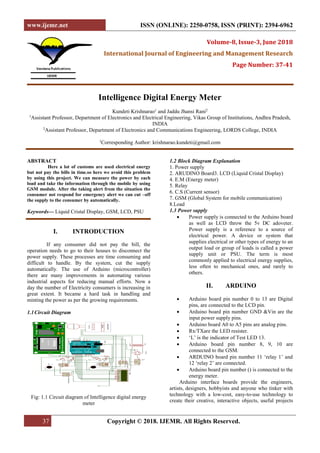
1.1Circuit Diagram
Fig: 1.1 Circuit diagram of Intelligence digital energy
meter
1.2 Block Diagram Explanation
1. Power supply
2. ARUDINO Board3. LCD (Liquid Cristal Display)
4. E.M (Energy meter)
5. Relay
6. C.S (Current sensor)
7. GSM (Global System for mobile communication)
8.Load
1.3 Power supply
• Power supply is connected to the Arduino board
as well as LCD throw the 5v DC adoveter.
Power supply is a reference to a source of
electrical power. A device or system that
supplies electrical or other types of energy to an
output load or group of loads is called a power
supply unit or PSU. The term is most
commonly applied to electrical energy supplies,
less often to mechanical ones, and rarely to
others.
II. ARDUINO
• Arduino board pin number 0 to 13 are Digital
pins, are connected to the LCD pin.
• Arduino board pin number GND &Vin are the
input power supply pins.
• Arduino board A0 to A5 pins are analog pins.
• Rx/TXare the LED resister.
• ‘L’ is the indicator of Test LED 13.
• Arduino board pin number 8, 9, 10 are
connected to the GSM.
• ARDUINO board pin number 11 ‘relay 1’ and
12 ‘relay 2’ are connected.
• Arduino board pin number () is connected to the
energy meter.
Arduino interface boards provide the engineers,
artists, designers, hobbyists and anyone who tinker with
technology with a low-cost, easy-to-use technology to
create their creative, interactive objects, useful projects
ANALOGIN
ATMEGA328P-PU
1121
ResetBTN
ON
www.TheEngineeringProjects.com
PD0/RXD
PD1/TXD
PD2/INT0
~PD3/INT1/OC2B
PD4/T0/XCK
~PD5/T1/OC0B
~PD7/AIN1
PC5/ADC5/SCL
PC4/ADC4/SDA
PC3/ADC3
PC2/ADC2
PC1/ADC1
PC0/ADC0
RESET
PB0/ICP1/CLKO
~PB1/OC1A
~PB2/OC1B
~PB3/MOSI/OC2A
PD7/AIN1
PB4/MISO
PB5/SCK
AREF
0
1
2
3
4
5
6
7
8
9
10
11
12
13
A5
A4
A3
A2
A1
A0
ARD1
ARDUINOUNO
D7
14
D6
13
D5
12
D4
11
D3
10
D2
9
D1
8
D0
7
E
6
RW
5
RS
4
VSS
1
VDD
2
VEE
3
READING
LCDLM016L
D2
1N4148
R1
10K
D1
1N4148
R2
330
R3
330
Q2
NPN
R4
10K
L1
230VAC
L2
12V
SIMCard
SIM900D
S2-1041Y-Z097C
CE0980
PowerBTN
ON
NEXT
STATUS
TXD
RXD
www.TheEngineeringProjects.com
GSM1
SIM900D-GREEN
Q1
NPN
IP+
4
IP-
5
VIOUT
3
VCC
1
GND
2
U1CURRENTSENSOR
230VACSUPPLY
RELAY2
RLY-SPNO
RELAY1
INDICATORS
IP+
4
IP-
5
VIOUT
3
VCC
1
GND
2
U2CURRENTSENSOR
ENERGYMETER
TR1
TRAN-2P2S
BR1
B250C1000
VI
1
VO
3
GND
2
U3
7805
www.ijemr.net ISSN (ONLINE): 2250-0758, ISSN (PRINT): 2394-6962
38 Copyright © 2018. IJEMR. All Rights Reserved.
etc., A whole new breed of projects can now be built that
can be controlled from a computer.
2.1 LCD (Liquid crystal display)
• LCD Pin no 1, 3, 5 & 16 are connected to the
ground.
• LCD Pin number is 2 & 15 are connected to the
VCC (5V DC) supply.
• LCD Pin number 4 &6 are connected to
ARDUNIO Board pin number 2 & 3.
• LCD Pin number 11, 12, 13 & 14 are connected
to ARDUNIO Board pin number 4, 5, 6 & 7.
III. ENERGY METER
• Energy meter is connected to the relay pin
number 1 & Arduino board pin number ()
connected.
• Energy meter is a main load indicator device.
“A smart meter is an electronic device that
records consumption of electrics energy in intervals of
an hours or less and communicates that information at
least daily back to the utility for monitoring and billing.
… Unlike home energy monitors, smart meters can
gather data for reporting.”
3.1 Applications
• House Hold Purposes
• Industries
• Hospitals
3.2Advantages
• Installation is simple.
• Cost of manual maintenance is reduced.
• Monthly bills alert by SMS.
• Automatically easy to connect and disconnect.
• System accuracy is high.
3.3 Power Supply
Power supply is a reference to a source of
electrical power. A device or system that supplies
electrical or other types of energy to an output load or
group of loads is called a power supply unit or PSU. The
term is most commonly applied to electrical energy
supplies, less often to mechanical ones, and rarely to
others.
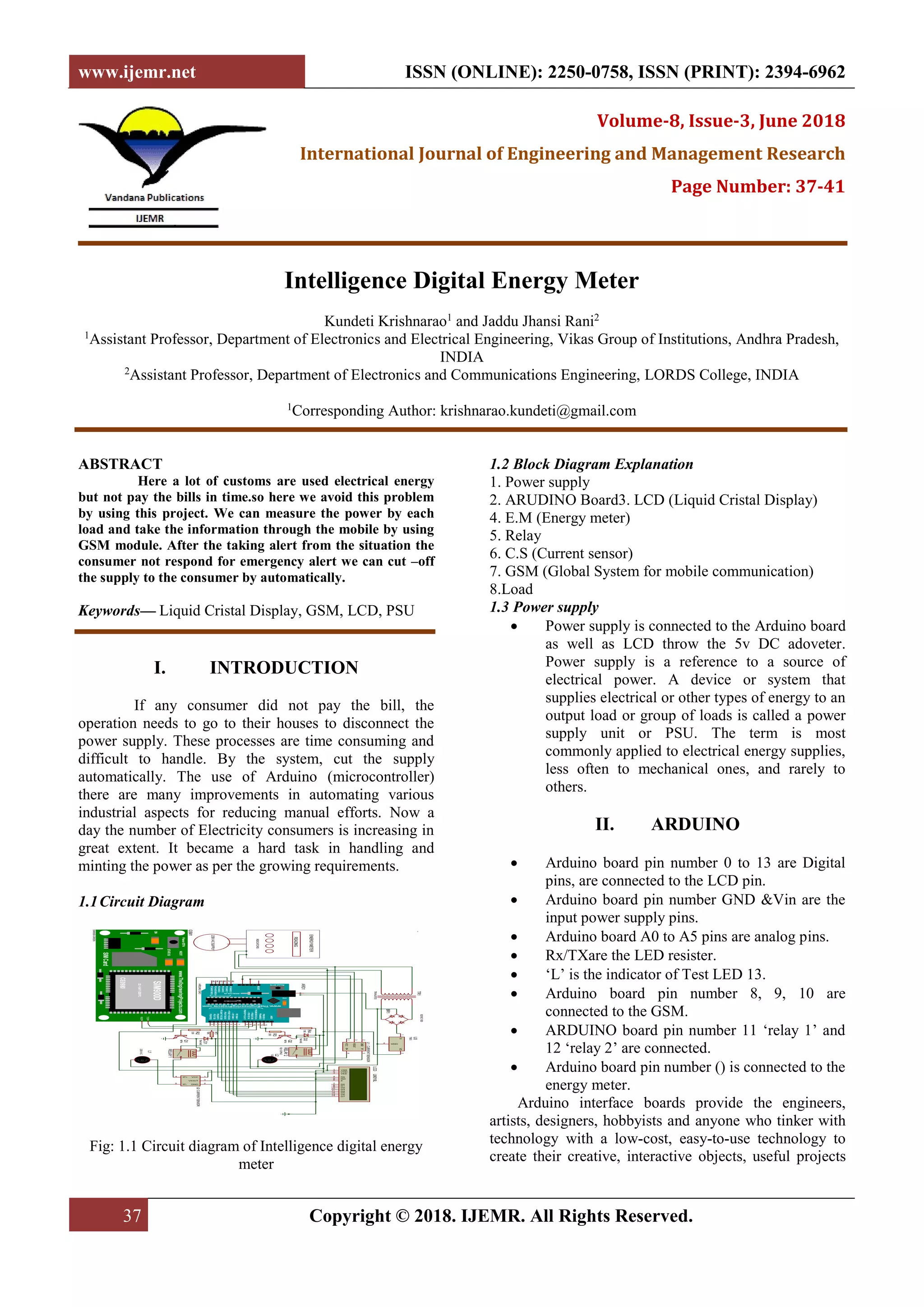
Fig3.1 Power supply on Arduino
Fig: 3.2 Arduino board
3.4 Hardware specification
• Microcontroller: ATmega328
• Operating Voltage: 5V
• Input Voltage(recommended):7-12V
• Input Voltage (limits): 6-20V
• Digital I/O Pins: 14 (of which 6 provide PWM
output)
• Analog Input Pins: 6
3.5 Arduino board explanation
Shapes and S
www.ijemr.net ISSN (ONLINE): 2250-0758, ISSN (PRINT): 2394-6962
39 Copyright © 2018. IJEMR. All Rights Reserved.
IV. LCD (LIQUID CRYSTAL
DISPLAY) SIZES
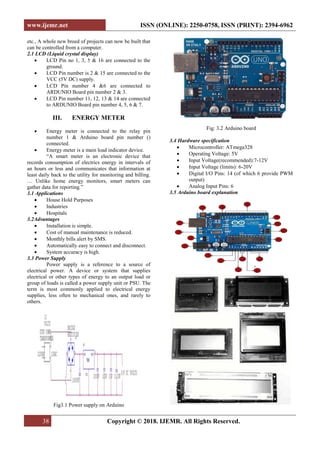
Even limited to character-based modules, there
is still a wide variety of shapes and sizes available. Line
lengths of 8, 16,20,24,32 and 40 characters are all
standard, in one, two and four-line versions. (as shown in
fig 3.6)
4.1Electrical block diagram
4.1 Electrical block diagram for LCD
4.2 PIN description
Most LCDs with 1 controller has 14 Pins and
LCDs with 2 controller has 16 Pins (two pins are extra in
both for back-light LED connections). (as shown in fig
3.9)
4.2 Pin diagram of 1*16 lines LCD
4.3 Digital energy meter
4.4 smart energy meter
V. RELAY
Fig: 5.1 relay
Fig: 5.2Relay construction
5.1 Electrical Current Sensor
Fig:5.3 Electrical current sensor
www.ijemr.net ISSN (ONLINE): 2250-0758, ISSN (PRINT): 2394-6962
40 Copyright © 2018. IJEMR. All Rights Reserved.
The Allegro ACS75x family of current sensors
provides economical and precise solutions for current
sensing in industrial, automotive, commercial, and
communications systems. The device package allows for
easy implementation by the customer. Typical
applications include motor control, load detection and
management, power supplies, and overcurrent fault
protection.
Fig: 5.4(a) Operation of sensor
VI. GSM (GLOBAL SYSTEM FOR
MOBILE COMMUNICATIONS)
GSM (Global System for Mobile
communications) is a cellular network, which means that
mobile phones connect to it by searching for cells in the
immediate vicinity. GSM networks operate in four
different frequency ranges. Most GSM networks operate
in the 900 MHz or 1800 MHz bands. Some countries in
the Americas use the 850 MHz and 1900 MHz bands
because the 900 and 1800 MHz frequency bands were
already allocated.
Fig: 6.1 GSM Network
6.1 Our project kit
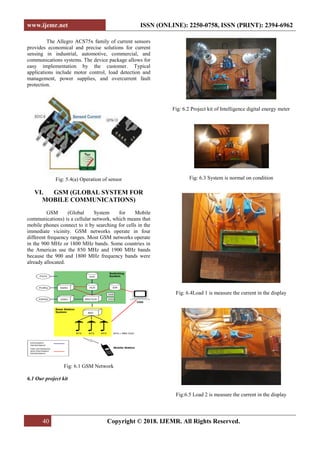
Fig: 6.2 Project kit of Intelligence digital energy meter
Fig: 6.3 System is normal on condition
Fig: 6.4Load 1 is measure the current in the display
Fig:6.5 Load 2 is measure the current in the display
www.ijemr.net ISSN (ONLINE): 2250-0758, ISSN (PRINT): 2394-6962
41 Copyright © 2018. IJEMR. All Rights Reserved.
Fig:6.6 Alert message on overload through the mobile
Fig:6.7Automatic cut off power
VII. CONCLUSION
This research paper demonstrates the concept
sand implementation of automatic trip control system for
energy management using Arduino controller and GSM.
It mainly focused on industrial purpose. The similar idea
can be implemented for domestic areas for avoiding the
illegal usage of electricity. This paper is aimed at
reducing the heavy power and revenue losses that occur
due to power theft by the customers. By this design it
can be concluded that power theft can be effectively
curbed by detecting where the power theft occurs and
informing the authorities. Also, an automatic circuit
breaker may be integrated to the unit so as to remotely
cut off the power supply to the house or consumer who
tries to indulge in power theft.
FUTURESCOPE
Though many have tried implementing a
country wide AMRS, it is still an unreachable goal,
many factors like cost, feasibility and mainly the need to
replace the existing system have hindered its
development. At least in near future, the cost involved in
the building of this system could be minimized by using
more efficient technology implemented worldwide.
REFERENCES
[1] Liang Zhao. (2013). Development of an energy
monitoring system for large public buildings. Elsevier
journal, Energy and Buildings, 66, 41-48.
[2] M. Trejo-Perea, G.J. Ríos Moreno, A. Castañeda-
Miranda, D. Vargas-Vázquez, R.V. Carrillo-Serrano, &
G. Herrera-Ruiz. (2013). Development of a real time
energy monitoring platform user-friendly for buildings.
Elsevier journal Procedia Technology, 7, 238-247.
[3] Abhinandan Jain. (2012, May). Smart and Intelligent
gsm based automatic meter reading system.
International Journal of Engineering Research &
Technology,1 (3), 1-6.
[4] Abhinandan Jain. (2012, June). Design and
development of gsm based energy meter. International
Journal of Computer Applications (0975-888), 47(12),
41-45.
[5] S.H. Shete. (2013, January). GSM enabled embedded
system for energy measurement & billing. International
Journal of Scientific & Engineering Research, 4(1), 1-7.
[6] www.wikipedia.com.Traditional energy meter
systems. Available at:
https://www.google.co.in/search?q=Traditional+Energy+
meter+systems%E2%80%9D&tbm=isch&tbo=u&source
=univ&sa=X&ved=0ahUKEwi494-
rpa3bAhULMI8KHf9XB-
gQsAQIfQ&biw=1366&bih=662
[7] A. Jain, D. Kumar, & J. Kedia. (2012). Design and
development of gsm based energy meter. International
Journal of Computer applications, 47(12), 41-45.
[8] V. V. Dhok & S. S. Deshmukh. (2014). Automatic
energy meter reading system reviews. The International
Journal of science & Technoledge, 2(1), 20-24.

Intelligence Digital Energy Meter

  • 1.
    www.ijemr.net ISSN (ONLINE):2250-0758, ISSN (PRINT): 2394-6962 37 Copyright © 2018. IJEMR. All Rights Reserved. Volume-8, Issue-3, June 2018 International Journal of Engineering and Management Research Page Number: 37-41 Intelligence Digital Energy Meter Kundeti Krishnarao1 and Jaddu Jhansi Rani2 1 Assistant Professor, Department of Electronics and Electrical Engineering, Vikas Group of Institutions, Andhra Pradesh, INDIA 2 Assistant Professor, Department of Electronics and Communications Engineering, LORDS College, INDIA 1 Corresponding Author: krishnarao.kundeti@gmail.com ABSTRACT Here a lot of customs are used electrical energy but not pay the bills in time.so here we avoid this problem by using this project. We can measure the power by each load and take the information through the mobile by using GSM module. After the taking alert from the situation the consumer not respond for emergency alert we can cut –off the supply to the consumer by automatically. Keywords— Liquid Cristal Display, GSM, LCD, PSU I. INTRODUCTION If any consumer did not pay the bill, the operation needs to go to their houses to disconnect the power supply. These processes are time consuming and difficult to handle. By the system, cut the supply automatically. The use of Arduino (microcontroller) there are many improvements in automating various industrial aspects for reducing manual efforts. Now a day the number of Electricity consumers is increasing in great extent. It became a hard task in handling and minting the power as per the growing requirements. 1.1Circuit Diagram Fig: 1.1 Circuit diagram of Intelligence digital energy meter 1.2 Block Diagram Explanation 1. Power supply 2. ARUDINO Board3. LCD (Liquid Cristal Display) 4. E.M (Energy meter) 5. Relay 6. C.S (Current sensor) 7. GSM (Global System for mobile communication) 8.Load 1.3 Power supply • Power supply is connected to the Arduino board as well as LCD throw the 5v DC adoveter. Power supply is a reference to a source of electrical power. A device or system that supplies electrical or other types of energy to an output load or group of loads is called a power supply unit or PSU. The term is most commonly applied to electrical energy supplies, less often to mechanical ones, and rarely to others. II. ARDUINO • Arduino board pin number 0 to 13 are Digital pins, are connected to the LCD pin. • Arduino board pin number GND &Vin are the input power supply pins. • Arduino board A0 to A5 pins are analog pins. • Rx/TXare the LED resister. • ‘L’ is the indicator of Test LED 13. • Arduino board pin number 8, 9, 10 are connected to the GSM. • ARDUINO board pin number 11 ‘relay 1’ and 12 ‘relay 2’ are connected. • Arduino board pin number () is connected to the energy meter. Arduino interface boards provide the engineers, artists, designers, hobbyists and anyone who tinker with technology with a low-cost, easy-to-use technology to create their creative, interactive objects, useful projects ANALOGIN ATMEGA328P-PU 1121 ResetBTN ON www.TheEngineeringProjects.com PD0/RXD PD1/TXD PD2/INT0 ~PD3/INT1/OC2B PD4/T0/XCK ~PD5/T1/OC0B ~PD7/AIN1 PC5/ADC5/SCL PC4/ADC4/SDA PC3/ADC3 PC2/ADC2 PC1/ADC1 PC0/ADC0 RESET PB0/ICP1/CLKO ~PB1/OC1A ~PB2/OC1B ~PB3/MOSI/OC2A PD7/AIN1 PB4/MISO PB5/SCK AREF 0 1 2 3 4 5 6 7 8 9 10 11 12 13 A5 A4 A3 A2 A1 A0 ARD1 ARDUINOUNO D7 14 D6 13 D5 12 D4 11 D3 10 D2 9 D1 8 D0 7 E 6 RW 5 RS 4 VSS 1 VDD 2 VEE 3 READING LCDLM016L D2 1N4148 R1 10K D1 1N4148 R2 330 R3 330 Q2 NPN R4 10K L1 230VAC L2 12V SIMCard SIM900D S2-1041Y-Z097C CE0980 PowerBTN ON NEXT STATUS TXD RXD www.TheEngineeringProjects.com GSM1 SIM900D-GREEN Q1 NPN IP+ 4 IP- 5 VIOUT 3 VCC 1 GND 2 U1CURRENTSENSOR 230VACSUPPLY RELAY2 RLY-SPNO RELAY1 INDICATORS IP+ 4 IP- 5 VIOUT 3 VCC 1 GND 2 U2CURRENTSENSOR ENERGYMETER TR1 TRAN-2P2S BR1 B250C1000 VI 1 VO 3 GND 2 U3 7805
  • 2.
    www.ijemr.net ISSN (ONLINE):2250-0758, ISSN (PRINT): 2394-6962 38 Copyright © 2018. IJEMR. All Rights Reserved. etc., A whole new breed of projects can now be built that can be controlled from a computer. 2.1 LCD (Liquid crystal display) • LCD Pin no 1, 3, 5 & 16 are connected to the ground. • LCD Pin number is 2 & 15 are connected to the VCC (5V DC) supply. • LCD Pin number 4 &6 are connected to ARDUNIO Board pin number 2 & 3. • LCD Pin number 11, 12, 13 & 14 are connected to ARDUNIO Board pin number 4, 5, 6 & 7. III. ENERGY METER • Energy meter is connected to the relay pin number 1 & Arduino board pin number () connected. • Energy meter is a main load indicator device. “A smart meter is an electronic device that records consumption of electrics energy in intervals of an hours or less and communicates that information at least daily back to the utility for monitoring and billing. … Unlike home energy monitors, smart meters can gather data for reporting.” 3.1 Applications • House Hold Purposes • Industries • Hospitals 3.2Advantages • Installation is simple. • Cost of manual maintenance is reduced. • Monthly bills alert by SMS. • Automatically easy to connect and disconnect. • System accuracy is high. 3.3 Power Supply Power supply is a reference to a source of electrical power. A device or system that supplies electrical or other types of energy to an output load or group of loads is called a power supply unit or PSU. The term is most commonly applied to electrical energy supplies, less often to mechanical ones, and rarely to others. Fig3.1 Power supply on Arduino Fig: 3.2 Arduino board 3.4 Hardware specification • Microcontroller: ATmega328 • Operating Voltage: 5V • Input Voltage(recommended):7-12V • Input Voltage (limits): 6-20V • Digital I/O Pins: 14 (of which 6 provide PWM output) • Analog Input Pins: 6 3.5 Arduino board explanation Shapes and S
  • 3.
    www.ijemr.net ISSN (ONLINE):2250-0758, ISSN (PRINT): 2394-6962 39 Copyright © 2018. IJEMR. All Rights Reserved. IV. LCD (LIQUID CRYSTAL DISPLAY) SIZES Even limited to character-based modules, there is still a wide variety of shapes and sizes available. Line lengths of 8, 16,20,24,32 and 40 characters are all standard, in one, two and four-line versions. (as shown in fig 3.6) 4.1Electrical block diagram 4.1 Electrical block diagram for LCD 4.2 PIN description Most LCDs with 1 controller has 14 Pins and LCDs with 2 controller has 16 Pins (two pins are extra in both for back-light LED connections). (as shown in fig 3.9) 4.2 Pin diagram of 1*16 lines LCD 4.3 Digital energy meter 4.4 smart energy meter V. RELAY Fig: 5.1 relay Fig: 5.2Relay construction 5.1 Electrical Current Sensor Fig:5.3 Electrical current sensor
  • 4.
    www.ijemr.net ISSN (ONLINE):2250-0758, ISSN (PRINT): 2394-6962 40 Copyright © 2018. IJEMR. All Rights Reserved. The Allegro ACS75x family of current sensors provides economical and precise solutions for current sensing in industrial, automotive, commercial, and communications systems. The device package allows for easy implementation by the customer. Typical applications include motor control, load detection and management, power supplies, and overcurrent fault protection. Fig: 5.4(a) Operation of sensor VI. GSM (GLOBAL SYSTEM FOR MOBILE COMMUNICATIONS) GSM (Global System for Mobile communications) is a cellular network, which means that mobile phones connect to it by searching for cells in the immediate vicinity. GSM networks operate in four different frequency ranges. Most GSM networks operate in the 900 MHz or 1800 MHz bands. Some countries in the Americas use the 850 MHz and 1900 MHz bands because the 900 and 1800 MHz frequency bands were already allocated. Fig: 6.1 GSM Network 6.1 Our project kit Fig: 6.2 Project kit of Intelligence digital energy meter Fig: 6.3 System is normal on condition Fig: 6.4Load 1 is measure the current in the display Fig:6.5 Load 2 is measure the current in the display
  • 5.
    www.ijemr.net ISSN (ONLINE):2250-0758, ISSN (PRINT): 2394-6962 41 Copyright © 2018. IJEMR. All Rights Reserved. Fig:6.6 Alert message on overload through the mobile Fig:6.7Automatic cut off power VII. CONCLUSION This research paper demonstrates the concept sand implementation of automatic trip control system for energy management using Arduino controller and GSM. It mainly focused on industrial purpose. The similar idea can be implemented for domestic areas for avoiding the illegal usage of electricity. This paper is aimed at reducing the heavy power and revenue losses that occur due to power theft by the customers. By this design it can be concluded that power theft can be effectively curbed by detecting where the power theft occurs and informing the authorities. Also, an automatic circuit breaker may be integrated to the unit so as to remotely cut off the power supply to the house or consumer who tries to indulge in power theft. FUTURESCOPE Though many have tried implementing a country wide AMRS, it is still an unreachable goal, many factors like cost, feasibility and mainly the need to replace the existing system have hindered its development. At least in near future, the cost involved in the building of this system could be minimized by using more efficient technology implemented worldwide. REFERENCES [1] Liang Zhao. (2013). Development of an energy monitoring system for large public buildings. Elsevier journal, Energy and Buildings, 66, 41-48. [2] M. Trejo-Perea, G.J. Ríos Moreno, A. Castañeda- Miranda, D. Vargas-Vázquez, R.V. Carrillo-Serrano, & G. Herrera-Ruiz. (2013). Development of a real time energy monitoring platform user-friendly for buildings. Elsevier journal Procedia Technology, 7, 238-247. [3] Abhinandan Jain. (2012, May). Smart and Intelligent gsm based automatic meter reading system. International Journal of Engineering Research & Technology,1 (3), 1-6. [4] Abhinandan Jain. (2012, June). Design and development of gsm based energy meter. International Journal of Computer Applications (0975-888), 47(12), 41-45. [5] S.H. Shete. (2013, January). GSM enabled embedded system for energy measurement & billing. International Journal of Scientific & Engineering Research, 4(1), 1-7. [6] www.wikipedia.com.Traditional energy meter systems. Available at: https://www.google.co.in/search?q=Traditional+Energy+ meter+systems%E2%80%9D&tbm=isch&tbo=u&source =univ&sa=X&ved=0ahUKEwi494- rpa3bAhULMI8KHf9XB- gQsAQIfQ&biw=1366&bih=662 [7] A. Jain, D. Kumar, & J. Kedia. (2012). Design and development of gsm based energy meter. International Journal of Computer applications, 47(12), 41-45. [8] V. V. Dhok & S. S. Deshmukh. (2014). Automatic energy meter reading system reviews. The International Journal of science & Technoledge, 2(1), 20-24.