INTELLECTUAL DISABILITIES
PRESENTATION BY:
Mathews Orwa
mathewsorwa@gmail.com
9-1
INTELLECTUAL DISABILITIES
EDUC 502
9-1
CHAPTER 9: INTELLECTUAL DISABILITIES
(EBD)
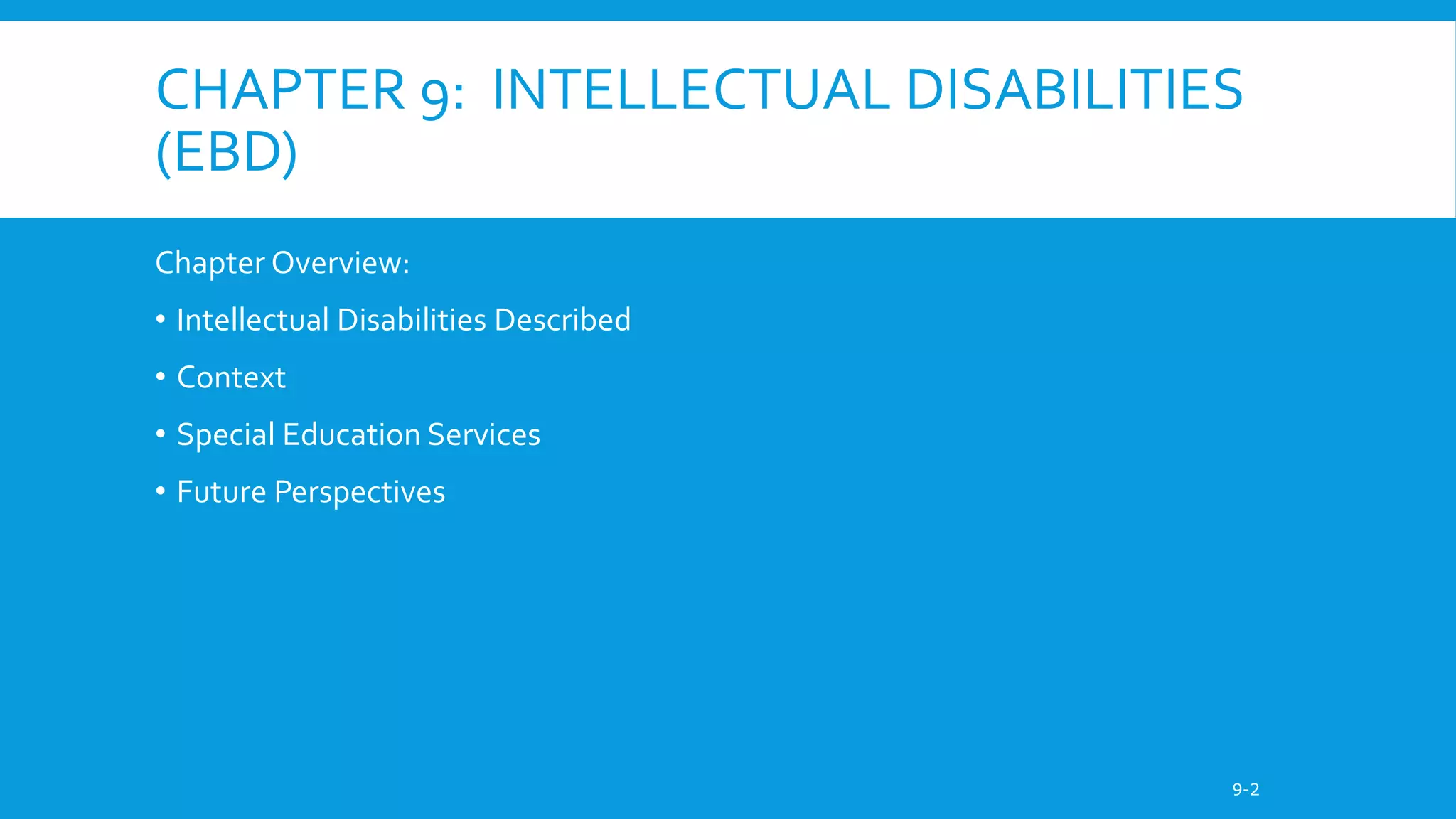
Chapter Overview:
• Intellectual Disabilities Described
• Context
• Special Education Services
• Future Perspectives
9-2
CHAPTER 9: INTELLECTUAL DISABILITIES
INTELLECTUAL DISABILITIES DESCRIBED
Intellectual Disabilities Defined
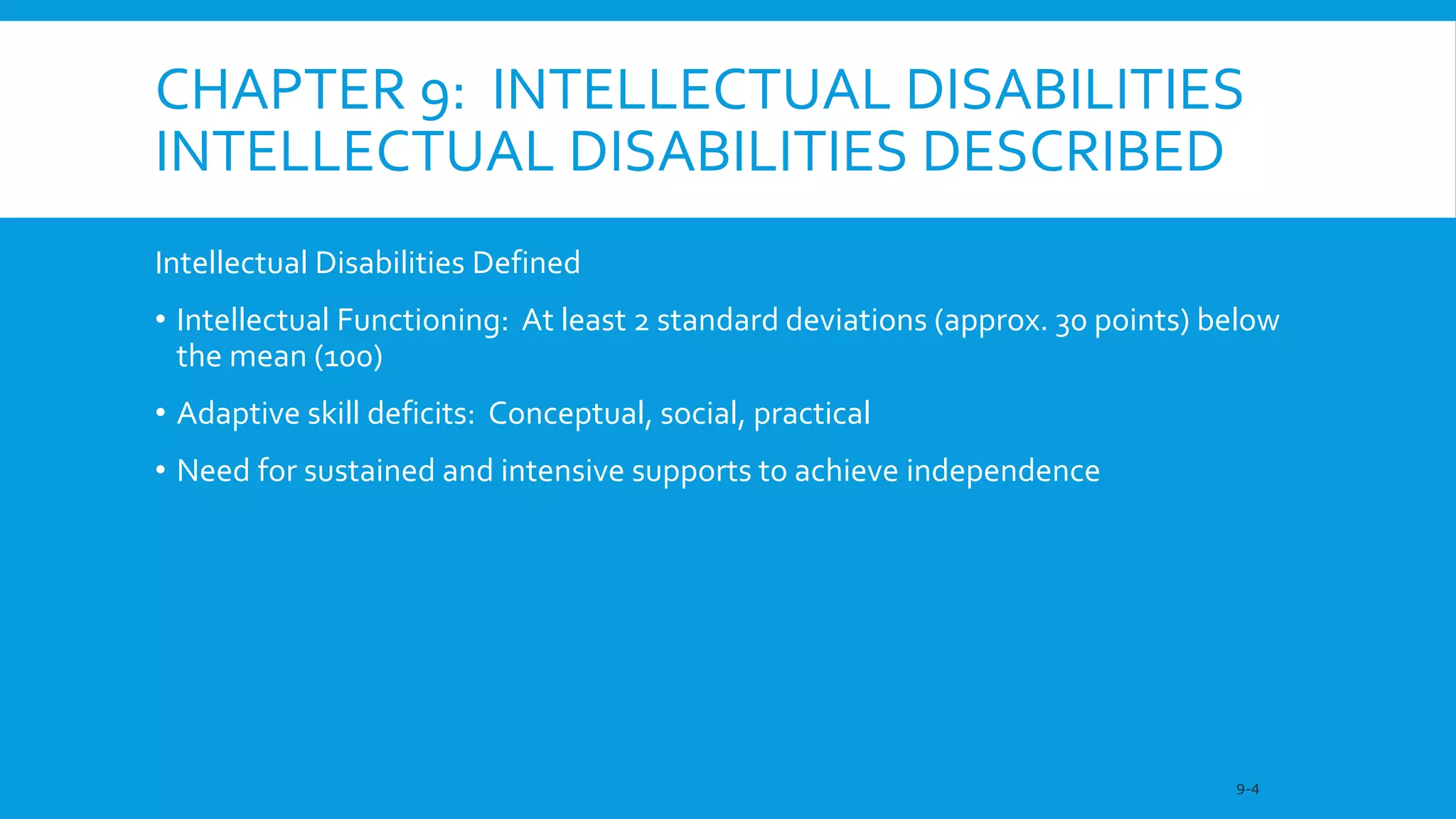
• Intellectual Functioning: At least 2 standard deviations (approx. 30 points) below
the mean (100)
• Adaptive skill deficits: Conceptual, social, practical
• Need for sustained and intensive supports to achieve independence
9-4
CHAPTER 9: INTELLECTUAL DISABILITIES
INTELLECTUAL DISABILITIES DESCRIBED
Types of Intellectual Disabilities
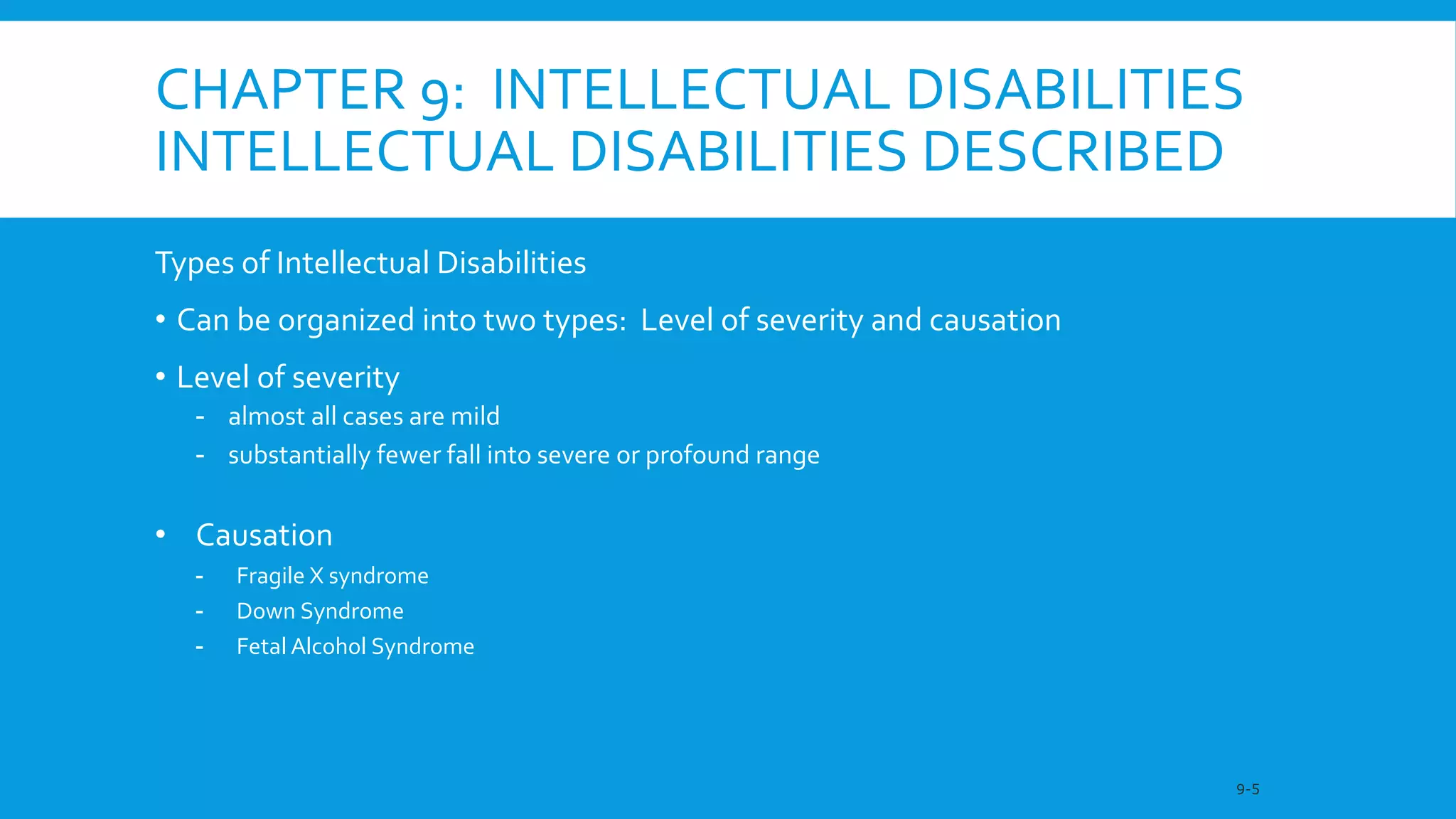
• Can be organized into two types: Level of severity and causation
• Level of severity
- almost all cases are mild
- substantially fewer fall into severe or profound range
• Causation
- Fragile X syndrome
- Down Syndrome
- Fetal Alcohol Syndrome
9-5
CHAPTER 9: INTELLECTUAL DISABILITIES
INTELLECTUAL DISABILITIES DESCRIBED
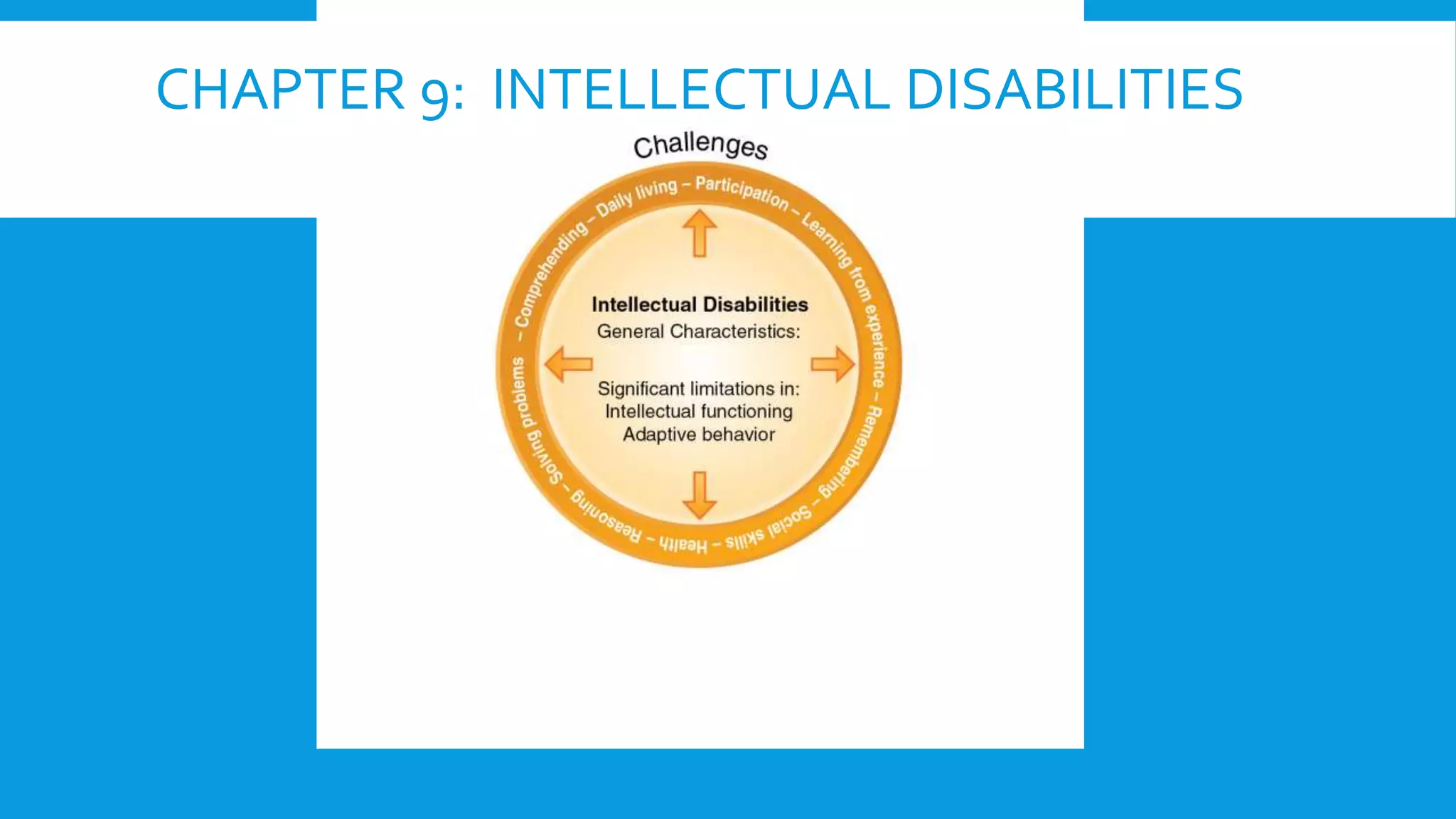
Characteristics
• Problems with cognition: memory, communication, learning
• Problems with adaptive behavior: managing daily life, making friends
• Require supports to sustain independence
9-6
CHAPTER 9: INTELLECTUAL DISABILITIES
INTELLECTUAL DISABILITIES DESCRIBED
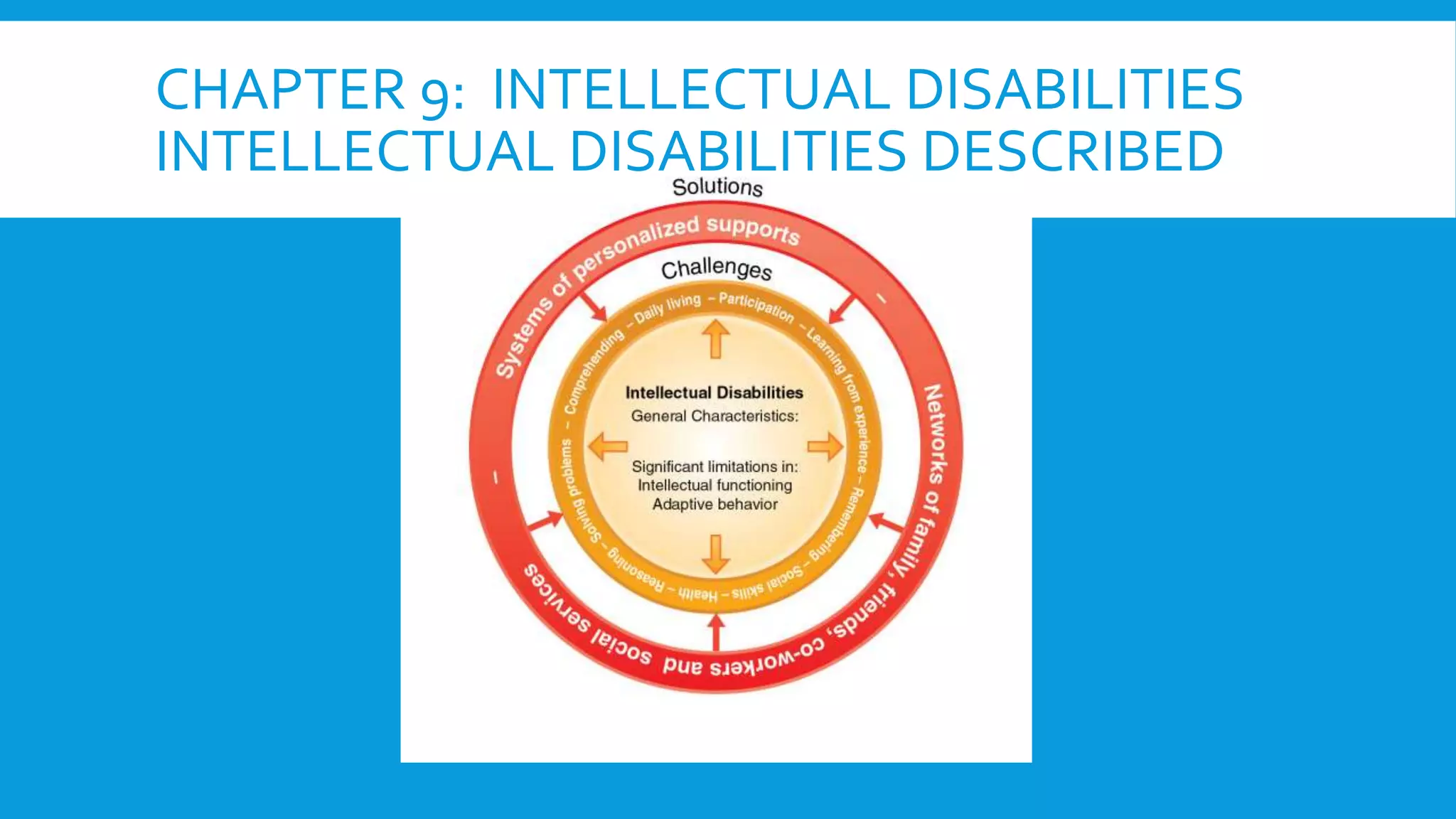
Challenges andTheir Solutions
• Supports from different sources can help overcome challenges
- Utilizing networks of supports
- SpecialOlympics, Best Buddies International, vocational rehabilitation
• Language can reduce bias and discrimination
- language is a reflection of perceptions
9-8
CHAPTER 9: INTELLECTUAL DISABILITIES
INTELLECTUAL DISABILITIES DESCRIBED
CHAPTER 9: INTELLECTUAL DISABILITIES
CONTEXT
People & Situations
• Stigma associated with intellectual disabilities creates a challenge and barrier to
social justice
• People with intellectual disabilities have historically been seen as a danger to
society and isolated from their communities and families
9-10
CHAPTER 9: INTELLECTUAL DISABILITIES
CONTEXT
Origins
• 1960s and 70s time of great change in attitudes and practices
• Kennedy family has made a significant impact in the treatment of people with
intellectual disabilities
9-11
CHAPTER 9: INTELLECTUAL DISABILITIES
CONTEXT
Prevalence and Placement
• Considered a high incidence disability
• Students with intellectual disabilities experience less inclusion than most other
groups of students with disabilities
• Many students participate in community-based instruction
9-12
CHAPTER 9: INTELLECTUAL DISABILITIES
SPECIAL EDUCATION SERVICES
Early Intervention
• Preschool programs can reduce impact of intellectual disabilities
• High quality inclusive preschool programs benefit children with and without
disabilities
9-13
CHAPTER 9: INTELLECTUAL DISABILITIES
SPECIAL EDUCATION SERVICES
SchoolYears
• Students should access general education curriculum as much as possible, but
functional curriculum helps mastery of adaptive skills which leads to
independence
• Successful adults able to make good choices and advocate for themselves
• Skills often need to be taught
9-14
CHAPTER 9: INTELLECTUAL DISABILITIES
SPECIAL EDUCATION SERVICESTransition
• Focus on readiness for post-secondary education and careers in the
community
• Successful transition requires significant preparation and use of
special approaches
• Supported employment programs: assists in locating employment,
skill training, and keeping position
9-15
CHAPTER 9: INTELLECTUAL DISABILITIES
FUTURE PERSPECTIVES
Technology: Connecting and Scheduling
• E-buddies program: connects people, builds natural supports, and
develops friendships and communication
• Technology systems can help manage daily life and help meeting
work and social obligations
9-16
CHAPTER 9: INTELLECTUAL DISABILITIES
FUTURE PERSPECTIVES
Prevention: Environmental protections
• Protection from toxins, reckless parental behavior, and viruses can reduce
incidence of intellectual disabilities
• Childhood poverty, lack of healthcare and inaccurate information threatens
known preventive measures from being implemented
9-17

Intellectual disability

  • 1.
  • 2.
  • 3.
    CHAPTER 9: INTELLECTUALDISABILITIES (EBD) Chapter Overview: • Intellectual Disabilities Described • Context • Special Education Services • Future Perspectives 9-2
  • 4.
    CHAPTER 9: INTELLECTUALDISABILITIES INTELLECTUAL DISABILITIES DESCRIBED Intellectual Disabilities Defined • Intellectual Functioning: At least 2 standard deviations (approx. 30 points) below the mean (100) • Adaptive skill deficits: Conceptual, social, practical • Need for sustained and intensive supports to achieve independence 9-4
  • 5.
    CHAPTER 9: INTELLECTUALDISABILITIES INTELLECTUAL DISABILITIES DESCRIBED Types of Intellectual Disabilities • Can be organized into two types: Level of severity and causation • Level of severity - almost all cases are mild - substantially fewer fall into severe or profound range • Causation - Fragile X syndrome - Down Syndrome - Fetal Alcohol Syndrome 9-5
  • 6.
    CHAPTER 9: INTELLECTUALDISABILITIES INTELLECTUAL DISABILITIES DESCRIBED Characteristics • Problems with cognition: memory, communication, learning • Problems with adaptive behavior: managing daily life, making friends • Require supports to sustain independence 9-6
  • 7.
  • 8.
    CHAPTER 9: INTELLECTUALDISABILITIES INTELLECTUAL DISABILITIES DESCRIBED Challenges andTheir Solutions • Supports from different sources can help overcome challenges - Utilizing networks of supports - SpecialOlympics, Best Buddies International, vocational rehabilitation • Language can reduce bias and discrimination - language is a reflection of perceptions 9-8
  • 9.
    CHAPTER 9: INTELLECTUALDISABILITIES INTELLECTUAL DISABILITIES DESCRIBED
  • 10.
    CHAPTER 9: INTELLECTUALDISABILITIES CONTEXT People & Situations • Stigma associated with intellectual disabilities creates a challenge and barrier to social justice • People with intellectual disabilities have historically been seen as a danger to society and isolated from their communities and families 9-10
  • 11.
    CHAPTER 9: INTELLECTUALDISABILITIES CONTEXT Origins • 1960s and 70s time of great change in attitudes and practices • Kennedy family has made a significant impact in the treatment of people with intellectual disabilities 9-11
  • 12.
    CHAPTER 9: INTELLECTUALDISABILITIES CONTEXT Prevalence and Placement • Considered a high incidence disability • Students with intellectual disabilities experience less inclusion than most other groups of students with disabilities • Many students participate in community-based instruction 9-12
  • 13.
    CHAPTER 9: INTELLECTUALDISABILITIES SPECIAL EDUCATION SERVICES Early Intervention • Preschool programs can reduce impact of intellectual disabilities • High quality inclusive preschool programs benefit children with and without disabilities 9-13
  • 14.
    CHAPTER 9: INTELLECTUALDISABILITIES SPECIAL EDUCATION SERVICES SchoolYears • Students should access general education curriculum as much as possible, but functional curriculum helps mastery of adaptive skills which leads to independence • Successful adults able to make good choices and advocate for themselves • Skills often need to be taught 9-14
  • 15.
    CHAPTER 9: INTELLECTUALDISABILITIES SPECIAL EDUCATION SERVICESTransition • Focus on readiness for post-secondary education and careers in the community • Successful transition requires significant preparation and use of special approaches • Supported employment programs: assists in locating employment, skill training, and keeping position 9-15
  • 16.
    CHAPTER 9: INTELLECTUALDISABILITIES FUTURE PERSPECTIVES Technology: Connecting and Scheduling • E-buddies program: connects people, builds natural supports, and develops friendships and communication • Technology systems can help manage daily life and help meeting work and social obligations 9-16
  • 17.
    CHAPTER 9: INTELLECTUALDISABILITIES FUTURE PERSPECTIVES Prevention: Environmental protections • Protection from toxins, reckless parental behavior, and viruses can reduce incidence of intellectual disabilities • Childhood poverty, lack of healthcare and inaccurate information threatens known preventive measures from being implemented 9-17