Submitted by:
Vikal Karmakar
Apoorv Gupta
What is an Intellectual Property ?
 Intellectual property is a legal field that refers to creations of the mind such as
musical, literary, and artistic works; inventions; and symbols, names, images, and
designs used in commerce, including copyrights, trademarks, patents, and related
rights.
 It’s an intangible asset
 Examples of intellectual property
a) Include an author's copyright on a book
b) A distinctive logo design representing a soft drink company and its products,
c) Unique design elements of a web site
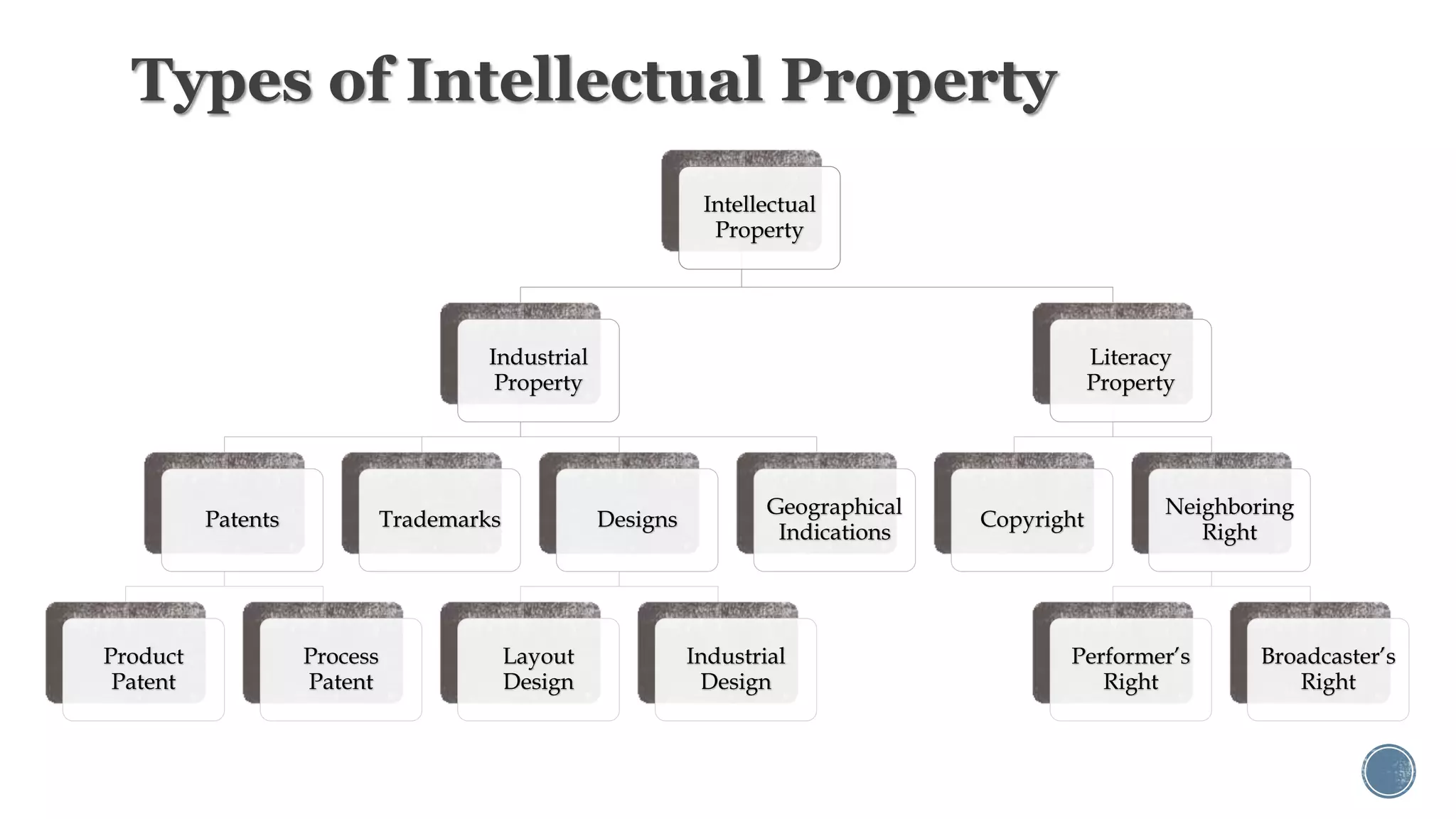
Intellectual
Property
Industrial
Property
Patents
Product
Patent
Process
Patent
Trademarks Designs
Layout
Design
Industrial
Design
Geographical
Indications
Literacy
Property
Copyright
Neighboring
Right
Performer’s
Right
Broadcaster’s
Right
Types of Intellectual Property
What are Intellectual Property Rights ?
 It refer to the legal ownership by a person or business of an invention/discovery
attached to particular product or processes which protects the owner against
unauthorized copying or imitation.
 A general term covering Patents, Copyright, Trademark, Industrial designs,
Geographical indications, Protection of layout design of integrated circuits and
Protection of undisclosed information (trade secrets).
 IPR can be assigned, gifted, sold and licensed like any other property.
Objectives of IPR
 To give statutory expression to the moral and economic rights of creators in their creations and such rights
of the public in access to those creations.
 To promote creativity and the dissemination and the application of its result to encourage fair trading
which would contribute to economic and social development as it is a deliberate act of governmental
policy.
 Along with the social and economic, scientific and cultural development of the society must be
encouraged.
 Spread of respect for creators and inventors.
 Understanding the role and importance of IP.
 Prevent third parties from becoming unjustly enriched by reaping what they have not sown.
 Regulate the creation, use and exploitation of mental or creative labour.
Patents
 Meaning:
Patents protects processes, methods and inventions that are ”Novel”, “Non-
obvious” and “Useful”. If granted a patent gives you monopoly on selling, using,
making or importing on novel.
 Types:
 Product Patents
 Process Patents
Terms of Patents
 Section 53 of the Patent Act prescribes a uniform term of 20 years from the date of filling
the patent application in India for all categories of patents in compliance with Article 33 of
TRIPS.
 There is no provision for an extension of the patent term. Term of patent in case of
applications filed under the PCT designating India is 20 years from the international
filling date.
Trademarks
 A trade mark is any sign which can distinguish the goods of one trader from those of
another. Sign includes, words, logos, pictures, or a combination of these.
 A trade mark is used as a marketing tool so that customers can recognize the product
of a particular trader.
 The trademark owner can be an individual, business organization, or any legal entity
 To register a trade mark , the mark must be distinctive and not deceptive, or contrary
to law or morality and not identical or similar to any earlier marks for the same or
similar goods.
Types of trademark
 Word: A word or other groupings of letters/ alphabets is the most common type of mark. APPLE, GOOGLE,
INFOSYS, TATA, IBM etc.
 Device: Logo, Pictures of Drawings, or a combination of Pictures and Words or Drawings, etc.
 Shape of Goods: The shape of a product or the shape of a container may serve a function of identifying to
the origin of goods. Shape of KitKat, hide and seek biscuits, etc.
 Colour: The particular colour or combination of colour is recognized as a trademark if it is established that
the colour (s) function as a uniquely identifying mark to identify the origin of goods or services.
 Sound: Sound marks are a non-conventional trademark and are possible to be registered in India, provided
the sound functions as an identifier for the origin of goods or services. Nokia tune, Intel, Samsung ringtone etc.
10
Trademark Registration & Terms
 Trademark rights established by:
 First to use the "mark"
 First to file application with Patent and Trademark Office(PTO)
 Registered owner can use mark nationwide.
 Term of registration of a trademark is 10 years, which may be renewed for a further period
of ten years on payment of prescribed renewal fees.
 Non-user of a registered trademark for a continuous period of 10 years is a ground for
cancellation of registration of such trademark at the behest of any aggrieved party.
Copyrights
 A right, which is available for creating an original literary or dramatic or musical or artistic work.
 Registration can be done at the Office of the Registrar of Copyrights in New Delhi
 Protection for the expression of an idea and not for the idea itself.
 The owner may assign to any person the copyright.
 Giving owner, incentives in the form of recognition and fair economic reward increases their
activity.
 The work is open for public inspection once the copyright is registered.
 A provision of ‘fair use’ in the law, which allows copyrighted work to be used for teaching and
research and development.
12
Copyright Protection
Author and Agent have exclusive rights to:
 Reproduce the copyrighted work
 Prepare derivative works
 Distribute copies or phone records of the copyrighted work,
 Perform the copyrighted work publicly
 Display the copyrighted work publicly
13
Scope of Copyright Protection
 Literary works
 Musical works
 Dramatic works
 Choreography
 Motion pictures
 Pictorial, graphic, sculptoral works
 Sound recordings
 Architectural works
Term of copyright
 Work of Literature (Literary Work) or dramatic work or musical work or artistic work other
than photographs (Published)- lifetime of the author - 60 years from the death of the author
of the work
 Work of Literature (Literary Work) or music work or artistic work other than photographs -
(Unpublished) which has not been published, performed or offered for sale or for broadcast
during the lifetime of the author - 60 years after of the death of the author from the end
of the year in which the work was first published or performed or offered for sale
 Cinematograph Film, Photographs and computer programmes (Published) / (Unpublished),
Sound recording, Anonymous and pseudonymous works, Posthumous work - 60 Years
beginning the end of the year in which the work is published or made available to the
public with the specific consent of the author or creator of the work
Conclusion
 Intellectual property rights reward creativity and human endeavour, which fuel the
progress of humankind.
 Understanding the country’s IP Rights and following the best practices can drastically
reduce the risk of losing the company’s intellectual property.
 Indian government has initiated various steps towards Intellectual Properties Rights
Protection.

Intellectual property rights 2

  • 1.
  • 2.
    What is anIntellectual Property ?  Intellectual property is a legal field that refers to creations of the mind such as musical, literary, and artistic works; inventions; and symbols, names, images, and designs used in commerce, including copyrights, trademarks, patents, and related rights.  It’s an intangible asset  Examples of intellectual property a) Include an author's copyright on a book b) A distinctive logo design representing a soft drink company and its products, c) Unique design elements of a web site
  • 3.
  • 4.
    What are IntellectualProperty Rights ?  It refer to the legal ownership by a person or business of an invention/discovery attached to particular product or processes which protects the owner against unauthorized copying or imitation.  A general term covering Patents, Copyright, Trademark, Industrial designs, Geographical indications, Protection of layout design of integrated circuits and Protection of undisclosed information (trade secrets).  IPR can be assigned, gifted, sold and licensed like any other property.
  • 5.
    Objectives of IPR To give statutory expression to the moral and economic rights of creators in their creations and such rights of the public in access to those creations.  To promote creativity and the dissemination and the application of its result to encourage fair trading which would contribute to economic and social development as it is a deliberate act of governmental policy.  Along with the social and economic, scientific and cultural development of the society must be encouraged.  Spread of respect for creators and inventors.  Understanding the role and importance of IP.  Prevent third parties from becoming unjustly enriched by reaping what they have not sown.  Regulate the creation, use and exploitation of mental or creative labour.
  • 6.
    Patents  Meaning: Patents protectsprocesses, methods and inventions that are ”Novel”, “Non- obvious” and “Useful”. If granted a patent gives you monopoly on selling, using, making or importing on novel.  Types:  Product Patents  Process Patents
  • 7.
    Terms of Patents Section 53 of the Patent Act prescribes a uniform term of 20 years from the date of filling the patent application in India for all categories of patents in compliance with Article 33 of TRIPS.  There is no provision for an extension of the patent term. Term of patent in case of applications filed under the PCT designating India is 20 years from the international filling date.
  • 8.
    Trademarks  A trademark is any sign which can distinguish the goods of one trader from those of another. Sign includes, words, logos, pictures, or a combination of these.  A trade mark is used as a marketing tool so that customers can recognize the product of a particular trader.  The trademark owner can be an individual, business organization, or any legal entity  To register a trade mark , the mark must be distinctive and not deceptive, or contrary to law or morality and not identical or similar to any earlier marks for the same or similar goods.
  • 9.
    Types of trademark Word: A word or other groupings of letters/ alphabets is the most common type of mark. APPLE, GOOGLE, INFOSYS, TATA, IBM etc.  Device: Logo, Pictures of Drawings, or a combination of Pictures and Words or Drawings, etc.  Shape of Goods: The shape of a product or the shape of a container may serve a function of identifying to the origin of goods. Shape of KitKat, hide and seek biscuits, etc.  Colour: The particular colour or combination of colour is recognized as a trademark if it is established that the colour (s) function as a uniquely identifying mark to identify the origin of goods or services.  Sound: Sound marks are a non-conventional trademark and are possible to be registered in India, provided the sound functions as an identifier for the origin of goods or services. Nokia tune, Intel, Samsung ringtone etc.
  • 10.
    10 Trademark Registration &Terms  Trademark rights established by:  First to use the "mark"  First to file application with Patent and Trademark Office(PTO)  Registered owner can use mark nationwide.  Term of registration of a trademark is 10 years, which may be renewed for a further period of ten years on payment of prescribed renewal fees.  Non-user of a registered trademark for a continuous period of 10 years is a ground for cancellation of registration of such trademark at the behest of any aggrieved party.
  • 11.
    Copyrights  A right,which is available for creating an original literary or dramatic or musical or artistic work.  Registration can be done at the Office of the Registrar of Copyrights in New Delhi  Protection for the expression of an idea and not for the idea itself.  The owner may assign to any person the copyright.  Giving owner, incentives in the form of recognition and fair economic reward increases their activity.  The work is open for public inspection once the copyright is registered.  A provision of ‘fair use’ in the law, which allows copyrighted work to be used for teaching and research and development.
  • 12.
    12 Copyright Protection Author andAgent have exclusive rights to:  Reproduce the copyrighted work  Prepare derivative works  Distribute copies or phone records of the copyrighted work,  Perform the copyrighted work publicly  Display the copyrighted work publicly
  • 13.
    13 Scope of CopyrightProtection  Literary works  Musical works  Dramatic works  Choreography  Motion pictures  Pictorial, graphic, sculptoral works  Sound recordings  Architectural works
  • 14.
    Term of copyright Work of Literature (Literary Work) or dramatic work or musical work or artistic work other than photographs (Published)- lifetime of the author - 60 years from the death of the author of the work  Work of Literature (Literary Work) or music work or artistic work other than photographs - (Unpublished) which has not been published, performed or offered for sale or for broadcast during the lifetime of the author - 60 years after of the death of the author from the end of the year in which the work was first published or performed or offered for sale  Cinematograph Film, Photographs and computer programmes (Published) / (Unpublished), Sound recording, Anonymous and pseudonymous works, Posthumous work - 60 Years beginning the end of the year in which the work is published or made available to the public with the specific consent of the author or creator of the work
  • 15.
    Conclusion  Intellectual propertyrights reward creativity and human endeavour, which fuel the progress of humankind.  Understanding the country’s IP Rights and following the best practices can drastically reduce the risk of losing the company’s intellectual property.  Indian government has initiated various steps towards Intellectual Properties Rights Protection.