Intellectual Property
Rezaul Karim Refath
ID: 181-15-1871
Section: PC-G
1
Presented By Presented To
Aliza Ahmed Khan
Lecturer, Department of
Computer Science and
Engineering
2
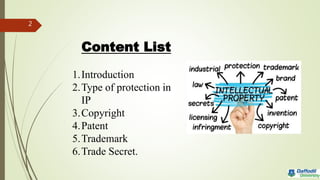
Content List
1.Introduction
2.Type of protection in
IP
3.Copyright
4.Patent
5.Trademark
6.Trade Secret.
Introduction
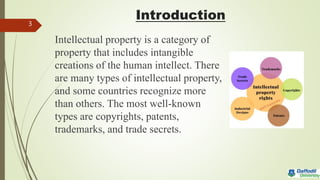
Intellectual property is a category of
property that includes intangible
creations of the human intellect. There
are many types of intellectual property,
and some countries recognize more
than others. The most well-known
types are copyrights, patents,
trademarks, and trade secrets.
3
Introduction
Intellectual property (IP) refers to creations of the mind,
such as inventions; literary and artistic works; designs; and
symbols, names and images used in commerce.
4
Type of protection in IP
Four Type of protection available in IP.
1. Copyright.
2. Patent.
3. Trademark.
4. Trade Secret.
5
Copyright
Copyright refers to the legal right of the
owner of intellectual property. In simpler
terms, copyright is the right to copy. This
means that the original creators of products
and anyone they give authorization to are
the only ones with the exclusive right to
reproduce the work.
6
Copyright
Copyright is a type of intellectual property
that gives its owner the exclusive right to
copy and distribute a creative work, usually
for a limited time. The creative work may be
in a literary, artistic, educational, or musical
form.
7
Copyright
Copyright owners rights on those property
1. Make copies of the work.
2. Produce derivative works.
3. Distribute copies.
4. Display the work in public
5. Perform the work in public
8
Patent
The primary goal of the patent law is to
encourage innovation and
commercialization of technological
advances. Patent law incentivizes inventors
to publicly disclose their inventions in
exchange for certain exclusive rights. A
patent protects inventions. These inventions
can include new and useful processes,
machines, manufactures, compositions of
matter as well as improvements to these.
9
Trademark
a trademark is a word, phrase, symbol,
and/or design that identifies and
distinguishes the source of the goods of one
party from those of others. A service mark is
a word, phrase, symbol, and/or design that
identifies and distinguishes the source of a
service rather than goods. Examples include
brand names, slogans, and logos.
10
Trade secret
Trade secrets are intellectual property (IP)
rights on confidential information which
may be sold or licensed.
11
Trade secret
In general, to qualify as a trade secret, the
information must be:commercially valuable
because it is secret,be known only to a
limited group of persons, and be subject to
reasonable steps taken by the rightful holder
of the information to keep it secret,
including the use of confidentiality
agreements for business partners and
employees.
12

Intellectual property

  • 1.
    Intellectual Property Rezaul KarimRefath ID: 181-15-1871 Section: PC-G 1 Presented By Presented To Aliza Ahmed Khan Lecturer, Department of Computer Science and Engineering
  • 2.
    2 Content List 1.Introduction 2.Type ofprotection in IP 3.Copyright 4.Patent 5.Trademark 6.Trade Secret.
  • 3.
    Introduction Intellectual property isa category of property that includes intangible creations of the human intellect. There are many types of intellectual property, and some countries recognize more than others. The most well-known types are copyrights, patents, trademarks, and trade secrets. 3
  • 4.
    Introduction Intellectual property (IP)refers to creations of the mind, such as inventions; literary and artistic works; designs; and symbols, names and images used in commerce. 4
  • 5.
    Type of protectionin IP Four Type of protection available in IP. 1. Copyright. 2. Patent. 3. Trademark. 4. Trade Secret. 5
  • 6.
    Copyright Copyright refers tothe legal right of the owner of intellectual property. In simpler terms, copyright is the right to copy. This means that the original creators of products and anyone they give authorization to are the only ones with the exclusive right to reproduce the work. 6
  • 7.
    Copyright Copyright is atype of intellectual property that gives its owner the exclusive right to copy and distribute a creative work, usually for a limited time. The creative work may be in a literary, artistic, educational, or musical form. 7
  • 8.
    Copyright Copyright owners rightson those property 1. Make copies of the work. 2. Produce derivative works. 3. Distribute copies. 4. Display the work in public 5. Perform the work in public 8
  • 9.
    Patent The primary goalof the patent law is to encourage innovation and commercialization of technological advances. Patent law incentivizes inventors to publicly disclose their inventions in exchange for certain exclusive rights. A patent protects inventions. These inventions can include new and useful processes, machines, manufactures, compositions of matter as well as improvements to these. 9
  • 10.
    Trademark a trademark isa word, phrase, symbol, and/or design that identifies and distinguishes the source of the goods of one party from those of others. A service mark is a word, phrase, symbol, and/or design that identifies and distinguishes the source of a service rather than goods. Examples include brand names, slogans, and logos. 10
  • 11.
    Trade secret Trade secretsare intellectual property (IP) rights on confidential information which may be sold or licensed. 11
  • 12.
    Trade secret In general,to qualify as a trade secret, the information must be:commercially valuable because it is secret,be known only to a limited group of persons, and be subject to reasonable steps taken by the rightful holder of the information to keep it secret, including the use of confidentiality agreements for business partners and employees. 12