Integrating Multimedia
Carissa Clark
Multimedia offers exciting possibilities for meeting
the needs of 21st century learners.
Technology Increase
This increased reliance on technology combined
with what we know about brain processing, offers
enormous potential for instruction. Research has
shown us that the brain processes information
using two channels visual and auditory. When
information is presented using both channels, the
brain can accommodate more new information. By
taking advantage of this multimodal processing
capability and technology-based tools, we can
dramatically enhance student learning through
multimedia instruction.
Understanding Multimedia
1. Effective multimedia recognizes that working memory has a limited
capacity to process information.
2. Effective multimedia presentations take advantage of both the auditory
and visual channels in working memory to deliver content. Using multiple
channels increases the overall amount of information the brain can process.
3. Effective multimedia understands that text may be particularly challenging
to process, with involvement from both the visual and auditory channels
required.
4. Effective multimedia presentations recognize that long-term memory
organizes information into meaningful chunks called schema. Presenting
information in a way that makes use of existing organizing structures
(schema) or that helps students organize the information can greatly
assist the learner in incorporating information into Long Term memory.
Types of Technology
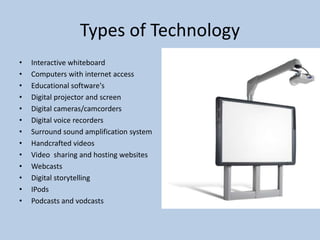
• Interactive whiteboard
• Computers with internet access
• Educational software's
• Digital projector and screen
• Digital cameras/camcorders
• Digital voice recorders
• Surround sound amplification system
• Handcrafted videos
• Video sharing and hosting websites
• Webcasts
• Digital storytelling
• IPods
• Podcasts and vodcasts
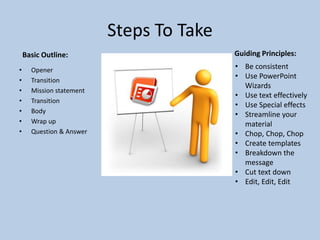
Steps To Take
• Opener
• Transition
• Mission statement
• Transition
• Body
• Wrap up
• Question & Answer
Basic Outline: Guiding Principles:
• Be consistent
• Use PowerPoint
Wizards
• Use text effectively
• Use Special effects
• Streamline your
material
• Chop, Chop, Chop
• Create templates
• Breakdown the
message
• Cut text down
• Edit, Edit, Edit
References• jukes, Ian. B ri ng i ng Do wn t he H o us e: Cr ea t i ng Se ns a t io na l K n o c k - Yo ur - So c k s
O f f P res en t a t io ns. : The Info Savvy Group, 2005. Print.
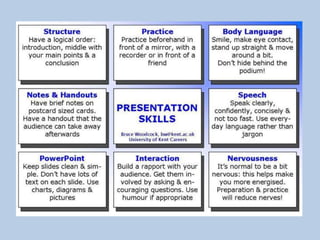
• "TIPS ON MAKING PRESENTATIONS." How to make presentations. University of Kent Careers
and Employability Service. , n.d. Web. 14 June 2014.
<http://www.kent.ac.uk/careers/presentationskills.htm>.
• "Understanding Multimedia Learning." . N.p., 1 Sept. 2008. Web. 14 June 2014.
<http://www.brainpop.com/educators/community/wp-
content/uploads/2014/02/120618_BrainPOP_White_Paper.pdf>.
Helpful Website:
http://www.kent.ac.uk/careers/presentationskills.htm

Integrating multimedia

  • 1.
    Integrating Multimedia Carissa Clark Multimediaoffers exciting possibilities for meeting the needs of 21st century learners.
  • 2.
    Technology Increase This increasedreliance on technology combined with what we know about brain processing, offers enormous potential for instruction. Research has shown us that the brain processes information using two channels visual and auditory. When information is presented using both channels, the brain can accommodate more new information. By taking advantage of this multimodal processing capability and technology-based tools, we can dramatically enhance student learning through multimedia instruction.
  • 3.
    Understanding Multimedia 1. Effectivemultimedia recognizes that working memory has a limited capacity to process information. 2. Effective multimedia presentations take advantage of both the auditory and visual channels in working memory to deliver content. Using multiple channels increases the overall amount of information the brain can process. 3. Effective multimedia understands that text may be particularly challenging to process, with involvement from both the visual and auditory channels required. 4. Effective multimedia presentations recognize that long-term memory organizes information into meaningful chunks called schema. Presenting information in a way that makes use of existing organizing structures (schema) or that helps students organize the information can greatly assist the learner in incorporating information into Long Term memory.
  • 4.
    Types of Technology •Interactive whiteboard • Computers with internet access • Educational software's • Digital projector and screen • Digital cameras/camcorders • Digital voice recorders • Surround sound amplification system • Handcrafted videos • Video sharing and hosting websites • Webcasts • Digital storytelling • IPods • Podcasts and vodcasts
  • 5.
    Steps To Take •Opener • Transition • Mission statement • Transition • Body • Wrap up • Question & Answer Basic Outline: Guiding Principles: • Be consistent • Use PowerPoint Wizards • Use text effectively • Use Special effects • Streamline your material • Chop, Chop, Chop • Create templates • Breakdown the message • Cut text down • Edit, Edit, Edit
  • 7.
    References• jukes, Ian.B ri ng i ng Do wn t he H o us e: Cr ea t i ng Se ns a t io na l K n o c k - Yo ur - So c k s O f f P res en t a t io ns. : The Info Savvy Group, 2005. Print. • "TIPS ON MAKING PRESENTATIONS." How to make presentations. University of Kent Careers and Employability Service. , n.d. Web. 14 June 2014. <http://www.kent.ac.uk/careers/presentationskills.htm>. • "Understanding Multimedia Learning." . N.p., 1 Sept. 2008. Web. 14 June 2014. <http://www.brainpop.com/educators/community/wp- content/uploads/2014/02/120618_BrainPOP_White_Paper.pdf>. Helpful Website: http://www.kent.ac.uk/careers/presentationskills.htm