Commercializing Agricultural
Sector in Kenya: Wake the
Kenyan Giant!
Stephen Vundi Mungula,
SIANI Expert Group in Kenya
#SIANI17
Commercializing Agricultural Sector
in Kenya: Wake the Kenyan Giant
Stephen Vundi Mungula
Lead Junior Professional - SIANI Kenya
Outline
Introduction
The Journey
Experiences and Achievements
Findings from Second Approach
• The origin – SIANI Kenya Chapter (SKCEG)
• Objectives of expert group
• First Approach
• Second Approach
Conclusion and Way Forward
 Why Giant
WHY GIANT ?
Driver for economic growth and
transformation…high economic growth
directly linked to increased agric’ production
Percentage of population involved/affected by
agriculture
Kenya agro-ecological zone diversity
Demographic Characteristics - Youth
Introduction
 A brainstorming on findings led to the establishment
of a multidisciplinary group of experts.
ASDSP a joint programme by GOS and GOK (3)
baseline survey tell on Commercialization;-
Productivity, Income and Food Security
A worrying trend on 1) Household food security, 2)
Food productivity and incomes 3)
Un(under)employment 4) Youth and Women in
agriculture 5) Land degradation and 6) little/No
commercialization
Introduction cont.
Objectives of SIANI Kenya Chapter
What is the current status of the agricultural
sector in Kenya?
Why is the sector the way it is?
How can stakeholders harness the sector’s
potential and remove obstacles to
commercialization?
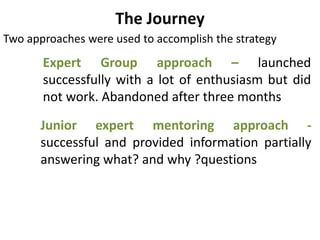
The Journey
Expert Group approach – launched
successfully with a lot of enthusiasm but did
not work. Abandoned after three months
Two approaches were used to accomplish the strategy
Junior expert mentoring approach -
successful and provided information partially
answering what? and why ?questions
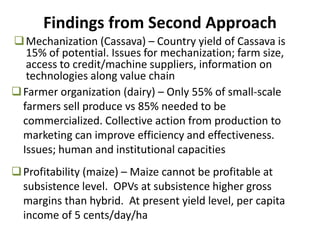
Mechanization (Cassava) – Country yield of Cassava is
15% of potential. Issues for mechanization; farm size,
access to credit/machine suppliers, information on
technologies along value chain
Findings from Second Approach
Farmer organization (dairy) – Only 55% of small-scale
farmers sell produce vs 85% needed to be
commercialized. Collective action from production to
marketing can improve efficiency and effectiveness.
Issues; human and institutional capacities
Profitability (maize) – Maize cannot be profitable at
subsistence level. OPVs at subsistence higher gross
margins than hybrid. At present yield level, per capita
income of 5 cents/day/ha
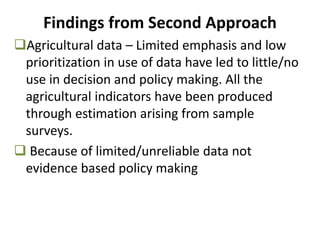
Agricultural data – Limited emphasis and low
prioritization in use of data have led to little/no
use in decision and policy making. All the
agricultural indicators have been produced
through estimation arising from sample
surveys.
 Because of limited/unreliable data not
evidence based policy making
Findings from Second Approach
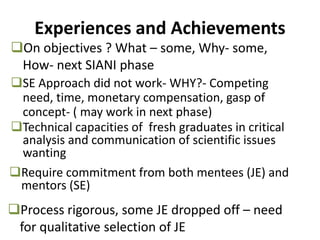
Experiences and Achievements
SE Approach did not work- WHY?- Competing
need, time, monetary compensation, gasp of
concept- ( may work in next phase)
Process rigorous, some JE dropped off – need
for qualitative selection of JE
Technical capacities of fresh graduates in critical
analysis and communication of scientific issues
wanting
Require commitment from both mentees (JE) and
mentors (SE)
On objectives ? What – some, Why- some,
How- next SIANI phase
Many stakeholders in the agricultural sector all
trying to commercialize agriculture
Conclusions and Way forward
Output papers give evidence that
commercialization is superficially being
addressed
Need for deeper understanding of
commercialization and sharing of this to
stakeholders
Need to develop adequate policies to make
agriculture a driver of rural transformation
THANK
YOU

Wake the Kenyan Giant

  • 1.
    Commercializing Agricultural Sector inKenya: Wake the Kenyan Giant! Stephen Vundi Mungula, SIANI Expert Group in Kenya #SIANI17
  • 2.
    Commercializing Agricultural Sector inKenya: Wake the Kenyan Giant Stephen Vundi Mungula Lead Junior Professional - SIANI Kenya
  • 3.
    Outline Introduction The Journey Experiences andAchievements Findings from Second Approach • The origin – SIANI Kenya Chapter (SKCEG) • Objectives of expert group • First Approach • Second Approach Conclusion and Way Forward  Why Giant
  • 4.
    WHY GIANT ? Driverfor economic growth and transformation…high economic growth directly linked to increased agric’ production Percentage of population involved/affected by agriculture Kenya agro-ecological zone diversity Demographic Characteristics - Youth
  • 5.
    Introduction  A brainstormingon findings led to the establishment of a multidisciplinary group of experts. ASDSP a joint programme by GOS and GOK (3) baseline survey tell on Commercialization;- Productivity, Income and Food Security A worrying trend on 1) Household food security, 2) Food productivity and incomes 3) Un(under)employment 4) Youth and Women in agriculture 5) Land degradation and 6) little/No commercialization
  • 6.
    Introduction cont. Objectives ofSIANI Kenya Chapter What is the current status of the agricultural sector in Kenya? Why is the sector the way it is? How can stakeholders harness the sector’s potential and remove obstacles to commercialization?
  • 7.
    The Journey Expert Groupapproach – launched successfully with a lot of enthusiasm but did not work. Abandoned after three months Two approaches were used to accomplish the strategy Junior expert mentoring approach - successful and provided information partially answering what? and why ?questions
  • 8.
    Mechanization (Cassava) –Country yield of Cassava is 15% of potential. Issues for mechanization; farm size, access to credit/machine suppliers, information on technologies along value chain Findings from Second Approach Farmer organization (dairy) – Only 55% of small-scale farmers sell produce vs 85% needed to be commercialized. Collective action from production to marketing can improve efficiency and effectiveness. Issues; human and institutional capacities Profitability (maize) – Maize cannot be profitable at subsistence level. OPVs at subsistence higher gross margins than hybrid. At present yield level, per capita income of 5 cents/day/ha
  • 9.
    Agricultural data –Limited emphasis and low prioritization in use of data have led to little/no use in decision and policy making. All the agricultural indicators have been produced through estimation arising from sample surveys.  Because of limited/unreliable data not evidence based policy making Findings from Second Approach
  • 10.
    Experiences and Achievements SEApproach did not work- WHY?- Competing need, time, monetary compensation, gasp of concept- ( may work in next phase) Process rigorous, some JE dropped off – need for qualitative selection of JE Technical capacities of fresh graduates in critical analysis and communication of scientific issues wanting Require commitment from both mentees (JE) and mentors (SE) On objectives ? What – some, Why- some, How- next SIANI phase
  • 11.
    Many stakeholders inthe agricultural sector all trying to commercialize agriculture Conclusions and Way forward Output papers give evidence that commercialization is superficially being addressed Need for deeper understanding of commercialization and sharing of this to stakeholders Need to develop adequate policies to make agriculture a driver of rural transformation
  • 12.

Editor's Notes

  • #6 Origin; An multidisciplinary group of experts who would consolidate knowledge and focus their interactive capacities to address the challenges that hinder commercialization of Kenya’s agriculture
  • #7 How would the expert group answer these questions regarding commercialization in Kenya? Policy Briefs Situational analysis papers Report on what, why and how
  • #8 Senior experts – 1st Experts drawn from….are to be assigned to each of the categories into a “node” according to their area of expertise. For example, there would be one node of productivity experts, and a node of environment experts, infrastructure experts etc who will work on developing these respective sections of the report and analysis of data sets. There are areas of overlap for many of the categories. For example environmental conditions impacts productivity. In such cases of overlap, the "environment expert node" should review and comment/provide input to the work and drafts made by the "productivity expert node", and so on. The idea is that one node holds the overall workload and responsibility for “their” parameter/field of expertise, while receiving inputs and perspectives from experts with knowledge of areas that overlap. Each of the parameters/nodes must cover the following over-arching issues: policy (regulations/laws) and gender, in order to avoid these two important issues to stand alone Analysis VC based Well on the way to commercialization; dairy, fish, poultry, maize and banana. Big potential for commercialization; cassava, meat, honey, mango, Irish potatoes. Outliers can be considered for commercialization; local vegetables, agroforestry, soya bean, sorghum, pasture. Second- je/ guiding se Junior experts identified Problem Trees / Cause-Effect methodology used to investigate issues assigned with regard to commercialization. Engage in WRITESHOPS entailing extensive literature review, data collection and analysis on key issues. Periodic presentations of Papers to SEs by JEs for review & guidance. Low level or subsistence- very low level of productivity and production often at a loss, to a large degree for subsistence. This is the majority of the farmers. Intermediate level- intermediate level of productivity and emerging entrepreneurship skills, greater degree of marketing of produce High level- fully commercial producer, producing for the market.