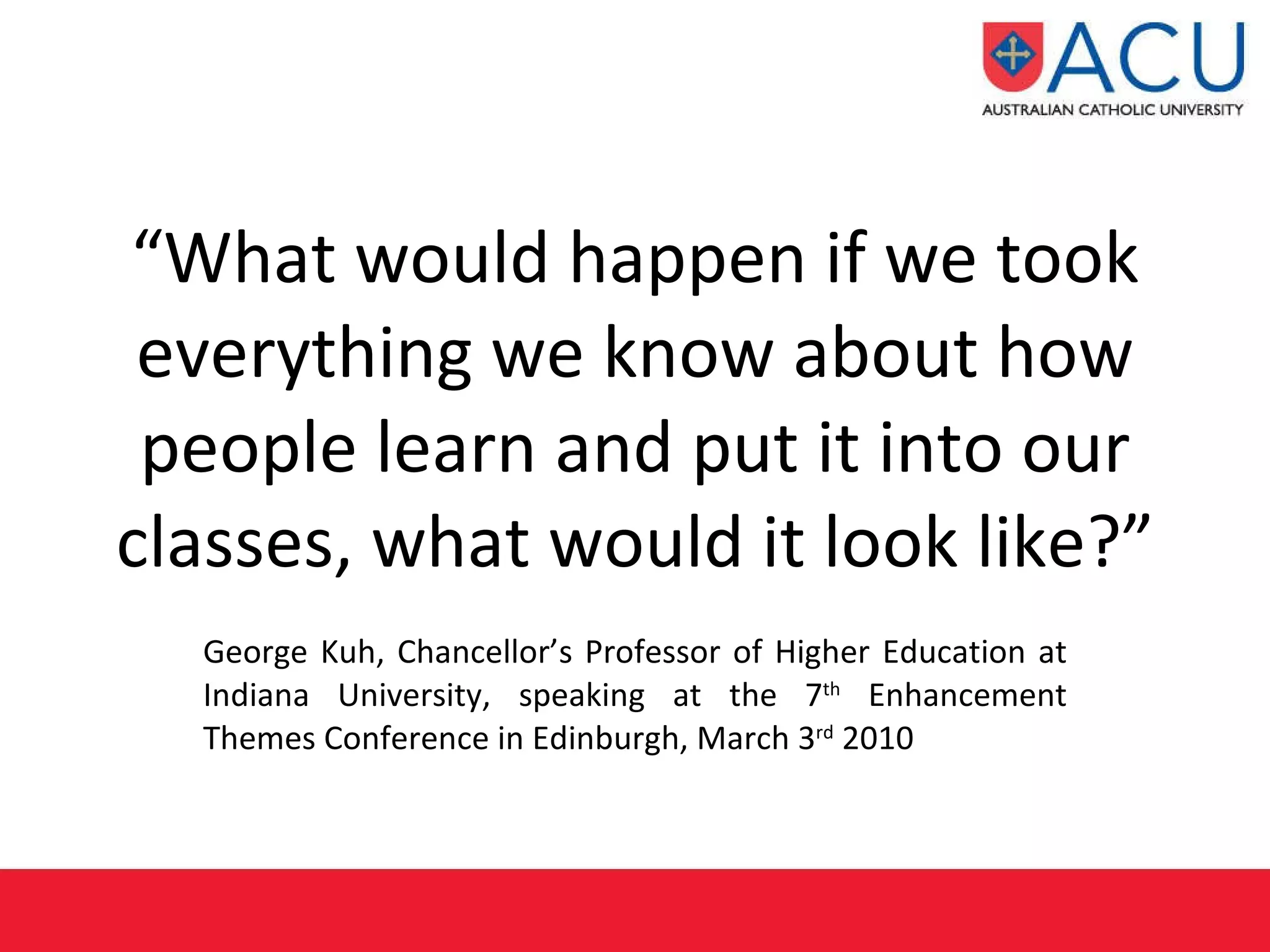

“ What would happen if we took everything we know about how people learn and put it into our classes, what would it look like?” George Kuh, Chancellor’s Professor of Higher Education at Indiana University, speaking at the 7 th  Enhancement Themes Conference in Edinburgh, March 3 rd  2010
That’s what I’m trying to find out.
Integrating Curriculum, Pedagogy & G raduate Attributes Dr Madeleine Mattarozzi Laming
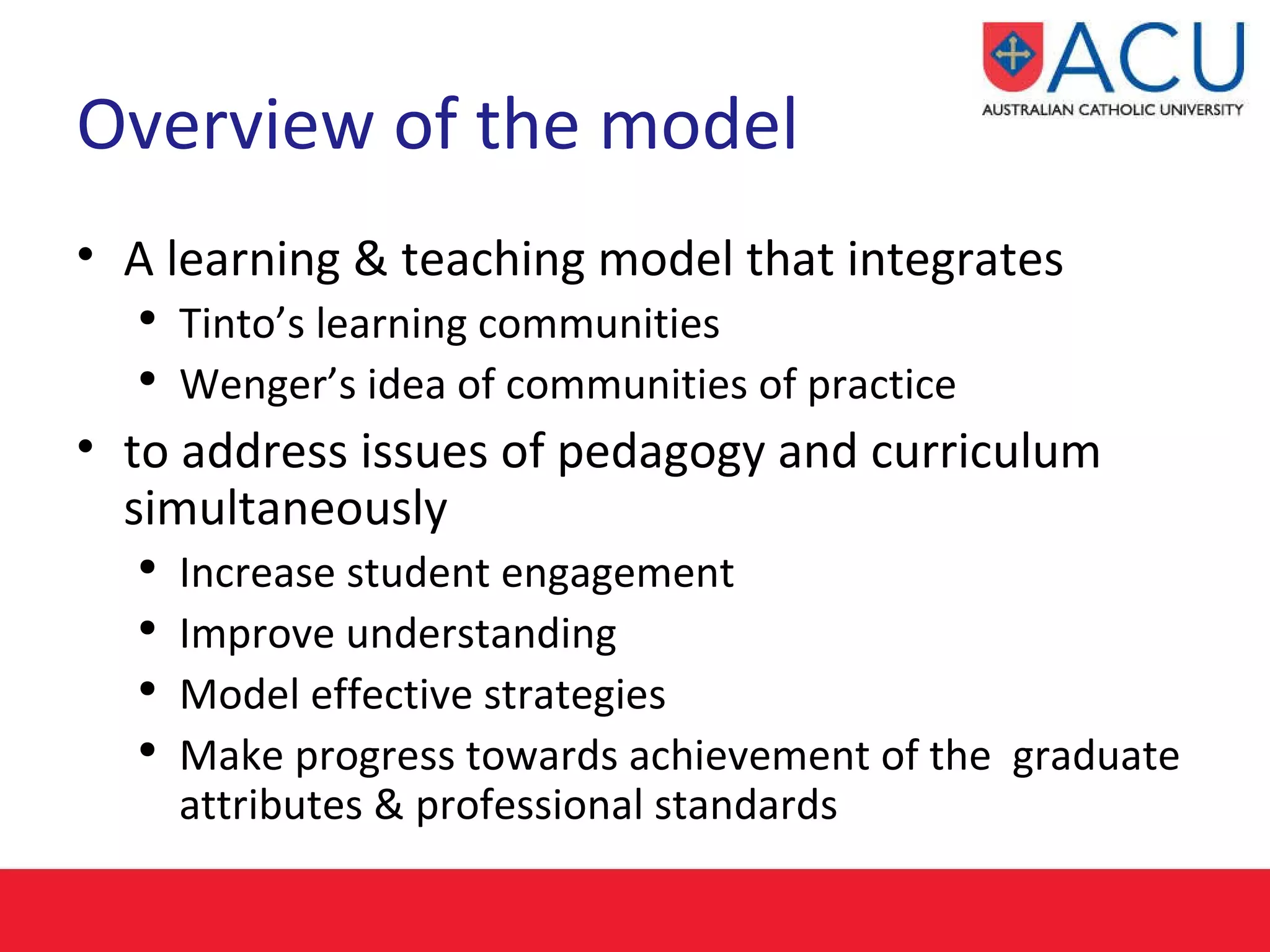
Overview of the model A learning & teaching model that integrates Tinto’s learning communities  Wenger’s idea of communities of practice  to address issues of pedagogy and curriculum simultaneously Increase student engagement Improve understanding  Model effective strategies  Make progress towards achievement of the  graduate attributes & professional standards
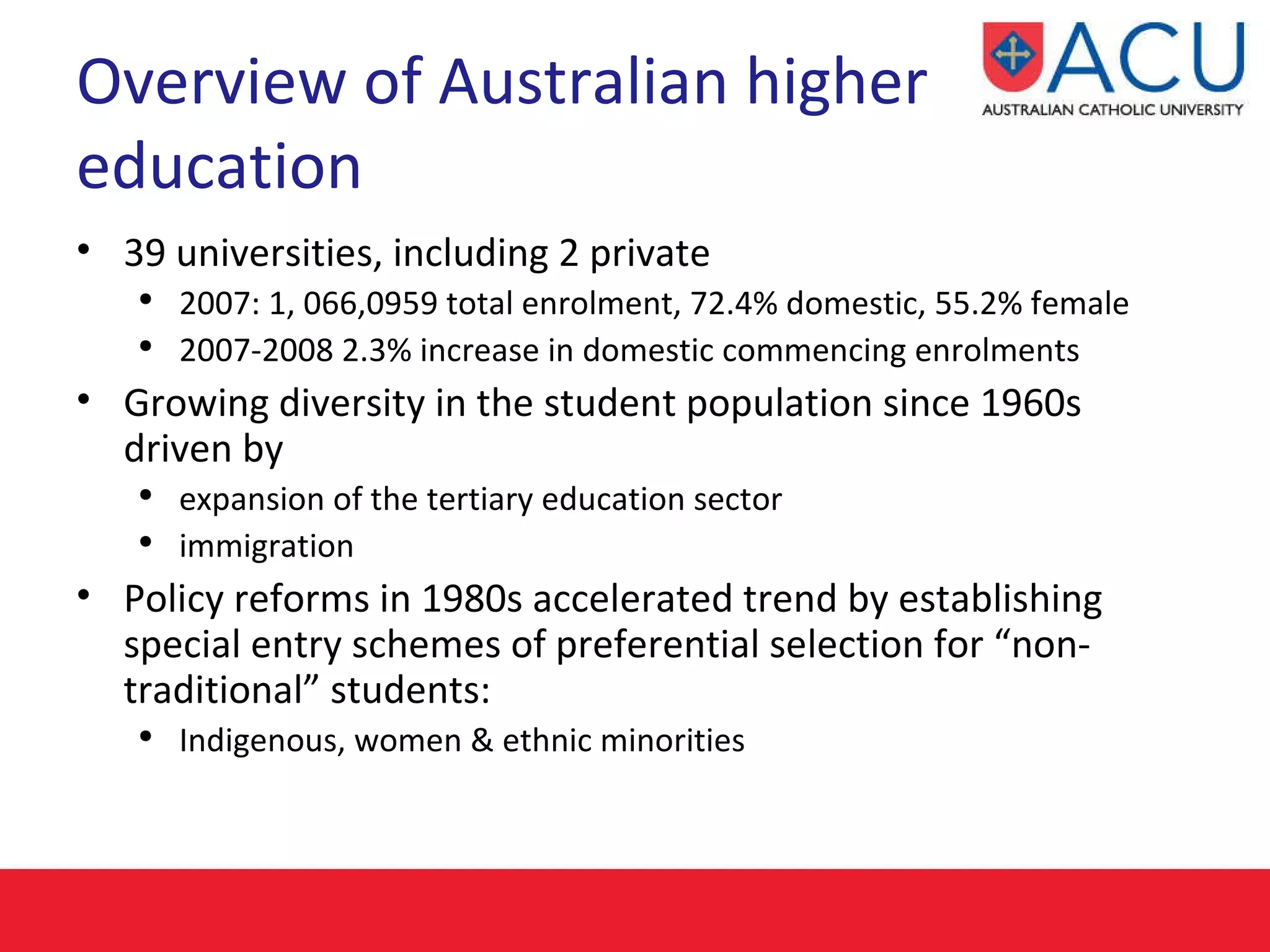
Overview of Australian higher education 39 universities, including 2 private 2007: 1, 066,0959 total enrolment, 72.4% domestic, 55.2% female 2007-2008 2.3% increase in domestic commencing enrolments Growing diversity in the student population since 1960s driven by  expansion of the tertiary education sector  immigration   Policy reforms in 1980s accelerated trend by establishing special entry schemes of preferential selection for “non-traditional” students: Indigenous, women & ethnic minorities
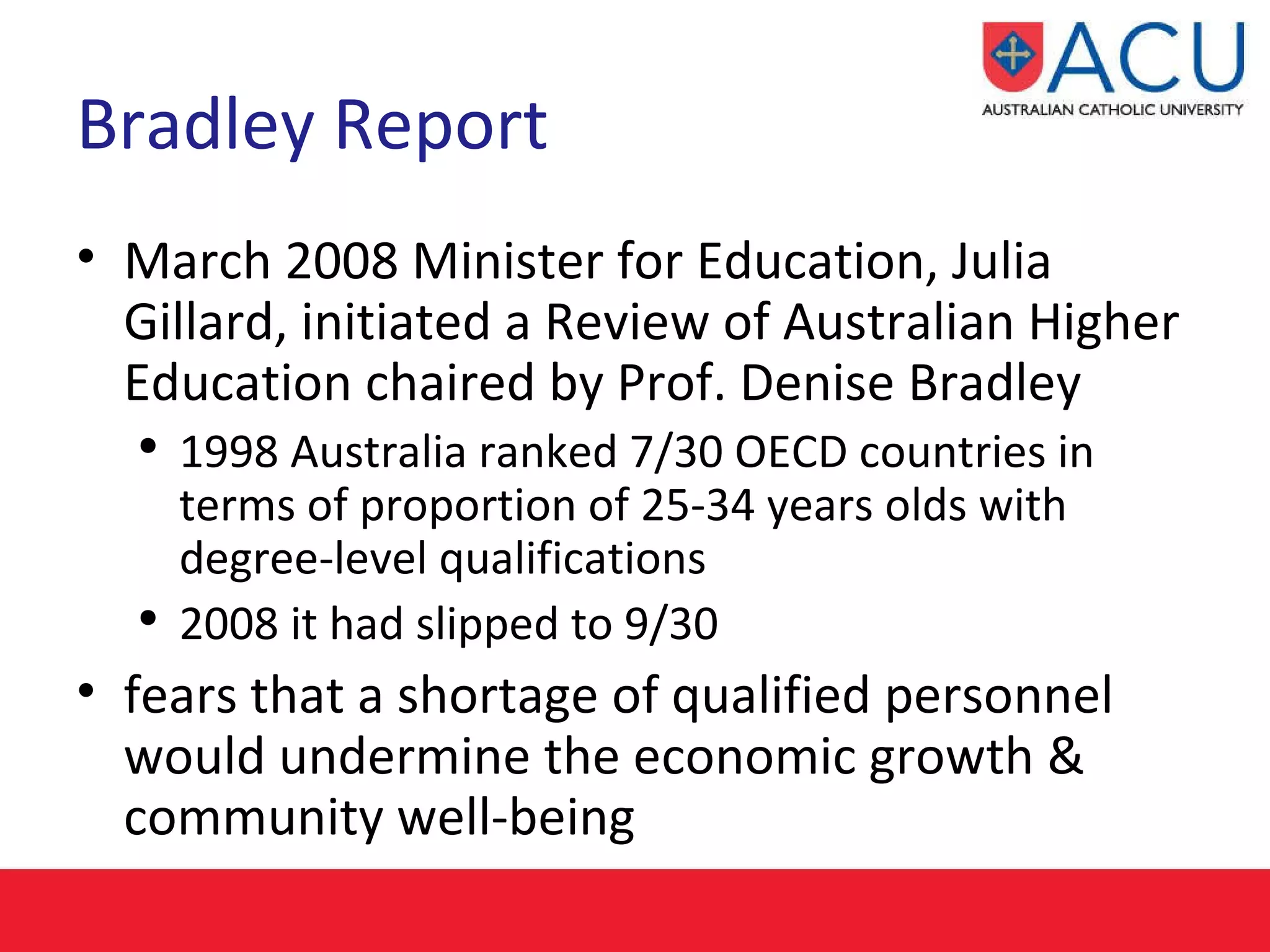
Bradley Report March 2008 Minister for Education, Julia Gillard, initiated a Review of Australian Higher Education chaired by Prof. Denise Bradley 1998 Australia ranked 7/30 OECD countries in terms of proportion of 25-34 years olds with degree-level qualifications  2008 it had slipped to 9/30  fears that a shortage of qualified personnel would undermine the economic growth & community well-being
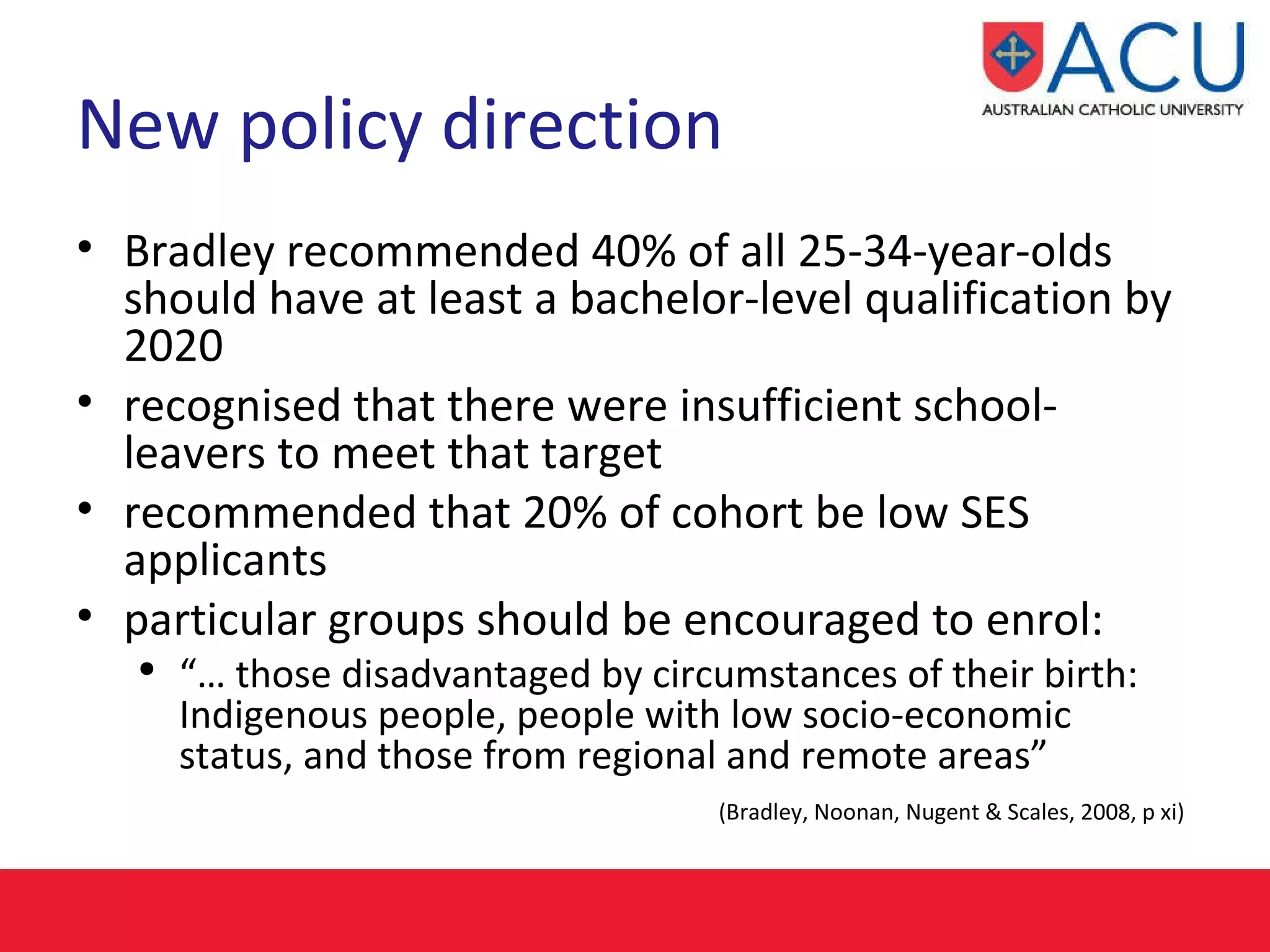
New policy direction Bradley recommended 40% of all 25-34-year-olds should have at least a bachelor-level qualification by 2020   recognised that there were insufficient school-leavers to meet that target recommended that 20% of cohort be low SES applicants particular groups should be encouraged to enrol: “…  those disadvantaged by circumstances of their birth: Indigenous people, people with low socio-economic status, and those from regional and remote areas”  (Bradley, Noonan, Nugent & Scales, 2008, p xi)
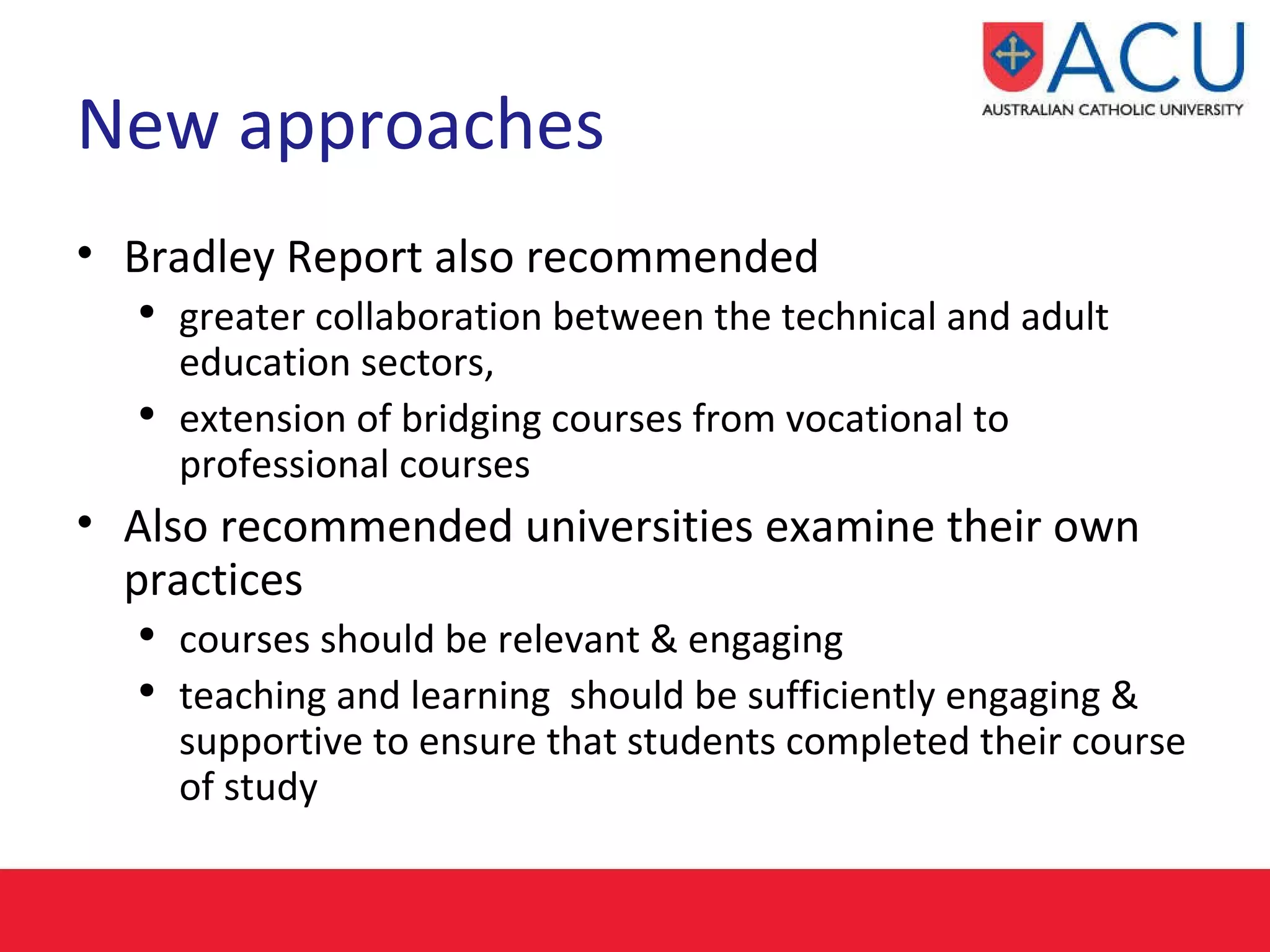
New approaches Bradley Report also recommended greater collaboration between the technical and adult education sectors,  extension of bridging courses from vocational to professional courses  Also recommended universities examine their own practices courses should be relevant & engaging  teaching and learning  should be sufficiently engaging & supportive to ensure that students completed their course of study
Overview of Australian Catholic University publicly funded university in the Catholic tradition  formed in 1991 from the amalgamation of four Catholic tertiary institutions in eastern Australia   2 campuses in Victoria: Melbourne & (rural) Ballarat long tradition of accepting students from a very wide range of social & cultural backgrounds   very strong links to Indigenous community a number of alternative entry programs  including non-year 12 access scheme & Clemente
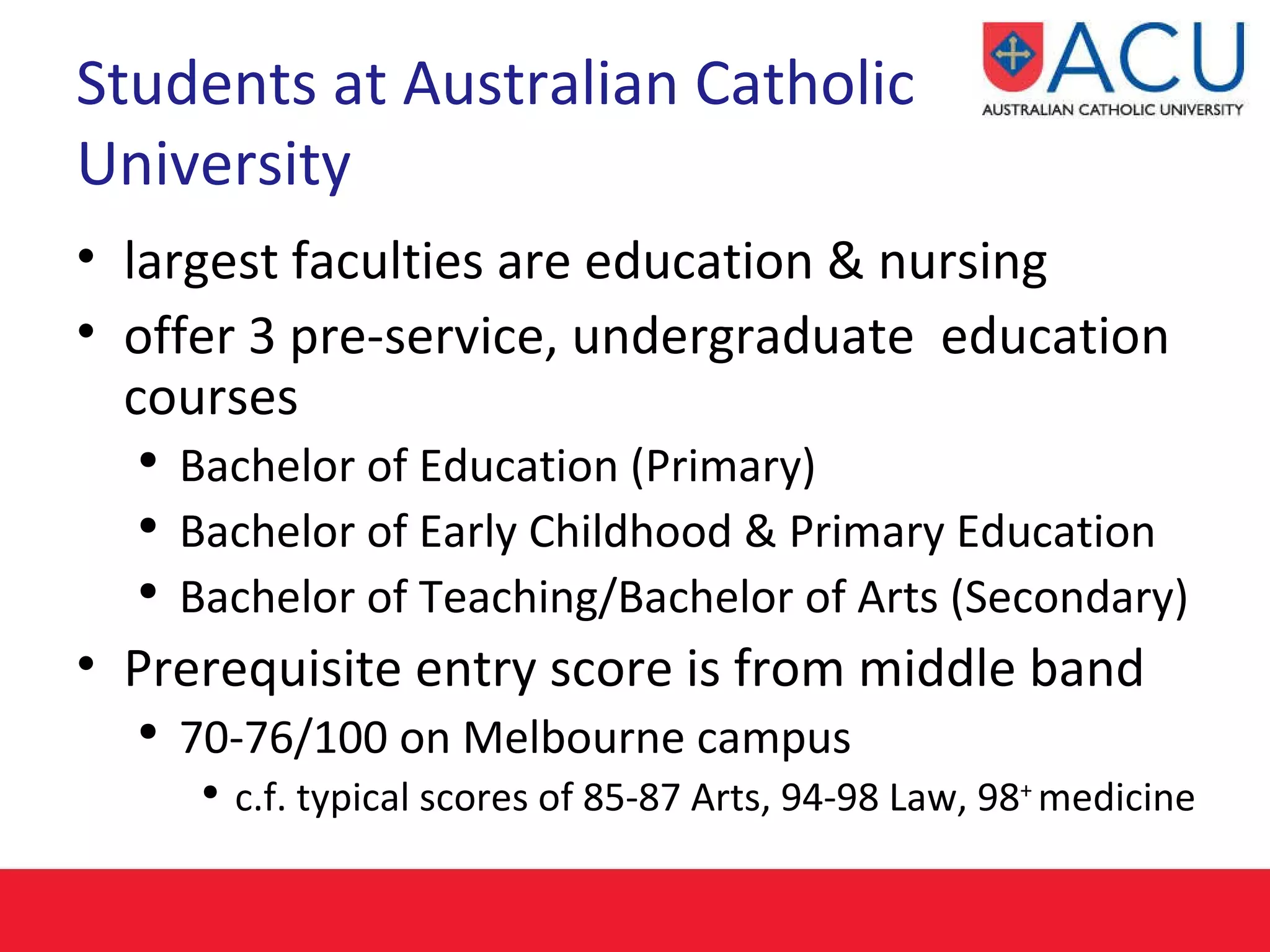
Students at Australian Catholic University largest faculties are education & nursing offer 3 pre-service, undergraduate  education courses Bachelor of Education (Primary) Bachelor of Early Childhood & Primary Education Bachelor of Teaching/Bachelor of Arts (Secondary) Prerequisite entry score is from middle band 70-76/100 on Melbourne campus c.f. typical scores of 85-87 Arts, 94-98 Law, 98 +  medicine
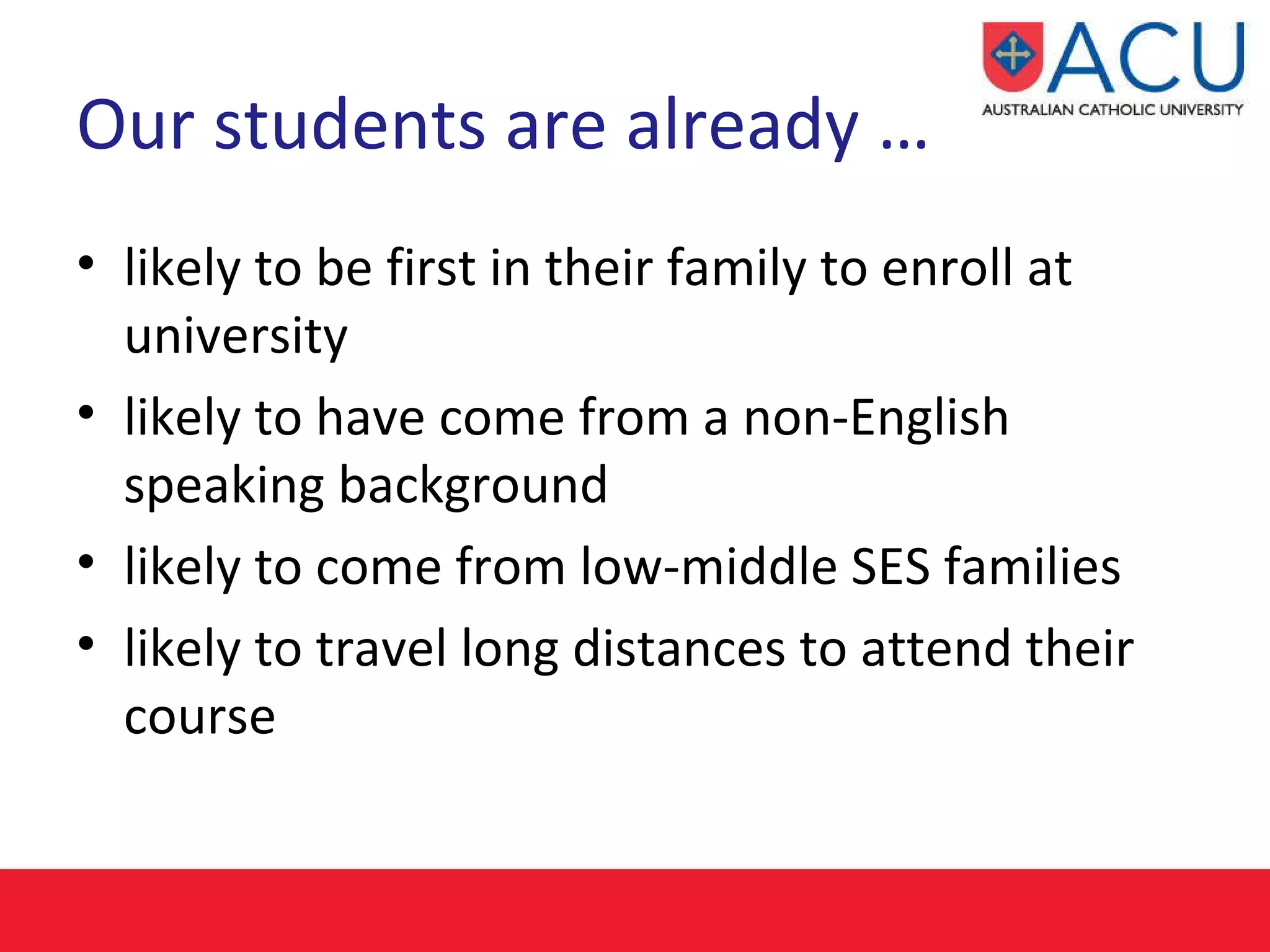
Our students are already … likely to be first in their family to enroll at university  likely to have come from a non-English speaking background likely to come from low-middle SES families likely to travel long distances to attend their course
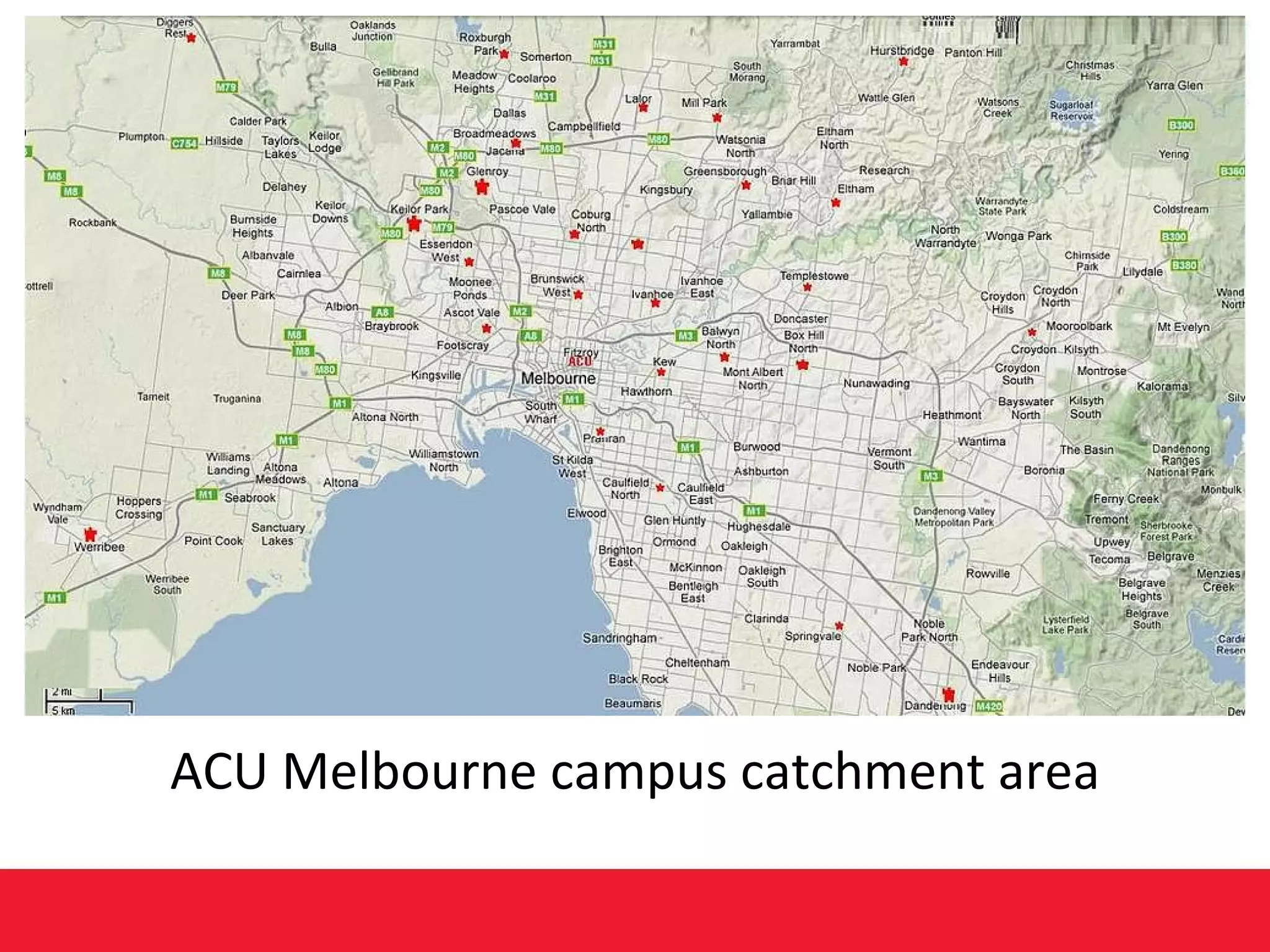
ACU Melbourne campus catchment area
New approaches to learning & teaching Beginning in 2007 new approaches to learning & teaching were tried Shared learning & assessment tasks First year B.Ed students took concurrent units in maths and learning Staff drew explicit links between content of both units  students kept journals in which they reflected on  how  they learned maths: problem solving strategies, learning styles, memory techniques …
Shared learning &  assessment # 1  Assessment Task Three: Analysis of  Factors Affecting Learning
As the semester progresses, make notes on a weekly basis about your progress as a learner in the Self Improvement Plan in EDMA103. Focus on the ways that you are going about improving your knowledge and understanding. Give detailed examples of the ways in which these activities help you to improve, for example: “ I am now using visual cues to help me memorise key information.” ““ It’s easier to understand complex information if I discuss it with other people.” There are 2 compulsory questions that you must answer every week:  1. What breakthrough have I made this week?  2. What helped me to make this breakthrough?  Other questions you need to consider: Are there particular aspects of learning that you don’t enjoy or that make you anxious?  How are you dealing with this situation? How do you know when you have learned something? In Week 11, you will submit your diary for assessment together with a report on the factors that have affected your learning.
More developments in  learning & teaching Collaborative learning introduced in 2008 Online groups were added in 2009
Collaborative Learning  # 1 & 2
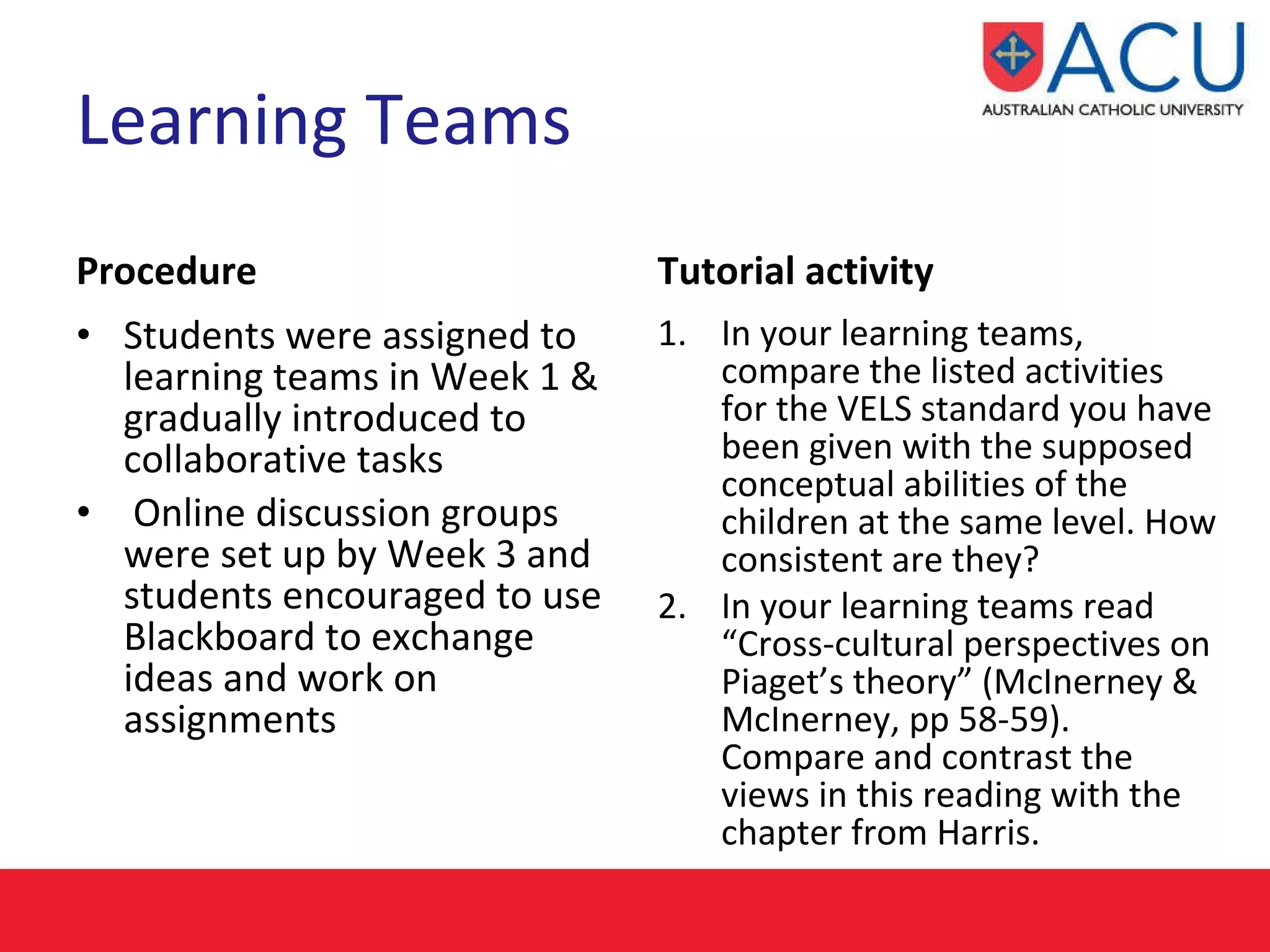
Learning Teams Procedure Students were assigned to learning teams in Week 1 &  gradually introduced to collaborative tasks Online discussion groups were set up by Week 3 and students encouraged to use Blackboard to exchange ideas and work on assignments Tutorial activity In your learning teams, compare the listed activities for the VELS standard you have been given with the supposed conceptual abilities of the children at the same level. How consistent are they?  In your learning teams read “Cross-cultural perspectives on Piaget’s theory” (McInerney & McInerney, pp 58-59). Compare and contrast the views in this reading with the chapter from Harris.
Graduate Attributes diversity of the student population is not an excuse for reducing quality ACU has developed a set of graduate attributes to ensure that the quality of teaching remains high and that graduates are employable   ACU Strategic Plan  ACU Learning and Teaching Plan 2009-2011
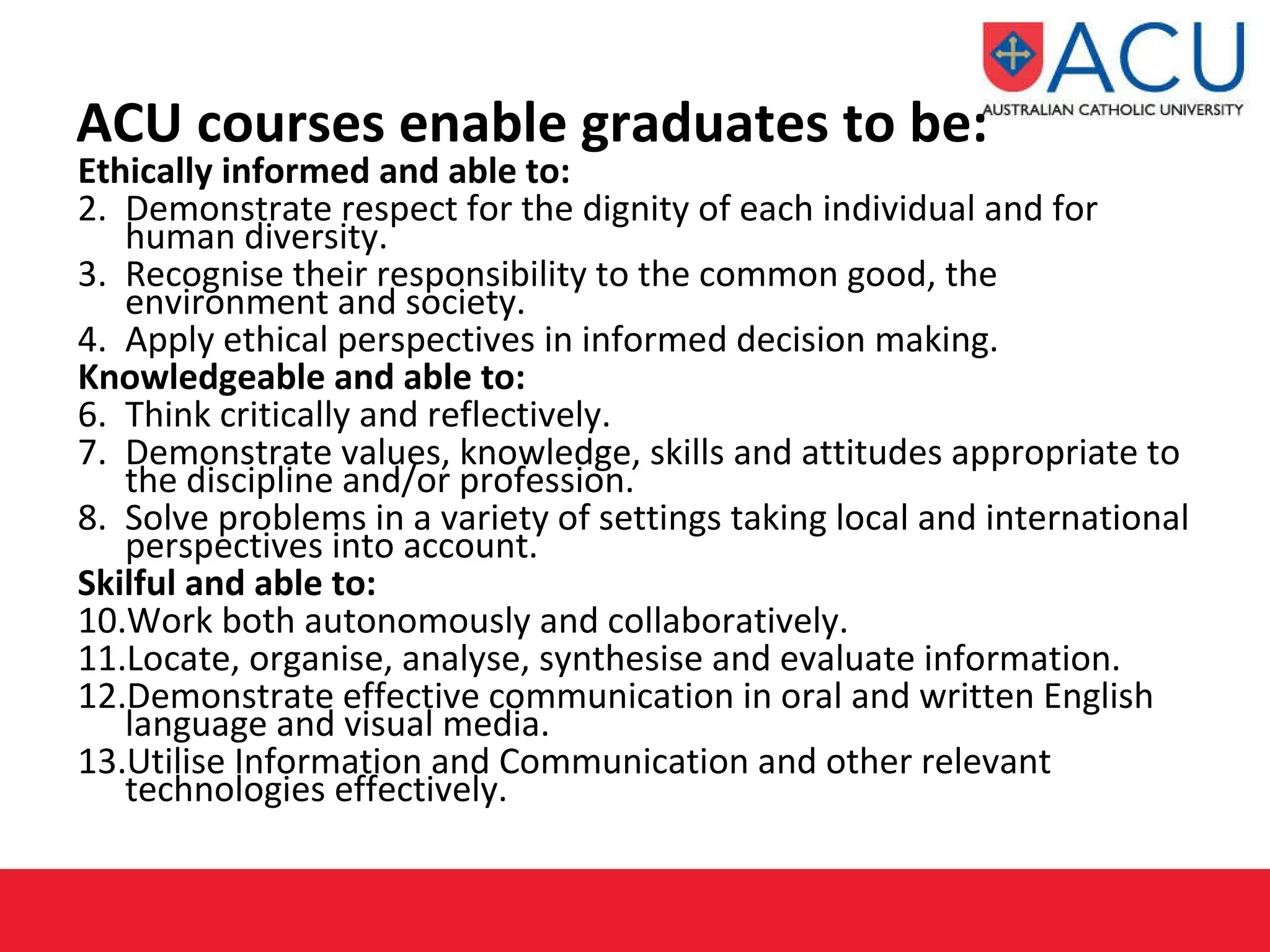
ACU courses enable graduates to be: Ethically informed and able to: Demonstrate respect for the dignity of each individual and for human diversity. Recognise their responsibility to the common good, the environment and society. Apply ethical perspectives in informed decision making. Knowledgeable and able to: Think critically and reflectively. Demonstrate values, knowledge, skills and attitudes appropriate to the discipline and/or profession. Solve problems in a variety of settings taking local and international perspectives into account.  Skilful and able to: Work both autonomously and collaboratively. Locate, organise, analyse, synthesise and evaluate information. Demonstrate effective communication in oral and written English language and visual media. Utilise Information and Communication and other relevant technologies effectively.
Professional Standards according to the Standards of Professional Practice issued by the Victorian Institute of Teaching graduating teachers must demonstrate professional knowledge including knowledge of how students learn  professional practice including the ability to use a variety of teaching styles to engage students Professional engagement including the ability to reflect on their performance and improve
Meanwhile … At the Ballarat Campus, Trish Young established Tertiary Learning Communities (TLCs) program in 2008 1 hour seminar focusing on academic skills & issues relating to transition  also a social networking program  Close collaboration with Student Support Services & case management for some students nursing students were included in TLC in 2009
Next Step …  to develop an integrated model that would address  address issues of curriculum & pedagogy concurrently provide additional support for students through their first year accommodate university graduate attributes begin work on professional standards (maybe)
Theoretical underpinning
Reorganising the Curriculum Tinto (2003) outlines three types of  learning community  that are progressively more complex: Linked courses Freshman interest groups Cluster courses Co-ordinated studies all forms of learning community have led to improvements in students’ community engagement, engagement with their studies & academic success
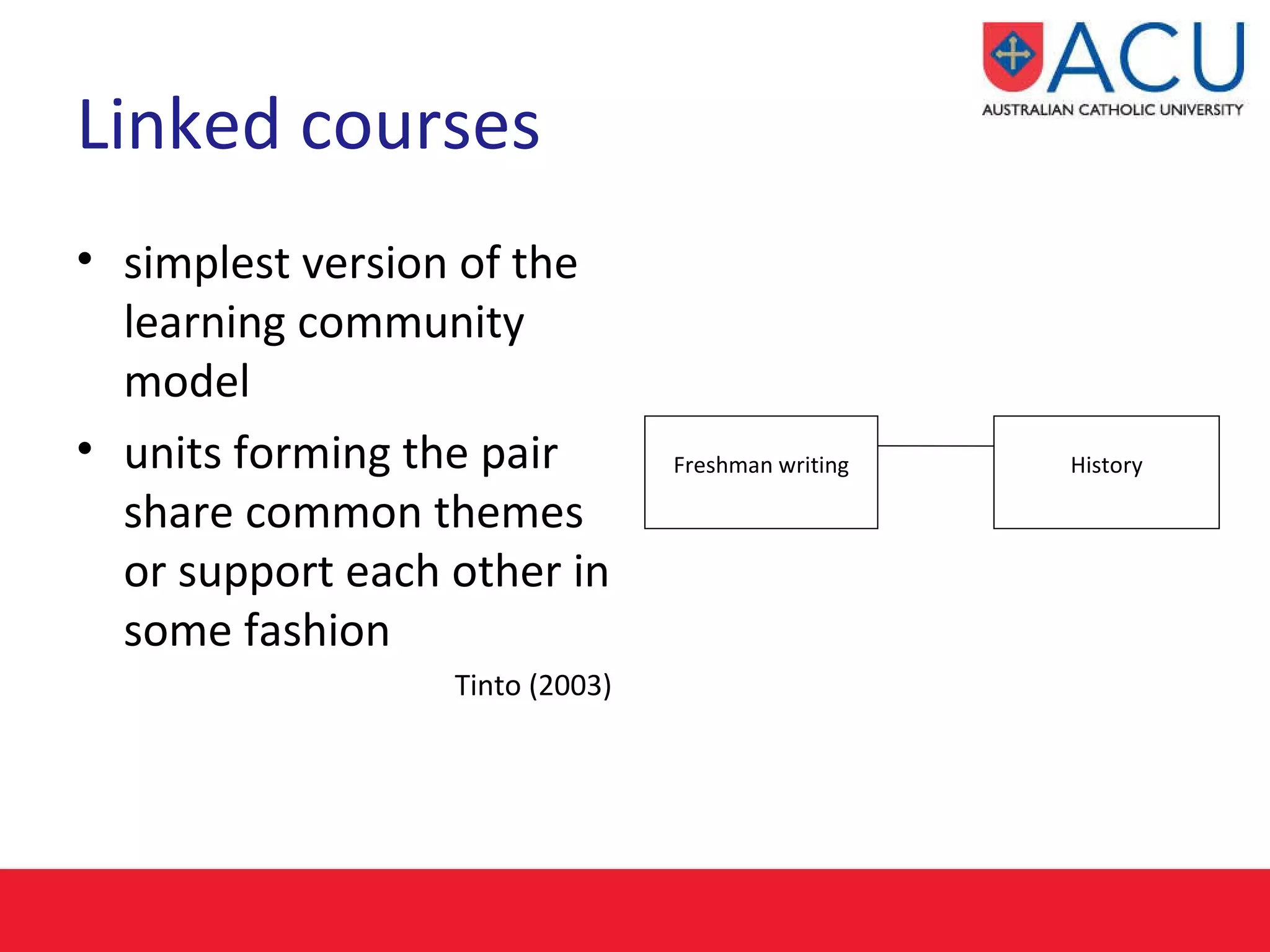
Linked courses simplest version of the  learning community model units forming the pair share common themes or support each other in some fashion   Tinto (2003) Freshman writing History
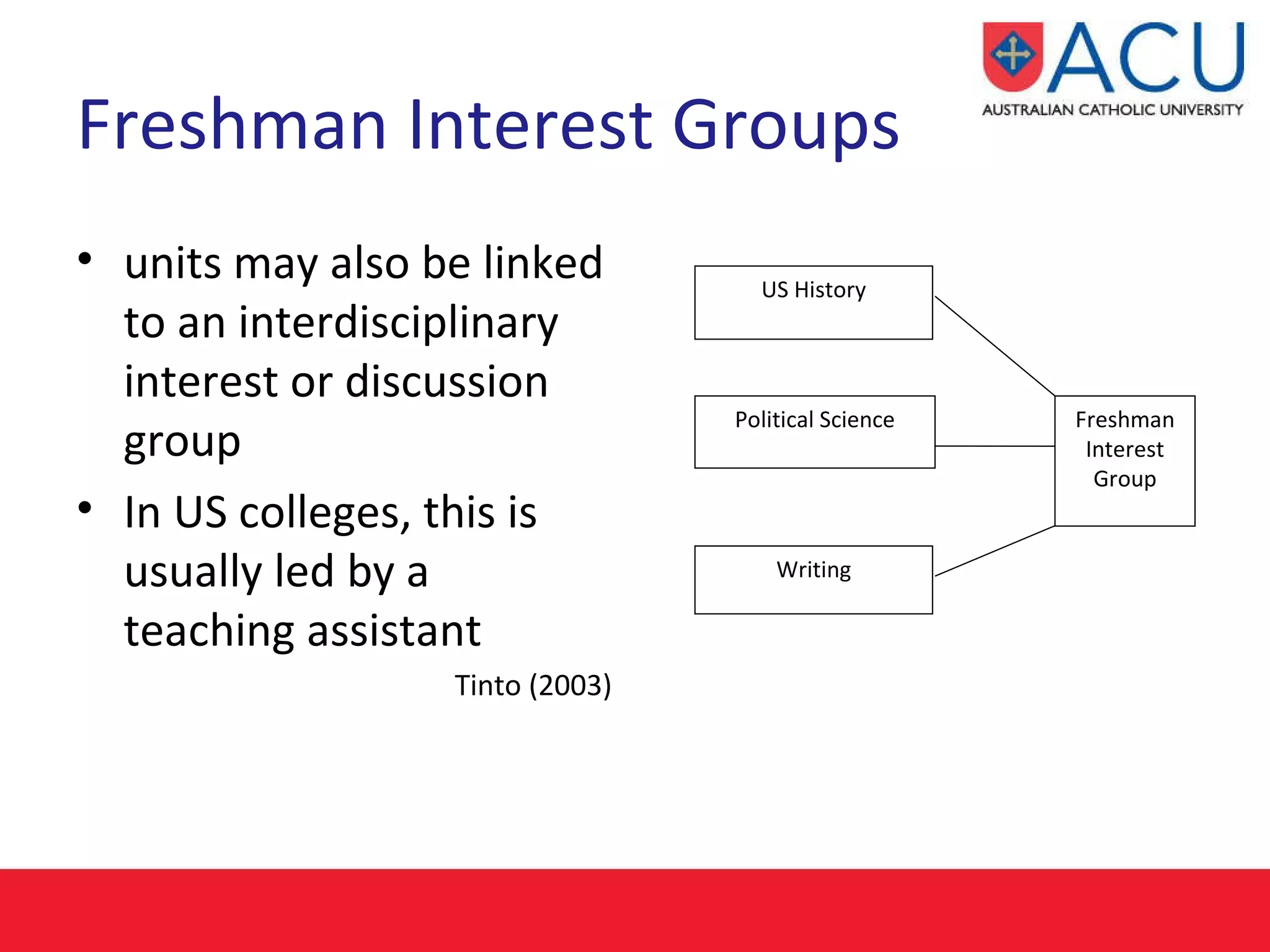
Freshman Interest Groups units may also be linked to an interdisciplinary interest or discussion group In US colleges, this is usually led by a  teaching assistant Tinto (2003) US History Freshman Interest Group Political Science Writing
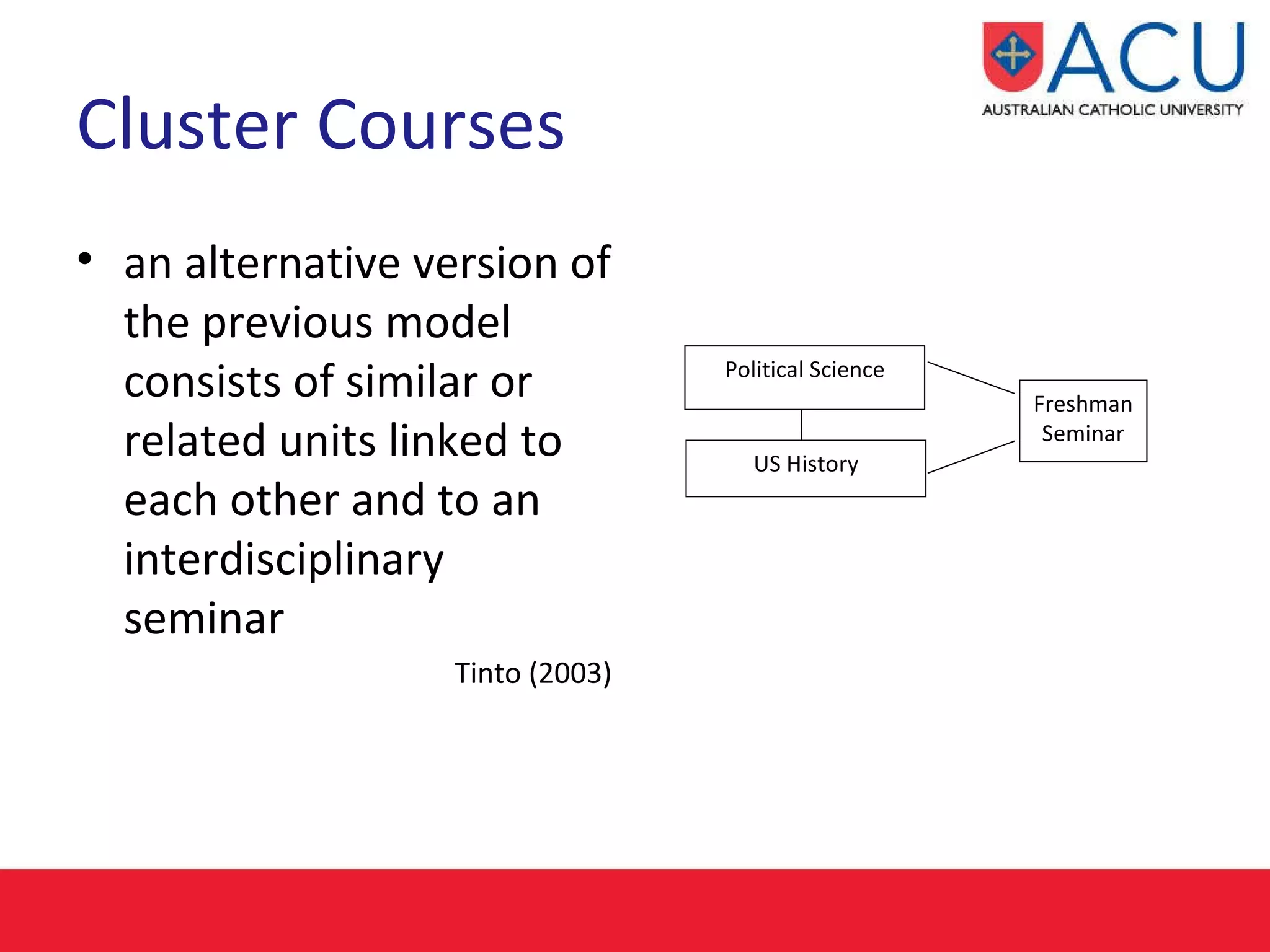
Cluster Courses an alternative version of the previous model consists of similar or related units linked to each other and to an interdisciplinary seminar   Tinto (2003) Political Science US History Freshman Seminar
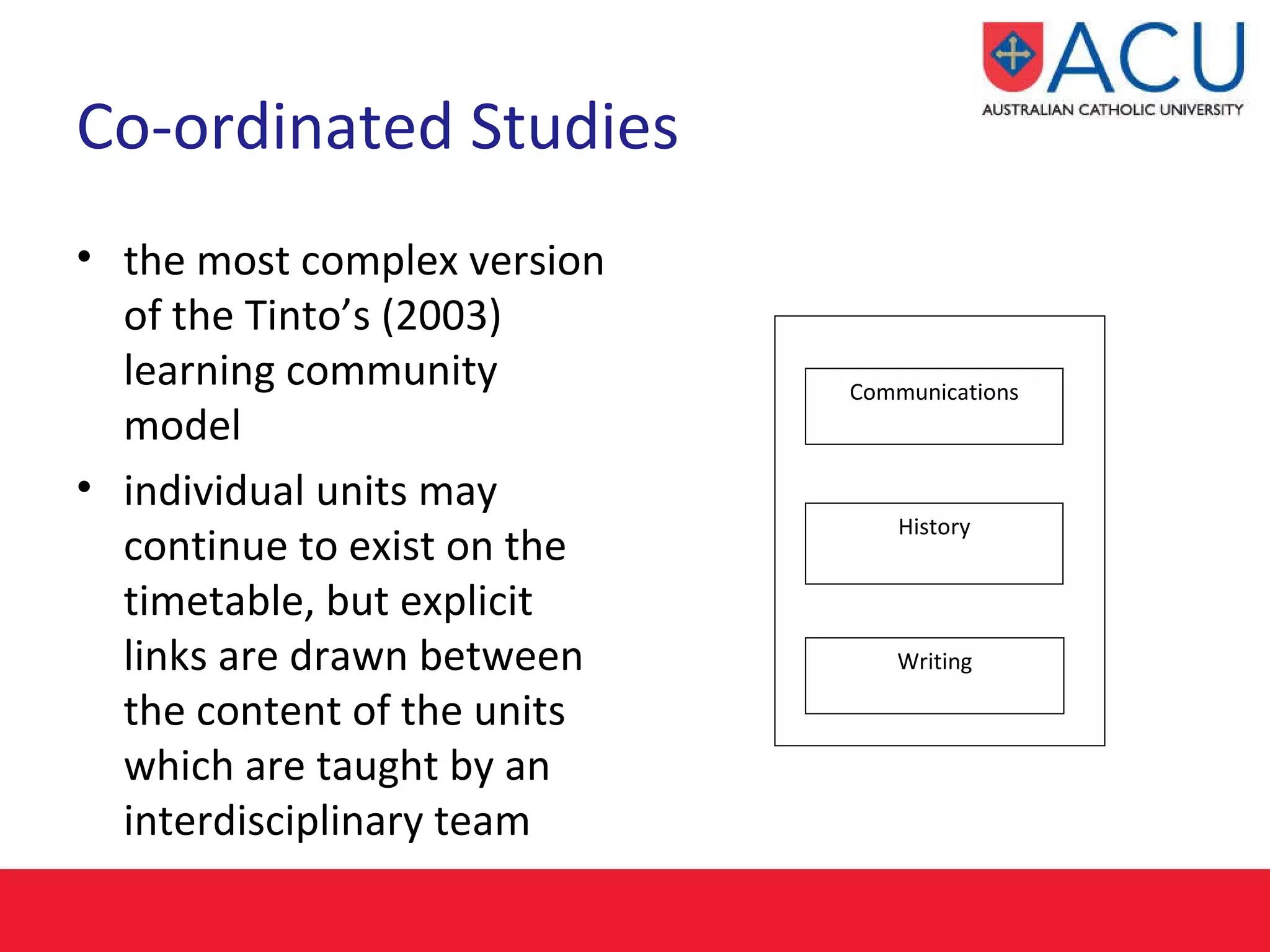
Co-ordinated Studies   the most complex version of the Tinto’s (2003)  learning community model  individual units may continue to exist on the timetable, but explicit links are drawn between the content of the units which are taught by an interdisciplinary team Communications History Writing
Reorganising the Classroom   drawing on developments in cognitive psychology and social theory Lave and Wenger (1991) proposed a model of learning as a social relationship.  situated learning  asserts that learning relies on appropriate social engagements which provide a suitable context for learning.  Learning occurs through engagement with a  community of practice ; a group of people brought together  by joining in common activities
Becoming through doing novice teachers learn to become teachers by participating in learning and teaching practices and through using the language of learning and teaching (Lave & Wenger, 1991) their identities as teachers are formed through belonging to a community of learner/teachers-teacher/learners (Wenger, 1998).
Putting the models together
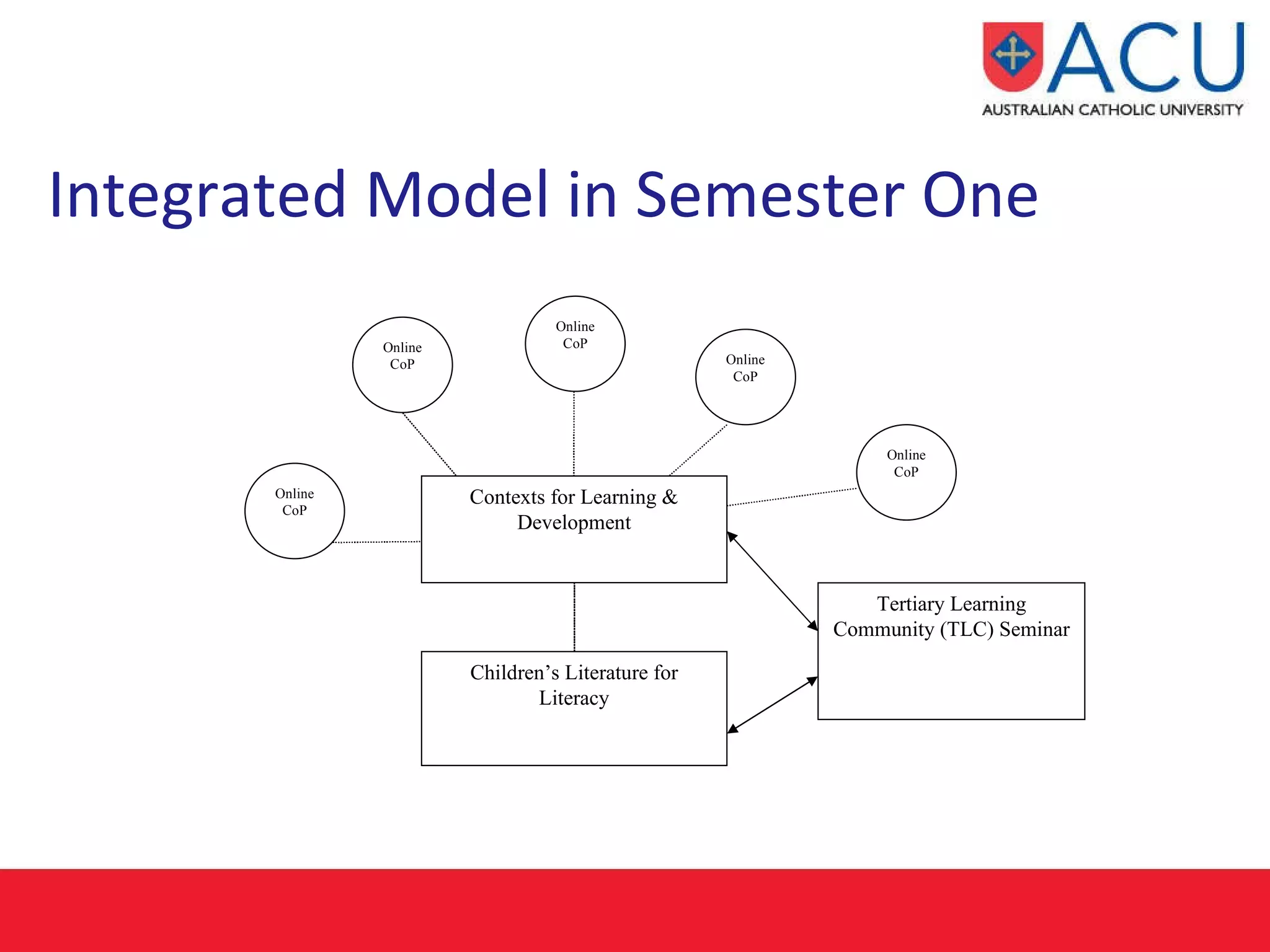
Integrated Model in Semester One   Contexts for Learning & Development Children’s Literature for Literacy Tertiary Learning Community (TLC) Seminar Online CoP Online CoP Online CoP Online CoP Online CoP
Integrated Model in Semester One   Explicit links are made between the content of both units  e.g. what family/cultural features should you keep in mind when selecting children’s literature  for a particular group? topics addressed in the TLC Seminars are applicable to both units learning teams are established in the Contexts unit, but members  are encouraged to discuss topics & share ideas relating to both units graduate attributes are embedded in the learning outcomes & assessment tasks of both units
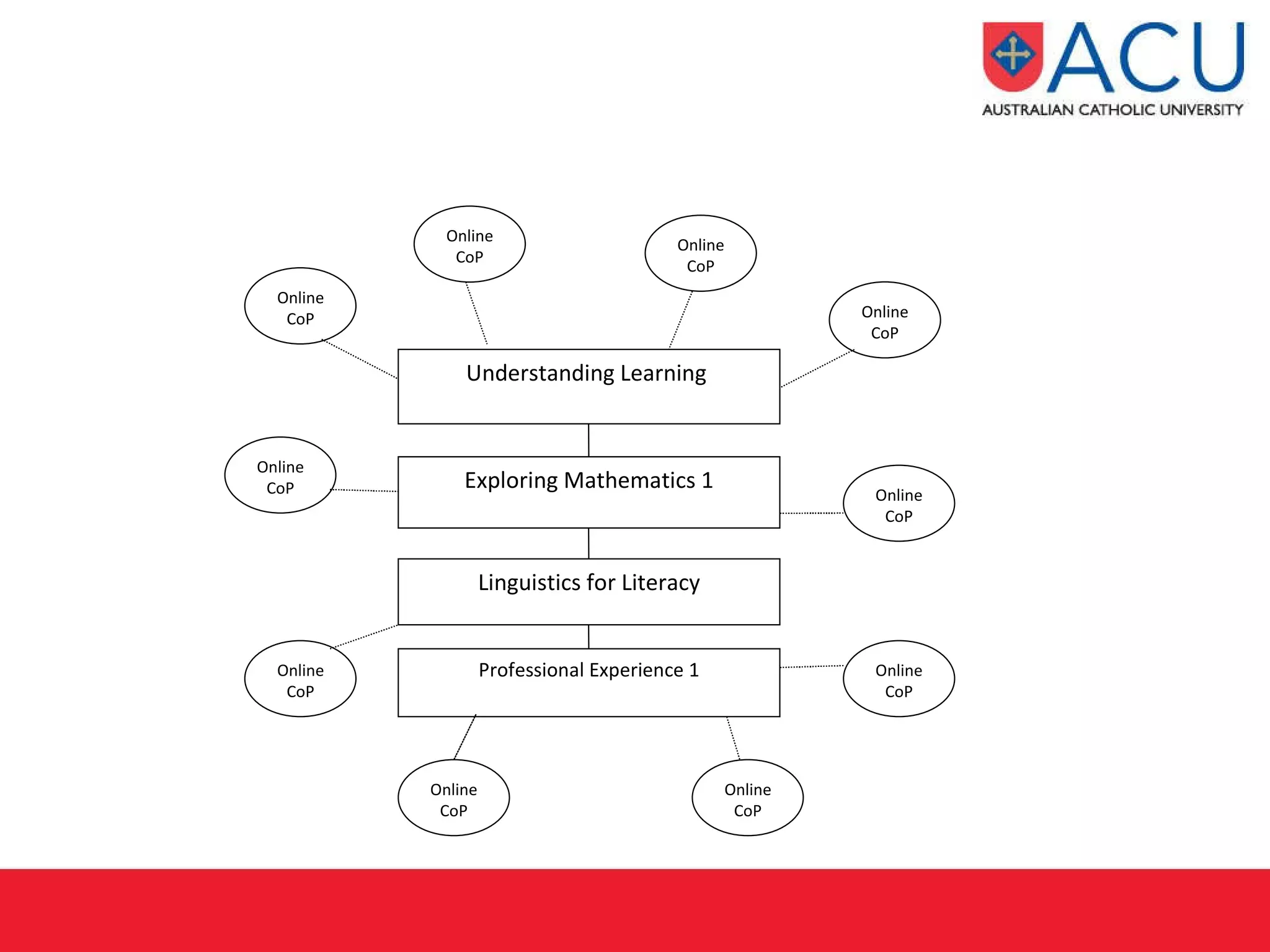
Integrated Model in Semester Two   TLC seminars do not continue learning teams are maintained in class and online staff continue to make explicit links are made between the content of all units including field experience graduate attributes are embedded in the learning outcomes & assessment tasks of both units
Professional Experience 1 Exploring Mathematics 1 Linguistics for Literacy Understanding Learning  Online CoP Online CoP Online CoP Online CoP Online CoP Online CoP Online CoP Online CoP Online CoP Online CoP
Some Questions  does it make a difference? model is a work in progress and has not been fully evaluated preliminary results indicate majority of students recognised a benefit from shared learning & assessment NB: some did not, or resented  the approach all students benefited from social networking Ballarat students benefited from academic skills support
Some Questions what about the staff? In some respects staff attitudes have been  a bigger barrier; “it’s  my  unit…” has required a lot of time & energy to set up  also strong support from Head of School The School of Education is introducing e-portfolios in 2010; what role should they play in this approach to learning & teaching?
 

Integrating Curriculum, Pedagogy & Graduate Attributes

  • 1.
    “ What wouldhappen if we took everything we know about how people learn and put it into our classes, what would it look like?” George Kuh, Chancellor’s Professor of Higher Education at Indiana University, speaking at the 7 th Enhancement Themes Conference in Edinburgh, March 3 rd 2010
  • 2.
    That’s what I’mtrying to find out.
  • 3.
    Integrating Curriculum, Pedagogy& G raduate Attributes Dr Madeleine Mattarozzi Laming
  • 4.
    Overview of themodel A learning & teaching model that integrates Tinto’s learning communities Wenger’s idea of communities of practice to address issues of pedagogy and curriculum simultaneously Increase student engagement Improve understanding Model effective strategies Make progress towards achievement of the graduate attributes & professional standards
  • 5.
    Overview of Australianhigher education 39 universities, including 2 private 2007: 1, 066,0959 total enrolment, 72.4% domestic, 55.2% female 2007-2008 2.3% increase in domestic commencing enrolments Growing diversity in the student population since 1960s driven by expansion of the tertiary education sector immigration Policy reforms in 1980s accelerated trend by establishing special entry schemes of preferential selection for “non-traditional” students: Indigenous, women & ethnic minorities
  • 6.
    Bradley Report March2008 Minister for Education, Julia Gillard, initiated a Review of Australian Higher Education chaired by Prof. Denise Bradley 1998 Australia ranked 7/30 OECD countries in terms of proportion of 25-34 years olds with degree-level qualifications 2008 it had slipped to 9/30 fears that a shortage of qualified personnel would undermine the economic growth & community well-being
  • 7.
    New policy directionBradley recommended 40% of all 25-34-year-olds should have at least a bachelor-level qualification by 2020 recognised that there were insufficient school-leavers to meet that target recommended that 20% of cohort be low SES applicants particular groups should be encouraged to enrol: “… those disadvantaged by circumstances of their birth: Indigenous people, people with low socio-economic status, and those from regional and remote areas” (Bradley, Noonan, Nugent & Scales, 2008, p xi)
  • 8.
    New approaches BradleyReport also recommended greater collaboration between the technical and adult education sectors, extension of bridging courses from vocational to professional courses Also recommended universities examine their own practices courses should be relevant & engaging teaching and learning should be sufficiently engaging & supportive to ensure that students completed their course of study
  • 9.
    Overview of AustralianCatholic University publicly funded university in the Catholic tradition formed in 1991 from the amalgamation of four Catholic tertiary institutions in eastern Australia 2 campuses in Victoria: Melbourne & (rural) Ballarat long tradition of accepting students from a very wide range of social & cultural backgrounds very strong links to Indigenous community a number of alternative entry programs including non-year 12 access scheme & Clemente
  • 10.
    Students at AustralianCatholic University largest faculties are education & nursing offer 3 pre-service, undergraduate education courses Bachelor of Education (Primary) Bachelor of Early Childhood & Primary Education Bachelor of Teaching/Bachelor of Arts (Secondary) Prerequisite entry score is from middle band 70-76/100 on Melbourne campus c.f. typical scores of 85-87 Arts, 94-98 Law, 98 + medicine
  • 11.
    Our students arealready … likely to be first in their family to enroll at university likely to have come from a non-English speaking background likely to come from low-middle SES families likely to travel long distances to attend their course
  • 12.
    ACU Melbourne campuscatchment area
  • 13.
    New approaches tolearning & teaching Beginning in 2007 new approaches to learning & teaching were tried Shared learning & assessment tasks First year B.Ed students took concurrent units in maths and learning Staff drew explicit links between content of both units students kept journals in which they reflected on how they learned maths: problem solving strategies, learning styles, memory techniques …
  • 14.
    Shared learning & assessment # 1 Assessment Task Three: Analysis of Factors Affecting Learning
  • 15.
    As the semesterprogresses, make notes on a weekly basis about your progress as a learner in the Self Improvement Plan in EDMA103. Focus on the ways that you are going about improving your knowledge and understanding. Give detailed examples of the ways in which these activities help you to improve, for example: “ I am now using visual cues to help me memorise key information.” ““ It’s easier to understand complex information if I discuss it with other people.” There are 2 compulsory questions that you must answer every week: 1. What breakthrough have I made this week? 2. What helped me to make this breakthrough? Other questions you need to consider: Are there particular aspects of learning that you don’t enjoy or that make you anxious? How are you dealing with this situation? How do you know when you have learned something? In Week 11, you will submit your diary for assessment together with a report on the factors that have affected your learning.
  • 16.
    More developments in learning & teaching Collaborative learning introduced in 2008 Online groups were added in 2009
  • 17.
  • 18.
    Learning Teams ProcedureStudents were assigned to learning teams in Week 1 & gradually introduced to collaborative tasks Online discussion groups were set up by Week 3 and students encouraged to use Blackboard to exchange ideas and work on assignments Tutorial activity In your learning teams, compare the listed activities for the VELS standard you have been given with the supposed conceptual abilities of the children at the same level. How consistent are they? In your learning teams read “Cross-cultural perspectives on Piaget’s theory” (McInerney & McInerney, pp 58-59). Compare and contrast the views in this reading with the chapter from Harris.
  • 19.
    Graduate Attributes diversityof the student population is not an excuse for reducing quality ACU has developed a set of graduate attributes to ensure that the quality of teaching remains high and that graduates are employable ACU Strategic Plan ACU Learning and Teaching Plan 2009-2011
  • 20.
    ACU courses enablegraduates to be: Ethically informed and able to: Demonstrate respect for the dignity of each individual and for human diversity. Recognise their responsibility to the common good, the environment and society. Apply ethical perspectives in informed decision making. Knowledgeable and able to: Think critically and reflectively. Demonstrate values, knowledge, skills and attitudes appropriate to the discipline and/or profession. Solve problems in a variety of settings taking local and international perspectives into account. Skilful and able to: Work both autonomously and collaboratively. Locate, organise, analyse, synthesise and evaluate information. Demonstrate effective communication in oral and written English language and visual media. Utilise Information and Communication and other relevant technologies effectively.
  • 21.
    Professional Standards accordingto the Standards of Professional Practice issued by the Victorian Institute of Teaching graduating teachers must demonstrate professional knowledge including knowledge of how students learn professional practice including the ability to use a variety of teaching styles to engage students Professional engagement including the ability to reflect on their performance and improve
  • 22.
    Meanwhile … Atthe Ballarat Campus, Trish Young established Tertiary Learning Communities (TLCs) program in 2008 1 hour seminar focusing on academic skills & issues relating to transition also a social networking program Close collaboration with Student Support Services & case management for some students nursing students were included in TLC in 2009
  • 23.
    Next Step … to develop an integrated model that would address address issues of curriculum & pedagogy concurrently provide additional support for students through their first year accommodate university graduate attributes begin work on professional standards (maybe)
  • 24.
  • 25.
    Reorganising the CurriculumTinto (2003) outlines three types of learning community that are progressively more complex: Linked courses Freshman interest groups Cluster courses Co-ordinated studies all forms of learning community have led to improvements in students’ community engagement, engagement with their studies & academic success
  • 26.
    Linked courses simplestversion of the learning community model units forming the pair share common themes or support each other in some fashion Tinto (2003) Freshman writing History
  • 27.
    Freshman Interest Groupsunits may also be linked to an interdisciplinary interest or discussion group In US colleges, this is usually led by a teaching assistant Tinto (2003) US History Freshman Interest Group Political Science Writing
  • 28.
    Cluster Courses analternative version of the previous model consists of similar or related units linked to each other and to an interdisciplinary seminar Tinto (2003) Political Science US History Freshman Seminar
  • 29.
    Co-ordinated Studies the most complex version of the Tinto’s (2003) learning community model individual units may continue to exist on the timetable, but explicit links are drawn between the content of the units which are taught by an interdisciplinary team Communications History Writing
  • 30.
    Reorganising the Classroom drawing on developments in cognitive psychology and social theory Lave and Wenger (1991) proposed a model of learning as a social relationship. situated learning asserts that learning relies on appropriate social engagements which provide a suitable context for learning. Learning occurs through engagement with a community of practice ; a group of people brought together by joining in common activities
  • 31.
    Becoming through doingnovice teachers learn to become teachers by participating in learning and teaching practices and through using the language of learning and teaching (Lave & Wenger, 1991) their identities as teachers are formed through belonging to a community of learner/teachers-teacher/learners (Wenger, 1998).
  • 32.
  • 33.
    Integrated Model inSemester One Contexts for Learning & Development Children’s Literature for Literacy Tertiary Learning Community (TLC) Seminar Online CoP Online CoP Online CoP Online CoP Online CoP
  • 34.
    Integrated Model inSemester One Explicit links are made between the content of both units e.g. what family/cultural features should you keep in mind when selecting children’s literature for a particular group? topics addressed in the TLC Seminars are applicable to both units learning teams are established in the Contexts unit, but members are encouraged to discuss topics & share ideas relating to both units graduate attributes are embedded in the learning outcomes & assessment tasks of both units
  • 35.
    Integrated Model inSemester Two TLC seminars do not continue learning teams are maintained in class and online staff continue to make explicit links are made between the content of all units including field experience graduate attributes are embedded in the learning outcomes & assessment tasks of both units
  • 36.
    Professional Experience 1Exploring Mathematics 1 Linguistics for Literacy Understanding Learning Online CoP Online CoP Online CoP Online CoP Online CoP Online CoP Online CoP Online CoP Online CoP Online CoP
  • 37.
    Some Questions does it make a difference? model is a work in progress and has not been fully evaluated preliminary results indicate majority of students recognised a benefit from shared learning & assessment NB: some did not, or resented the approach all students benefited from social networking Ballarat students benefited from academic skills support
  • 38.
    Some Questions whatabout the staff? In some respects staff attitudes have been a bigger barrier; “it’s my unit…” has required a lot of time & energy to set up also strong support from Head of School The School of Education is introducing e-portfolios in 2010; what role should they play in this approach to learning & teaching?
  • 39.