Presentation Title Example
Author: Simon Haslett
15th
October 2009
Developing professional practice in HE
Chapter 4
Developing Good Practice in Assessment
Chapter 4: Developing Good Practice in
Assessment
1. Chapter objectives
2. Who cares about assessment?
3. Purposes of assessment
4. The assessment process
5. Modes of assessment
6. Key issues in assessment
7. Developing assessment for learning
8. Bibliography
1: Chapter objectives
• to identify the multiple purposes of assessment
• to describe key terms and concepts in assessment
• to reflect on and develop own assessment practices
2: Who cares about assessment?
• There are a range of “stakeholders” who have an
interest in the assessment process including:
– The students themselves
– The university department
– Current or future student employers
• Reflect upon which stakeholders are the most powerful
in influencing assessment practices in your own
teaching.
3: Purposes of assessment
• Different stakeholders have different areas of interest in
assessment.
• Reflect upon who is likely to be interested in the following
purposes of assessment?
– Diagnosis of individual learning/progress checking
– Informing further learning and teaching
– Ranking and selection (e.g. for further study or particular
professions)
– Organisational quality control
– Accreditation and certification
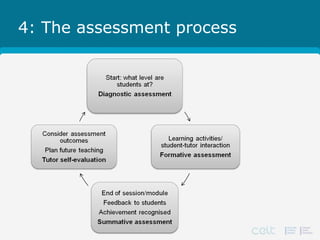
• Look at the simple diagram on slide 4: this suggests differing
purposes of assessment at different stages too
4: The assessment process
5: Modes of assessment
• Much assessment in HE nowadays is measured against
learning outcomes i.e. it is criterion-referenced. However,
there are other modes:
– norm-referenced assessment
• results are relative to the cohort e.g. the top 20% get the top
grade (regardless of mark)
• pass marks etc. may go up or down year on year, depending
on the difficulty of the assessment
– criterion-referenced
• students measured against outcomes or criteria i.e. the
student can…
• usually transparent (everyone has access to the criteria)
– ipsative
• student sets own goals
• performance is measured against own previous work
6: Key issues in assessment
• Go to the library room to read
Bloxham & Boyd (2007) chapter 3:The conflicting purposes of
assessment
• Review the case studies in Bloxham & Boyd and note the
importance of ensuring that our assessment practices
are:
– Valid
– Reliable
– Transparent
7: Developing assessment for learning
• Choose one of the following learning tools (it should be
one that you could use in your own teaching, though
ideally it will be new to you):
– Reflective learning journal
– Web page, wiki, discussion forum or other online tool
– Poster presentation
– Small group collaborative project
• Consider its use as an assessment tool:
– Strengths and weaknesses (in terms of validity, reliability,
transparency etc.)
– Its suitability for peer/self assessment
– Where in the assessment process/cycle it might work best
11. Bibliography
• BLOXHAM, S. & BOYD, P. (2007) Developing Effective
Assessment in Higher Education Maidenhead,
Berkshire. Open University Press
• BOUD, D. & FALCHIKOV, N. (2007) Rethinking
Assessment in Higher Education: learning for the
longer term London. Routledge
• EAST, R. (2008) Effective Assessment Strategies in
Law [on-line]
www.ukcle.ac.uk/resources/assessment/effective.html
accessed 25 January 2010

Developing professional practice ch 4

  • 1.
    Presentation Title Example Author:Simon Haslett 15th October 2009 Developing professional practice in HE Chapter 4 Developing Good Practice in Assessment
  • 2.
    Chapter 4: DevelopingGood Practice in Assessment 1. Chapter objectives 2. Who cares about assessment? 3. Purposes of assessment 4. The assessment process 5. Modes of assessment 6. Key issues in assessment 7. Developing assessment for learning 8. Bibliography
  • 3.
    1: Chapter objectives •to identify the multiple purposes of assessment • to describe key terms and concepts in assessment • to reflect on and develop own assessment practices
  • 4.
    2: Who caresabout assessment? • There are a range of “stakeholders” who have an interest in the assessment process including: – The students themselves – The university department – Current or future student employers • Reflect upon which stakeholders are the most powerful in influencing assessment practices in your own teaching.
  • 5.
    3: Purposes ofassessment • Different stakeholders have different areas of interest in assessment. • Reflect upon who is likely to be interested in the following purposes of assessment? – Diagnosis of individual learning/progress checking – Informing further learning and teaching – Ranking and selection (e.g. for further study or particular professions) – Organisational quality control – Accreditation and certification • Look at the simple diagram on slide 4: this suggests differing purposes of assessment at different stages too
  • 6.
  • 7.
    5: Modes ofassessment • Much assessment in HE nowadays is measured against learning outcomes i.e. it is criterion-referenced. However, there are other modes: – norm-referenced assessment • results are relative to the cohort e.g. the top 20% get the top grade (regardless of mark) • pass marks etc. may go up or down year on year, depending on the difficulty of the assessment – criterion-referenced • students measured against outcomes or criteria i.e. the student can… • usually transparent (everyone has access to the criteria) – ipsative • student sets own goals • performance is measured against own previous work
  • 8.
    6: Key issuesin assessment • Go to the library room to read Bloxham & Boyd (2007) chapter 3:The conflicting purposes of assessment • Review the case studies in Bloxham & Boyd and note the importance of ensuring that our assessment practices are: – Valid – Reliable – Transparent
  • 9.
    7: Developing assessmentfor learning • Choose one of the following learning tools (it should be one that you could use in your own teaching, though ideally it will be new to you): – Reflective learning journal – Web page, wiki, discussion forum or other online tool – Poster presentation – Small group collaborative project • Consider its use as an assessment tool: – Strengths and weaknesses (in terms of validity, reliability, transparency etc.) – Its suitability for peer/self assessment – Where in the assessment process/cycle it might work best
  • 10.
    11. Bibliography • BLOXHAM,S. & BOYD, P. (2007) Developing Effective Assessment in Higher Education Maidenhead, Berkshire. Open University Press • BOUD, D. & FALCHIKOV, N. (2007) Rethinking Assessment in Higher Education: learning for the longer term London. Routledge • EAST, R. (2008) Effective Assessment Strategies in Law [on-line] www.ukcle.ac.uk/resources/assessment/effective.html accessed 25 January 2010