E-mail Marketing Masterclass 28 th  April 2009 Dr Dave Chaffey www.davechaffey.com/blog www.davechaffey.com/presentations
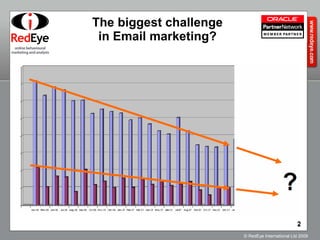
The biggest challenge in Email marketing?
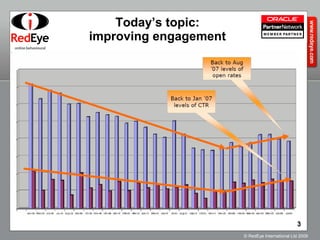
Today’s topic: improving engagement
Today’s topics Benchmarking engagement What should I be measuring? How to best target & personalise Behavioural targeting Creating a structured testing programme What to test? How to test? What other companies are doing? Case studies to inspire
About Dave Clients include 3M, BP, CIPD, Euroffice, HSBC,  IDM, Intel, Sony, Tui and Tektronix.  Analyst at  www.econsultancy.com .  E-marketing consultant at  www.cScape.com . E-marketing trainer and consultant Cranfield School of Management  Leeds University Business School Warwick (E-business) 2 Previously Birmingham, Derby Visiting lecturer at leading  UK business schools Internet Marketing E-business and e-commerce Mgt Total E-mail Marketing Author of 6 best-selling business books Recognised by the CIM in 2004 as one of 50 people who have ‘shaped the future of marketing’ and by DTI in 2005 as a key contributor to the development of UK E-commerce in the last 10 years An e-marketing “guru”! www.davechaffey.com/blog
Activity. What affects E-mail campaign success rate? CREATIVE  RELEVANCE, Readability, Reach  Individualised, ISP delivery, INCENTIVISATION  TARGETING/Segmentation  INTEGRATION  CONTENT/COPYWRITING  ATTRIBUTES  LANDING PAGE
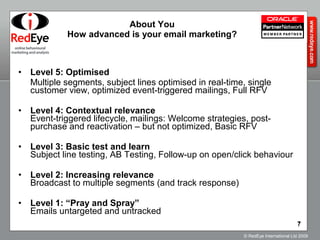
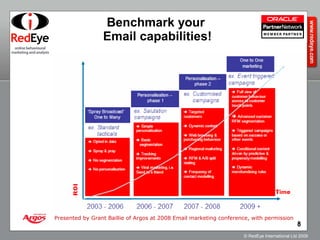
About You How advanced is your email marketing? Level 5: Optimised Multiple segments, subject lines optimised in real-time, single customer view, optimized event-triggered mailings, Full RFV Level 4: Contextual relevance Event-triggered lifecycle, mailings: Welcome strategies, post-purchase and reactivation – but not optimized, Basic RFV Level 3: Basic test and learn Subject line testing, AB Testing, Follow-up on open/click behaviour Level 2: Increasing relevance Broadcast to multiple segments (and track response) Level 1: “Pray and Spray” Emails untargeted and untracked
Benchmark your  Email capabilities! Presented by Grant Baillie of Argos at 2008 Email marketing conference, with permission
1 Measuring engagement
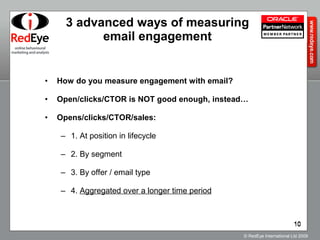
3 advanced ways of measuring email engagement How do you measure engagement with email? Open/clicks/CTOR is NOT good enough, instead… Opens/clicks/CTOR/sales: 1. At position in lifecycle 2. By segment 3. By offer / email type 4.  Aggregated over a longer time period
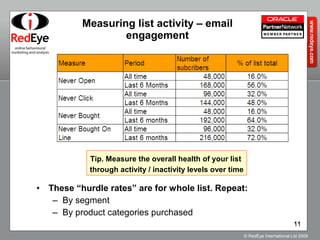
Measuring list activity – email engagement These “hurdle rates” are for whole list. Repeat: By segment By product categories purchased Tip. Measure the overall health of your list  through activity / inactivity levels over time
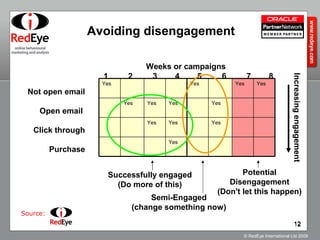
Avoiding disengagement Not open email Open email  Click through Purchase Weeks or campaigns 1  2  3  4   5  6  7  8 Potential Disengagement (Don't let this happen) Successfully engaged (Do more of this) Semi-Engaged (change something now) Increasing engagement Source: Yes Yes Yes Yes Yes Yes Yes Yes Yes Yes Yes Yes
2 Which are the best targeting variables?
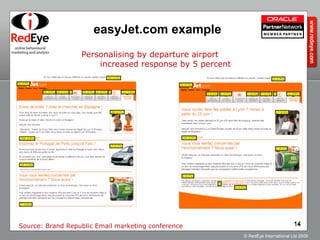
easyJet.com example Source: Brand Republic Email marketing conference Personalising by departure airport  increased response by 5 percent
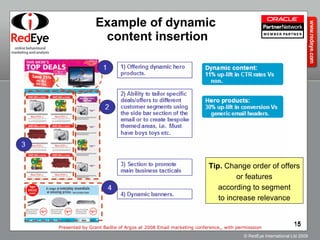
Example of dynamic  content insertion Presented by Grant Baillie of Argos at 2008 Email marketing conference,, with permisssion Tip.  Change order of offers or features according to segment to increase relevance
Q. Which targeting factors give best response?
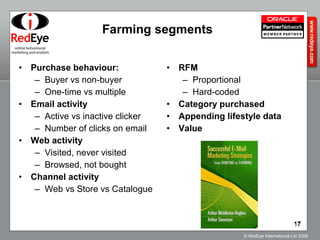
Farming segments Purchase behaviour: Buyer vs non-buyer One-time vs multiple Email activity Active vs inactive clicker Number of clicks on email Web activity Visited, never visited Browsed, not bought Channel activity Web vs Store vs Catalogue RFM Proportional Hard-coded Category purchased  Appending lifestyle data Value
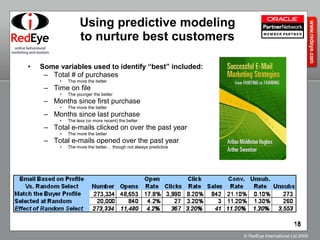
Using predictive modeling to nurture best customers Some variables used to identify “best” included: Total # of purchases The more the better Time on file The younger the better Months since first purchase The more the better Months since last purchase The less (or more recent) the better Total e-mails clicked on over the past year The more the better Total e-mails opened over the past year The more the better… though not always predictive
 
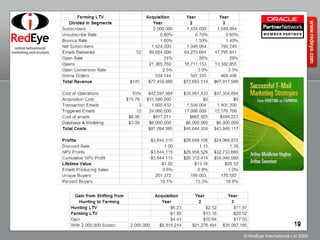
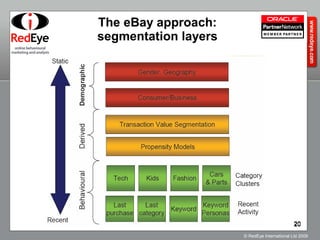
The eBay approach: segmentation layers
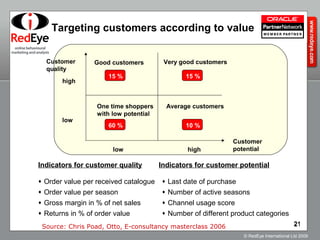
Targeting customers according to value Customer potential Customer quality high low low high One time shoppers   with low potential Average customers Good customers Very good customers  15 % 15 % 60 % 10 % Indicators for customer quality   Indicators for customer potential   Order value per received catalogue Order value per season Gross margin in % of net sales Returns in % of order value Last date of purchase Number of active seasons Channel usage score Number of different product categories Source: Chris Poad, Otto, E-consultancy masterclass 2006
Behavioural targeting
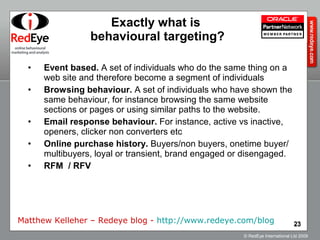
Exactly what is  behavioural targeting? Event based.  A set of individuals who do the same thing on a web site and therefore become a segment of individuals  Browsing behaviour.  A set of individuals who have shown the same behaviour, for instance browsing the same website sections or pages or using similar paths to the website.  Email response behaviour.  For instance, active vs inactive, openers, clicker non converters etc  Online purchase history.  Buyers/non buyers, onetime buyer/multibuyers, loyal or transient, brand engaged or disengaged.   RFM  / RFV Matthew Kelleher – Redeye blog -  http://www.redeye.com/blog
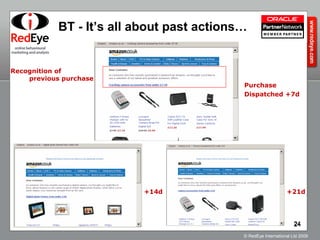
BT - It’s all about past actions… Purchase  Dispatched +7d +14d +21d Recognition of previous purchase
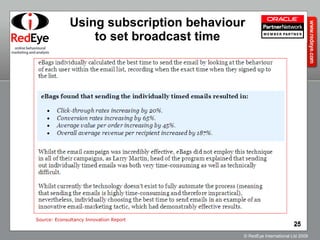
Using subscription behaviour to set broadcast time Source: Econsultancy Innovation Report
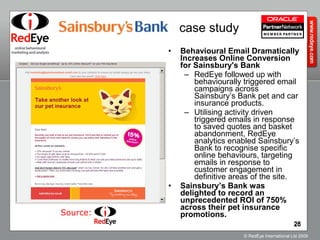
Behavioural Email Dramatically Increases Online Conversion for Sainsbury's Bank RedEye followed up with behaviourally triggered email campaigns across Sainsbury’s Bank pet and car insurance products.  Utilising activity driven triggered emails in response to saved quotes and basket abandonment, RedEye analytics enabled Sainsbury’s Bank to recognise specific online behaviours, targeting emails in response to customer engagement in definitive areas of the site.  Sainsbury’s Bank was delighted to record an unprecedented ROI of 750% across their pet insurance promotions.  Source: case study
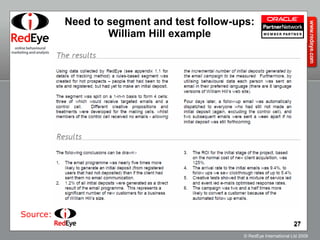
Need to segment and test follow-ups: William Hill example Source:
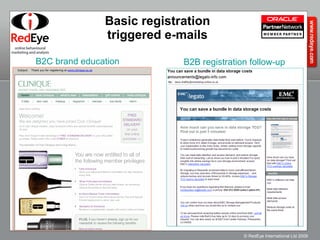
Basic registration triggered e-mails B2C brand education B2B registration follow-up
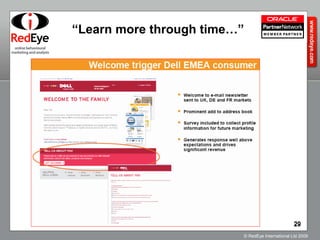
“ Learn more through time…”
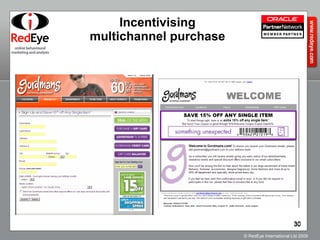
Incentivising multichannel purchase
 
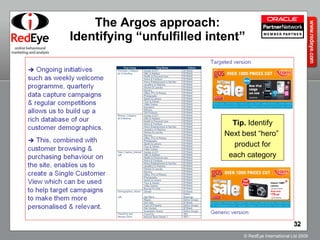
The Argos approach: Identifying “unfulfilled intent” Tip.  Identify Next best “hero”  product for each category
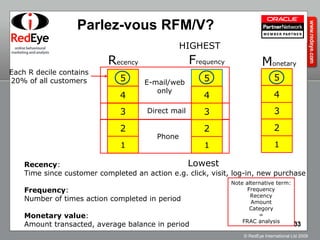
Parlez-vous RFM/V? 5 1 2 3 4 5 R ecency F requency M onetary 1 2 3 4 5 1 2 3 4 5 Each R decile contains 20% of all customers Recency : Time since customer completed an action e.g. click, visit, log-in, new purchase Frequency : Number of times action completed in period Monetary value : Amount transacted, average balance in period HIGHEST Lowest  Note alternative term: Frequency Recency Amount Category = FRAC analysis 1 3 4 Phone E-mail/web only Direct mail
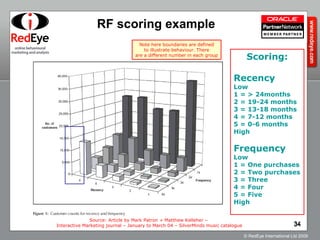
RF scoring example Source: Article by Mark Patron + Matthew Kelleher –  Interactive Marketing journal – January to March 04 – SilverMinds music catalogue Scoring: Recency Low  1 = > 24months 2 = 19-24 months 3 = 13-18 months 4 = 7-12 months 5 = 0-6 months High  Frequency Low 1 = One purchases 2 = Two purchases 3 = Three  4 = Four 5 = Five High Note here boundaries are defined to illustrate behaviour. There are a different number in each group
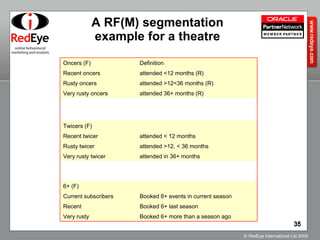
A RF(M) segmentation example for a theatre Booked 6+ more than a season ago Very rusty Booked 6+ last season Recent Booked 6+ events in current season Current subscribers   6+ (F) attended in 36+ months Very rusty twicer attended >12, < 36 months Rusty twicer attended < 12 months Recent twicer   Twicers (F) attended 36+ months (R) Very rusty oncers attended >12<36 months (R) Rusty oncers attended <12 months (R) Recent oncers Definition Oncers (F)
Q. How well are you using  ‘Sense & Respond’ marketing Source, adapted from:
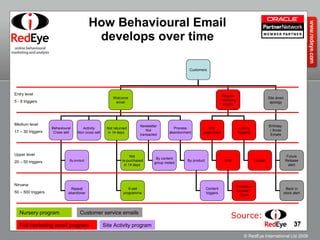
How Behavioural Email develops over time Entry level 5 - 8 triggers Medium level 17 – 30 triggers Upper level 20 – 50 triggers Nirvana 50 – 500 triggers Nursery program Site Activity program Full marketing email program Customer service emails Source: Customers Welcome email Behavioural Cross sell Regular marketing emails Site  segmented Activity flagging RFM Predictive Lapsed /  Churn By product Site down apology Birthday  / Xmas Emails Repeat abandoner Future Release alert Back in stock alert Lapsed Activity Non cross sell Not returned in 14 days  Not  re-purchased in 14 days  Process abandonment X-sell programme By product Newsletter Not transacted By content group visited Content triggers
More inspiring examples of  touch strategies
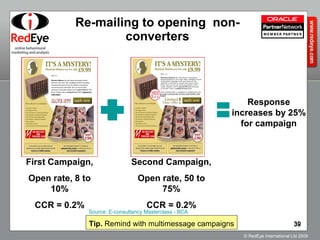
Re-mailing to opening  non-converters Response increases by 25% for campaign First Campaign, Open rate, 8 to 10% CCR = 0.2% Second Campaign,  Open rate, 50 to 75% CCR = 0.2% Source: E-consultancy Masterclass - BCA Tip.  Remind with multimessage campaigns
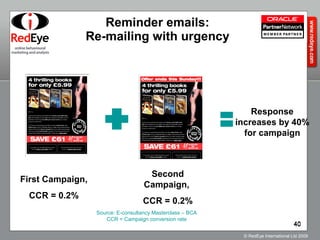
Reminder emails: Re-mailing with urgency Response increases by 40% for campaign First Campaign, CCR = 0.2% Second Campaign,  CCR = 0.2% Source: E-consultancy Masterclass – BCA CCR = Campaign conversion rate
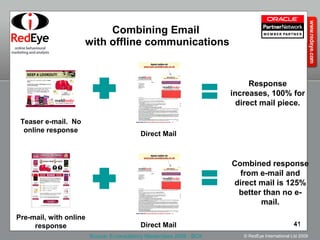
Combining Email  with offline communications Combined response from e-mail and direct mail is 125% better than no e-mail. Response increases, 100% for direct mail piece. Source: E-consultancy Masterclass 2005 - BCA Pre-mail, with online response Teaser e-mail.  No online response Direct Mail Direct Mail
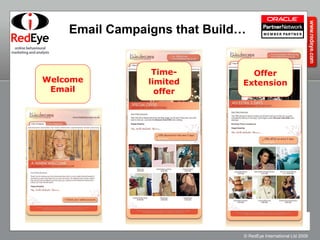
Email Campaigns that Build… Welcome Email Time-limited offer Offer Extension
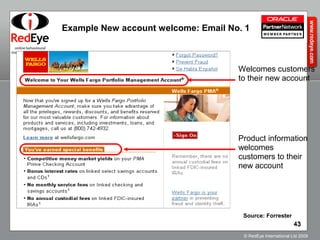
Example New account welcome: Email No. 1 Welcomes customers to their new account Product information welcomes customers to their new account Source: Forrester
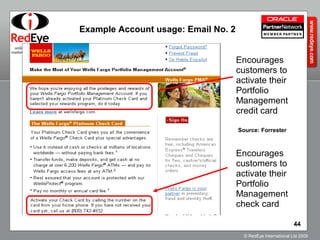
Example Account usage: Email No. 2 Encourages customers to activate their Portfolio Management credit card Encourages customers to activate their Portfolio Management check card Source: Forrester
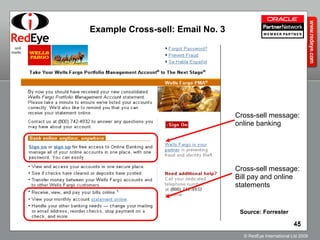
Example Cross-sell: Email No. 3 Cross-sell message: online banking Cross-sell message:  Bill pay and online statements Source: Forrester
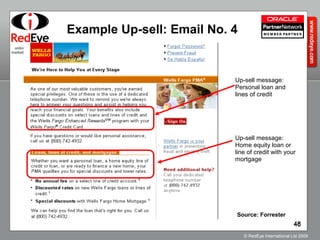
Example Up-sell: Email No. 4 Up-sell message: Personal loan and lines of credit Up-sell message: Home equity loan or line of credit with your mortgage Source: Forrester
3 Creating a testing and optimisation plan for  Email marketing
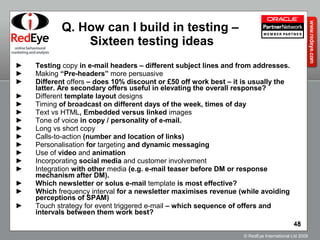
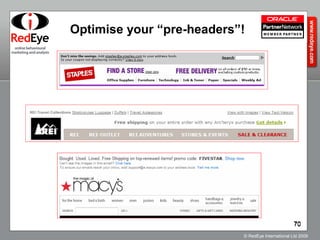
Q. How can I build in testing –  Sixteen testing ideas Testing  copy  in e-mail headers – different subject lines and from addresses. Making  “Pre-headers”  more persuasive Different  offers  – does 10% discount or £50 off work best – it is usually the latter. Are secondary offers useful in elevating the overall response? Different  template layout  designs Timing  of broadcast on different days of the week, times of day Text vs HTML , Embedded versus linked  images Tone of voice  in copy / personality of e-mail. Long vs short copy Calls-to-action  (number and location of links) Personalisation  for  targeting  and dynamic messaging Use of  video  and  animation Incorporating  social media  and customer involvement Integration  with other  media  (e.g. e-mail teaser before DM or response mechanism after DM). Which newsletter or solus e-mail  template  is most effective? Which  frequency interval  for a newsletter maximises revenue (while avoiding perceptions of SPAM) Touch strategy for event triggered e-mail  – which sequence of offers and intervals between them work best?
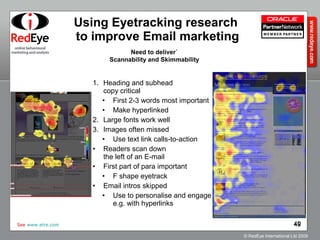
Using Eyetracking research  to improve Email marketing Heading and subhead  copy critical First 2-3 words most important Make hyperlinked Large fonts work well Images often missed Use text link calls-to-action Readers scan down  the left of an E-mail   First part of para important F shape eyetrack Email intros skipped   Use to personalise and engage e.g. with hyperlinks Need to deliver` Scannability and Skimmability See  www.etre.com
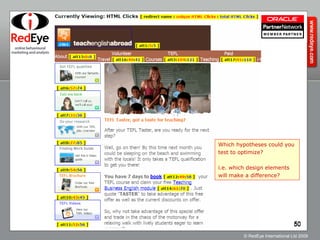
Which hypotheses could you  test to optimize? i.e. which design elements will make a difference?
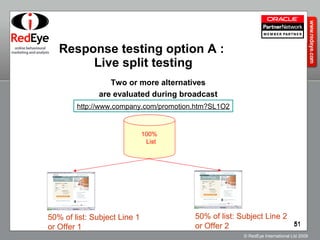
Response testing option A :  Live split testing 50% of list: Subject Line 1 or Offer 1 Two or more alternatives are evaluated during broadcast 50% of list: Subject Line 2 or Offer 2 100%   List http://www.company.com/promotion.htm?SL1O2
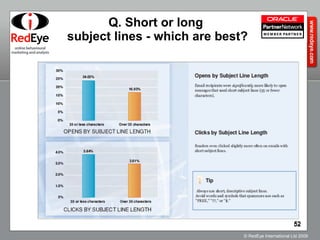
Q. Short or long  subject lines - which are best?
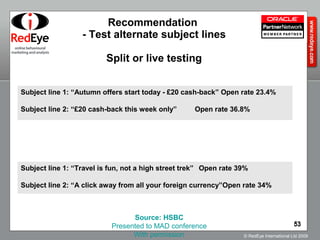
Recommendation  - Test alternate subject lines Split or live testing Subject line 1: “ Autumn offers start today - £20 cash-back”  Open rate 23.4% Subject line 2: “ £20 cash-back this week only” Open rate 36.8% Subject line 1: “Travel is fun, not a high street trek” Open rate 39%  Subject line 2: “A click away from all your foreign currency” Open rate 34% Source: HSBC Presented to MAD conference With permission
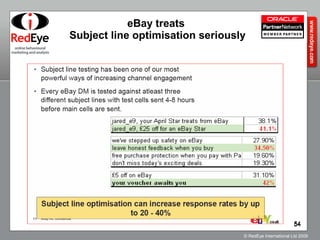
eBay treats  Subject line optimisation seriously
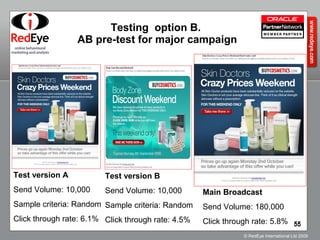
Testing  option B.  AB pre-test for major campaign Test version A Send Volume: 10,000 Sample criteria: Random Click through rate: 6.1% Test version B Send Volume: 10,000 Sample criteria: Random Click through rate: 4.5% Main Broadcast Send Volume: 180,000 Click through rate: 5.8%
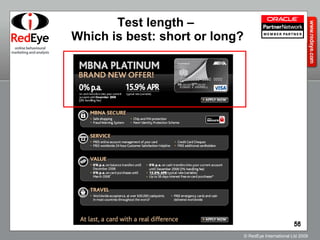
Test length –  Which is best: short or long?
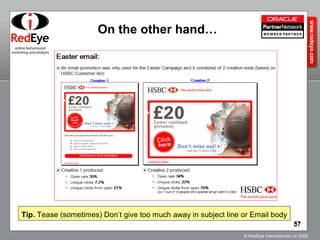
On the other hand… Tip.  Tease (sometimes) Don’t give too much away in subject line or Email body
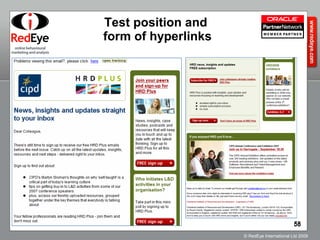
Test position and  form of hyperlinks
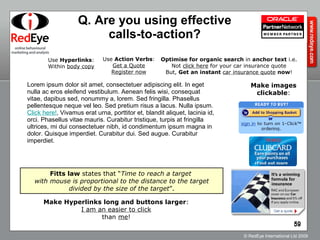
Q. Are you using effective  calls-to-action?  Lorem ipsum dolor sit amet, consectetuer adipiscing elit. In eget nulla ac eros eleifend vestibulum. Aenean felis wisi, consequat vitae, dapibus sed, nonummy a, lorem. Sed fringilla. Phasellus pellentesque neque vel leo. Sed pretium risus a lacus. Nulla ipsum.  Click here! , Vivamus erat urna, porttitor et, blandit aliquet, lacinia id, orci. Phasellus vitae mauris. Curabitur tristique, turpis at fringilla ultrices, mi dui consectetuer nibh, id condimentum ipsum magna in dolor. Quisque imperdiet. Curabitur dui. Sed augue. Curabitur imperdiet.  Use  Action Verbs : Get a Quote Register now Make images clickable : Optimise for organic search  in  anchor text  i.e. Not  click here  for your car insurance quote But,  Get an instant  car insurance quote   now ! Make Hyperlinks long and buttons larger : I am an easier to click than  me ! Fitts law  states that “ Time to reach a target  with mouse is proportional to the distance to the target divided by the size of the target ”. Use  Hyperlinks : Within  body copy
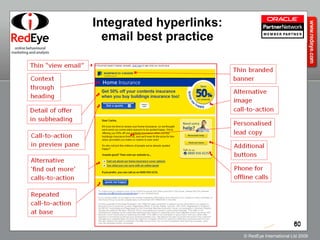
Integrated hyperlinks: email best practice
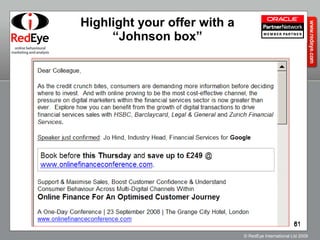
Highlight your offer with a “Johnson box”
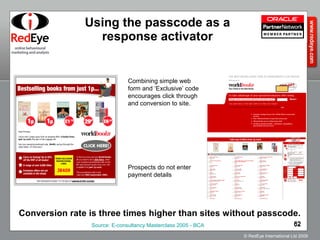
Using the passcode as a response activator Combining simple web form and ‘Exclusive’ code encourages click through and conversion to site. Prospects do not enter payment details Conversion rate is three times higher than sites without passcode. Source: E-consultancy Masterclass 2005 - BCA
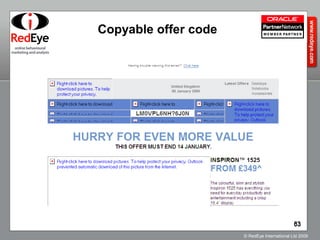
Copyable offer code
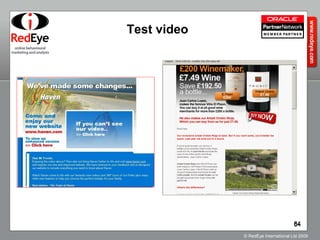
Test video
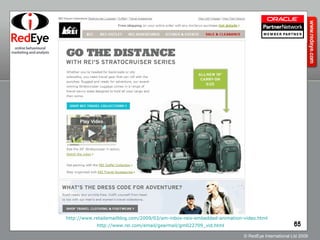
http://www.rei.com/email/gearmail/gm022709_vid.html   http://www.retailemailblog.com/2009/03/am-inbox-reis-embedded-animation-video.html
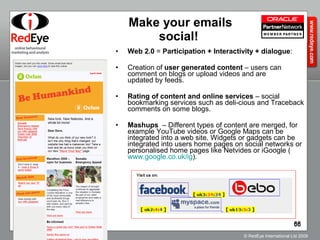
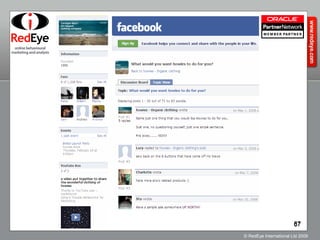
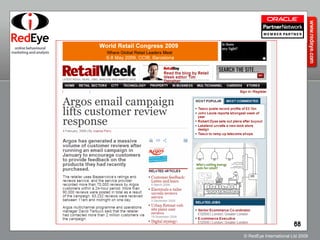
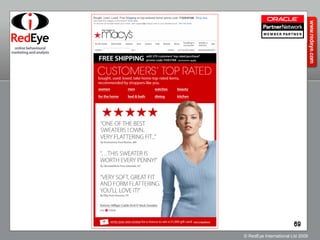
Make your emails social!  Web 2.0  =  Participation + Interactivity + dialogue : Creation of  user generated content  – users can  comment on blogs or upload videos and are  updated by feeds. Rating of content and online services  – social bookmarking services such as deli-cious and Traceback comments on some blogs. Mashups  – Different types of content are merged, for example YouTube videos or Google Maps can be integrated into a web site. Widgets or gadgets can be integrated into users home pages on social networks or personalised home pages like Netvides or iGoogle ( www.google.co.uk/ig ).


Optimise your “pre-headers”!
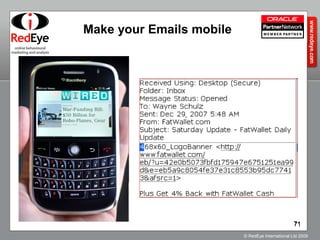
Make your Emails mobile
 
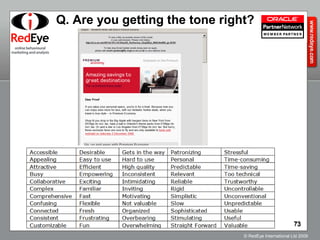
Q. Are you getting the tone right?
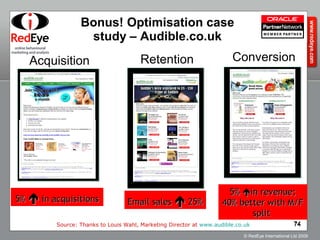
Bonus! Optimisation case study – Audible.co.uk Acquisition Retention Conversion 5%    in acquisitions 5%   in revenue; 40% better with M/F split  Email sales    25% Source: Thanks to Louis Wahl, Marketing Director at  www.audible.co.uk
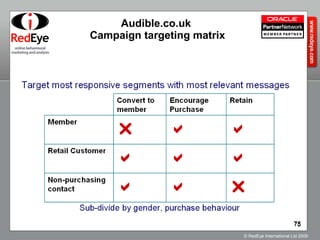
Audible.co.uk  Campaign targeting matrix
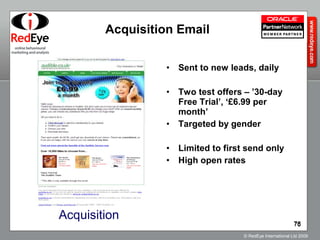
Acquisition Email Sent to new leads, daily Two test offers – ’30-day Free Trial’, ‘£6.99 per month’ Targeted by gender Limited to first send only High open rates Acquisition
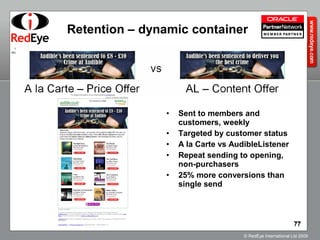
Retention – dynamic container Sent to members and customers, weekly Targeted by customer status A la Carte vs AudibleListener Repeat sending to opening, non-purchasers 25% more conversions than single send
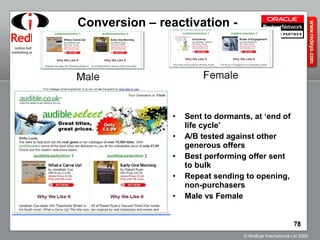
Conversion – reactivation - dynamic Sent to dormants, at ‘end of life cycle’ A/B tested against other generous offers Best performing offer sent to bulk Repeat sending to opening, non-purchasers Male vs Female
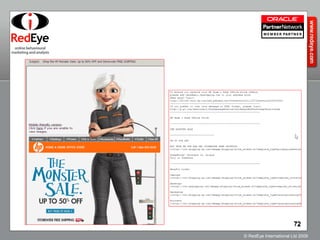
Discussion and Q & A Format – Split into groups to discuss how to make these types Behavioural marketing successful: 1. Welcome strategies  2. Re-engagement strategies 3. Targeting based on past behaviour Please discuss key issues / questions which will govern success, e.g. frequency, personalisation, testing Report back at ….  with: Best practice recommendations  and examples of approaches Questions
Retail Gather softer information initially e.g. “how savvy with product” clicks populate database – according to product / vertical Accelerated first offer – First welcome email has strong offer to segment - danger of extended offers Apology emails Service emails e.g. password for reactivation Basket abandonment – ask why – provide phone messages – give main reasons
Financial Services 1 Enewsletters in FS have to be info-led – need consistent format to highlight products and call-to-action 2 Cross-sell upsell in service emails? Using store&save of quote information email 3 Basket abandonment – review all steps – include relevant information
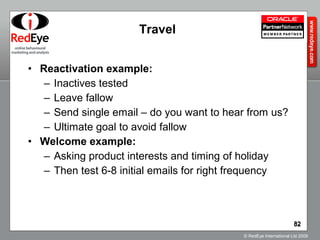
Travel Reactivation example: Inactives tested Leave fallow Send single email – do you want to hear from us? Ultimate goal to avoid fallow Welcome example: Asking product interests and timing of holiday Then test 6-8 initial emails for right frequency
Please complete the feedback forms Download presentation: www.davechaffey.com/presentations   Any questions, any time, do e-mail me: [email_address]   Subscribe to my E-marketing Essentials, monthly briefing  in What‘s New in Digital Marketing  www.davechaffey.com /blog   Stay in contact through: www.twitter.com/DaveChaffey   www.linkedin.com/in/davechaffey   Thank you!

2009 Email Marketing Masterclass Red Eye

  • 1.
    E-mail Marketing Masterclass28 th April 2009 Dr Dave Chaffey www.davechaffey.com/blog www.davechaffey.com/presentations
  • 2.
    The biggest challengein Email marketing?
  • 3.
  • 4.
    Today’s topics Benchmarkingengagement What should I be measuring? How to best target & personalise Behavioural targeting Creating a structured testing programme What to test? How to test? What other companies are doing? Case studies to inspire
  • 5.
    About Dave Clientsinclude 3M, BP, CIPD, Euroffice, HSBC, IDM, Intel, Sony, Tui and Tektronix. Analyst at www.econsultancy.com . E-marketing consultant at www.cScape.com . E-marketing trainer and consultant Cranfield School of Management Leeds University Business School Warwick (E-business) 2 Previously Birmingham, Derby Visiting lecturer at leading UK business schools Internet Marketing E-business and e-commerce Mgt Total E-mail Marketing Author of 6 best-selling business books Recognised by the CIM in 2004 as one of 50 people who have ‘shaped the future of marketing’ and by DTI in 2005 as a key contributor to the development of UK E-commerce in the last 10 years An e-marketing “guru”! www.davechaffey.com/blog
  • 6.
    Activity. What affectsE-mail campaign success rate? CREATIVE RELEVANCE, Readability, Reach Individualised, ISP delivery, INCENTIVISATION TARGETING/Segmentation INTEGRATION CONTENT/COPYWRITING ATTRIBUTES LANDING PAGE
  • 7.
    About You Howadvanced is your email marketing? Level 5: Optimised Multiple segments, subject lines optimised in real-time, single customer view, optimized event-triggered mailings, Full RFV Level 4: Contextual relevance Event-triggered lifecycle, mailings: Welcome strategies, post-purchase and reactivation – but not optimized, Basic RFV Level 3: Basic test and learn Subject line testing, AB Testing, Follow-up on open/click behaviour Level 2: Increasing relevance Broadcast to multiple segments (and track response) Level 1: “Pray and Spray” Emails untargeted and untracked
  • 8.
    Benchmark your Email capabilities! Presented by Grant Baillie of Argos at 2008 Email marketing conference, with permission
  • 9.
  • 10.
    3 advanced waysof measuring email engagement How do you measure engagement with email? Open/clicks/CTOR is NOT good enough, instead… Opens/clicks/CTOR/sales: 1. At position in lifecycle 2. By segment 3. By offer / email type 4. Aggregated over a longer time period
  • 11.
    Measuring list activity– email engagement These “hurdle rates” are for whole list. Repeat: By segment By product categories purchased Tip. Measure the overall health of your list through activity / inactivity levels over time
  • 12.
    Avoiding disengagement Notopen email Open email Click through Purchase Weeks or campaigns 1 2 3 4 5 6 7 8 Potential Disengagement (Don't let this happen) Successfully engaged (Do more of this) Semi-Engaged (change something now) Increasing engagement Source: Yes Yes Yes Yes Yes Yes Yes Yes Yes Yes Yes Yes
  • 13.
    2 Which arethe best targeting variables?
  • 14.
    easyJet.com example Source:Brand Republic Email marketing conference Personalising by departure airport increased response by 5 percent
  • 15.
    Example of dynamic content insertion Presented by Grant Baillie of Argos at 2008 Email marketing conference,, with permisssion Tip. Change order of offers or features according to segment to increase relevance
  • 16.
    Q. Which targetingfactors give best response?
  • 17.
    Farming segments Purchasebehaviour: Buyer vs non-buyer One-time vs multiple Email activity Active vs inactive clicker Number of clicks on email Web activity Visited, never visited Browsed, not bought Channel activity Web vs Store vs Catalogue RFM Proportional Hard-coded Category purchased Appending lifestyle data Value
  • 18.
    Using predictive modelingto nurture best customers Some variables used to identify “best” included: Total # of purchases The more the better Time on file The younger the better Months since first purchase The more the better Months since last purchase The less (or more recent) the better Total e-mails clicked on over the past year The more the better Total e-mails opened over the past year The more the better… though not always predictive
  • 19.
  • 20.
    The eBay approach:segmentation layers
  • 21.
    Targeting customers accordingto value Customer potential Customer quality high low low high One time shoppers with low potential Average customers Good customers Very good customers 15 % 15 % 60 % 10 % Indicators for customer quality Indicators for customer potential Order value per received catalogue Order value per season Gross margin in % of net sales Returns in % of order value Last date of purchase Number of active seasons Channel usage score Number of different product categories Source: Chris Poad, Otto, E-consultancy masterclass 2006
  • 22.
  • 23.
    Exactly what is behavioural targeting? Event based. A set of individuals who do the same thing on a web site and therefore become a segment of individuals Browsing behaviour. A set of individuals who have shown the same behaviour, for instance browsing the same website sections or pages or using similar paths to the website. Email response behaviour. For instance, active vs inactive, openers, clicker non converters etc Online purchase history. Buyers/non buyers, onetime buyer/multibuyers, loyal or transient, brand engaged or disengaged. RFM  / RFV Matthew Kelleher – Redeye blog - http://www.redeye.com/blog
  • 24.
    BT - It’sall about past actions… Purchase Dispatched +7d +14d +21d Recognition of previous purchase
  • 25.
    Using subscription behaviourto set broadcast time Source: Econsultancy Innovation Report
  • 26.
    Behavioural Email DramaticallyIncreases Online Conversion for Sainsbury's Bank RedEye followed up with behaviourally triggered email campaigns across Sainsbury’s Bank pet and car insurance products. Utilising activity driven triggered emails in response to saved quotes and basket abandonment, RedEye analytics enabled Sainsbury’s Bank to recognise specific online behaviours, targeting emails in response to customer engagement in definitive areas of the site. Sainsbury’s Bank was delighted to record an unprecedented ROI of 750% across their pet insurance promotions. Source: case study
  • 27.
    Need to segmentand test follow-ups: William Hill example Source:
  • 28.
    Basic registration triggerede-mails B2C brand education B2B registration follow-up
  • 29.
    “ Learn morethrough time…”
  • 30.
  • 31.
  • 32.
    The Argos approach:Identifying “unfulfilled intent” Tip. Identify Next best “hero” product for each category
  • 33.
    Parlez-vous RFM/V? 51 2 3 4 5 R ecency F requency M onetary 1 2 3 4 5 1 2 3 4 5 Each R decile contains 20% of all customers Recency : Time since customer completed an action e.g. click, visit, log-in, new purchase Frequency : Number of times action completed in period Monetary value : Amount transacted, average balance in period HIGHEST Lowest Note alternative term: Frequency Recency Amount Category = FRAC analysis 1 3 4 Phone E-mail/web only Direct mail
  • 34.
    RF scoring exampleSource: Article by Mark Patron + Matthew Kelleher – Interactive Marketing journal – January to March 04 – SilverMinds music catalogue Scoring: Recency Low 1 = > 24months 2 = 19-24 months 3 = 13-18 months 4 = 7-12 months 5 = 0-6 months High Frequency Low 1 = One purchases 2 = Two purchases 3 = Three 4 = Four 5 = Five High Note here boundaries are defined to illustrate behaviour. There are a different number in each group
  • 35.
    A RF(M) segmentationexample for a theatre Booked 6+ more than a season ago Very rusty Booked 6+ last season Recent Booked 6+ events in current season Current subscribers   6+ (F) attended in 36+ months Very rusty twicer attended >12, < 36 months Rusty twicer attended < 12 months Recent twicer   Twicers (F) attended 36+ months (R) Very rusty oncers attended >12<36 months (R) Rusty oncers attended <12 months (R) Recent oncers Definition Oncers (F)
  • 36.
    Q. How wellare you using ‘Sense & Respond’ marketing Source, adapted from:
  • 37.
    How Behavioural Emaildevelops over time Entry level 5 - 8 triggers Medium level 17 – 30 triggers Upper level 20 – 50 triggers Nirvana 50 – 500 triggers Nursery program Site Activity program Full marketing email program Customer service emails Source: Customers Welcome email Behavioural Cross sell Regular marketing emails Site segmented Activity flagging RFM Predictive Lapsed / Churn By product Site down apology Birthday / Xmas Emails Repeat abandoner Future Release alert Back in stock alert Lapsed Activity Non cross sell Not returned in 14 days Not re-purchased in 14 days Process abandonment X-sell programme By product Newsletter Not transacted By content group visited Content triggers
  • 38.
    More inspiring examplesof touch strategies
  • 39.
    Re-mailing to opening non-converters Response increases by 25% for campaign First Campaign, Open rate, 8 to 10% CCR = 0.2% Second Campaign, Open rate, 50 to 75% CCR = 0.2% Source: E-consultancy Masterclass - BCA Tip. Remind with multimessage campaigns
  • 40.
    Reminder emails: Re-mailingwith urgency Response increases by 40% for campaign First Campaign, CCR = 0.2% Second Campaign, CCR = 0.2% Source: E-consultancy Masterclass – BCA CCR = Campaign conversion rate
  • 41.
    Combining Email with offline communications Combined response from e-mail and direct mail is 125% better than no e-mail. Response increases, 100% for direct mail piece. Source: E-consultancy Masterclass 2005 - BCA Pre-mail, with online response Teaser e-mail. No online response Direct Mail Direct Mail
  • 42.
    Email Campaigns thatBuild… Welcome Email Time-limited offer Offer Extension
  • 43.
    Example New accountwelcome: Email No. 1 Welcomes customers to their new account Product information welcomes customers to their new account Source: Forrester
  • 44.
    Example Account usage:Email No. 2 Encourages customers to activate their Portfolio Management credit card Encourages customers to activate their Portfolio Management check card Source: Forrester
  • 45.
    Example Cross-sell: EmailNo. 3 Cross-sell message: online banking Cross-sell message: Bill pay and online statements Source: Forrester
  • 46.
    Example Up-sell: EmailNo. 4 Up-sell message: Personal loan and lines of credit Up-sell message: Home equity loan or line of credit with your mortgage Source: Forrester
  • 47.
    3 Creating atesting and optimisation plan for Email marketing
  • 48.
    Q. How canI build in testing – Sixteen testing ideas Testing copy in e-mail headers – different subject lines and from addresses. Making “Pre-headers” more persuasive Different offers – does 10% discount or £50 off work best – it is usually the latter. Are secondary offers useful in elevating the overall response? Different template layout designs Timing of broadcast on different days of the week, times of day Text vs HTML , Embedded versus linked images Tone of voice in copy / personality of e-mail. Long vs short copy Calls-to-action (number and location of links) Personalisation for targeting and dynamic messaging Use of video and animation Incorporating social media and customer involvement Integration with other media (e.g. e-mail teaser before DM or response mechanism after DM). Which newsletter or solus e-mail template is most effective? Which frequency interval for a newsletter maximises revenue (while avoiding perceptions of SPAM) Touch strategy for event triggered e-mail – which sequence of offers and intervals between them work best?
  • 49.
    Using Eyetracking research to improve Email marketing Heading and subhead copy critical First 2-3 words most important Make hyperlinked Large fonts work well Images often missed Use text link calls-to-action Readers scan down the left of an E-mail First part of para important F shape eyetrack Email intros skipped Use to personalise and engage e.g. with hyperlinks Need to deliver` Scannability and Skimmability See www.etre.com
  • 50.
    Which hypotheses couldyou test to optimize? i.e. which design elements will make a difference?
  • 51.
    Response testing optionA : Live split testing 50% of list: Subject Line 1 or Offer 1 Two or more alternatives are evaluated during broadcast 50% of list: Subject Line 2 or Offer 2 100% List http://www.company.com/promotion.htm?SL1O2
  • 52.
    Q. Short orlong subject lines - which are best?
  • 53.
    Recommendation -Test alternate subject lines Split or live testing Subject line 1: “ Autumn offers start today - £20 cash-back” Open rate 23.4% Subject line 2: “ £20 cash-back this week only” Open rate 36.8% Subject line 1: “Travel is fun, not a high street trek” Open rate 39% Subject line 2: “A click away from all your foreign currency” Open rate 34% Source: HSBC Presented to MAD conference With permission
  • 54.
    eBay treats Subject line optimisation seriously
  • 55.
    Testing optionB. AB pre-test for major campaign Test version A Send Volume: 10,000 Sample criteria: Random Click through rate: 6.1% Test version B Send Volume: 10,000 Sample criteria: Random Click through rate: 4.5% Main Broadcast Send Volume: 180,000 Click through rate: 5.8%
  • 56.
    Test length – Which is best: short or long?
  • 57.
    On the otherhand… Tip. Tease (sometimes) Don’t give too much away in subject line or Email body
  • 58.
    Test position and form of hyperlinks
  • 59.
    Q. Are youusing effective calls-to-action? Lorem ipsum dolor sit amet, consectetuer adipiscing elit. In eget nulla ac eros eleifend vestibulum. Aenean felis wisi, consequat vitae, dapibus sed, nonummy a, lorem. Sed fringilla. Phasellus pellentesque neque vel leo. Sed pretium risus a lacus. Nulla ipsum. Click here! , Vivamus erat urna, porttitor et, blandit aliquet, lacinia id, orci. Phasellus vitae mauris. Curabitur tristique, turpis at fringilla ultrices, mi dui consectetuer nibh, id condimentum ipsum magna in dolor. Quisque imperdiet. Curabitur dui. Sed augue. Curabitur imperdiet. Use Action Verbs : Get a Quote Register now Make images clickable : Optimise for organic search in anchor text i.e. Not click here for your car insurance quote But, Get an instant car insurance quote now ! Make Hyperlinks long and buttons larger : I am an easier to click than me ! Fitts law states that “ Time to reach a target with mouse is proportional to the distance to the target divided by the size of the target ”. Use Hyperlinks : Within body copy
  • 60.
  • 61.
    Highlight your offerwith a “Johnson box”
  • 62.
    Using the passcodeas a response activator Combining simple web form and ‘Exclusive’ code encourages click through and conversion to site. Prospects do not enter payment details Conversion rate is three times higher than sites without passcode. Source: E-consultancy Masterclass 2005 - BCA
  • 63.
  • 64.
  • 65.
    http://www.rei.com/email/gearmail/gm022709_vid.html http://www.retailemailblog.com/2009/03/am-inbox-reis-embedded-animation-video.html
  • 66.
    Make your emailssocial! Web 2.0 = Participation + Interactivity + dialogue : Creation of user generated content – users can comment on blogs or upload videos and are updated by feeds. Rating of content and online services – social bookmarking services such as deli-cious and Traceback comments on some blogs. Mashups – Different types of content are merged, for example YouTube videos or Google Maps can be integrated into a web site. Widgets or gadgets can be integrated into users home pages on social networks or personalised home pages like Netvides or iGoogle ( www.google.co.uk/ig ).
  • 67.
  • 68.
  • 69.
  • 70.
  • 71.
  • 72.
  • 73.
    Q. Are yougetting the tone right?
  • 74.
    Bonus! Optimisation casestudy – Audible.co.uk Acquisition Retention Conversion 5%  in acquisitions 5%  in revenue; 40% better with M/F split Email sales  25% Source: Thanks to Louis Wahl, Marketing Director at www.audible.co.uk
  • 75.
    Audible.co.uk Campaigntargeting matrix
  • 76.
    Acquisition Email Sentto new leads, daily Two test offers – ’30-day Free Trial’, ‘£6.99 per month’ Targeted by gender Limited to first send only High open rates Acquisition
  • 77.
    Retention – dynamiccontainer Sent to members and customers, weekly Targeted by customer status A la Carte vs AudibleListener Repeat sending to opening, non-purchasers 25% more conversions than single send
  • 78.
    Conversion – reactivation- dynamic Sent to dormants, at ‘end of life cycle’ A/B tested against other generous offers Best performing offer sent to bulk Repeat sending to opening, non-purchasers Male vs Female
  • 79.
    Discussion and Q& A Format – Split into groups to discuss how to make these types Behavioural marketing successful: 1. Welcome strategies 2. Re-engagement strategies 3. Targeting based on past behaviour Please discuss key issues / questions which will govern success, e.g. frequency, personalisation, testing Report back at …. with: Best practice recommendations and examples of approaches Questions
  • 80.
    Retail Gather softerinformation initially e.g. “how savvy with product” clicks populate database – according to product / vertical Accelerated first offer – First welcome email has strong offer to segment - danger of extended offers Apology emails Service emails e.g. password for reactivation Basket abandonment – ask why – provide phone messages – give main reasons
  • 81.
    Financial Services 1Enewsletters in FS have to be info-led – need consistent format to highlight products and call-to-action 2 Cross-sell upsell in service emails? Using store&save of quote information email 3 Basket abandonment – review all steps – include relevant information
  • 82.
    Travel Reactivation example:Inactives tested Leave fallow Send single email – do you want to hear from us? Ultimate goal to avoid fallow Welcome example: Asking product interests and timing of holiday Then test 6-8 initial emails for right frequency
  • 83.
    Please complete thefeedback forms Download presentation: www.davechaffey.com/presentations Any questions, any time, do e-mail me: [email_address] Subscribe to my E-marketing Essentials, monthly briefing in What‘s New in Digital Marketing www.davechaffey.com /blog Stay in contact through: www.twitter.com/DaveChaffey www.linkedin.com/in/davechaffey Thank you!