Reverse engineering and
instrumenting android apps
Gaurav Lochan
Little Eye Labs

Friday 13 December 13
Outline
Motivation?
Instrumentation
Guts of an android app
Instrumentation approaches
Chosen approach

Friday 13 December 13
Motivation?
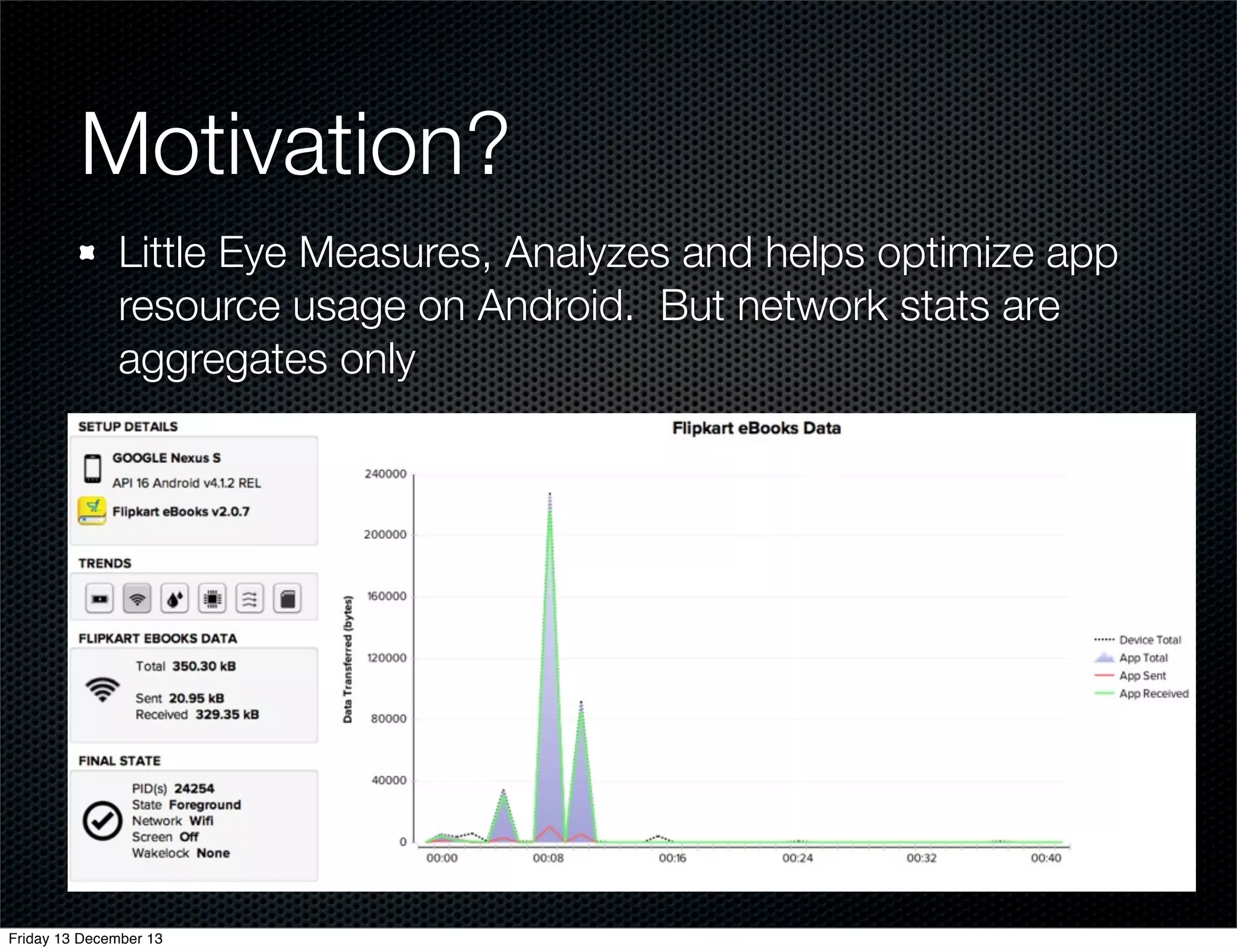
Little Eye Measures, Analyzes and helps optimize app
resource usage on Android. But network stats are
aggregates only

Friday 13 December 13
Motivation (2)
Needed granular network stats - each endpoint/URL,
Latency, Data transferred
Considered different approaches
Implement a VPN client app
Use a proxy
Looked at OS stats - didn’t find anything
Java debug wire protocol (JDWP)
Instrumentation
Friday 13 December 13
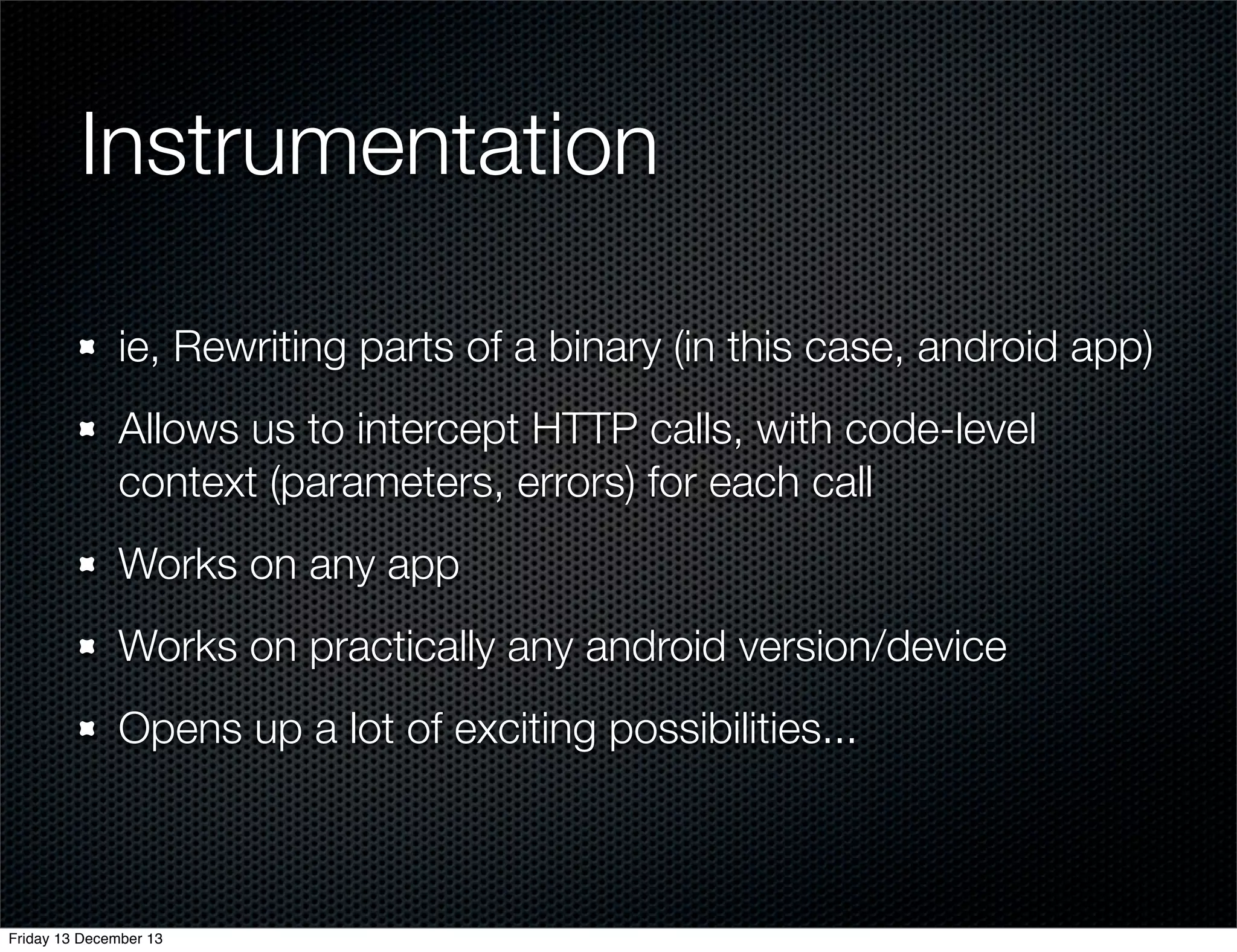
Instrumentation
ie, Rewriting parts of a binary (in this case, android app)
Allows us to intercept HTTP calls, with code-level
context (parameters, errors) for each call
Works on any app
Works on practically any android version/device
Opens up a lot of exciting possibilities...

Friday 13 December 13
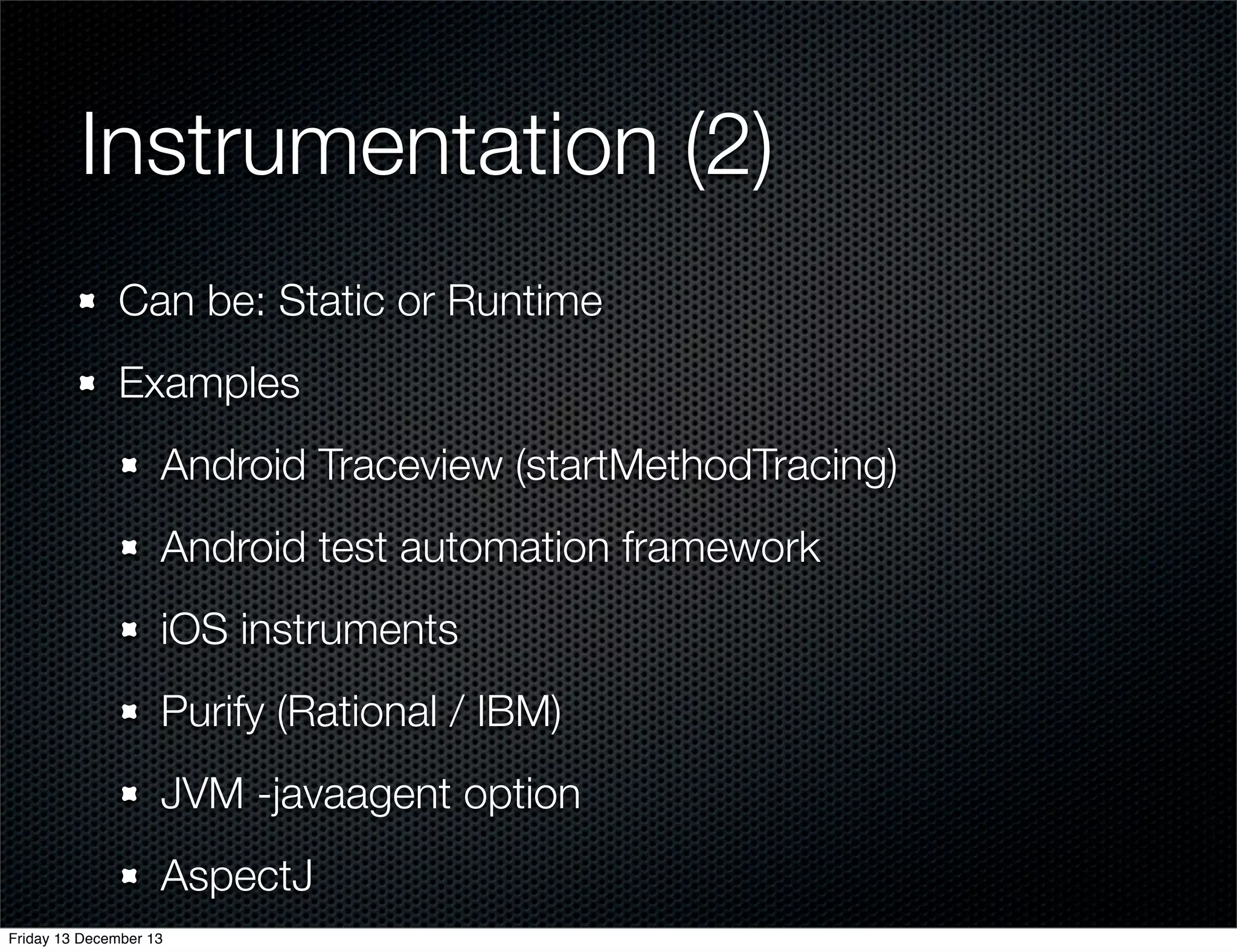
Instrumentation (2)
Can be: Static or Runtime
Examples
Android Traceview (startMethodTracing)
Android test automation framework
iOS instruments
Purify (Rational / IBM)
JVM -javaagent option
AspectJ
Friday 13 December 13
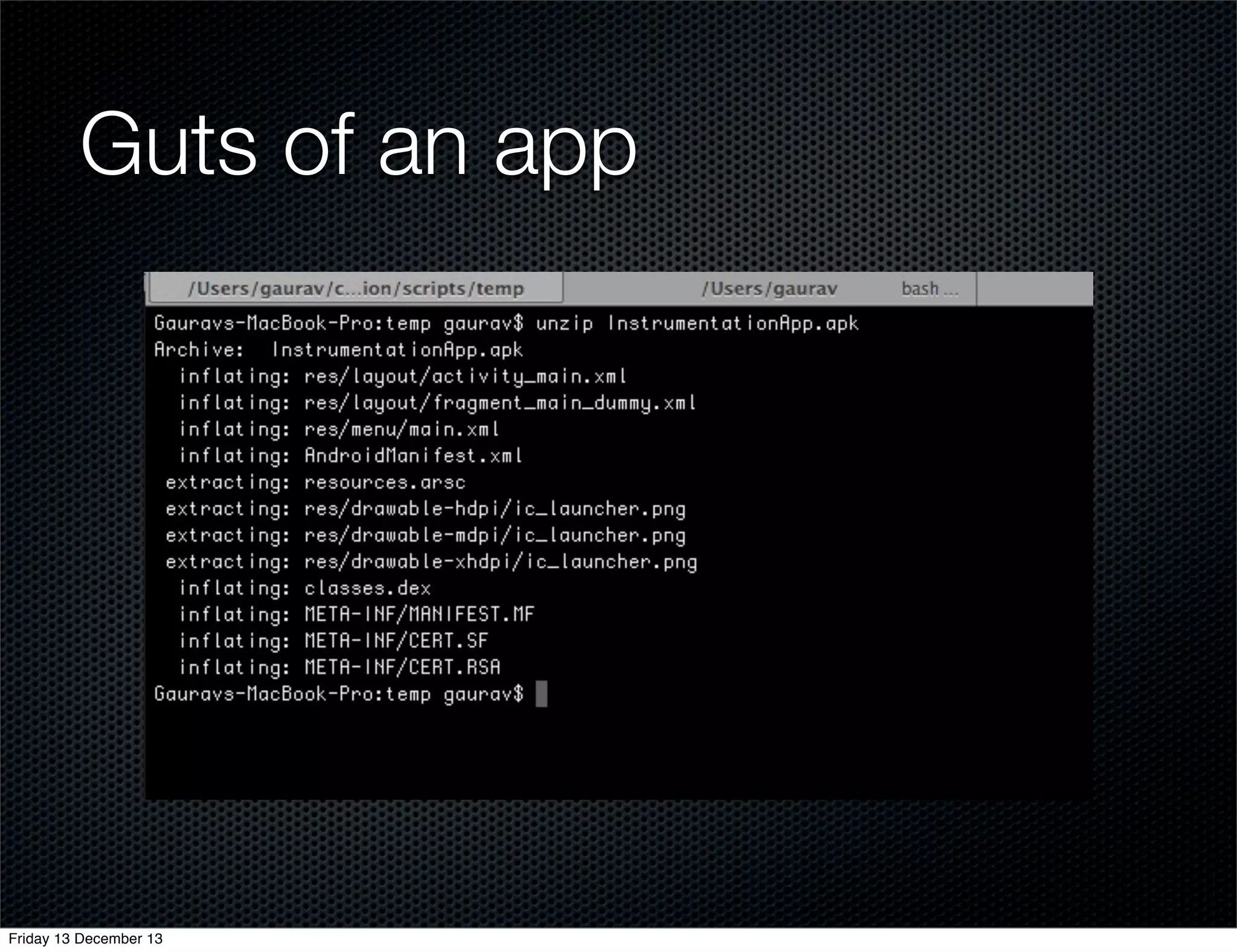
Guts of an app

Friday 13 December 13
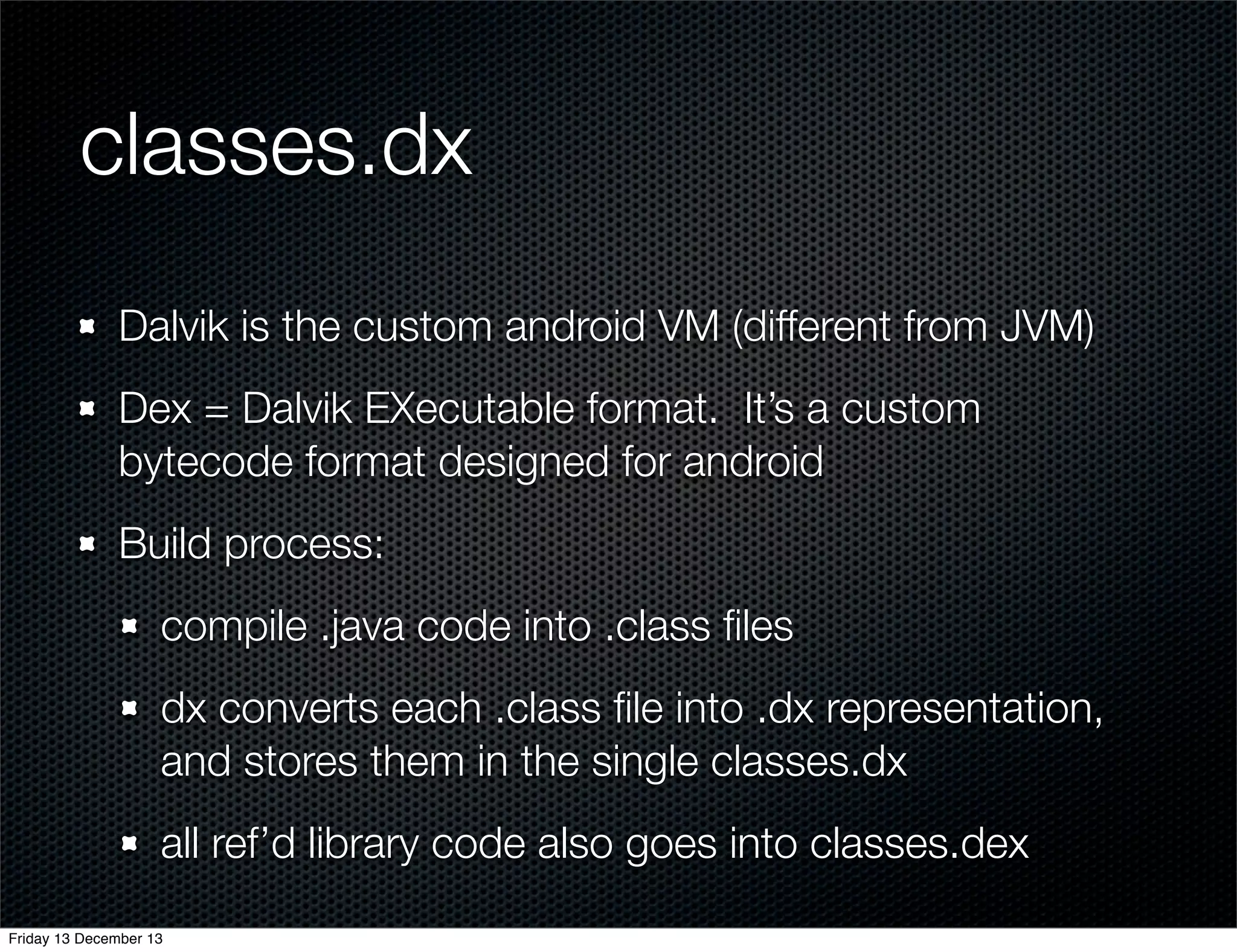
classes.dx
Dalvik is the custom android VM (different from JVM)
Dex = Dalvik EXecutable format. It’s a custom
bytecode format designed for android
Build process:
compile .java code into .class files
dx converts each .class file into .dx representation,
and stores them in the single classes.dx
all ref’d library code also goes into classes.dex
Friday 13 December 13
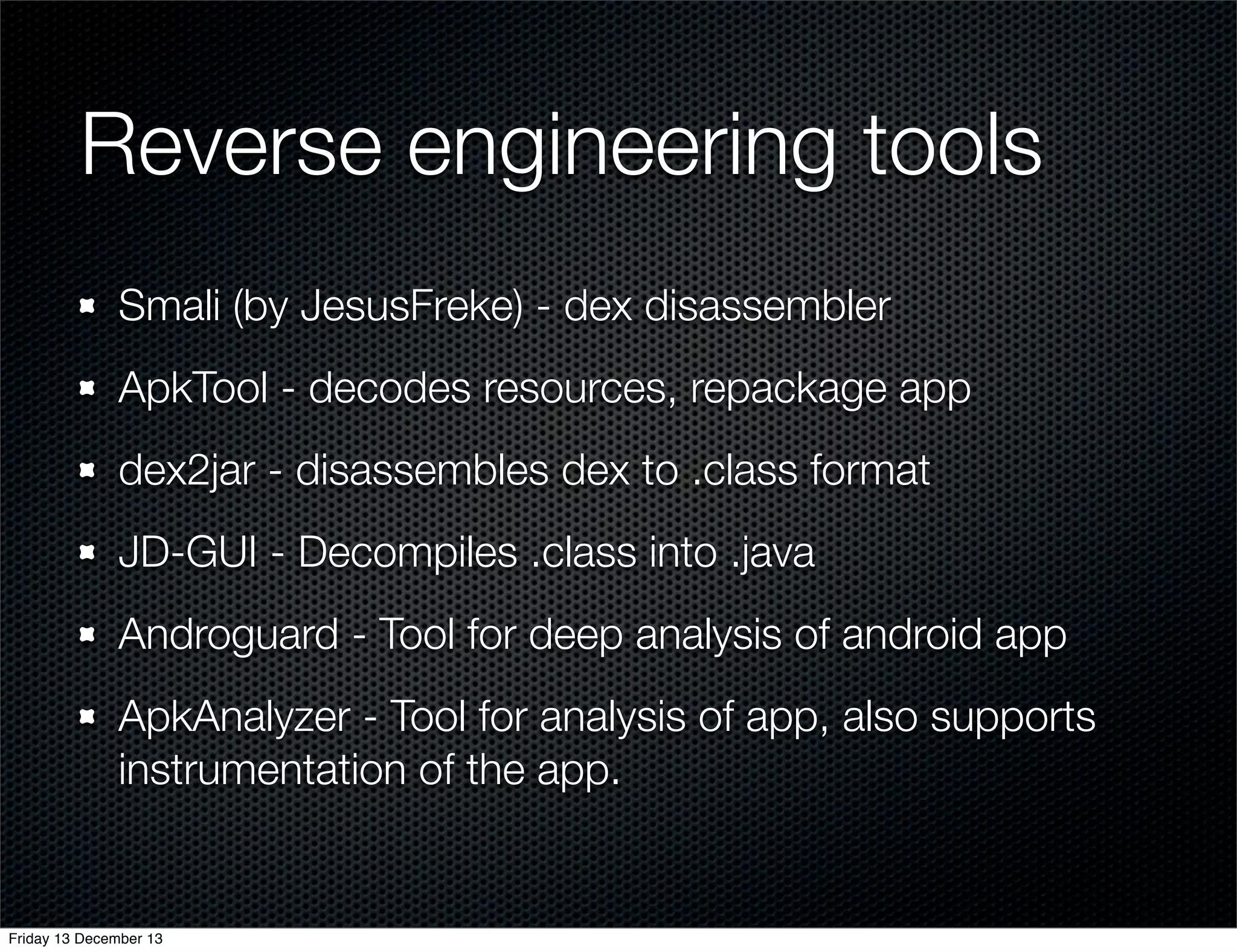
Reverse engineering tools
Smali (by JesusFreke) - dex disassembler
ApkTool - decodes resources, repackage app
dex2jar - disassembles dex to .class format
JD-GUI - Decompiles .class into .java
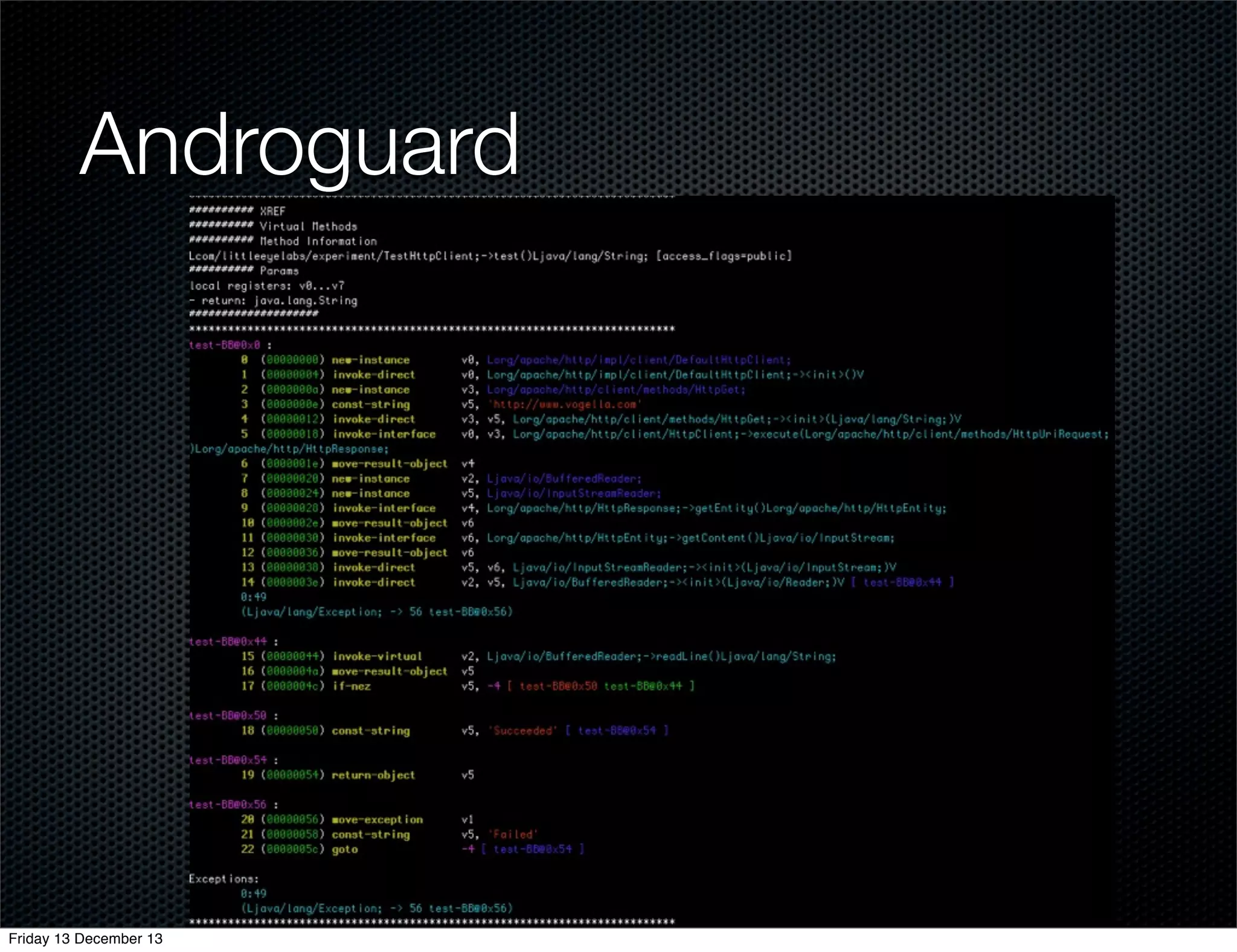
Androguard - Tool for deep analysis of android app
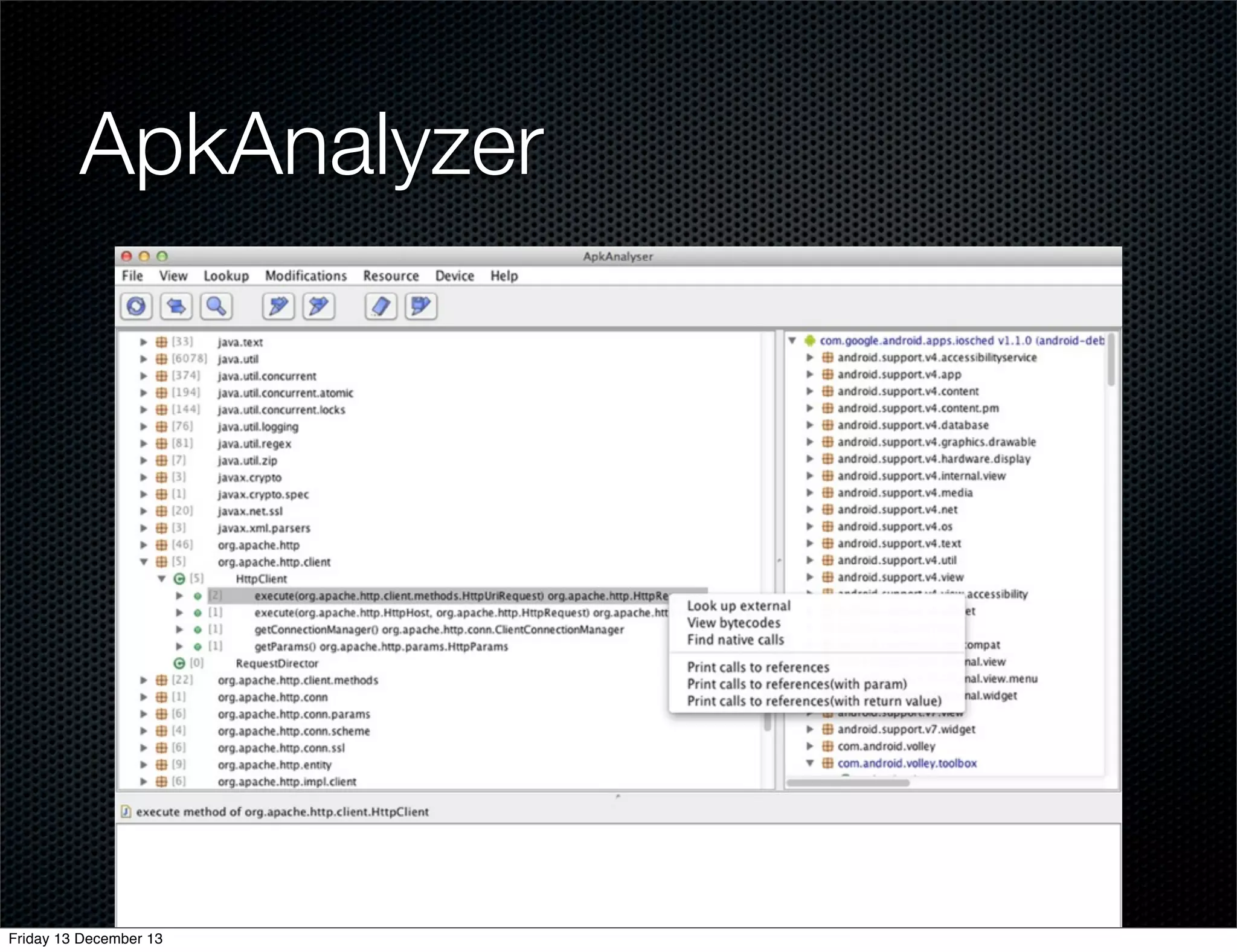
ApkAnalyzer - Tool for analysis of app, also supports
instrumentation of the app.

Friday 13 December 13
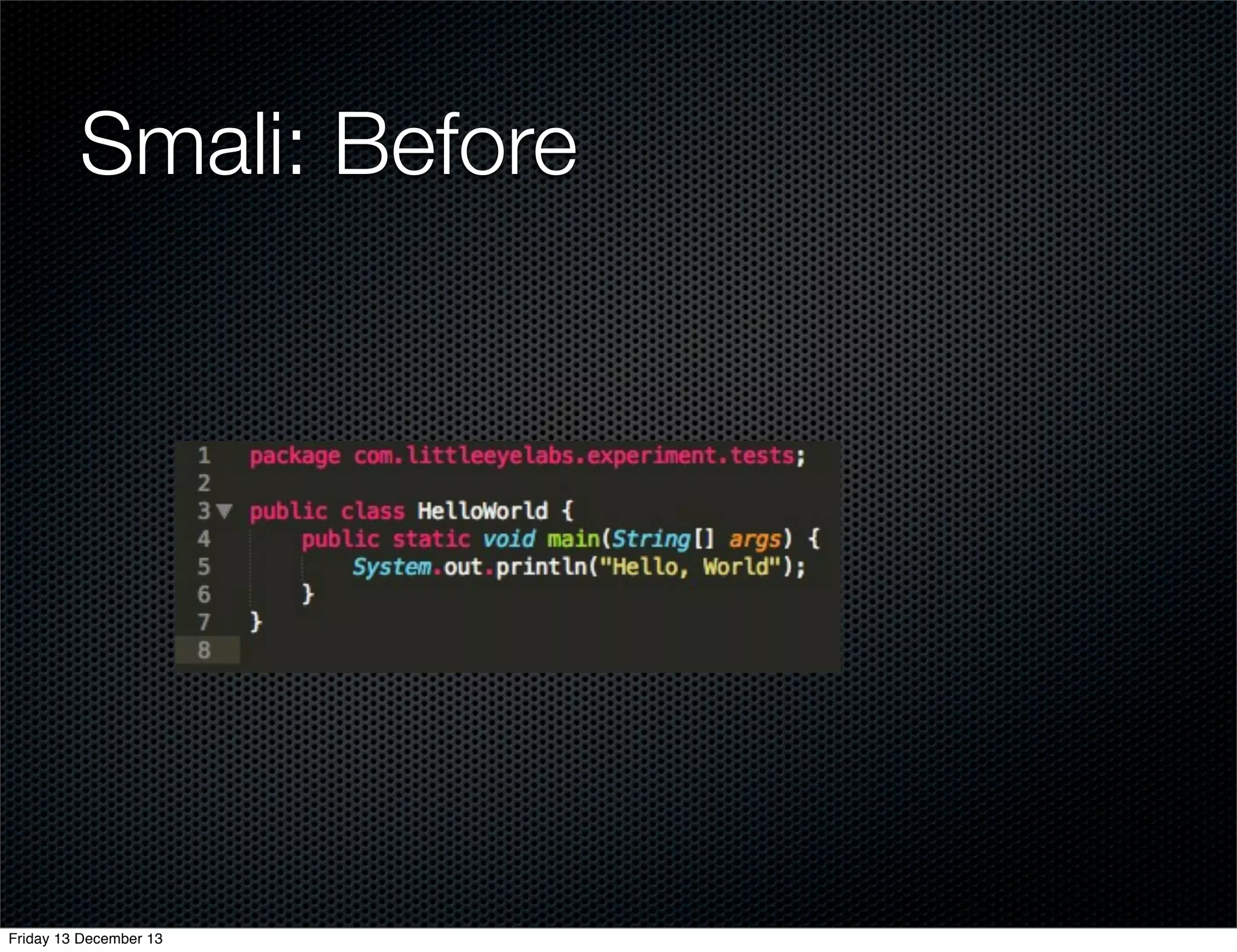
Smali: Before

Friday 13 December 13
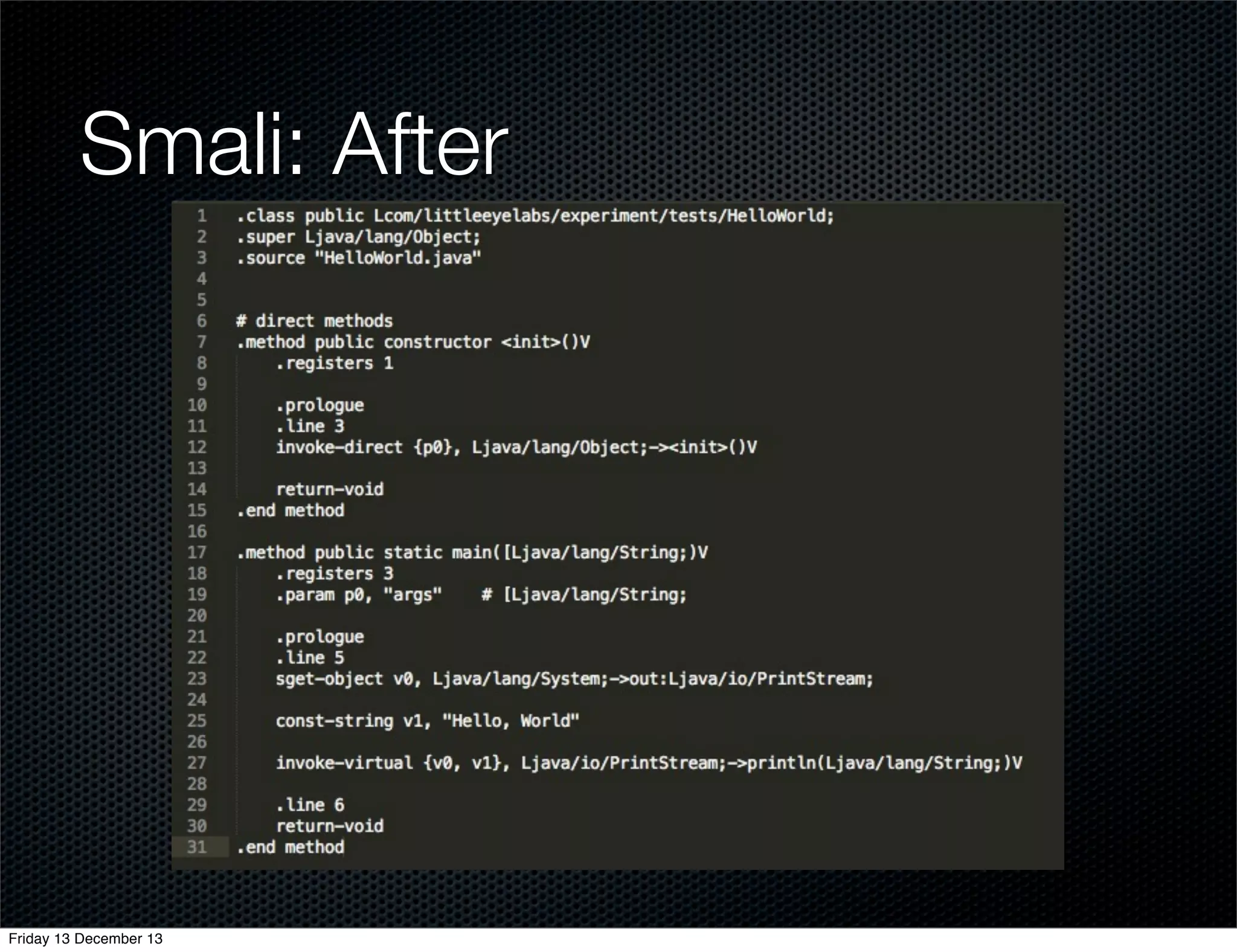
Smali: After

Friday 13 December 13
Androguard

Friday 13 December 13
ApkAnalyzer

Friday 13 December 13
Instrumentation Approaches
Explored the following approaches on android
Runtime
Instrument .class files during build process
Instrument .dex file

Friday 13 December 13
Runtime instrumentation
A JVM allows this - pass in a java.lang.instrumentation
(using the -javaagent flag) which can transform class at
class-load time
Dalvik doesn’t support this
It supports passing in a android.app.instrumentation,
but that has a limited set of methods, mostly for
automated testing

Friday 13 December 13
Instrumenting .class files
Considered modifying .class files, in two ways:
Using the JavaAssist tool/library
AspectJ
Both are well understood tools, but need to be done at
build time
Requires a process change, plus not all of our users
have access to the build (e.g. 3rd party QA team)

Friday 13 December 13
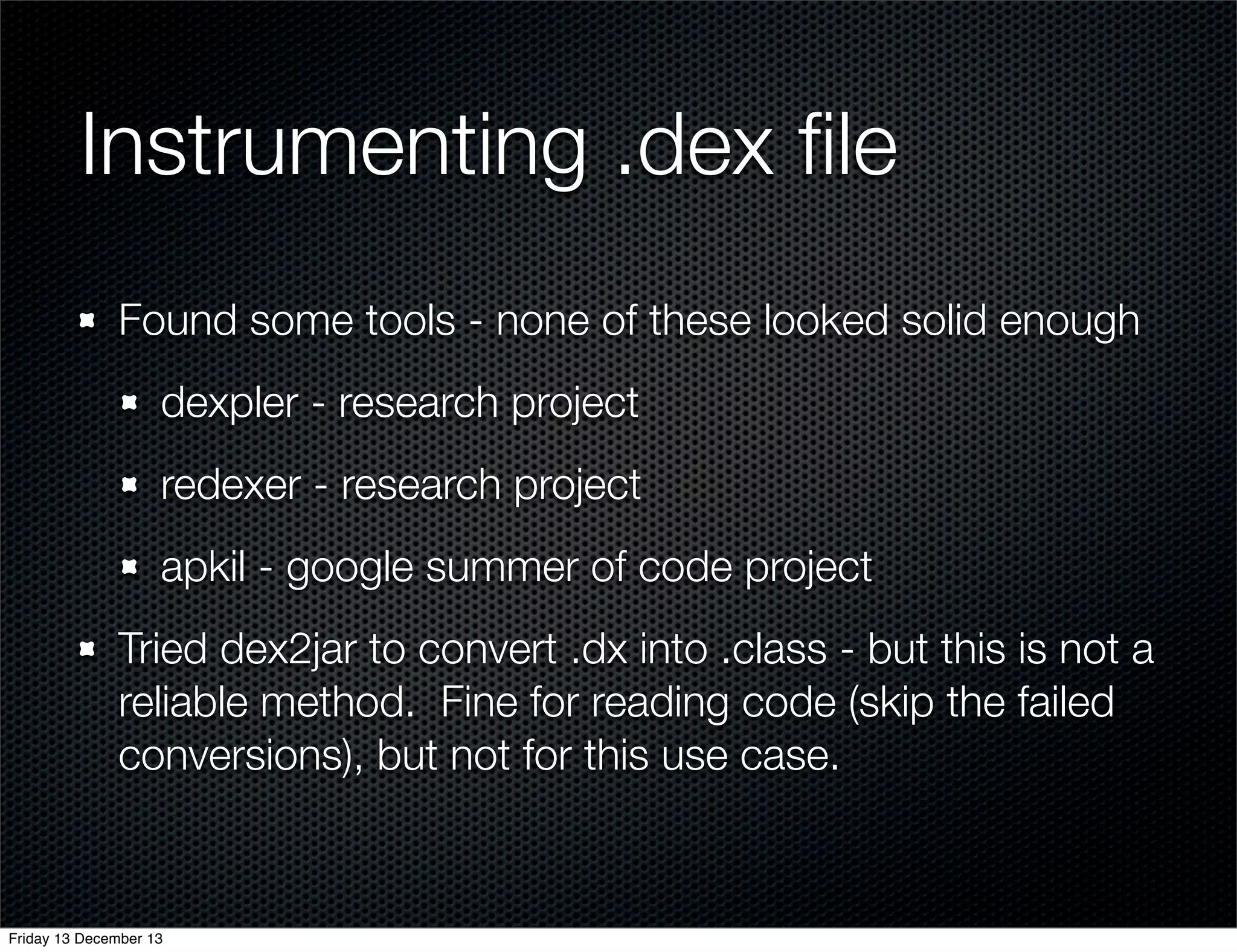
Instrumenting .dex file
Found some tools - none of these looked solid enough
dexpler - research project
redexer - research project
apkil - google summer of code project
Tried dex2jar to convert .dx into .class - but this is not a
reliable method. Fine for reading code (skip the failed
conversions), but not for this use case.

Friday 13 December 13
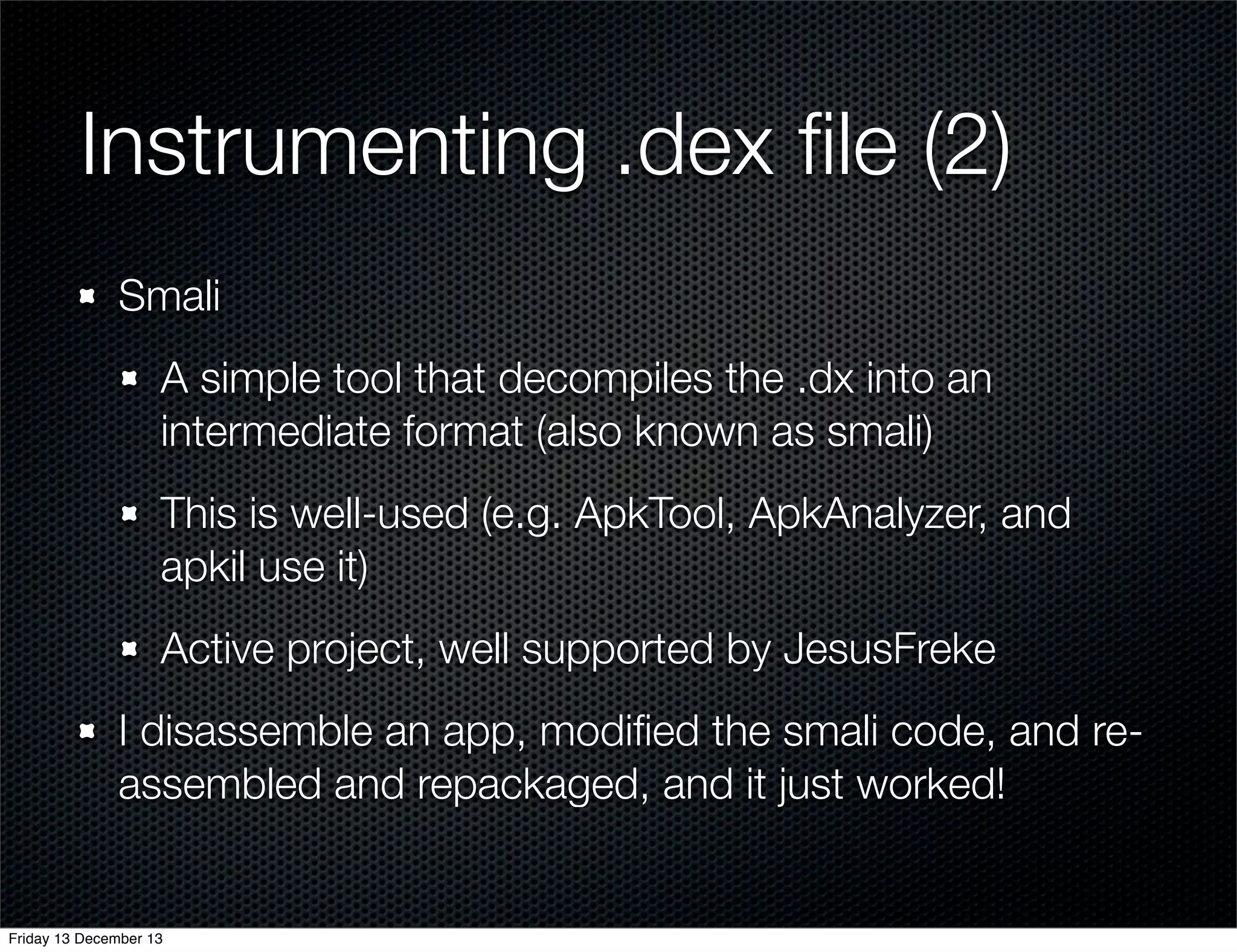
Instrumenting .dex file (2)
Smali
A simple tool that decompiles the .dx into an
intermediate format (also known as smali)
This is well-used (e.g. ApkTool, ApkAnalyzer, and
apkil use it)
Active project, well supported by JesusFreke
I disassemble an app, modified the smali code, and reassembled and repackaged, and it just worked!

Friday 13 December 13
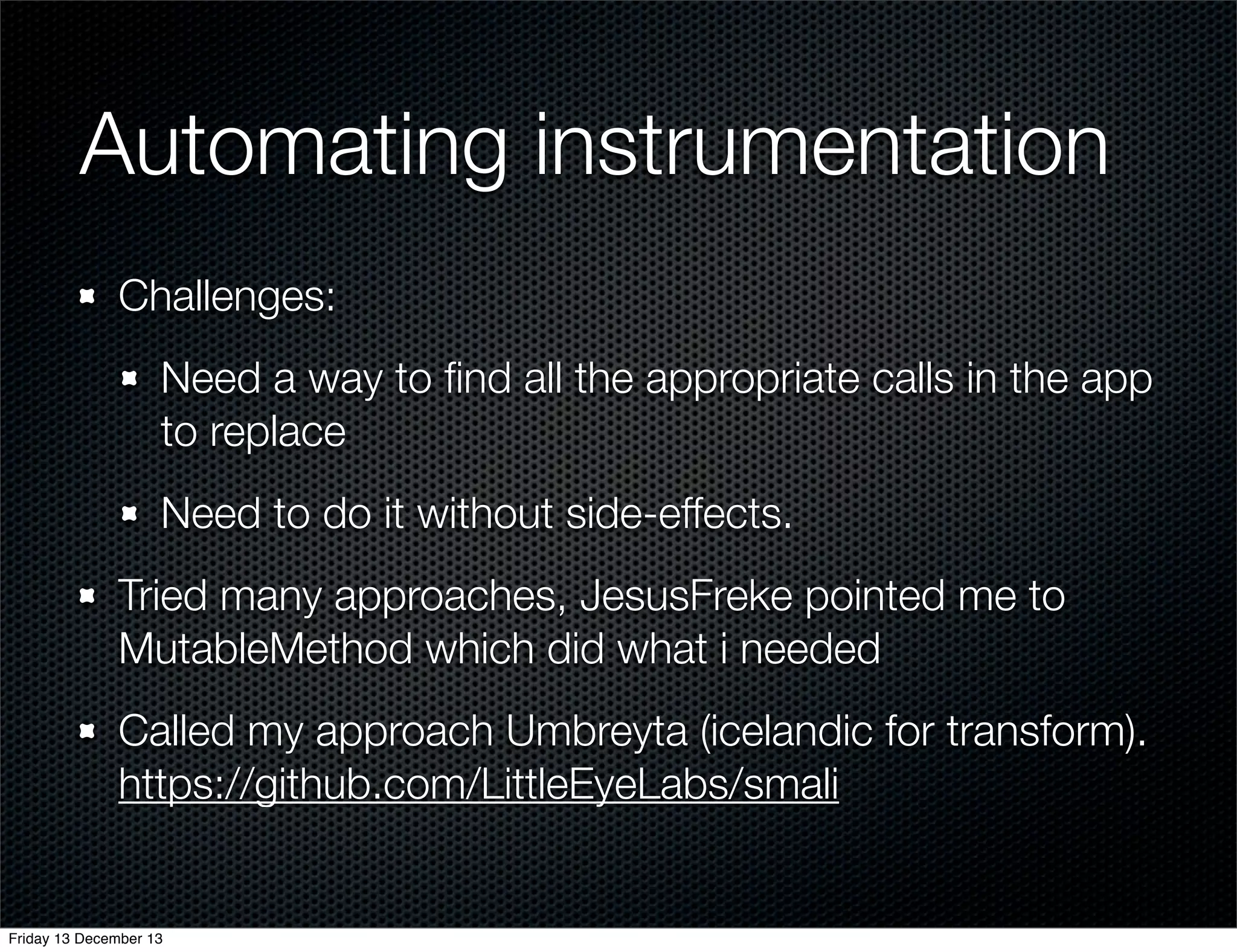
Automating instrumentation
Challenges:
Need a way to find all the appropriate calls in the app
to replace
Need to do it without side-effects.
Tried many approaches, JesusFreke pointed me to
MutableMethod which did what i needed
Called my approach Umbreyta (icelandic for transform).
https://github.com/LittleEyeLabs/smali

Friday 13 December 13
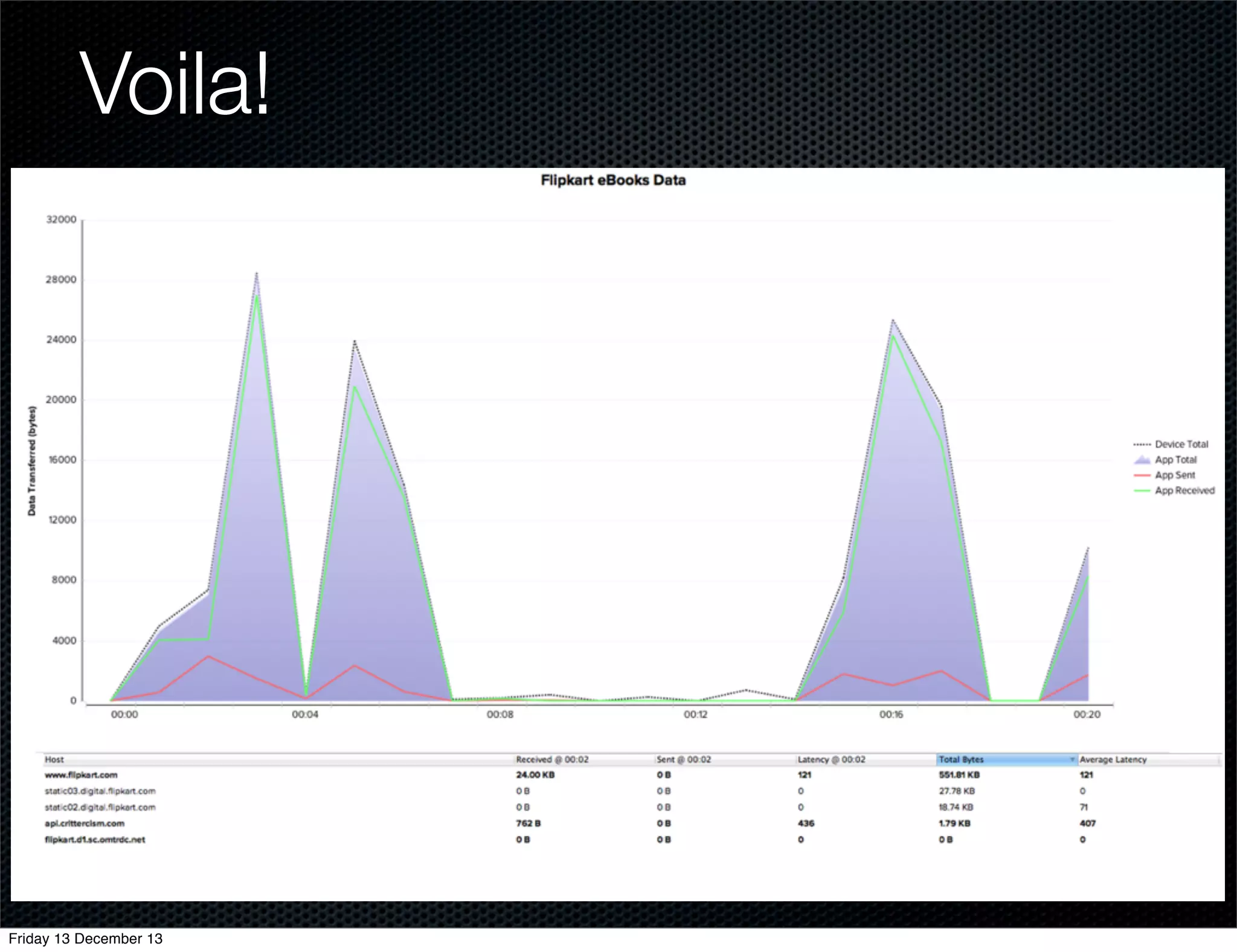
Voila!

Friday 13 December 13

Reverse engineering and instrumentation of android apps

  • 1.
    Reverse engineering and instrumentingandroid apps Gaurav Lochan Little Eye Labs Friday 13 December 13
  • 2.
    Outline Motivation? Instrumentation Guts of anandroid app Instrumentation approaches Chosen approach Friday 13 December 13
  • 3.
    Motivation? Little Eye Measures,Analyzes and helps optimize app resource usage on Android. But network stats are aggregates only Friday 13 December 13
  • 4.
    Motivation (2) Needed granularnetwork stats - each endpoint/URL, Latency, Data transferred Considered different approaches Implement a VPN client app Use a proxy Looked at OS stats - didn’t find anything Java debug wire protocol (JDWP) Instrumentation Friday 13 December 13
  • 5.
    Instrumentation ie, Rewriting partsof a binary (in this case, android app) Allows us to intercept HTTP calls, with code-level context (parameters, errors) for each call Works on any app Works on practically any android version/device Opens up a lot of exciting possibilities... Friday 13 December 13
  • 6.
    Instrumentation (2) Can be:Static or Runtime Examples Android Traceview (startMethodTracing) Android test automation framework iOS instruments Purify (Rational / IBM) JVM -javaagent option AspectJ Friday 13 December 13
  • 7.
    Guts of anapp Friday 13 December 13
  • 8.
    classes.dx Dalvik is thecustom android VM (different from JVM) Dex = Dalvik EXecutable format. It’s a custom bytecode format designed for android Build process: compile .java code into .class files dx converts each .class file into .dx representation, and stores them in the single classes.dx all ref’d library code also goes into classes.dex Friday 13 December 13
  • 9.
    Reverse engineering tools Smali(by JesusFreke) - dex disassembler ApkTool - decodes resources, repackage app dex2jar - disassembles dex to .class format JD-GUI - Decompiles .class into .java Androguard - Tool for deep analysis of android app ApkAnalyzer - Tool for analysis of app, also supports instrumentation of the app. Friday 13 December 13
  • 10.
  • 11.
  • 12.
  • 13.
  • 14.
    Instrumentation Approaches Explored thefollowing approaches on android Runtime Instrument .class files during build process Instrument .dex file Friday 13 December 13
  • 15.
    Runtime instrumentation A JVMallows this - pass in a java.lang.instrumentation (using the -javaagent flag) which can transform class at class-load time Dalvik doesn’t support this It supports passing in a android.app.instrumentation, but that has a limited set of methods, mostly for automated testing Friday 13 December 13
  • 16.
    Instrumenting .class files Consideredmodifying .class files, in two ways: Using the JavaAssist tool/library AspectJ Both are well understood tools, but need to be done at build time Requires a process change, plus not all of our users have access to the build (e.g. 3rd party QA team) Friday 13 December 13
  • 17.
    Instrumenting .dex file Foundsome tools - none of these looked solid enough dexpler - research project redexer - research project apkil - google summer of code project Tried dex2jar to convert .dx into .class - but this is not a reliable method. Fine for reading code (skip the failed conversions), but not for this use case. Friday 13 December 13
  • 18.
    Instrumenting .dex file(2) Smali A simple tool that decompiles the .dx into an intermediate format (also known as smali) This is well-used (e.g. ApkTool, ApkAnalyzer, and apkil use it) Active project, well supported by JesusFreke I disassemble an app, modified the smali code, and reassembled and repackaged, and it just worked! Friday 13 December 13
  • 19.
    Automating instrumentation Challenges: Need away to find all the appropriate calls in the app to replace Need to do it without side-effects. Tried many approaches, JesusFreke pointed me to MutableMethod which did what i needed Called my approach Umbreyta (icelandic for transform). https://github.com/LittleEyeLabs/smali Friday 13 December 13
  • 20.