INSTRUCTIONAL DESIGN
MODELS FOR
ELEMENTARY SCHOOL
TEACHERS
JODY WOOD
UNIVERSITY OF PHOENIX
NOVEMBER 30, 2015
Organization
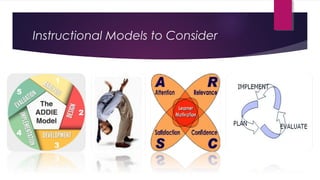
Instructional Models to Consider
Why use Models
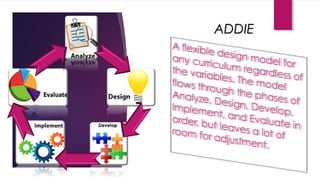
ADDIEADDIE
ADDIE Components
ADDIE Implications
 ADDIE provided educators with
helpful, clearly defined stages for the
planning and effective
implementation of instruction
(Peterson, 2003)
 Application to multiple situations
enables multiple learning styles to be
met.
 Allows for adjustment during both
planning and implementation (Hodell,
2011)
“The process can be
applicable in a variety of
settings, because of its
systematic and generic
structure. The framework
provides developers with a
means for identifying the target
audience’s needs and
reinforces the use of this
information for the design and
development of programs”
(Peterson, 2003, p. 14)
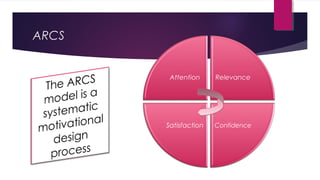
ARCS
Attention Relevance
ConfidenceSatisfaction
• Create
curiosity
• Generate
thinking
challenges
• Use interesting
teaching
methods
• Align with
goals
• Match
learning to
motivation
• Apply the
knowledge
• Performance
requirements
• Opportunities
for success
• Personal
control
• Reinforce
• Acknowledge
• Summarize
Provide
opportunities for
the learners to
apply their
knowledge
Relate to real life
situations, Pose
challenging
questions, and use
media
Make the learning
applicable the
learner’s past,
present, and
future
Allow the
learner to guide
and direct their
own learning
Stages of Arcs
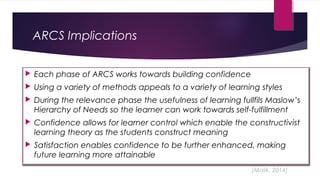
ARCS Implications
 Each phase of ARCS works towards building confidence
 Using a variety of methods appeals to a variety of learning styles
 During the relevance phase the usefulness of learning fullfils Maslow’s
Hierarchy of Needs so the learner can work towards self-fulfillment
 Confidence allows for learner control which enable the constructivist
learning theory as the students construct meaning
 Satisfaction enables confidence to be further enhanced, making
future learning more attainable
(Malik, 2014)
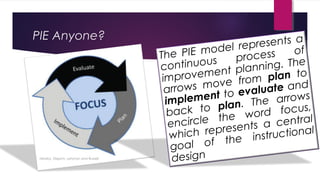
PIE Anyone?
The PIE model represents a
continuous process of
improvement planning. The
arrows move from plan to
implement to evaluate and
back to plan. The arrows
encircle the word focus,
which represents a central
goal of the instructional
designNewby, Stepich, Lehman and Russell
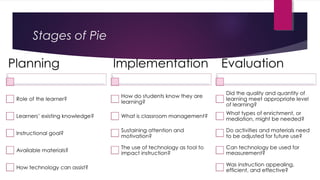
Stages of Pie
Backwards Design
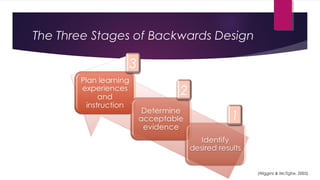
The Three Stages of Backwards Design
(Wiggins & McTighe, 2005).
1
3
2
Backwards Design Implications
Advantages
 Students don’t get
stuck on just details
 Instruction focuses on
broad vision
 When assessments
are designed first, the
instruction drives
students towards
what they need to
know
Learning
Implications
 Instruction can be
differentiated
 Cognitive learning
theory applies as
students are given
the opportunity to
develop
individually
“Designing curriculum that both
accommodates learning needs
and targets deeper levels of
understanding is possible.
Through the use of the
backward design approach,
learning can become relevant
and meaningful for all students,
supporting their mastery of
general curricular standards.
When standards, assessment,
and inquiry-oriented activities
drive the curriculum, learning
can be transformed.”
Final Thoughts
Childre, Sands, & Pope, 2009, p. 14
In Conclusion
(Morrison, 2013)
References
 Childre, A., Sands, J. R., & Pope, S. T. (2009). Backward design: Targeting depth of understanding for all learners. Teaching
Exceptional Children, 41(5), 6-14. Retrieved from http://search.proquest.com/docview/201089722?accountid=458
 Christensen, T. K., & Osguthorpe, R. T. (2004). How do instructional-design practitioners make instructional-strategy
decisions? Performance Improvement Quarterly, 17(3), 45-65. Retrieved from
http://search.proquest.com/docview/218561971?accountid=458
 Gustafson, K. L., & Branch, R. M. (2002). Survey of instructional development models (4th ed.). Syracuse, NY: ERIC.
 Hodell, C. (2011). Isd from the ground up:  A no-nonsense approach to instructional design (3rd ed.). United States of
America: American Society for Training & Development.
 MALIK, S. s. (2014). Effectiveness of ARCS model of motivational design to overcome non completion rates of students in
distance education. Turkish Online Journal Of Distance Education,15(2), 194-200.
 Morrison, D. (2013). Review of instructional design models applied to K-12 learning environments. Retrieved from
https://onlinelearninginsights.wordpress.com/2013/11/15/review-of-instructional-design-models-applied-to-k-12-learning-
environments/
 Peterson, C. (2003). Bringing ADDIE to Life: Instructional Design at Its Best. Journal of Educational Multimedia and
Hypermedia, 12(3), 227-241. Norfolk, VA: Association for the Advancement of Computing in Education (AACE).
 Wiggins, G., & McTighe, J. (2005). Understanding by Design (Expanded Second Edition). Alexandria, VA, USA: Association
for Supervision & Curriculum Development (ASCD). Retrieved from http://www.ebrary.com

Instructional designmodels jodywood_weekfive

  • 1.
    INSTRUCTIONAL DESIGN MODELS FOR ELEMENTARYSCHOOL TEACHERS JODY WOOD UNIVERSITY OF PHOENIX NOVEMBER 30, 2015
  • 2.
  • 3.
  • 4.
  • 6.
  • 7.
  • 8.
    ADDIE Implications  ADDIEprovided educators with helpful, clearly defined stages for the planning and effective implementation of instruction (Peterson, 2003)  Application to multiple situations enables multiple learning styles to be met.  Allows for adjustment during both planning and implementation (Hodell, 2011) “The process can be applicable in a variety of settings, because of its systematic and generic structure. The framework provides developers with a means for identifying the target audience’s needs and reinforces the use of this information for the design and development of programs” (Peterson, 2003, p. 14)
  • 9.
  • 10.
    • Create curiosity • Generate thinking challenges •Use interesting teaching methods • Align with goals • Match learning to motivation • Apply the knowledge • Performance requirements • Opportunities for success • Personal control • Reinforce • Acknowledge • Summarize Provide opportunities for the learners to apply their knowledge Relate to real life situations, Pose challenging questions, and use media Make the learning applicable the learner’s past, present, and future Allow the learner to guide and direct their own learning Stages of Arcs
  • 11.
    ARCS Implications  Eachphase of ARCS works towards building confidence  Using a variety of methods appeals to a variety of learning styles  During the relevance phase the usefulness of learning fullfils Maslow’s Hierarchy of Needs so the learner can work towards self-fulfillment  Confidence allows for learner control which enable the constructivist learning theory as the students construct meaning  Satisfaction enables confidence to be further enhanced, making future learning more attainable (Malik, 2014)
  • 12.
    PIE Anyone? The PIEmodel represents a continuous process of improvement planning. The arrows move from plan to implement to evaluate and back to plan. The arrows encircle the word focus, which represents a central goal of the instructional designNewby, Stepich, Lehman and Russell
  • 13.
  • 14.
  • 15.
    The Three Stagesof Backwards Design (Wiggins & McTighe, 2005). 1 3 2
  • 16.
    Backwards Design Implications Advantages Students don’t get stuck on just details  Instruction focuses on broad vision  When assessments are designed first, the instruction drives students towards what they need to know Learning Implications  Instruction can be differentiated  Cognitive learning theory applies as students are given the opportunity to develop individually “Designing curriculum that both accommodates learning needs and targets deeper levels of understanding is possible. Through the use of the backward design approach, learning can become relevant and meaningful for all students, supporting their mastery of general curricular standards. When standards, assessment, and inquiry-oriented activities drive the curriculum, learning can be transformed.” Final Thoughts Childre, Sands, & Pope, 2009, p. 14
  • 17.
  • 18.
    References  Childre, A.,Sands, J. R., & Pope, S. T. (2009). Backward design: Targeting depth of understanding for all learners. Teaching Exceptional Children, 41(5), 6-14. Retrieved from http://search.proquest.com/docview/201089722?accountid=458  Christensen, T. K., & Osguthorpe, R. T. (2004). How do instructional-design practitioners make instructional-strategy decisions? Performance Improvement Quarterly, 17(3), 45-65. Retrieved from http://search.proquest.com/docview/218561971?accountid=458  Gustafson, K. L., & Branch, R. M. (2002). Survey of instructional development models (4th ed.). Syracuse, NY: ERIC.  Hodell, C. (2011). Isd from the ground up:  A no-nonsense approach to instructional design (3rd ed.). United States of America: American Society for Training & Development.  MALIK, S. s. (2014). Effectiveness of ARCS model of motivational design to overcome non completion rates of students in distance education. Turkish Online Journal Of Distance Education,15(2), 194-200.  Morrison, D. (2013). Review of instructional design models applied to K-12 learning environments. Retrieved from https://onlinelearninginsights.wordpress.com/2013/11/15/review-of-instructional-design-models-applied-to-k-12-learning- environments/  Peterson, C. (2003). Bringing ADDIE to Life: Instructional Design at Its Best. Journal of Educational Multimedia and Hypermedia, 12(3), 227-241. Norfolk, VA: Association for the Advancement of Computing in Education (AACE).  Wiggins, G., & McTighe, J. (2005). Understanding by Design (Expanded Second Edition). Alexandria, VA, USA: Association for Supervision & Curriculum Development (ASCD). Retrieved from http://www.ebrary.com

Editor's Notes

  • #3 The organization that is interested in finding new ways to present instruction is Salk Elementary, located in Mesa, Arizona, Salk’s background includes a new principal who is in her second year at the school. However, for the purpose of this presentation, the topic in general will be for any elementary educational facility. There has been considerable mention that there is a need for instruction to shift to meet the changing needs of the standards, and the changes in how students are learning (Prensky, 2001). Schools are typically given text books and curriculums, however Morrison (2013), believed there is a need for K-12 educators to be equipped with skills in instructional design. Teachers need this skill set to adapt  curriculum in order to provide relevant learning experiences for their students. (http://www.mpsaz.org/salk/academics/studentphotos/view/30399
  • #4 Instructional design according to Dick, Carey, and Carey (2001), is plan of activities to meet an instructional goal (as cited in Christensen & Osguthorpe, 2004). There are several different instructional models, but the ones that have been chosen for this particular learning environment are… The ARCS model was developed by John Keller in relation to attempting to include motivation into the learning process (Malik, 2014). Malik (2014) pointed out that the model is built upon theory that if a student is motivated to learn there is an understandable value in the information. Keller felt that many of the other models left out the motivation and believed that motivation had to be the essence of learning (as cited in Malik, 2014).
  • #5 [Allow pause time for audience to read this quote]
  • #6 Martin Ryder of University of Colorado at Denver, understood that instructional design models could have great value, but this value is dependent on the model’s context. Ryder discussed just like any instrument has a specific intent of the user, so does a model. A model should be able to assess and support the desired learning objectives (Morrison, 2013). In order to meet the needs of instructional goals a model that is carefully planned can provide a lot of value to an educational program.
  • #7 The ADDIE model provides designers with the necessary structure for designing any curriculum regardless of the variables involved. With that said, this model can be utilized in any setting from classroom lecture to distance learning. The way this model is broken down makes it very thorough and detailed. This also allows for the quick and efficient design of projects ADDIE stands for Analysis, Design, Development, Implementation and Evaluation, these five dynamic phases are connected in such a way that they influence each other throughout the entire Instructional System Development (ISD) process (Hodell, 2011).
  • #8 Analyze: During this phase, you must assess your learners, their skills and background knowledge. Consider the goals of the lesson or course, what problems need to be addressed, and the physical context in which you are to teach them. Design: Choose your learning objectives, approach and develop a strategy for the lesson's implementation. Develop: Create your materials, select a delivery method and design your evaluation/assessment. Implement: Conduct the lesson! Evaluate: This phase includes the formative (reflection at each stage) and summative (feedback at end of process) evaluations.
  • #9 This approach provides educators with useful, clearly defined stages for the effective implementation of instruction.
  • #10 This model suggests that setting some sort of objective or desired outcome is important to the design process and creates a useful way for measuring outcomes. This model recognizes that most teachers have little time for designing and developing their own material and utilizes media and material which is already developed. Rowland (1992) warned that if design models were too heavy in theory, they could lose value to practitioners as its discourse and assumptions diverge from the situations and realities of actual practice. Therefore, it is important that models be easy to use, and applicable to their purposes. This model also focuses on the importance of active student engagement and participation as an aid in their learning. In the end this model focuses on the importance of the “total picture” to assure both the learners are achieving the objectives and also that the instructional process itself was feasible (Gustafson & Branch, 2002, p.44).
  • #11 Attention – Grabbing attention is the most important component of the ARCS model. Without the learner’s interest learners may not want to invest the time to stay focused and find out more. Instruction during this portion should include concrete, or relatable examples that stimulate interest, and incorporate humor; provide some challenges perhaps by presenting problems that students need to brainstorm to find solutions, use a lot of questions to get them thinking, and offer hands-on/mobile learning methods; and incorporate a variety of teaching methods, especially those methods that students like such as media, technology, movement outside of their desks, anything that will keep them engaged! (Malik, 2014) Relevance – Learners will not maintain information, nor continue to pay attention if relevance is not conveyed. Instructional methods: Describe how the information will help the learner at present, and in the future; assess what makes the learner “tick”, or rather learning styles and interests, provide differentiated learning opportunities perhaps by allowing choices of learning activities, or how the learner will present the activity; Connect the learning to what the learner knows, build on prior knowledge, and relate the learning to high interests topics, and allow the learner to practice/apply the knowledge. Confidence – Confidence levels, along with effort, correspond to a learner’s motivation level. Show the learner that you care and are involved in this process, provide reassurance that the learner is capable, but also provide challenging activities that build confidence. Confidence is raised when a challenge is met, not when standards have been lowered. Instructional methods: Learners should be given the opportunity to know performance requirements to be able to measure potential success, provide rubrics and a syllabus so the learner can assess the amount of effort they will have to invest; allow the learners to experience success through chunking assignments, and providing feedback that enables the learner to make changes; and allow for the learner to believe success was related to personal ability or effort rather than a lack of challenging materials, provide the learner with feedback through a note, or a letter grade, than enable to learner to self-assess the results based on efforts. Satisfaction – Learners need to have some kind of satisfaction from a learning experience. The satisfaction is gained from a sense of achievement. Feedback and reinforcement are important, and when a learner has results that can be appreciated, motivation to learn increases. Learners can be motivated through extrinsic motivators such as rewards, or certificates; Intrinsic motivation is an internal feeling of accomplishment, and a teacher can foster those feelings by allowing for the learner to use newly learned skills either through demonstrating the skills, or helping another student learn the skills; and equity increases the learner’s satisfaction when he/she knows that there are consistent standards, the teacher can help increase equity through evaluative feedback. Over all, satisfaction is going to be what keep the learner motivated for future learning opportunities.
  • #13 The PIE Model is also referred to as the Newby, Stepich, Lehman, and Russell model ( as cited in Gustafson & Branch, 2002). Newby, Stepich, Lehman, and Russell (2000), intended the model for the classroom specifically for the same individual or small group using media and technology as support providing the incorporation of the technology into lessons was carefully planned (as cited in Gustafson & Branch, 2002).
  • #14 Allow for discussion…
  • #15 The backward design model is a three step process that helps teachers to focus their curriculum on big ideas, essential questions, and authentic performance. Wiggins and McTighe (2005) suggested a reverse approach to designing curriculum: by first asking what should students understand, or be able to do; then planning can proceed to what would be the best evidence of that learning; and finally the teacher is ready to determine the appropriate learning activities. The shift here is from first determining such things as which book the class is going to read, to what should the students be able to do when they leave this class (Wiggins & McTighe, 2005).
  • #16 Identifying desired results: or (click) stage 1…The consideration is what are the goals? This is where we focus on what the standards are, and what curriculum expectations. What should the students understand and know? (Wiggins & McTighe, 2005). Determining acceptable evidence: or (click) stage 2… How are we going to know if the students have achieved those desired results? Before designing any lessons, determine first how will we determine students understanding, or efficiency of the goal? (Wiggins & McTighe, 2005). Planning learning experiences and the instruction, is (click) the last component… Once we know what results we want and how we can determine those results, then we can determine learning activities. Here, the teacher determines what and how will things be taught, what activities, what delivery methods, and other considerations that go into the instruction (Wiggins & McTighe, 2005).
  • #17 Advantages Backward Design is a strategy that turns most unit planning on its head, and emphasizes key ideas that affect the way students view their world. Advantages include: Students are less likely to become so immersed in the factual detail of a unit that they miss the whole point for studying the topic. Instruction focuses on global understandings and not on daily activities; daily lessons are constructed with a clear vision of what the overall “gain” from the unit is to be. Assessment is designed before lesson planning, so that instruction drives students toward the essence of what they need to know. Wiggins and McTighe caution that enduring understandings are not intended to be taught to students as facts. Instead, they represent the insight that students must all individually develop about the material as they process the information and engage in learning during the unit.
  • #19 http://elearninginfographics.com/the-addie-instructional-design-model-infographic/