INSTRUCTIONAL
DESIGN CONCEPT
Rizki Farani S.Pd., M.Pd.
Prodi Pendidikan Bahasa Inggris
Fakultas Psikologi dan Ilmu Sosial Budaya
Universitas Islam Indonesia
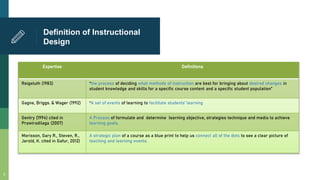
Definition of Instructional
Design
2
Expertise Definitions
Reigeluth (1983) “the process of deciding what methods of instruction are best for bringing about desired changes in
student knowledge and skills for a specific course content and a specific student population”
Gagne, Briggs. & Wager (1992) “A set of events of learning to facilitate students' learning
Gentry (1994) cited in
Prawiradilaga (2007)
A Process of formulate and determine learning objective, strategies technique and media to achieve
learning goals.
Morisson, Gary R., Steven, R.,
Jerold, K. cited in Gafur, 2012)
A strategic plan of a course as a blue print to help us connect all of the dots to see a clear picture of
teaching and learning events.
What is
Instractional
Design?
3
Morisson, Gary R., Steven, R., Jerold, K. cited in Gafur, 2012)
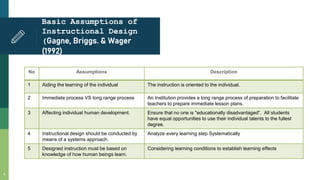
Basic Assumptions of
Instructional Design
(Gagne, Briggs. & Wager
(1992)
4
No Assumptions Description
1 Aiding the learning of the individual The instruction is oriented to the individual.
2 Immediate process VS long range process An Institution provides a long range process of preparation to facilitate
teachers to prepare immediate lesson plans.
3 Affecting individual human development. Ensure that no one is "educationally disadvantaged“. All students
have equal opportunities to use their individual talents to the fullest
degree.
4 Instructional design should be conducted by
means of a systems approach.
Analyze every learning step Systematically
5 Designed instruction must be based on
knowledge of how human beings learn.
Considering learning conditions to establish learning effects
What is
Instractional
Design?
5
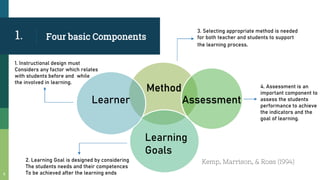
Four basic Components
6
Method
Assessment
Learning
Goals
Learner
3. Selecting appropriate method is needed
for both teacher and students to support
the learning process.
4. Assessment is an
important component to
assess the students
performance to achieve
the indicators and the
goal of learning.
2. Learning Goal is designed by considering
The students needs and their competences
To be achieved after the learning ends
1. Instructional design must
Considers any factor which relates
with students before and while
the involved in learning.
1.
Kemp, Marrison, & Ross (1994)
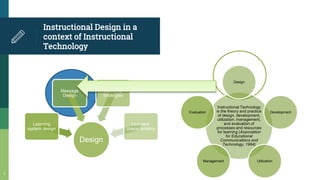
Instructional Design in a
context of Instructional
Technology
7
Instructional Technology
is the theory and practice
of design, development,
utilization, management,
and evaluation of
processes and resources
for learning (Association
for Educational
Communications and
Technology, 1994)
Design
Development
UtilizationManagement
Evaluation
Design
Learning
system design
Message
Design
Learning
Strategies
Learners’
characteristics
Conclusion
Instructional Design is the first process in preparing
learning. The process of preparation will affect the
learning process thus it needs careful decision to
design strategic plan to facilitate students’ learning.
8
References
▪ Reigeluth, C.M. 1983. Instructional- Design Theories and Models: An
Overview of their Current Status. New Jersey: Lawrence Erlbaum
Associates. Inc.
▪ Gagne, Briggs and Wager. 1992. Principles of Instructional Design.
4th edition. Florida: Harcourt Brace College Publishers.
▪ Gafur, A. 2012. Desain Pembelajaran: Konsep, Model dan Aplikasinya
dalam Perencanaan Pelaksanaan Pembelajaran. Yogyakarta: Ombak.
▪ Prawiradilaga, D.S. and Universitas Negeri Jakarta. 2007. Prinsip
Desain Pembelajaran. Jakarta: Kencana.
9

Instructional design concept

  • 1.
    INSTRUCTIONAL DESIGN CONCEPT Rizki FaraniS.Pd., M.Pd. Prodi Pendidikan Bahasa Inggris Fakultas Psikologi dan Ilmu Sosial Budaya Universitas Islam Indonesia
  • 2.
    Definition of Instructional Design 2 ExpertiseDefinitions Reigeluth (1983) “the process of deciding what methods of instruction are best for bringing about desired changes in student knowledge and skills for a specific course content and a specific student population” Gagne, Briggs. & Wager (1992) “A set of events of learning to facilitate students' learning Gentry (1994) cited in Prawiradilaga (2007) A Process of formulate and determine learning objective, strategies technique and media to achieve learning goals. Morisson, Gary R., Steven, R., Jerold, K. cited in Gafur, 2012) A strategic plan of a course as a blue print to help us connect all of the dots to see a clear picture of teaching and learning events.
  • 3.
    What is Instractional Design? 3 Morisson, GaryR., Steven, R., Jerold, K. cited in Gafur, 2012)
  • 4.
    Basic Assumptions of InstructionalDesign (Gagne, Briggs. & Wager (1992) 4 No Assumptions Description 1 Aiding the learning of the individual The instruction is oriented to the individual. 2 Immediate process VS long range process An Institution provides a long range process of preparation to facilitate teachers to prepare immediate lesson plans. 3 Affecting individual human development. Ensure that no one is "educationally disadvantaged“. All students have equal opportunities to use their individual talents to the fullest degree. 4 Instructional design should be conducted by means of a systems approach. Analyze every learning step Systematically 5 Designed instruction must be based on knowledge of how human beings learn. Considering learning conditions to establish learning effects
  • 5.
  • 6.
    Four basic Components 6 Method Assessment Learning Goals Learner 3.Selecting appropriate method is needed for both teacher and students to support the learning process. 4. Assessment is an important component to assess the students performance to achieve the indicators and the goal of learning. 2. Learning Goal is designed by considering The students needs and their competences To be achieved after the learning ends 1. Instructional design must Considers any factor which relates with students before and while the involved in learning. 1. Kemp, Marrison, & Ross (1994)
  • 7.
    Instructional Design ina context of Instructional Technology 7 Instructional Technology is the theory and practice of design, development, utilization, management, and evaluation of processes and resources for learning (Association for Educational Communications and Technology, 1994) Design Development UtilizationManagement Evaluation Design Learning system design Message Design Learning Strategies Learners’ characteristics
  • 8.
    Conclusion Instructional Design isthe first process in preparing learning. The process of preparation will affect the learning process thus it needs careful decision to design strategic plan to facilitate students’ learning. 8
  • 9.
    References ▪ Reigeluth, C.M.1983. Instructional- Design Theories and Models: An Overview of their Current Status. New Jersey: Lawrence Erlbaum Associates. Inc. ▪ Gagne, Briggs and Wager. 1992. Principles of Instructional Design. 4th edition. Florida: Harcourt Brace College Publishers. ▪ Gafur, A. 2012. Desain Pembelajaran: Konsep, Model dan Aplikasinya dalam Perencanaan Pelaksanaan Pembelajaran. Yogyakarta: Ombak. ▪ Prawiradilaga, D.S. and Universitas Negeri Jakarta. 2007. Prinsip Desain Pembelajaran. Jakarta: Kencana. 9