Chapter 8

DEVELOPING AN
INSTRUCTIONAL STRATEGY
SELECTION OF A DELIVERY SYSTEM
(pg. 166-168)
 There is usually a general methodology that is

used for managing and delivering the teaching
and learning activities that we call instruction
 This general methodology is referred to as the

delivery system
 Delivery system and instructional strategies

are not synonymous
 The best way to define delivery system more

precisely is through a list of examples.
 Traditional model
 Large-group lecture with small group
 Telecourse

 Computer based instruction
 Site based internship and mentoring
 In an ideal instructional design process, one

would first consider the goal, learner
characteristics , learning, and performance

context, objectives, and assessment
requirements, and then work through the

following considerations and decisions to at
arrive at the selection of the best delivery system
1.

Review the instructional analysis and identify logical
clusters of objectives that will be taught in appropriate
sequences

2.

Plan the learning components that will be used in the
instruction

3.

Choose the most effective student groupings for
learning

4.

Specify effective media and materials that are within
the range of cost, convenience, and practicality for the
learning context

5.

Assign objectives to lesson and consolidate media
CONTENT SEQUENCING AND
CLUSTERING
(pg. 168-171)
 CONTENT SEQUENCE
 The first step in developing an instructional

strategy are :
1) Identifying a teaching sequence

2) Manageable content of learning
WHAT SEQUENCE SHOULD
FOLLOW IN PRESENTING
CONTENT TO THE LEARNER ??
 The most useful tool in determining the answer to

this question is your instructional analysis.
 You will generally begin with the lower level

subordinate skills on the left and work your up way
through hierarchy until you reach the main goal
step.
 It is not a good idea to present information about a

skill until you have presented information on all
related subordinate skill.
 Work your own way from left, the beginning point

and proceed to the right.
 If there are subordinate capabilities for any of the

major steps, then they would be taught prior to going
on to the next major component.
CLUSTERING
INSTRUCTION
 The next question is how you will group your

instructional activities.
 You may decide to present one objective at time, or

cluster several related objectives.
 Five factor when determining the amout of information

to be presented ( or the size of “cluster”)
1. The age level of your learners
2.

The age complexity of the material

3.

The type of learning taking place

4.

Whether the activity can be varied,thereby focusing
attention on the task

5.

The amount of time required to include all the events in
the instructional strategy for each cluster of content
presented
LEARNING COMPONENTS OF
INSTRUCTIONAL STRATEGY
(pg. 171-177)
 An instructional strategy describes the general

components of a set of instructional materials and
the procedures that will be used with those
materials to enabled student mastery of learning
outcomes
 The concepts of an instructional strategy
originated with the events of instruction described
in Gagne`s Conditions of Learning (1985). In this
cognitive psychologist`s view, nine events
represent external instructional activities that
support internal mental processes of learning
 Gaining attention
 Informing learner of the objective
 Stimulating recall of prerequisite learning
 Presenting the stimulus material
 Providing learning guidance
 Eliciting the performance
 Providing feedback about performance correctness
 Assessing the performance
 Enhancing retention and transfer
 The Dick and Carey model is based on this cognitive

perspective, and we teach it in this text for several
reasons
 It is grounded in learning theory
 It conforms to currently prevailing views of instruction

in public education (standards based
accountability), higher education accreditation and
business/industry/military training (performancebased)
 It is a necessary foundational system of instructional

design for new students of the field and the most
intuitive system to learn
 To facilities the instructional design process, we

have organized Gagne`s event of instruction into
five major learning components that are part of

an overall instructional strategy
1. Preinstructional activities
2. Content presentation
3. Learner participation
4. Assessment
5. Follow-through activities
 Preinstructional Activities
 Prior to beginning formal instruction, you should

consider three factors.
1. Motivating learner
2. Informing the learner of the objectives
3. Stimulating recall of prerequisite skills
 Motivating learner
 One of the typical criticisms of instruction is its lack of

interest and appeal to the learner
 One instructional designer who attempts to deal with
this problem in a systematic ways in John Keller
(1987),who developed the ARCS model based on his
review of the psychological literature on motivation.
 The 4 parts of his model
Attention, Relevance, Confidence and satisfaction
 The first aspect of motivations is to gain the attention of
learners and subsequently sustain it throughout the
instruction
 Their initial attention can be gained by using emotional
or personal information, asking questions, creating
mental challenges, and perhaps the best method of
all, using human-interest example
 The second aspect of motivation is relevance
 Instruction must be related to important goals in the

learners` lives
 For learners to be highly motivated , they must be
confident that they can master the objectives for the
instruction
 If they lack confidence, then they will be less motivated
 Learners who are overconfident are also problematic
, they see no need to attend to the instruction because
they already know it all
 High motivation depends on whether the learner
derives satisfaction from the learning experience
SUMMARY OF LEARNING
COMPONENTS
(pg. 178-179)
 The learning components of a complete

instructional strategy are summarized below in
their typical chronological sequences
A. Preinstructional Activities
1) Gain attention and motivate learners
2) Describe objective
3) Describe and promote recall of prerequisite
skills.
B. Content Presentation
1) Content
2) Learning Guidance

C. Learner Participation
1) Practice
2) Feedback
D. Assesment
1) Entry skills test
2) Pretest
3) Posttest

E. Follow through activities
1) Memory aids for retention
2) Transfer considerations
LEARNING COMPONENTS FOR
LEARNERS OF DIFFERENT MATURITY
AND ABILITY
-pg. 179 Consider different learners’ needs for instructional

strategies
 All learners could manage their own intellectual
processing; foster learning
 They would be independent learners or had “learned

how to learn”
 Should be planned selectively rather than being

provided slavishly for all learners.
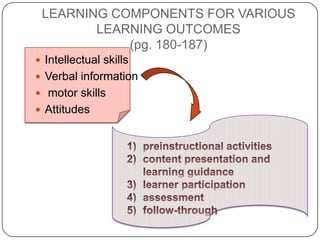
LEARNING COMPONENTS FOR VARIOUS
LEARNING OUTCOMES
(pg. 180-187)
 Intellectual skills
 Verbal information
 motor skills
 Attitudes
LEARNING COMPONENTS FOR
CONSTRUCTIVIST STRATEGIES
(pg. 187-194)
 Constructivism has roots in cognitive psychology

and has two branches:
 Cognitive constructivism
 Social constructivism

 Cognitive ID Models and constructivist planning

practices
 Table 8.2 provides a comparison of the steps in a

cognitive ID model with constructivist planning
practices.
 Theoretical considerations
 A theoretical difference pervading comparisons of

cognitive and constructivist views is rooted in the roles
of content and the learner.
 Cognitive assumption is that the content drives the
system
 The learner is the driving factor in constructivism
 Previously, more focuses on products and outcomes
but now more focuses on process
 The CLE is an instructional strategy includes goals for
learners that spring from the inquiry process instead of
from the content domain
 Driscoll (2005) describes 5 aspects of constructivism

that should be considered in ID:






1)reasoning, critical thinking, and problem solving
2)retention, understanding, and use
3) cognitive flexibility
4) self-regulation
5) mindful reflection and epistemic flexibility

 no. 3, 4, and 5 collectively called metacognition

 Other capabilities that Gagne described as cognitive

strategies.
 Reason for choosing CLEs – when the original goal
is learning to solve ill-defined problems and develop
cognitive strategies
 Designing Constructivist Learning Environments
 Reasoning, critical thinking, and problem solving
 Complex, realistic and relevant
 Retention, understanding, use
 Providing for interaction among learners, peers, and teachers
 Cognitive flexibility
 Ability to adapt and change one’s mental organization of
knowledge and mental management of solution strategies for
solving new, unexpected problem
 Self-regulation
 Identifying learning outcomes of personal interest or value
and choosing to pursue them
 Mindful reflection and epistemic flexibility
 Reflected by learners who maintain awareness of their own
process of constructing knowledge and choosing ways of
learning and knowing
 Planning Constructivist Learning Environments
 The designer must also decide the best path for lear

 Considerations of several factors: Considerations of learners’ characteristic -

ability, maturity, and experience
 The skills of the teacher, trainer, or instructional
manager
STUDENT GROUPINGS
(pg. 194-195)
 Planning the learning components of an

instructional of an instructional strategy – need to
plans the details of student groupings and media
selections
 Type of student grouping – individual, pairs, small
group and large group – depends on specific
social interaction requirements
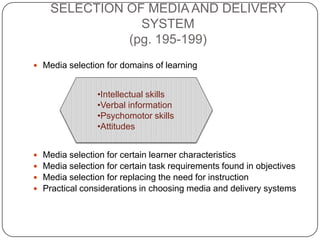
SELECTION OF MEDIA AND DELIVERY
SYSTEM
(pg. 195-199)
 Media selection for domains of learning

•Intellectual skills
•Verbal information
•Psychomotor skills
•Attitudes





Media selection for certain learner characteristics
Media selection for certain task requirements found in objectives
Media selection for replacing the need for instruction
Practical considerations in choosing media and delivery systems

Topic 8: developing an instructional strategy

  • 1.
  • 2.
    SELECTION OF ADELIVERY SYSTEM (pg. 166-168)  There is usually a general methodology that is used for managing and delivering the teaching and learning activities that we call instruction  This general methodology is referred to as the delivery system  Delivery system and instructional strategies are not synonymous
  • 3.
     The bestway to define delivery system more precisely is through a list of examples.  Traditional model  Large-group lecture with small group  Telecourse  Computer based instruction  Site based internship and mentoring
  • 4.
     In anideal instructional design process, one would first consider the goal, learner characteristics , learning, and performance context, objectives, and assessment requirements, and then work through the following considerations and decisions to at arrive at the selection of the best delivery system
  • 5.
    1. Review the instructionalanalysis and identify logical clusters of objectives that will be taught in appropriate sequences 2. Plan the learning components that will be used in the instruction 3. Choose the most effective student groupings for learning 4. Specify effective media and materials that are within the range of cost, convenience, and practicality for the learning context 5. Assign objectives to lesson and consolidate media
  • 6.
    CONTENT SEQUENCING AND CLUSTERING (pg.168-171)  CONTENT SEQUENCE  The first step in developing an instructional strategy are : 1) Identifying a teaching sequence 2) Manageable content of learning
  • 7.
    WHAT SEQUENCE SHOULD FOLLOWIN PRESENTING CONTENT TO THE LEARNER ??  The most useful tool in determining the answer to this question is your instructional analysis.  You will generally begin with the lower level subordinate skills on the left and work your up way through hierarchy until you reach the main goal step.
  • 8.
     It isnot a good idea to present information about a skill until you have presented information on all related subordinate skill.  Work your own way from left, the beginning point and proceed to the right.  If there are subordinate capabilities for any of the major steps, then they would be taught prior to going on to the next major component.
  • 9.
    CLUSTERING INSTRUCTION  The nextquestion is how you will group your instructional activities.  You may decide to present one objective at time, or cluster several related objectives.
  • 10.
     Five factorwhen determining the amout of information to be presented ( or the size of “cluster”) 1. The age level of your learners 2. The age complexity of the material 3. The type of learning taking place 4. Whether the activity can be varied,thereby focusing attention on the task 5. The amount of time required to include all the events in the instructional strategy for each cluster of content presented
  • 11.
    LEARNING COMPONENTS OF INSTRUCTIONALSTRATEGY (pg. 171-177)  An instructional strategy describes the general components of a set of instructional materials and the procedures that will be used with those materials to enabled student mastery of learning outcomes  The concepts of an instructional strategy originated with the events of instruction described in Gagne`s Conditions of Learning (1985). In this cognitive psychologist`s view, nine events represent external instructional activities that support internal mental processes of learning
  • 12.
     Gaining attention Informing learner of the objective  Stimulating recall of prerequisite learning  Presenting the stimulus material  Providing learning guidance  Eliciting the performance  Providing feedback about performance correctness  Assessing the performance  Enhancing retention and transfer
  • 13.
     The Dickand Carey model is based on this cognitive perspective, and we teach it in this text for several reasons  It is grounded in learning theory  It conforms to currently prevailing views of instruction in public education (standards based accountability), higher education accreditation and business/industry/military training (performancebased)  It is a necessary foundational system of instructional design for new students of the field and the most intuitive system to learn
  • 14.
     To facilitiesthe instructional design process, we have organized Gagne`s event of instruction into five major learning components that are part of an overall instructional strategy 1. Preinstructional activities 2. Content presentation 3. Learner participation 4. Assessment 5. Follow-through activities
  • 15.
     Preinstructional Activities Prior to beginning formal instruction, you should consider three factors. 1. Motivating learner 2. Informing the learner of the objectives 3. Stimulating recall of prerequisite skills
  • 16.
     Motivating learner One of the typical criticisms of instruction is its lack of interest and appeal to the learner  One instructional designer who attempts to deal with this problem in a systematic ways in John Keller (1987),who developed the ARCS model based on his review of the psychological literature on motivation.  The 4 parts of his model Attention, Relevance, Confidence and satisfaction  The first aspect of motivations is to gain the attention of learners and subsequently sustain it throughout the instruction  Their initial attention can be gained by using emotional or personal information, asking questions, creating mental challenges, and perhaps the best method of all, using human-interest example
  • 17.
     The secondaspect of motivation is relevance  Instruction must be related to important goals in the learners` lives  For learners to be highly motivated , they must be confident that they can master the objectives for the instruction  If they lack confidence, then they will be less motivated  Learners who are overconfident are also problematic , they see no need to attend to the instruction because they already know it all  High motivation depends on whether the learner derives satisfaction from the learning experience
  • 18.
    SUMMARY OF LEARNING COMPONENTS (pg.178-179)  The learning components of a complete instructional strategy are summarized below in their typical chronological sequences A. Preinstructional Activities 1) Gain attention and motivate learners 2) Describe objective 3) Describe and promote recall of prerequisite skills.
  • 19.
    B. Content Presentation 1)Content 2) Learning Guidance C. Learner Participation 1) Practice 2) Feedback
  • 20.
    D. Assesment 1) Entryskills test 2) Pretest 3) Posttest E. Follow through activities 1) Memory aids for retention 2) Transfer considerations
  • 21.
    LEARNING COMPONENTS FOR LEARNERSOF DIFFERENT MATURITY AND ABILITY -pg. 179 Consider different learners’ needs for instructional strategies  All learners could manage their own intellectual processing; foster learning  They would be independent learners or had “learned how to learn”  Should be planned selectively rather than being provided slavishly for all learners.
  • 22.
    LEARNING COMPONENTS FORVARIOUS LEARNING OUTCOMES (pg. 180-187)  Intellectual skills  Verbal information  motor skills  Attitudes
  • 23.
    LEARNING COMPONENTS FOR CONSTRUCTIVISTSTRATEGIES (pg. 187-194)  Constructivism has roots in cognitive psychology and has two branches:  Cognitive constructivism  Social constructivism  Cognitive ID Models and constructivist planning practices  Table 8.2 provides a comparison of the steps in a cognitive ID model with constructivist planning practices.
  • 24.
     Theoretical considerations A theoretical difference pervading comparisons of cognitive and constructivist views is rooted in the roles of content and the learner.  Cognitive assumption is that the content drives the system  The learner is the driving factor in constructivism  Previously, more focuses on products and outcomes but now more focuses on process  The CLE is an instructional strategy includes goals for learners that spring from the inquiry process instead of from the content domain
  • 25.
     Driscoll (2005)describes 5 aspects of constructivism that should be considered in ID:      1)reasoning, critical thinking, and problem solving 2)retention, understanding, and use 3) cognitive flexibility 4) self-regulation 5) mindful reflection and epistemic flexibility  no. 3, 4, and 5 collectively called metacognition  Other capabilities that Gagne described as cognitive strategies.  Reason for choosing CLEs – when the original goal is learning to solve ill-defined problems and develop cognitive strategies
  • 26.
     Designing ConstructivistLearning Environments  Reasoning, critical thinking, and problem solving  Complex, realistic and relevant  Retention, understanding, use  Providing for interaction among learners, peers, and teachers  Cognitive flexibility  Ability to adapt and change one’s mental organization of knowledge and mental management of solution strategies for solving new, unexpected problem  Self-regulation  Identifying learning outcomes of personal interest or value and choosing to pursue them  Mindful reflection and epistemic flexibility  Reflected by learners who maintain awareness of their own process of constructing knowledge and choosing ways of learning and knowing
  • 27.
     Planning ConstructivistLearning Environments  The designer must also decide the best path for lear  Considerations of several factors: Considerations of learners’ characteristic - ability, maturity, and experience  The skills of the teacher, trainer, or instructional manager
  • 28.
    STUDENT GROUPINGS (pg. 194-195) Planning the learning components of an instructional of an instructional strategy – need to plans the details of student groupings and media selections  Type of student grouping – individual, pairs, small group and large group – depends on specific social interaction requirements
  • 29.
    SELECTION OF MEDIAAND DELIVERY SYSTEM (pg. 195-199)  Media selection for domains of learning •Intellectual skills •Verbal information •Psychomotor skills •Attitudes     Media selection for certain learner characteristics Media selection for certain task requirements found in objectives Media selection for replacing the need for instruction Practical considerations in choosing media and delivery systems