June 5, 2020, 8:00 AM
via Google Meet
MOST ESSENTIAL LEARNING
COMPETENCIES (MELC)
IN
ENGLISH
REY EWAY VILLAGRACIA
School English Coordinator/ SLAC Focal Person
177
178
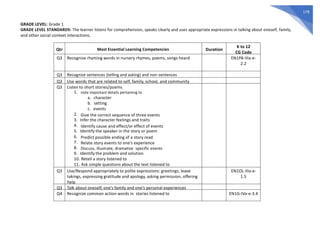
GRADE LEVEL: Grade 1
GRADE LEVEL STANDARDS: The learner listens for comprehension, speaks clearly and uses appropriate expressions in talking about oneself, family,
and other social context interactions.
Qtr Most Essential Learning Competencies Duration
K to 12
CG Code
Q3 Recognize rhyming words in nursery rhymes, poems, songs heard EN1PA-IIIa-e-
2.2
Q3 Recognize sentences (telling and asking) and non-sentences
Q3 Use words that are related to self, family, school, and community
Q3 Listen to short stories/poems
1. note important details pertaining to
a. character
b. setting
c. events
2. Give the correct sequence of three events
3. Infer the character feelings and traits
4. Identify cause and effect/or effect of events
5. Identify the speaker in the story or poem
6. Predict possible ending of a story read
7. Relate story events to one’s experience
8. Discuss, illustrate, dramatize specific events
9. Identify the problem and solution
10. Retell a story listened to
11. Ask simple questions about the text listened to
Q3 Use/Respond appropriately to polite expressions: greetings, leave
takings, expressing gratitude and apology, asking permission, offering
help
EN1OL-IIIa-e-
1.5
Q3 Talk about oneself, one’s family and one’s personal experiences
Q4 Recognize common action words in stories listened to EN1G-IVa-e-3.4
179
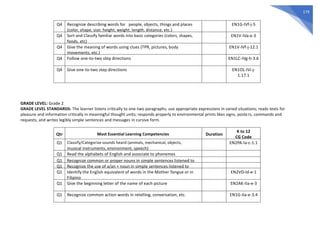
Q4 Recognize describing words for people, objects, things and places
(color, shape, size, height, weight, length, distance, etc.)
EN1G-IVf-j-5
Q4 Sort and Classify familiar words into basic categories (colors, shapes,
foods, etc)
EN1V-IVa-e-3
Q4 Give the meaning of words using clues (TPR, pictures, body
movements, etc.)
EN1V-IVf-j-12.1
Q4 Follow one-to-two step directions EN1LC-IVg-h-3.6
Q4 Give one-to-two step directions EN1OL-IVi-j-
1.17.1
GRADE LEVEL: Grade 2
GRADE LEVEL STANDARDS: The learner listens critically to one-two paragraphs; use appropriate expressions in varied situations; reads texts for
pleasure and information critically in meaningful thought units; responds properly to environmental prints likes signs, posters, commands and
requests; and writes legibly simple sentences and messages in cursive form.
Qtr Most Essential Learning Competencies Duration
K to 12
CG Code
Q1 Classify/Categorize sounds heard (animals, mechanical, objects,
musical instruments, environment, speech)
EN2PA-Ia-c-1.1
Q1 Read the alphabets of English and associate to phonemes
Q1 Recognize common or proper nouns in simple sentences listened to
Q1 Recognize the use of a/an + noun in simple sentences listened to
Q1 Identify the English equivalent of words in the Mother Tongue or in
Filipino
EN2VD-Id-e-1
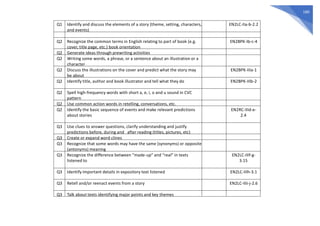
Q1 Give the beginning letter of the name of each picture EN2AK-IIa-e-3
Q1 Recognize common action words in retelling, conversation, etc. EN1G-IIa-e-3.4
180
Q1 Identify and discuss the elements of a story (theme, setting, characters,
and events)
EN2LC-IIa-b-2.2
Q2 Recognize the common terms in English relating to part of book (e.g.
cover, title page, etc.) book orientation
EN2BPK-Ib-c-4
Q2 Generate ideas through prewriting activities
Q2 Writing some words, a phrase, or a sentence about an illustration or a
character
Q2 Discuss the illustrations on the cover and predict what the story may
be about
EN2BPK-IIIa-1
Q2 Identify title, author and book illustrator and tell what they do EN2BPK-IIIb-2
Q2 Spell high-frequency words with short a, e, i, o and u sound in CVC
pattern
Q2 Use common action words in retelling, conversations, etc.
Q2 Identify the basic sequence of events and make relevant predictions
about stories
EN2RC-IIId-e-
2.4
Q3 Use clues to answer questions, clarify understanding and justify
predictions before, during and after reading (titles, pictures, etc)
Q3 Create or expand word clines
Q3 Recognize that some words may have the same (synonyms) or opposite
(antonyms) meaning
Q3 Recognize the difference between “made-up” and “real” in texts
listened to
EN2LC-IIIf-g-
3.15
Q3 Identify important details in expository text listened EN2LC-IIIh-3.1
Q3 Retell and/or reenact events from a story EN2LC-IIIi-j-2.6
Q3 Talk about texts identifying major points and key themes
181
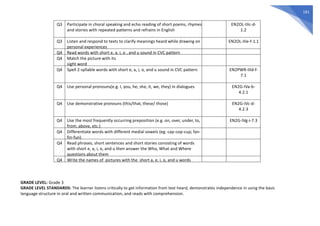
Q3 Participate in choral speaking and echo reading of short poems, rhymes
and stories with repeated patterns and refrains in English
EN2OL-IIIc-d-
1.2
Q3 Listen and respond to texts to clarify meanings heard while drawing on
personal experiences
EN2OL-IIIe-f-1.1
Q4 Read words with short e, a, i, o , and u sound in CVC pattern
Q4 Match the picture with its
sight word
Q4 Spell 2-syllable words with short e, a, i, o, and u sound in CVC pattern EN2PWR-IIId-f-
7.1
Q4 Use personal pronouns(e.g. I, you, he, she, it, we, they) in dialogues EN2G-IVa-b-
4.2.1
Q4 Use demonstrative pronouns (this/that, these/ those) EN2G-IVc-d-
4.2.3
Q4 Use the most frequently occurring preposition (e.g. on, over, under, to,
from, above, etc.)
EN2G-IVg-i-7.3
Q4 Differentiate words with different medial vowels (eg: cap-cop-cup; fan-
fin-fun)
Q4 Read phrases, short sentences and short stories consisting of words
with short e, a, i, o, and u then answer the Who, What and Where
questions about them
Q4 Write the names of pictures with the short a, e, i, o, and u words
GRADE LEVEL: Grade 3
GRADE LEVEL STANDARDS: The learner listens critically to get information from text heard, demonstrates independence in using the basic
language structure in oral and written communication, and reads with comprehension.
182
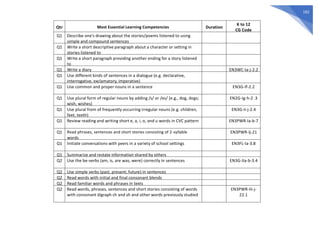
Qtr Most Essential Learning Competencies Duration
K to 12
CG Code
Q1 Describe one’s drawing about the stories/poems listened to using
simple and compound sentences
Q1 Write a short descriptive paragraph about a character or setting in
stories listened to
Q1 Write a short paragraph providing another ending for a story listened
to
Q1 Write a diary EN3WC-Ia-j-2.2
Q1 Use different kinds of sentences in a dialogue (e.g. declarative,
interrogative, exclamatory, imperative)
Q1 Use common and proper nouns in a sentence EN3G-If-2.2
Q1 Use plural form of regular nouns by adding /s/ or /es/ (e.g., dog, dogs;
wish, wishes)
EN2G-Ig-h-2 .3
Q1 Use plural from of frequently occurring irregular nouns (e.g. children,
feet, teeth)
EN3G-Ii-j-2.4
Q1 Review reading and writing short e, a, i, o, and u words in CVC pattern EN3PWR-Ia-b-7
Q1 Read phrases, sentences and short stories consisting of 2-syllable
words
EN3PWR-Ij-21
Q1 Initiate conversations with peers in a variety of school settings EN3FL-Ia-3.8
Q1 Summarize and restate information shared by others
Q2 Use the be-verbs (am, is, are was, were) correctly in sentences EN3G-IIa-b-3.4
Q2 Use simple verbs (past, present, future) in sentences
Q2 Read words with initial and final consonant blends
Q2 Read familiar words and phrases in texts
Q2 Read words, phrases, sentences and short stories consisting of words
with consonant digraph ch and sh and other words previously studied
EN3PWR-IIi-j-
22.1
183
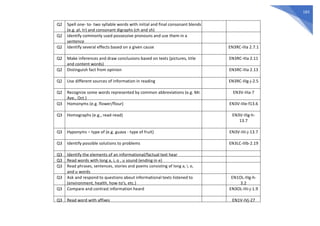
Q2 Spell one- to- two syllable words with initial and final consonant blends
(e.g. pl, tr) and consonant digraphs (ch and sh)
Q2 Identify commonly used possessive pronouns and use them in a
sentence
Q2 Identify several effects based on a given cause EN3RC-IIIa 2.7.1
Q2 Make inferences and draw conclusions based on texts (pictures, title
and content words)
EN3RC-IIIa 2.11
Q2 Distinguish fact from opinion EN3RC-IIIa 2.13
Q2 Use different sources of information in reading EN3RC-IIIg-j-2.5
Q2 Recognize some words represented by common abbreviations (e.g. Mr.
Ave., Oct.)
EN3V-IIIa-7
Q3 Homonyms (e.g. flower/flour) EN3V-IIIe-f13.6
Q3 Homographs (e.g., read-read) EN3V-IIIg-h-
13.7
Q3 Hyponyms – type of (e.g. guava - type of fruit) EN3V-IIIi-j-13.7
Q3 Identify possible solutions to problems EN3LC-IIIb-2.19
Q3 Identify the elements of an informational/factual text hear
Q3 Read words with long a, i, o , u sound (ending in e)
Q3 Read phrases, sentences, stories and poems consisting of long a, i, o,
and u words
Q3 Ask and respond to questions about informational texts listened to
(environment, health, how-to’s, etc.)
EN1OL-IIIg-h-
3.2
Q3 Compare and contrast information heard EN3OL-IIIi-j-1.9
Q3 Read word with affixes EN1V-IVj-27
184
Q3 Write a simple story EN2WC-IVa-e-
22
Q4 Use the degrees of adjectives in making comparisons (positive,
comparative, superlative)
EN3G-IVi-j-5.2
Q4 Recognize adverbs of manner EN3G-IVi-j-6.1
Q4 Interpret simple maps of unfamiliar places, signs and symbols
Q4 Interpret simple graphs, tables, and pictographs
Q4 Restate facts from informational texts (climate change, children’s
rights, traffic safety, etc.) listened to
EN3LC-IVi-j-3.5
Q4 Read words containing vowel digraphs - ai, ay, ea, ee, oo, oa
Q4 Read phrases, sentences and stories with vowel digraphs - ai, ay, ea,
ee, oo, oa
Q4 Read words with vowel diphthongs: oy (boy), oi (boil), ou (out) ow
(bow)
Q4 Read phrases, sentences and short stories consisting vowel diphthongs:
oy, oi, ou, ow
Q4 Recognize and read some irregularly spelled words (e.g. such as
enough, through, beautiful)
EN3PWR-IVj-22
Q4 Present information in varied artistic ways (e.g. role playing, show and
tell, radio play/podcast/broadcast/reporting/poster presentations)
EN3OL-IVa-e-
1.19
GRADE LEVEL: Grade 4
GRADE LEVEL STANDARDS: The learner listens critically to various text types and expresses ideas accurately in both oral and written forms;
demonstrates confidence in the use of the language to meet everyday needs; and reads independently and gets relevant informat ion from various
text types.
Qtr Most Essential Learning Competencies Duration K to 12
185
CG Code
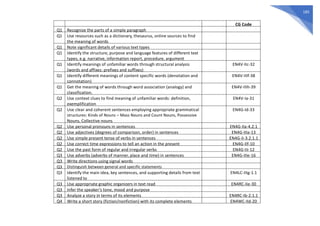
Q1 Recognize the parts of a simple paragraph
Q1 Use resources such as a dictionary, thesaurus, online sources to find
the meaning of words
Q1 Note significant details of various text types
Q1 Identify the structure, purpose and language features of different text
types, e.g. narrative, information report, procedure, argument
Q1 Identify meanings of unfamiliar words through structural analysis
(words and affixes: prefixes and suffixes)
EN4V-IIc-32
Q1 Identify different meanings of content specific words (denotation and
connotation)
EN4V-IIIf-38
Q1 Get the meaning of words through word association (analogy) and
classification.
EN4V-IIIh-39
Q2 Use context clues to find meaning of unfamiliar words: definition,
exemplification
EN4V-Ia-31
Q2 Use clear and coherent sentences employing appropriate grammatical
structures: Kinds of Nouns – Mass Nouns and Count Nouns, Possessive
Nouns, Collective nouns
EN4G-Id-33
Q2 Use personal pronouns in sentences EN4G-IIa-4.2.1
Q2 Use adjectives (degrees of comparison, order) in sentences EN4G-IIIa-13
Q2 Use simple present tense of verbs in sentences EN4G-Ii-3.2.1.1
Q2 Use correct time expressions to tell an action in the present EN4G-IIf-10
Q2 Use the past form of regular and irregular verbs EN4G-IIi-12
Q3 Use adverbs (adverbs of manner, place and time) in sentences EN4G-IIIe-16
Q3 Write directions using signal words
Q3 Distinguish between general and specific statements
Q3 Identify the main idea, key sentences, and supporting details from text
listened to
EN4LC-IIIg-1.1
Q3 Use appropriate graphic organizers in text read EN4RC-IIe-30
Q3 Infer the speaker’s tone, mood and purpose
Q3 Analyze a story in terms of its elements EN4RC-Ib-2.1.1
Q4 Write a short story (fiction/nonfiction) with its complete elements EN4WC-IId-20
186
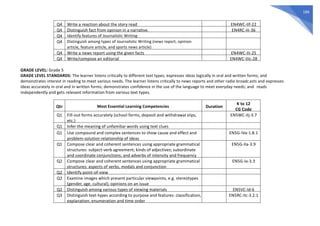
Q4 Write a reaction about the story read EN4WC-IIf-22
Q4 Distinguish fact from opinion in a narrative. EN4RC-IIi-36
Q4 Identify features of Journalistic Writing
Q4 Distinguish among types of Journalistic Writing (news report, opinion
article, feature article, and sports news article)
Q4 Write a news report using the given facts EN4WC-IIi-25
Q4 Write/compose an editorial EN4WC-IIIc-28
GRADE LEVEL: Grade 5
GRADE LEVEL STANDARDS: The learner listens critically to different text types; expresses ideas logically in oral and written forms; and
demonstrates interest in reading to meet various needs. The learner listens critically to news reports and other radio broadcasts and expresses
ideas accurately in oral and in written forms; demonstrates confidence in the use of the language to meet everyday needs; and reads
independently and gets relevant information from various text types.
Qtr Most Essential Learning Competencies Duration
K to 12
CG Code
Q1 Fill-out forms accurately (school forms, deposit and withdrawal slips,
etc.)
EN5WC-IIj-3.7
Q1 Infer the meaning of unfamiliar words using text clues
Q1 Use compound and complex sentences to show cause and effect and
problem-solution relationship of ideas
EN5G-IVa-1.8.1
Q1 Compose clear and coherent sentences using appropriate grammatical
structures: subject-verb agreement; kinds of adjectives; subordinate
and coordinate conjunctions; and adverbs of intensity and frequency
EN5G-IIa-3.9
Q2 Compose clear and coherent sentences using appropriate grammatical
structures: aspects of verbs, modals and conjunction
EN5G-Ia-3.3
Q2 Identify point-of-view
Q2 Examine images which present particular viewpoints, e.g. stereotypes
(gender, age, cultural), opinions on an issue
Q2 Distinguish among various types of viewing materials EN5VC-Id-6
Q3 Distinguish text-types according to purpose and features: classification,
explanation, enumeration and time order
EN5RC-IIc-3.2.1
187
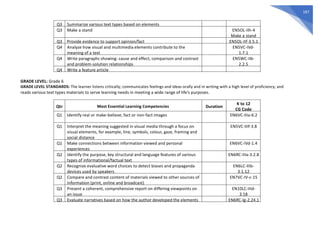
Q3 Summarize various text types based on elements
Q3 Make a stand EN5OL-IIh-4
Make a stand
Q3 Provide evidence to support opinion/fact EN5OL-IIf-3.5.1
Q4 Analyze how visual and multimedia elements contribute to the
meaning of a text
EN5VC-IVd-
1.7.1
Q4 Write paragraphs showing: cause and effect, comparison and contrast
and problem-solution relationships
EN5WC-IIb-
2.2.5
Q4 Write a feature article
GRADE LEVEL: Grade 6
GRADE LEVEL STANDARDS: The learner listens critically; communicates feelings and ideas orally and in writing with a high level of proficiency; and
reads various text types materials to serve learning needs in meeting a wide range of life’s purposes.
Qtr Most Essential Learning Competencies Duration
K to 12
CG Code
Q1 Identify real or make-believe, fact or non-fact images EN6VC-IIIa-6.2
Q1 Interpret the meaning suggested in visual media through a focus on
visual elements, for example, line, symbols, colour, gaze, framing and
social distance
EN5VC-IIIf-3.8
Q1 Make connections between information viewed and personal
experiences
EN6VC-IVd-1.4
Q2 Identify the purpose, key structural and language features of various
types of informational/factual text
EN6RC-IIIa-3.2.8
Q2 Recognize evaluative word choices to detect biases and propaganda
devices used by speakers
EN6LC-IIIb-
3.1.12
Q2 Compare and contrast content of materials viewed to other sources of
information (print, online and broadcast)
EN7VC-IV-c-15
Q3 Present a coherent, comprehensive report on differing viewpoints on
an issue
EN10LC-IIId-
3.18
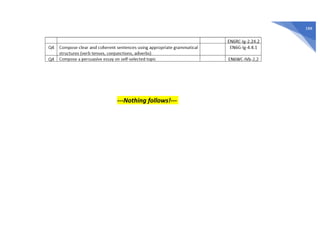
Q3 Evaluate narratives based on how the author developed the elements EN6RC-Ig-2.24.1
---Nothing follows!---

Elementary English MELCs with Grade Level Standards (For Sharing)

  • 1.
    June 5, 2020,8:00 AM via Google Meet MOST ESSENTIAL LEARNING COMPETENCIES (MELC) IN ENGLISH REY EWAY VILLAGRACIA School English Coordinator/ SLAC Focal Person
  • 2.
  • 3.
    178 GRADE LEVEL: Grade1 GRADE LEVEL STANDARDS: The learner listens for comprehension, speaks clearly and uses appropriate expressions in talking about oneself, family, and other social context interactions. Qtr Most Essential Learning Competencies Duration K to 12 CG Code Q3 Recognize rhyming words in nursery rhymes, poems, songs heard EN1PA-IIIa-e- 2.2 Q3 Recognize sentences (telling and asking) and non-sentences Q3 Use words that are related to self, family, school, and community Q3 Listen to short stories/poems 1. note important details pertaining to a. character b. setting c. events 2. Give the correct sequence of three events 3. Infer the character feelings and traits 4. Identify cause and effect/or effect of events 5. Identify the speaker in the story or poem 6. Predict possible ending of a story read 7. Relate story events to one’s experience 8. Discuss, illustrate, dramatize specific events 9. Identify the problem and solution 10. Retell a story listened to 11. Ask simple questions about the text listened to Q3 Use/Respond appropriately to polite expressions: greetings, leave takings, expressing gratitude and apology, asking permission, offering help EN1OL-IIIa-e- 1.5 Q3 Talk about oneself, one’s family and one’s personal experiences Q4 Recognize common action words in stories listened to EN1G-IVa-e-3.4
  • 4.
    179 Q4 Recognize describingwords for people, objects, things and places (color, shape, size, height, weight, length, distance, etc.) EN1G-IVf-j-5 Q4 Sort and Classify familiar words into basic categories (colors, shapes, foods, etc) EN1V-IVa-e-3 Q4 Give the meaning of words using clues (TPR, pictures, body movements, etc.) EN1V-IVf-j-12.1 Q4 Follow one-to-two step directions EN1LC-IVg-h-3.6 Q4 Give one-to-two step directions EN1OL-IVi-j- 1.17.1 GRADE LEVEL: Grade 2 GRADE LEVEL STANDARDS: The learner listens critically to one-two paragraphs; use appropriate expressions in varied situations; reads texts for pleasure and information critically in meaningful thought units; responds properly to environmental prints likes signs, posters, commands and requests; and writes legibly simple sentences and messages in cursive form. Qtr Most Essential Learning Competencies Duration K to 12 CG Code Q1 Classify/Categorize sounds heard (animals, mechanical, objects, musical instruments, environment, speech) EN2PA-Ia-c-1.1 Q1 Read the alphabets of English and associate to phonemes Q1 Recognize common or proper nouns in simple sentences listened to Q1 Recognize the use of a/an + noun in simple sentences listened to Q1 Identify the English equivalent of words in the Mother Tongue or in Filipino EN2VD-Id-e-1 Q1 Give the beginning letter of the name of each picture EN2AK-IIa-e-3 Q1 Recognize common action words in retelling, conversation, etc. EN1G-IIa-e-3.4
  • 5.
    180 Q1 Identify anddiscuss the elements of a story (theme, setting, characters, and events) EN2LC-IIa-b-2.2 Q2 Recognize the common terms in English relating to part of book (e.g. cover, title page, etc.) book orientation EN2BPK-Ib-c-4 Q2 Generate ideas through prewriting activities Q2 Writing some words, a phrase, or a sentence about an illustration or a character Q2 Discuss the illustrations on the cover and predict what the story may be about EN2BPK-IIIa-1 Q2 Identify title, author and book illustrator and tell what they do EN2BPK-IIIb-2 Q2 Spell high-frequency words with short a, e, i, o and u sound in CVC pattern Q2 Use common action words in retelling, conversations, etc. Q2 Identify the basic sequence of events and make relevant predictions about stories EN2RC-IIId-e- 2.4 Q3 Use clues to answer questions, clarify understanding and justify predictions before, during and after reading (titles, pictures, etc) Q3 Create or expand word clines Q3 Recognize that some words may have the same (synonyms) or opposite (antonyms) meaning Q3 Recognize the difference between “made-up” and “real” in texts listened to EN2LC-IIIf-g- 3.15 Q3 Identify important details in expository text listened EN2LC-IIIh-3.1 Q3 Retell and/or reenact events from a story EN2LC-IIIi-j-2.6 Q3 Talk about texts identifying major points and key themes
  • 6.
    181 Q3 Participate inchoral speaking and echo reading of short poems, rhymes and stories with repeated patterns and refrains in English EN2OL-IIIc-d- 1.2 Q3 Listen and respond to texts to clarify meanings heard while drawing on personal experiences EN2OL-IIIe-f-1.1 Q4 Read words with short e, a, i, o , and u sound in CVC pattern Q4 Match the picture with its sight word Q4 Spell 2-syllable words with short e, a, i, o, and u sound in CVC pattern EN2PWR-IIId-f- 7.1 Q4 Use personal pronouns(e.g. I, you, he, she, it, we, they) in dialogues EN2G-IVa-b- 4.2.1 Q4 Use demonstrative pronouns (this/that, these/ those) EN2G-IVc-d- 4.2.3 Q4 Use the most frequently occurring preposition (e.g. on, over, under, to, from, above, etc.) EN2G-IVg-i-7.3 Q4 Differentiate words with different medial vowels (eg: cap-cop-cup; fan- fin-fun) Q4 Read phrases, short sentences and short stories consisting of words with short e, a, i, o, and u then answer the Who, What and Where questions about them Q4 Write the names of pictures with the short a, e, i, o, and u words GRADE LEVEL: Grade 3 GRADE LEVEL STANDARDS: The learner listens critically to get information from text heard, demonstrates independence in using the basic language structure in oral and written communication, and reads with comprehension.
  • 7.
    182 Qtr Most EssentialLearning Competencies Duration K to 12 CG Code Q1 Describe one’s drawing about the stories/poems listened to using simple and compound sentences Q1 Write a short descriptive paragraph about a character or setting in stories listened to Q1 Write a short paragraph providing another ending for a story listened to Q1 Write a diary EN3WC-Ia-j-2.2 Q1 Use different kinds of sentences in a dialogue (e.g. declarative, interrogative, exclamatory, imperative) Q1 Use common and proper nouns in a sentence EN3G-If-2.2 Q1 Use plural form of regular nouns by adding /s/ or /es/ (e.g., dog, dogs; wish, wishes) EN2G-Ig-h-2 .3 Q1 Use plural from of frequently occurring irregular nouns (e.g. children, feet, teeth) EN3G-Ii-j-2.4 Q1 Review reading and writing short e, a, i, o, and u words in CVC pattern EN3PWR-Ia-b-7 Q1 Read phrases, sentences and short stories consisting of 2-syllable words EN3PWR-Ij-21 Q1 Initiate conversations with peers in a variety of school settings EN3FL-Ia-3.8 Q1 Summarize and restate information shared by others Q2 Use the be-verbs (am, is, are was, were) correctly in sentences EN3G-IIa-b-3.4 Q2 Use simple verbs (past, present, future) in sentences Q2 Read words with initial and final consonant blends Q2 Read familiar words and phrases in texts Q2 Read words, phrases, sentences and short stories consisting of words with consonant digraph ch and sh and other words previously studied EN3PWR-IIi-j- 22.1
  • 8.
    183 Q2 Spell one-to- two syllable words with initial and final consonant blends (e.g. pl, tr) and consonant digraphs (ch and sh) Q2 Identify commonly used possessive pronouns and use them in a sentence Q2 Identify several effects based on a given cause EN3RC-IIIa 2.7.1 Q2 Make inferences and draw conclusions based on texts (pictures, title and content words) EN3RC-IIIa 2.11 Q2 Distinguish fact from opinion EN3RC-IIIa 2.13 Q2 Use different sources of information in reading EN3RC-IIIg-j-2.5 Q2 Recognize some words represented by common abbreviations (e.g. Mr. Ave., Oct.) EN3V-IIIa-7 Q3 Homonyms (e.g. flower/flour) EN3V-IIIe-f13.6 Q3 Homographs (e.g., read-read) EN3V-IIIg-h- 13.7 Q3 Hyponyms – type of (e.g. guava - type of fruit) EN3V-IIIi-j-13.7 Q3 Identify possible solutions to problems EN3LC-IIIb-2.19 Q3 Identify the elements of an informational/factual text hear Q3 Read words with long a, i, o , u sound (ending in e) Q3 Read phrases, sentences, stories and poems consisting of long a, i, o, and u words Q3 Ask and respond to questions about informational texts listened to (environment, health, how-to’s, etc.) EN1OL-IIIg-h- 3.2 Q3 Compare and contrast information heard EN3OL-IIIi-j-1.9 Q3 Read word with affixes EN1V-IVj-27
  • 9.
    184 Q3 Write asimple story EN2WC-IVa-e- 22 Q4 Use the degrees of adjectives in making comparisons (positive, comparative, superlative) EN3G-IVi-j-5.2 Q4 Recognize adverbs of manner EN3G-IVi-j-6.1 Q4 Interpret simple maps of unfamiliar places, signs and symbols Q4 Interpret simple graphs, tables, and pictographs Q4 Restate facts from informational texts (climate change, children’s rights, traffic safety, etc.) listened to EN3LC-IVi-j-3.5 Q4 Read words containing vowel digraphs - ai, ay, ea, ee, oo, oa Q4 Read phrases, sentences and stories with vowel digraphs - ai, ay, ea, ee, oo, oa Q4 Read words with vowel diphthongs: oy (boy), oi (boil), ou (out) ow (bow) Q4 Read phrases, sentences and short stories consisting vowel diphthongs: oy, oi, ou, ow Q4 Recognize and read some irregularly spelled words (e.g. such as enough, through, beautiful) EN3PWR-IVj-22 Q4 Present information in varied artistic ways (e.g. role playing, show and tell, radio play/podcast/broadcast/reporting/poster presentations) EN3OL-IVa-e- 1.19 GRADE LEVEL: Grade 4 GRADE LEVEL STANDARDS: The learner listens critically to various text types and expresses ideas accurately in both oral and written forms; demonstrates confidence in the use of the language to meet everyday needs; and reads independently and gets relevant informat ion from various text types. Qtr Most Essential Learning Competencies Duration K to 12
  • 10.
    185 CG Code Q1 Recognizethe parts of a simple paragraph Q1 Use resources such as a dictionary, thesaurus, online sources to find the meaning of words Q1 Note significant details of various text types Q1 Identify the structure, purpose and language features of different text types, e.g. narrative, information report, procedure, argument Q1 Identify meanings of unfamiliar words through structural analysis (words and affixes: prefixes and suffixes) EN4V-IIc-32 Q1 Identify different meanings of content specific words (denotation and connotation) EN4V-IIIf-38 Q1 Get the meaning of words through word association (analogy) and classification. EN4V-IIIh-39 Q2 Use context clues to find meaning of unfamiliar words: definition, exemplification EN4V-Ia-31 Q2 Use clear and coherent sentences employing appropriate grammatical structures: Kinds of Nouns – Mass Nouns and Count Nouns, Possessive Nouns, Collective nouns EN4G-Id-33 Q2 Use personal pronouns in sentences EN4G-IIa-4.2.1 Q2 Use adjectives (degrees of comparison, order) in sentences EN4G-IIIa-13 Q2 Use simple present tense of verbs in sentences EN4G-Ii-3.2.1.1 Q2 Use correct time expressions to tell an action in the present EN4G-IIf-10 Q2 Use the past form of regular and irregular verbs EN4G-IIi-12 Q3 Use adverbs (adverbs of manner, place and time) in sentences EN4G-IIIe-16 Q3 Write directions using signal words Q3 Distinguish between general and specific statements Q3 Identify the main idea, key sentences, and supporting details from text listened to EN4LC-IIIg-1.1 Q3 Use appropriate graphic organizers in text read EN4RC-IIe-30 Q3 Infer the speaker’s tone, mood and purpose Q3 Analyze a story in terms of its elements EN4RC-Ib-2.1.1 Q4 Write a short story (fiction/nonfiction) with its complete elements EN4WC-IId-20
  • 11.
    186 Q4 Write areaction about the story read EN4WC-IIf-22 Q4 Distinguish fact from opinion in a narrative. EN4RC-IIi-36 Q4 Identify features of Journalistic Writing Q4 Distinguish among types of Journalistic Writing (news report, opinion article, feature article, and sports news article) Q4 Write a news report using the given facts EN4WC-IIi-25 Q4 Write/compose an editorial EN4WC-IIIc-28 GRADE LEVEL: Grade 5 GRADE LEVEL STANDARDS: The learner listens critically to different text types; expresses ideas logically in oral and written forms; and demonstrates interest in reading to meet various needs. The learner listens critically to news reports and other radio broadcasts and expresses ideas accurately in oral and in written forms; demonstrates confidence in the use of the language to meet everyday needs; and reads independently and gets relevant information from various text types. Qtr Most Essential Learning Competencies Duration K to 12 CG Code Q1 Fill-out forms accurately (school forms, deposit and withdrawal slips, etc.) EN5WC-IIj-3.7 Q1 Infer the meaning of unfamiliar words using text clues Q1 Use compound and complex sentences to show cause and effect and problem-solution relationship of ideas EN5G-IVa-1.8.1 Q1 Compose clear and coherent sentences using appropriate grammatical structures: subject-verb agreement; kinds of adjectives; subordinate and coordinate conjunctions; and adverbs of intensity and frequency EN5G-IIa-3.9 Q2 Compose clear and coherent sentences using appropriate grammatical structures: aspects of verbs, modals and conjunction EN5G-Ia-3.3 Q2 Identify point-of-view Q2 Examine images which present particular viewpoints, e.g. stereotypes (gender, age, cultural), opinions on an issue Q2 Distinguish among various types of viewing materials EN5VC-Id-6 Q3 Distinguish text-types according to purpose and features: classification, explanation, enumeration and time order EN5RC-IIc-3.2.1
  • 12.
    187 Q3 Summarize varioustext types based on elements Q3 Make a stand EN5OL-IIh-4 Make a stand Q3 Provide evidence to support opinion/fact EN5OL-IIf-3.5.1 Q4 Analyze how visual and multimedia elements contribute to the meaning of a text EN5VC-IVd- 1.7.1 Q4 Write paragraphs showing: cause and effect, comparison and contrast and problem-solution relationships EN5WC-IIb- 2.2.5 Q4 Write a feature article GRADE LEVEL: Grade 6 GRADE LEVEL STANDARDS: The learner listens critically; communicates feelings and ideas orally and in writing with a high level of proficiency; and reads various text types materials to serve learning needs in meeting a wide range of life’s purposes. Qtr Most Essential Learning Competencies Duration K to 12 CG Code Q1 Identify real or make-believe, fact or non-fact images EN6VC-IIIa-6.2 Q1 Interpret the meaning suggested in visual media through a focus on visual elements, for example, line, symbols, colour, gaze, framing and social distance EN5VC-IIIf-3.8 Q1 Make connections between information viewed and personal experiences EN6VC-IVd-1.4 Q2 Identify the purpose, key structural and language features of various types of informational/factual text EN6RC-IIIa-3.2.8 Q2 Recognize evaluative word choices to detect biases and propaganda devices used by speakers EN6LC-IIIb- 3.1.12 Q2 Compare and contrast content of materials viewed to other sources of information (print, online and broadcast) EN7VC-IV-c-15 Q3 Present a coherent, comprehensive report on differing viewpoints on an issue EN10LC-IIId- 3.18 Q3 Evaluate narratives based on how the author developed the elements EN6RC-Ig-2.24.1
  • 13.