Open Access to Science: a practical Institutional Repository perspective 6th CALSI Workshop Polytechnic University of Valencia Valencia, Spain 14-16 November 2007   Dr Jessie M.N. Hey Intelligence, Agents and Multimedia Group Learning Societies Lab School of Electronics and Computer Science  University of Southampton, UK http://eprints.soton.ac.uk
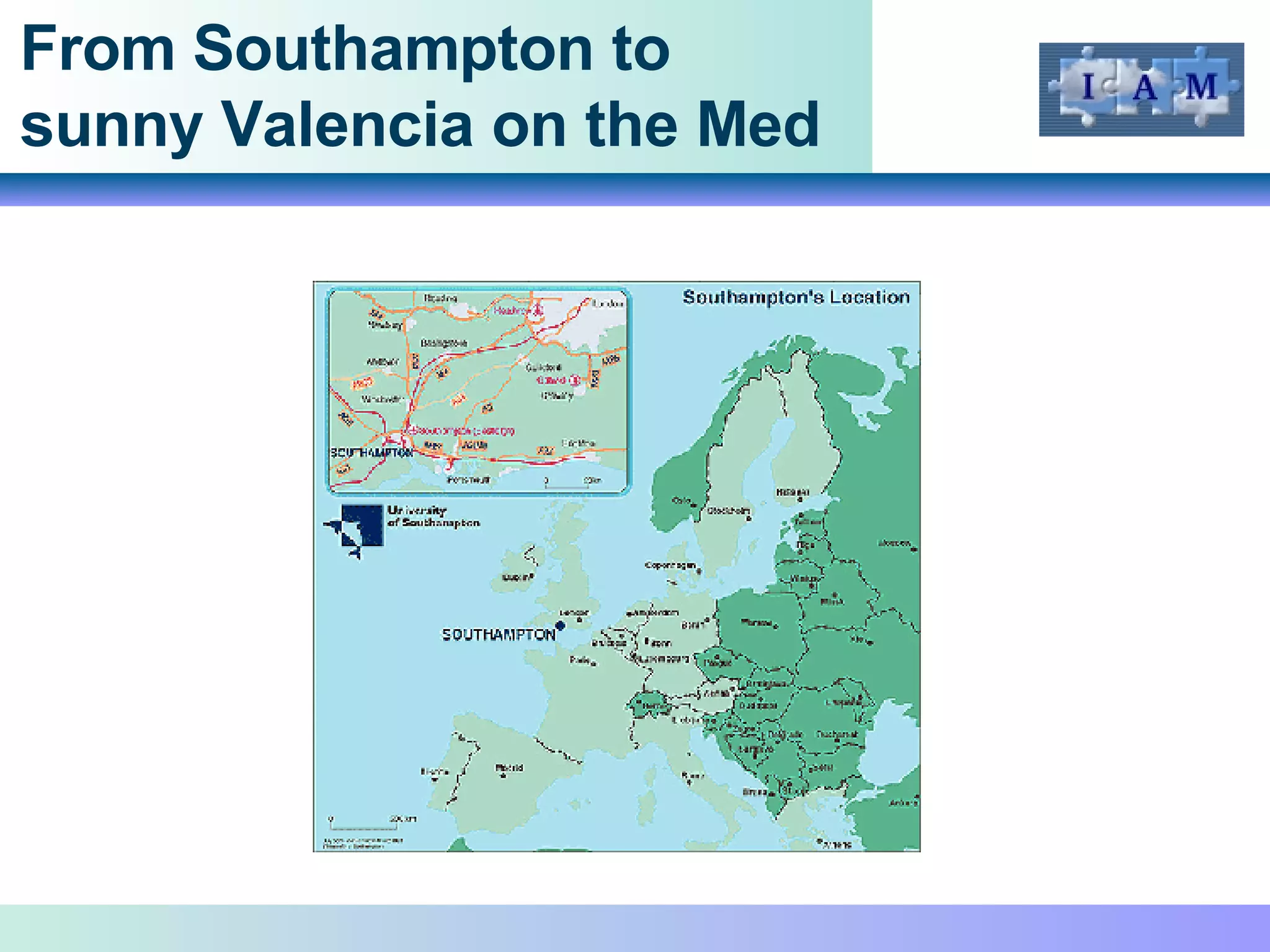
From Southampton to sunny Valencia on the Med
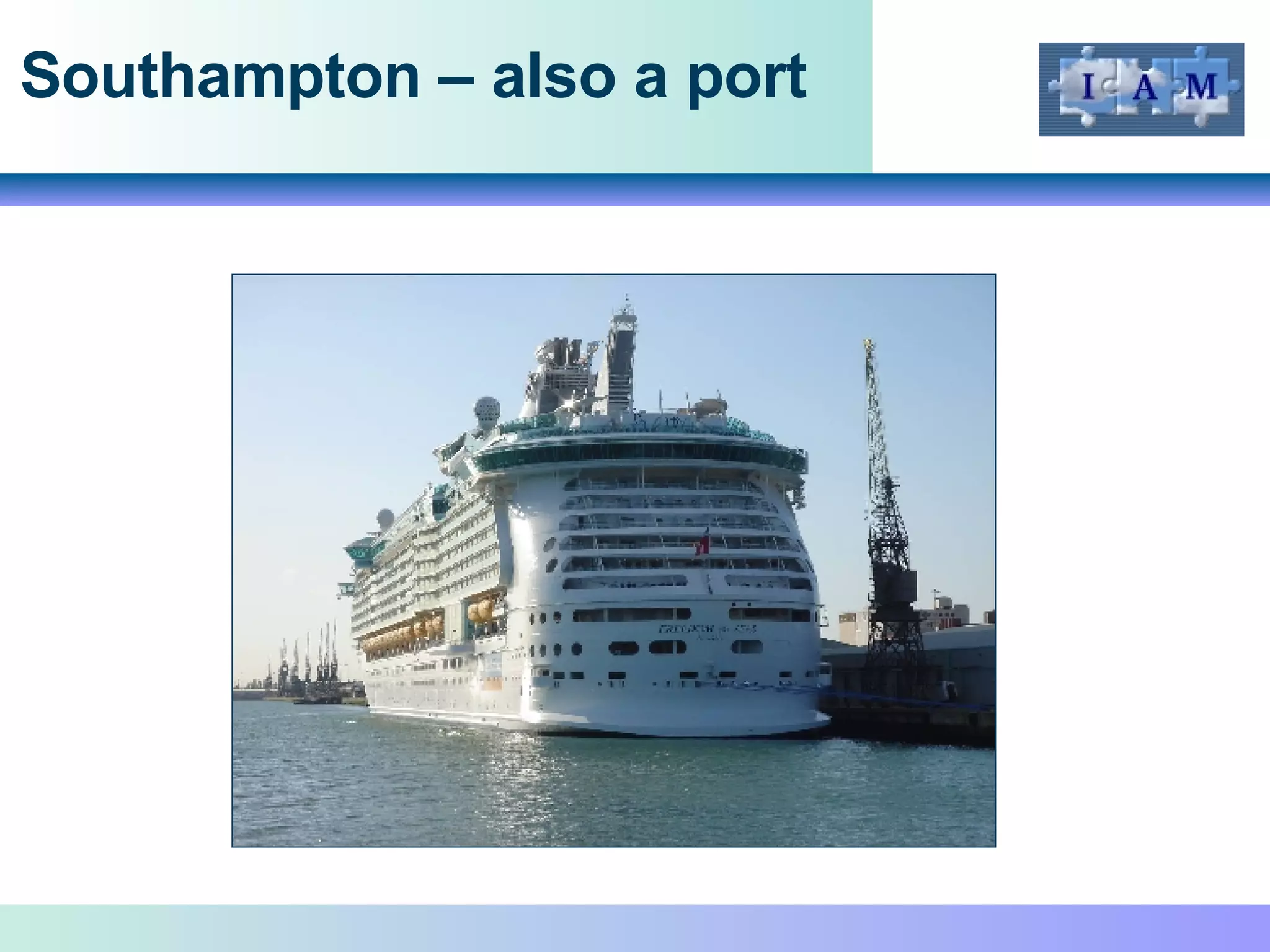
Southampton – also a port
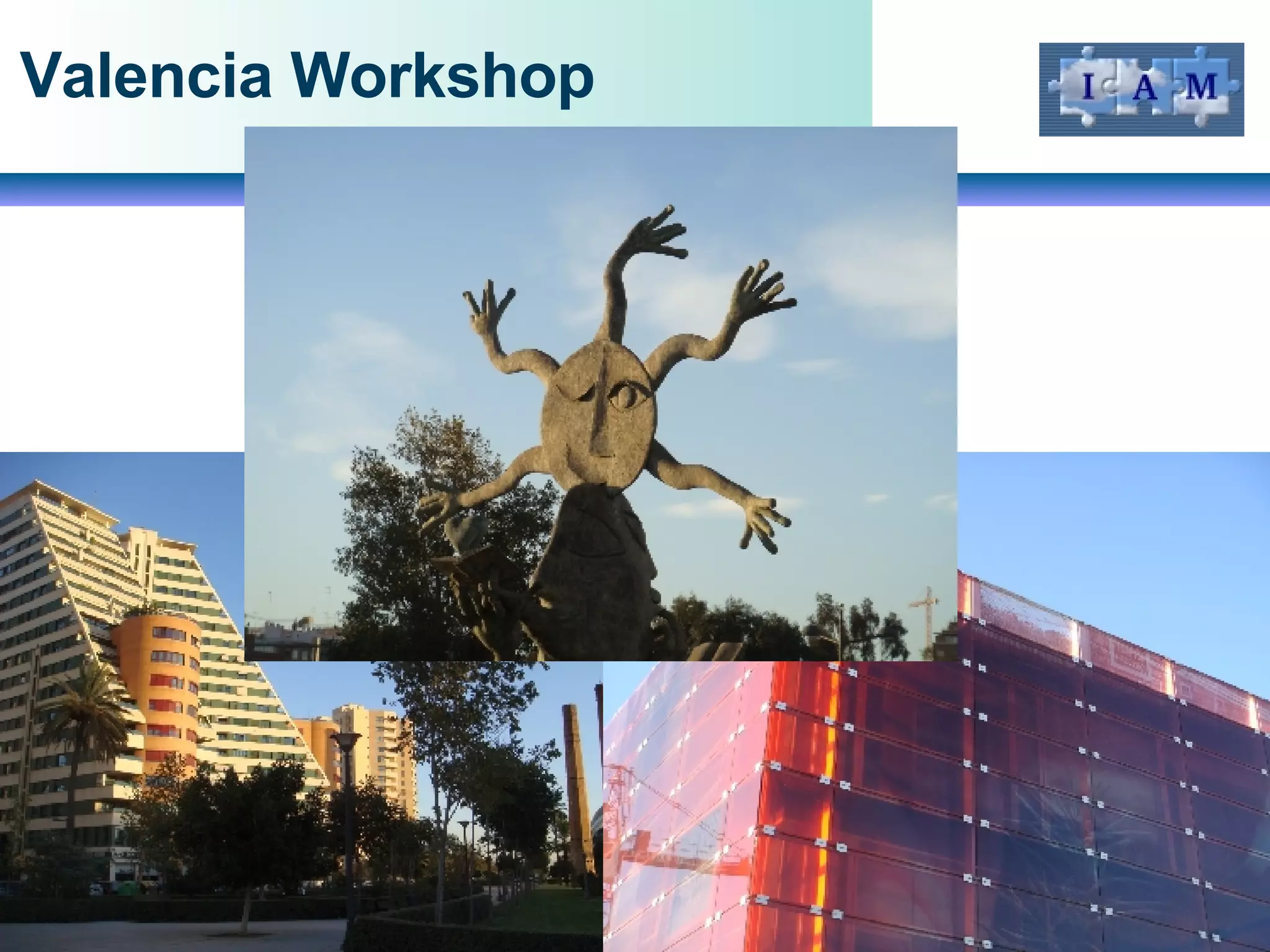
Valencia Workshop
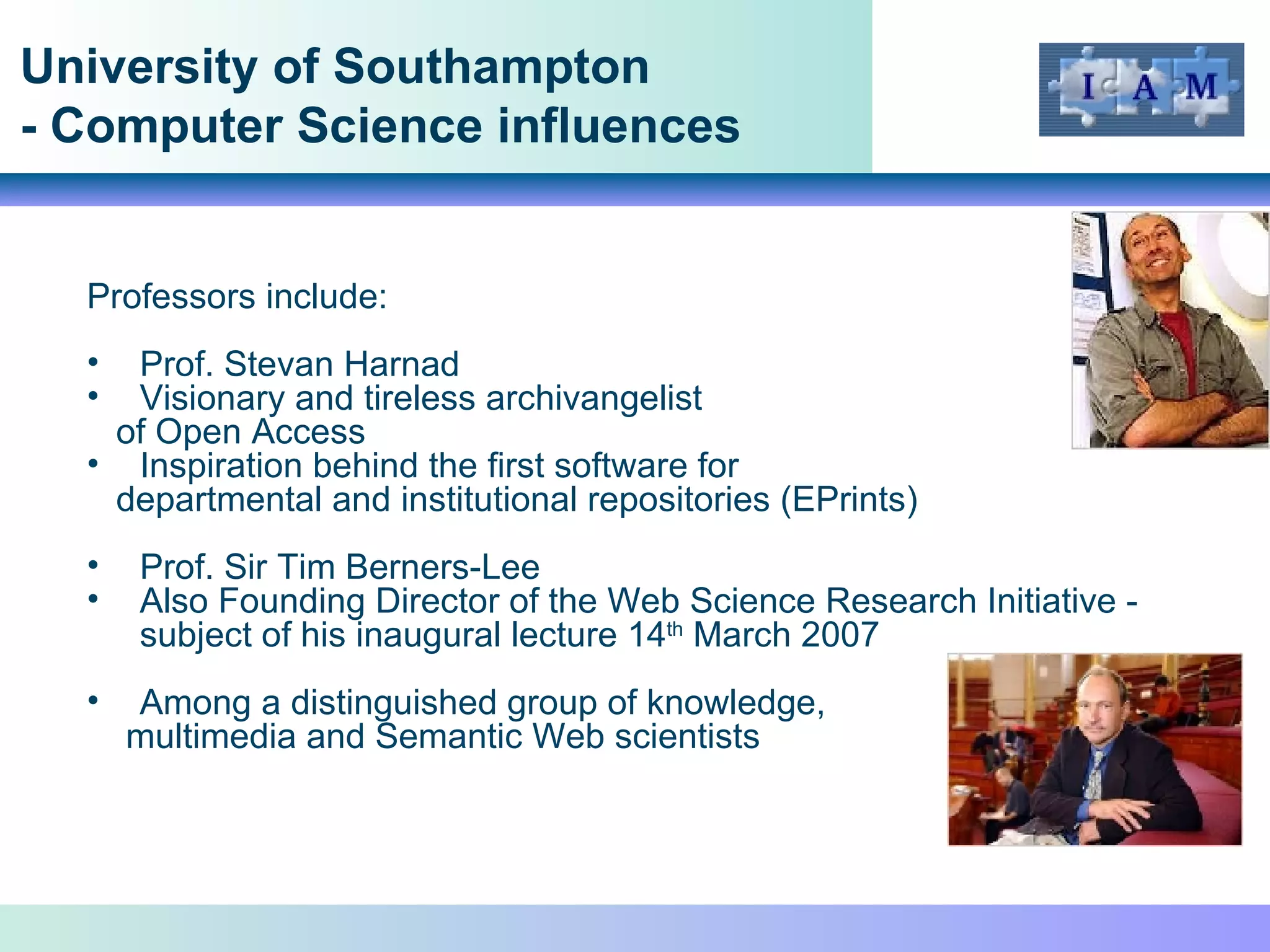
University of Southampton - Computer Science influences Professors include: Prof. Stevan Harnad Visionary and tireless archivangelist of Open Access Inspiration behind the first software for departmental and institutional repositories (EPrints)  Prof. Sir Tim Berners-Lee Also Founding Director of the Web Science Research Initiative - subject of his inaugural lecture 14 th  March 2007 Among a distinguished group of knowledge, multimedia and Semantic Web scientists
What is Science? Useful to think broadly for this purpose: Including engineering, arts and scholarship “ Science” is the activity of researchers and scientists in universities and research institutions throughout Europe and the world, all of whom are concerned with novel insights and creating new knowledge
What is Open Access? Open Access brings us free online access to peer-reviewed research  Potentially including 2.5 million articles a year from 25,000 journals Ensures ideas and results are taken up by as many other researchers as possible Influenced by Budapest Open Access Initiative 6 years ago
What are Institutional Repositories (IRs)? Institutional Repositories curate and showcase the intellectual output of the institution Broader, in principle, than the Open Access vision Also include potentially conference papers, theses, reports, working papers, presentations, posters, multimedia outputs, data, etc Concepts explored in the TARDis project Simpson, Pauline and Hey, Jessie M.N. (2005) Institutional e-Print repositories for research visibility. In, Drake, Miriam (ed.)  Encyclopedia of Library and Information Science 2nd ed.  USA, Dekker.  http://eprints.soton.ac.uk/9057/
Research is global We recently had a workshop thinking far ahead to the Global Research Library 2020 Willows Lodge Workshop Woodinville, Washington, USA 30 Sept – 2 nd  Oct 2007 http://www.lib.washington.edu/grl2020/
We anticipate profound changes in science (becoming e-science or more broadly e-research) and in library community roles  See for example: Towards 2020 Science ed. Stephen Emmott, Microsoft Research Ltd  2006 http://research.microsoft.com/towards2020science/downloads.htm e-Science and Its Implications for the Library Community  Tony Hey and Jessie Hey  2006 http://eprints.rclis.org/archive/00009155/
A telling view from a global researcher Ann Marie Kimball, Professor, Epidemiology, University of Washington and Director, Asia Pacific Economic Cooperation Emerging Infections Network (APEC EINET) A Grand Challenge to Information Systems: Success  in Infectious Disease Control in the Asia Pacific http://www.lib.washington.edu/grl2020/presentations.html   .........Open Access is vital to speed of reaction
Workshop followed by the Microsoft Library Summit  2007 on Oct 3rd Keynote by Jon Udell:  Remixing the library Abstract : In an online world of small pieces loosely joined,  librarians are among the most well qualified and highly motivated joiners of those pieces . Library patrons, meanwhile, are in transition. Once mainly consumers of information, they are now, on the two-way web, becoming producers too.  Can libraries function  not only as centers of consumption, but also  as centers of production? http://jonudell.net/talks/lib2020/talk.html   And we see, eg at the E-LIS workshop before this one,  librarians are regaining a more active role in Institutional Repositories – getting closer to the action
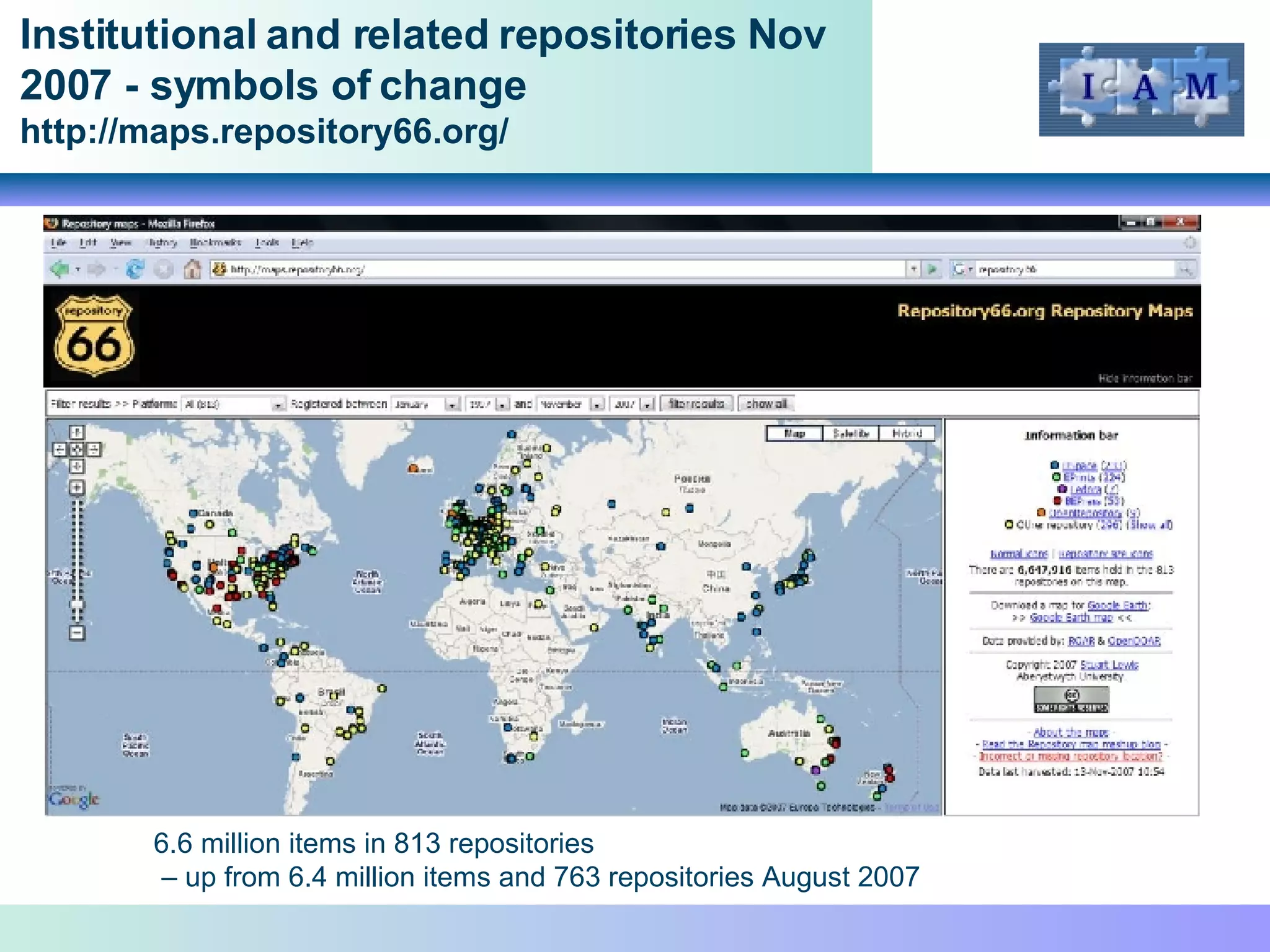
Institutional and related repositories Nov 2007 - symbols of change  http://maps.repository66.org/ 6.6 million items in 813 repositories –  up from 6.4 million items and 763 repositories August 2007
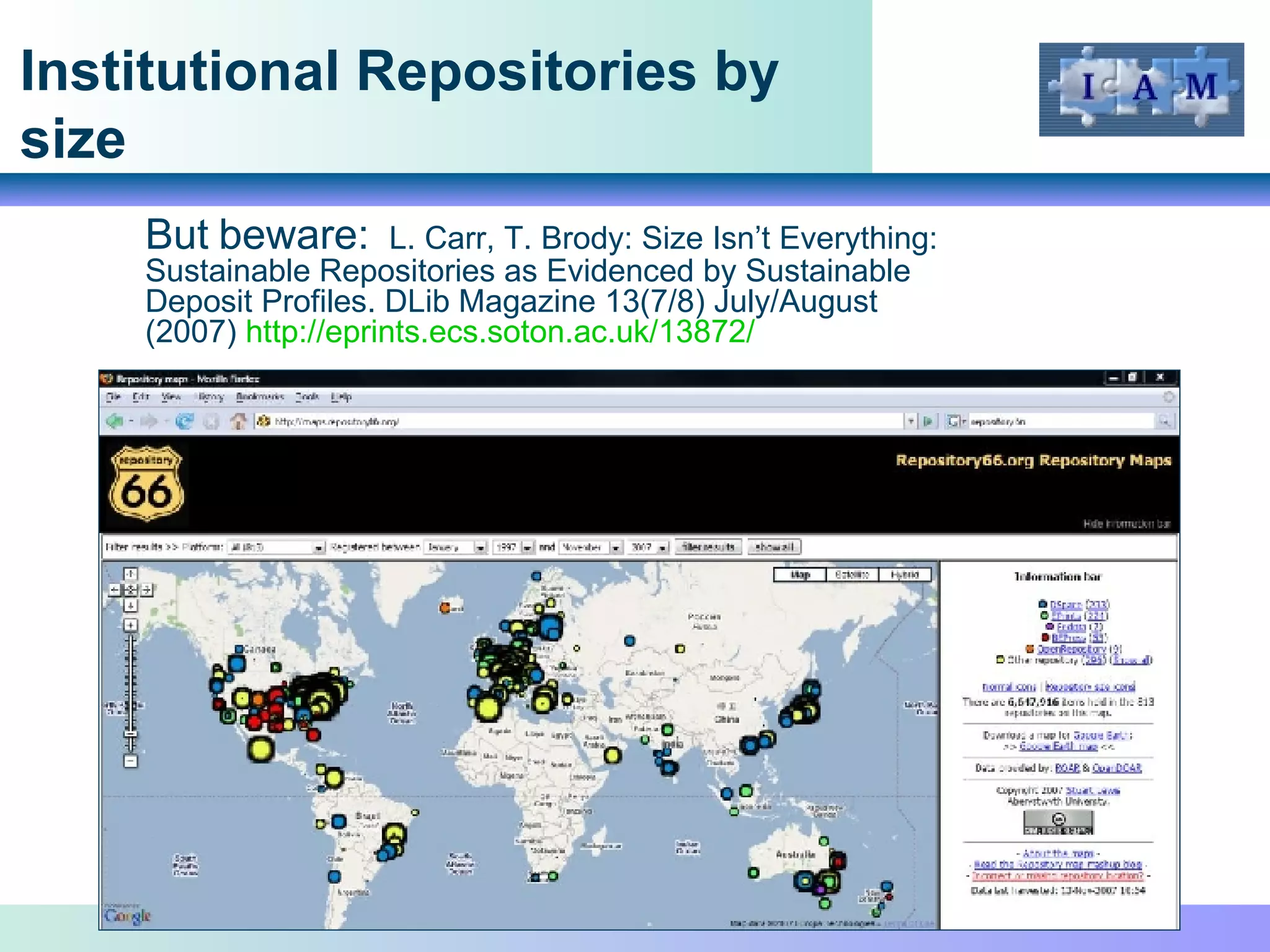
Institutional Repositories by size But beware:  L. Carr, T. Brody: Size Isn’t Everything: Sustainable Repositories as Evidenced by Sustainable Deposit Profiles. DLib Magazine 13(7/8) July/August (2007)  http://eprints.ecs.soton.ac.uk/13872 /
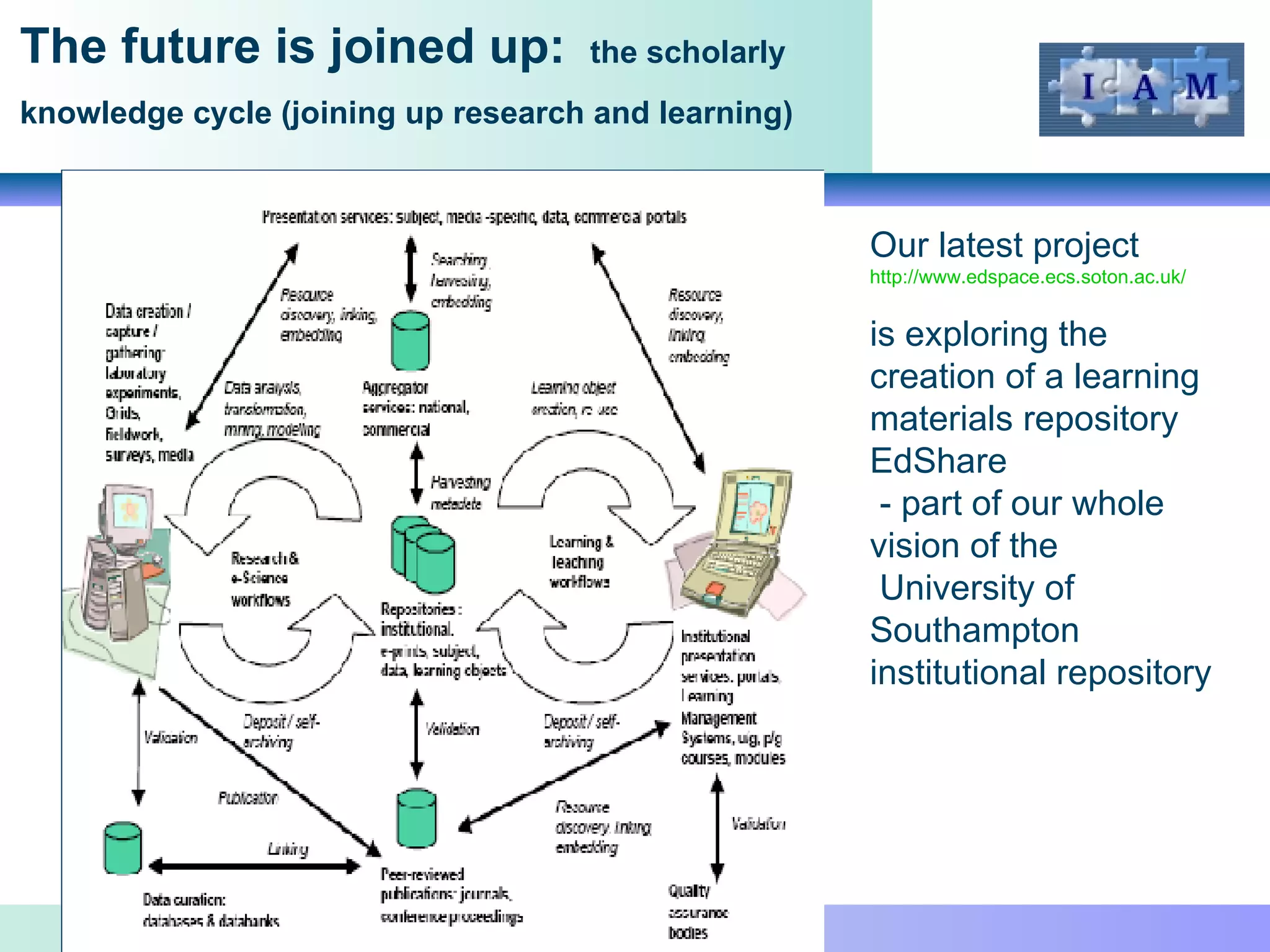
The future is joined up:   the scholarly knowledge cycle (joining up research and learning)   Our latest project http://www.edspace.ecs.soton.ac.uk/ is exploring the creation of a learning materials repository EdShare - part of our whole vision of the University of Southampton  institutional repository Thanks to Liz Lyon
Southampton portfolio of databases combine towards the institutional repository with increasing heterogeneity Research – more full text but also expect more video/audio with talks/delivering papers Expect more complex objects in the Arts eCrystals – specialised formats for data SERPENT – more video and audio EdShare – again more multimedia
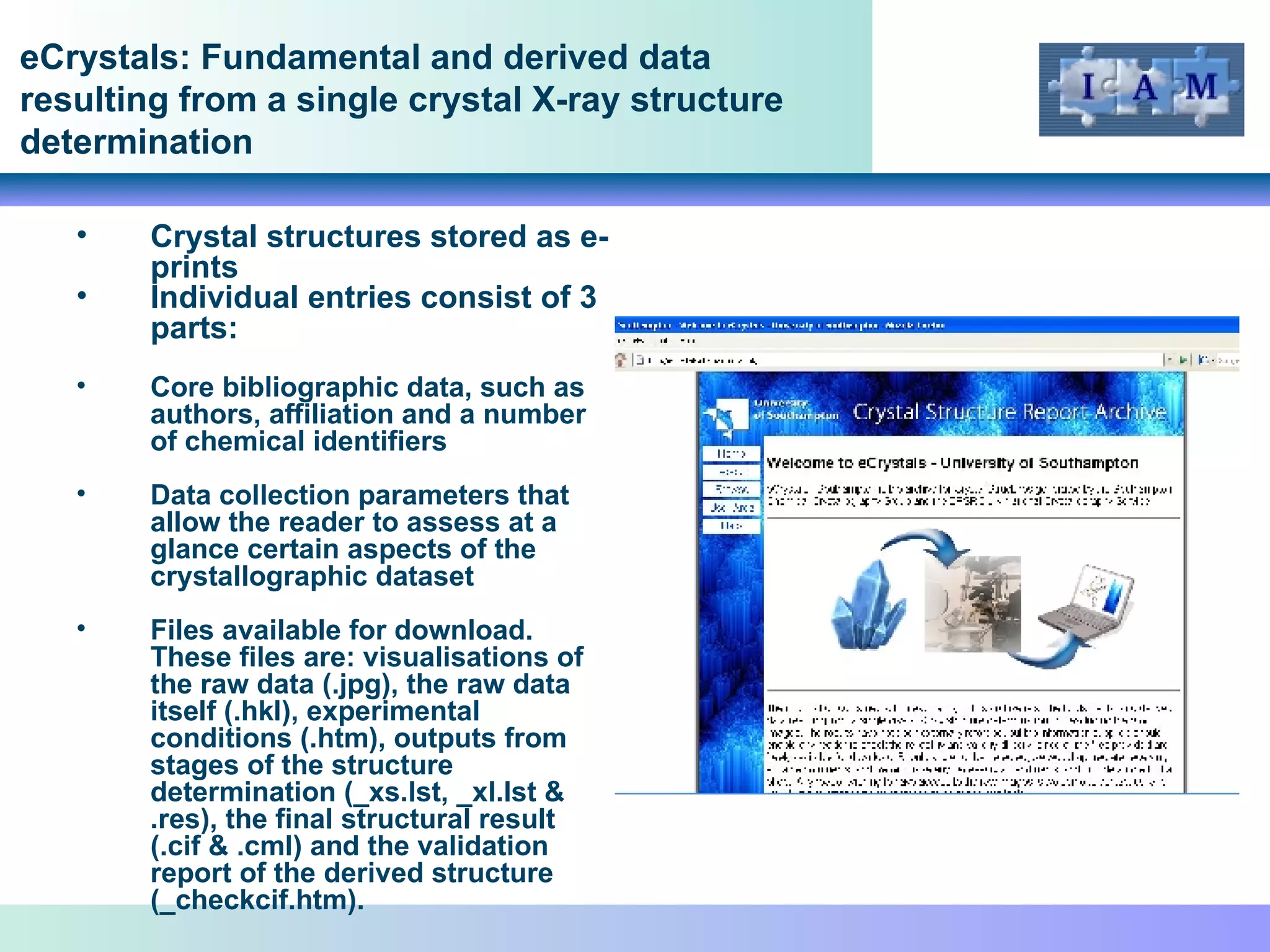
eCrystals: Fundamental and derived data resulting from a single crystal X-ray structure determination Crystal structures stored as e-prints Individual entries consist of 3 parts: Core bibliographic data, such as authors, affiliation and a number of chemical identifiers Data collection parameters that allow the reader to assess at a glance certain aspects of the crystallographic dataset Files available for download. These files are: visualisations of the raw data (.jpg), the raw data itself (.hkl), experimental conditions (.htm), outputs from stages of the structure determination (_xs.lst, _xl.lst & .res), the final structural result (.cif & .cml) and the validation report of the derived structure (_checkcif.htm).
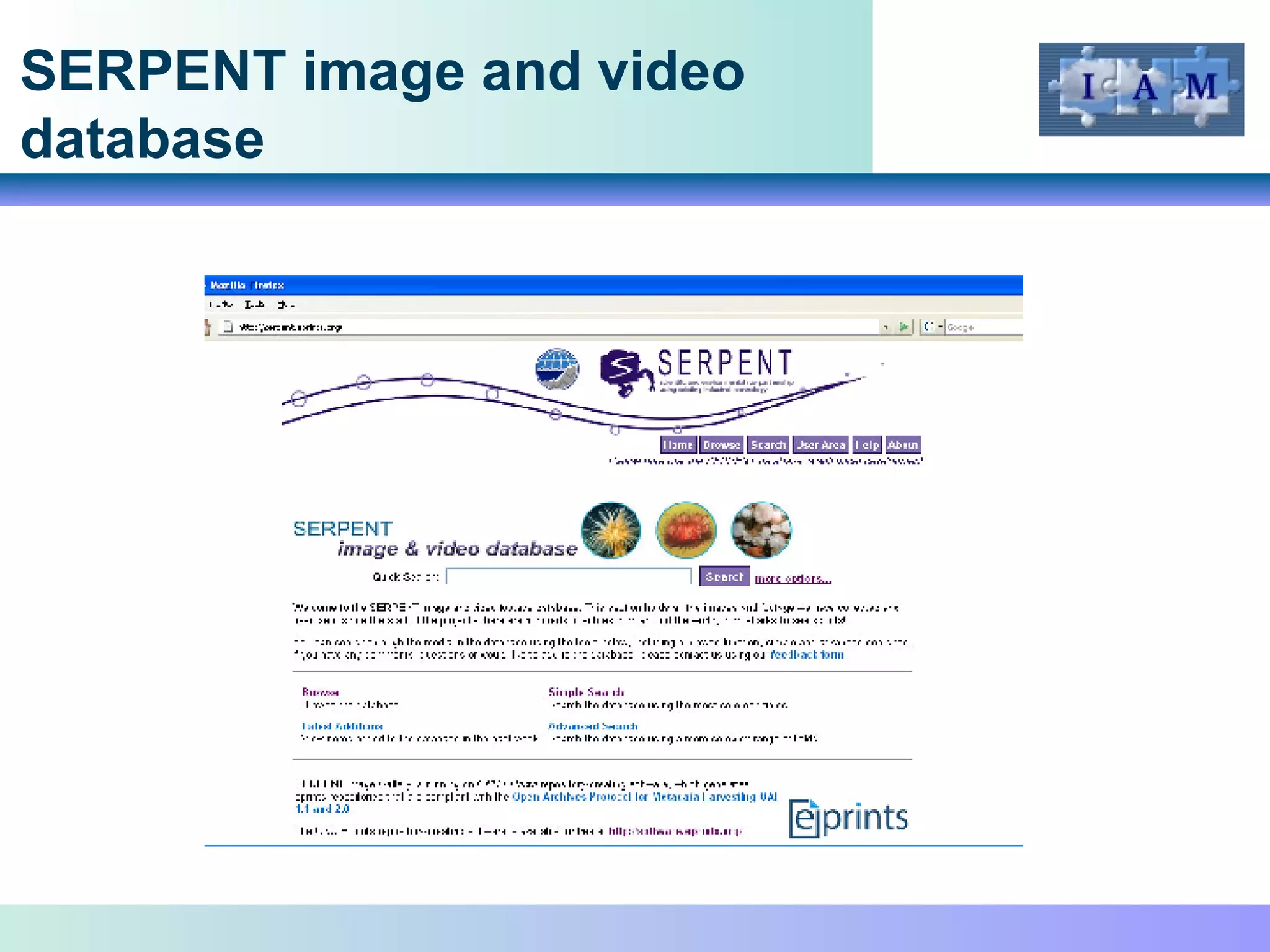
SERPENT image and video database
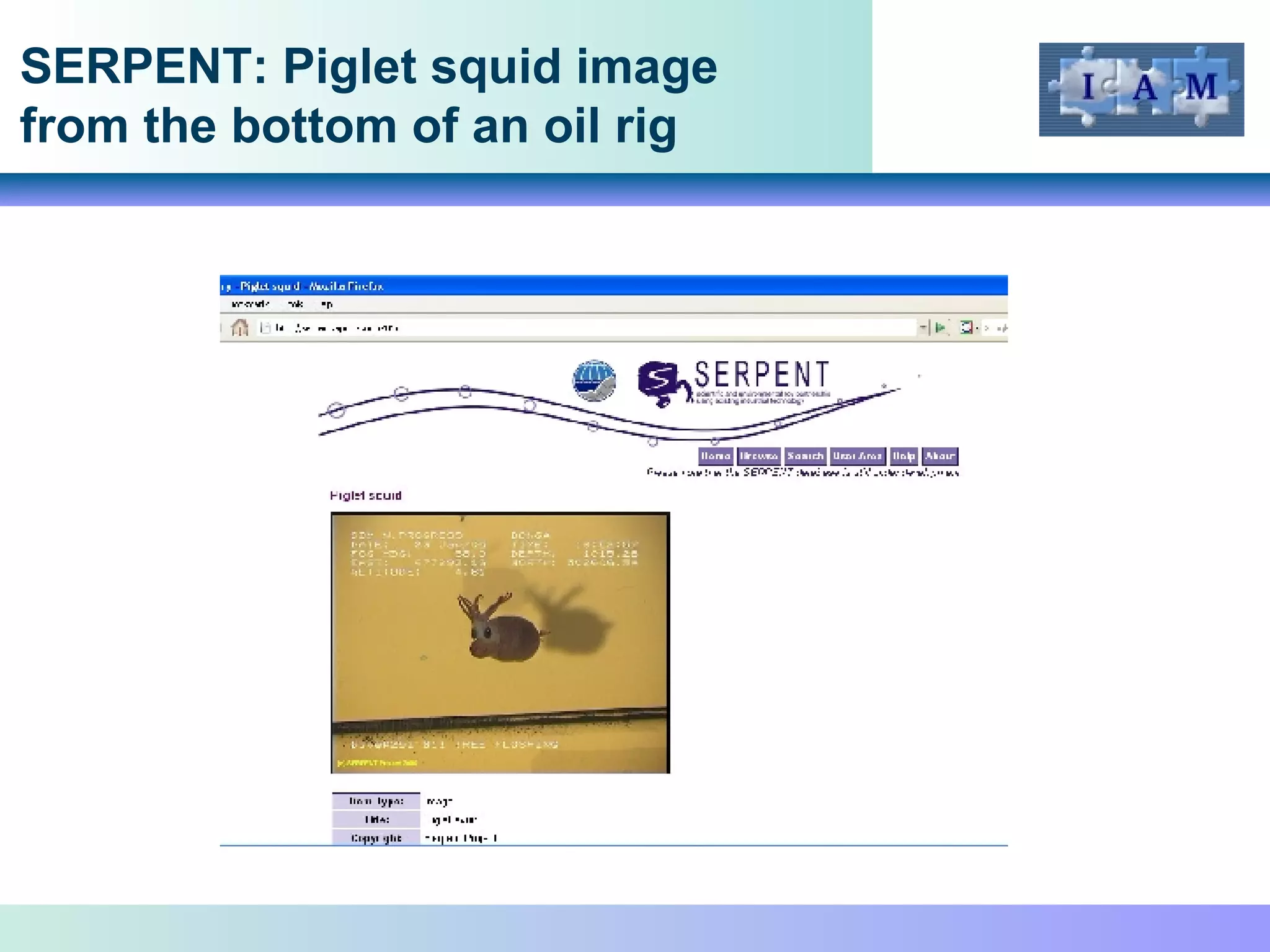
SERPENT: Piglet squid image from the bottom of an oil rig
Next stages: projects aim for richer, better preserved ‘joined up’ repositories KULTUR  creating a transferable and sustainable institutional repository model for research output in the creative and applied arts PRESERV and PRESERV2  http://preserv.eprints.org/ enabling long term access to materials in institutional repositories CLADDIER  http://claddier.badc.ac.uk/   exploring joining up data in environmental databases e.g. British Atmospheric Data Centre (BADC)  to the institutional repositories at Southampton and STFC DataShare  http://www.disc-uk.org/datashare.html   exploring ‘orphaned’ datasets and institutional repositories
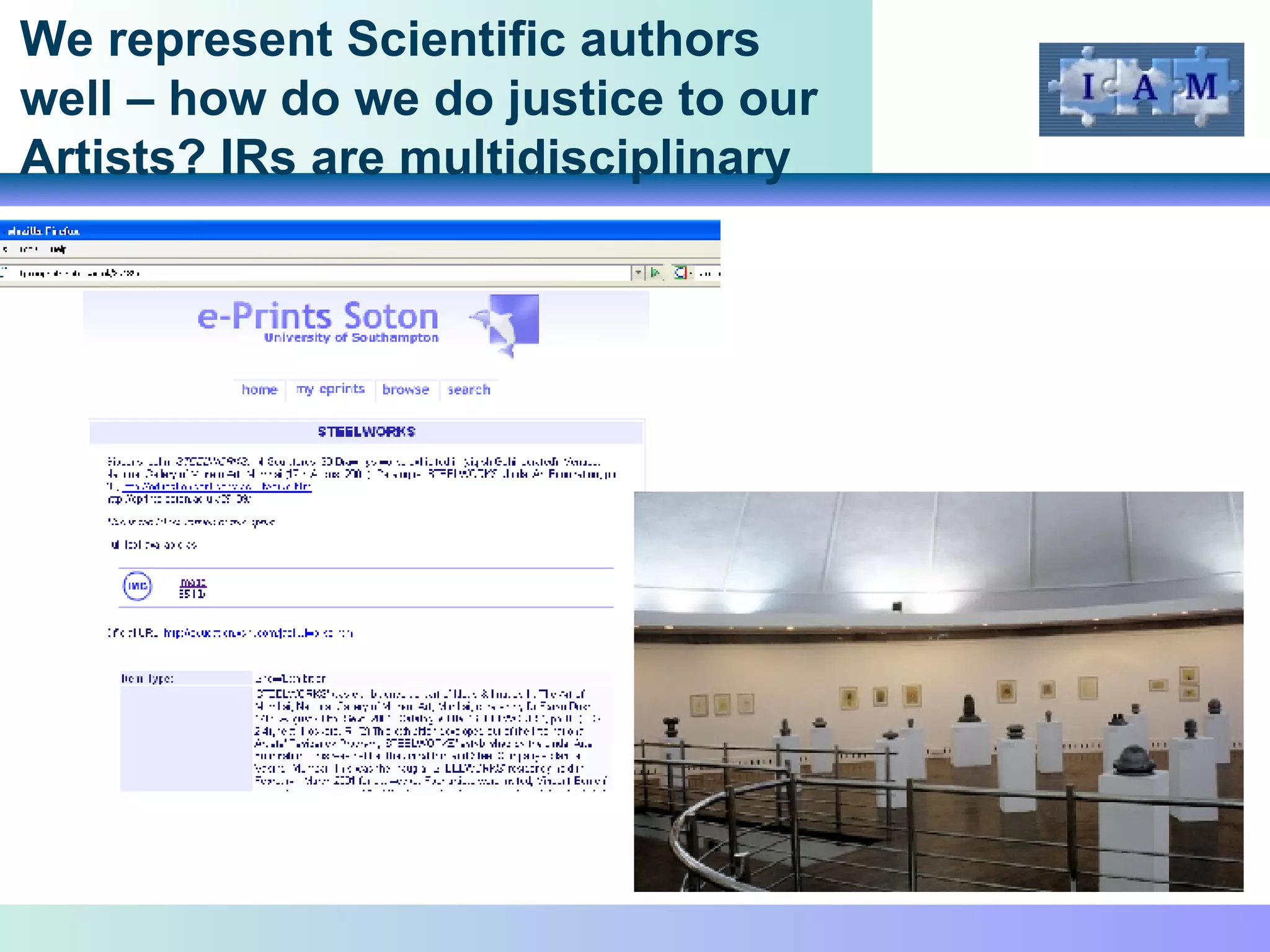
We represent Scientific authors well – how do we do justice to our  Artists? IRs are multidisciplinary
But we are not alone! Everyone wants their own picture to showcase their expanding area Repositories expanding linearly (Tim Brody’s E-LIS talk this week) Departmental Institutional National e.g. UK, Wales, Scotland... Netherlands  - a good size..... Europe – e.g. funded research Following example of other funders eg UKPMC funders group
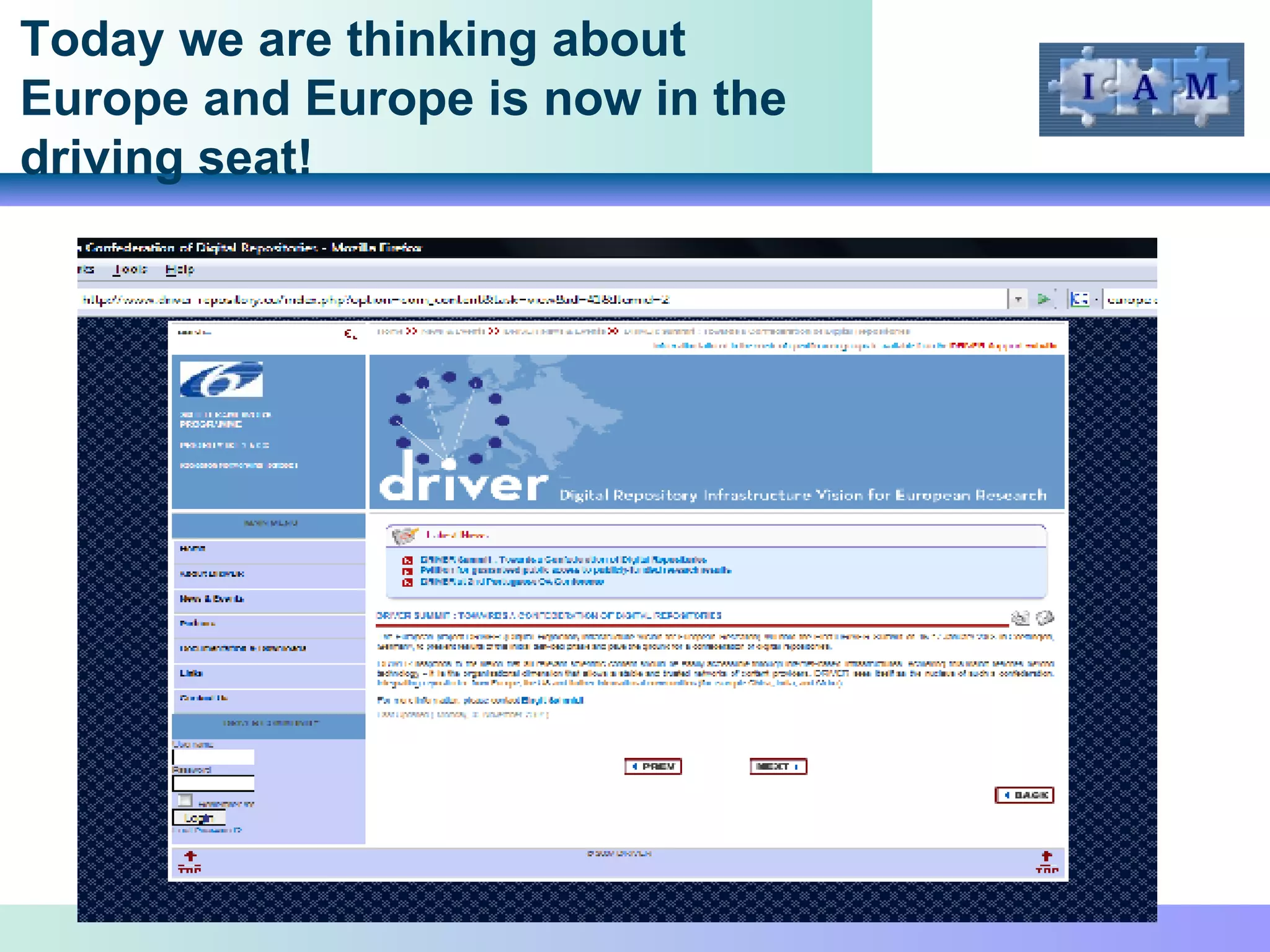
Today we are thinking about Europe and Europe is now in the driving seat!
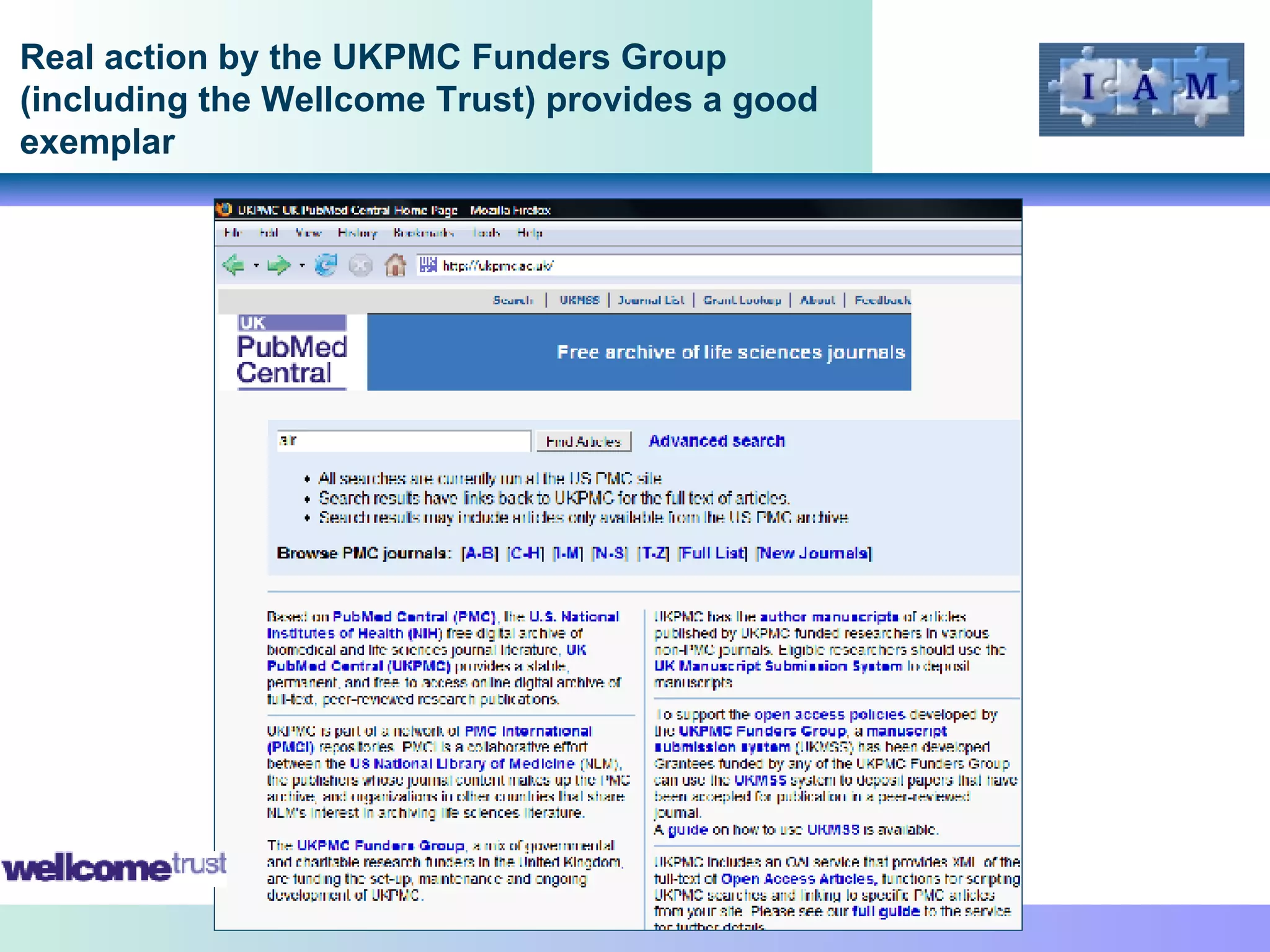
Real action by the UKPMC Funders Group (including the Wellcome Trust) provides a good exemplar
More subject based repositories affect  IRs however Especially PubMed Central – funder obviously wants theirs to be priority Ideally we want a copy in our repository too to be sure Will need new ways of working with these - easy deposit or compromise on easy trusted links
The increasing activities in Europe – our first speaker A Conference of Rectors of European Universities convened in Liège on 18 October 2007 by the Rector of the University of Liège, Bernard Rentier, has launched  EurOpenScholar : “ a showcase and a tool for the promotion of Open Access (OA) in Europe.” It will be a consortium of European universities resolved to move forward on OA and to try to convince the largest possible number of researchers, their institutions and their European Funding Agencies to engage now in what will undoubtedly be the mode of communication of tomorrow.
Initiatives in different regions can be practical and appropriate In a victory for libraries, the Senate on October 23 passed an appropriations bill that included a mandatory public access directive for research funded by the National Institutes of Health (NIH).
On a local level Remember: Only about 6 minutes of metadata entry is required to deposit a paper Carr and Harnad 2005 A clear majority of researchers say they will willingly comply with a mandate  Swan and Brown 2005 Meanwhile the world is changing with you
However, Europe will have a big part to play and to be proud of Thank you – Jessie Hey jesshey@acm.org  and Leslie Carr [email_address] Science and scholarship will become increasingly global and Open Access

Open Access to Science: a practical Institutional Repository perspective

  • 1.
    Open Access toScience: a practical Institutional Repository perspective 6th CALSI Workshop Polytechnic University of Valencia Valencia, Spain 14-16 November 2007 Dr Jessie M.N. Hey Intelligence, Agents and Multimedia Group Learning Societies Lab School of Electronics and Computer Science University of Southampton, UK http://eprints.soton.ac.uk
  • 2.
    From Southampton tosunny Valencia on the Med
  • 3.
  • 4.
  • 5.
    University of Southampton- Computer Science influences Professors include: Prof. Stevan Harnad Visionary and tireless archivangelist of Open Access Inspiration behind the first software for departmental and institutional repositories (EPrints) Prof. Sir Tim Berners-Lee Also Founding Director of the Web Science Research Initiative - subject of his inaugural lecture 14 th March 2007 Among a distinguished group of knowledge, multimedia and Semantic Web scientists
  • 6.
    What is Science?Useful to think broadly for this purpose: Including engineering, arts and scholarship “ Science” is the activity of researchers and scientists in universities and research institutions throughout Europe and the world, all of whom are concerned with novel insights and creating new knowledge
  • 7.
    What is OpenAccess? Open Access brings us free online access to peer-reviewed research Potentially including 2.5 million articles a year from 25,000 journals Ensures ideas and results are taken up by as many other researchers as possible Influenced by Budapest Open Access Initiative 6 years ago
  • 8.
    What are InstitutionalRepositories (IRs)? Institutional Repositories curate and showcase the intellectual output of the institution Broader, in principle, than the Open Access vision Also include potentially conference papers, theses, reports, working papers, presentations, posters, multimedia outputs, data, etc Concepts explored in the TARDis project Simpson, Pauline and Hey, Jessie M.N. (2005) Institutional e-Print repositories for research visibility. In, Drake, Miriam (ed.) Encyclopedia of Library and Information Science 2nd ed. USA, Dekker. http://eprints.soton.ac.uk/9057/
  • 9.
    Research is globalWe recently had a workshop thinking far ahead to the Global Research Library 2020 Willows Lodge Workshop Woodinville, Washington, USA 30 Sept – 2 nd Oct 2007 http://www.lib.washington.edu/grl2020/
  • 10.
    We anticipate profoundchanges in science (becoming e-science or more broadly e-research) and in library community roles See for example: Towards 2020 Science ed. Stephen Emmott, Microsoft Research Ltd 2006 http://research.microsoft.com/towards2020science/downloads.htm e-Science and Its Implications for the Library Community Tony Hey and Jessie Hey 2006 http://eprints.rclis.org/archive/00009155/
  • 11.
    A telling viewfrom a global researcher Ann Marie Kimball, Professor, Epidemiology, University of Washington and Director, Asia Pacific Economic Cooperation Emerging Infections Network (APEC EINET) A Grand Challenge to Information Systems: Success in Infectious Disease Control in the Asia Pacific http://www.lib.washington.edu/grl2020/presentations.html .........Open Access is vital to speed of reaction
  • 12.
    Workshop followed bythe Microsoft Library Summit 2007 on Oct 3rd Keynote by Jon Udell: Remixing the library Abstract : In an online world of small pieces loosely joined, librarians are among the most well qualified and highly motivated joiners of those pieces . Library patrons, meanwhile, are in transition. Once mainly consumers of information, they are now, on the two-way web, becoming producers too. Can libraries function not only as centers of consumption, but also as centers of production? http://jonudell.net/talks/lib2020/talk.html And we see, eg at the E-LIS workshop before this one, librarians are regaining a more active role in Institutional Repositories – getting closer to the action
  • 13.
    Institutional and relatedrepositories Nov 2007 - symbols of change http://maps.repository66.org/ 6.6 million items in 813 repositories – up from 6.4 million items and 763 repositories August 2007
  • 14.
    Institutional Repositories bysize But beware: L. Carr, T. Brody: Size Isn’t Everything: Sustainable Repositories as Evidenced by Sustainable Deposit Profiles. DLib Magazine 13(7/8) July/August (2007) http://eprints.ecs.soton.ac.uk/13872 /
  • 15.
    The future isjoined up: the scholarly knowledge cycle (joining up research and learning) Our latest project http://www.edspace.ecs.soton.ac.uk/ is exploring the creation of a learning materials repository EdShare - part of our whole vision of the University of Southampton institutional repository Thanks to Liz Lyon
  • 16.
    Southampton portfolio ofdatabases combine towards the institutional repository with increasing heterogeneity Research – more full text but also expect more video/audio with talks/delivering papers Expect more complex objects in the Arts eCrystals – specialised formats for data SERPENT – more video and audio EdShare – again more multimedia
  • 17.
    eCrystals: Fundamental andderived data resulting from a single crystal X-ray structure determination Crystal structures stored as e-prints Individual entries consist of 3 parts: Core bibliographic data, such as authors, affiliation and a number of chemical identifiers Data collection parameters that allow the reader to assess at a glance certain aspects of the crystallographic dataset Files available for download. These files are: visualisations of the raw data (.jpg), the raw data itself (.hkl), experimental conditions (.htm), outputs from stages of the structure determination (_xs.lst, _xl.lst & .res), the final structural result (.cif & .cml) and the validation report of the derived structure (_checkcif.htm).
  • 18.
    SERPENT image andvideo database
  • 19.
    SERPENT: Piglet squidimage from the bottom of an oil rig
  • 20.
    Next stages: projectsaim for richer, better preserved ‘joined up’ repositories KULTUR creating a transferable and sustainable institutional repository model for research output in the creative and applied arts PRESERV and PRESERV2 http://preserv.eprints.org/ enabling long term access to materials in institutional repositories CLADDIER http://claddier.badc.ac.uk/ exploring joining up data in environmental databases e.g. British Atmospheric Data Centre (BADC) to the institutional repositories at Southampton and STFC DataShare http://www.disc-uk.org/datashare.html exploring ‘orphaned’ datasets and institutional repositories
  • 21.
    We represent Scientificauthors well – how do we do justice to our Artists? IRs are multidisciplinary
  • 22.
    But we arenot alone! Everyone wants their own picture to showcase their expanding area Repositories expanding linearly (Tim Brody’s E-LIS talk this week) Departmental Institutional National e.g. UK, Wales, Scotland... Netherlands - a good size..... Europe – e.g. funded research Following example of other funders eg UKPMC funders group
  • 23.
    Today we arethinking about Europe and Europe is now in the driving seat!
  • 24.
    Real action bythe UKPMC Funders Group (including the Wellcome Trust) provides a good exemplar
  • 25.
    More subject basedrepositories affect IRs however Especially PubMed Central – funder obviously wants theirs to be priority Ideally we want a copy in our repository too to be sure Will need new ways of working with these - easy deposit or compromise on easy trusted links
  • 26.
    The increasing activitiesin Europe – our first speaker A Conference of Rectors of European Universities convened in Liège on 18 October 2007 by the Rector of the University of Liège, Bernard Rentier, has launched EurOpenScholar : “ a showcase and a tool for the promotion of Open Access (OA) in Europe.” It will be a consortium of European universities resolved to move forward on OA and to try to convince the largest possible number of researchers, their institutions and their European Funding Agencies to engage now in what will undoubtedly be the mode of communication of tomorrow.
  • 27.
    Initiatives in differentregions can be practical and appropriate In a victory for libraries, the Senate on October 23 passed an appropriations bill that included a mandatory public access directive for research funded by the National Institutes of Health (NIH).
  • 28.
    On a locallevel Remember: Only about 6 minutes of metadata entry is required to deposit a paper Carr and Harnad 2005 A clear majority of researchers say they will willingly comply with a mandate Swan and Brown 2005 Meanwhile the world is changing with you
  • 29.
    However, Europe willhave a big part to play and to be proud of Thank you – Jessie Hey jesshey@acm.org and Leslie Carr [email_address] Science and scholarship will become increasingly global and Open Access