Bernadette Elder –
Inspiring Communities Together
Neighbourhood based charity
• Membership led – Trustees elected through membership
• Delivers activity – learning and volunteering
• Facilitates – bring people together through two local forums
• Advocate – link between agencies and local community
• Securing resources – paid work linked to aims
Strategic Context
3
Salford Together Partnership
• Four high performing partners –
within broader network of partners
• £98M Pooled Budget - Integrated
Care for Older People (ICP)
• Governed by Alliance Contract
• Underpinned by 2014-18 Service
and Financial plan (inc. BCF)
• Formal Programme Management
approach (ICP)
• ICP one of three major
transformation initiatives
- Out of hospital Care (primary care
investment, renewal) & HT
Salford care economy
• Urban area in Greater Manchester
• Population of circa 230,000
• Area of significant deprivation
and health inequalities
• Largely co-terminus
- Salford CGG (health commissioner)
- Salford Royal (acute and community
healthcare provider)
- Salford City Council (adult social care)
- Greater Manchester West (mental health
provider)
• Long history of successful
partnership working
Over view of Salford
• Total population is 236,000
• Eight neighbourhoods
• Although there are diverse levels of affluence,
Salford is ranked as one of the most deprived local
authority areas in England with life expectancy lower
than the England average
• Population of people aged 65 and over is 35,000
• Number of older people is forecast to rise by 28% by
2030
5
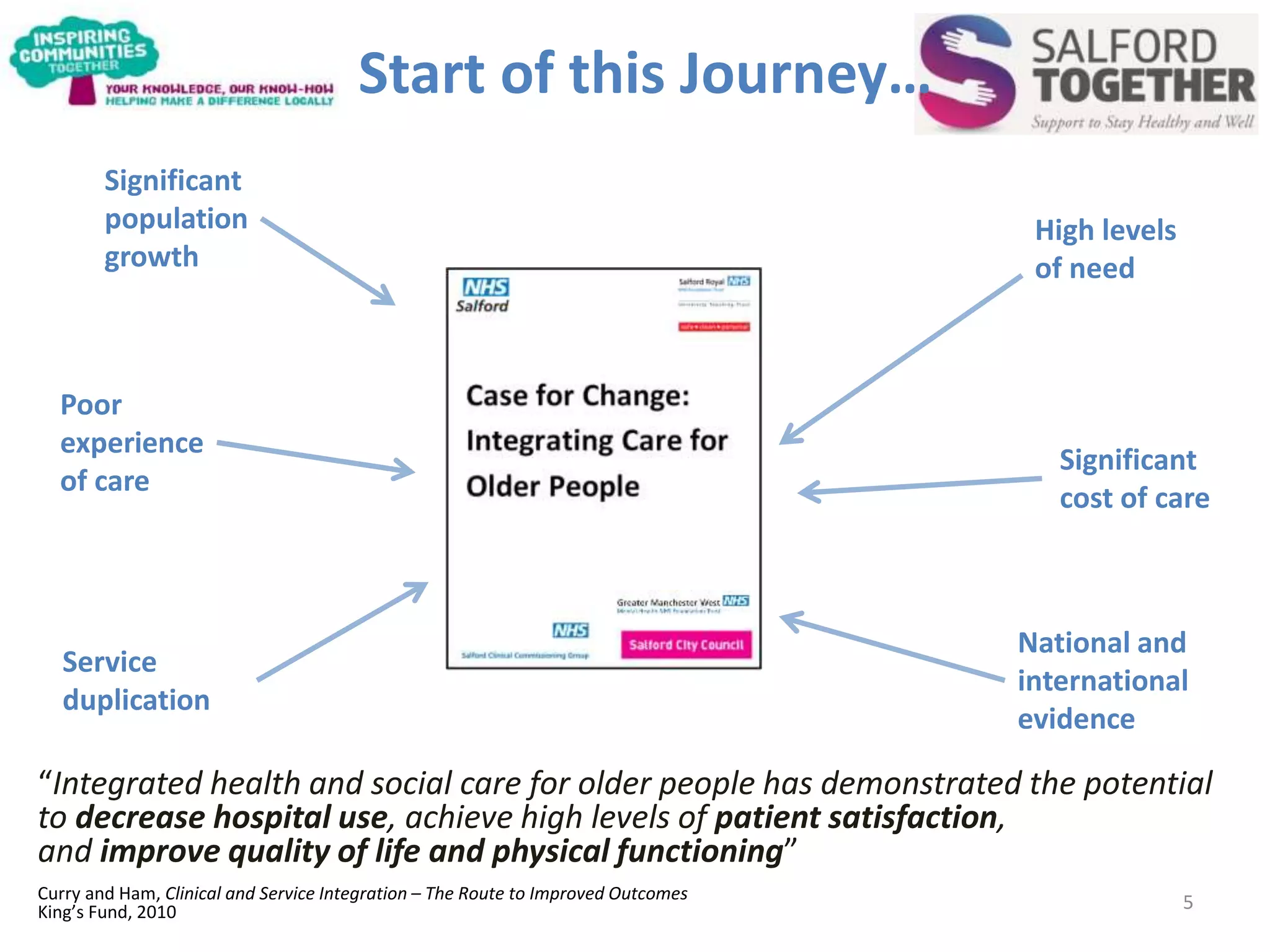
“Integrated health and social care for older people has demonstrated the potential
to decrease hospital use, achieve high levels of patient satisfaction,
and improve quality of life and physical functioning”
Curry and Ham, Clinical and Service Integration – The Route to Improved Outcomes
King’s Fund, 2010
High levels
of need
National and
international
evidence
Significant
population
growth
Significant
cost of care
Poor
experience
of care
Service
duplication
The Start of this Journey…
Salford’s Integrated Care Programme
Multi Disciplinary Groups
provide targeted support to
older people who are most at
risk and have a population
focus on screening, primary
prevention and signposting to
community support
3
Local community assets
enable older people to remain
independent, with greater
confidence to manage their
own care
1
Centre of Contact
acts as an central health and
social care hub, supporting
Multi Disciplinary Groups,
helping people to navigate
services and support
mechanisms, and coordinating
telecare monitoring
2
1
Promoting independence
for older people
 Better health and social
care outcomes
 Improved experience for
services users and carers
 Reduced health and
social care costs
32
Housing
Work
stream
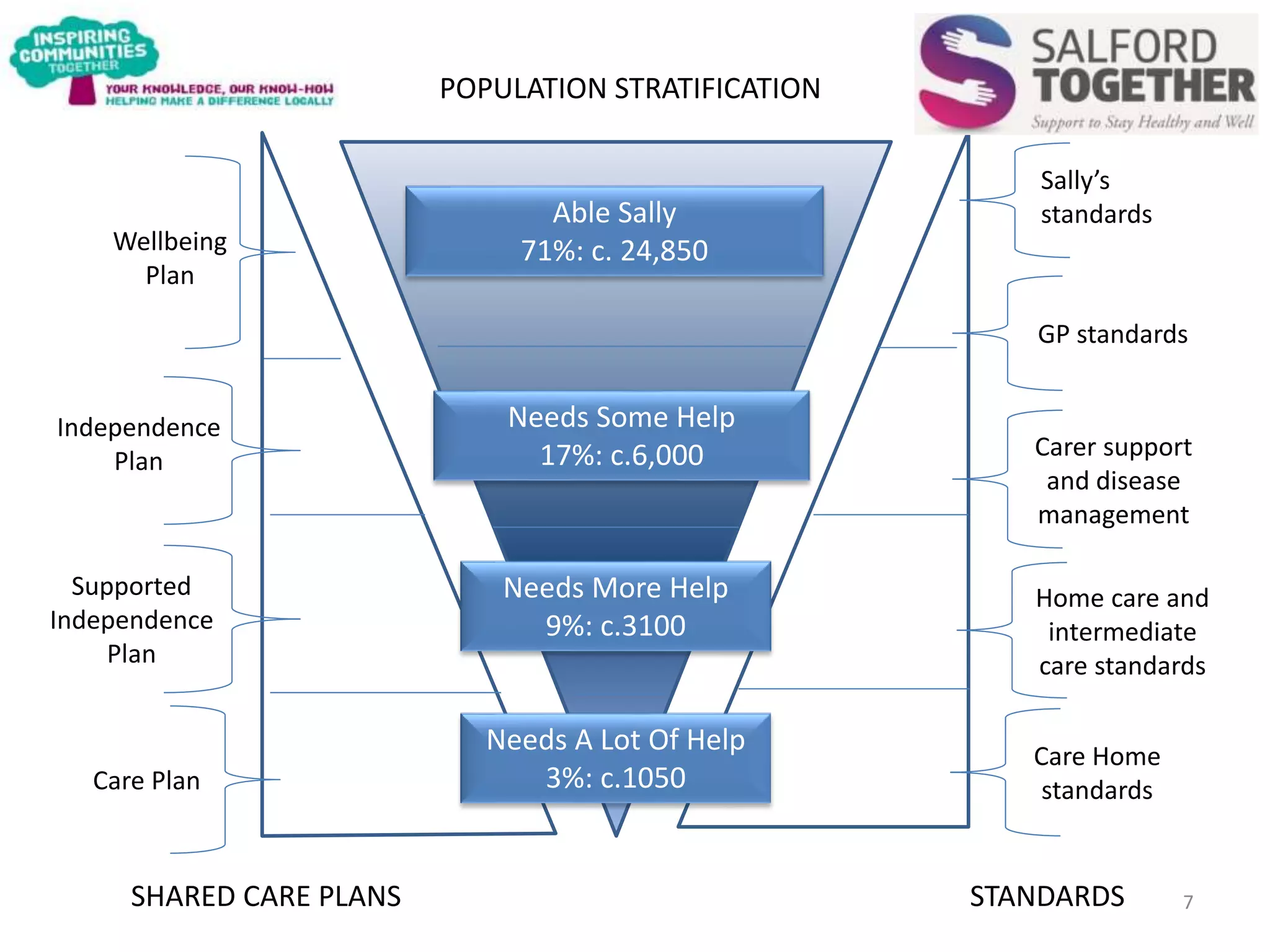
Wellbeing
Plan
Care Plan
Independence
Plan
Supported
Independence
Plan
SHARED CARE PLANS
POPULATION STRATIFICATION
STANDARDS
Care Home
standards
Home care and
intermediate
care standards
GP standards
Carer support
and disease
management
Able Sally
71%: c. 24,850
Needs Some Help
17%: c.6,000
Needs More Help
9%: c.3100
Needs A Lot Of Help
3%: c.1050
Sally’s
standards
7
Making it
easier to find
the right
support/help
and how to
look after
yourself at
home safely
Helping mature persons
know what
help/support there is
Everyone working
together so mature
persons feel happy and
well
Keeping mature persons
safe by staying involved
in the community
• Knowing what is in the neighbourhood
• Knowing how to find out about what
is in the neighbourhood
• Knowing how to use what is in the
neighbourhood
• Giving information and advice on how
to look after yourself so mature persons
can be happy and well
• Keeping mature persons out of hospital
• Keeping mature persons happy and
healthy at
home
Aim Primary Drivers Secondary Drivers
Integrated Care Programme – plain English version
2020 targets – what and why?
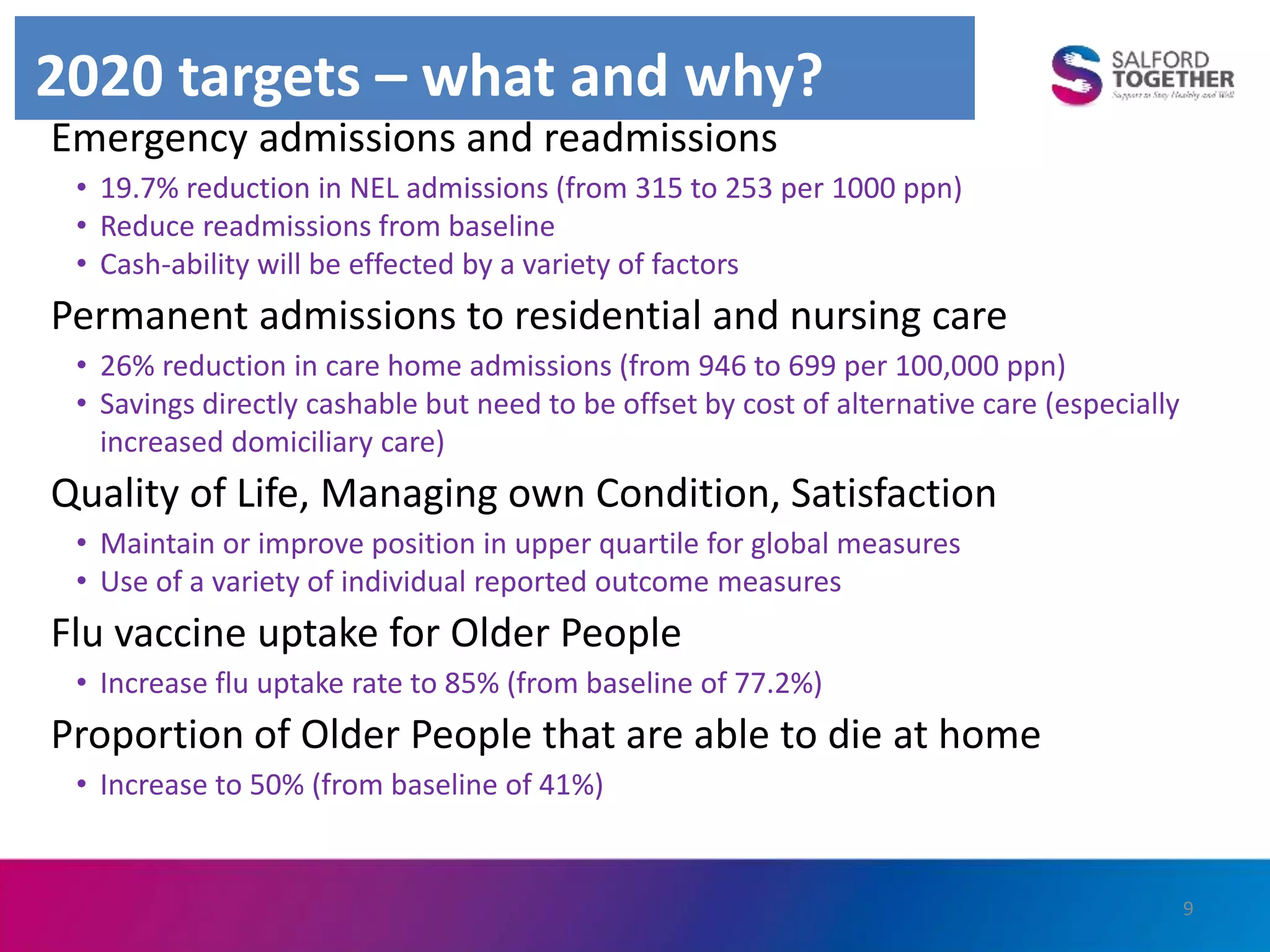
Emergency admissions and readmissions
• 19.7% reduction in NEL admissions (from 315 to 253 per 1000 ppn)
• Reduce readmissions from baseline
• Cash-ability will be effected by a variety of factors
Permanent admissions to residential and nursing care
• 26% reduction in care home admissions (from 946 to 699 per 100,000 ppn)
• Savings directly cashable but need to be offset by cost of alternative care (especially
increased domiciliary care)
Quality of Life, Managing own Condition, Satisfaction
• Maintain or improve position in upper quartile for global measures
• Use of a variety of individual reported outcome measures
Flu vaccine uptake for Older People
• Increase flu uptake rate to 85% (from baseline of 77.2%)
Proportion of Older People that are able to die at home
• Increase to 50% (from baseline of 41%)
9
Community Asset model
“Using the knowledge and life experiences of older people to make life better by
listening to and valuing their views: making sure this influences services to be
better in future by building on community strengths. This will keep older people
in Salford healthy, happy and independent for longer”
Engagement
• The Citizen Reference Group (CRG) This formal structure was established
as part of the ICP programme. The group of local older people are
supported through a development worker and meet monthly to look at
aspects of the programme – acting as a critical friend. Members engage
with areas of work which interest them and act as ambassadors for the
programme by sharing key messages from the programme with their own
networks.
• The community asset work stream project group have engaged with older
people through the network of partners who attend the monthly meetings
(housing providers, development workers, third sector organisations,
health workers and Salford City Council). Older people are invited to take
part in workshops and focus groups to understand what is important to
them to support their own health and well being.
Community asset model
• An Age Friendly City – the commitment of the city to
support older people to stay healthy and well.
• Older Person Standards and Well Being Plans- the
commitment by older people to support their own health
and well being.
• A set of tools developed by and for older people based in
local neighbourhoods – the commitment of community
and deliverers to support older people to stay healthy and
well
Community asset work stream project group
The network includes a wide range of partners including mature people, City Council ,
University, Businesses, Charities, Social Enterprises, and Third Sector,
Work across a number of areas including housing, volunteering, befriending and Leisure
and Health Improvement connections.
Community asset approach
• Ensure there is access to advice and guidance for older
people to stay healthy and well and manage their own
health and well being at a neighbourhood level with a
focus on prevention and well being
• Ensuring there is opportunity to access activity at a
neighbourhood level and funding to support new
activity
• Developing technology as a tool for improved health
and well being
• Building volunteering as a life choice in older age and
linking to the centre of contact and community
connectors model
• Joining up what is already happening
Cost and value to the NHS
• Loneliness = £ to some one who smokes 15
cigarettes a day
• Falls = over 4 million NHS bed days each year
• 14% (nearly 5000) of people aged 65 and over may
be at risk of malnutrition (using BAPEN prevalence
tool)
• Bad oral health leads to poor levels of nutrition &
can lead to social isolation
• Technology can be a means to enable older people
to renew and develop social contacts and engage
actively in their communities.
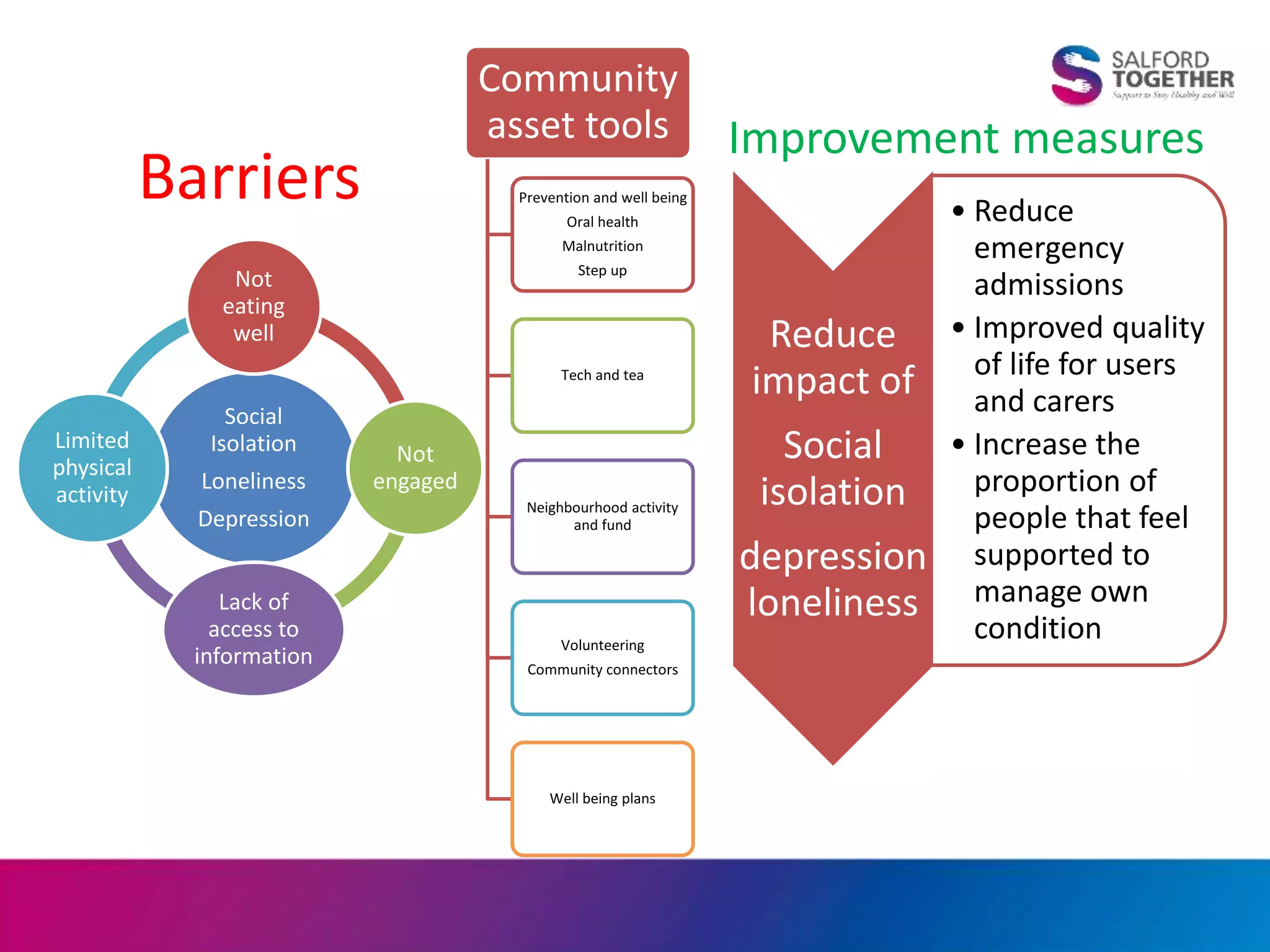
Social
Isolation
Loneliness
Depression
Not
eating
well
Not
engaged
Lack of
access to
information
Limited
physical
activity
Community
asset tools
Prevention and well being
Oral health
Malnutrition
Step up
Tech and tea
Neighbourhood activity
and fund
Volunteering
Community connectors
Well being plans
Reduce
impact of
Social
isolation
depression
loneliness
• Reduce
emergency
admissions
• Improved quality
of life for users
and carers
• Increase the
proportion of
people that feel
supported to
manage own
condition
Barriers
Improvement measures
The model in action
Community asset tools = £500,000
• Asset mapping – development support to understand
what we have and identify gaps and opportunities
• Prevention and well being – Step up programme and
advice and guidance including development of tools
with older people
• Neighbourhood activity - funding to support access to
activity at a neighbourhood level and support new
activity
• Technology – tech and tea across the city as a tool for
improved health and well being
• Volunteering as a life choice in older age
Delivered by 3rd sector in the community
to support activity already being delivered
Prevention and well being
• Step up
• Malnutrition
• Oral health
• Campaigns and events
Salford - National Pilot Site
Raising awareness Working together
Identifying malnutrition
Personalised care, support
and treatment
Monitoring and evaluating
Working together
http://www.nhselect2.org.uk/malnutrition/salford.php
Neighbourhood activity and fund
• Well being plans
• Increase in volunteers
• Increase in people accessing neighbourhood activity
The Salford Wellbeing Plan
Technology
• Tech and tea
• Digital Champions
• Intergenerational
• Improved local access
Tech and tea
Tech and tea engages older people in understanding the benefits
of technology in helping them to:
• engage in neighbourhood activity
• reduce social isolation and loneliness
• improve health and well being outcomes
The benefits
• Learning new things – how to surf the web
• Keeping in touch – contacting family and friends
• Improving health and well being – access to information
• Reducing social isolation and loneliness – meeting new friends
- http://communityreporter.net/videos/tech-and-tea-
2015
Helping each other – giving time
Volunteering
Formal - Volunteer coordination to develop a network of
volunteers and provide support
• Volunteers in care homes pilot
• Well Being Champions
• Digital Champions
Informal – Community connectors – delivered through
Age UK Salford. Encouraging and supporting people to
knock on
Neighbourhood groups – volunteering for each other
What it means to people in Salford
• Increased public awareness that losing weight, bad oral health
and being lonely are not a natural part of ageing
• More older people equipped with tools to self manage their
own health and well being
• More neighbourhood assets have access to information and
tools to support older people to manage their own health and
well being
• More neighbourhood assets are better equipped to detect
early signs and know how to provide advice and guidance to
older people
• Easier access to activity and written information for older
people to help them manage their own health and well being
Meeting the targets
Improvement measures:
• Technology as a tool to increase the proportion of older people that feel
able to manage their own long term condition and improve the quality
of life for users and carers
• Prevention and well being activity ensuring there is access to activity,
advice and guidance for older people to stay healthy and well and
manage their own health and well being at a neighbourhood level with a
focus on prevention and well being. This will help reduce emergency
admissions and readmissions.
• Neighbourhood activity ensuring there is opportunity to access activity
at a neighbourhood level and funding to support new activity to increase
the proportion of older people that feel able to manage their own long
term condition and improve the quality of life for users and carers
Moving from health to well being
Medical model
• Hospital to home – Salford Home Safe
• In own home –
– Multi Disciplinary Groups (MDG)
– Centre of Contact
– GP Surgery
Asset based model
• Building on individual strengths
• Using the right tools – well being plan
• Setting personal goals
• Joining up what is already happening and flipping the axis to
support the best outcomes for the person as safely and as
quickly as possible
Demonstrating the
difference
Quality improvement:
• A test and learn approach – Small scale test and rapid scale up based on
evidence – dash board of measurers:
• Loneliness tool
• Well being plans
• Digital skills
• Increase in volunteers
• increased community resilience
• Improved level of fitness measurers
• Increase in awareness of eating well in later life quiz
High level evaluation - CLASSIC:
• Improved quality of life measurers
Home
CA
coordination
group
Medical
support
Community
assets
Person
ill at
home
Wellbeing
Plan
Reconnecting individuals to the community
Centre
of
Contact
Home
Safe
Ready to
manage
own health
Home support
• Care on call
• Health Trainers
• Befriending
• housing
Hand holding
• Well being coaches
Sign posting
• Health Improvement
• Neighbourhood
management
Confidence
bld
MDG
GP
surgery
Opportunities and challenges
Opportunities:
• Community Asset approach recognised as part of the solution
• Budget allocation – Lowest % at present
• Starting to demonstrate impact = £££
• VCS as partners in coproduction of model
Challenges:
• Moving funding outside the system
• VCS working in partnership – Salford approach 3SC (86
members)
• Large contracts V small scale neighbourhood interventions
Thank you for listening –
For further information
http://www.salfordtogether.com
http://inspiringcommunitiestogether.co.uk
bernadette@inspiringcommunitiestogether.co.uk

Inspiring communities together 2015

  • 1.
    Bernadette Elder – InspiringCommunities Together
  • 2.
    Inspiring Communities Together Neighbourhoodbased charity • Membership led – Trustees elected through membership • Delivers activity – learning and volunteering • Facilitates – bring people together through two local forums • Advocate – link between agencies and local community • Securing resources – paid work linked to aims
  • 3.
    Strategic Context 3 Salford TogetherPartnership • Four high performing partners – within broader network of partners • £98M Pooled Budget - Integrated Care for Older People (ICP) • Governed by Alliance Contract • Underpinned by 2014-18 Service and Financial plan (inc. BCF) • Formal Programme Management approach (ICP) • ICP one of three major transformation initiatives - Out of hospital Care (primary care investment, renewal) & HT Salford care economy • Urban area in Greater Manchester • Population of circa 230,000 • Area of significant deprivation and health inequalities • Largely co-terminus - Salford CGG (health commissioner) - Salford Royal (acute and community healthcare provider) - Salford City Council (adult social care) - Greater Manchester West (mental health provider) • Long history of successful partnership working
  • 4.
    Over view ofSalford • Total population is 236,000 • Eight neighbourhoods • Although there are diverse levels of affluence, Salford is ranked as one of the most deprived local authority areas in England with life expectancy lower than the England average • Population of people aged 65 and over is 35,000 • Number of older people is forecast to rise by 28% by 2030
  • 5.
    5 “Integrated health andsocial care for older people has demonstrated the potential to decrease hospital use, achieve high levels of patient satisfaction, and improve quality of life and physical functioning” Curry and Ham, Clinical and Service Integration – The Route to Improved Outcomes King’s Fund, 2010 High levels of need National and international evidence Significant population growth Significant cost of care Poor experience of care Service duplication The Start of this Journey…
  • 6.
    Salford’s Integrated CareProgramme Multi Disciplinary Groups provide targeted support to older people who are most at risk and have a population focus on screening, primary prevention and signposting to community support 3 Local community assets enable older people to remain independent, with greater confidence to manage their own care 1 Centre of Contact acts as an central health and social care hub, supporting Multi Disciplinary Groups, helping people to navigate services and support mechanisms, and coordinating telecare monitoring 2 1 Promoting independence for older people  Better health and social care outcomes  Improved experience for services users and carers  Reduced health and social care costs 32 Housing Work stream
  • 7.
    Wellbeing Plan Care Plan Independence Plan Supported Independence Plan SHARED CAREPLANS POPULATION STRATIFICATION STANDARDS Care Home standards Home care and intermediate care standards GP standards Carer support and disease management Able Sally 71%: c. 24,850 Needs Some Help 17%: c.6,000 Needs More Help 9%: c.3100 Needs A Lot Of Help 3%: c.1050 Sally’s standards 7
  • 8.
    Making it easier tofind the right support/help and how to look after yourself at home safely Helping mature persons know what help/support there is Everyone working together so mature persons feel happy and well Keeping mature persons safe by staying involved in the community • Knowing what is in the neighbourhood • Knowing how to find out about what is in the neighbourhood • Knowing how to use what is in the neighbourhood • Giving information and advice on how to look after yourself so mature persons can be happy and well • Keeping mature persons out of hospital • Keeping mature persons happy and healthy at home Aim Primary Drivers Secondary Drivers Integrated Care Programme – plain English version
  • 9.
    2020 targets –what and why? Emergency admissions and readmissions • 19.7% reduction in NEL admissions (from 315 to 253 per 1000 ppn) • Reduce readmissions from baseline • Cash-ability will be effected by a variety of factors Permanent admissions to residential and nursing care • 26% reduction in care home admissions (from 946 to 699 per 100,000 ppn) • Savings directly cashable but need to be offset by cost of alternative care (especially increased domiciliary care) Quality of Life, Managing own Condition, Satisfaction • Maintain or improve position in upper quartile for global measures • Use of a variety of individual reported outcome measures Flu vaccine uptake for Older People • Increase flu uptake rate to 85% (from baseline of 77.2%) Proportion of Older People that are able to die at home • Increase to 50% (from baseline of 41%) 9
  • 10.
    Community Asset model “Usingthe knowledge and life experiences of older people to make life better by listening to and valuing their views: making sure this influences services to be better in future by building on community strengths. This will keep older people in Salford healthy, happy and independent for longer”
  • 11.
    Engagement • The CitizenReference Group (CRG) This formal structure was established as part of the ICP programme. The group of local older people are supported through a development worker and meet monthly to look at aspects of the programme – acting as a critical friend. Members engage with areas of work which interest them and act as ambassadors for the programme by sharing key messages from the programme with their own networks. • The community asset work stream project group have engaged with older people through the network of partners who attend the monthly meetings (housing providers, development workers, third sector organisations, health workers and Salford City Council). Older people are invited to take part in workshops and focus groups to understand what is important to them to support their own health and well being.
  • 12.
    Community asset model •An Age Friendly City – the commitment of the city to support older people to stay healthy and well. • Older Person Standards and Well Being Plans- the commitment by older people to support their own health and well being. • A set of tools developed by and for older people based in local neighbourhoods – the commitment of community and deliverers to support older people to stay healthy and well Community asset work stream project group The network includes a wide range of partners including mature people, City Council , University, Businesses, Charities, Social Enterprises, and Third Sector, Work across a number of areas including housing, volunteering, befriending and Leisure and Health Improvement connections.
  • 13.
    Community asset approach •Ensure there is access to advice and guidance for older people to stay healthy and well and manage their own health and well being at a neighbourhood level with a focus on prevention and well being • Ensuring there is opportunity to access activity at a neighbourhood level and funding to support new activity • Developing technology as a tool for improved health and well being • Building volunteering as a life choice in older age and linking to the centre of contact and community connectors model • Joining up what is already happening
  • 14.
    Cost and valueto the NHS • Loneliness = £ to some one who smokes 15 cigarettes a day • Falls = over 4 million NHS bed days each year • 14% (nearly 5000) of people aged 65 and over may be at risk of malnutrition (using BAPEN prevalence tool) • Bad oral health leads to poor levels of nutrition & can lead to social isolation • Technology can be a means to enable older people to renew and develop social contacts and engage actively in their communities.
  • 15.
    Social Isolation Loneliness Depression Not eating well Not engaged Lack of access to information Limited physical activity Community assettools Prevention and well being Oral health Malnutrition Step up Tech and tea Neighbourhood activity and fund Volunteering Community connectors Well being plans Reduce impact of Social isolation depression loneliness • Reduce emergency admissions • Improved quality of life for users and carers • Increase the proportion of people that feel supported to manage own condition Barriers Improvement measures
  • 16.
  • 17.
    Community asset tools= £500,000 • Asset mapping – development support to understand what we have and identify gaps and opportunities • Prevention and well being – Step up programme and advice and guidance including development of tools with older people • Neighbourhood activity - funding to support access to activity at a neighbourhood level and support new activity • Technology – tech and tea across the city as a tool for improved health and well being • Volunteering as a life choice in older age Delivered by 3rd sector in the community to support activity already being delivered
  • 18.
    Prevention and wellbeing • Step up • Malnutrition • Oral health • Campaigns and events
  • 19.
    Salford - NationalPilot Site Raising awareness Working together Identifying malnutrition Personalised care, support and treatment Monitoring and evaluating
  • 20.
  • 21.
    Neighbourhood activity andfund • Well being plans • Increase in volunteers • Increase in people accessing neighbourhood activity
  • 22.
  • 24.
    Technology • Tech andtea • Digital Champions • Intergenerational • Improved local access
  • 25.
    Tech and tea Techand tea engages older people in understanding the benefits of technology in helping them to: • engage in neighbourhood activity • reduce social isolation and loneliness • improve health and well being outcomes The benefits • Learning new things – how to surf the web • Keeping in touch – contacting family and friends • Improving health and well being – access to information • Reducing social isolation and loneliness – meeting new friends - http://communityreporter.net/videos/tech-and-tea- 2015
  • 26.
    Helping each other– giving time
  • 27.
    Volunteering Formal - Volunteercoordination to develop a network of volunteers and provide support • Volunteers in care homes pilot • Well Being Champions • Digital Champions Informal – Community connectors – delivered through Age UK Salford. Encouraging and supporting people to knock on Neighbourhood groups – volunteering for each other
  • 28.
    What it meansto people in Salford • Increased public awareness that losing weight, bad oral health and being lonely are not a natural part of ageing • More older people equipped with tools to self manage their own health and well being • More neighbourhood assets have access to information and tools to support older people to manage their own health and well being • More neighbourhood assets are better equipped to detect early signs and know how to provide advice and guidance to older people • Easier access to activity and written information for older people to help them manage their own health and well being
  • 29.
    Meeting the targets Improvementmeasures: • Technology as a tool to increase the proportion of older people that feel able to manage their own long term condition and improve the quality of life for users and carers • Prevention and well being activity ensuring there is access to activity, advice and guidance for older people to stay healthy and well and manage their own health and well being at a neighbourhood level with a focus on prevention and well being. This will help reduce emergency admissions and readmissions. • Neighbourhood activity ensuring there is opportunity to access activity at a neighbourhood level and funding to support new activity to increase the proportion of older people that feel able to manage their own long term condition and improve the quality of life for users and carers
  • 30.
    Moving from healthto well being Medical model • Hospital to home – Salford Home Safe • In own home – – Multi Disciplinary Groups (MDG) – Centre of Contact – GP Surgery Asset based model • Building on individual strengths • Using the right tools – well being plan • Setting personal goals • Joining up what is already happening and flipping the axis to support the best outcomes for the person as safely and as quickly as possible
  • 31.
    Demonstrating the difference Quality improvement: •A test and learn approach – Small scale test and rapid scale up based on evidence – dash board of measurers: • Loneliness tool • Well being plans • Digital skills • Increase in volunteers • increased community resilience • Improved level of fitness measurers • Increase in awareness of eating well in later life quiz High level evaluation - CLASSIC: • Improved quality of life measurers
  • 32.
    Home CA coordination group Medical support Community assets Person ill at home Wellbeing Plan Reconnecting individualsto the community Centre of Contact Home Safe Ready to manage own health Home support • Care on call • Health Trainers • Befriending • housing Hand holding • Well being coaches Sign posting • Health Improvement • Neighbourhood management Confidence bld MDG GP surgery
  • 33.
    Opportunities and challenges Opportunities: •Community Asset approach recognised as part of the solution • Budget allocation – Lowest % at present • Starting to demonstrate impact = £££ • VCS as partners in coproduction of model Challenges: • Moving funding outside the system • VCS working in partnership – Salford approach 3SC (86 members) • Large contracts V small scale neighbourhood interventions
  • 34.
    Thank you forlistening – For further information http://www.salfordtogether.com http://inspiringcommunitiestogether.co.uk bernadette@inspiringcommunitiestogether.co.uk

Editor's Notes

  • #13 Matt – Martin to lead the session
  • #15 Matt – Martin to lead the session
  • #17 Matt
  • #19 Matt
  • #21 Matt – Martin to lead the session
  • #22 Matt
  • #24 Matt
  • #25 Matt
  • #26 Matt – Martin to lead the session
  • #27 Matt
  • #28 Matt – Martin to lead the session
  • #29 Matt – Martin to lead the session
  • #31 Matt – Martin to lead the session
  • #34 Matt – Martin to lead the session
  • #35 Matt – Martin to lead the session