Intergenerational
Community Building
Nancy Henkin, Ph.D.
Generations United
Washington, DC
Why NOW?
• Demographic changes
• Silo-ed approach to problem
solving
• Social isolation
What is intergenerational
community building?
Intentionally bringing diverse age groups
together to address issues that affect
people at all stages of life , to foster
social connectedness, and to promote
mutual understanding/empathy.
Theoretical Underpinnings
• Life course perspective
• Age- segregation
• Social capital/collective efficacy
• Age-inclusive public spaces: Agency and
Belonging
Communities for All Ages: A
Case Study
Vision
• People of all ages are supported, empowered and
engaged in community life
• Diverse organizations and residents work
together for the common good
• Strong social networks foster interdependence
across ages and cultures
• The physical environment promotes cross-
generational interaction
Lens
• Engagement across the life span
• Focus on cross-generational
relationships
• Assets and place-based
• Economies of scale
( one intervention to
address multiple problems
Approach
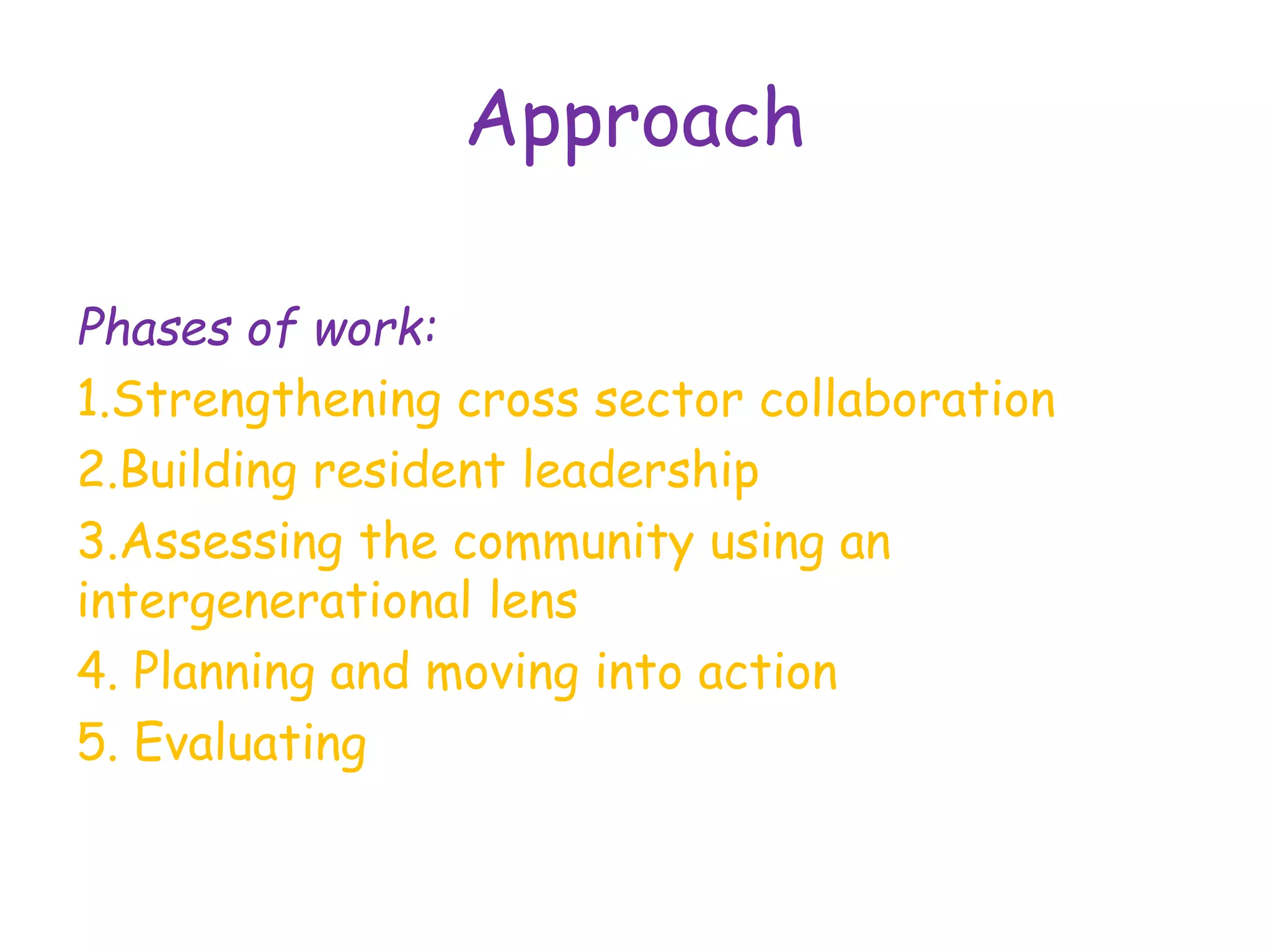
Phases of work:
1.Strengthening cross sector collaboration
2.Building resident leadership
3.Assessing the community using an
intergenerational lens
4. Planning and moving into action
5. Evaluating
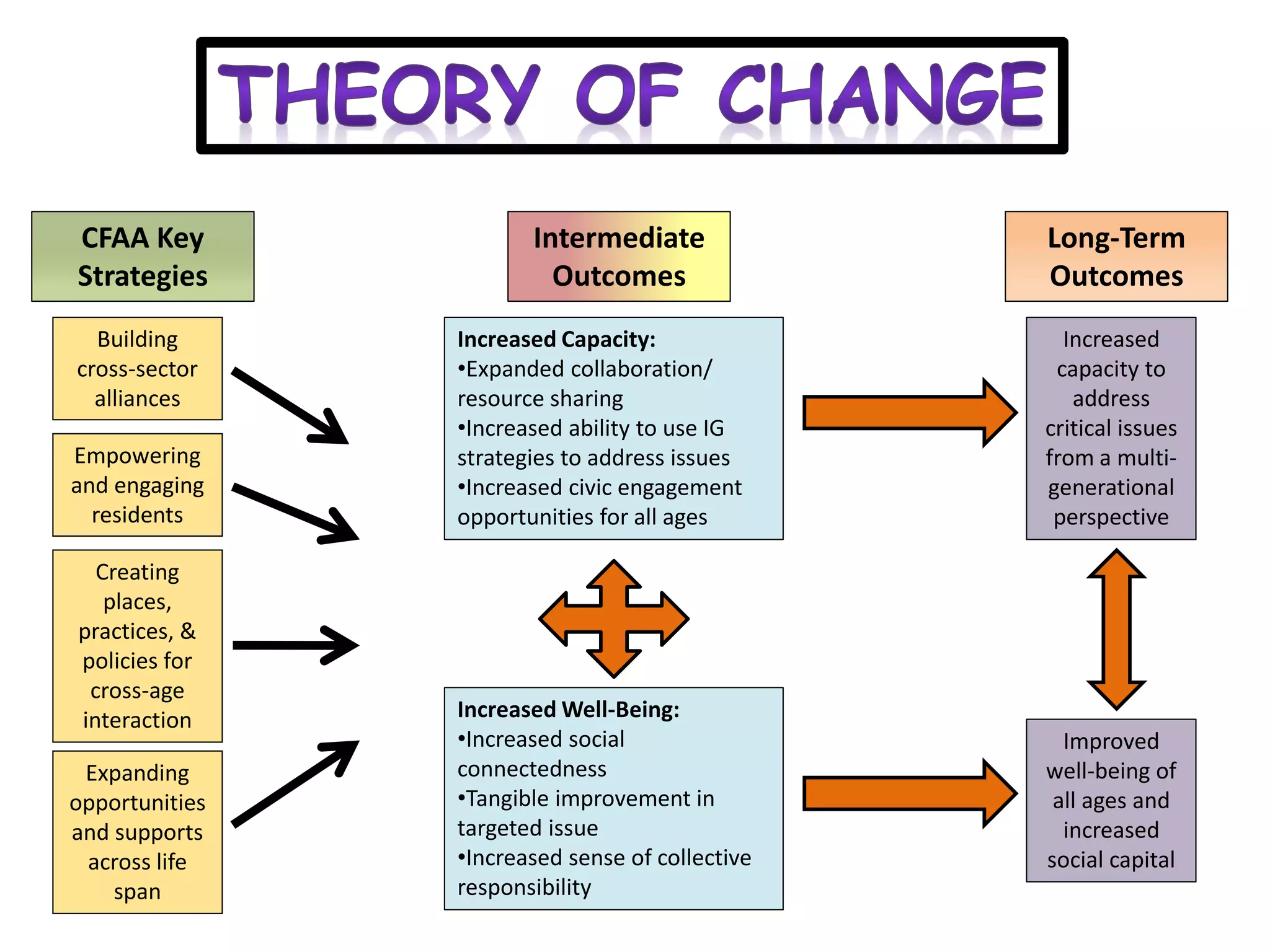
CFAA Key
Strategies
Empowering
and engaging
residents
Creating
places,
practices, &
policies for
cross-age
interaction
Building
cross-sector
alliances
Expanding
opportunities
and supports
across life
span
Increased Capacity:
•Expanded collaboration/
resource sharing
•Increased ability to use IG
strategies to address issues
•Increased civic engagement
opportunities for all ages
Increased Well-Being:
•Increased social
connectedness
•Tangible improvement in
targeted issue
•Increased sense of collective
responsibility
Intermediate
Outcomes
Long-Term
Outcomes
Increased
capacity to
address
critical issues
from a multi-
generational
perspective
Improved
well-being of
all ages and
increased
social capital
Key Strategies
Building Cross-Sector Alliances
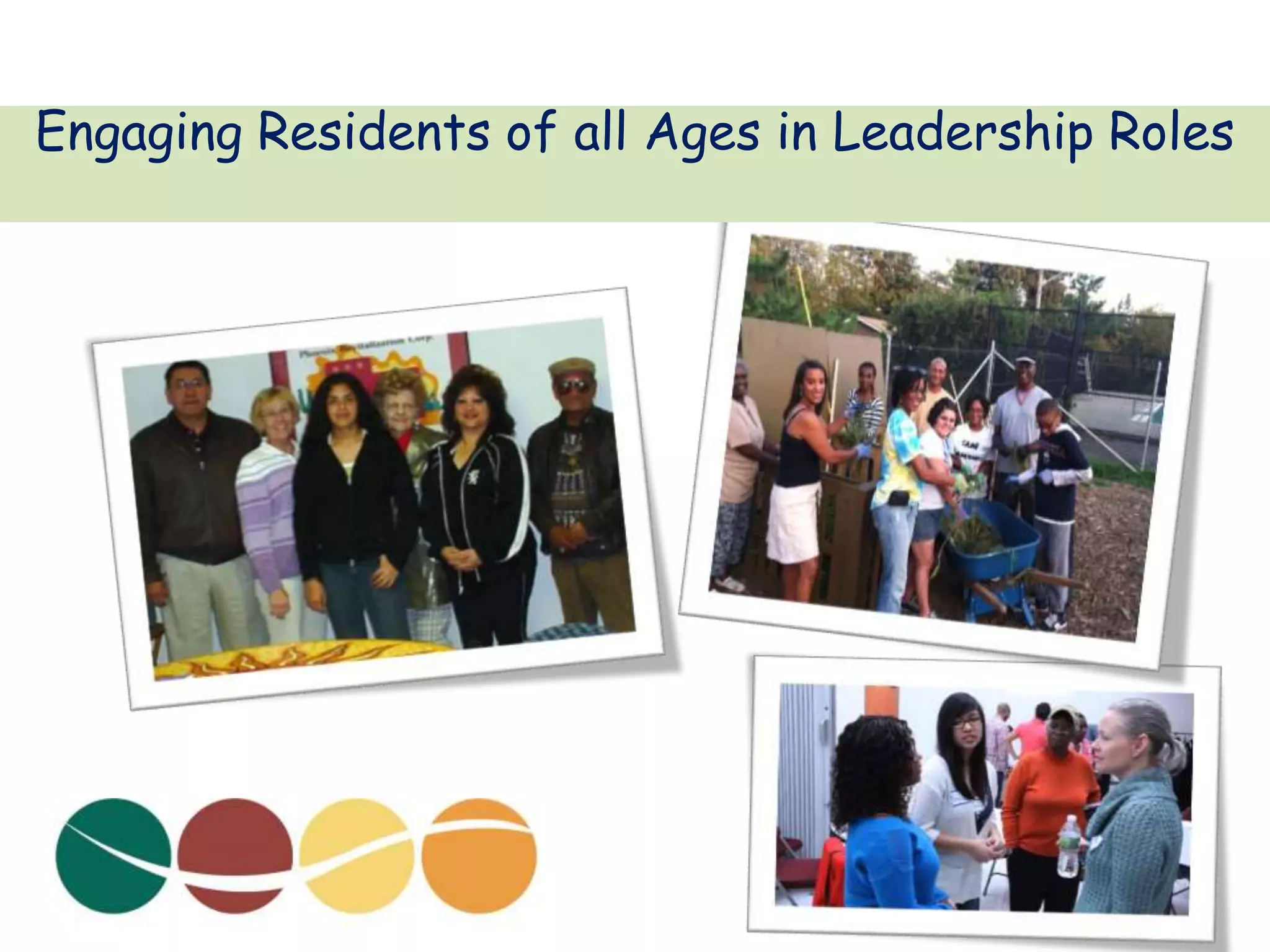
Engaging Residents of all Ages in Leadership Roles
Creating Places, Practices and Policies for
Cross-Age Interaction
• Expanding opportunities and supports across
the lifespan
Well-being outcomes
• Increased access to healthy, affordable
food
• Increased participation in physical
exercise
• Decreased levels of violence
• Improved physical infrastructure
• Increased support for schools
Social capital outcomes
• Increased trust and engagement across
age, race, class and ethnicity
“I think older people are afraid of
younger people…but when you mix them up
together…its not so scary, is it? Young
people are like everybody else, you have
to get used to them…reach out to
them…embrace them”
-Older adult resident
Community capacity outcomes
• Expanded opportunities for all ages to
contribute to communities (community
planning, bridging leadership, advisory
boards, organizing, advocacy)
• More inclusive leadership development
practices
• Expanded organizational alliances
(universities, aging network, faith-
based)
Lessons learned
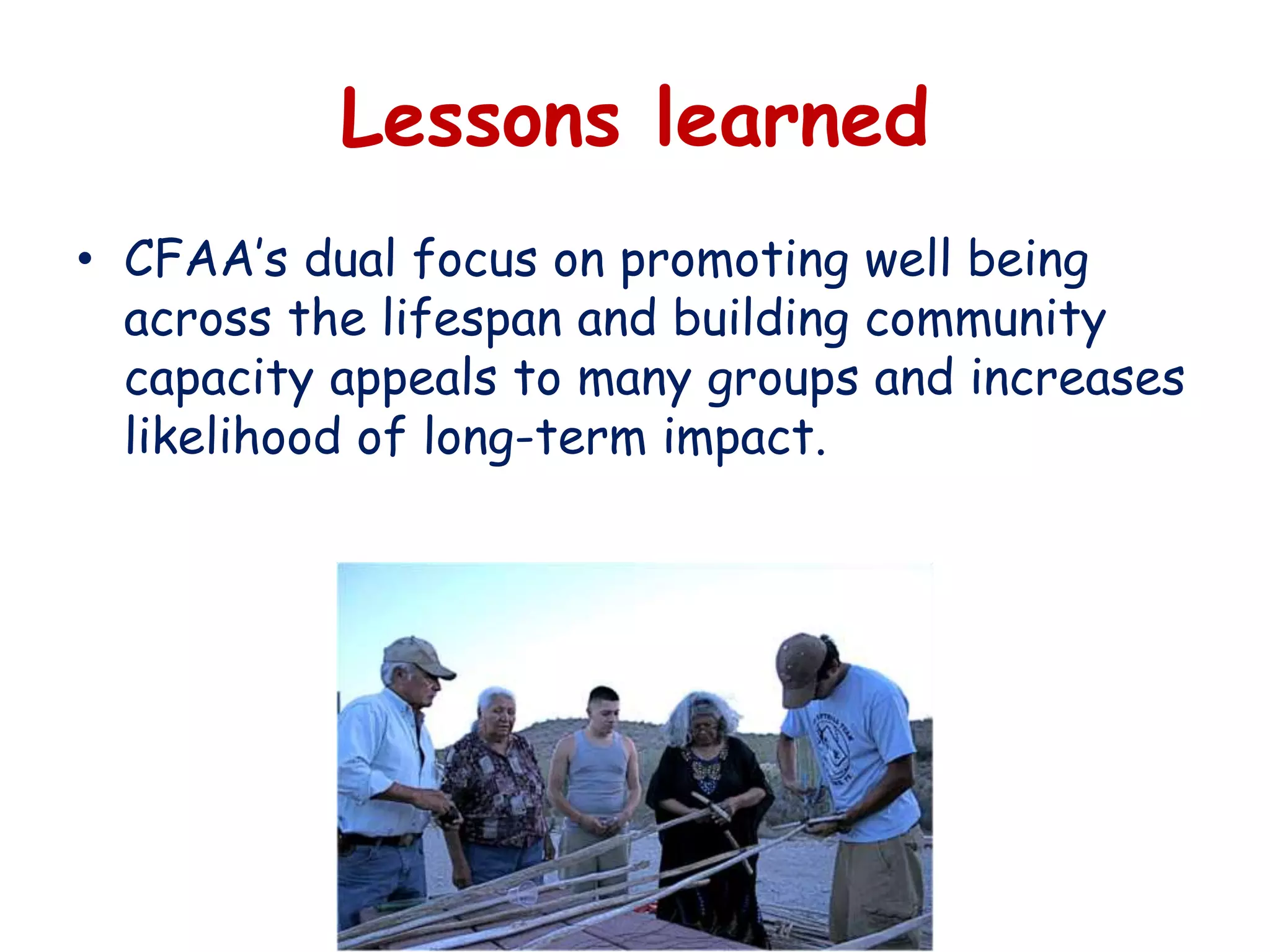
• CFAA’s dual focus on promoting well being
across the lifespan and building community
capacity appeals to many groups and increases
likelihood of long-term impact.
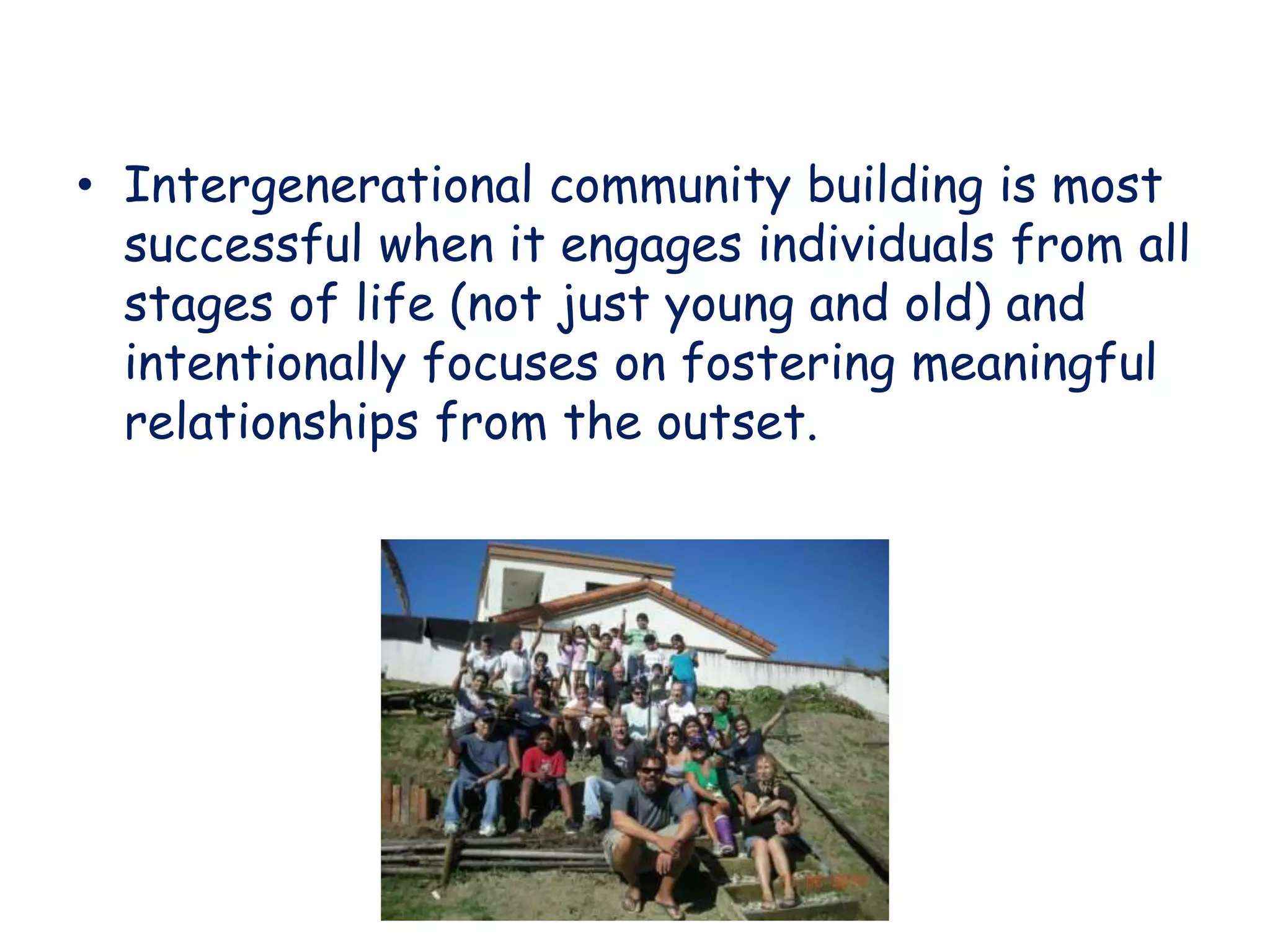
• Intergenerational community building is most
successful when it engages individuals from all
stages of life (not just young and old) and
intentionally focuses on fostering meaningful
relationships from the outset.
• Multi generational spaces hold great promise
for building social capital and creating a
tangible representation of the CFAA vision.
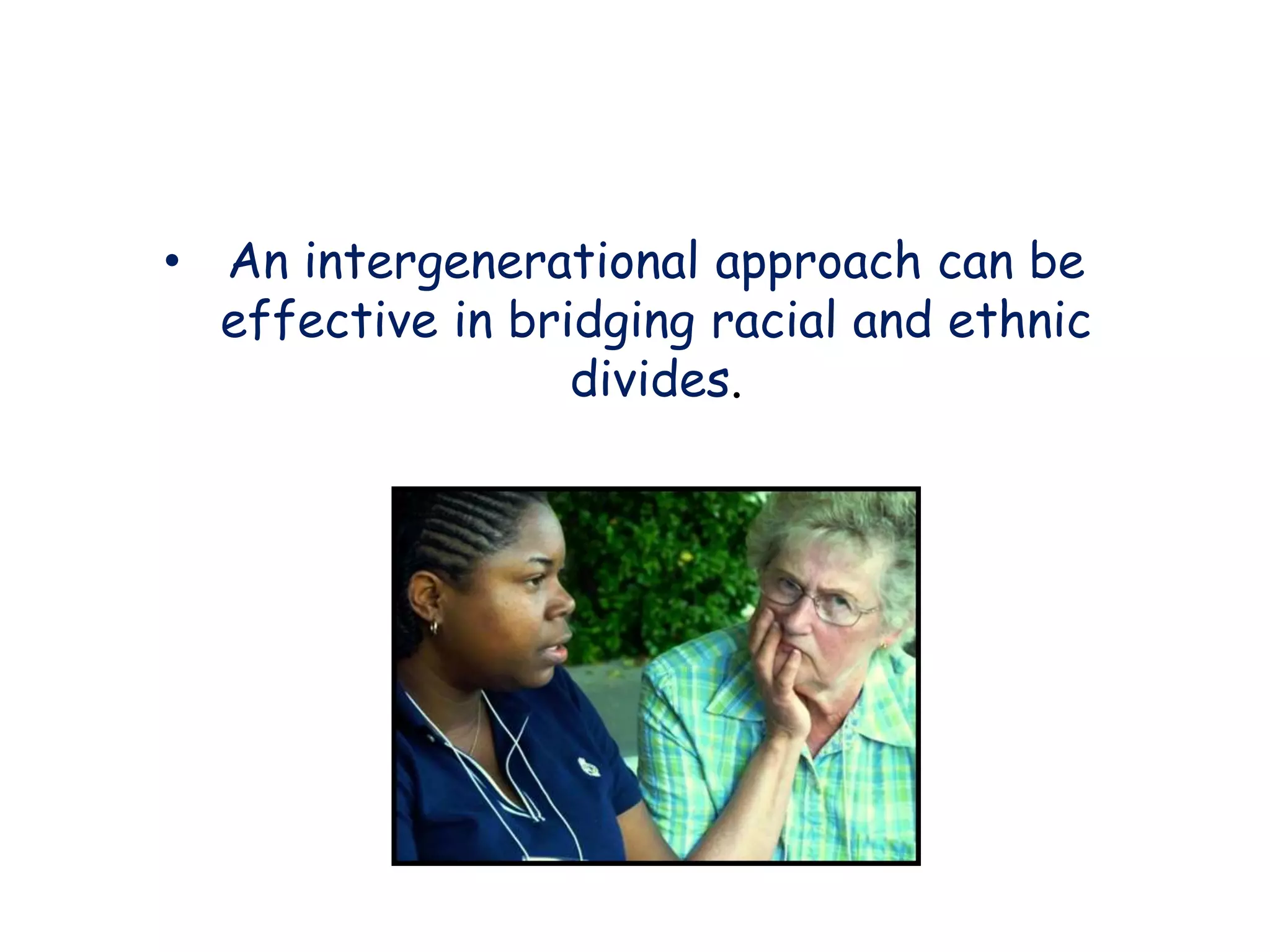
• An intergenerational approach can be
effective in bridging racial and ethnic
divides.
“We are caught in an inescapable
network of mutuality, tied in a single
garment of destiny. Whatever affects
one directly, affects all indirectly.”
Martin Luther King, Jr.
QUESTIONS?
IMAGINE THE POSSIBILITIES!
Opportunities and Challenges
• In what ways could an intergenerational
approach add value to your work and help you
build communities that are good for growing
up and growing older?
• How could an intergenerational lens be
infused into other Scottish initiatives
( e.g. age-friendly, social isolation, redesign
of public space, entrepreneurship, immigrant
integration)?
Discuss for 20 minutes in break out groups.
Resources
Found at www.gu.org/resources:
Communities for All Ages: Lessons Learned
Communities for All Ages: Resource Guide
Leadership for All Ages
Creating An Age- Advantaged Community
• Age-Inclusive Public Spaces (2020) D. Hauderowicz and
K. Serena (eds)
• Intergenerational Contact Zones (2020), M.Kaplan, L.
Thang, M. Sanchez and J. Hoffman (eds)
• “Communities for All Ages” in The Global Age-Friendly
Community Movement, P. Stafford (ed).

Intergenerational Community Building

  • 1.
    Intergenerational Community Building Nancy Henkin,Ph.D. Generations United Washington, DC
  • 2.
    Why NOW? • Demographicchanges • Silo-ed approach to problem solving • Social isolation
  • 3.
    What is intergenerational communitybuilding? Intentionally bringing diverse age groups together to address issues that affect people at all stages of life , to foster social connectedness, and to promote mutual understanding/empathy.
  • 4.
    Theoretical Underpinnings • Lifecourse perspective • Age- segregation • Social capital/collective efficacy • Age-inclusive public spaces: Agency and Belonging
  • 5.
    Communities for AllAges: A Case Study
  • 6.
    Vision • People ofall ages are supported, empowered and engaged in community life • Diverse organizations and residents work together for the common good • Strong social networks foster interdependence across ages and cultures • The physical environment promotes cross- generational interaction
  • 7.
    Lens • Engagement acrossthe life span • Focus on cross-generational relationships • Assets and place-based • Economies of scale ( one intervention to address multiple problems
  • 8.
    Approach Phases of work: 1.Strengtheningcross sector collaboration 2.Building resident leadership 3.Assessing the community using an intergenerational lens 4. Planning and moving into action 5. Evaluating
  • 9.
    CFAA Key Strategies Empowering and engaging residents Creating places, practices,& policies for cross-age interaction Building cross-sector alliances Expanding opportunities and supports across life span Increased Capacity: •Expanded collaboration/ resource sharing •Increased ability to use IG strategies to address issues •Increased civic engagement opportunities for all ages Increased Well-Being: •Increased social connectedness •Tangible improvement in targeted issue •Increased sense of collective responsibility Intermediate Outcomes Long-Term Outcomes Increased capacity to address critical issues from a multi- generational perspective Improved well-being of all ages and increased social capital
  • 10.
  • 11.
    Engaging Residents ofall Ages in Leadership Roles
  • 12.
    Creating Places, Practicesand Policies for Cross-Age Interaction
  • 13.
    • Expanding opportunitiesand supports across the lifespan
  • 14.
    Well-being outcomes • Increasedaccess to healthy, affordable food • Increased participation in physical exercise • Decreased levels of violence • Improved physical infrastructure • Increased support for schools
  • 15.
    Social capital outcomes •Increased trust and engagement across age, race, class and ethnicity “I think older people are afraid of younger people…but when you mix them up together…its not so scary, is it? Young people are like everybody else, you have to get used to them…reach out to them…embrace them” -Older adult resident
  • 16.
    Community capacity outcomes •Expanded opportunities for all ages to contribute to communities (community planning, bridging leadership, advisory boards, organizing, advocacy) • More inclusive leadership development practices • Expanded organizational alliances (universities, aging network, faith- based)
  • 17.
    Lessons learned • CFAA’sdual focus on promoting well being across the lifespan and building community capacity appeals to many groups and increases likelihood of long-term impact.
  • 18.
    • Intergenerational communitybuilding is most successful when it engages individuals from all stages of life (not just young and old) and intentionally focuses on fostering meaningful relationships from the outset.
  • 19.
    • Multi generationalspaces hold great promise for building social capital and creating a tangible representation of the CFAA vision.
  • 20.
    • An intergenerationalapproach can be effective in bridging racial and ethnic divides.
  • 21.
    “We are caughtin an inescapable network of mutuality, tied in a single garment of destiny. Whatever affects one directly, affects all indirectly.” Martin Luther King, Jr.
  • 22.
  • 23.
    Opportunities and Challenges •In what ways could an intergenerational approach add value to your work and help you build communities that are good for growing up and growing older? • How could an intergenerational lens be infused into other Scottish initiatives ( e.g. age-friendly, social isolation, redesign of public space, entrepreneurship, immigrant integration)? Discuss for 20 minutes in break out groups.
  • 24.
    Resources Found at www.gu.org/resources: Communitiesfor All Ages: Lessons Learned Communities for All Ages: Resource Guide Leadership for All Ages Creating An Age- Advantaged Community • Age-Inclusive Public Spaces (2020) D. Hauderowicz and K. Serena (eds) • Intergenerational Contact Zones (2020), M.Kaplan, L. Thang, M. Sanchez and J. Hoffman (eds) • “Communities for All Ages” in The Global Age-Friendly Community Movement, P. Stafford (ed).