Acquisition Integration
A Guide to Successful Culture, Sales,
IT and Operational Integration Post M&A
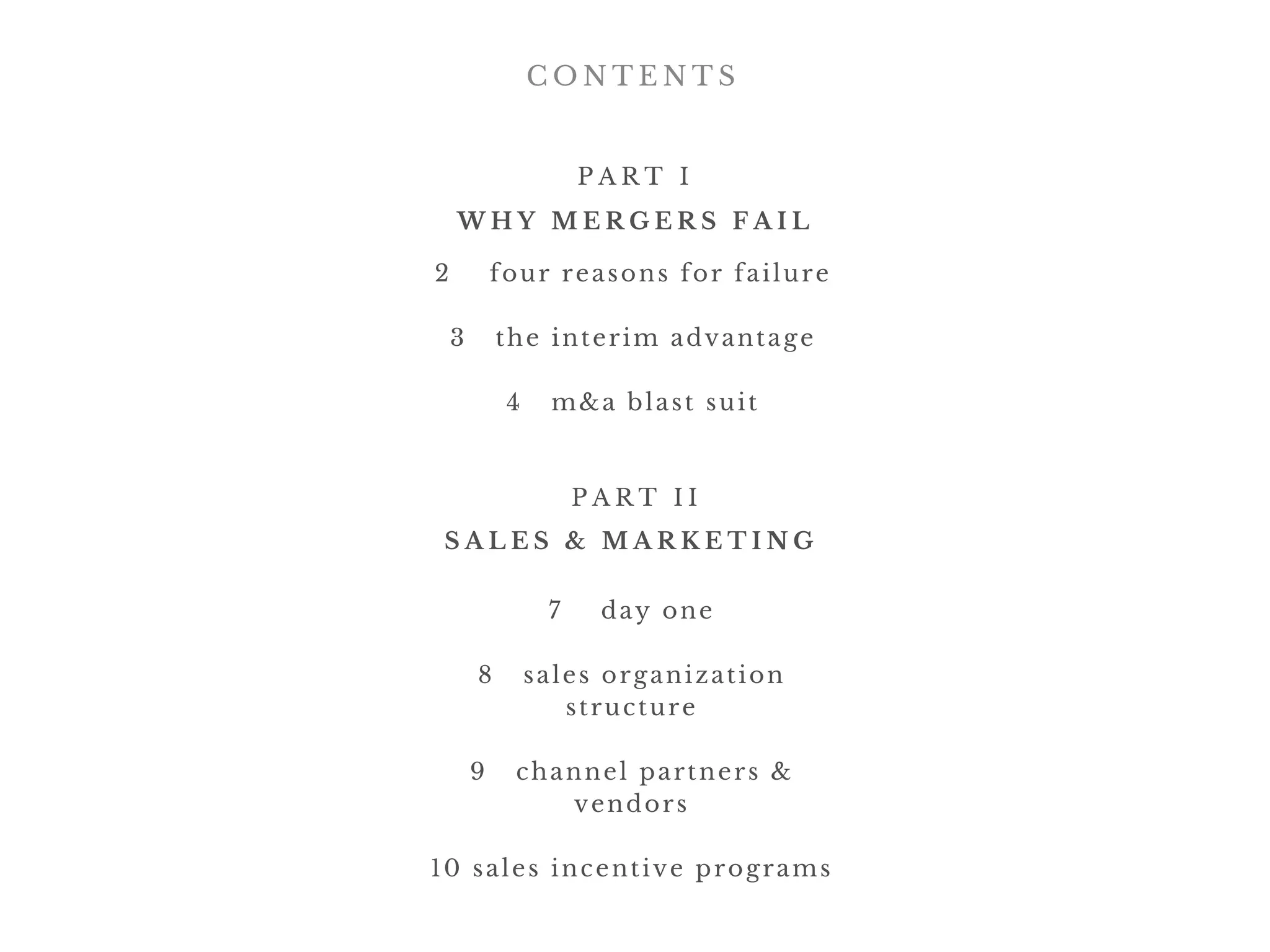
C O N T E N T S
P A R T I
2    four reasons for failure
3   the interim advantage
4   m&a blast suit
W H Y M E R G E R S F A I L
P A R T I I
7    day one
8   sales organization
structure
9   channel partners &
vendors
10 sales incentive programs
S A L E S   & M A R K E T I N G  
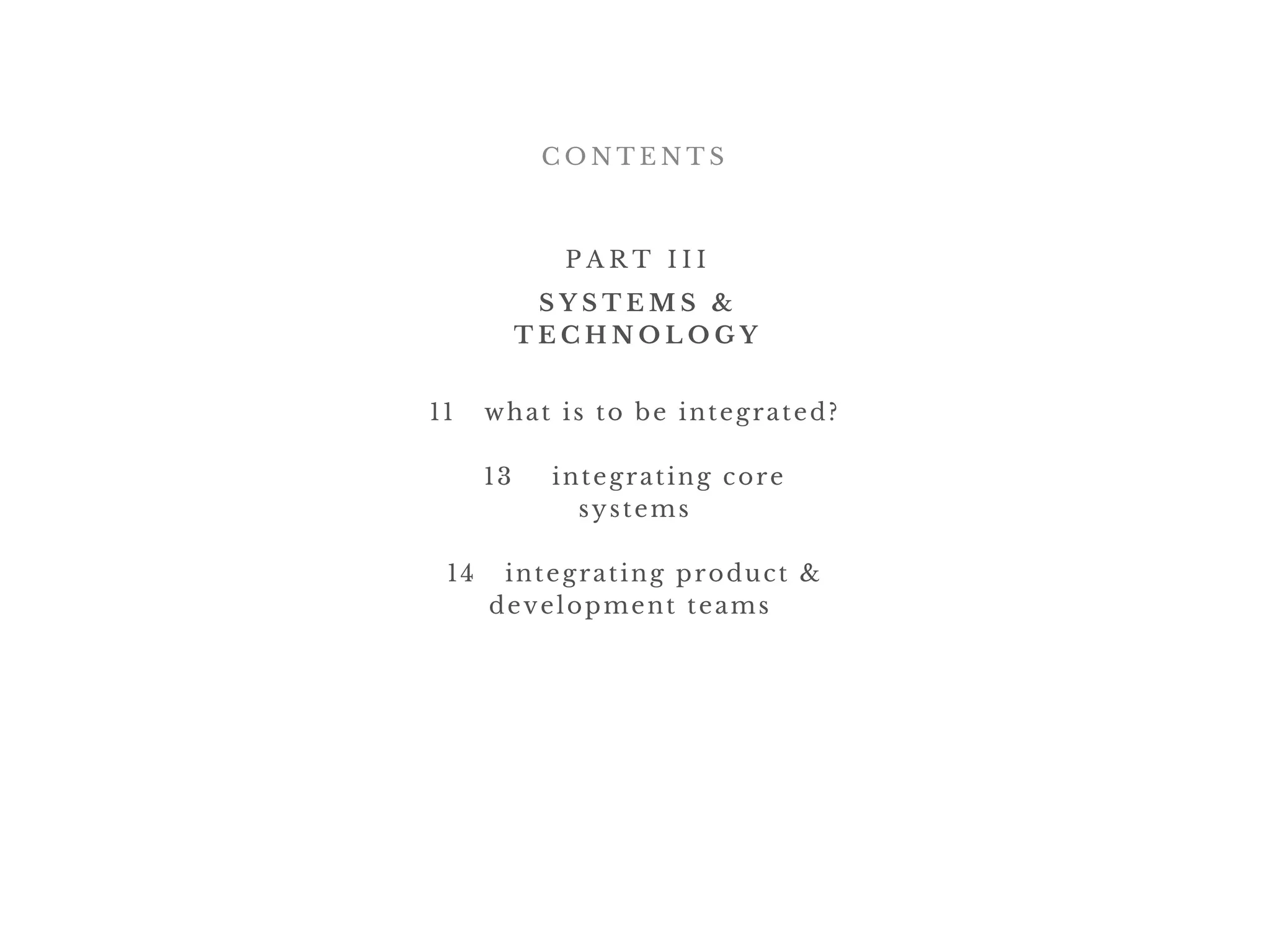
C O N T E N T S
P A R T I I I
11   what is to be integrated?
13    integrating core
systems
14   integrating product &
development teams 
S Y S T E M S &
T E C H N O L O G Y
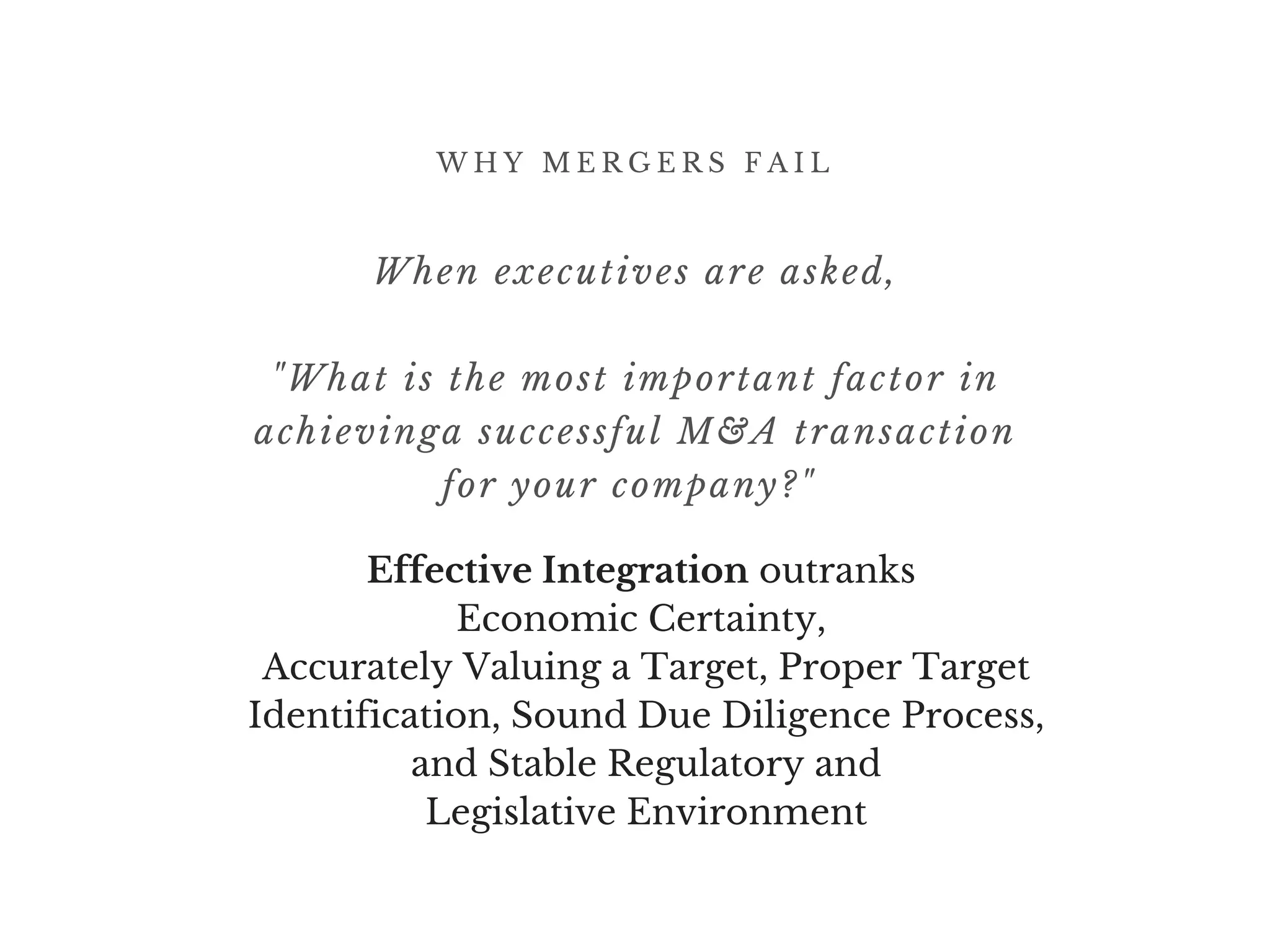
W H Y M E R G E R S F A I L
When executives are asked,
"What is the most important factor in
achievinga successful M&A transaction
for your company?" 
Effective Integration outranks 
Economic Certainty, 
Accurately Valuing a Target, Proper Target
Identification, Sound Due Diligence Process,
and Stable Regulatory and
Legislative Environment
Companies seek to accelerate revenue growth or enter new markets through mergers
and acquisitions. They spend a lot of energy and resources identifying the right targets
based on synergy and combined financial models.
But oftentimes, the real value of the acquisition is not realized. M&A typically fails
during integration. All that effort and capital spent on acquiring the target is wasted.
Why? There can be several reasons: 
1. Unless you are a large company that can afford their own in-house acquisition
integration department, companies simply don’t have the internal resources to assign to
an acquisition integration to do it right.
2. The existing management team fears creating a costly disruption in the acquired
target.
3. The integration burden is placed on existing managers who already have a day job
causing endless delay and lack of initiative.
PART 1
1
W H Y M E R G E R S F A I L
4. The talent in the acquired firm is ignored and “stars” exit early, quickly causing a
critical talent drain and loss of business know-how.
Every acquisition integration requires a dedicated, objective leader to achieve a
timely and cost effective successful outcome. The leader must have the business
acumen and soft skills to execute on the complex business objectives and strategy
without negatively disrupting the combined organizations and their customers. It’s a
careful balancing act that is learned from years of extensive experience.
The emphasis is on leader.  An interim executive can readily step-in, manage the
various functions, communicate with the C-Suite, Board and management teams and
execute with confidence.
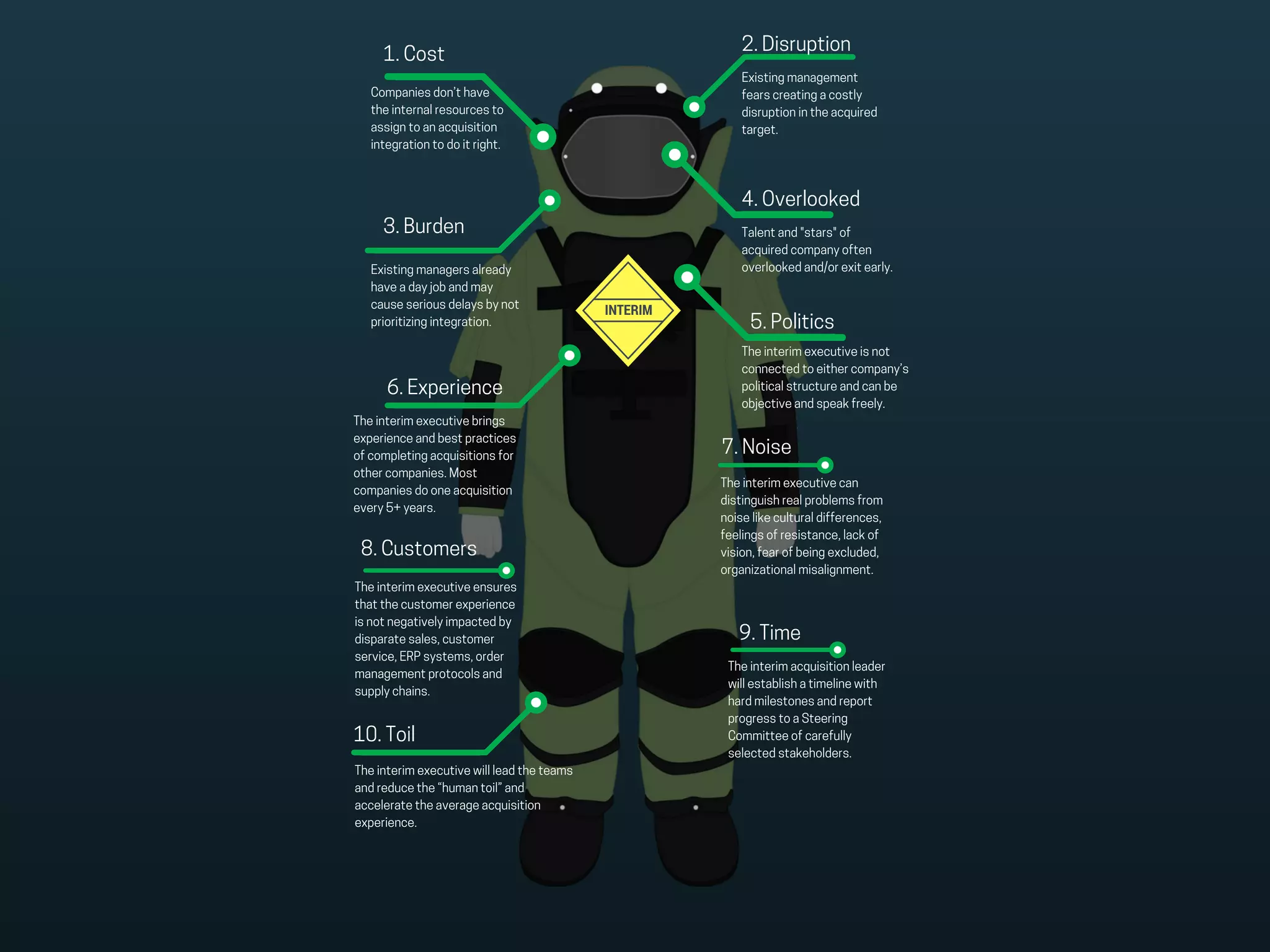
The benefits of an interim executive to lead the integration are manifold (See "Blast
Suit" Diagram on page 4):
1. The interim executive is not connected to either company’s political structure.
He/she can speak freely, impartially and objectively about the problems. He/she will
include and listen to the right functional leads on both sides. He/she will build
needed relationships and trust on all sides to accelerate the integration.
2
THE INTERIM ADVANTAGE
1. Cost
Companies don’t have
the internal resources to
assign to an acquisition
integration to do it right.
2. Disruption
Existing management
fears creating a costly
disruption in the acquired
target.
3. Burden
Existing managers already
have a day job and may
cause serious delays by not
prioritizing integration. 
4. Overlooked
Talent and "stars" of
acquired company often
overlooked and/or exit early.
5. Politics
The interim executive is not
connected to either company’s
political structure and can be
objective and speak freely.
6. Experience
INTERIM
The interim executive can
distinguish real problems from
noise like cultural differences,
feelings of resistance, lack of
vision, fear of being excluded,
organizational misalignment.
The interim executive brings
experience and best practices
of completing acquisitions for
other companies. Most
companies do one acquisition
every 5+ years.  
7. Noise
8. Customers
The interim executive ensures
that the customer experience
is not negatively impacted by
disparate sales, customer
service, ERP systems, order
management protocols and
supply chains.
9. Time
The interim acquisition leader
will establish a timeline with
hard milestones and report
progress to a Steering
Committee of carefully
selected stakeholders. 
10. Toil
The interim executive will lead the teams
and reduce the “human toil” and
accelerate the average acquisition
experience.
2. The interim executive brings experience and best practices of completing
acquisitions for other companies. For most clients, an acquisition happens every
five years or longer and the internal talent lacks enough experience.
3. The interim executive has the experience to distinguish the real problems from
the “noise.” Every acquisition or merger generates a tremendous amount of what I
call “noise”: It’s all the supposed problems identified by employees in all functions
at all levels of why the integration is going to fail. Most of it is rooted in cultural
differences, feelings of resistance, lack of vision, fear of being excluded,
organizational misalignment, geographic separation, to name a few. The
experienced acquisition leader will collect all of the noise and identify the real
problems in an atmosphere of inclusion and trust. Each acquisition is different and
the real problems can exist anywhere inside the noise. The acquisition leader will
engage and communicate with the organization to be effective in every situation.
4. The interim executive will also ensure that the customer experience is not
negatively impacted. This is not easy, as you will have disparate sales, customer
service, ERP systems, order management protocols and supply chains. Customers
are always weary of mergers and acquisitions, but the consensus is that the
customer experience never improves. You do not want to lose market share.
5. The interim acquisition leader will establish a timeline with hard milestones and
report progress to a Steering Committee of carefully selected stakeholders (C-Suite,
Board Members, Investors as appropriate). 
4
He/she will make sure that communication occurs at the right intervals and in real
time. The acquisition executive will level-set the integration objectives up front:
What do we want this integrated company to look like? An assimilation? A hybrid of
best practices? A cost optimization play? The acquisition executive can advise the
leadership on these decisions and develop the integration plan and timeline
accordingly.
6. The interim executive has the ability to shape the integration around the
complex acquisition objectives that drove the merger in the first place. Sometimes
these objectives are highly sensitive in nature and should not be shared with
internal managers (i.e divestiture, cost reduction, geographic consolidation,
liquidation of assets)
7. The interim executive will lead the teams and reduce the “human toil” and
accelerate the average acquisition experience. The leadership is accomplished
through influence or cross-functional reporting structures as appropriate.  Every
company culture is different.
The four important areas that a seasoned acquisition integration leader manages --
and which we will talk in more detail -- are:
1. Customer experience (communication, order management)
2. Creation of a joint sales force
5
3. Proper cadence of system integration (email, ERP, portals, platforms)
4. Managing the temperament of the leadership (CEO, CFO, Board, Owners,
Investors) on all sides for the benefit of a successful, timely integration. This is
where executive soft skills are crucial. The soft skills, the executive’s ability to lead
organizational change and influence, are equally important, if not more
important, than the hard skills.
One more note: Timing is critical. A successful integration requires preparation
and a strong “Day One” execution. The integration executive should be brought in
at least two weeks before the closing to prepare the organization for a successful
kick-off.
6
In the area of Sales & Marketing, the acquiring company needs to identify the
critical issues prior to the closing in preparation for “Day One.”
Day One is an important milestone and should be well coordinated. It’s the best
day to communicate to employees, the sales team, vendors and customers (in
that order).  If you don’t communicate what is happening right away, they will
make stuff up – and that’s always worse than the real story.
At the heart of the merger is the story…not as stated in the press release, but as
interpreted by existing and potential customers. What is the resulting value that
the combined entity should contribute to the customers’ experience?
Delivering this value should guide merging companies on 1) Marketing
messaging and Alignment,
2) Sales Organizational Structure,
3) Go-to-market solution planning,
4) Channel Partner and Vendor Programs, 
PART 2
7
S A L E S & M A R K E T I N G
7
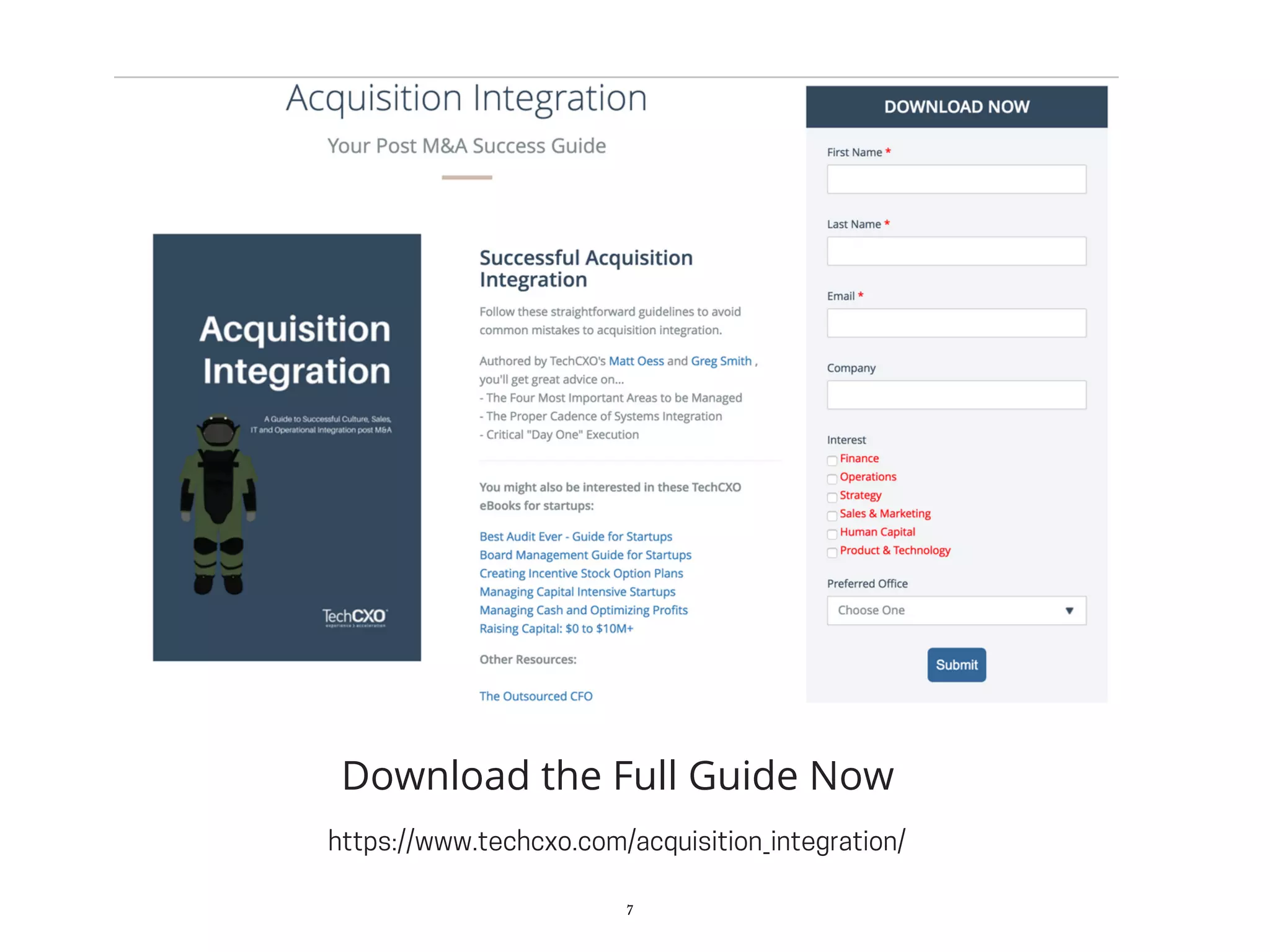
https://www.techcxo.com/acquisition_integration/
Download the Full Guide Now
FOLLOW US
facebook.com/techcxo
linkedin.com/techcxo
twitter.com/techcxo
© TechCXO 2018 | All rights reserved
www.techcxo.com
Matt Oess
matt.oess@techcxo.com
(404) 889-3539
Matt Oess is a strategy and
sales partner.  His
TechCXO work with
global companies has
included Larson-Juhl (a
Berkshire Hathaway
company), GE, and Pitney
Bowes. 
Greg Smith
greg.smith@techcxo.com
(404) 353-4939
Greg Smith is Managing
Partner for TechCXO's
Product & Technology
practice. He has been a
CTO/COO for several
companies and run pre-
and post- M&A projects
for clients.
AUTHORS

Acquisition Integration Post M&A Guide

  • 1.
    Acquisition Integration A Guideto Successful Culture, Sales, IT and Operational Integration Post M&A
  • 2.
    C O NT E N T S P A R T I 2    four reasons for failure 3   the interim advantage 4   m&a blast suit W H Y M E R G E R S F A I L P A R T I I 7    day one 8   sales organization structure 9   channel partners & vendors 10 sales incentive programs S A L E S   & M A R K E T I N G  
  • 3.
    C O NT E N T S P A R T I I I 11   what is to be integrated? 13    integrating core systems 14   integrating product & development teams  S Y S T E M S & T E C H N O L O G Y
  • 4.
    W H YM E R G E R S F A I L When executives are asked, "What is the most important factor in achievinga successful M&A transaction for your company?"  Effective Integration outranks  Economic Certainty,  Accurately Valuing a Target, Proper Target Identification, Sound Due Diligence Process, and Stable Regulatory and Legislative Environment
  • 5.
    Companies seek toaccelerate revenue growth or enter new markets through mergers and acquisitions. They spend a lot of energy and resources identifying the right targets based on synergy and combined financial models. But oftentimes, the real value of the acquisition is not realized. M&A typically fails during integration. All that effort and capital spent on acquiring the target is wasted. Why? There can be several reasons:  1. Unless you are a large company that can afford their own in-house acquisition integration department, companies simply don’t have the internal resources to assign to an acquisition integration to do it right. 2. The existing management team fears creating a costly disruption in the acquired target. 3. The integration burden is placed on existing managers who already have a day job causing endless delay and lack of initiative. PART 1 1 W H Y M E R G E R S F A I L
  • 6.
    4. The talentin the acquired firm is ignored and “stars” exit early, quickly causing a critical talent drain and loss of business know-how. Every acquisition integration requires a dedicated, objective leader to achieve a timely and cost effective successful outcome. The leader must have the business acumen and soft skills to execute on the complex business objectives and strategy without negatively disrupting the combined organizations and their customers. It’s a careful balancing act that is learned from years of extensive experience. The emphasis is on leader.  An interim executive can readily step-in, manage the various functions, communicate with the C-Suite, Board and management teams and execute with confidence. The benefits of an interim executive to lead the integration are manifold (See "Blast Suit" Diagram on page 4): 1. The interim executive is not connected to either company’s political structure. He/she can speak freely, impartially and objectively about the problems. He/she will include and listen to the right functional leads on both sides. He/she will build needed relationships and trust on all sides to accelerate the integration. 2 THE INTERIM ADVANTAGE
  • 7.
    1. Cost Companies don’thave the internal resources to assign to an acquisition integration to do it right. 2. Disruption Existing management fears creating a costly disruption in the acquired target. 3. Burden Existing managers already have a day job and may cause serious delays by not prioritizing integration.  4. Overlooked Talent and "stars" of acquired company often overlooked and/or exit early. 5. Politics The interim executive is not connected to either company’s political structure and can be objective and speak freely. 6. Experience INTERIM The interim executive can distinguish real problems from noise like cultural differences, feelings of resistance, lack of vision, fear of being excluded, organizational misalignment. The interim executive brings experience and best practices of completing acquisitions for other companies. Most companies do one acquisition every 5+ years.   7. Noise 8. Customers The interim executive ensures that the customer experience is not negatively impacted by disparate sales, customer service, ERP systems, order management protocols and supply chains. 9. Time The interim acquisition leader will establish a timeline with hard milestones and report progress to a Steering Committee of carefully selected stakeholders.  10. Toil The interim executive will lead the teams and reduce the “human toil” and accelerate the average acquisition experience.
  • 8.
    2. The interimexecutive brings experience and best practices of completing acquisitions for other companies. For most clients, an acquisition happens every five years or longer and the internal talent lacks enough experience. 3. The interim executive has the experience to distinguish the real problems from the “noise.” Every acquisition or merger generates a tremendous amount of what I call “noise”: It’s all the supposed problems identified by employees in all functions at all levels of why the integration is going to fail. Most of it is rooted in cultural differences, feelings of resistance, lack of vision, fear of being excluded, organizational misalignment, geographic separation, to name a few. The experienced acquisition leader will collect all of the noise and identify the real problems in an atmosphere of inclusion and trust. Each acquisition is different and the real problems can exist anywhere inside the noise. The acquisition leader will engage and communicate with the organization to be effective in every situation. 4. The interim executive will also ensure that the customer experience is not negatively impacted. This is not easy, as you will have disparate sales, customer service, ERP systems, order management protocols and supply chains. Customers are always weary of mergers and acquisitions, but the consensus is that the customer experience never improves. You do not want to lose market share. 5. The interim acquisition leader will establish a timeline with hard milestones and report progress to a Steering Committee of carefully selected stakeholders (C-Suite, Board Members, Investors as appropriate).  4
  • 9.
    He/she will makesure that communication occurs at the right intervals and in real time. The acquisition executive will level-set the integration objectives up front: What do we want this integrated company to look like? An assimilation? A hybrid of best practices? A cost optimization play? The acquisition executive can advise the leadership on these decisions and develop the integration plan and timeline accordingly. 6. The interim executive has the ability to shape the integration around the complex acquisition objectives that drove the merger in the first place. Sometimes these objectives are highly sensitive in nature and should not be shared with internal managers (i.e divestiture, cost reduction, geographic consolidation, liquidation of assets) 7. The interim executive will lead the teams and reduce the “human toil” and accelerate the average acquisition experience. The leadership is accomplished through influence or cross-functional reporting structures as appropriate.  Every company culture is different. The four important areas that a seasoned acquisition integration leader manages -- and which we will talk in more detail -- are: 1. Customer experience (communication, order management) 2. Creation of a joint sales force 5
  • 10.
    3. Proper cadenceof system integration (email, ERP, portals, platforms) 4. Managing the temperament of the leadership (CEO, CFO, Board, Owners, Investors) on all sides for the benefit of a successful, timely integration. This is where executive soft skills are crucial. The soft skills, the executive’s ability to lead organizational change and influence, are equally important, if not more important, than the hard skills. One more note: Timing is critical. A successful integration requires preparation and a strong “Day One” execution. The integration executive should be brought in at least two weeks before the closing to prepare the organization for a successful kick-off. 6
  • 11.
    In the areaof Sales & Marketing, the acquiring company needs to identify the critical issues prior to the closing in preparation for “Day One.” Day One is an important milestone and should be well coordinated. It’s the best day to communicate to employees, the sales team, vendors and customers (in that order).  If you don’t communicate what is happening right away, they will make stuff up – and that’s always worse than the real story. At the heart of the merger is the story…not as stated in the press release, but as interpreted by existing and potential customers. What is the resulting value that the combined entity should contribute to the customers’ experience? Delivering this value should guide merging companies on 1) Marketing messaging and Alignment, 2) Sales Organizational Structure, 3) Go-to-market solution planning, 4) Channel Partner and Vendor Programs,  PART 2 7 S A L E S & M A R K E T I N G
  • 12.
  • 13.
    FOLLOW US facebook.com/techcxo linkedin.com/techcxo twitter.com/techcxo © TechCXO2018 | All rights reserved www.techcxo.com Matt Oess matt.oess@techcxo.com (404) 889-3539 Matt Oess is a strategy and sales partner.  His TechCXO work with global companies has included Larson-Juhl (a Berkshire Hathaway company), GE, and Pitney Bowes.  Greg Smith greg.smith@techcxo.com (404) 353-4939 Greg Smith is Managing Partner for TechCXO's Product & Technology practice. He has been a CTO/COO for several companies and run pre- and post- M&A projects for clients. AUTHORS