Envisioning a Future Design
Education in vulnerable emerging
economies
Lesley-Ann Noel
lesley-ann.noel@sta.uwi.edu
The University of the West Indies, St. Augustine Campus
Trinidad & Tobago
DESIGN RESEARCH IN ACADEMIC PRACTICE
INSIGHT 2015 January 23 – 24th 2015 Bangalore India
KEYWORDS
Design Education, Vulnerable Developing Economies
• “Since most design professions involve shaping goods and
services within large industrial economies, this political-
economic context is one key to the realities of design
education today and tomorrow”
Ken Friedman
2Lesley-Ann Noel University of the West Indies
• “While the need for design education is obvious in large
emerging economies such as in Brazil or India, the need may
seem less obvious in very more vulnerable economies, where
there is no critical mass of designers or even public
appreciation for design.
• Is there a need for design education in Least Developed
Countries, Landlocked developing countries and ‘Small Island
developing states’ like those found in the Caribbean and the
Pacific, or in many of the economies of Africa?
3Lesley-Ann Noel University of the West Indies
ABOUT DEVELOPING ECONOMIES
• A developing country is one where the
majority of the population lives on
significantly less money with fewer basic
public services than in highly industrialized
countries.
• Designers’ skills and services are needed in
all developing countries, but could also
place a very great role in the development
and progress of these most vulnerable
developing countries.
4Lesley-Ann Noel University of the West Indies
Least Developed Countries
• Poorest segment of the international community
• approx. 12% of the world population (880 million people)
• less than 2 per cent of the world GDP
• about 1% of global trade in goods.
• primarily agrarian economies
• affected by low productivity and low investment
• little success in diversifying into the manufacturing sector,
• limited product range
• labour-intensive manufacturing e.g. textiles and clothing.
• 34 countries in Africa, 13 in Asia and the Pacific and 1 in Latin
America.
5Lesley-Ann Noel University of the West Indies
Landlocked Developing Countries
• 31 countries
• sixteen are also LDCs
• total population - 428 million.
• lack access to the sea,
• isolated from world markets
• high transit costs, which impact economic
development.
• in most cases the nearest neighbours of
LLDCs are also developing countries and
• major markets are far away, making it near
impossible to export high value-added
products.
6
Lesley-Ann Noel University of the West Indies
Small Island Developing States
• 39 countries
• The combined population of 63.2million
• narrow resource base
• small markets that deny = poor economies of scale
• small domestic markets,
• heavy dependence on external and remote markets,
• high costs of energy, infrastructure, transportation
communications,
• long distances from major export markets and imported inputs
for production,
• low and irregular volumes of international traffic,
• fragile natural environments and limited resilience to natural
disasters such as hurricanes,
• limited opportunities for their private sectors
• large reliance on the public sector,
• growing populations, volatile economic growth.
7
Lesley-Ann Noel University of the West Indies
FACTORS ASSOCIATED WITH
DEVELOPMENT SUCCESS
• Economic growth,
• a vibrant private sector,
• empowerment,
• good governance and
• ownership by the countries of
their own development agenda.
World Bank
8Lesley-Ann Noel University of the West Indies
Four indicators of competitiveness
• The ability of enterprises to export to an array of
countries without special government support.
• The ability of enterprises to engage in foreign direct
investment based upon skills and assets developed
at home.
• The ability of enterprises to operate according to
international standards and quality
• The ability of enterprises to earn above-average
returns in a market setting which includes domestic
competitors and rival enterprises from other
countries.
9
Wint
Lesley-Ann Noel University of the West Indies
CORRELATION BETWEEN DESIGN AND
COMPETITIVENESS
• Countries positioned higher in the stages of
development tend to be those where design policies
and programmes are in place.
• In more competitive economies there is a greater
consciousness of the need for innovation and design
in order to remain competitive, while countries with
less sophisticated economies are less likely to use
design policies to improve their industries as a tool
for social development or to address issues such as
to improve basic systems such as health
infrastructure, crime prevention, education and
transport
10
Raulik-Murphy
Lesley-Ann Noel University of the West Indies
CORRELATION BETWEEN DESIGN AND
COMPETITIVENESS
• Design can play a role in ensuring that
manufacturing industries remain competitive
even in the developing world, where they
can contribute to the modernisation of
traditional industries through the
development of more market-focussed
products, with competitive branding and
packaging, and even through the
development of more efficient machinery
and processes in collaboration with other
technical professionals.
11Lesley-Ann Noel University of the West Indies
CORRELATION BETWEEN DESIGN AND
COMPETITIVENESS
• Designers can also play a role in the
preservation of non-manufactured
goods such as indigenous crafts by
playing a role in developing products
that ensure that these products are
still appreciated, and offering support
to museums and other cultural
institutions in the presentation of
these crafts to the public.
12Lesley-Ann Noel University of the West Indies
Examples of design practice and improving industries
and increasing competitiveness in the developing world
• India
National Design Policy document that aims to create a ‘design enabled Indian
industry which could have a positive impact on both the national economy and the
quality of life’.
• South Africa
Design is often used to meet the country’s specific needs e.g. mining.
• South Korea
the Korean Institute of Design Promotion with the Ministry of Commerce, Industryand
energy prepare annual and five year plans.
• Turkey
planned the establishment of industrial design schools to meet future demand
anticipated from import-substitution strategies between the 1960s and 1980s, and
therefore industrial design in Turkey emerged at an educational level before the actual
demand was created by Turkish industry.
• Indonesia
several industrial design programmes and industrial designers employed by many
sectors of the economy including manufacturing, small and medium-scale industry,
media, government and education.
13Lesley-Ann Noel University of the West Indies
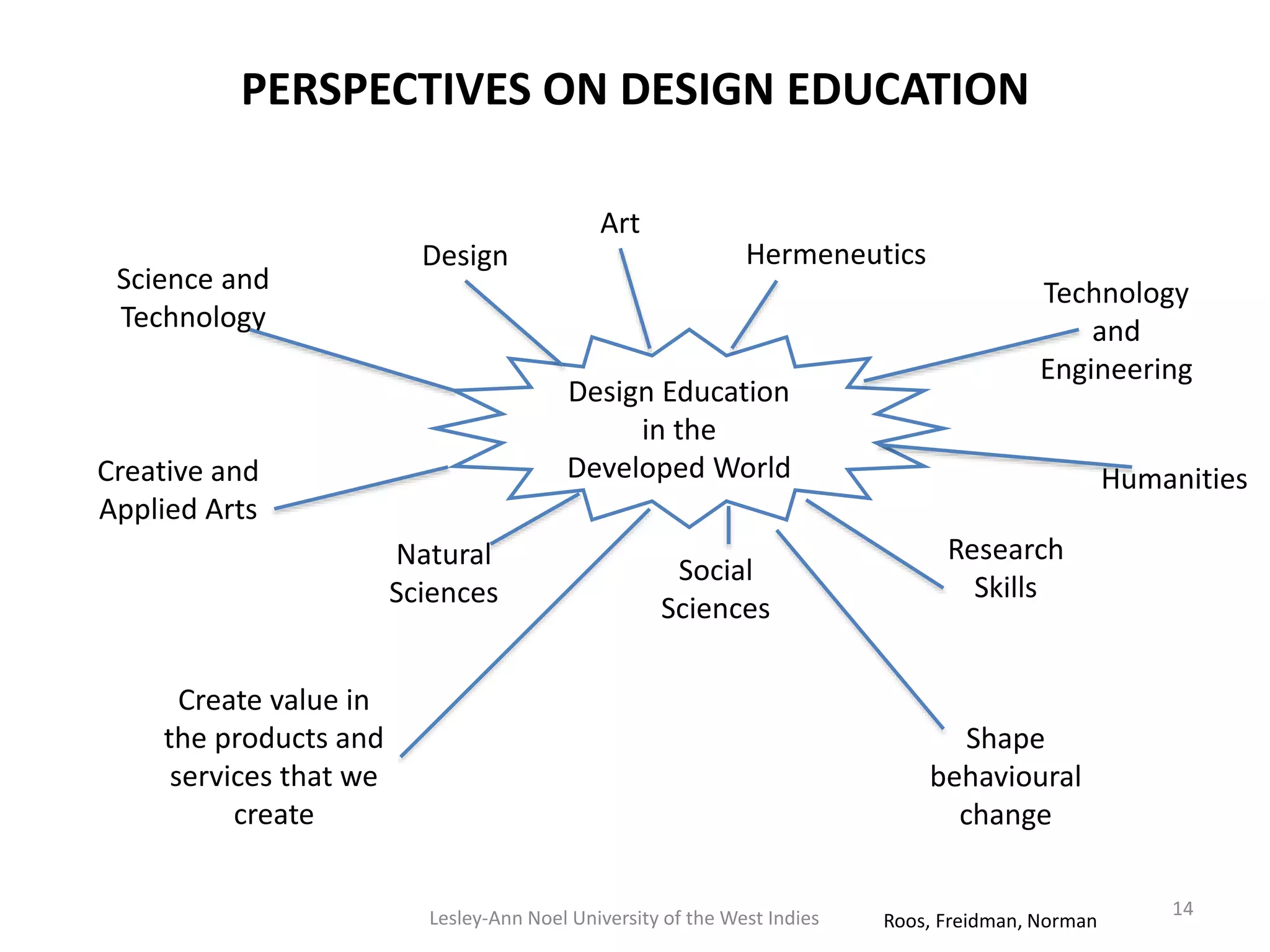
PERSPECTIVES ON DESIGN EDUCATION
14
Science and
Technology
Design
Art
Hermeneutics
Creative and
Applied Arts
Technology
and
Engineering
Natural
Sciences
Humanities
Social
Sciences
Research
Skills
Create value in
the products and
services that we
create
Shape
behavioural
change
Design Education
in the
Developed World
Roos, Freidman, NormanLesley-Ann Noel University of the West Indies
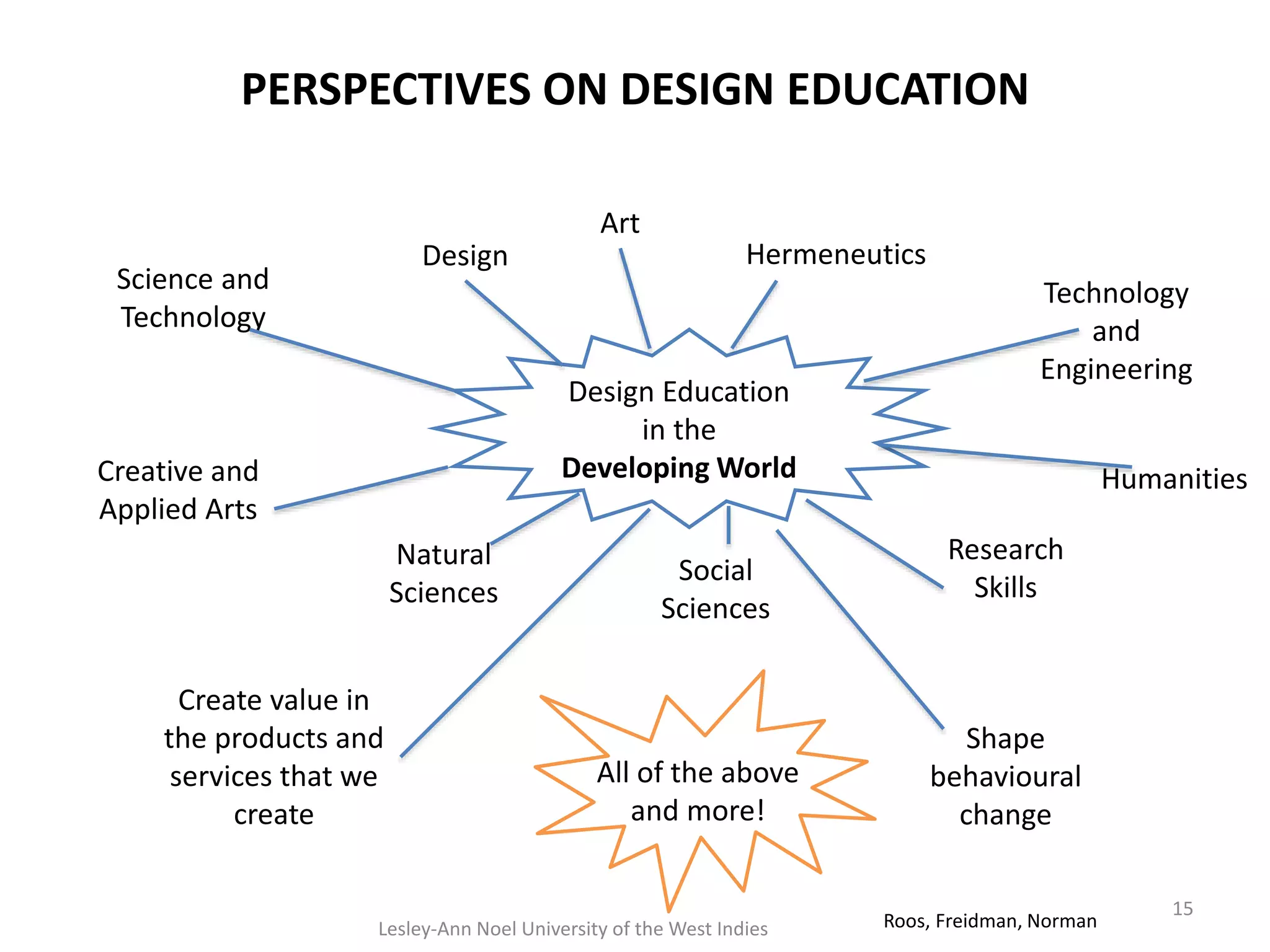
PERSPECTIVES ON DESIGN EDUCATION
15
Science and
Technology
Design
Art
Hermeneutics
Creative and
Applied Arts
Technology
and
Engineering
Natural
Sciences
Humanities
Social
Sciences
Research
Skills
Create value in
the products and
services that we
create
Shape
behavioural
change
Design Education
in the
Developing World
Roos, Freidman, Norman
All of the above
and more!
Lesley-Ann Noel University of the West Indies
• Design input in manufacturing in developing
countries is often from external sources.
• Necessary to increase the design capacity in these
countries, so that designers can play a role in
developing locally generated solutions to design
problems including product development and
responses to social issues.
• Locally generated solutions can also tie back to
one of the World Bank’s common factors for
successful development – ‘ownership by countries
of their own development agenda.
16
Design education in the developing
world
Lesley-Ann Noel University of the West Indies
Skills for Designers in the Developing World
• Social and Environmental Responsibility
• Anthropology and ethnography
• Sustainability
• Culture
• Behavioural Sciences / Change Management
• Entrepreneurship
• Skills relating to advocacy, lobbying and
collaborating with the public sector
17Lesley-Ann Noel University of the West Indies
Designers in the Developing World
• Lobbyist
• Anthropologist/Ethnographer
• Environmentalist
• Behavioural Scientist
18Lesley-Ann Noel University of the West Indies
Challenges for Designers in Least
Developed Countries (LDCs)
• Improve productivity and product
ranges within the manufacturing
sector
• Create opportunities for investment
• Support economic diversification
strategies of these countries
• Support initiatives to meet the
Millennium Development Goals
19Lesley-Ann Noel University of the West Indies
Challenges for Designers in Landlocked
Developing Countries (LLDCs)
• Support efforts to improve
transportation logistics
• Develop successful high-value
added products that can be
exported and distributed despite
the landlocked nature of these
countries
20Lesley-Ann Noel University of the West Indies
Challenges for Designers in Small Island
Developing States (SIDS)
• Support initiatives related to climate
change and natural disasters and
Sustainable Development
• Support import-substitution /
reduction strategies
• Address product development
challenges related to smallness of
markets and isolation from large
markets
21Lesley-Ann Noel University of the West Indies
CONCLUSION
22
Is there a need for design education in LDCs, LLDCs and SIDS like those
found in the Caribbean and the Pacific, or in many of the economies of
Africa and Asia?
YES!!!
Even in the most vulnerable economies,
designers and design education can
contribute to promoting change and
supporting economic growth.
Lesley-Ann Noel University of the West Indies

Envisioning a Future Design Education in vulnerable emerging economies - Insight 2015, Bangalore, India

  • 1.
    Envisioning a FutureDesign Education in vulnerable emerging economies Lesley-Ann Noel lesley-ann.noel@sta.uwi.edu The University of the West Indies, St. Augustine Campus Trinidad & Tobago DESIGN RESEARCH IN ACADEMIC PRACTICE INSIGHT 2015 January 23 – 24th 2015 Bangalore India KEYWORDS Design Education, Vulnerable Developing Economies
  • 2.
    • “Since mostdesign professions involve shaping goods and services within large industrial economies, this political- economic context is one key to the realities of design education today and tomorrow” Ken Friedman 2Lesley-Ann Noel University of the West Indies
  • 3.
    • “While theneed for design education is obvious in large emerging economies such as in Brazil or India, the need may seem less obvious in very more vulnerable economies, where there is no critical mass of designers or even public appreciation for design. • Is there a need for design education in Least Developed Countries, Landlocked developing countries and ‘Small Island developing states’ like those found in the Caribbean and the Pacific, or in many of the economies of Africa? 3Lesley-Ann Noel University of the West Indies
  • 4.
    ABOUT DEVELOPING ECONOMIES •A developing country is one where the majority of the population lives on significantly less money with fewer basic public services than in highly industrialized countries. • Designers’ skills and services are needed in all developing countries, but could also place a very great role in the development and progress of these most vulnerable developing countries. 4Lesley-Ann Noel University of the West Indies
  • 5.
    Least Developed Countries •Poorest segment of the international community • approx. 12% of the world population (880 million people) • less than 2 per cent of the world GDP • about 1% of global trade in goods. • primarily agrarian economies • affected by low productivity and low investment • little success in diversifying into the manufacturing sector, • limited product range • labour-intensive manufacturing e.g. textiles and clothing. • 34 countries in Africa, 13 in Asia and the Pacific and 1 in Latin America. 5Lesley-Ann Noel University of the West Indies
  • 6.
    Landlocked Developing Countries •31 countries • sixteen are also LDCs • total population - 428 million. • lack access to the sea, • isolated from world markets • high transit costs, which impact economic development. • in most cases the nearest neighbours of LLDCs are also developing countries and • major markets are far away, making it near impossible to export high value-added products. 6 Lesley-Ann Noel University of the West Indies
  • 7.
    Small Island DevelopingStates • 39 countries • The combined population of 63.2million • narrow resource base • small markets that deny = poor economies of scale • small domestic markets, • heavy dependence on external and remote markets, • high costs of energy, infrastructure, transportation communications, • long distances from major export markets and imported inputs for production, • low and irregular volumes of international traffic, • fragile natural environments and limited resilience to natural disasters such as hurricanes, • limited opportunities for their private sectors • large reliance on the public sector, • growing populations, volatile economic growth. 7 Lesley-Ann Noel University of the West Indies
  • 8.
    FACTORS ASSOCIATED WITH DEVELOPMENTSUCCESS • Economic growth, • a vibrant private sector, • empowerment, • good governance and • ownership by the countries of their own development agenda. World Bank 8Lesley-Ann Noel University of the West Indies
  • 9.
    Four indicators ofcompetitiveness • The ability of enterprises to export to an array of countries without special government support. • The ability of enterprises to engage in foreign direct investment based upon skills and assets developed at home. • The ability of enterprises to operate according to international standards and quality • The ability of enterprises to earn above-average returns in a market setting which includes domestic competitors and rival enterprises from other countries. 9 Wint Lesley-Ann Noel University of the West Indies
  • 10.
    CORRELATION BETWEEN DESIGNAND COMPETITIVENESS • Countries positioned higher in the stages of development tend to be those where design policies and programmes are in place. • In more competitive economies there is a greater consciousness of the need for innovation and design in order to remain competitive, while countries with less sophisticated economies are less likely to use design policies to improve their industries as a tool for social development or to address issues such as to improve basic systems such as health infrastructure, crime prevention, education and transport 10 Raulik-Murphy Lesley-Ann Noel University of the West Indies
  • 11.
    CORRELATION BETWEEN DESIGNAND COMPETITIVENESS • Design can play a role in ensuring that manufacturing industries remain competitive even in the developing world, where they can contribute to the modernisation of traditional industries through the development of more market-focussed products, with competitive branding and packaging, and even through the development of more efficient machinery and processes in collaboration with other technical professionals. 11Lesley-Ann Noel University of the West Indies
  • 12.
    CORRELATION BETWEEN DESIGNAND COMPETITIVENESS • Designers can also play a role in the preservation of non-manufactured goods such as indigenous crafts by playing a role in developing products that ensure that these products are still appreciated, and offering support to museums and other cultural institutions in the presentation of these crafts to the public. 12Lesley-Ann Noel University of the West Indies
  • 13.
    Examples of designpractice and improving industries and increasing competitiveness in the developing world • India National Design Policy document that aims to create a ‘design enabled Indian industry which could have a positive impact on both the national economy and the quality of life’. • South Africa Design is often used to meet the country’s specific needs e.g. mining. • South Korea the Korean Institute of Design Promotion with the Ministry of Commerce, Industryand energy prepare annual and five year plans. • Turkey planned the establishment of industrial design schools to meet future demand anticipated from import-substitution strategies between the 1960s and 1980s, and therefore industrial design in Turkey emerged at an educational level before the actual demand was created by Turkish industry. • Indonesia several industrial design programmes and industrial designers employed by many sectors of the economy including manufacturing, small and medium-scale industry, media, government and education. 13Lesley-Ann Noel University of the West Indies
  • 14.
    PERSPECTIVES ON DESIGNEDUCATION 14 Science and Technology Design Art Hermeneutics Creative and Applied Arts Technology and Engineering Natural Sciences Humanities Social Sciences Research Skills Create value in the products and services that we create Shape behavioural change Design Education in the Developed World Roos, Freidman, NormanLesley-Ann Noel University of the West Indies
  • 15.
    PERSPECTIVES ON DESIGNEDUCATION 15 Science and Technology Design Art Hermeneutics Creative and Applied Arts Technology and Engineering Natural Sciences Humanities Social Sciences Research Skills Create value in the products and services that we create Shape behavioural change Design Education in the Developing World Roos, Freidman, Norman All of the above and more! Lesley-Ann Noel University of the West Indies
  • 16.
    • Design inputin manufacturing in developing countries is often from external sources. • Necessary to increase the design capacity in these countries, so that designers can play a role in developing locally generated solutions to design problems including product development and responses to social issues. • Locally generated solutions can also tie back to one of the World Bank’s common factors for successful development – ‘ownership by countries of their own development agenda. 16 Design education in the developing world Lesley-Ann Noel University of the West Indies
  • 17.
    Skills for Designersin the Developing World • Social and Environmental Responsibility • Anthropology and ethnography • Sustainability • Culture • Behavioural Sciences / Change Management • Entrepreneurship • Skills relating to advocacy, lobbying and collaborating with the public sector 17Lesley-Ann Noel University of the West Indies
  • 18.
    Designers in theDeveloping World • Lobbyist • Anthropologist/Ethnographer • Environmentalist • Behavioural Scientist 18Lesley-Ann Noel University of the West Indies
  • 19.
    Challenges for Designersin Least Developed Countries (LDCs) • Improve productivity and product ranges within the manufacturing sector • Create opportunities for investment • Support economic diversification strategies of these countries • Support initiatives to meet the Millennium Development Goals 19Lesley-Ann Noel University of the West Indies
  • 20.
    Challenges for Designersin Landlocked Developing Countries (LLDCs) • Support efforts to improve transportation logistics • Develop successful high-value added products that can be exported and distributed despite the landlocked nature of these countries 20Lesley-Ann Noel University of the West Indies
  • 21.
    Challenges for Designersin Small Island Developing States (SIDS) • Support initiatives related to climate change and natural disasters and Sustainable Development • Support import-substitution / reduction strategies • Address product development challenges related to smallness of markets and isolation from large markets 21Lesley-Ann Noel University of the West Indies
  • 22.
    CONCLUSION 22 Is there aneed for design education in LDCs, LLDCs and SIDS like those found in the Caribbean and the Pacific, or in many of the economies of Africa and Asia? YES!!! Even in the most vulnerable economies, designers and design education can contribute to promoting change and supporting economic growth. Lesley-Ann Noel University of the West Indies

Editor's Notes

  • #3 Prof. Ken Friedman wrote the above statement in his paper “Models of Design: Envisioning a Future Design Education” and in this statement he seems to tie the political and social contexts of design education to large industrial economies. While on the surface, this may seem reasonable; it then makes one question the validity and the relevance of design practice and design education outside of large industrial economies. Isn’t design practiced outside of this type of context? Don’t design schools exist in these places? While the reality is that most design professions and design schools operate within large economies, this paper considers the education and practices designers and design schools, which operate in small emerging economies. This paper uses Prof. Friedman’s article as a starting point for a discussion on design education, but shifts the focus away from places where design is traditionally taught, and practised, to places where makers are still operating primarily in pre-industrial modes. While the need for design education is obvious in large emerging economies such as in Brazil or India, the need may seem less obvious in very more vulnerable economies, where there is no critical mass of designers or even public appreciation for design. Is there a need for design education in Least Developed Countries, Landlocked developing countries and ‘Small Island developing states’ like those found in the Caribbean and the Pacific, or in many of the economies of Africa? Are there any unrecognized opportunities for designers and design educators to play a role in the development of these countries? Are there any benefits to promoting design education in a pre-industrial context? Is there any benefit to stimulating design in places with little or no design or manufacturing culture? How can design education and design research support the development these types of societies?
  • #4 Prof. Ken Friedman wrote the above statement in his paper “Models of Design: Envisioning a Future Design Education” and in this statement he seems to tie the political and social contexts of design education to large industrial economies. While on the surface, this may seem reasonable; it then makes one question the validity and the relevance of design practice and design education outside of large industrial economies. Isn’t design practiced outside of this type of context? Don’t design schools exist in these places? While the reality is that most design professions and design schools operate within large economies, this paper considers the education and practices designers and design schools, which operate in small emerging economies. This paper uses Prof. Friedman’s article as a starting point for a discussion on design education, but shifts the focus away from places where design is traditionally taught, and practised, to places where makers are still operating primarily in pre-industrial modes. While the need for design education is obvious in large emerging economies such as in Brazil or India, the need may seem less obvious in very more vulnerable economies, where there is no critical mass of designers or even public appreciation for design. Is there a need for design education in Least Developed Countries, Landlocked developing countries and ‘Small Island developing states’ like those found in the Caribbean and the Pacific, or in many of the economies of Africa? Are there any unrecognized opportunities for designers and design educators to play a role in the development of these countries? Are there any benefits to promoting design education in a pre-industrial context? Is there any benefit to stimulating design in places with little or no design or manufacturing culture? How can design education and design research support the development these types of societies?