Creating Caribbean Stories
Through Design
Lesley-Ann Noel
University of the West Indies
St. Augustine Campus
Trinidad and Tobago
lesley-ann.noel@sta.uwi.edu
Learning Theory
Constructivist Learning Theory
We learn best when we actively construct our own
understanding.’
(Pritchard, 2013 p.18)
Knowledge, concepts, skills and attitudes.
This activity takes into account the prior knowledge;
understanding and skills of both the university students and
the primary school students, and both groups are able to
contribute to the exercise on equal terms. The children
contribute the content of the story by sharing their life
experiences in the village, the literature that they have read,
and their hopes and dreams. The university students
contribute to the experience by interpreting and illustrating
the stories. They even have the freedom to choose an
illustration style compatible with their own skill levels or lack
thereof.
Learning Theory
Constructivist Learning Theory
Learners need enough previous knowledge and
understanding to enable them to learn new things; they need
help making explicit the links with new and previous
knowledge.
Provision should be made for social interaction and
discussion in groups of varying sizes, both with and without
the teacher.
Meaningful contexts for learning are very important; (what is
meaningful for a teacher may not be meaningful for a child).
Children’s awareness of their own thought processes should
be promoted.
Learning Theory
Theory of Multiple
Intelligences
(Pritchard, 2013 p.38).
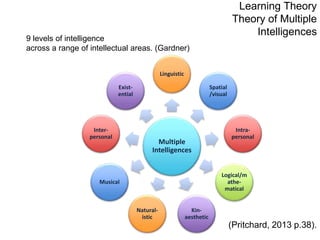
9 levels of intelligence
across a range of intellectual areas. (Gardner)
Multiple
Intelligences
Linguistic
Spatial
/visual
Intra-
personal
Logical/m
athe-
matical
Kin-
aesthetic
Natural-
istic
Musical
Inter-
personal
Exist-
ential
Learning Theory
Design Strategies
Participatory Design
This project also served as a means
of introducing the students to
participatory design or co-design
methodologies.
The application of participatory
design practices (both at the moment
of idea generation and continuing
throughout the design process at all
key moments of decision) to very
large-scale problems will change
design and may change the world.
(Sanders and Stappers )
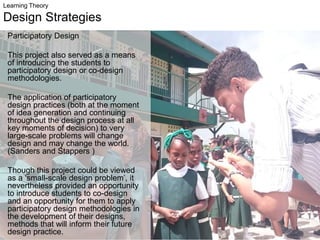
Though this project could be viewed
as a ‘small-scale design problem’, it
nevertheless provided an opportunity
to introduce students to co-design
and an opportunity for them to apply
participatory design methodologies in
the development of their designs,
methods that will inform their future
design practice.
Learning Theory
Design Strategies Design Process
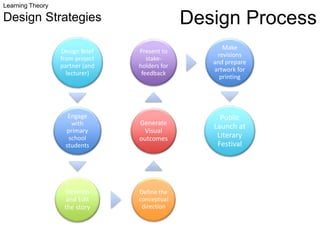
Design Brief
from project
partner (and
lecturer)
Engage
with
primary
school
students
Develop
and Edit
the story
Define the
conceptual
direction
Generate
Visual
outcomes
Present to
stake-
holders for
feedback
Make
revisions
and prepare
artwork for
printing
Public
Launch at
Literary
Festival
Benefits to stakeholders
University students • developed their metacognitive abilities while
executing the required tasks
• gained experience in layout and illustration
• acquired skills in lesson / activity planning,
facilitation and delivery, story telling, project
reporting, project management, as well as
experience in facilitating
Primary school students • practiced skills that were directly linked to their
core curriculum such as: story telling, including
sequencing, creative writing, reading, writing,
and drawing.
• engaged with adults from outside of their milieu
broadening their worldview
• inspired other children to create their own books
Bridge Foundation • Will have access to more locally-themed
literature for future projects.
• Gained exposure at local book fair.
Visual Arts - UWI • Real-life scenario created better environment for
teaching.
• Gained exposure at local book fair.
Phase 1 - Preparation
UWI academic staff and representatives of the Bridge Foundation met to
declare and agree on project objectives.
Objectives:
• To promote reading in the school, making linkages with books that the
children had already read.
• to provide ‘role models’ for the young children, by having them interact with
the university students, the children would have the opportunity to bond with
young people who could provide positive role models for them.
• to provide examples of behaviours that could be modeled by the teachers,
by providing examples of different ways that art, books and reading could
be used inside and outside of the classroom.
• to provide an opportunity for Service Learning, which is one of the ‘themes’
of the UWI.
• To provide an opportunity for students to apply their skills in design, layout,
illustration and product development and project management skills to
develop strategies to execute the project within a very short space of time.
PHASE 2: - STUDENT
BRIEFING
Students were given the project brief in a class
devoted to preparing the students to meet the
project objectives. In this class students
discussed several relevant topics that provided
vital background information for the project such
as life in Guayaguayare and rural Trinidad and
Tobago; how to tell a story; how to promote
literacy etc. A general theme for the
stories/activity was selected “What is it like to be
a child in Guayaguayare”. This theme was
chosen so that the child would have a theme
that was ‘close’ to their reality that would drive
the exercise.
Four ‘trigger’ activities were presented then do
an activity that would lead to them telling
another story.
– Telling group stories’
– ‘Reading stories’
– Drawing stories
– Drawing Monsters
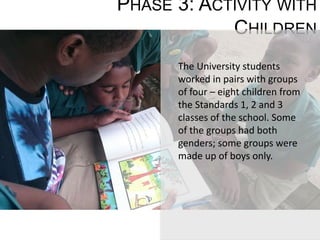
PHASE 3: ACTIVITY WITH
CHILDREN
The University students
worked in pairs with groups
of four – eight children from
the Standards 1, 2 and 3
classes of the school. Some
of the groups had both
genders; some groups were
made up of boys only.
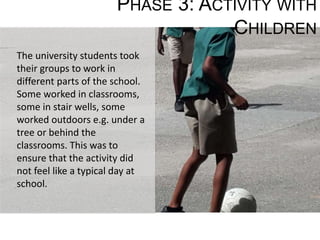
PHASE 3: ACTIVITY WITH
CHILDREN
The university students took
their groups to work in
different parts of the school.
Some worked in classrooms,
some in stair wells, some
worked outdoors e.g. under a
tree or behind the
classrooms. This was to
ensure that the activity did
not feel like a typical day at
school.
PHASE 3: ACTIVITY WITH
CHILDREN
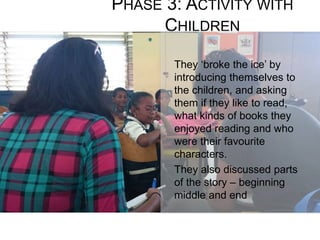
They ‘broke the ice’ by
introducing themselves to
the children, and asking
them if they like to read,
what kinds of books they
enjoyed reading and who
were their favourite
characters.
They also discussed parts
of the story – beginning
middle and end
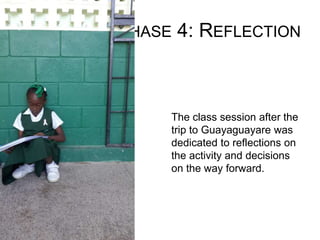
PHASE 4: REFLECTION
The class session after the
trip to Guayaguayare was
dedicated to reflections on
the activity and decisions
on the way forward.
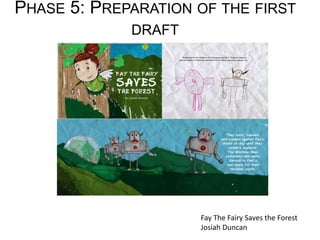
PHASE 5: PREPARATION OF THE FIRST
DRAFT
Fay The Fairy Saves the Forest
Josiah Duncan
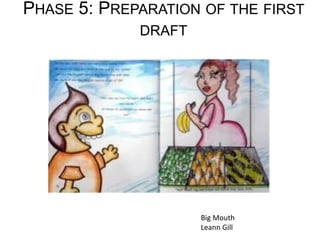
PHASE 5: PREPARATION OF THE FIRST
DRAFT
Big Mouth
Leann Gill
PHASE 5: PREPARATION OF THE FIRST
DRAFT
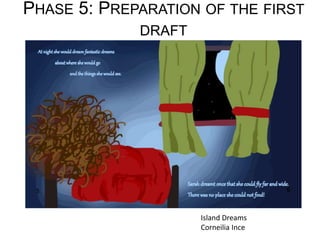
Island Dreams
Corneilia Ince
PHASE 5: PREPARATION OF THE FIRST
DRAFT
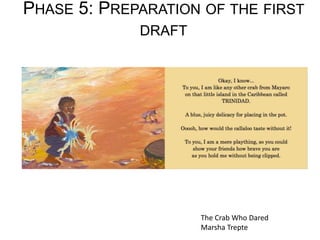
The Crab Who Dared
Marsha Trepte
PHASE 5: PREPARATION OF THE FIRST
DRAFT
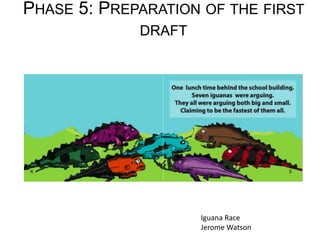
Iguana Race
Jerome Watson
PHASE 5: PREPARATION OF THE FIRST
DRAFT
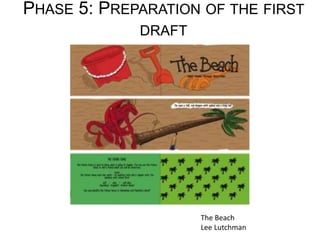
The Beach
Lee Lutchman
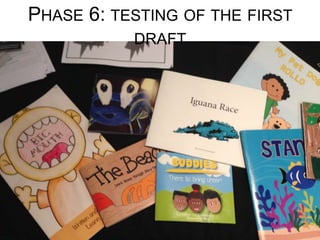
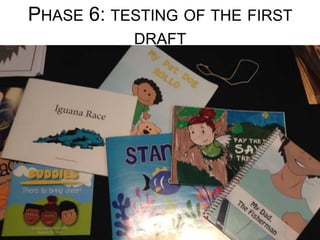
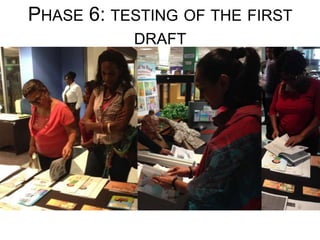
PHASE 6: TESTING OF THE FIRST
DRAFT
PHASE 6: TESTING OF THE FIRST
DRAFT
PHASE 6: TESTING OF THE FIRST
DRAFT
Reflections
It is interesting to note the changing
preferences for the books according
to the audience that was evaluating
them, the books that the design
lecturers thought were the most
successful, were not necessarily the
favourites of the Bridge Foundation,
nor the children, and the children
were at times very attracted to some
illustration styles that could be
considered very simple, especially if
the story was humorous. There
seemed to be little difference in
preference between the urban and
rural children.
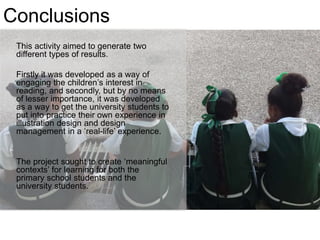
Conclusions
This activity aimed to generate two
different types of results.
Firstly it was developed as a way of
engaging the children’s interest in
reading, and secondly, but by no means
of lesser importance, it was developed
as a way to get the university students to
put into practice their own experience in
illustration design and design
management in a ‘real-life’ experience.
The project sought to create ‘meaningful
contexts’ for learning for both the
primary school students and the
university students.
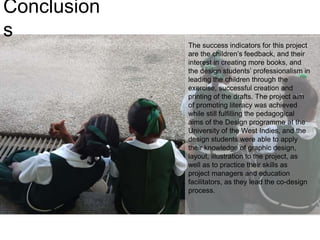
Conclusion
s
The success indicators for this project
are the children’s feedback, and their
interest in creating more books, and
the design students’ professionalism in
leading the children through the
exercise, successful creation and
printing of the drafts. The project aim
of promoting literacy was achieved
while still fulfilling the pedagogical
aims of the Design programme at the
University of the West Indies, and the
design students were able to apply
their knowledge of graphic design,
layout, illustration to the project, as
well as to practice their skills as
project managers and education
facilitators, as they lead the co-design
process.
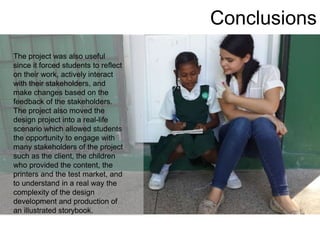
Conclusions
The project was also useful
since it forced students to reflect
on their work, actively interact
with their stakeholders, and
make changes based on the
feedback of the stakeholders.
The project also moved the
design project into a real-life
scenario which allowed students
the opportunity to engage with
many stakeholders of the project
such as the client, the children
who provided the content, the
printers and the test market, and
to understand in a real way the
complexity of the design
development and production of
an illustrated storybook.

Creating caribbean stories through design

  • 1.
    Creating Caribbean Stories ThroughDesign Lesley-Ann Noel University of the West Indies St. Augustine Campus Trinidad and Tobago lesley-ann.noel@sta.uwi.edu
  • 4.
    Learning Theory Constructivist LearningTheory We learn best when we actively construct our own understanding.’ (Pritchard, 2013 p.18) Knowledge, concepts, skills and attitudes. This activity takes into account the prior knowledge; understanding and skills of both the university students and the primary school students, and both groups are able to contribute to the exercise on equal terms. The children contribute the content of the story by sharing their life experiences in the village, the literature that they have read, and their hopes and dreams. The university students contribute to the experience by interpreting and illustrating the stories. They even have the freedom to choose an illustration style compatible with their own skill levels or lack thereof.
  • 5.
    Learning Theory Constructivist LearningTheory Learners need enough previous knowledge and understanding to enable them to learn new things; they need help making explicit the links with new and previous knowledge. Provision should be made for social interaction and discussion in groups of varying sizes, both with and without the teacher. Meaningful contexts for learning are very important; (what is meaningful for a teacher may not be meaningful for a child). Children’s awareness of their own thought processes should be promoted.
  • 6.
    Learning Theory Theory ofMultiple Intelligences (Pritchard, 2013 p.38). 9 levels of intelligence across a range of intellectual areas. (Gardner) Multiple Intelligences Linguistic Spatial /visual Intra- personal Logical/m athe- matical Kin- aesthetic Natural- istic Musical Inter- personal Exist- ential
  • 7.
    Learning Theory Design Strategies ParticipatoryDesign This project also served as a means of introducing the students to participatory design or co-design methodologies. The application of participatory design practices (both at the moment of idea generation and continuing throughout the design process at all key moments of decision) to very large-scale problems will change design and may change the world. (Sanders and Stappers ) Though this project could be viewed as a ‘small-scale design problem’, it nevertheless provided an opportunity to introduce students to co-design and an opportunity for them to apply participatory design methodologies in the development of their designs, methods that will inform their future design practice.
  • 8.
    Learning Theory Design StrategiesDesign Process Design Brief from project partner (and lecturer) Engage with primary school students Develop and Edit the story Define the conceptual direction Generate Visual outcomes Present to stake- holders for feedback Make revisions and prepare artwork for printing Public Launch at Literary Festival
  • 9.
    Benefits to stakeholders Universitystudents • developed their metacognitive abilities while executing the required tasks • gained experience in layout and illustration • acquired skills in lesson / activity planning, facilitation and delivery, story telling, project reporting, project management, as well as experience in facilitating Primary school students • practiced skills that were directly linked to their core curriculum such as: story telling, including sequencing, creative writing, reading, writing, and drawing. • engaged with adults from outside of their milieu broadening their worldview • inspired other children to create their own books Bridge Foundation • Will have access to more locally-themed literature for future projects. • Gained exposure at local book fair. Visual Arts - UWI • Real-life scenario created better environment for teaching. • Gained exposure at local book fair.
  • 10.
    Phase 1 -Preparation UWI academic staff and representatives of the Bridge Foundation met to declare and agree on project objectives. Objectives: • To promote reading in the school, making linkages with books that the children had already read. • to provide ‘role models’ for the young children, by having them interact with the university students, the children would have the opportunity to bond with young people who could provide positive role models for them. • to provide examples of behaviours that could be modeled by the teachers, by providing examples of different ways that art, books and reading could be used inside and outside of the classroom. • to provide an opportunity for Service Learning, which is one of the ‘themes’ of the UWI. • To provide an opportunity for students to apply their skills in design, layout, illustration and product development and project management skills to develop strategies to execute the project within a very short space of time.
  • 11.
    PHASE 2: -STUDENT BRIEFING Students were given the project brief in a class devoted to preparing the students to meet the project objectives. In this class students discussed several relevant topics that provided vital background information for the project such as life in Guayaguayare and rural Trinidad and Tobago; how to tell a story; how to promote literacy etc. A general theme for the stories/activity was selected “What is it like to be a child in Guayaguayare”. This theme was chosen so that the child would have a theme that was ‘close’ to their reality that would drive the exercise. Four ‘trigger’ activities were presented then do an activity that would lead to them telling another story. – Telling group stories’ – ‘Reading stories’ – Drawing stories – Drawing Monsters
  • 12.
    PHASE 3: ACTIVITYWITH CHILDREN The University students worked in pairs with groups of four – eight children from the Standards 1, 2 and 3 classes of the school. Some of the groups had both genders; some groups were made up of boys only.
  • 13.
    PHASE 3: ACTIVITYWITH CHILDREN The university students took their groups to work in different parts of the school. Some worked in classrooms, some in stair wells, some worked outdoors e.g. under a tree or behind the classrooms. This was to ensure that the activity did not feel like a typical day at school.
  • 14.
    PHASE 3: ACTIVITYWITH CHILDREN They ‘broke the ice’ by introducing themselves to the children, and asking them if they like to read, what kinds of books they enjoyed reading and who were their favourite characters. They also discussed parts of the story – beginning middle and end
  • 15.
    PHASE 4: REFLECTION Theclass session after the trip to Guayaguayare was dedicated to reflections on the activity and decisions on the way forward.
  • 16.
    PHASE 5: PREPARATIONOF THE FIRST DRAFT Fay The Fairy Saves the Forest Josiah Duncan
  • 17.
    PHASE 5: PREPARATIONOF THE FIRST DRAFT Big Mouth Leann Gill
  • 18.
    PHASE 5: PREPARATIONOF THE FIRST DRAFT Island Dreams Corneilia Ince
  • 19.
    PHASE 5: PREPARATIONOF THE FIRST DRAFT The Crab Who Dared Marsha Trepte
  • 20.
    PHASE 5: PREPARATIONOF THE FIRST DRAFT Iguana Race Jerome Watson
  • 21.
    PHASE 5: PREPARATIONOF THE FIRST DRAFT The Beach Lee Lutchman
  • 22.
    PHASE 6: TESTINGOF THE FIRST DRAFT
  • 23.
    PHASE 6: TESTINGOF THE FIRST DRAFT
  • 24.
    PHASE 6: TESTINGOF THE FIRST DRAFT
  • 25.
    Reflections It is interestingto note the changing preferences for the books according to the audience that was evaluating them, the books that the design lecturers thought were the most successful, were not necessarily the favourites of the Bridge Foundation, nor the children, and the children were at times very attracted to some illustration styles that could be considered very simple, especially if the story was humorous. There seemed to be little difference in preference between the urban and rural children.
  • 26.
    Conclusions This activity aimedto generate two different types of results. Firstly it was developed as a way of engaging the children’s interest in reading, and secondly, but by no means of lesser importance, it was developed as a way to get the university students to put into practice their own experience in illustration design and design management in a ‘real-life’ experience. The project sought to create ‘meaningful contexts’ for learning for both the primary school students and the university students.
  • 27.
    Conclusion s The success indicatorsfor this project are the children’s feedback, and their interest in creating more books, and the design students’ professionalism in leading the children through the exercise, successful creation and printing of the drafts. The project aim of promoting literacy was achieved while still fulfilling the pedagogical aims of the Design programme at the University of the West Indies, and the design students were able to apply their knowledge of graphic design, layout, illustration to the project, as well as to practice their skills as project managers and education facilitators, as they lead the co-design process.
  • 28.
    Conclusions The project wasalso useful since it forced students to reflect on their work, actively interact with their stakeholders, and make changes based on the feedback of the stakeholders. The project also moved the design project into a real-life scenario which allowed students the opportunity to engage with many stakeholders of the project such as the client, the children who provided the content, the printers and the test market, and to understand in a real way the complexity of the design development and production of an illustrated storybook.