Downloaded 16 times
![[•] TEST
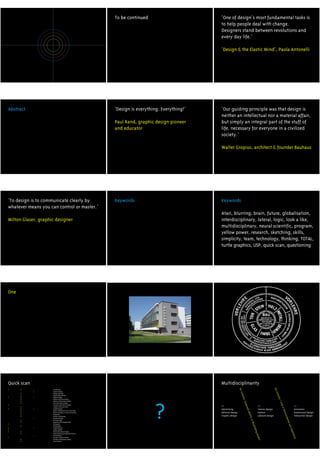
[•] TO BE CONTINUED [•]
‘One of design’s most fundamental tasks is to help people deal with change.
Designers stand between revolutions and every day life.’ (‘Design & the Elastic mind’,
Paola Antonelli)
[•] ABSTRACT
[•] Thank you for inviting & offering me the opportunity to re-think design education on
paper and on screen.
‘Design is everything. Everything!’ (Paul Rand, graphic design pioneer and educator)
[•] Although we all know fifteen minutes is not enough to consider and review a
complex subject like design & education or design education, I will try to answer your
question ‘WHAT DO YOU SEE AS THE KEY CHALLENGES TO HIGHER EDUCATION IN ART
AND DESIGN?’ in a nutshell.
‘Our guiding principle was that design is neither an intellectual nor a material affair, but
simply an integral part of the stuff of life, necessary for everyone in a civilized society.’
(Walter Gropius, architect & founder Bauhaus)
[•] But there are quite some items to discuss . . . Feel free to stop me, if I am running
out of time.
‘To design is to communicate clearly by whatever means you can control or
master.’ (Milton Glaser, graphic designer)](https://image.slidesharecdn.com/20110219tobecontinuedext-110219155525-phpapp01/85/To-be-continued-13-320.jpg)
![[•] KEYWORDS
[•] First: Atari, last: questioning.
Atari, blurring, brain, future, globalisation, interdisciplinary, lateral, logic, look a like,
multidisciplinary, neural scientific, program, yellow power, research, sketching, skills,
simplicity, team, technology, thinking, TOTAL, turtle graphics, USP, quick scan,
questioning.
[•] ONE
[•] Most Art & Design Institutes offer quite a number of bachelor courses [•] which are
rooted in the past and can be catogorized in 2D, 3D and 4D.
[•] Just a recent quick scan: three institutes 28 courses. Is n’t this fragmentation
levelling education and narrowing research, experiment and innovation?
[•] (Questionmark)
[•] Are the no-zone in between diciplines not the most interesting?
[•] (Questionmark)
[•][•][•][•] Will multi-di-sci-pli-na-ri-ty transcend the boundaries between disciplines?
[•] (Questionmark)
But of course some exceptions should be mentioned:
[•] One of the unique and defining features of the Berlin Weissensee School of Art is the
fact that all students attend a one-year interdisciplinary art foundation course together.
[•] This foundation course is principally oriented towards the perception and visualisation
of humans and their environment.
[•] Ensci Paris has a very interesting, open, project based curriculum. [•] Students of
different years may choose freely and can mingle each trimester to work on dedicated
assignments.
[•] Design Academy Eindhoven offers a fresh curriculum, created by industrial designer
Jan Lucassen (TEL). He centered MAN in eight programs: 1. Man and living. 2. Man and
communication. 3. Man and well-being. 4. Man and leisure. 5. Man and mobility. 6. Man
and identity. 7. Man and Activity. 8. Man and public space.](https://image.slidesharecdn.com/20110219tobecontinuedext-110219155525-phpapp01/85/To-be-continued-14-320.jpg)
![[•] The Design Academy now present itself as The House of Concepts.
[•] For over thirty years The Department of Typography & Graphic Communication at
The University of Reading has been the only one of its kind in Britain. [•] The university
offers just one bachelor course . . .
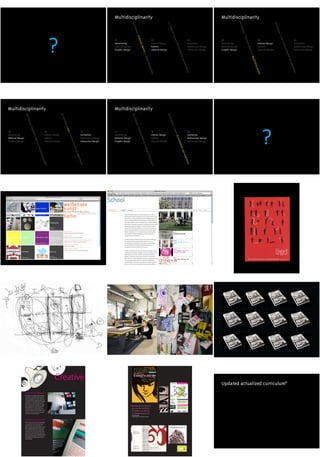
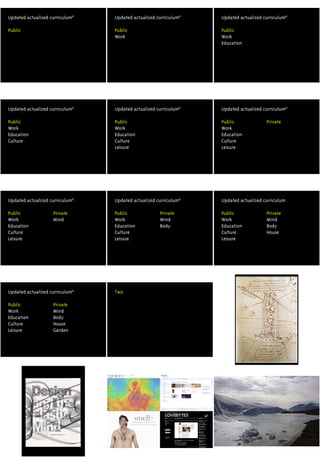
[•] Concerning another sophisticated way of organizing an updated actualized
curriculum: [•] is the next subdivision relavant? [•] Note: two sizes fits all, check it
yourself. [•][•][•][•][•][•][•][•]
Updated actualized curriculum © ®
Public Private
Work Mind
Education Body
Culture House
Leisure Garden
[•] TWO
[•] I will not predict the future of design. [•] I do not think the discours is very fruitfull.
[•] Most talks prattle on till all latest futuristic gadgets – probably some nanodevices or
smart textiles products – are listed and described.
[•] Besides Paola Antonelli’s introduction concerning historically wrong predictions about
progress, during the last century, in Design and the Elastic Mind – the most recent
available overview in print [•] featuring innovating design – is rather hilarious . . .
[•] Concerning our future: we all know by now not only our climate, [•] but also the
economic order is gonna change quite fundamentally.
[•] Like Angela Davis once proudly introduced Black Power, Kishore Mahbubani may
actually be the first intellectual representative of Yellow Power. [•] He is reasoning
change for already quite some time. [•] I quote: ‘The simplest answer is that from year
1 to year 1820, the two largest economies were China and India. However, with the
passing of the era of Western domination of world history, there will be an almost
natural return of China and India to the number one and number two slots in Global
GNP ranking.’ [End of quote.]](https://image.slidesharecdn.com/20110219tobecontinuedext-110219155525-phpapp01/85/To-be-continued-15-320.jpg)
![The issue in China and India somehow seems related to big numbers.
[•] Anyhow some multinationals like [•] AKZO and Philips are actually moving
management and staff since they are producing in Asia ánd [•] – be aware this is a
bolean equation – are opening up local markets simeltanously.
Also the first Dutch agencies – [•] like Dumbar, Mattmo, and [•] Northern Light – are
opening offices in Shanghai, while [•] Rem Koolhaas is succesfull all over the world,
[•] especially in Beijing. I think education should catch up really fast . . .
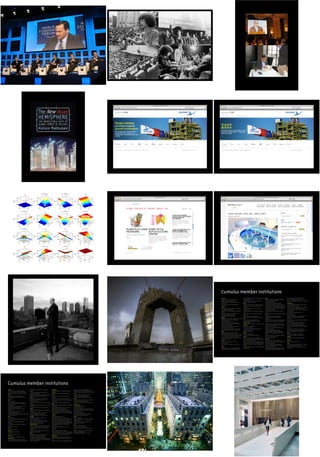
[•] Cumulus presents an impressive list [•] of somehow related institutes.
[•] Thanks to Erasmus-funding students are able to travel the world, [•] and study
abroad.
[•] We started to connect & link institutes, and shared some projects, either here or
there. Of course the tutors joined.
But this all seems to be rather incidental and for a relatively short period of time.
[•] If we want to face the world and – [•] oops, some Bolean once more – to change
our students perspective is n’t we by now to try to deepen collaboration?
[•] Why don’t we promote global cross-overs and co-creation working on the same
assignment in two places?
[•] (Questionmark)
Shouldn’t we?
[•] THREE
[•] Already some time ago, on the streets, and in the fields, all my beloved friends
wore hats . . , high boots . . , and a gun on every hip . . . [•] Yes, sure, its a Bolean!
[•] Of course, at the time, I was not aware of my very first USP . . .
I’m afraid most Art & Design Instututes are look a likes from an outsider point of view.
[•] All those slightly different design programs seem to level.](https://image.slidesharecdn.com/20110219tobecontinuedext-110219155525-phpapp01/85/To-be-continued-16-320.jpg)
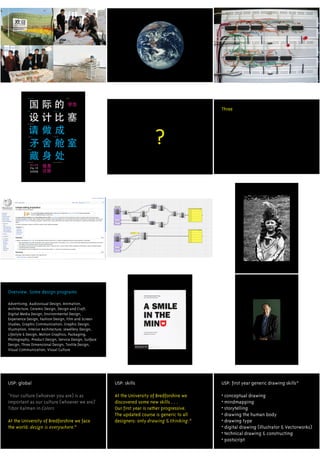
![Overview. Some design programs
Advertising, Audiovisual Design, Animation, Architecture, Ceramic Design, Design and
Craft, Digital Media Design, Environmental Design, Experience Design, Fashion Design,
Film and Screen Studies, Graphic Communication, Graphic Design, Illustration, Interior
Architecture, Jewellery Design, Lifestyle & Design, Motion Graphics, Packaging,
Photography, Product Design, Service Design, Surface Design, Three Dimensional
Design, Textile Design, Visual Communication, Visual Culture
(Aside: shouldn’t specialisation be the end of an educational career instead of the
beginning?) Wouldn’t it be interesting to emphasize one’s strenght. To present and use a
realistic USP as a starting point for future educational development?
[•] Always think opposite! [•] Think different.
Two examples. [•] Again, just examples, huh?! [•][•][•]
USP: global ©
‘Your culture (whoever you are) is as important as our culture (whoever we are)’
(Tibor Kalman in Colors)
At the University of Bredforshire we face the world: design is everywhere.
USP: skills ©
At the University of Bredforshire we discovered some new skills . . .
Our first year is rather progressive.
The updated course is generic to all designers: only drawing & thinking.
Drawing
Conceptual drawing
Mindmapping
Storytelling
Drawing the human body](https://image.slidesharecdn.com/20110219tobecontinuedext-110219155525-phpapp01/85/To-be-continued-17-320.jpg)
![Drawing type
Digital drawing (Illustrator & Vectorworks)
Technical drawing & constructing
Postscript
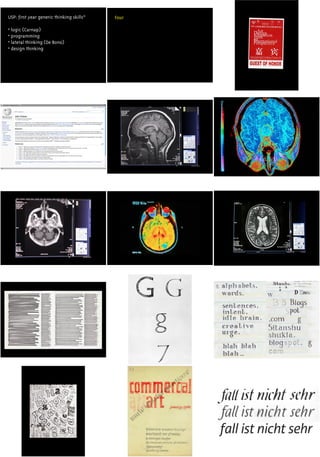
Thinking
Logic (Carnap)
Programming
Lateral thinking (De Bono)
Design thinking
[•] FOUR
In this context I’d like to share some actual insights.
[•] After visiting the Shanghai International Fashion Culture Festival in 2010 and
listening to a stunning lecture titled: What guides the designer’ hand? Inside the
ultimate design studio: the brain by Art Historian John Onians [•], I am prudently
concluding every design programme might need some tuning, re-introducing the manual
experiment to equalize subjects like ‘concepting’, ‘design thinking’ and ‘strategy’.
[• ] Recent neuroscientific insights seem to confirm not only the eye and the hand need
training, also the designers brain needs manual feed to keep in optimum condition.
[• ] The key concept to grasp is that of neural plasticity.
I quote: [• ] ‘Another is that the laying down of those memories is associated with
structural changes in the brain. [• ] We have always known that previous experience is
important for artistic success, but we never knew exactly why. [•] Now we know that it
is because each experience we have actually changes our brain’s structure, leaving us
with better resources for dealing with that particular experience if we have it again.’
And: [•] ‘Each trained artist or designer acquires over time a brain whose structure helps
him or her to perform the particular tasks he or she is engaged in. [•] The process by
which this happens is one that only recently has been understood. [. . .]
[•] By concentrating on a particular activity we re-design the area of the brain that we](https://image.slidesharecdn.com/20110219tobecontinuedext-110219155525-phpapp01/85/To-be-continued-18-320.jpg)
![use for it. [. . .] [•] Of course those neurally based motor skills will then influence his
own work, [•] and they will do so without him being conscious of it.
[•] This is one of the most important insights yielded by neuroscience.
[•] In a field like art or design you can have lots of bright ideas, [•] but if you don’t
have the required motor skills with pencil or mouse your work will not be a success.’
With reference to John Onians, [•] and with the help of Claudia Mareis (Forschungs-
dozentin für Designtheorie at Hochschule der Künste Bern), recently, I have been
reading quite a number of scientific papers concerning the significance of sketching to
the profession.
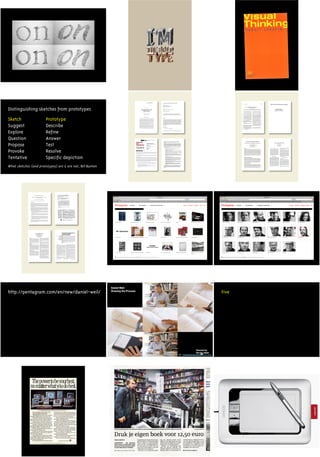
Distinguishing sketches from prototypes
Sketch Prototype
Suggest Describe
Explore Refine
Question Answer
Propose Test
Provoke Resolve
Tentative Specific depiction
What sketches (and prototypes) are & are not, Bill Buxton
[•] Most studies carry sturdy titles like: ‘The Dialectics of Sketching, or ‘What does
drawing reval about thinking’, or ‘Sketches for design, and design of sketches’. To share
a few insights:
[•] ‘Designers sketch to expolre design solutions, to record their ideas, or to illustrate
them and communicate them with others.’
[•] ‘The ambiguity of design sketches, rather than promoting confusion, promotes
innovation.’
[•] ‘I see the real causal factor as taking the time to focus and make what is seen
conscious.’](https://image.slidesharecdn.com/20110219tobecontinuedext-110219155525-phpapp01/85/To-be-continued-19-320.jpg)
![[•] In this context I’d like to recommend a short vimeo on drawing by Pentagrams
Daniel Weil. [•] Like many designers, Weil uses sketching to visualize, generate and
refine his ideas. [•] He is a passionate advocate of imaginary notating, and a true
collector. Daniel Weil has, by his estimation, more than 375 sketchbooks, going all the
way back to 1978.
[•] ‘In a way the books become both a diary and record for my thoughts: the things
I see, the things I think about, and the designs I’m designing,‘ says daniel Weil.
‘Drawing is a designer’s most fundamental tool; it is design thinking made visible.’
[•] FIVE
Society is rapidly transforming, and technique is always innovating.
[•] The profession changed radically due to a number of technologic innovations.
Probably design and technology are linked due to mass-production.
[•] Recently the Espresso Book Machine is available at the American Book Center in
Amsterdam and will deliver anybody a book within minutes if an accurate .pdf is
provided.
[•] Meantime, over time, we all changed pencils, [•] and bought quite expensive digital
ones. [•] And as it seems the individual independent designer is disappearing. Nowadays
most designers, which are oriented towards complex intellectual challenges, are part of
multidisciplinary teams while blurring the boundaries between disciplines.
I’m quoting ‘Engineering design thinking. Teaching & learning’:
[•] ‘To an increasing degree, design is being recognized and thought as a team process
with multiple socio-technological dimensions. Design is defined as a social process in
which teams define and negotiate decisions . . . And:
[•] ‘Results indicated that student design teams that challenged assumptions throughout
the designproces, with clynical semantic coherence, performed better than teams that
had little variation over the designprocess. These results support the hypothesis that
high performing designteams cycle between divergent and convergent patterns of
thinking & questioning.’
[•] (Questionmark)
Why do we keep training students as if individual designers?](https://image.slidesharecdn.com/20110219tobecontinuedext-110219155525-phpapp01/85/To-be-continued-20-320.jpg)
![[•] SIX
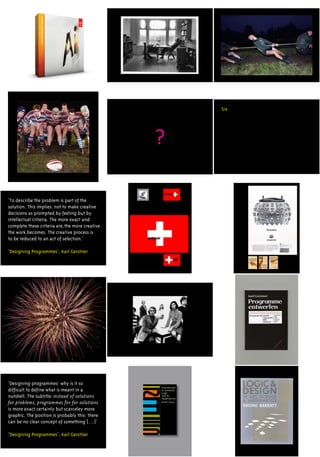
‘To describe the problem is part of the solution. This implies: not to make creative
decisions as prompted by feeling but by intellectuel criteria. The more exact and
complete these criteria are, the more creative the work becomes. The creative process
is to be reduced to an act of selection.’ (‘Designing Programmes’, Karl Gerstner)
[•] ‘To describe the problem is part of the solution’, Karl Gerstner [•] states in [•]
Designing Programmes. (Please be aware of the subtitle: instead of solutions for
problems programmes for solutions.)
Alas rather late, [•] at the start of the new millennium in 2001, I discovered the
compact but influential title, at [•] TOTAL DESIGN the famous identity agency in
Amsterdam. [•] The book, first publicated in 1964, had not lost its impact.
‘Designing programmes: why is it so difficult to define what is meant in a nutshell. The
subtitle: instead of solutions for problems, programmes for for solutions is more exact
certainly but scarceley more graphic. The position is probably this: there can be no clear
concept of something [...]’. (‘Designing Programmes’, Karl Gerstner)
[•] I am used to de-compoze and atomize, because Design is driven by [•][•] vertical,
as well as [•][•] horizontal thinking and practised by [•][•] deducting and combining.
[•] If a division in approaches on protocol analysis can be made in ‘formal’ and
‘informal’ like Barbara Tversky, professor of Psychology at Colombia University and
emerita at Stanford University, is suggesting in ‘What do architects & students perceive
in their design sketches?’, I’d stick to the first catagory. I quote:
[•] ‘In formal protocol analysis, design is seen as a rational problem-solving search
process through a “solution space”. [•] Its main focus is to describe design in terms of
general taxonomy of problem solving [. . .]’.
[•] ‘In informal analysis, on the other hand, design is seen as a proces in wich each
designer “construct his/her own reality” by his/her own actions that are reflective,
reponsive and opportunistic to the design situation, as Dorst & Dijkhuis characterized it.’](https://image.slidesharecdn.com/20110219tobecontinuedext-110219155525-phpapp01/85/To-be-continued-21-320.jpg)
![[• ] Indeed, my motto is already for quite sometime: ‘Ordening. Structuring.
Programming. Simplifying Complexity’.
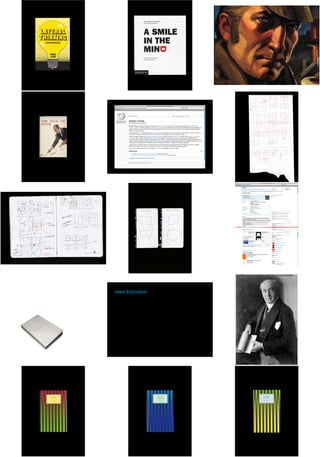
[•] You might spot some evidence in the next three examples.
[•] First: a series of covers wrapping up [•] Louis Couperus (1863-1923), a quite
famous Dutch novelist of the late 19th and early 20th century.
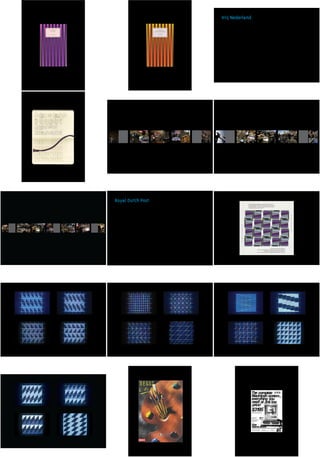
[•] The design, [•] from 1981, [•] is infact not much more [•] then a color scheme. [•]
[•] Second: a magazine production – for number ten of 2007 – on the public
appearances and the body language of George Bush. [•] First my notes, [•] then some
selected studies [•] concerning sequence, [•] format and rythm.
[•] Third (last): a commission by Royal Dutch Post. [•] This is a very special stamp,
which is distributed [•] only in the beginning of december, [•] just before X-mas.
[•] These early digital sketches, [•] are made with Degas, [•] the popular, much
cheaper rival of Mac Draw, [•] because I could not afford a Mac as a starter at that
time.
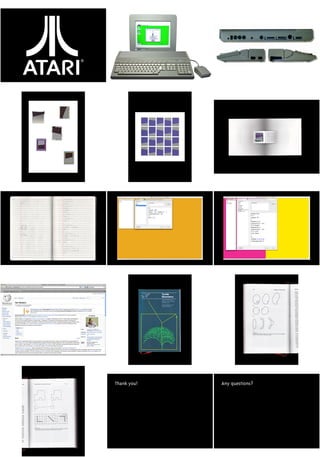
[•] So we mainly used Atari those first years . . . [•] Besides the (German) machine
was quite good, [•] especially because the ST was ‘open’ & all ports were easy to
program.
[•] The final sketches, however, are again just plain framed papercuts: precize, accurate
and effective.
[•] But apart from illustrating a specific mindset, these early examples show the effects
of a powerfull research driven methodology, caused by curiosity, beyond questioning and
expressed by the urge to investigate: on color, on rythm, on technology.
[•] They also show experiment might produce valuable result within any laboratory,
i-lab or designkitchen.
[•] When possible, in my spare time, I am studying LOGO – a LISP-dialect – producing
simple pen-up-pen-down Turtle Graphics . . .
[•] . . . Yes, I think programming – writing code – should be part of every up-to-date
curriculum to offer students another perspective and influence design-methodology.](https://image.slidesharecdn.com/20110219tobecontinuedext-110219155525-phpapp01/85/To-be-continued-22-320.jpg)
![[•] So, at the end of this presentation, I’d like to quote Harold Abelson – [•] a mathe-
matician and professor of Computer Science at MIT – who is stating in the Preface of
‘Turtle Geometry’:
[•] ‘It is our hope that these powerfull but simple tools for creating and exploring richly
interactive environments will dissolve the barriers to the production of knowledge as the
printing press dissolved barriers to its transmission.’
[•] ‘This hope is more than our wish for students to experience the joy of discovery and
the give and take between investigator and investigation that typifies scientific research.
[•] Like Piaget, Dewey, and Montessori, we are convinced that personal involvement
and agency are essential to truly effective education.’
[•] Thank you!
[•] Any questions?](https://image.slidesharecdn.com/20110219tobecontinuedext-110219155525-phpapp01/85/To-be-continued-23-320.jpg)

The document discusses challenges facing higher education in art and design, emphasizing the need for interdisciplinary approaches and innovative curricula that move beyond traditional fragmentation. It highlights examples of unique educational models from various institutions and underscores the importance of incorporating neuroscience insights into design education. The author argues for a reevaluation of how design programs are structured and suggests collaborative, global projects as a means to enhance learning experiences.


