"
Creative Industries:	

Its relevance in a design
education?	

Does a case exists in 2003. . ?
for Singapore International Design Forum (IDF)	

by Ron Newman


"
This presentation was developed for the Singapore
International Design Forum (IDF) in 2003 by Professor Ron
Newman who was also the convener of the event for the
Singapore Designers Association. Professor Newman is now
CEO of the fully online Virtu Design Institute.	
This DesignMeetings website is the Research portal of Virtu
Design Institute.
Skills	

Culture	

Commerce	

Knowledge	

Design
Education
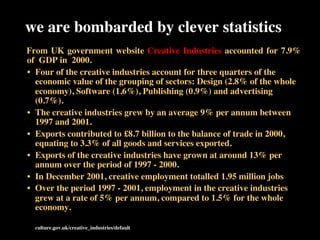
we are bombarded by clever statistics


From UK government website Creative Industries accounted for 7.9% 	


of GDP in 2000.	

•  Four of the creative industries account for three quarters of the
economic value of the grouping of sectors: Design (2.8% of the whole
economy), Software (1.6%), Publishing (0.9%) and advertising
(0.7%).	

•  The creative industries grew by an average 9% per annum between
1997 and 2001.	

•  Exports contributed to £8.7 billion to the balance of trade in 2000,
equating to 3.3% of all goods and services exported.	

•  Exports of the creative industries have grown at around 13% per
annum over the period of 1997 - 2000.	

•  In December 2001, creative employment totalled 1.95 million jobs	

•  Over the period 1997 - 2001, employment in the creative industries
grew at a rate of 5% per annum, compared to 1.5% for the whole
economy.	


 culture.gov.uk/creative_industries/default
. . .there are real concerns in many
economies, not to be left out . . . ?	


UK’s Department for Culture, Media and Sport, the Arts Council of England
(ACE) and the Design Council launch a guide to careers: Your Creative Future.
Outines career options in booming UK industries, including digital media, design,
film, television, and the performing arts, interspersing them with the personal
experiences of some of today’s creative practitioners. Estimated revenues of £60
billion and a workforce numbering around 1.4 million, the Creative Industries
are fast becoming a cornerstone of the UK economy, as Secretary of State for
Culture, Media and Sport Chris Smith points out in the guide’s foreword: “The
creative industries offer some of the best, most interesting and rewarding careers
around. And opportunities in these areas are set to increase over the coming years
as the UK’s creative industries go from strength to strength. Growing twice as
fast as the economy as a whole, they are generating wealth and creating new jobs
for the future.” Andrew Summers, Chief Executive of the Design Council, says:
“All the evidence shows that Creative Industries like design are continuing to
expand at an extraordinary rate …”!
–  Extracts from The Auckland University of Technology Dean of the
Faculty of Arts, Professor Peter Harwood's speech at the opening of the
Arts For Your Sake festival of student works, November 2001. 	

–  I wish to briefly explore the new concept or term
creative industries". The Blair government in Britain in 1997
defined the concept as "activities which have their origin in individual
creativity, skill and talent and which have the potential for wealth and
job creation through generation and exploitation of intellectual
property". 	

–  Some 13 industry sectors were identified including craft and antique
markets, IT software, film, TV, radio, visual arts, interactive leisure
software, publishing, advertising and architecture. To these we have
added the humanities and social sciences, fashion, graphic and spatial
design, language, Maori art and design and the culinary arts.
The term "creative"or "liberal arts"as defined in the
early 1700's is to be liberal, free or virtuous (i.e. non commercial). Hence
the slight snobbery or elitism in higher education about fine arts in
contrast to "cultural industries" and the consequent dumbing down
effects of mass entertainment - cultural industries like media and movies
which often fail to combine art and culture but instead form commercial
exploitation. 	

–  Today, these two themes, "creative arts" and "cultural industries" have
evolved into a third, or the next era of "creative industries" and the term
focuses on the twin truths that the core of culture is still "creativity" but
creativity is produced, deployed, consumed and enjoyed quite differently
from the way it used to be. "Industries" refers to economic sectors and in
this sense is interactive; oriented to the new economy; small enterprise
based; requiring content with individual artistic talent; i.e. a service
sector with high added value in the business of applied creativity
(including education, finance, tourism and hospitality. !
The creative industries are the fastest growing and most significant hot-
	

spots of the new economy in the world: 	

we see new commitments being made !	

•  In the United Kingdom the creative industries have revenues of some £60
billion and employ 1.5 billion people. They contribute over 4% of the UK
GDP and the sector is growing at almost twice the rate of the economy as a
whole.	

•  In Canada, creative industries account for some $29.6 billion in GDP. New
media growth in Toronto is about 20-25% per annum with total output about
US$700 million. A spectrum of creative industries sectors in the New
England states accounted for US$6.6 billion turnover, growing at 14% per
annum. 	

•  Australia also reports substantial turnover, employment and growth in the
creative industries sectors. Queensland alone estimates creative industries to
have revenues of A$5 billion p.a., with an annual growth rate of 7% and
employment increases of 42%. Identified strengths for the sector in
Queensland include: highly talented individuals; high levels of innovation; a
culture that values diversity and enthusiasm and strong government support
for the sector (e.g. Queensland government grant of $15 million for a
Creative Industries Precinct at Queensland University Technology (QUT).!
Some suggest that the contribution of the Creative Industries
in the new economy overcomes the false dichotomy or
dualism between science and arts. Because the creative
industries are not like existing industries, government and
policy change is required. Similarly, curriculum challenges
include input from creativity so that artistic talent and
"culture" assume central positions in our thinking. 	

!
In a recent paper by Cunningham and Hartley of
Queensland University of Technology (QUT), suggested that
"Creative Industries" is an idea whose time has come.!
that the direct Creative Industries link is the way forward
rather than the notion of Cultural Industries inputting into
commerce.	


does it have to be either / or . . . ?!
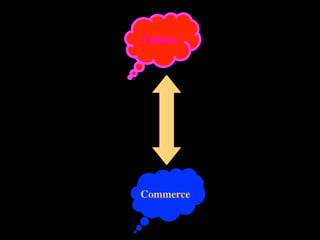
Culture	

Commerce
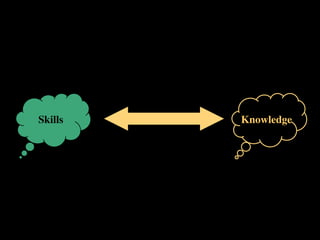
Skills	

 Knowledge
New
Technology!
New Values	

New
Business
Models!
Culture	

Commerce
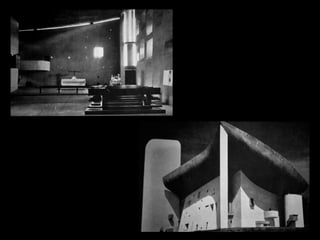
"..you employ stone, wood and concrete, and with these materials you build
houses and palaces; that is construction. Ingenuity is at work. But suddenly
you touch my heart, you do me good, I am happy and I say 'this is beautiful'.
That is architecture. Art enters in." Le Corbusier
!
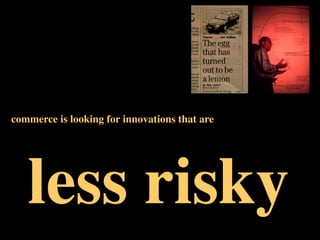
commerce is looking for innovations that are	


less risky 	

Copyright ©
Skills	

 Knowledge
“In today's complex world, it is no longer possible to tackle a design
problem from a single skill: a multi disciplinary team approach is
required. The answer to high complexity is what I call High Design.
By high design I mean an integrated process incorporating all the
skills on which design has historically based itself, plus all the new
design related skills we need to be able to respond to the complexity
and challenges of the present and be able to anticipate those in the
future.”	

Marzano, S'Flying over Las Vegas' EDC 1992
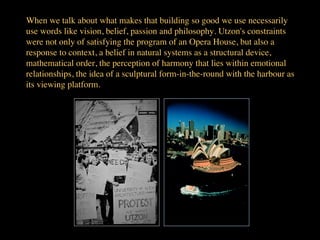
When we talk about what makes that building so good we use necessarily
use words like vision, belief, passion and philosophy. Utzon's constraints
were not only of satisfying the program of an Opera House, but also a
response to context, a belief in natural systems as a structural device,
mathematical order, the perception of harmony that lies within emotional
relationships, the idea of a sculptural form-in-the-round with the harbour as
its viewing platform.
Future
Practice!
Future Practice!	

• Design Leadership	

• Culture  Vision	

• Innovation  Risk	

• New values	

• Enhanced process
an example: Welcome to the
wonderful world of
Introduction
• Established in 1984	

• by Dare Jennings	

• Plenty of young optimism	

• Stores all around the world
Design Philosophies	

•  Radical	

•  Free thinking	

•  Relate to the present	

•  Employes individual artists	

•  Surrealism
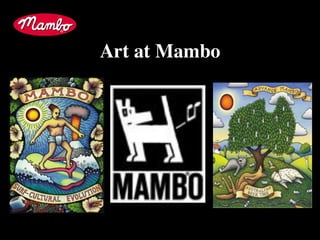
Art at Mambo
Ethics is the Business
•  Own set of moral principles	

•  Belief in common sub-conscious	

•  Cultural awareness	

•  Vision for Niche Market	

•  Humorous yet ethical
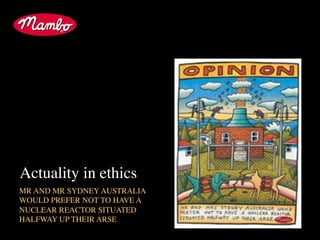
Actuality in ethics
MR AND MR SYDNEY AUSTRALIA
WOULD PREFER NOT TO HAVE A
NUCLEAR REACTOR SITUATED
HALFWAY UP THEIR ARSE
Management
•  Mariage between creativity
and business	

•  Management techinques	

•  Momentum of change
The Mambo NON Future
•  Purchased by Gazel Corporation Limited	

•  Divisionalised structure introduced	

•  Mambo lost focus 	

•  Executives on service agreement with Gazel
Future Practice!	

• Design Leadership	

• Culture  Vision	

• Innovation  Risk	

• New values	

• Enhanced process
Skills	

Culture	

Commerce	

Knowledge	

Design
Education
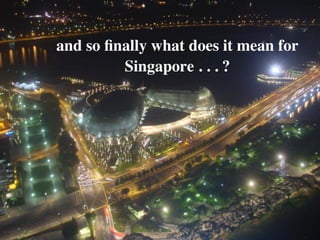
and so finally what does it mean for 	

Singapore . . . ?!
ARTS COUNCIL HAS NEW CHIEF:	


The national Arts Council of Singapore has a new chief
executive officer, Mr Lee Suan Hiang, currently CEO of Spring
Singapore. Mr Lee, 53, will take up his new position on Oct.
15, 2003.	


He will also assume the new post of Fellow in charge of the
Creative Industries Strategy Group at the Ministry of
Information, Communications and the Arts. There he will help
develop design and other creative sectors.	

The Straights Times Sept 16th, 2003	

and so already Singapore has officially
adopted the language . . . !!
“ in my view Singapore needs to be careful not
to adopt the ideas of others so readily, but
rather it should innovate and develop
strategies that suit its own unique position . . !”	

!
Ron Newman 2003!
and remember There are two important factors, the two
poles in the creation of art: the artist on one hand, and on
the other, the spectator who becomes the posterity...
Millions of artists create, only a few thousand are
discussed or accepted by the spectator and many less
again are consecrated by posterity. 

Marcel Duchamp from Le Processus Creatif.


Creative Industries:	

Its relevance in a design
education?	

a case exists in 2003. . ?
for Singapore International Design Forum (IDF)	

by Ron Newman

Presentation IDF 03 Singapore Creative Industries in 2003

  • 1.


 " Creative Industries: Its relevancein a design education? Does a case exists in 2003. . ? for Singapore International Design Forum (IDF) by Ron Newman
  • 2.


 " This presentation wasdeveloped for the Singapore International Design Forum (IDF) in 2003 by Professor Ron Newman who was also the convener of the event for the Singapore Designers Association. Professor Newman is now CEO of the fully online Virtu Design Institute. This DesignMeetings website is the Research portal of Virtu Design Institute.
  • 3.
  • 4.
    we are bombardedby clever statistics From UK government website Creative Industries accounted for 7.9% of GDP in 2000. •  Four of the creative industries account for three quarters of the economic value of the grouping of sectors: Design (2.8% of the whole economy), Software (1.6%), Publishing (0.9%) and advertising (0.7%). •  The creative industries grew by an average 9% per annum between 1997 and 2001. •  Exports contributed to £8.7 billion to the balance of trade in 2000, equating to 3.3% of all goods and services exported. •  Exports of the creative industries have grown at around 13% per annum over the period of 1997 - 2000. •  In December 2001, creative employment totalled 1.95 million jobs •  Over the period 1997 - 2001, employment in the creative industries grew at a rate of 5% per annum, compared to 1.5% for the whole economy. culture.gov.uk/creative_industries/default
  • 5.
    . . .thereare real concerns in many economies, not to be left out . . . ? UK’s Department for Culture, Media and Sport, the Arts Council of England (ACE) and the Design Council launch a guide to careers: Your Creative Future. Outines career options in booming UK industries, including digital media, design, film, television, and the performing arts, interspersing them with the personal experiences of some of today’s creative practitioners. Estimated revenues of £60 billion and a workforce numbering around 1.4 million, the Creative Industries are fast becoming a cornerstone of the UK economy, as Secretary of State for Culture, Media and Sport Chris Smith points out in the guide’s foreword: “The creative industries offer some of the best, most interesting and rewarding careers around. And opportunities in these areas are set to increase over the coming years as the UK’s creative industries go from strength to strength. Growing twice as fast as the economy as a whole, they are generating wealth and creating new jobs for the future.” Andrew Summers, Chief Executive of the Design Council, says: “All the evidence shows that Creative Industries like design are continuing to expand at an extraordinary rate …”!
  • 6.
    –  Extracts fromThe Auckland University of Technology Dean of the Faculty of Arts, Professor Peter Harwood's speech at the opening of the Arts For Your Sake festival of student works, November 2001. –  I wish to briefly explore the new concept or term creative industries". The Blair government in Britain in 1997 defined the concept as "activities which have their origin in individual creativity, skill and talent and which have the potential for wealth and job creation through generation and exploitation of intellectual property". –  Some 13 industry sectors were identified including craft and antique markets, IT software, film, TV, radio, visual arts, interactive leisure software, publishing, advertising and architecture. To these we have added the humanities and social sciences, fashion, graphic and spatial design, language, Maori art and design and the culinary arts.
  • 7.
    The term "creative"or"liberal arts"as defined in the early 1700's is to be liberal, free or virtuous (i.e. non commercial). Hence the slight snobbery or elitism in higher education about fine arts in contrast to "cultural industries" and the consequent dumbing down effects of mass entertainment - cultural industries like media and movies which often fail to combine art and culture but instead form commercial exploitation. –  Today, these two themes, "creative arts" and "cultural industries" have evolved into a third, or the next era of "creative industries" and the term focuses on the twin truths that the core of culture is still "creativity" but creativity is produced, deployed, consumed and enjoyed quite differently from the way it used to be. "Industries" refers to economic sectors and in this sense is interactive; oriented to the new economy; small enterprise based; requiring content with individual artistic talent; i.e. a service sector with high added value in the business of applied creativity (including education, finance, tourism and hospitality. !
  • 8.
    The creative industriesare the fastest growing and most significant hot- spots of the new economy in the world: we see new commitments being made ! •  In the United Kingdom the creative industries have revenues of some £60 billion and employ 1.5 billion people. They contribute over 4% of the UK GDP and the sector is growing at almost twice the rate of the economy as a whole. •  In Canada, creative industries account for some $29.6 billion in GDP. New media growth in Toronto is about 20-25% per annum with total output about US$700 million. A spectrum of creative industries sectors in the New England states accounted for US$6.6 billion turnover, growing at 14% per annum. •  Australia also reports substantial turnover, employment and growth in the creative industries sectors. Queensland alone estimates creative industries to have revenues of A$5 billion p.a., with an annual growth rate of 7% and employment increases of 42%. Identified strengths for the sector in Queensland include: highly talented individuals; high levels of innovation; a culture that values diversity and enthusiasm and strong government support for the sector (e.g. Queensland government grant of $15 million for a Creative Industries Precinct at Queensland University Technology (QUT).!
  • 9.
    Some suggest thatthe contribution of the Creative Industries in the new economy overcomes the false dichotomy or dualism between science and arts. Because the creative industries are not like existing industries, government and policy change is required. Similarly, curriculum challenges include input from creativity so that artistic talent and "culture" assume central positions in our thinking. !
  • 10.
    In a recentpaper by Cunningham and Hartley of Queensland University of Technology (QUT), suggested that "Creative Industries" is an idea whose time has come.!
  • 11.
    that the directCreative Industries link is the way forward rather than the notion of Cultural Industries inputting into commerce. does it have to be either / or . . . ?!
  • 12.
  • 13.
  • 14.
  • 15.
  • 16.
    "..you employ stone,wood and concrete, and with these materials you build houses and palaces; that is construction. Ingenuity is at work. But suddenly you touch my heart, you do me good, I am happy and I say 'this is beautiful'. That is architecture. Art enters in." Le Corbusier !
  • 19.
    commerce is lookingfor innovations that are less risky Copyright ©
  • 20.
  • 21.
    “In today's complexworld, it is no longer possible to tackle a design problem from a single skill: a multi disciplinary team approach is required. The answer to high complexity is what I call High Design. By high design I mean an integrated process incorporating all the skills on which design has historically based itself, plus all the new design related skills we need to be able to respond to the complexity and challenges of the present and be able to anticipate those in the future.” Marzano, S'Flying over Las Vegas' EDC 1992
  • 23.
    When we talkabout what makes that building so good we use necessarily use words like vision, belief, passion and philosophy. Utzon's constraints were not only of satisfying the program of an Opera House, but also a response to context, a belief in natural systems as a structural device, mathematical order, the perception of harmony that lies within emotional relationships, the idea of a sculptural form-in-the-round with the harbour as its viewing platform.
  • 24.
  • 25.
    Future Practice! • DesignLeadership • Culture Vision • Innovation Risk • New values • Enhanced process
  • 26.
    an example: Welcometo the wonderful world of
  • 27.
    Introduction • Established in 1984 • byDare Jennings • Plenty of young optimism • Stores all around the world
  • 28.
    Design Philosophies •  Radical • Free thinking •  Relate to the present •  Employes individual artists •  Surrealism
  • 29.
  • 30.
    Ethics is theBusiness •  Own set of moral principles •  Belief in common sub-conscious •  Cultural awareness •  Vision for Niche Market •  Humorous yet ethical
  • 31.
    Actuality in ethics MRAND MR SYDNEY AUSTRALIA WOULD PREFER NOT TO HAVE A NUCLEAR REACTOR SITUATED HALFWAY UP THEIR ARSE
  • 32.
    Management •  Mariage betweencreativity and business •  Management techinques •  Momentum of change
  • 33.
    The Mambo NONFuture •  Purchased by Gazel Corporation Limited •  Divisionalised structure introduced •  Mambo lost focus •  Executives on service agreement with Gazel
  • 34.
    Future Practice! • DesignLeadership • Culture Vision • Innovation Risk • New values • Enhanced process
  • 35.
  • 36.
    and so finallywhat does it mean for Singapore . . . ?!
  • 37.
    ARTS COUNCIL HASNEW CHIEF: The national Arts Council of Singapore has a new chief executive officer, Mr Lee Suan Hiang, currently CEO of Spring Singapore. Mr Lee, 53, will take up his new position on Oct. 15, 2003. He will also assume the new post of Fellow in charge of the Creative Industries Strategy Group at the Ministry of Information, Communications and the Arts. There he will help develop design and other creative sectors. The Straights Times Sept 16th, 2003 and so already Singapore has officially adopted the language . . . !!
  • 38.
    “ in myview Singapore needs to be careful not to adopt the ideas of others so readily, but rather it should innovate and develop strategies that suit its own unique position . . !” ! Ron Newman 2003!
  • 39.
    and remember Thereare two important factors, the two poles in the creation of art: the artist on one hand, and on the other, the spectator who becomes the posterity... Millions of artists create, only a few thousand are discussed or accepted by the spectator and many less again are consecrated by posterity. Marcel Duchamp from Le Processus Creatif.
  • 40.


 Creative Industries: Its relevancein a design education? a case exists in 2003. . ? for Singapore International Design Forum (IDF) by Ron Newman