15 th  International Conference of Women Engineers and Scientists, ICWES 15 19 - 22 July 2011, Adelaide Convention Centre Review of the UNESCO Report, “Engineering: Issues, Challenges and Opportunities for Development”   Session Title: Gender Equity/Diversity  Wednesday 20 July 2011, 13:30 - 15:00 Dr Tony Marjoram Former Head of Engineering, Division of Basic and Engineering Sciences, United Nations Educational, Scientific and Cultural Organisation
Overview … engineering, science and technology Invited to discuss the UNESCO Engineering Report, with reference to the following points and topics: Target audience of the Report Thematic scope of the Report Production method (how authors, texts/topics selected) Theoretical and analytical approach (vision behind the report) Findings and conclusions of the Report Gender issues and engineering I will cover these points, with particular reference to the findings and conclusions of the Report and to indicators of EST
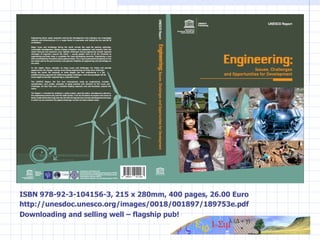
ISBN 978-92-3-104156-3, 215 x 280mm, 400 pages, 26.00 Euro http://unesdoc.unesco.org/images/0018/001897/189753e.pdf   Downloading and selling well – flagship pub!
UNESCO Report, “Engineering – Issues and Challenges for Development” Produced by UNESCO in conjunction with t he three main international engineering organisations: World Federation of Engineering Organisations (WFEO) International Council Academies of Engineering and  Technological Sciences (CAETS)  International Federation of Consulting Engineers (FIDIC) Eight sections/chapters, 400 pages (started as 250), 1.25kg, with 120 contributors from 40 countries Introductory statements by the Director-General of UNESCO, Presidents of WFEO, CAETS and FIDIC Introduction and soft launch at WEC2008, publication and  hard launch October 2010
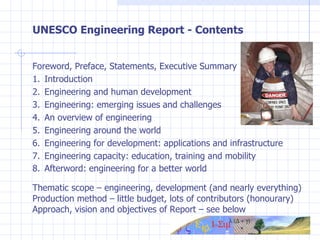
UNESCO Engineering Report - Contents Foreword, Preface, Statements, Executive Summary 1.  Introduction 2.  Engineering and human development 3. Engineering: emerging issues and challenges 4.  An overview of engineering 5. Engineering around the world 6.  Engineering for development: applications and infrastructure 7.  Engineering capacity: education, training and mobility 8.  Afterword: engineering for a better world Thematic scope – engineering, development (and nearly everything) Production method – little budget, lots of contributors (honourary) Approach, vision and objectives of Report – see below
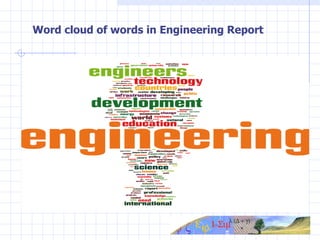
Word cloud of words in Engineering Report
UNESCO Engineering Report:  Issues, Challenges and Opportunities One of the main issues and challenges for the UNESCO engineering over the last 2-3 years was the production of this  Report  This is the first ever international report on engineering, intended to:  identify issues and challenges and opportunities for engineering promote better public understanding of engineering and its role  in society, and highlight ways of making engineering and engineering  education more attractive to young people, esp women The report is for decision-makers, engineering community and public to better understand and address these issues and challenges.
The UNESCO Engineering Report The Report is intended as: a platform for the presentation and discussion of the issues, challenges and opportunities for engineering, with particular reference to development Overall global issues and challenges include: the  need to reduce poverty, promote sustainable social and  economic development and address the other UN  Millennium Development Goals (MDGs) and climate change, Poverty and sustainable development relate particularly to access to knowledge and technology to address basic needs – which relates particularly to engineering and the need to bridge the digital and broader technology and gender divides
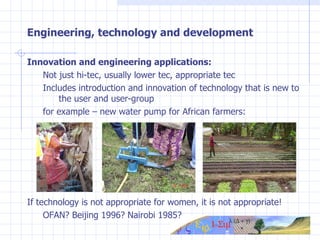
Engineering, technology and development Innovation and engineering applications: Not just hi-tec, usually lower tec, appropriate tec Includes introduction and innovation of technology that is new to  the user and user-group for example – new water pump for African farmers: If technology is not appropriate for women, it is not appropriate! OFAN? Beijing 1996? Nairobi 1985?
Main findings of the Report, need to: Advocate the role of e ngineering  as the driver of innovation, social  and economic development , Develop public and policy awareness and understanding of  engineering, and related gender issues Develop information on engineering, highlighting the urgent need  for better statistics and indicators on engineering Promote the transformation of engineering education, curricula and  teaching methods to  emphasise relevance and problem-solving More effectively apply engineering and technology to global issues  - poverty reduction, sustainable development, climate change Development of greener/sustainable, gender neutral engineering  and technology
Emerging issues and challenges Particular emerging issues and challenges include: climate change mitigation and adaptation and the urgent need  to move to a low-carbon future,  the consequences of the recent global financial crisis, and  calls for increased investment in infrastructure, engineering  capacity and associated research and development At the same time, many countries are concerned about: the apparent decline of interest and enrolment of young people,  esp young women, in engineering, science and technology the effect this will have on capacity and development these issues are compounded in developing countries by the  brain-drain of engineers (particularly to Europe and North  America)
The Report shows that: Many of these issues, challenges and opportunities are connected as possible solutions For example, a clear finding is that, when young people (esp women), the wider public and policy-makers see information and indicators showing that engineering, innovation and technology is part of the solution to global issues, their attention and interest is raised and they are attracted to engineering The Report is an international response to the  urgent need for the engineering community to engage with these wider audiences and the private sector in promoting such an agenda for engineering – and for the world
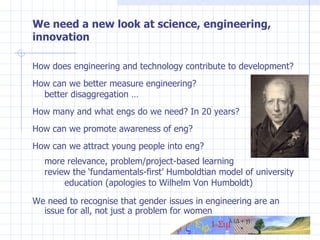
We need a new look at science, engineering, innovation How does engineering and technology contribute to development? How can we better measure engineering?  better disaggregation … How many and what engs do we need? In 20 years? How can we promote awareness of eng? How can we attract young people into eng? more relevance, problem/project-based learning review the ‘fundamentals-first’ Humboldtian model of university  education (apologies to Wilhelm Von Humboldt) We need to recognise that gender issues in engineering are an issue for all, not just a problem for women
For example - women in engineering The participation of women in engineering, and broader gender issues relating to engineering, are of increasing importance in the context of equity, access and contribution to development. Efforts to promote the participation of women in engineering in many countries increased enrolment in engineering courses in the 1980s and 1990s: from an average of between 10% and 15% to 20% and above  in some countries Since 2000, progress and enrolment seem to have declined, back to 10% in some countries   In other countries the participation of women in engineering is less, and in a few countries there are no women engineers at all.
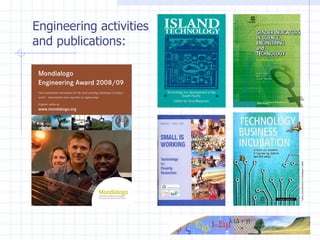
…  and gender indicators UNESCO information toolkit on  “Gender Indicators in Science, Engineering and Technology” , Sophia Huyer and Gunnar Westholm This toolkit introduces and discusses the need for gender indicators in engineering, science and technology, provides a background to the field and case studies comprised of the collection and analysis of gender-disaggregated data The main purpose of the toolkit is to provide guidelines, learning and teaching materials to promote the collection of indicators, facilitate better information, understanding, advocacy, policy-making and planning for engineering, science and technology No data no visibility, no visibility no interest … no engineering?
Engineering activities  and publications:


ICWES15 - A Review of the UNESCO Report: "Engineering: Issues, Challenges and Opportunities for Development". Presented by Dr Tony Marjoram, UNESCO

  • 1.
    15 th International Conference of Women Engineers and Scientists, ICWES 15 19 - 22 July 2011, Adelaide Convention Centre Review of the UNESCO Report, “Engineering: Issues, Challenges and Opportunities for Development” Session Title: Gender Equity/Diversity Wednesday 20 July 2011, 13:30 - 15:00 Dr Tony Marjoram Former Head of Engineering, Division of Basic and Engineering Sciences, United Nations Educational, Scientific and Cultural Organisation
  • 2.
    Overview … engineering,science and technology Invited to discuss the UNESCO Engineering Report, with reference to the following points and topics: Target audience of the Report Thematic scope of the Report Production method (how authors, texts/topics selected) Theoretical and analytical approach (vision behind the report) Findings and conclusions of the Report Gender issues and engineering I will cover these points, with particular reference to the findings and conclusions of the Report and to indicators of EST
  • 3.
    ISBN 978-92-3-104156-3, 215x 280mm, 400 pages, 26.00 Euro http://unesdoc.unesco.org/images/0018/001897/189753e.pdf Downloading and selling well – flagship pub!
  • 4.
    UNESCO Report, “Engineering– Issues and Challenges for Development” Produced by UNESCO in conjunction with t he three main international engineering organisations: World Federation of Engineering Organisations (WFEO) International Council Academies of Engineering and Technological Sciences (CAETS) International Federation of Consulting Engineers (FIDIC) Eight sections/chapters, 400 pages (started as 250), 1.25kg, with 120 contributors from 40 countries Introductory statements by the Director-General of UNESCO, Presidents of WFEO, CAETS and FIDIC Introduction and soft launch at WEC2008, publication and hard launch October 2010
  • 5.
    UNESCO Engineering Report- Contents Foreword, Preface, Statements, Executive Summary 1. Introduction 2. Engineering and human development 3. Engineering: emerging issues and challenges 4. An overview of engineering 5. Engineering around the world 6. Engineering for development: applications and infrastructure 7. Engineering capacity: education, training and mobility 8. Afterword: engineering for a better world Thematic scope – engineering, development (and nearly everything) Production method – little budget, lots of contributors (honourary) Approach, vision and objectives of Report – see below
  • 6.
    Word cloud ofwords in Engineering Report
  • 7.
    UNESCO Engineering Report: Issues, Challenges and Opportunities One of the main issues and challenges for the UNESCO engineering over the last 2-3 years was the production of this Report This is the first ever international report on engineering, intended to: identify issues and challenges and opportunities for engineering promote better public understanding of engineering and its role in society, and highlight ways of making engineering and engineering education more attractive to young people, esp women The report is for decision-makers, engineering community and public to better understand and address these issues and challenges.
  • 8.
    The UNESCO EngineeringReport The Report is intended as: a platform for the presentation and discussion of the issues, challenges and opportunities for engineering, with particular reference to development Overall global issues and challenges include: the need to reduce poverty, promote sustainable social and economic development and address the other UN Millennium Development Goals (MDGs) and climate change, Poverty and sustainable development relate particularly to access to knowledge and technology to address basic needs – which relates particularly to engineering and the need to bridge the digital and broader technology and gender divides
  • 9.
    Engineering, technology anddevelopment Innovation and engineering applications: Not just hi-tec, usually lower tec, appropriate tec Includes introduction and innovation of technology that is new to the user and user-group for example – new water pump for African farmers: If technology is not appropriate for women, it is not appropriate! OFAN? Beijing 1996? Nairobi 1985?
  • 10.
    Main findings ofthe Report, need to: Advocate the role of e ngineering as the driver of innovation, social and economic development , Develop public and policy awareness and understanding of engineering, and related gender issues Develop information on engineering, highlighting the urgent need for better statistics and indicators on engineering Promote the transformation of engineering education, curricula and teaching methods to emphasise relevance and problem-solving More effectively apply engineering and technology to global issues - poverty reduction, sustainable development, climate change Development of greener/sustainable, gender neutral engineering and technology
  • 11.
    Emerging issues andchallenges Particular emerging issues and challenges include: climate change mitigation and adaptation and the urgent need to move to a low-carbon future, the consequences of the recent global financial crisis, and calls for increased investment in infrastructure, engineering capacity and associated research and development At the same time, many countries are concerned about: the apparent decline of interest and enrolment of young people, esp young women, in engineering, science and technology the effect this will have on capacity and development these issues are compounded in developing countries by the brain-drain of engineers (particularly to Europe and North America)
  • 12.
    The Report showsthat: Many of these issues, challenges and opportunities are connected as possible solutions For example, a clear finding is that, when young people (esp women), the wider public and policy-makers see information and indicators showing that engineering, innovation and technology is part of the solution to global issues, their attention and interest is raised and they are attracted to engineering The Report is an international response to the urgent need for the engineering community to engage with these wider audiences and the private sector in promoting such an agenda for engineering – and for the world
  • 13.
    We need anew look at science, engineering, innovation How does engineering and technology contribute to development? How can we better measure engineering? better disaggregation … How many and what engs do we need? In 20 years? How can we promote awareness of eng? How can we attract young people into eng? more relevance, problem/project-based learning review the ‘fundamentals-first’ Humboldtian model of university education (apologies to Wilhelm Von Humboldt) We need to recognise that gender issues in engineering are an issue for all, not just a problem for women
  • 14.
    For example -women in engineering The participation of women in engineering, and broader gender issues relating to engineering, are of increasing importance in the context of equity, access and contribution to development. Efforts to promote the participation of women in engineering in many countries increased enrolment in engineering courses in the 1980s and 1990s: from an average of between 10% and 15% to 20% and above in some countries Since 2000, progress and enrolment seem to have declined, back to 10% in some countries In other countries the participation of women in engineering is less, and in a few countries there are no women engineers at all.
  • 15.
    … andgender indicators UNESCO information toolkit on “Gender Indicators in Science, Engineering and Technology” , Sophia Huyer and Gunnar Westholm This toolkit introduces and discusses the need for gender indicators in engineering, science and technology, provides a background to the field and case studies comprised of the collection and analysis of gender-disaggregated data The main purpose of the toolkit is to provide guidelines, learning and teaching materials to promote the collection of indicators, facilitate better information, understanding, advocacy, policy-making and planning for engineering, science and technology No data no visibility, no visibility no interest … no engineering?
  • 16.
    Engineering activities and publications:
  • 17.
  • 18.