Insects of Public Health
Importance
1. Mosquitoes
Anophilines, Culicines
1. Flies
House fly, sand fly, Tsetse fly, black fly
3. Human lice
Head
and body
lice, crab
lice
4. Fleas
Rat
Flies
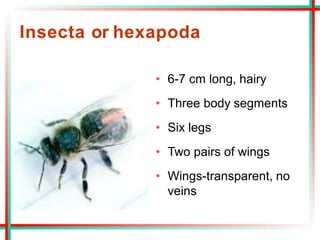
Insecta or hexapoda
• 6-7 cm long, hairy
• Three body segments
• Six legs
• Two pairs of wings
• Wings-transparent, no
veins
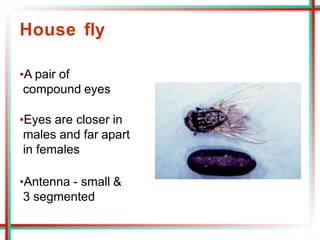
House fly
•A pair of
compound eyes
•Eyes are closer in
males and far apart
in females
•Antenna - small &
3 segmented
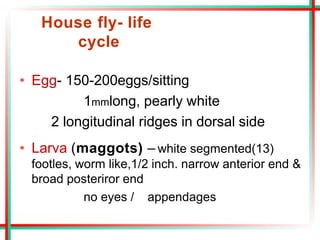
House fly- life
cycle
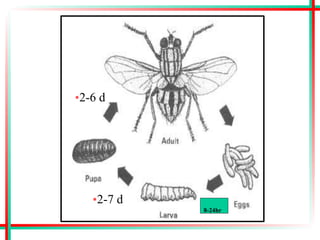
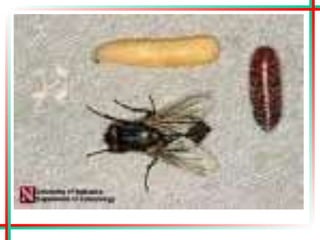
• Egg- 150-200eggs/sitting
1mmlong, pearly white
2 longitudinal ridges in dorsal side
• Larva (maggots) – white segmented(13)
footles, worm like,1/2 inch. narrow anterior end &
broad posteriror end
no eyes / appendages
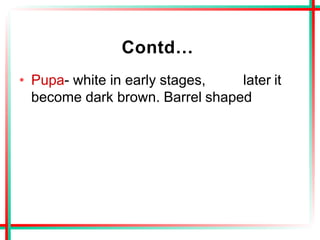
Contd…
• Pupa- white in early stages, later it
become dark brown. Barrel shaped
•2-6 d
•2-7 d
8-24hr
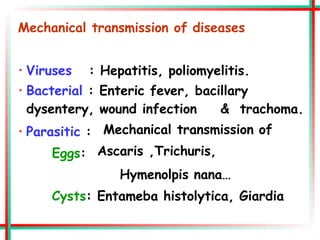
Mechanical transmission of diseases
• Viruses : Hepatitis, poliomyelitis.
• Bacterial : Enteric fever, bacillary
dysentery, wound infection & trachoma.
• Parasitic :
Eggs:
Mechanical transmission of
Ascaris ,Trichuris,
Hymenolpis nana…
Cysts: Entameba histolytica, Giardia
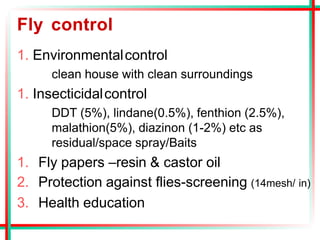
Fly control
1. Environmentalcontrol
clean house with clean surroundings
1. Insecticidalcontrol
DDT (5%), lindane(0.5%), fenthion (2.5%),
malathion(5%), diazinon (1-2%) etc as
residual/space spray/Baits
1. Fly papers –resin & castor oil
2. Protection against flies-screening (14mesh/ in)
3. Health education
Sand fly
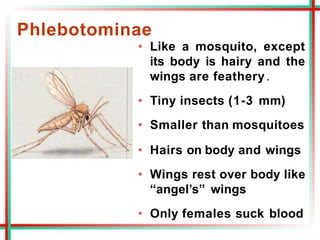
Phlebotominae
• Like a mosquito, except
its body is hairy and the
wings are feathery.
• Tiny insects (1-3 mm)
• Smaller than mosquitoes
• Hairs on body and wings
• Wings rest over body like
ā€œangel’sā€ wings
• Only females suck blood
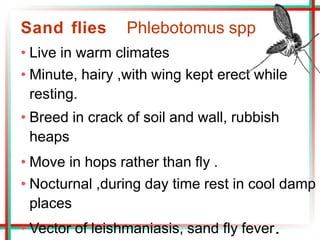
Sand flies Phlebotomus spp
• Live in warm climates
• Minute, hairy ,with wing kept erect while
resting.
• Breed in crack of soil and wall, rubbish
heaps
• Move in hops rather than fly .
• Nocturnal ,during day time rest in cool damp
places
• Vector of leishmaniasis, sand fly fever.
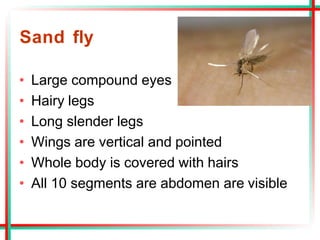
Sand fly
• Large compound eyes
• Hairy legs
• Long slender legs
• Wings are vertical and pointed
• Whole body is covered with hairs
• All 10 segments are abdomen are visible
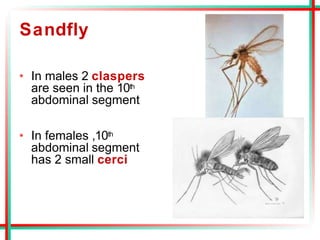
Sandfly
• In males 2 claspers
are seen in the 10th
abdominal segment
• In females ,10th
abdominal segment
has 2 small cerci
Sand fly
Vector for Leishmaniasis
ā—ˆL.Donovani -visceral leishmaniasis.
ā—ˆL. tropica -cutaneous leishmaniasis.
ā—ˆL.braziliensis -mucocutenous.
Transmission cyclopropagative.
ā—ˆSand fly fever viral disease
mild fever like influenza
propagative
Fleas of medical importance
Ctenocephalides
• Ecto- parasites of dog and cat
• Characterized by black teeth like structure
on head known genetal comb and
another set on first thoracic segment-
pronotal comb
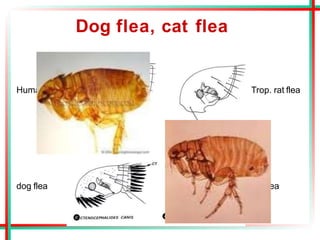
Dog flea, cat flea
Human flea Trop. rat flea
dog flea cat flea
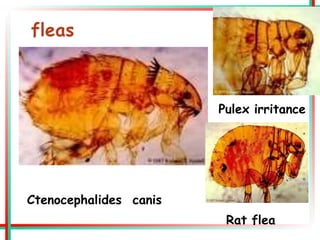
Ctenocephalides canis
Rat flea
Pulex irritance
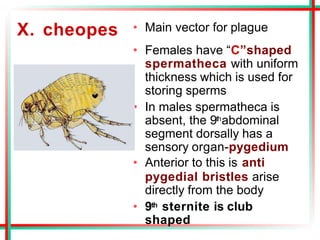
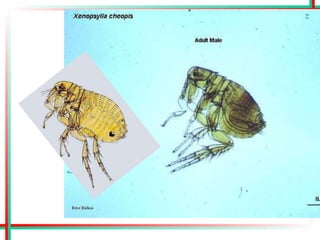
X. cheopes • Main vector for plague
• Females have ā€œCā€shaped
spermatheca with uniform
thickness which is used for
storing sperms
• In males spermatheca is
absent, the 9thabdominal
segment dorsally has a
sensory organ-pygedium
• Anterior to this is anti
pygedial bristles arise
directly from the body
• 9th sternite is club
shaped
X. astia
• In female-spermatheca is bulbus at the
middle –a shaped
• In male- anti pygedial bristles
arise directly from the body
• 9th sternite is ribbon shaped
X. braziliensis
• In female-spermatheca is bulbus at one
end –b shaped
• In male- anti pygedial bristles
arise from a conical base
• 9th sternite is absent
Fleas transmited
• Plague (bubonic)
• Endemic or murine typhus
• Chiggerosis
• Hymenolepis diminuta
• Modeof transmission
ā—ˆBiting-blocked flea
ā—ˆMechanical transmission
ā—ˆFaecal
Control of fleas
• Insecticides
ā—ˆDDT(5-10%),γHCH, dieldrin, diazinon(2%)
ā—ˆApplied in floors & walls up to 1ft
ā—ˆApplied in rat burrows
• Repellents
ā—ˆDiethyl toluamide
• Rodent control
Human lice
Lice
• Small wingless insects
• Three species that solely live on humans
ā—ˆPediculus humanus occurs in two subspecies
the head louse ( Pediculus capitis) and
the body louse ( Pediculuscorporis)
• The body louse lives mostly in the
clothing and attaches its eggs to its
fibers
• The third species of human lice is
Phthirus pubis the crab or pubic louse.
Head louse- Pediculus humanuscapitis
• The head louse lives in the hair and
attaches eggs (nits) to the hair
• Body - dorso-ventrally flattened, has head,
thorax & abdomen
• Head-pointed, bears a pair of 5 segmented
antennae, Simple eyes.Head has a pair of
antennae which is sucking & piercing type
• Thorax(square shaped) has 3 pairs of
appendages.Last segment of appendages
ends with claws
• Abdomen – 9 sements.Last segment imale it
is pointed, females - bilobed
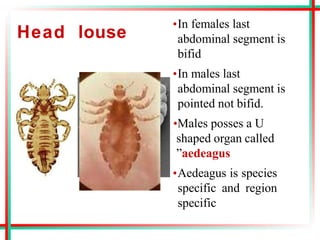
Head louse
•In females last
abdominal segment is
bifid
•In males last
abdominal segment is
pointed not bifid.
•Males posses a U
shaped organ called
ā€aedeagus
•Aedeagus is species
specific and region
specific
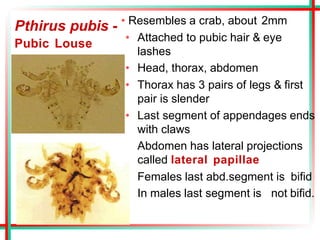
Pubic Louse
Pthirus pubis - • Resembles a crab, about 2mm
• Attached to pubic hair & eye
lashes
• Head, thorax, abdomen
• Thorax has 3 pairs of legs & first
pair is slender
• Last segment of appendages ends
with claws
• Abdomen has lateral projections
called lateral papillae
• Females last abd.segment is bifid
• In males last segment is not bifid.
Lice -PH importance
disease transmission:
lice act as a vector for
- Epidemic typhus
- Epidemic relapsing fever,
- Trench fever.
Pediculosis, irritation and
pruritus.
Control of lice
• Insecticide s -Lotion with 0.5%
malathion,toapplied and kept on for 24-48 hrs.
• Personal hygiene
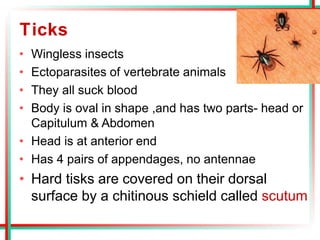
Ticks
• Wingless insects
• Ectoparasites of vertebrate animals
• They all suck blood
• Body is oval in shape ,and has two parts- head or
Capitulum & Abdomen
• Head is at anterior end
• Has 4 pairs of appendages, no antennae
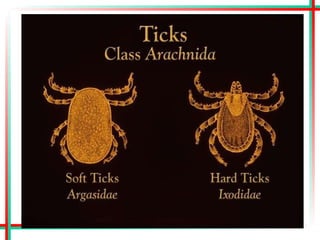
• Hard tisks are covered on their dorsal
surface by a chitinous schield called scutum
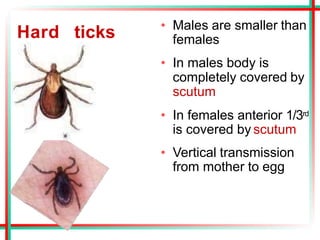
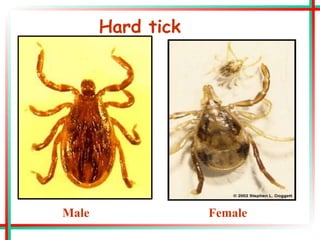
Hard ticks • Males are smaller than
females
• In males body is
completely covered by
scutum
• In females anterior 1/3rd
is covered by scutum
• Vertical transmission
from mother to egg
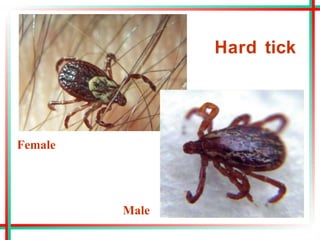
Hard tick
Male
Female
Hard tick
Female
Male
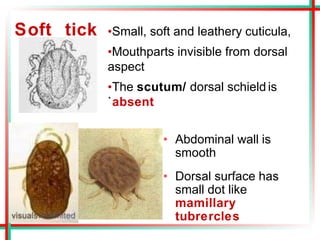
Soft tick •Small, soft and leathery cuticula,
•Mouthparts invisible from dorsal
aspect
•The scutum/ dorsal schield is
`absent
• Abdominal wall is
smooth
• Dorsal surface has
small dot like
mamillary
tubrercles
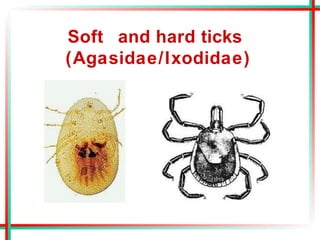
Soft and hard ticks
(Agasidae/Ixodidae)
•Hard tick hard cuticle
- Babesiosis,Tularemia
- Quneensland fever,
- Rocky mountain spotted fever,
- Tick paralysis ,KFD
•Soft tick soft cuticle
- Relapsing fever Borrelia duttoni
- Q fever
- KFD
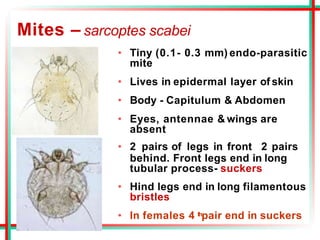
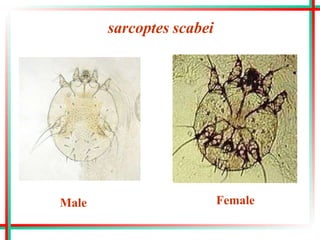
Mites – sarcoptes scabei
• Tiny (0.1- 0.3 mm) endo-parasitic
mite
• Lives in epidermal layer of skin
• Body - Capitulum & Abdomen
• Eyes, antennae & wings are
absent
• 2 pairs of legs in front 2 pairs
behind. Front legs end in long
tubular process- suckers
• Hind legs end in long filamentous
bristles
• In females 4 thpair end in suckers
sarcoptes scabei
Female
Male
sarcoptes scabei- Public health imp
• Causes human scabies
• Scabies is characterized by an intensely
pruritic, erythematous, papular eruption
caused by burrowing of adult female mites
in upper layers of the epidermis, creating
serpiginous burrows. Itching is most
intense at night
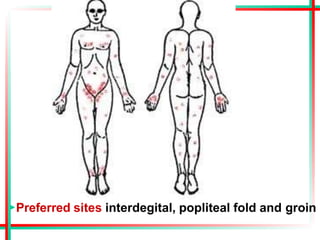
• Sites of lesion – hands & wrist
(63%),extensor aspect of wrist (11%),
ā–¶Preferred sites interdegital, popliteal fold and groin
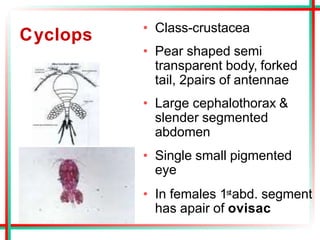
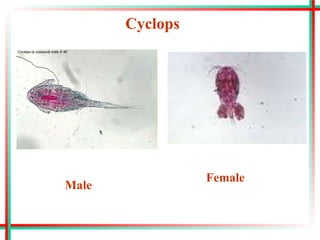
Cyclops • Class-crustacea
• Pear shaped semi
transparent body, forked
tail, 2pairs of antennae
• Large cephalothorax &
slender segmented
abdomen
• Single small pigmented
eye
• In females 1stabd. segment
has apair of ovisac
Cyclops
Female
Male
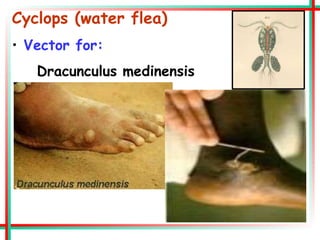
Cyclops (water flea)
• Vector for:
Dracunculus medinensis
Control
• Physical
straining of water through a piece fine cloth
Boiling at 60 degree C
• Chemical – chlorine 5ppm,alum
4gm/gallon, abate 1mg/l
• Biological – gambusia fish
• Abolish step well, promote sanitary well
insectsofpublichealthimportance-121006021342-phpapp02.pptx

insectsofpublichealthimportance-121006021342-phpapp02.pptx

  • 1.
    Insects of PublicHealth Importance
  • 2.
    1. Mosquitoes Anophilines, Culicines 1.Flies House fly, sand fly, Tsetse fly, black fly 3. Human lice Head and body lice, crab lice 4. Fleas Rat
  • 3.
  • 4.
    Insecta or hexapoda •6-7 cm long, hairy • Three body segments • Six legs • Two pairs of wings • Wings-transparent, no veins
  • 5.
    House fly •A pairof compound eyes •Eyes are closer in males and far apart in females •Antenna - small & 3 segmented
  • 6.
    House fly- life cycle •Egg- 150-200eggs/sitting 1mmlong, pearly white 2 longitudinal ridges in dorsal side • Larva (maggots) – white segmented(13) footles, worm like,1/2 inch. narrow anterior end & broad posteriror end no eyes / appendages
  • 7.
    Contd… • Pupa- whitein early stages, later it become dark brown. Barrel shaped
  • 8.
  • 10.
    Mechanical transmission ofdiseases • Viruses : Hepatitis, poliomyelitis. • Bacterial : Enteric fever, bacillary dysentery, wound infection & trachoma. • Parasitic : Eggs: Mechanical transmission of Ascaris ,Trichuris, Hymenolpis nana… Cysts: Entameba histolytica, Giardia
  • 11.
    Fly control 1. Environmentalcontrol cleanhouse with clean surroundings 1. Insecticidalcontrol DDT (5%), lindane(0.5%), fenthion (2.5%), malathion(5%), diazinon (1-2%) etc as residual/space spray/Baits 1. Fly papers –resin & castor oil 2. Protection against flies-screening (14mesh/ in) 3. Health education
  • 12.
  • 13.
    Phlebotominae • Like amosquito, except its body is hairy and the wings are feathery. • Tiny insects (1-3 mm) • Smaller than mosquitoes • Hairs on body and wings • Wings rest over body like ā€œangel’sā€ wings • Only females suck blood
  • 14.
    Sand flies Phlebotomusspp • Live in warm climates • Minute, hairy ,with wing kept erect while resting. • Breed in crack of soil and wall, rubbish heaps • Move in hops rather than fly . • Nocturnal ,during day time rest in cool damp places • Vector of leishmaniasis, sand fly fever.
  • 15.
    Sand fly • Largecompound eyes • Hairy legs • Long slender legs • Wings are vertical and pointed • Whole body is covered with hairs • All 10 segments are abdomen are visible
  • 16.
    Sandfly • In males2 claspers are seen in the 10th abdominal segment • In females ,10th abdominal segment has 2 small cerci
  • 17.
    Sand fly Vector forLeishmaniasis ā—ˆL.Donovani -visceral leishmaniasis. ā—ˆL. tropica -cutaneous leishmaniasis. ā—ˆL.braziliensis -mucocutenous. Transmission cyclopropagative. ā—ˆSand fly fever viral disease mild fever like influenza propagative
  • 18.
    Fleas of medicalimportance
  • 19.
    Ctenocephalides • Ecto- parasitesof dog and cat • Characterized by black teeth like structure on head known genetal comb and another set on first thoracic segment- pronotal comb
  • 20.
    Dog flea, catflea Human flea Trop. rat flea dog flea cat flea
  • 21.
  • 22.
    X. cheopes •Main vector for plague • Females have ā€œCā€shaped spermatheca with uniform thickness which is used for storing sperms • In males spermatheca is absent, the 9thabdominal segment dorsally has a sensory organ-pygedium • Anterior to this is anti pygedial bristles arise directly from the body • 9th sternite is club shaped
  • 24.
    X. astia • Infemale-spermatheca is bulbus at the middle –a shaped • In male- anti pygedial bristles arise directly from the body • 9th sternite is ribbon shaped
  • 25.
    X. braziliensis • Infemale-spermatheca is bulbus at one end –b shaped • In male- anti pygedial bristles arise from a conical base • 9th sternite is absent
  • 26.
    Fleas transmited • Plague(bubonic) • Endemic or murine typhus • Chiggerosis • Hymenolepis diminuta • Modeof transmission ā—ˆBiting-blocked flea ā—ˆMechanical transmission ā—ˆFaecal
  • 27.
    Control of fleas •Insecticides ā—ˆDDT(5-10%),γHCH, dieldrin, diazinon(2%) ā—ˆApplied in floors & walls up to 1ft ā—ˆApplied in rat burrows • Repellents ā—ˆDiethyl toluamide • Rodent control
  • 28.
  • 29.
    Lice • Small winglessinsects • Three species that solely live on humans ā—ˆPediculus humanus occurs in two subspecies the head louse ( Pediculus capitis) and the body louse ( Pediculuscorporis) • The body louse lives mostly in the clothing and attaches its eggs to its fibers • The third species of human lice is Phthirus pubis the crab or pubic louse.
  • 30.
    Head louse- Pediculushumanuscapitis • The head louse lives in the hair and attaches eggs (nits) to the hair • Body - dorso-ventrally flattened, has head, thorax & abdomen • Head-pointed, bears a pair of 5 segmented antennae, Simple eyes.Head has a pair of antennae which is sucking & piercing type • Thorax(square shaped) has 3 pairs of appendages.Last segment of appendages ends with claws • Abdomen – 9 sements.Last segment imale it is pointed, females - bilobed
  • 31.
    Head louse •In femaleslast abdominal segment is bifid •In males last abdominal segment is pointed not bifid. •Males posses a U shaped organ called ā€aedeagus •Aedeagus is species specific and region specific
  • 32.
    Pubic Louse Pthirus pubis- • Resembles a crab, about 2mm • Attached to pubic hair & eye lashes • Head, thorax, abdomen • Thorax has 3 pairs of legs & first pair is slender • Last segment of appendages ends with claws • Abdomen has lateral projections called lateral papillae • Females last abd.segment is bifid • In males last segment is not bifid.
  • 33.
    Lice -PH importance diseasetransmission: lice act as a vector for - Epidemic typhus - Epidemic relapsing fever, - Trench fever. Pediculosis, irritation and pruritus.
  • 34.
    Control of lice •Insecticide s -Lotion with 0.5% malathion,toapplied and kept on for 24-48 hrs. • Personal hygiene
  • 35.
    Ticks • Wingless insects •Ectoparasites of vertebrate animals • They all suck blood • Body is oval in shape ,and has two parts- head or Capitulum & Abdomen • Head is at anterior end • Has 4 pairs of appendages, no antennae • Hard tisks are covered on their dorsal surface by a chitinous schield called scutum
  • 36.
    Hard ticks •Males are smaller than females • In males body is completely covered by scutum • In females anterior 1/3rd is covered by scutum • Vertical transmission from mother to egg
  • 37.
  • 38.
  • 39.
    Soft tick •Small,soft and leathery cuticula, •Mouthparts invisible from dorsal aspect •The scutum/ dorsal schield is `absent • Abdominal wall is smooth • Dorsal surface has small dot like mamillary tubrercles
  • 40.
    Soft and hardticks (Agasidae/Ixodidae)
  • 42.
    •Hard tick hardcuticle - Babesiosis,Tularemia - Quneensland fever, - Rocky mountain spotted fever, - Tick paralysis ,KFD •Soft tick soft cuticle - Relapsing fever Borrelia duttoni - Q fever - KFD
  • 43.
    Mites – sarcoptesscabei • Tiny (0.1- 0.3 mm) endo-parasitic mite • Lives in epidermal layer of skin • Body - Capitulum & Abdomen • Eyes, antennae & wings are absent • 2 pairs of legs in front 2 pairs behind. Front legs end in long tubular process- suckers • Hind legs end in long filamentous bristles • In females 4 thpair end in suckers
  • 44.
  • 45.
    sarcoptes scabei- Publichealth imp • Causes human scabies • Scabies is characterized by an intensely pruritic, erythematous, papular eruption caused by burrowing of adult female mites in upper layers of the epidermis, creating serpiginous burrows. Itching is most intense at night • Sites of lesion – hands & wrist (63%),extensor aspect of wrist (11%),
  • 46.
    ā–¶Preferred sites interdegital,popliteal fold and groin
  • 47.
    Cyclops • Class-crustacea •Pear shaped semi transparent body, forked tail, 2pairs of antennae • Large cephalothorax & slender segmented abdomen • Single small pigmented eye • In females 1stabd. segment has apair of ovisac
  • 48.
  • 49.
    Cyclops (water flea) •Vector for: Dracunculus medinensis
  • 50.
    Control • Physical straining ofwater through a piece fine cloth Boiling at 60 degree C • Chemical – chlorine 5ppm,alum 4gm/gallon, abate 1mg/l • Biological – gambusia fish • Abolish step well, promote sanitary well