Baculovirus and Insect Cell Expression Protocols
3rd Edition David W. Murhammer (Ed.) download
https://ebookgate.com/product/baculovirus-and-insect-cell-
expression-protocols-3rd-edition-david-w-murhammer-ed/
Get Instant Ebook Downloads – Browse at https://ebookgate.com
Get Your Digital Files Instantly: PDF, ePub, MOBI and More
Quick Digital Downloads: PDF, ePub, MOBI and Other Formats
Dendritic Cell Protocols 3rd ed. 2016 Edition Elodie
Segura
https://ebookgate.com/product/dendritic-cell-protocols-3rd-
ed-2016-edition-elodie-segura/
Insect Resistance Management Biology Economics and
Prediction 2nd Edition David W. Onstad (Eds.)
https://ebookgate.com/product/insect-resistance-management-
biology-economics-and-prediction-2nd-edition-david-w-onstad-eds/
Cancer Cell Signaling Methods and Protocols 1st
Edition. Edition David M. Terrian
https://ebookgate.com/product/cancer-cell-signaling-methods-and-
protocols-1st-edition-edition-david-m-terrian/
Basic Cell Culture Protocols 3rd Edition Cheryl D.
Helgason (Auth.)
https://ebookgate.com/product/basic-cell-culture-protocols-3rd-
edition-cheryl-d-helgason-auth/
Cancer Cell Signaling Methods and Protocols 3rd Edition
Martha Robles-Flores (Editor)
https://ebookgate.com/product/cancer-cell-signaling-methods-and-
protocols-3rd-edition-martha-robles-flores-editor/
Human Embryonic Stem Cell Protocols 3rd ed. 2016
Edition Kursad Turksen
https://ebookgate.com/product/human-embryonic-stem-cell-
protocols-3rd-ed-2016-edition-kursad-turksen/
African Archaeology 3rd Edition David W. Phillipson
https://ebookgate.com/product/african-archaeology-3rd-edition-
david-w-phillipson/
High Throughput Protein Expression and Purification
Methods and Protocols 1st Edition Jim Koehn
https://ebookgate.com/product/high-throughput-protein-expression-
and-purification-methods-and-protocols-1st-edition-jim-koehn/
Gene Mapping Discovery and Expression Methods and
Protocols 1st Edition Minou Bina (Auth.)
https://ebookgate.com/product/gene-mapping-discovery-and-
expression-methods-and-protocols-1st-edition-minou-bina-auth/
Baculovirus
andInsect
CellExpression
Protocols
DavidW. Murhammer Editor
ThirdEdition
Methods in
Molecular Biology 1350
ME T H O D S I N MO L E C U L A R BI O L O G Y
Series Editor
John M. Walker
School of Life and Medical Sciences
University of Hertfordshire
Hatfield, Hertfordshire, AL10 9AB, UK
For further volumes:
http://www.springer.com/series/7651
Baculovirus and Insect Cell
Expression Protocols
Third Edition
Edited by
DavidW. Murhammer
DepartmentofChemical&BiochemicalEngineering,UniversityofIowa,IowaCity,IA,USA
Editor
David W. Murhammer
Department of Chemical & Biochemical Engineering
University of Iowa
Iowa City, IA, USA
ISSN 1064-3745 ISSN 1940-6029 (electronic)
Methods in Molecular Biology
ISBN 978-1-4939-3042-5 ISBN 978-1-4939-3043-2 (eBook)
DOI 10.1007/978-1-4939-3043-2
Library of Congress Control Number: 2015952020
Springer New York Heidelberg Dordrecht London
© Springer Science+Business Media, LLC 2016
This work is subject to copyright. All rights are reserved by the Publisher, whether the whole or part of the material is
concerned, specifically the rights of translation, reprinting, reuse of illustrations, recitation, broadcasting, reproduction
on microfilms or in any other physical way, and transmission or information storage and retrieval, electronic adaptation,
computer software, or by similar or dissimilar methodology now known or hereafter developed.
The use of general descriptive names, registered names, trademarks, service marks, etc. in this publication does not
imply, even in the absence of a specific statement, that such names are exempt from the relevant protective laws and
regulations and therefore free for general use.
The publisher, the authors and the editors are safe to assume that the advice and information in this book are believed to
be true and accurate at the date of publication. Neither the publisher nor the authors or the editors give a warranty,
express or implied, with respect to the material contained herein or for any errors or omissions that may have been made.
Printed on acid-free paper
Humana Press is a brand of Springer
Springer Science+Business Media LLC New York is part of Springer Science+Business Media (www.springer.com)
v
Baculoviruses, which are a group of viruses that infect invertebrates, were first “discovered”
in diseased silk worms in the 1500s, although the viral nature of this disease was not demon-
strated until 1947. Subsequently, hundreds of other baculoviruses have been discovered. For
example, the Autographa californica multiple nucleopolyhedrovirus (AcMNPV) was first
isolated from the alfalfa looper (i.e., A. californica) insect species. AcMNPV is the most
widely used and best characterized baculovirus and is known to infect many insect species in
addition to A. californica, including Spodoptera frugiperda (fall armyworm) and Trichoplusia
ni (cabbage looper). Furthermore, AcMNPV is the baculovirus that is usually used to pro-
duce recombinant baculoviruses for subsequent recombinant protein synthesis.
Shangyin Gao and Thomas Grace independently established the first continuous insect
cell lines in the late 1950s and early 1960s. In the 1960s and 1970s insect cell culture was
primarily used as a model to study insect metabolism and for the in vitro synthesis of bacu-
loviruses for potential use in insect control (i.e., as a biopesticide). The widespread use of
insect cell culture, however, did not occur until the baculovirus expression vector system
(BEVS) was independently developed in the Max D. Summers and Lois K. Miller laborato-
ries in the early 1980s. The BEVS takes advantage of the very strong polyhedrin promoter
found in the AcMNPV genome whose natural product (polyhedrin protein) is nonessential
in insect cell culture. Thus, the BEVS involves using the polyhedrin promoter to drive for-
eign protein expression and provides the means to express high levels of recombinant pro-
teins in a relatively short time. Note that there have been many extensions of this basic
principle, many of which are described in this book. In brief, some advantages of the BEVS
are (1) ease of constructing a recombinant baculovirus (compared to isolating stably trans-
formed cells), (2) potentially high expression levels, and (3) the ability of host insect cells
to properly process proteins in a manner similar to mammalian cells. Thus, the BEVS pro-
vides a recombinant protein expression system intermediate between bacteria (e.g., E. coli)
and mammalian cells (e.g., CHO cells) in terms of expression levels, cost, and ability to
perform complex protein modifications. The BEVS has become especially popular for
small-scale recombinant protein expression in laboratories throughout the world when bio-
logically active proteins are required for research applications. Furthermore, the BEVS is
becoming a popular choice for producing commercial farm animal and human vaccines. For
example, a subunit/marker vaccine against classical swine fever (“Porcilis Pesti”) produced
by MSD Animal Health was released in 1998 for vaccinating pigs, a virus-like particle vac-
cine against cervical cancer (“Cervarix”) produced by GlaxoSmithKline was released in
2007 for vaccinating human girls, and an annual trivalent flu vaccine (“Flublok”) produced
by Protein Sciences was released in 2013 for vaccinating humans.
The third edition of Baculovirus and Insect Cell Expression Protocols (the first edition,
edited by Christopher D. Richardson, was published in 1995 and the second edition, edited
by David W. Murhammer, was published in 2007) was written to provide an updated step-
by-step guide to biochemists, molecular biologists, biochemical engineers, and others using
the BEVS and/or insect cells for producing recombinant proteins. Furthermore, the third
edition of Baculovirus and Insect Cell Expression Protocols will provide assistance to scientists
Preface
vi
and engineers interested in developing and producing baculovirus insecticides. In both of
these cases the procedures involved in producing products at laboratory scale and large
scale will be discussed, as well as production in insect larvae.
The third edition of Baculovirus and Insect Cell Expression Protocols is divided into
seven parts. The first part, entitled “Introduction,” contains one chapter that serves as an
overview of the major techniques discussed in detail elsewhere in the book. Furthermore,
this chapter provides step-by-step procedures involved in quantifying cell growth, baculo-
virus infection, and cell metabolism. It is strongly recommended that this chapter be read
prior to reading your specific chapter(s) of interest. The second part, entitled “Baculovirus
molecular biology/development of recombinant baculoviruses,” contains three chapters
that give an overview of baculovirus molecular biology and methods involved in construct-
ing and isolating recombinant baculoviruses. Moreover, this part contains another chapter
thatdiscussesusingmodifiedbaculovirusestoexpressgenesinmammaliancells(“BacMam”).
The third part, entitled “Insect cell culture,” contains four chapters that list currently avail-
able insect cell lines, methods to isolate new cell lines and develop your own serum-free
medium, and routine maintenance and storage of insect cell lines and baculoviruses. The
fourth part, entitled “Protein production with recombinant baculoviruses,” contains four
chapters that discuss small- and large-scale recombinant protein production with the BEVS
in both insect and mammalian cell culture and in insect larvae. The other two chapters in
this part discuss the large-scale production of virus-like particles and an alternative approach
to expressing multicomponent protein complexes. The fifth part, entitled “Recombinant
protein production with transformed insect cells,” contains a chapter that discusses meth-
ods involved in developing stably transformed insect cells for expressing recombinant pro-
teins directly from the insect cell genome, another chapter about improving the protein
processing capabilities of host insect cells for use with the BEVS, and a chapter about using
Drosophila cell lines, which provide an alternative to the lepidopteran insect cell lines used
with the BEVS. The sixth part, entitled “Baculovirus development and production for use
as insecticides,” contains three chapters about the use, production, and characterization of
baculoviruses (both wild type and recombinant) for use as biopesticides. The seventh part,
entitled “Miscellaneous techniques and applications of the baculovirus/insect cell system,”
contains three chapters that discuss the use of green fluorescent protein, tubular reactors,
and RNAi for research applications. The other two chapters discuss the application of the
baculovirus/insect cell system to study apoptosis and generating envelop-modified baculo-
virus for gene delivery into mammalian cells.
The third edition of Baculovirus and Insect Cell Expression Protocols provides the detailed
steps required to perform the techniques involved with the use of baculoviruses and insect
cell culture and discusses problems that may be encountered. It is hoped that this book will
not only aid the user in successfully completing the tasks described herein but also stimulate
the development of improved techniques and new applications of baculoviruses and insect
cell culture.
The editor would like to thank the 39 contributors for their excellent submissions and
the Series Editor, John Walker, for his guidance throughout the process of producing this
book. Furthermore, a special thanks to Katie Schnedler for her assistance in converting
figures into the proper format.
Iowa City, IA, USA David W. Murhammer
Preface
vii
Contents
Preface. . . . . . . . . . . . . . . . . . . . . . . . . . . . . . . . . . . . . . . . . . . . . . . . . . . . . . . . . . v
Contributors. . . . . . . . . . . . . . . . . . . . . . . . . . . . . . . . . . . . . . . . . . . . . . . . . . . . . . . . . . xi
PART I INTRODUCTION
1 Useful Tips, Widely Used Techniques, and Quantifying
Cell Metabolic Behavior . . . . . . . . . . . . . . . . . . . . . . . . . . . . . . . . . . . . . . . . . 3
David W. Murhammer
PART II BACULOVIRUS MOLECULAR BIOLOGY/DEVELOPMENT
OF RECOMBINANT BACULOVIRUSES
2 Introduction to Baculovirus Molecular Biology. . . . . . . . . . . . . . . . . . . . . . . . 25
Barbara J. Kelly, Linda A. King, and Robert D. Possee
3 Baculovirus Transfer Vectors . . . . . . . . . . . . . . . . . . . . . . . . . . . . . . . . . . . . . . 51
Robert D. Possee and Linda A. King
4 Recombinant Baculovirus Isolation . . . . . . . . . . . . . . . . . . . . . . . . . . . . . . . . . 73
Linda A. King, Richard Hitchman, and Robert D. Possee
5 Gene Expression in Mammalian Cells Using BacMam,
a Modified Baculovirus System . . . . . . . . . . . . . . . . . . . . . . . . . . . . . . . . . . . . 95
James A. Fornwald, Quinn Lu, Frederick M. Boyce, and Robert S. Ames
PART III INSECT CELL CULTURE
6 Available Lepidopteran Insect Cell Lines . . . . . . . . . . . . . . . . . . . . . . . . . . . . . 119
Dwight E. Lynn and Robert L. Harrison
7 Lepidopteran Insect Cell Line Isolation from Insect Tissue . . . . . . . . . . . . . . . 143
Dwight E. Lynn
8 Development of Serum-Free Media for Lepidopteran Insect Cell Lines . . . . . . 161
Leslie C.L. Chan and Steven Reid
9 Routine Maintenance and Storage of Lepidopteran Insect Cell Lines
and Baculoviruses . . . . . . . . . . . . . . . . . . . . . . . . . . . . . . . . . . . . . . . . . . . . . . 197
Dwight E. Lynn and Robert L. Harrison
PART IV PROTEIN PRODUCTION WITH RECOMBINANT BACULOVIRUSES
10 Small-Scale Production of Recombinant Proteins Using the Baculovirus
Expression Vector System . . . . . . . . . . . . . . . . . . . . . . . . . . . . . . . . . . . . . . . . 225
Jian-Ping Yang
11 Recombinant Protein Production in Large-Scale Agitated Bioreactors
Using the Baculovirus Expression Vector System. . . . . . . . . . . . . . . . . . . . . . . 241
Christine M. Thompson, Johnny Montes, Marc G. Aucoin,
and Amine A. Kamen
viii
12 Protein Expression in Insect and Mammalian Cells Using Baculoviruses
in Wave Bioreactors. . . . . . . . . . . . . . . . . . . . . . . . . . . . . . . . . . . . . . . . . . . . . 263
Sue H. Kadwell and Laurie K. Overton
13 Protein Production with Recombinant Baculoviruses
in Lepidopteran Larvae . . . . . . . . . . . . . . . . . . . . . . . . . . . . . . . . . . . . . . . . . . 285
Elena Kovaleva and David C. Davis
14 Production of Virus-Like Particles for Vaccination. . . . . . . . . . . . . . . . . . . . . . 299
Christine M. Thompson, Marc G. Aucoin, and Amine A. Kamen
15 Alternative Strategies for Expressing Multicomponent Protein
Complexes in Insect Cells . . . . . . . . . . . . . . . . . . . . . . . . . . . . . . . . . . . . . . . . 317
Stephanie Chen
PART V RECOMBINANT PROTEIN PRODUCTION WITH TRANSFORMED
INSECT CELLS
16 Transforming Lepidopteran Insect Cells for Continuous Recombinant
Protein Expression . . . . . . . . . . . . . . . . . . . . . . . . . . . . . . . . . . . . . . . . . . . . . 329
Robert L. Harrison and Donald L. Jarvis
17 Stable Drosophila Cell Lines: An Alternative Approach
to Exogenous Protein Expression . . . . . . . . . . . . . . . . . . . . . . . . . . . . . . . . . . 349
Marija Backovic and Thomas Krey
18 Transforming Lepidopteran Insect Cells for Improved Protein
Processing and Expression. . . . . . . . . . . . . . . . . . . . . . . . . . . . . . . . . . . . . . . . 359
Robert L. Harrison and Donald L. Jarvis
PART VI BACULOVIRUS DEVELOPMENT AND PRODUCTION
FOR USE AS INSECTICIDES
19 Introduction to the Use of Baculoviruses as Biological Insecticides . . . . . . . . . 383
Holly J.R. Popham, Tyasning Nusawardani, and Bryony C. Bonning
20 Baculovirus Insecticide Production in Insect Larvae . . . . . . . . . . . . . . . . . . . . 393
Nikolai van Beek and David C. Davis
21 Evaluation of the Insecticidal Efficacy of Wild Type
and Recombinant Baculoviruses . . . . . . . . . . . . . . . . . . . . . . . . . . . . . . . . . . . 407
Holly J.R. Popham, Mark R. Ellersieck, Huarong Li,
and Bryony C. Bonning
PART VII MISCELLANEOUS TECHNIQUES AND APPLICATIONS
OF THE BACULOVIRUS/INSECT CELL SYSTEM
22 Evaluating Baculovirus Infection Using Green Fluorescent
Protein and Variants . . . . . . . . . . . . . . . . . . . . . . . . . . . . . . . . . . . . . . . . . . . . 447
Hsuan-Chen Wu, Hyung Joon Cha, and William E. Bentley
23 Tubular Bioreactor for Probing Baculovirus Infection
and Protein Production. . . . . . . . . . . . . . . . . . . . . . . . . . . . . . . . . . . . . . . . . . 461
Hsuan-Chen Wu, Yu-Chen Hu, and William E. Bentley
Contents
ix
24 Gene Silencing in Insect Cells Using RNAi . . . . . . . . . . . . . . . . . . . . . . . . . . . 469
Hsuan-Chen Wu, John C. March, and William E. Bentley
25 Using the Baculovirus/Insect Cell System to Study Apoptosis. . . . . . . . . . . . . 477
Nor Chejanovsky
26 Generation of Envelope-Modified Baculoviruses for Gene
Delivery into Mammalian Cells . . . . . . . . . . . . . . . . . . . . . . . . . . . . . . . . . . . . 491
Christian Hofmann
Index . . . . . . . . . . . . . . . . . . . . . . . . . . . . . . . . . . . . . . . . . . . . . . . . . . . . . . . . . . . . . . . 505
Contents
xi
Contributors
ROBERT S. AMES • Platform Technology and Science GlaxoSmithKline, Collegeville, PA, USA
MARC G. AUCOIN • Department of Chemical Engineering, University of Waterloo,
Waterloo, Canada
MARIJA BACKOVIC • Unité de Virologie Structurale, Département de Virologie and CNRS
Unité Mixte de Recherche, Institut Pasteur, Paris, France
NIKOLAI VAN BEEK • Kenya Biologics Ltd, Thika, Kenya
WILLIAM E. BENTLEY • Fischell Department of Bioengineering, University of Maryland,
College Park, MD, USA; Institute for Bioscience and Biotechnology Research, University
of Maryland, College Park, MD, USA
BRYONY C. BONNING • Department of Entomology, Iowa State University, Ames, IA, USA
FREDERICK M. BOYCE • Department of Neurology, Massachusetts General Hospital,
Harvard Medical School, Boston, MA, USA
HYUNG JOON CHA • Department of Chemical Engineering, Pohang University of Science
and Technology, Pohang, Korea
LESLIE C.L. CHAN • Patheon Biologics, 37 Kent Street, Brisbane, QLD 4102, Australia
NOR CHEJANOVSKY • Entomology Department, Institute of Plant Protection, The Volcani
Center, Bet Dagan, Israel
STEPHANIE CHEN • Biological Sciences, GlaxoSmithKline, Collegeville, PA, USA
DAVID C. DAVIS • Frontier Agricultural Sciences, Newark, DE, USA
MARK R. ELLERSIECK • Department of Statistics, University of Missouri, Columbia, MO, USA
JAMES A. FORNWALD • Platform Technology and Science GlaxoSmithKline,
Collegeville, PA, USA
ROBERT L. HARRISON • USDA/ARS Insect Biocontrol Laboratory, Beltsville, MD, USA
RICHARD HITCHMAN • School of Biological and Molecular Sciences, Oxford Brookes
University, Oxford, UK
CHRISTIAN HOFMANN • Roche Pharma AG, Grenzach-Wyhlen, Germany
YU-CHEN HU • Department of Biochemical Science and Technology, National Taiwan
University, Taipei, Taiwan
DONALD L. JARVIS • Department of Molecular Biology, University of Wyoming, Laramie,
WY, USA
SUE H. KADWELL • Department of Biological Sciences, Molecular Discovery Research,
Platform Technology and Science, GlaxoSmithKline, Research Triangle Park, NC, USA
AMINE A. KAMEN • Department of Bioengineering, McGill University, Montreal, Canada;
National Research Council Canada, Montreal, Canada
BARBARA J. KELLY • The Moyne Institute of Preventive Medicine, Trinity College, Dublin,
Ireland
LINDA A. KING • School of Biological and Molecular Sciences, Oxford Brookes University,
Oxford, UK
ELENA KOVALEVA • Harris IT Services-NIH/NHBLI, Bethesda, MD, USA
THOMAS KREY • Unité de Virologie Structurale, Département de Virologie and CNRS
Unité Mixte de Recherche, Institut Pasteur, Paris, France
xii
HUARONG LI • Dow AgroSciences Discovery Research, Dow AgroSciences, Indianapolis,
IN, USA
QUINN LU • Platform Technology and Science GlaxoSmithKline, Collegeville, PA, USA
DWIGHT E. LYNN • INSell Consulting, Newcastle, ME, USA
JOHN C. MARCH • Department of Biological and Environmental Engineering, Cornell
University, Ithaca, NY, USA
JOHNNY MONTES • National Research Council Canada, Montreal, Canada
DAVID W. MURHAMMER • Department of Chemical and Biochemical Engineering,
The University of Iowa, Iowa City, IA, USA
TYASNING NUSAWARDANI • Department of Entomology, Iowa State University, Ames, IA, USA
LAURIE K. OVERTON • Department of Biological Sciences, Molecular Discovery Research,
Platform Technology and Science, GlaxoSmithKline, Research Triangle Park, NC, USA
HOLLY J.R. POPHAM • USDA Agricultural Research Service, Biological Control of Insects
Research Laboratory, Columbia, MO, USA; AgBiTech, Columbia, MO, USA
ROBERT D. POSSEE • NERC CEH (Oxford), Oxford, UK
STEVEN REID • Australian Institute for Bioengineering and Nanotechnology, The University of
Queensland, St. Lucia, QLD, Australia
CHRISTINE M. THOMPSON • Department of Chemical Engineering, Ecole Polytechnique de
Montreal 2500, Chemin de Polytechnique, Montreal, Canada; National Research
Council Canada, Montreal, Canada
HSUAN-CHEN WU • Department of Biochemical Science and Technology, National Taiwan
University, Taipei, USA; Institute for Bioscience and Biotechnology Research, University
of Maryland, College Park, MD, USA
JIAN-PING YANG • Synthetic Biology, Life Science Solution, ThermoFisher Scientific,
Carlsbad, CA, USA
Contributors
Part I
Introduction
3
David W. Murhammer (ed.), Baculovirus and Insect Cell Expression Protocols, Methods in Molecular Biology,
vol. 1350, DOI 10.1007/978-1-4939-3043-2_1, © Springer Science+Business Media, LLC 2016
Chapter 1
Useful Tips, Widely Used Techniques, and Quantifying
Cell Metabolic Behavior
David W. Murhammer
Abstract
The insect cell culture/baculovirus system has three primary applications: (1) recombinant protein synthesis,
(2) biopesticide synthesis, and (3) as a model system (e.g., for studying apoptosis). The fundamental tech-
niques involved in these applications are described throughout this book. In this chapter the most widely
used techniques are summarized and the reader is directed to detailed information found elsewhere in this
book. Furthermore, many useful tips and my personal preferences that are rarely published are discussed
in this chapter along with quantitative methods to characterize cell growth, baculovirus infection, and
metabolism.
Key words Cell growth, Baculovirus infection, Population doubling time, Exponential growth, Cell
metabolism, Specific utilization rates, Specific production rates
1 Introduction
The most commonly used lepidopteran insect cell lines are isolates
from Spodoptera frugiperda (Sf-9 and Sf-21) and Trichoplusia ni
(Tn-5, which is commonly known as BTI-Tn-5B1-4 and is com-
mercially known as High Five™ cells (Invitrogen); see Note 1).
See Chapter 6 for an extensive list of available insect cell lines and
Chapter 7 for methods involved in new cell line development. The
Sf-9, Sf-21, and Tn-5 cells grow optimally at 27–28 °C and do not
require CO2 (due to the buffer system used in the medium). Thus,
temperature is the only parameter that needs to be controlled in
incubators used to grow these cells.
Following subculture, insect cells in batch culture (see Note 2)
proceed through the typical growth phases [1] (see Note 3 and
Fig. 1): (1) lag phase (see Note 4), (2) exponential growth phase
(see Note 5), (3) stationary phase (see Note 6), and (4) decline
(or death) phase. The lag phase is the time period between sub-
culturing and the exponential growth phase in which the cell
growth rate reaches its maximum. Lag phase is usually caused by
1.1 Cell Growth
4
an environmental change, e.g., using cells from the stationary
phase to start a new culture [1] (see Note 7). During the station-
ary phase the net growth rate is zero, i.e., the cell growth rate is
not necessarily zero, but it is equal to the cell death rate. Finally,
during the decline phase the cell death rate exceeds the cell
growth rate and the viable cell number declines.
The major parameters that are used to characterize cell
growth are specific growth rate (μ), population doubling time
(PDT), lag time, and maximum cell density. All of these parame-
ters are functions of the specific cell line and growth environment
(dissolved oxygen concentration, nutrient concentrations, temper-
ature, pH, etc.). Furthermore, % cell viability is a measure of cell
quality. Typical ranges of μ and PDT are 0.029–0.035 h−1
and
20–24 h, respectively, for the Sf-9, Sf-21, and Tn-5 cell lines [2].
The lag phase can be eliminated by using cells from the exponen-
tial growth phase (see Note 4). Finally, the maximum cell density
in batch culture varies considerably depending upon the cell line
and the medium composition, and can exceed 107
cells/mL in
some cases [3]. Additional details about these parameters are given
under Subheading 3.1.
Cell growth during the exponential growth phase can be rep-
resented by
N N t
= 0 exp( ),
m (1)
where N=cell density (cells/mL) at a given time t, N0 =cell density
(cells/mL) at time t=0, μ=specific growth rate (h−1
), and t=time
in culture (h).
Stationary
Phase
Decline
Phase
Exponential
Phase
Lag
Phase
L
Log
(viable
cell
density)
Time
Fig.1A typical cell growth curve (cell density vs.time) showing the lag,exponential,
stationary, and decline phases. The length of the lag phase (L) can be found by
extending the lag and exponential phase lines and finding the time at which they
intersect (as shown)
David W. Murhammer
5
Insect cells are infected with either a recombinant baculovirus (see
Chapter 4) to produce a recombinant protein or with a wild-type
baculovirus to produce biopesticides (recombinant baculovirus can
also be used as biopesticides, see Chapters 19 and 21). In all of these
cases it is critical that a high quality baculovirus (i.e., a pure baculo-
virus absent of mutants, see Subheading 3.2) and healthy cells (i.e.,
viability>95 %) in exponential growth be used. The most impor-
tant parameter involved in baculovirus infection is the multiplicity
of infection (MOI), which is the ratio of infectious baculovirus par-
ticles to cells. Details about the MOI and other important issues
involved in baculovirus infection are given under Subheading 3.2.
Cell metabolism involves characterizing how cells grow, utilize
nutrients, and produce products and byproducts. Cell growth, as
indicated under Subheadings 1.1 and 3.1, can be characterized
by μ, PDT, lag time, and maximum cell density. Other parame-
ters that can be used to characterize cell metabolism are specific
utilization (for nutrients) and specific production (for byproducts)
rates. For example, we found the specific utilization rates for
glucose in uninfected Sf-9 and Tn-5 cells to be −2.4 × 10⁻¹⁷
and
−2.8 × 10⁻¹⁷
mol/cell-s (the negative sign in indicative of con-
sumption that results in a reducing the glucose concentration),
respectively [2]. Furthermore, it was found that Sf-9 cells did
not produce measurable amounts of lactate and ammonium ions
when sufficient dissolved oxygen (DO) was present. In contrast,
the uninfected Tn-5 cells produced lactate and ammonium ions
at rates of 0.7 × 10⁻¹⁷
and 5.1 × 10⁻¹⁷
mol/cell-s, respectively,
when sufficient DO was present. Both the Sf-9 and Tn-5 cells
produced alanine (another common byproduct in insect cell cul-
ture) at rates of 1.1 × 10⁻¹⁷
and 1.5 × 10⁻¹⁷
mol/cell-s, respec-
tively. Information about other specific uptake and production
rates in these cell lines, both in uninfected and infected cells, can
be found in Rhiel et al. [2]. Details about evaluating these
parameters are given under Subheading 3.3.
2 Materials
1. Supplies and equipment listed in Chapters 9 and 10 for small-­
scale cultures or Chapters 11 and 12 for large-scale culture.
2. Coulter particle counter/sizer (Beckman Coulter, Inc.,
Fullerton, CA) (see Note 8).
1. Supplies and equipment listed in Chapter 10 for small-scale
cultures or Chapters 11 and 12 for large-scale culture.
2. Coulter particle counter/sizer (Beckman Coulter, Inc.,
Fullerton, CA) (see Note 8).
1.2 Baculovirus
Infection
1.3 Cell Metabolism
2.1 Cell Growth
2.2 Baculovirus
Infection
Widely Used Techniques
6
1. Dissolved Oxygen Respirometer (available from Cole Parmer,
Vernon Hills, Illinois) (see Note 9).
2. Nutrient and byproduct monitor, e.g., BioProfile 400 analyzer
(Nova Biomedical Corp., Waltham, MA) (see Note 10).
3. An HPLC for amino acid quantification.
3 Methods
Methods involved in routine cell growth in monolayer (i.e.,
attached) cultures are given under Subheading 3.1 in Chapter 9.
Methods involved in shaker flask culture can be found under
Subheading 3.3.5 in Chapter 8 and under Subheading 3.4 in
Chapter 10. I prefer the simplicity of using shaker flasks (vs. spin-
ner flasks) for suspension growth experiments where a high level
of environmental control is not needed. If a high level of environ-
mental control is necessary, then a bioreactor should be used
(e.g., see Chapters 11 and 12).
The cell density (cells/mL) and % viability can be determined with a
hemacytometer as indicated under Subheading 3.1.2 of Chapter 11.
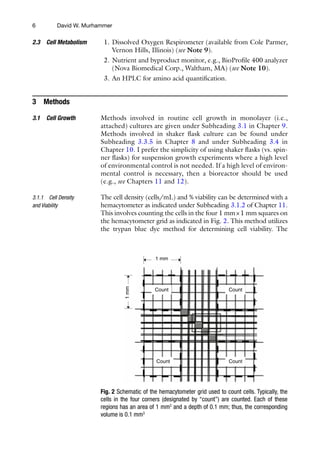
This involves counting the cells in the four 1 mm×1 mm squares on
the hemacytometer grid as indicated in Fig. 2. This method utilizes
the trypan blue dye method for determining cell viability. The
2.3 Cell Metabolism
3.1 Cell Growth
3.1.1 Cell Density
and Viability
1 mm
1
mm
Count
Count
Count
Count
Fig. 2 Schematic of the hemacytometer grid used to count cells. Typically, the
cells in the four corners (designated by “count”) are counted. Each of these
regions has an area of 1 mm2
and a depth of 0.1 mm; thus, the corresponding
volume is 0.1 mm3
David W. Murhammer
7
underlying principle is that the membranes of the dead cells will be
leaky and therefore will readily take up the blue dye and appear blue
under the microscope. In contrast, viable (i.e., live) cells have intact
membranes that will exclude the dye. While trypan blue dye exclu-
sion is commonly referred to as a measure of cell viability, it is more
accurately a measure of membrane integrity. Nonetheless, this is by
far the most commonly used method to determine cell viability due
to its simplicity and the fact that results can be obtained in ~5 min.
The MTT (3-(4,5-­
dimethylthiazolyl-2)-2,5-diphenyltetrazolium
bromide) cell proliferation assay [4] is a more elaborate assay that
can be used to provide a more authentic measure of cell viability.
The principle behind this assay is that the yellow tetrazolium MTT
is reduced by metabolically active cells to produce purple formazan
that can be quantified by spectroscopic methods. MTT cell prolif-
eration assay kits are available through many vendors, e.g., the
American Type Culture Collection (Manassas, VA; http:/
/www.
atcc.org).
I prefer using a Coulter particle counter (see Note 8) and the
trypan blue dye exclusion method for determining the total cell
density and cell viability, respectively. (Unfortunately, the Coulter
particle counter is a relatively expensive piece of equipment that
may be beyond the financial means of some laboratories.) The via-
ble cell density can then be determined by multiplying the total cell
density by the fraction of viable cells. Manufacturer instructions
can be followed to determine cell densities (and mean cell size)
with the Coulter particle counter.
Conducting cell counts in suspension cultures (i.e., spinner
flasks, shaker flask, and bioreactors) is much easier than in attached
cultures (i.e., tissue culture flasks). Specifically, cell samples can be
directly withdrawn from the cultures at the desired times, i.e.,
every 12–24 h, and continued until the cells are at least in the sta-
tionary growth phase (Fig. 1). In contrast, when conducting cell
counts for monolayer cultures, the cells must first be detached
from the growth surface (see Subheading 3.1 in Chapter 9). When
obtaining a growth curve for cells in monolayer culture the follow-
ing procedure should be followed.
1. Equally seed a number of tissue culture flasks equal to the
number of time points at which cell counts will be taken
(see Note 11).
2. Detach cells from one tissue culture flask.
3. Determine the cell density (cells/mL) and viability.
4. Repeat steps 2 and 3 at each time point at which a cell count
is to be taken. There should be a sufficient number of flasks
seeded to obtain a growth curve into the stationary growth
phase (Fig. 1).
Widely Used Techniques
8
A specific example will be used to demonstrate how these parameters
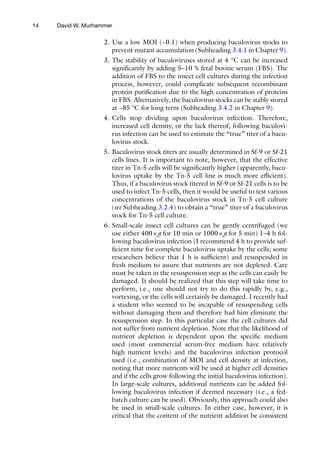
can be determined (Table 1 and Fig. 3).
1. Obtaincelldensity(cells/mL)versustimedata(Subheading3.1.1).
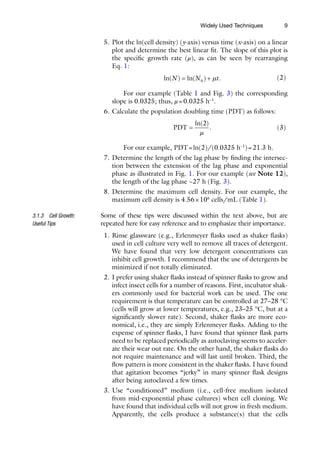
Example data for Sf-9 cell growth is given in Table 1.
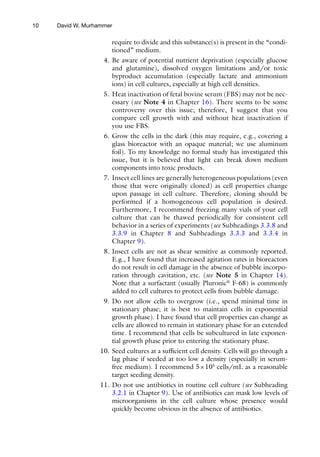
2. Plot the data from step 1 on a semi-log graph (i.e., cell density
on the log scale and time on the linear scale) as shown in Fig. 3
for our example.
3. Find the time range over which exponential phase occurs, i.e.,
where the data are approximately linear on the semilog plot.
For our example shown in Fig. 3, the exponential phase data
occur from 39.0 to 136.5 h.
4. Calculate the natural logarithm (ln) of the exponential phase
cell densities (between 39.0 and 136.5 h for our example).
3.1.2 Evaluating μ, PDT,
Lag Time, and Maximum
Cell Density
Table 1
Cell density versus time data for Sf-9 cell growth in a batch culture
Time (h) Cell density (cells/mL) Time (h) Cell density (cells/mL)
0.0 1.02×10⁵
112.0 1.99×10⁶
16.5 1.06×10⁵
136.5 3.46×10⁶
39.0 1.67×10⁵
159.5 4.32×10⁶
62.5 3.05×10⁵
192.5 4.56×10⁶
88.0 8.37×10⁵
208.0 4.47×10⁶
1.0E+07
1.0E+06
Cell
Density
(Cells/mL)
1.0E+05
1.0E+04
0 25 50 75 100 125
Time (h)
150 175 200 225
Fig. 3 Plot of growth curve data (Sf-9 cells grown in serum-free medium) to find
the location of the exponential growth phase and the length of the lag phase (see
Fig. 1)
David W. Murhammer
9
5. Plot the ln(cell density) (y-axis) versus time (x-axis) on a linear
plot and determine the best linear fit. The slope of this plot is
the specific growth rate (μ), as can be seen by rearranging
Eq. 1:
ln( ) ln( ) .
N N t
= +
0 m (2)
For our example (Table 1 and Fig. 3) the corresponding
slope is 0.0325; thus, μ=0.0325 h−1
.
6. Calculate the population doubling time (PDT) as follows:
PDT =
ln( )
.
2
m
(3)
For our example, PDT=ln(2)/(0.0325 h−1
)=21.3 h.
7. Determine the length of the lag phase by finding the intersec-
tion between the extension of the lag phase and exponential
phase as illustrated in Fig. 1. For our example (see Note 12),
the length of the lag phase ~27 h (Fig. 3).
8. Determine the maximum cell density. For our example, the
maximum cell density is 4.56×10⁶
cells/mL (Table 1).
Some of these tips were discussed within the text above, but are
repeated here for easy reference and to emphasize their importance.
1. Rinse glassware (e.g., Erlenmeyer flasks used as shaker flasks)
used in cell culture very well to remove all traces of detergent.
We have found that very low detergent concentrations can
inhibit cell growth. I recommend that the use of detergents be
minimized if not totally eliminated.
2. I prefer using shaker flasks instead of spinner flasks to grow and
infect insect cells for a number of reasons. First, incubator shak-
ers commonly used for bacterial work can be used. The one
requirement is that temperature can be controlled at 27–28 °C
(cells will grow at lower temperatures, e.g., 23–25 °C, but at a
significantly slower rate). Second, shaker flasks are more eco-
nomical, i.e., they are simply Erlenmeyer flasks. Adding to the
expense of spinner flasks, I have found that spinner flask parts
need to be replaced periodically as autoclaving seems to acceler-
ate their wear out rate. On the other hand, the shaker flasks do
not require maintenance and will last until broken. Third, the
flow pattern is more consistent in the shaker flasks. I have found
that agitation becomes “jerky” in many spinner flask designs
after being autoclaved a few times.
3. Use “conditioned” medium (i.e., cell-free medium isolated
from mid-exponential phase cultures) when cell cloning. We
have found that individual cells will not grow in fresh medium.
Apparently, the cells produce a substance(s) that the cells
3.1.3 Cell Growth:
Useful Tips
Widely Used Techniques
10
require to divide and this substance(s) is present in the “condi-
tioned” medium.
4. Be aware of potential nutrient deprivation (especially glucose
and glutamine), dissolved oxygen limitations and/or toxic
byproduct accumulation (especially lactate and ammonium
ions) in cell cultures, especially at high cell densities.
5. Heat inactivation of fetal bovine serum (FBS) may not be nec-
essary (see Note 4 in Chapter 16). There seems to be some
controversy over this issue; therefore, I suggest that you
compare cell growth with and without heat inactivation if
you use FBS.
6. Grow the cells in the dark (this may require, e.g., covering a
glass bioreactor with an opaque material; we use aluminum
foil). To my knowledge no formal study has investigated this
issue, but it is believed that light can break down medium
components into toxic products.
7. Insect cell lines are generally heterogeneous populations (even
those that were originally cloned) as cell properties change
upon passage in cell culture. Therefore, cloning should be
performed if a homogeneous cell population is desired.
Furthermore, I recommend freezing many vials of your cell
culture that can be thawed periodically for consistent cell
behavior in a series of experiments (see Subheadings 3.3.8 and
3.3.9 in Chapter 8 and Subheadings 3.3.3 and 3.3.4 in
Chapter 9).
8. Insect cells are not as shear sensitive as commonly reported.
E.g., I have found that increased agitation rates in bioreactors
do not result in cell damage in the absence of bubble incorpo-
ration through cavitation, etc. (see Note 5 in Chapter 14).
Note that a surfactant (usually Pluronic®
F-68) is commonly
added to cell cultures to protect cells from bubble damage.
9. Do not allow cells to overgrow (i.e., spend minimal time in
stationary phase; it is best to maintain cells in exponential
growth phase). I have found that cell properties can change as
cells are allowed to remain in stationary phase for an extended
time. I recommend that cells be subcultured in late exponen-
tial growth phase prior to entering the stationary phase.
10. Seed cultures at a sufficient cell density. Cells will go through a
lag phase if seeded at too low a density (especially in serum-­
free medium). I recommend 5×10⁵
cells/mL as a reasonable
target seeding density.
11. Do not use antibiotics in routine cell culture (see Subheading
3.2.1 in Chapter 9). Use of antibiotics can mask low levels of
microorganisms in the cell culture whose presence would
quickly become obvious in the absence of antibiotics.
David W. Murhammer
11
The first step in using the BEVS for producing a recombinant protein
is to construct the recombinant baculovirus (see Chapters 3 and 4
for details). If a pure recombinant protein is desired, then it is rec-
ommended that a baculovirus construct be made that adds a poly-
histidine tail to the protein. The resulting polyhistidine tag has a
strong affinity for binding transition metals. This property can be
used to remove the polyhistidine-containing protein from a mix-
ture of proteins in solution. The polyhistidine tag can then be
enzymatically removed to obtain the purified protein of interest.
Kits are commercially available for purifying these polyhistidine-­
containing recombinant proteins, e.g., the Ni-NTA Purification
System available from Life Technologies (Grand Island, New York).
It is critical that the recombinant baculovirus be pure prior to
its amplification and use in producing the recombinant protein.
Therefore, the baculovirus should be plaque purified as described
under Subheading 3.3 of Chapter 4.
It is recommended that the baculovirus (Subheading 3.2.1) be
amplified in shaker flasks or bioreactors (depending on the amount
of baculovirus stock required). It is critical to use either Sf-9 or
Sf-21 cells for producing baculovirus stocks (Tn-5, while an excel-
lent cell line for producing recombinant proteins, is not well suited
for producing baculovirus stocks) and that these cells are infected
at a relatively low MOI (~0.1) to prevent mutant accumulation
(Subheading 3.4.1 in Chapter 9). Furthermore, it has been found
that the addition of fetal bovine serum (5–10 %) significantly
enhances the stability of baculovirus stocks stored at 4 °C. Under
these conditions the baculovirus is stable for up to ~1 year.
Alternatively, baculovirus stocks can be stored at −85 °C for long
periods (see Subheading 3.4.2 in Chapter 9).
It is critical that an accurate (see Note 13) baculovirus titer (plaque
forming units/mL, PFU/mL; effectively the concentration of
infectious baculovirus particles) is known when infecting insect
cells. The most commonly used methods to determine baculovi-
rus titer are the plaque assay and end point dilution (also referred
to as limiting dilution). Both of these methods directly measure
baculovirus infectivity in cells and therefore provide a measure of
infectious baculovirus concentration. The plaque assay procedure
is described under Subheading 3.5 in Chapter 4. The basic end
point dilution procedure is described under Subheading 3.4 in
Chapter 10. A critical step in this procedure is identifying positive
wells (i.e., wells that contain cells infected by a baculovirus). The
procedure given in Chapter 10 relies on direct identification of
positive wells (which can be difficult for recombinant baculovi-
ruses lacking the polyhedrin gene). Alternative procedures for
identifying positive wells include the use of the anti-gp64 antibody
(Subheading 3.4 in Chapter 5) and the green fluorescent protein
3.2 Baculovirus
Infection
3.2.1 Recombinant
Baculovirus Development
3.2.2 Baculovirus
Amplification
3.2.3 Determining
Baculovirus Titer
Widely Used Techniques
12
(GFP) (Subheading 3.2 in Chapter 22). The anti-gp64 antibody
procedure is based on the principle that the gp64 protein is
expressed on the surface of baculovirus infected cells. The GFP
procedure is based on detecting GFP (this method requires insert-
ing the GFP gene into the baculovirus genome as described under
Subheading 3.1 in Chapter 22) following baculovirus infection.
Another method of tittering baculovirus is through flow cytome-
try following binding of a fluorescent dye to baculovirus DNA (see
Note 20 in Chapter 11). This procedure provides a total baculo-
virus concentration in contrast to the plaque assay and end point
dilution procedures that provide the desired infectious baculovi-
rus concentration.
The baculovirus tittering methods described above can best be
verified by infecting cell cultures at a range of concentrations and
observing cell growth or the lack thereof (see Subheadings 3.2.4
and 3.2.6).
The Poisson distribution [5] expresses the probability of a number
of events occurring during a given time period and can be used to
model the baculovirus infection process. First, the fraction of cells
infected by a specific number of baculovirus particles at a given
MOI can be predicted from
F n
n
n
( )
( ) exp( )
!
,
,MOI
MOI MOI
=
-
(4)
where F(n, MOI) is the fraction of cells infected with n baculovirus
particles when a multiplicity of infection of MOI is used.
The fraction of baculovirus infected cells can be predicted by
subtracting the fraction of uninfected cells (i.e., using n=0 in
Eq. 4) from 1.0:
( )
Fraction of insect cells infected with Baculovirus at a given MOI
= 1
1- -
exp( ).
MOI 
(5)
Some issues to consider when infecting an insect cell culture
include (1) the cell line to use, (2) the cell density at which the cells
should be infected, (3) the MOI to use, and (4) the product har-
vest time.
Sf-9 and Tn-5 are the most commonly used host cell lines
used to express recombinant proteins with the BEVS. It has been
demonstrated that the Tn-5 cell line expresses higher levels of
recombinant proteins in many, but not all, cases [6] and therefore
is usually a good choice for producing recombinant proteins. The
Mimic™ Sf-9 cell line commercially available from Life
Technologies (see Note 14) is a good choice if the recombinant
protein is glycosylated. The reader is also referred to Chapter 6
regarding the wide range of available insect cell lines and Chapter 7
regarding methods to develop new cell lines, as well as Chapter 18
3.2.4 Poisson
Distribution
3.2.5 Infection of Insect
Cell Cultures: Cell Line
Selection
David W. Murhammer
13
regarding cell line modification to improve protein processing.
Finally, Chapter 8 can be consulted regarding selecting an appro-
priate serum-free medium (see Note 15).
The time of infection (i.e., the cell density at infection) and the
MOI are interrelated due to such competing factors as the effect of
MOI on cell growth (see Note 16) and the potential for nutrient
depletion (see Note 2). In small-scale cultures it is almost always
desirable to use an MOI high enough to result in a synchronous
infection. I recommend using an MOI of 10 and infecting the cells
at a density of 1.5–2.0×10⁶
cells/mL. It is critical that the cells be
healthy (viability95 %) and be in exponential growth phase. Note
that the Poisson distribution (Eq. 5) predicts that 99.995 % of the
cells are infected by the primary infection when an MOI of 10 is
used. Therefore, cell density should not increase following infec-
tion at an MOI of 10. If the cell density does increase, then the
titer of the baculovirus stock has likely been overestimated.
In contrast, in large-scale culture it might be desirable to infect
at a low MOI to minimize the volume of required baculovirus stock
that needs to be added. In this case, the uninfected cells will con-
tinue to grow until all of the cells in culture have been infected. The
fraction of cells infected by the primary infection can be predicted
by the Poisson distribution (Eq. 5). For example, the Poisson dis-
tribution predicts that infecting cells at MOIs of 0.1 and 1.0 would
result in approximately 9.5 % and 63.2 % of the cells being infected
by the primary infection, respectively. It is possible that nutrients
may become depleted (dependent upon the specific infection strat-
egy used) and therefore nutrient addition (i.e., a fed-­batch approach)
may be desirable if a significant amount of cell growth occurs fol-
lowing baculovirus addition due to using low MOIs.
The procedures used to infect insect cell cultures to produce
recombinant proteins are given in Chapters 10 and 11 for small-­
scale and large-scale production, respectively.
It is critical that the recombinant protein product be harvested
before degradation by proteases that are either secreted by cells or
released by cells lyzed by the baculovirus infection (this is of par-
ticular importance for secreted proteins). A general guideline is to
harvest the recombinant protein when the cell viability decreases
to 75–80 %, although this should be adapted as appropriate to each
specific case.
Some of these tips were discussed within the text above, but are
repeated here for easy reference and to emphasize their
importance.
1. Baculoviruses should be produced in Sf-9 or Sf-21 cell cultures;
Tn-5 cells should not be used for this purpose.
3.2.6 Infection of Insect
Cell Cultures: Time
of Infection and MOI
3.2.7 Infection of Insect
Cell Cultures: Product
Harvest Time
3.2.8 Baculovirus
Infection: Useful Tips
Widely Used Techniques
14
2. Use a low MOI (~0.1) when producing baculovirus stocks to
prevent mutant accumulation (Subheading 3.4.1 in Chapter 9).
3. The stability of baculoviruses stored at 4 °C can be increased
significantly by adding 5–10 % fetal bovine serum (FBS). The
addition of FBS to the insect cell cultures during the infection
process, however, could complicate subsequent recombinant
protein purification due to the high concentration of proteins
in FBS. Alternatively, the baculovirus stocks can be stably stored
at −85 °C for long term (Subheading 3.4.2 in Chapter 9).
4. Cells stop dividing upon baculovirus infection. Therefore,
increased cell density, or the lack thereof, following baculovi-
rus infection can be used to estimate the “true” titer of a bacu-
lovirus stock.
5. Baculovirus stock titers are usually determined in Sf-9 or Sf-21
cells lines. It is important to note, however, that the effective
titer in Tn-5 cells will be significantly higher (apparently, bacu-
lovirus uptake by the Tn-5 cell line is much more efficient).
Thus, if a baculovirus stock titered in Sf-9 or Sf-21 cells is to be
used to infect Tn-5 cells, then it would be useful to test various
concentrations of the baculovirus stock in Tn-5 cell culture
(see Subheading 3.2.4) to obtain a “true” titer of a baculovirus
stock for Tn-5 cell culture.
6. Small-scale insect cell cultures can be gently centrifuged (we
use either 400×g for 10 min or 1000×g for 5 min) 1–4 h fol-
lowing baculovirus infection (I recommend 4 h to provide suf-
ficient time for complete baculovirus uptake by the cells; some
researchers believe that 1 h is sufficient) and resuspended in
fresh medium to assure that nutrients are not depleted. Care
must be taken in the resuspension step as the cells can easily be
damaged. It should be realized that this step will take time to
perform, i.e., one should not try to do this rapidly by, e.g.,
vortexing, or the cells will certainly be damaged. I recently had
a student who seemed to be incapable of resuspending cells
without damaging them and therefore had him eliminate the
resuspension step. In this particular case the cell cultures did
not suffer from nutrient depletion. Note that the likelihood of
nutrient depletion is dependent upon the specific medium
used (most commercial serum-free medium have relatively
high nutrient levels) and the baculovirus infection protocol
used (i.e., combination of MOI and cell density at infection,
noting that more nutrients will be used at higher cell densities
and if the cells grow following the initial baculovirus infection).
In large-scale cultures, additional nutrients can be added fol-
lowing baculovirus infection if deemed necessary (i.e., a fed-
batch culture can be used). Obviously, this approach could also
be used in small-scale cultures. In either case, however, it is
critical that the content of the nutrient addition be consistent
David W. Murhammer
15
with the cellular needs, which can be determined following
procedures outlined under Subheading 3.3.
7. It is tempting simply to use media with very high levels of
nutrients in order to prevent nutrient depletion. This approach,
however, does not seem to work. For example, increasing the
initial glucose concentration beyond a certain level (I cannot
find any definitive evidence regarding the specific concentra-
tion) does not result in increased maximum cell density prior
to glucose depletion. I suspect that this is due to an increased
glucose consumption rate; furthermore, very high glucose
concentrations may actually be inhibitory. It is certainly no
accident that most commercial insect cell culture media con-
tain maltose (a glucose dimer) in addition to glucose. The
maltose is slowly broken down into glucose as the cells grow,
thereby resulting in a relatively constant glucose concentration
in the medium until all of the maltose is depleted. I suspect
(although I cannot find specific evidence in support) that the
insect cells release an enzyme into the medium that breaks
down the maltose. Finally, it is important to account for the
presence of maltose in the medium when quantifying glucose
utilization rates (Subheading 3.3).
Quantifying cell metabolism is useful for both characterizing cell
behavior (e.g., lactate accumulation is usually indicative of ineffi-
cient use of glucose and for some cell lines, e.g., Sf-9, is indicative
of oxygen deficiency) and for designing media and developing
nutrient feeding strategies. Specific utilization and production
rates are used to quantify nutrient consumption and byproduct
production, respectively.
1. If a dissolved oxygen electrode is being used (e.g., in a bioreac-
tor), then turn off the oxygen supply and record the dissolved
oxygen (DO) concentration as a function of time. Do not
allow the DO concentration to fall below 20 % air saturation
(see Notes 17–19).
2. Plot the DO concentration (y-axis) versus time (x-axis) on lin-
ear axes.
3. Find the slope of the linear portion of the curve obtained in
step 2. The resulting slope represents the volumetric oxygen
utilization rate (OUR).
4. Determine the viable cell density (cells/mL) as described
under Subheading 3.1.1.
5. Calculate the specific OUR by dividing the volumetric OUR
obtained in step 3 by the viable cell density obtained in step 4.
This step requires that the DO concentration in terms of % air
saturation be converted to DO concentration in terms of
moles/L (M). The solubility of oxygen in pure water when air
3.3 Cell Metabolism
3.3.1 Specific Oxygen
Utilization Rate: Using
a Dissolved Oxygen (DO)
Electrode
Widely Used Techniques
16
is in the gas phase at 27 °C is ~0.26 mM [7]. Thus, 100 % air
saturation corresponds to ~0.26 mM oxygen. If desired, cor-
rections can be made for the effect of salts (i.e., actual medium
vs. pure water) in the solution on oxygen solubility [8]; how-
ever, the correction is usually small and can be ignored for
most applications.
6. Example: assume that we find a slope, i.e., a volumetric OUR,
of −2.8 % DO/min from step 3 at a cell density of 2.5×10⁶
cell/mL; the specific OUR can then be calculated:
( )
.
min
min .
Specific OUR
%DO
s
mM
%DO
=
-
æ
è
ç
ö
ø
÷
æ
è
ç
ö
ø
÷
æ
è
ç
ö
2 8
60
0 26
100 ø
ø
÷
æ
è
ç
ö
ø
÷
´
( )( )
= - ´ -
mol L
mM
cells mL mL L
m
/
. / /
.
10
2 5 10 1000
4 9 10
3
6
17
o
ol cell s
-
/
1. If a DO electrode is not present, then a DO monitor can be
used.
2. Remove the appropriate volume of cell suspension from the
culture (appropriate for the DO monitor chamber being used)
and place in the DO monitor chamber.
3. Record the DO concentration as a function of time. Note that
the DO concentration can be monitored to lower DO concen-
trations than in cell culture (Subheading 3.3.1) since the cells
will be discarded when the test is completed and it does not
matter if the cell metabolism is affected.
4. Follow steps 2–5 given under Subheading 3.3.1 to determine
the specific OUR.
As shown below, the methods used to calculate the specific nutri-
ent utilization and byproduct accumulation rates are different dur-
ing exponential growth than when the cell density is constant (i.e.,
in stationary growth phase and in baculovirus infected cultures).
1. Determine the viable cell density (Subheading 3.1.1) and
nutrient (e.g., glucose) and/or byproduct (e.g., lactate ion)
concentration as a function of time in culture (see Note 20).
2. Determine the range of times over which cells are in the expo-
nential phase.
3. Determine the specific growth rate (Subheading 3.1.2).
4. Plot cell density (y-axis) versus component of interest concen-
tration (x-axis) using exponential phase data only and deter-
mine the slope. For a nutrient this slope is referred to cell yield
coefficient.
5. The specific nutrient utilization rate (or specific byproduct
production rate) is then evaluated by dividing the specific
3.3.2 Specific Oxygen
Utilization Rate: Using
a Dissolved Oxygen (DO)
Monitor
3.3.3 Specific Nutrient
Utilization and Byproduct
Accumulation Rates
3.3.4 Specific Rates
During Exponential
Growth Phase
David W. Murhammer
17
growth rate (obtained in step 3) by the slope found in step 4.
Note that a utilization rate will be negative (i.e., nutrient
concentration decreases with time) and a production rate will
be positive (i.e., byproduct concentration increases with time).
6. Example: Consider the data for Sf-9 cell culture given in Table 2.
(a) Plotting ln(cell density) versus time yields a specific
growth rate (μ) of 0.0313 h−1
for the exponential phase
(−72 to 0 h pi). This follows the procedure given under
Subheading 3.1.2 and Fig. 3.
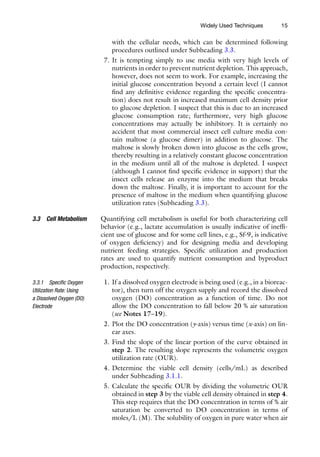
(b) Plot the cell density versus glucose concentration data for
the exponential growth data (for times from −72 to 0 h pi)
as shown in Fig. 4. For our example the slope is
−1.16×10⁵
cells/(mL-mM).
Table 2
Cell density and glucose concentration as a function of time in Sf-9 cell culture. Note that the cells
were allowed to grow 72 h prior to baculovirus infection at an MOI of 10
Time post-infection (h) Viable cell density (cells/mL) Glucose concentration (mM)
−72 2.2×10⁵
48.0
−48 4.8×10⁵
45.5
−24 1.0×10⁶
39.5
0 2.1×10⁶
32.0
24 2.3×10⁶
21.5
48 2.1×10⁶
11.5
72 2.2×10⁶
5.5
3.0E+06
2.0E+06
1.0E+06
0.0E+00
30 40
Glucose Conc. (mM)
50
Cell
Density
(Cells/mL)
Fig. 4 Plot of cell density versus glucose concentration in the exponential phase
for Sf-9 cell culture in serum-free medium. The slope of this curve is used to
determine the specific glucose consumption rate during exponential phase
Widely Used Techniques
18
(c) Calculate the specific utilization rate of glucose as follows:
( )
.
Specific glucose utilization rate
h
h
s
=
( )
æ
è
ç
ö
ø
÷
-
-
0 0313
3600
1
1
.
.
/
/
/
.
16 10 10 1000
7 5 10
5 3
´
æ
è
ç
ö
ø
÷
æ
è
ç
ö
ø
÷( )
= - ´
cells mL
mM
mM
mol L
mL L
-
-17
mol cell s
-
/
This approach should be used for cells in the stationary phase or in
a baculovirus-infected culture in which all the cells have been
infected, i.e., when the cell density is constant.
1. Determine the cell density (Subheading 3.1.1).
2. Determine the component concentration at many different
time points (I recommend at least 3–4 data points with at least
6–8 h between them) (see Note 20).
3. Plot the component concentration (y-axis) versus time and
determine the slope.
4. Calculate the specific utilization rate (or specific production
rate for a byproduct) by dividing the slope determined in step
2 by the cell density.
5. Example: consider the baculovirus infected cell data given in
Table 2 for times ranging from 0 to 72 h pi. Note that this is
an example where the cell density is essentially constant. For
our specific example the mean cell density for the 4 postinfec-
tion data points is 2.2×10⁶
cells/mL.
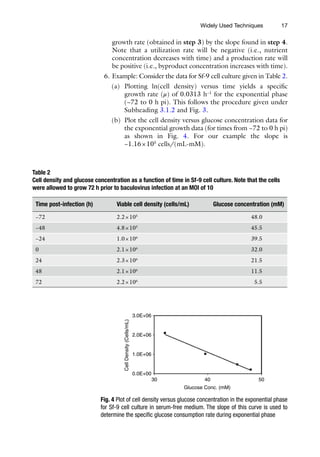
(a) Plot the glucose concentration versus time as given in
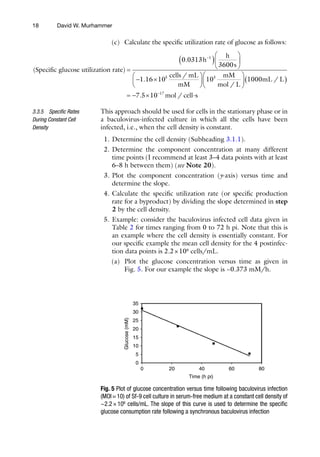
Fig. 5. For our example the slope is −0.373 mM/h.
3.3.5 Specific Rates
During Constant Cell
Density
35
30
25
20
15
Glucose
(mM)
10
5
0
0 20 40
Time (h pi)
60 80
Fig. 5 Plot of glucose concentration versus time following baculovirus infection
(MOI=10) of Sf-9 cell culture in serum-free medium at a constant cell density of
~2.2×10⁶
cells/mL. The slope of this curve is used to determine the specific
glucose consumption rate following a synchronous baculovirus infection
David W. Murhammer
19
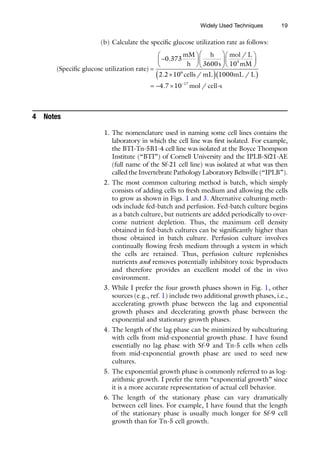
(b) Calculate the specific glucose utilization rate as follows:
( )
.
Specific glucose utilization rate
mM
h
h
s
=
-
æ
è
ç
ö
ø
÷
æ
è
ç
ö
0 373
3600 ø
ø
÷
æ
è
ç
ö
ø
÷
´
( )( )
= - ´ -
mol L
mM
cells mL mL L
m
/
. / /
.
10
2 2 10 1000
4 7 10
3
6
17
o
ol cell s
-
/
4 Notes
1. The nomenclature used in naming some cell lines contains the
laboratory in which the cell line was first isolated. For example,
the BTI-Tn-5B1-4 cell line was isolated at the Boyce Thompson
Institute (“BTI”) of Cornell University and the IPLB-Sf21-AE
(full name of the Sf-21 cell line) was isolated at what was then
calledtheInvertebratePathologyLaboratoryBeltsville(“IPLB”).
2. The most common culturing method is batch, which simply
consists of adding cells to fresh medium and allowing the cells
to grow as shown in Figs. 1 and 3. Alternative culturing meth-
ods include fed-batch and perfusion. Fed-batch culture begins
as a batch culture, but nutrients are added periodically to over-
come nutrient depletion. Thus, the maximum cell density
obtained in fed-batch cultures can be significantly higher than
those obtained in batch culture. Perfusion culture involves
continually flowing fresh medium through a system in which
the cells are retained. Thus, perfusion culture replenishes
nutrients and removes potentially inhibitory toxic byproducts
and therefore provides an excellent model of the in vivo
environment.
3. While I prefer the four growth phases shown in Fig. 1, other
sources (e.g., ref. 1) include two additional growth phases, i.e.,
accelerating growth phase between the lag and exponential
growth phases and decelerating growth phase between the
exponential and stationary growth phases.
4. The length of the lag phase can be minimized by subculturing
with cells from mid-exponential growth phase. I have found
essentially no lag phase with Sf-9 and Tn-5 cells when cells
from mid-exponential growth phase are used to seed new
cultures.
5. The exponential growth phase is commonly referred to as log-
arithmic growth. I prefer the term “exponential growth” since
it is a more accurate representation of actual cell behavior.
6. The length of the stationary phase can vary dramatically
between cell lines. For example, I have found that the length
of the stationary phase is usually much longer for Sf-9 cell
growth than for Tn-5 cell growth.
Widely Used Techniques
20
7. Cells usually enter the stationary phase as a result of running
out of a critical nutrient(s) (e.g., glucose and/or glutamine)
and/or accumulation of toxic byproduct(s) (e.g., lactate and/
or ammonium ions). Furthermore, protein synthesis (some of
which are necessary for cell division) in stationary phase cells is
generally reduced significantly compared to exponential phase
cells. Therefore, stationary phase cells used to seed a new cul-
ture will have to adapt to a completely different environment
(e.g., increased nutrient concentrations) and commence pro-
tein synthesis.
8. Purchase of a Coulter particle counter/sizer is optional since
cell counts can also be obtained through the use of a hemacy-
tometer. However, I prefer using the particle counter to obtain
total cell counts (note that this instruments cannot distinguish
between viable and nonviable cells) and the trypan blue exclu-
sion method to determine cell “viability.” (Note that the try-
pan blue exclusion method is actually a measure of membrane
integrity, but is commonly used as a measure of cell viability
due to its ease of use.) I have found the particle counter to be
more accurate and this instrument also provides the cell size
distribution. The cell size distribution is particularly useful in
monitoring baculovirus infection, i.e., cell size increases as the
baculovirus infection advances.
9. This oxygen monitor is applicable for small-scale cultures, e.g.,
shaker flasks. If a dissolved oxygen electrode is being used
(e.g., in a bioreactor), then the electrode should be used as
described under Subheading 3.3.1.
10. This bioprocess monitor will quantify glucose, lactate, gluta-
mine, glutamate, ammonium, dissolved oxygen, and carbon
dioxide. Furthermore, it will determine the culture pH.
11. It is critical that a given T-flask is only used for cell counts at
one time point since cell growth is significantly disrupted by
the cell detachment process.
12. In our example the long lag phase was probably due to seeding
at too low of a cell density (~105
cells/mL, see Table 1) in
serum-free medium. I would recommend that a seeding density
of at least 5×10⁵
cells/mL be used with serum-free medium.
13. Note that the accuracy of the baculovirus titers should be
viewed from the perspective that the assays are performed on a
log scale (i.e., tenfold dilutions are used) and therefore the
errors on a linear scale may be large. I believe that errors as large
as 40–50 % on a linear scale are not unexpected. Thus, if a
higher level of accuracy is desired, then cells should be infected
at a range of baculovirus concentrations and the titer estimated
by determining how much cells grow following infection
through the use of the Poisson distribution (Subheading 3.2.4).
David W. Murhammer
21
14. The Mimic™ Sf-9 cell line is the same as the SfSWT-1 cell line
developed by the Donald L. Jarvis laboratory. This cell line
­
contains the following mammalian glycosyltransferase genes:
α2,6-sialyltransferase, α2,3-sialyltransferase, β4-galactosyl
transferase, N-acetylglucosaminyltransferase I, and N-acety­
lglucosaminyl­
transferase II. Thus, this cell line has the capabil-
ity to produce recombinant proteins with terminally sialylated
N-glycans that cannot be produced in wild-­
type Sf-9 cells. See
Chapter 18 regarding strategies utilized to produce this and
other modified cell lines that can be used to improve protein
processing.
15. Serum-free medium should be used to produce recombinant
proteins, especially if the protein is secreted, since serum con-
tains large amounts of proteins that increases the difficulty of
obtaining the pure recombinant protein. Furthermore, a bacu-
lovirus vector that adds a polyhistidine tag should be used to
simplify purification (Subheading 3.2.1).
16. When an insect cell is infected with a baculovirus it stops
dividing. Therefore, infecting an insect cell culture at a high
MOI will result in infecting all of the cells in the culture (i.e.,
a synchronous infection) and cell growth will cease (i.e., the
cell density will remain constant until cell death causes a cell
density reduction). Conversely, infecting an insect cell culture
at a low MOI will result in many uninfected cells that will
continue to divide until they are infected by a secondary infec-
tion (i.e., these uninfected cells will be infected by baculovi-
ruses produced by the cells infected by the primary infection);
thus, the overall cell density will increase. These extreme
examples illustrate how the trend in cell density following
baculovirus infection and the Poisson distribution (Eq. 5) can
be utilized to estimate the titer in the baculovirus solution.
17. 100 % air saturation is the concentration of dissolved oxygen in
solution when the solution is in equilibrium with an air (which
contains 21 mole % oxygen) gas phase, i.e., it is the solubility
of oxygen in the aqueous solution under these conditions.
Note that using a pure oxygen gas phase can increase the oxy-
gen solubility by a factor of ~5 (actually 100/21).
18. It is strongly recommended that the dissolved oxygen concen-
tration not be allowed to go below 20 % air saturation when
measuring the oxygen utilization rate after turning off the oxy-
gen supply as this could alter cell metabolism.
19. Determining the oxygen utilization rate by monitoring the dis-
solved oxygen concentration after turning off the oxygen sup-
ply is dependent upon only oxygen within the cell culture
being utilized. Therefore, one must either account for oxygen
being transferred from the headspace (generally not an easy
task) or eliminate oxygen in the head space (e.g., by purging
with nitrogen). I recommend the latter approach.
Widely Used Techniques
22
20. Many of the nutrients and byproducts can be determined using
a bioprofile analyzer by following the manufacturer directions.
Furthermore, an HPLC can be used to determine amino acid
concentrations as described in reference [2].
References
1. Pirt SJ (1975) Principles of microbe and cell cul-
tivation. Wiley, New York
2. Rhiel M, Mitchell-Logean CM, Murhammer
DW (1997) Comparison of Trichoplusia ni BTI-
Tn-5B1-4 (High Five™) and Spodoptera frugi-
perda Sf-9 insect cell line metabolism in
suspension cultures. Biotechnol Bioeng 55:
909–920
3. Schmid G (1996) Insect cell cultivation: growth
and kinetics. Cytotechnology 20:43–56
4. Hansen MB, Nielsen SE, Berg K (1989)
Re-examination and further development of a
precise and rapid dye method for measuring cell
growth/cell kill. J Immunol Methods 119:
203–210
5. Devore JL (2004) Probability and statistics
for engineering and the sciences, 6th edn.
Brooks/Cole – Thomson Learning, Belmont,
CA
6. Davis TR, Wickham TJ, McKenna KA et al
(1993) Comparative recombinant protein pro-
duction of eight insect cell lines. In Vitro Cell
Dev Biol Anim 29:388–390
7. Perry RH, Green DW (eds) (1997) Perry’s
chemical engineers’ handbook, 7th edn.
McGraw-Hill, New York
8. Onda K, Sada E, Kobayashi T et al (1970)
Salting-out parameters of gas solubility in aque-
ous salt solutions. J Chem Eng (Japan)
3:18–24
David W. Murhammer
Part II
Baculovirus Molecular Biology/Development
of Recombinant Baculoviruses
25
David W. Murhammer (ed.), Baculovirus and Insect Cell Expression Protocols, Methods in Molecular Biology,
vol. 1350, DOI 10.1007/978-1-4939-3043-2_2, © Springer Science+Business Media, LLC 2016
Chapter 2
Introduction to Baculovirus Molecular Biology
Barbara J. Kelly, Linda A. King, and Robert D. Possee
Abstract
The development of baculovirus expression vector systems has accompanied a rapid expansion of our
knowledge about the genes, their function and regulation in insect cells. Classification of these viruses has
also been refined as we learn more about differences in gene content between isolates, how this affects
virus structure and their replication in insect larvae. Baculovirus gene expression occurs in an ordered
cascade, regulated by early, late and very late gene promoters. There is now a detailed knowledge of these
promoter elements and how they interact first with host cell-encoded RNA polymerases and later with
virus-encoded enzymes. The composition of this virus RNA polymerase is known. The virus replication
process culminates in the very high level expression of both polyhedrin and p10 gene products in the latter
stages of infection. It has also been realized that the insect host cell has innate defenses against baculovi-
ruses in the form of an apoptotic response to virus invasion. Baculoviruses counter this by encoding
apoptotic-suppressors, which also appear to have a role in determining the host range of the virus. Also of
importance to our understanding of baculovirus expression systems is how the virus can accumulate muta-
tions within genes that affect recombinant protein yield in cell culture. The summary in this chapter is not
exhaustive, but should provide a good preparation to those wishing to use this highly successful gene
expression system.
Key words Baculovirus, Gene expression, Promoters, Insect cells, Virus structure, Virus replication,
Apoptosis
1 Introduction
The last 20 years have seen baculoviruses maintain a reputation for
producing high yields of recombinant proteins in insect cells.
Despite the perceived difficulties of working with a virus in eukary-
otic cells, the fact that posttranslational modifications such as gly-
cosylation, fatty acid acylation, disulphide bond formation, and
phosphorylation are carried out very similar to the same processes
in mammalian cells has convinced many users of the value of bacu-
loviruses as expression vectors. Continuous development of the
system by many groups has seen the early problems of making
recombinant viruses a distant memory. Using baculoviruses as
expression vectors is no longer the preserve of specialist virologists.
26
The many commercial kits now available have brought the system
within the capabilities of any competent molecular biologist. Most
ofthesekitsarebasedontheprototypememberoftheBaculoviridae,
namely Autographa californica multiple nucleopolyhedrovirus
(AcMNPV) and utilize the highly expressed polyhedrin gene pro-
moter. The simplicity of culturing insect cells such as Spodoptera
frugiperda or Trichoplusia ni makes scale up of recombinant pro-
tein production feasible for most laboratories. The problems expe-
rienced with spinner or suspension cultures where shear forces
limited viability have largely been solved with the introduction of
serum-free media allied with antifoam and protective (e.g.,
Pluronic®
F-68) agents. The exploitation of baculoviruses as bio-
safe insecticides has also benefited from the work on expression
vectors and fundamental studies on virus gene function. While
most baculovirus expression vectors lack the original polyhedrin
gene required for making occluded viruses, recombinant virus
insecticides can preserve this process by utilizing nonessential
regions of the virus genome for the insertion of foreign genes
encoding insecticidal proteins.
2 Classification
The Baculoviridae are a family of DNA viruses with circular dou-
ble stranded genomes that only infect arthropods. They are char-
acterized by their ability to occlude virions in a crystalline protein
matrix to form either polyhedra or granules. Viruses forming
polyhedra are known as nucleopolyhedroviruses (NPVs) and
those forming granules as granuloviruses. This subdivision is
based on a number of criteria, including occlusion body mor-
phology and the mechanism by which nucleocapsids are envel-
oped in infected cells [1]. Granuloviruses produce small occlusion
bodies (OBs) (0.16−0.30 μm×0.30−0.50 μm) normally con-
taining one or occasionally two virions encapsulated in a protein
called granulin. Nucleopolyhedroviruses produce larger occlu-
sion bodies (0.5–1.5 μm in diameter) composed of polyhedrin
protein, which contain many virions. The family is divided into
four genera that only infect arthropods. The Alphabaculoviruses
and Betabaculoviruses comprise nucleopolyhedroviruses (NPVs)
and granuloviruses (GVs) that are isolated from Lepidoptera
(butterflies and moths). Figure 1 illustrates an example of each of
these genera. Deltabaculoviruses and Gammabaculoviruses com-
prise NPVs and infect dipteran (flies) and hymenopteran (sawflies)
species, respectively. The NPVs pathogenic for members of the
order Lepidoptera have been further subdivided into groups I
and II based on molecular phylogenies [1, 2]. An occluded virus
also infects the pink shrimp Penaeus monodon [3–5]. Partial
sequence analysis showed that it encodes proteins similar to those
produced by baculoviruses.
Barbara J. Kelly et al.
27
3 Baculovirus Structure
The double stranded, supercoiled, circular DNA genome of
AcMNPV is highly condensed within a nucleocapsid. This con-
densed packaging is facilitated by the core protein p6.9, a 54
amino acid protein rich in arginine [6]. A major protein of the
capsid, vp39, has also been identified. This 39 kDa protein has
been found to be distributed randomly over the surface of the
nucleocapsid [7].
There are two types of baculovirus progeny, budded virus
(BV) and occlusion-derived virus (ODV), which are genetically
identical [8]. However, there are differences in morphology, tim-
ing and cellular site of maturation, structural proteins, source of
viral envelopes, antigenicity, and infectivity [9–13].
BV particles possess spike-like structures known as peplomers,
composed of the glycoprotein GP64 for group I NPVs, at one end
of the virion [14]. The GP64 protein is incorporated throughout
the virus envelope, albeit at lower concentrations than at the
peplomers [14]. During infection, GP64 localizes to discrete areas
of the plasma membrane at which points budding of virions takes
place [15]. Thus, as BV particles bud from the plasma membrane
they acquire a plasma membrane-derived envelope containing the
GP64 glycoprotein.
Granuloviruses and group II NPVs lack GP64 but instead
encode a homolog of another envelope protein, LD130 [16].
While the LD130-encoding baculoviruses do not contain gp64
Fig. 1 Electronmicrographs of Autographa californica multiple nucleopolyhedrovirus (AcMNPV) polyhedron (a)
and Plodia interpunctella granulovirus (PiGV) granules (b). Note the multiple virus particles (vps) in longitudinal
or cross section in AcMNPV, whereas in PiGV each granule contains a single virus particle (vp). Virus particles
are occluded within polyhedrin protein (P) or granulin protein (G). Polyhedra are bounded by an envelope (PE),
which contains protein and carbohydrate. Scale bar is 200 nM
Baculovirus Molecular Biology
28
homologs, those encoding GP64 also contain a version of LD130.
The OpMNPV LD130 homolog was found to be a glycosylated
protein associated with BV particles and the plasma membrane of
cells at similar locations as the GP64 protein [17].
One of the major differences between BV and ODV is that the
latter do not contain GP64 or LD130. Instead a virus-encoded
envelope protein P74 is associated with the outside of the virus
[18, 19]. The presence of P74 on the outside of the virion enve-
lope suggests that it may play a role in ODV attachment to midgut
cells. Another structural protein of the ODV envelope of Spodoptera
littoralis (Spli) NPV has been identified. The gene encoding this
protein was termed per os infectivity factor (pif) and is homologous
to ORF 119 of AcMNPV [20]. A third gene product inferred to
be a structural protein is encoded by pif-2, which was identified in
Spodoptera exigua NPV and is present in AcMNPV as ORF22 [21].
Recent studies have also identified pif-4 [22] and pif-5 [23, 24] as
additional envelope proteins. The PIFs form a complex on the sur-
face of ODV [25].
Other ODV-specific envelope proteins include ODV-E25
[26], ODV-E66 [27], ODV-E56 [28], ODV-E18, and ODV-E35
[29]. These proteins, along with P74, have been found to associate
with intranuclear microvesicle structures, which appear in the
nucleus during infection [29, 30]. This association has led to the
suggestion that these microvesicles play a role in ODV envelop-
ment [27, 28]. Invagination of the inner nuclear membrane
observed during baculovirus infection has raised the possibility
that it may act as the source of the microvesicles [31–33].
Another ODV-specific protein, GP41, has been identified as
an O-linked glycoprotein, predicted to localize to the region
between the virus envelope and the nucleocapsid, an area referred
to as the tegument [34]. Although GP41 is not present in the bud-
ded form of the virus, it has been shown to be required for release
of nucleocapsids from the nucleus during BV production [35]. An
additional protein, ODV-EC27, has been identified as a structural
protein of the ODV envelope and capsid, and may be present in a
modified form in BV [29]. This protein may be a cyclin homolog,
involved in host cell cycle arrest during baculovirus infection [36].
An envelope protein of both BV and ODV has also been identified
(BV/ODV-E26) and found to be associated with intranuclear
microvesicles [37]. A seminal study of protein composition of
ODV was conducted by using a combination of techniques [38].
Screening expression libraries with antibodies generated to ODV
or BV and mass spectroscopic (MS) analysis of ODV protein
extracts identified up to 44 potential components unique to
ODV. This topic was revisited recently when the protein content of
BV was reexamined [39].
The major component of the NPV occlusion body is the
29 kDa polyhedrin protein. While the protein is thought to be small
Barbara J. Kelly et al.
29
enough to diffuse through nuclear pores, a nuclear localization
signal (KRKK) has been identified at amino acids 32–35 [40].
Another region of the protein (amino acids 19–110) is required for
assembly into large occlusion-like particles [40]. The polyhedrin
protein is resistant to solubilization except under strongly alkaline
conditions and functions to shield virions from physical and bio-
chemical decay while outside the insect host, as well as protecting
against proteolytic decay during late stages of infection [41].
Surrounding the polyhedral matrix of a mature occlusion body
is the polyhedron envelope (PE), also known as the polyhedron
membrane or calyx. The PE was originally reported to be com-
posed of carbohydrate [42]; however, a 34 kDa phosphorylated
protein (PP34) has since been found to be covalently bound to the
PE of AcMNPV via a thiol linkage [43]. The polyhedron envelope
is thought to increase the stability of the occlusion body in the
environment and has been found to protect occlusion bodies from
physical stress [43, 44]. A recombinant virus unable to produce
PP34 was found to be deficient in polyhedron envelope formation
and electron dense spacers, which are thought to be precursors of
the envelope structure [44, 45].
Both electron dense spacers and the polyhedron envelope have
been found in association with fibrillar structures composed of the
P10 protein [44, 46]. This protein, like polyhedrin, is produced in
large quantities during the occlusion phase. The association of the
polyhedron envelope with the P10-containing fibrillar structures
suggests a role for the protein in assembly and proper association
of the polyhedron envelope around the occlusion body matrix
[46]. Comparative analysis of P10 protein sequences revealed that
they appear to have an amphipathic alpha-helical terminus that
condenses as coiled-coil multimers [47]. The condensation of P10
monomers to coiled-coil multimers may be a step leading to fibrous
body formation in virus-infected cells.
4 Baculovirus Replication In Vivo
Within a cell, baculoviruses have a biphasic cycle of replication pro-
ducing two structurally distinct viral phenotypes responsible for
specialized functions within the insect host. Occlusion-derived
virus (ODV) initiates the primary infection in the gut epithelial
cells, while budded virus (BV) is responsible for secondary rounds
of infection in the insect host. Infection begins with ingestion of
occlusion bodies by a suitable insect host larval stage, followed by
dissolution of the occlusion body matrix in the alkaline midgut.
Occlusion-derived virus is released from dissolved occlusion bod-
ies, passes through the peritrophic membrane of the midgut and
infects the columnar epithelial cells that border the gut lumen.
It has been suggested that entry occurs by direct membrane fusion,
Baculovirus Molecular Biology
30
involving interaction between virion surface proteins and midgut
cell surface proteins [48]. Removal of P74, PIF1 or PIF2 from
virus particles by deletion of the appropriate gene has been dem-
onstrated to prevent infection of insect larvae via the oral route
[18–21]. Deletion of pifs-3-5 has a similar effect [22–24, 49].
Midgut regenerative cells have also been found to be sites of pri-
mary infection, albeit at a lower frequency than columnar cells
[50]. After replication in the epithelial cells, virus buds in a polar
manner, exiting the basal membrane into the hemolymph, thereby
allowing the infection to spread throughout the insect host. Early
synthesis of the BV envelope fusion protein GP64 seems to allow a
“pass through” strategy for the virus, whereby uncoated virus
nucleocapsids can rapidly exit the newly infected midgut cells to
accelerate the onset of systemic infections [51]. The insect tracheal
system has been identified as the main route used by the virus to
spread from one tissue to another [52]. Efficient BV formation in
AcMNPV requires Ac92 and Ac79 [53, 54].
In addition to enlargement of the nucleus upon baculovirus
infection, cells become rounded due to rearrangement of the cyto-
skeleton. A distinct structure termed the virogenic stroma develops
in the nucleus. This is a chromatin-like network of electron-dense
filaments. It is the predominant structure in the nucleus from 8 to
48 h postinfection (h pi) [55], and is thought to be the site of viral
DNA replication and late gene transcription, as well as nucleocap-
sid formation [56]. Once assembled, nucleocapsids are released
from the nucleus, gaining a nuclear membrane-derived envelope
that is subsequently lost during transit through the cytoplasm. In
the case of group I NPVs, the envelope glycoprotein GP64 local-
izes to discrete areas of the plasma membrane during infection and
it is at these sites that budding of nucleocapsids takes place [15].
The BV envelope is therefore derived from the plasma membrane
and contains the viral glycoprotein GP64. Group II NPVs, and
GVs, encode homologs of the envelope fusion (F) protein LD130
[16], which associate with BV particles, and the plasma membrane
of infected cells, at similar positions to GP64 in group I NPV-
infected cells [17]. These F proteins are functionally analogous to
GP64 since they can restore infectivity to mutant viruses lacking
gp64 [57]. GP64 is essential for cell-to-cell BV transmission, since
AcMNPV particles containing the protein, but not those lacking
the protein, are able to disseminate virus to other cells [58].
Later in infection (~24 h pi), BV production is reduced and
nucleocapsids are transported to sites of intranuclear envelopment
and incorporation into OBs [44]. The source of the ODV enve-
lope is unclear. A number of ODV envelope proteins have been
found to associate with intranuclear microvesicle structures that
appear in the nucleus during infection, thereby suggesting they
may be the source of the envelope [27–29].
Barbara J. Kelly et al.
31
Occlusion bodies accumulate until the terminal stages of infection
when the insect liquefies and the occlusion bodies are released
into the environment. Liquefaction appears to be caused by the
production of both virus-encoded chitinase and cathepsin genes
[59–61] and may also involve the fp25k product [62]. Deletion of
the cathepsin gene from Bombyx mori NPV reduced recombinant
protein degradation in virus-infected insects, presumably because
of the reduction in proteinase activity [63]. Just prior to death
many Lepidopteran species crawl to the top of the vegetation on
which they were feeding and hang from this elevated position,
facilitating dissemination of the virus as the cadaver decomposes
[64]. This enhanced locomotory activity (ELA) may well be virus-
induced, since insects infected with a B. mori NPV mutant lacking
the protein tyrosine phosphatase gene showed dramatically reduced
ELA before death after about 5 days [65]. However, removal of
ecdysteroid glucosyltransferase gene (egt) from a baculovirus was
found to reduce vertical movement of virus-infected insects on
plants [66]. Occlusion bodies serve as survival vehicles for the virus
when outside the insect host, as well as acting as dispersal agents
between individual insects. They may also protect the virus against
proteolytic decay during the end stages of infection [41].
5 Baculovirus Gene Expression and Replication
The complete sequence of AcMNPV clone 6 has been determined.
The original analysis of the 133,894 bp genome suggested that
the virus encodes 154 methionine-initiated, potentially expressed
open reading frames (ORFs) of 150 nucleotides or more [67].
However, resequencing of various regions of the genome and
comparison with other virus isolates has corrected a number of
errors and suggests that AcMNPV may only encode 150 genes.
Other baculoviruses have also been sequenced. An up-to-date
summary of completed genomes is available from the National
Center for Biotechnology Information (NCBI). Baculovirus gene
expression is divided into four temporal phases: immediate-early,
delayed-early, late, and very late, although the first two are often
considered as one. Immediate-early genes are distinguished from
delayed-early by their expression in the absence of de novo protein
synthesis. Expression of delayed-early genes, however, appears to
be dependent on the presence of immediate-early gene products.
Transcription of late genes occurs concurrently with the onset of
viral DNA replication at about 6 h pi. Very late gene transcription
begins at about 20 h pi and involves high levels of expression from
the polyhedrin and p10 promoters, two proteins involved in the
occlusion of virions. While levels of late gene mRNA transcripts
decrease at very late times in infection, very late polyhedrin and
p10 gene transcript levels continue to remain high [68].
Baculovirus Molecular Biology
32
Analysis of the AcMNPV genome has revealed that RNA
transcripts are not clustered according to their temporal expres-
sion. Instead, early and late genes are found distributed through-
out the genome. All AcMNPV RNAs are both 5′ methyl capped
and 3′ polyadenylated [69, 70]. Only one transcript, which is that
of the immediate-early gene ie-1, is known to be spliced [71].
However, transcriptional units involving overlapping RNAs have
been identified in the AcMNPV genome, which may provide an
alternative means of introducing a variety of expression [72, 73].
Overlapping transcripts composed of early and late RNAs with a
common 3′ end have been identified in a number of regions [72,
73]. The HindIII-K fragment of the AcMNPV genome produces
five overlapping RNAs, two immediate-early, one delayed-early,
and two late gene transcripts, transcribed in the same direction and
terminating at a common 3′ end [73]. This arrangement has been
implicated in the temporal regulation of these genes. It has been
suggested that the longer, later 5′ extended transcripts serve to
repress transcription of earlier genes, located downstream, proba-
bly by means of promoter occlusion, as well as acting as mRNAs
for late viral products [73].
The polyhedrin and p10 genes are also transcribed as several
overlapping RNAs. In the case of these two genes, however, tran-
scripts have common 5' ends, with longer RNAs being derived
from read through of termination signals at the 3′ end of the
smaller RNAs [72–74]. Four overlapping transcripts were mapped
to the p10 gene region and were found to comprise two sets: a late
phase pair of transcripts (1100 and 1500 bases) sharing a common
5′ end that are most abundant at 12 h pi and a very late phase pair
(750 and 2500 bases) that also have a common 5′ end and are
most abundant at 24 h pi [74]. Promoter occlusion may also be
operating in this region. Synthesis of earlier transcripts may prevent
RNA polymerase initiation at the p10 promoter located down-
stream. At later times, when transcription from upstream promot-
ers has ceased, RNA polymerase may be able to initiate at the
downstream p10 promoter [74].
Baculovirus early genes are transcribed before the onset of viral
DNA replication. Expression of many early genes begins
immediately after cell infection, with some transcripts, for exam-
ple the anti-apoptotic p35 gene early mRNAs, appearing within
the first 2 h [75]. Genes in this phase of the virus lifecycle are
transcribed by the host RNA polymerase II, as demonstrated by
the fact that early transcription is sensitive to α-amanitin [76], a
compound that binds to and inactivates the large subunit of RNA
polymerase II.
Most early baculovirus promoters contain a TATA element which, as
well as regulating the rate of transcription initiation, also establishes
5.1 Early Gene
Expression
5.1.1 Promoter Elements
Barbara J. Kelly et al.
Discovering Diverse Content Through
Random Scribd Documents
OILS, fixed, dangers of, (see combustion), 406
ONIONS, decoction of, error respecting, II. 246
OPERATION, cæsarian, 226—274
sigaultian, 274—280
OPIUM, sale of, should be regulated, 140—II. 383
poisoning by, II. 142—207
excessive dose of, II. 151
Turkey, II, 384
East Indian, II. 383
eaters, II. 388
symptoms of poisoning by, II. 389
action on the brain, II. 389—390
physiological action of, II. 390
treatment in cases of poisoning by, II. 391
mechanical removal of from the stomach, II. 392
detection of, 394
OPHTHALMIA, feigned, 372
OPTICAL deceptions, II. 247
ORGANIC lesions, and effects of poison, II. 162
ORPIMENT, II. 257
OSSIFICATION, III. 75
OVARIA, absence of, 192—213
essential to puberty, 192
diseased, 213
should be examined, II. 181
examination of the, III. 70
OVERBURY, Sir T. murder of, II. 130—137—222—331
OXALIC acid, II. 315
fatal mistakes of, 141—II. 315
poisoning by, II. 316
tests of, ib.
antidotes to, ib.
OXYGEN, requisite for respiration, II. 34
consumption of, increased by action, II. 34—39
death, by air deprived of, II. 42
OXYGENIZED blood, necessary to life, II. 20
OXFORD, University of, degrees in, 3—17
OXYMURIATIC acid gas, II. 464
P
PAINTER’S colic, II. 355
PALSY, feigned, 362
PAPIST, recusant cannot practice, 15
PARIS, cemeteries of, 95
PARISH Offices, physicians exempt, 18
PARR, old, 172
PARTURITION, 241
questions on, 241
during insensibility, 243
recent, signs of, 251
difficulty of determining, 258
diseases resembling, 254
PASSIONS violent, their effect, II. 26
PASSION, effects of, III. 14
PEEL, Sir Robert, cotton factories, 89
PEINE fort et dure, II. 56
PELVIS, distorted, 272—274
PENETRATION, in rape, 427
PENIS, malformation of, 203
excessive, 204
diminutive, 201
mutilated, 205
paralysis of, 205
PERFORATIONS, gastric, II. 164—III. 62
in the stomach, II. 164
appearance of, II. 175
not always a sign of poison, II. 175
PERICARDIUM, examination of, III. 56
PERSONAL identity, III 8—131—142
PHANTOMS of insanity, 321
PHARMACOPŒIA, 52
PHOSPHATES distinguished from arsenic, II. 241
PHOSPHORUS, II. 202—333
poisoning by, II. 333
PHYSICIAN, profession of, 1
College of, founded, 6
powers of, 23
charter confirmed, 13
College of how to sue, 28
classes of, 52
PICROTOXINE, II. 425
PLAGUE, regulations in time of, 86
contagion of, 95
definition of, 108
authorities on, 108—111—112
contagious, 109
Dr. Maclean on, 110
at Marseilles, ib.
Messina, ib.
ancient authorities on, 111
report of the College on, 113—Appx. 185
in London, 121
source of the, 127
at Malta, 1813, 130
police, 104
PLOMB or asphyxia of privies, 101
PLOUQUET’S test of infanticide, III. 117
POISON, definition of, II. 142
POISONS generally, II. 131
classification of, 199—207
slow, II. 132—143—149—355
vegetable, II. 138—182—366
narcotic, II. 141—154—161—200—203—381
consecutive, II. 147—149
accumulative, II. 148—149—260—355
absolute, II. 150
relative, II. ib.
corrosive, II. 154—200—201
astringent, II. 200—202—336
animal, II. 440
septic, II. 200—204—ib.
aerial, II. 204—456
acrid, II. 200—202—371
mineral, II. 209
mechanical, II. 334
narcotico-acrid, II. 200—203—205
absorption of, II. 208
external application of, II. ib.
effect of on animals, II. 193
of the toad, II. 139
of the lepus marinus, II. 141
of acrid bile, II. 158
of fishes, II. 204
of vipers, II. 442
POISONING, murder by, II. 128
antiquity of, II. 132—138
fables of, II. 136
evidence of, II. 153
questions on, II. 154
by arsenic, II. 216
sublimate, II. 259
antimony, II. 270
copper, II. 291
muriate of tin, II. 295
sulphate of zinc, II. 297
nitrate of silver, II. —
concentrated acids, II. 301
sulphuric acid, II. 303
oxalic acid, II. 316
potass, II. 202—320—322
soda, II. 323
ammonia, II. 324
lime, II. 325
baryta, II. 327
phosphorus, II. 333
lead, II. 353
white hellebore, II. 373
black hellebore, II. 374
fœtid hellebore, II. 375
elaterium, II. 376
colocynth, II. 377
euphorbium, II. 378
savine, II. 378
aconite, II. 380
nitre, II. 381
opium, II. 388
henbane, II. 395
prussic acid, II. 398
nightshade, II. 411
stramonium, II. 414
tobacco, II. 418
hemlock, II. 421
nux vomica, II. 422
mushrooms, II. 428
alcohol, II. 436
fish, II. 451
POISONOUS drugs, sale of, II. 139
proposed regulation, II. 141
fish, II. 449
POITOU, colic of, II. 340—344—346—350
POLICE plague, 104
medical, 138
POPPIES red, mistake arising from, II. 231
POTASS, II. 319
a poison, II. 202—320
carbonate and subcarbonate, effect on sublimate, II. 271
effect on copper, II. 293
arseniate of, effect on copper, II. 293
triple prussiate of, effect on copper, II. 294
subcarbonate of, II. 322
poisoning by, ib.
antidotes to, II. 323
POTASSÆ, liquor, II. 320
tests of, ib.
POTASSA fusa, II. 321
POTASSA cum calce, II. 321
PRACTICE within London and seven miles, confined to College of
Physicians and their Licentiates, 16—41
unlicenced, punishment of, 23—26
action for, 28
what is, 30—35
in the country, 41
PRATIQUE, 128
PREGNANCY, 230
See Gestation.
symptoms of, 233
how to ascertain, 236
mistaken for dropsy, 237
may be coexistent with dropsy, 238
privileges of, 239
feigned, 249
signs on dissection, III. 69
plea of, III. 131—141
PRESCRIPTIONS, 64
PRIAPISM, 205
PRINCE Charles Edward, 223
PRINCES, births of, disputed, ib.
precautions at, ib.
PRISON discipline, 89—II. 113
PRISONERS, death of, II. 111—112
PRIVIES, cleansing, 100
asphixia of, 101
explosion in, ib.
regulation of, 102
in Paris, ib.
gas of, II. 463
infants found in, III. 124
PRECOCITY of talent, 184
PROLAPSUS uteri, 287
feigned, 373
PROTESTANTS, French, charter to, 30
PRUSSIAN blue, nuisance of manufactory, 337
PRUSSIC acid, II. 207—396
spontaneous generation of, II. 162
properties of, II. 397
poisoning by, II. 398
suicide by, II. 399—401
accidents by, II. 399—401—402
physiological action of, II. 404
antidotes, II. 406
test of, II. 408
PTYALISM, extraordinary case of, II. 461
PUBERTY, age of, 170—185
signs of in males, 185
in females, 187
premature, 188
singular case of, 189
how to ascertain, 190
PUERPERAL insanity, III. 129
PUERITIA, 184
PULMONIC test of Infanticide, III. 109
PULVIS successionis, II. 142
PUNCTURES, II. 120
PUNISHMENTS, III. 147
PUTREFACTION, whether capable of generating contagion, 122
nuisances by, 330
as a test of death, II. 3
in cases of poisoning, II. 155—182
signs of in the stomach, II. 181
should not prevent dissection, II. 185
PUTRESCENT animal matter, II. 443
Q
QUARANTINE, 104—127
origin of, 127
laws, 131
vexatious application of, 131
necessity of, 136
QUICKSILVER, see Mercury.
QUO warranto against the President and Censors of the College of
Physicians, 46
QUICK or not, question of, III. 142
R
RANUNCULI, II. 207
RAPE, 416
accusation of, should be immediate, 416
appeal of abolished, 417
in Scotland, 417
immediate medical examination necessary, 417—424
signs of, 417
accuser and accused to be medically examined, 417
false accusation of, 418—426
general observations, 419—424
on the person of an infant, 419
cases of, 420
evidence of infant, 421
male infant under 14 deemed incapable of—sed q., 422
penetration, whether necessary, 427—433
emissio seminis, 427—433
whether Eunuchs can commit, 433
evidence on, 434—439
REALGAR, II. 259
RECOVERY of drowned persons, II. 78
RECTUM, poison inserted into, II. 222—230
examination of the, III. 64
RESEMBLANCE, personal, 220
animal, 221
RESPIRATION, II. 18
artificial, II. 21—78
cessation of, II. 33
utmost suspension of, II. 33
of infants, III. 113
in utero, 224
RESPONSIBILITY, criminal, III. 131
RHEUMATISM, feigned, 358
RICINUS, II. 203
ROYAL Letters, 3
RYE, spurred, poison of, II. 204
S
SAFETY lamp, II. 100
SAFFRON, meadow, II. 207
SALIVATION by sublimate, II. 261
SALT, spirit of, see muriatic acid.
SALT Tax, impolicy of, 90
SANDARACH, mistake of, II. 210
SATURNINE medicines, danger of, II. 359
SAUSAGES, danger of, II. 445
SAVINE, II. 207—378
administering, III. 86—94
SCAMMONY, II. 203
SCHOOLS, diseases in, 90
SCROFULA, hereditary, 173
SEARCHERS, duty of, 144
inadequacy of, 144
SENECTUS, 194
SEPTIC poisons, II. 204—440
SEX, mistaken, 285—286—288
SEXES, equal births of both, 259
SHEEP skins, steeping, a nuisance, 351
SICKNESS, the sweating, 124
SIGAULTIAN operation, 274—280
SIGHT, defective, feigned, 372
SILVER and its compounds, II. 202
nitrate of, II. 207—299
poisoning by, II. 300
tests of, II. 300
SKELETON, examination of the, III. 73
sex of, III. 76
SKULL, examination of, III. 36
SLAUGHTERING in cities, 92
SLAUGHTER houses, nuisance of, 344
SLOW poisoning, II. 145
SMALL pox, exposure of persons with, 86
contagion of, 98
effect of fresh air on, II. 5
SMELTING houses, when nuisances, 338—341
importance of, 342
evidence on, 348
SMOKE, nuisances by, 331—333
modes of diminishing, 335
SMOTHERING, death by, II. 48
SNUFF, dangerous abuse of, II. 419
SOAP boilers, a nuisance, 338
SODA, poisoning by, II. 202—323
tests of, II. 321
SOLEIL, coup de, III. 24—38
SOMNOLENCY, feigned, 359
SPINE, fracture of, III. 44
SPINAL marrow, functions of, II. 20—24
SPIRITS, effects of, II. 434
SPLEEN, ruptured, II. 123—III. 66
SPONTANEOUS combustion (see combustion), 402
SPORADIC fever, 117
SPURRED rye, II. 204
SQUILL, II. 203—207
STABBING, statute of, II. 2
STARCH, manufactories, 332
STARVATION, death by, II. 67—110
cases of, II. 68
voluntary, II. 69
STATUTES, 51. Hen. 3., 375
17. Edw. 2. c. 9., 291
12. Rich. 2. c. 13., 350
9. Hen. 5., 12
3. Hen. 8., 3
5. Hen. 8., 54
14  15. Hen. 8., 12—72
21. Hen. 8. c. 1., 402
22. Hen. 8., II. 128
22. Hen. 8. c. 1., 402
23. Hen. 8., II. 468
32. Hen. 8. c. 38., 18—54—72—169—II. 466
34.  35. Hen. 8., 19—30
37. Hen. 8. c. 26., 402
1. Mary. c. 9., 18—20—26—31
1.  2. Ph.  Ma. c. 8., 169
4.  5. Ph.  Ma. c. 4., 402
1. Edw. 6. c. 12., 402—II. 128
2. Edw. 6. c. 8., 297
2.  3. Edw. 6. c. 23., 169
5.  6. Edw. 6. c. 12., 171
1. Eliz. c. 1., 169
5. Eliz. c. 10., 154
43. Eliz. c. 13., 402
1. Ja. 1. c. 31., 86
1. Ja. 1. c. 8., II. 2
9. Ja. 1. c. 5., 15
21. Ja. 1. c. 21., III. 85
21. Ja. 1. c. 27., III. ib.
22.  23. Car. 2. c. 7., 402
2. Wm.  Ma. sess. 2. c. 8., 336
7.  8. Wm. 3. c. 35., 171
8. Ann. c. 18., 375
10. Ann. c. 19., 171
1. Geo. 1. c. 48., 402
9. Geo. 1. c. 22., 402
10. Geo. 1., 21—40
12. Geo. 1. c. 61., 352
13. Geo. 1., 21
4. Geo. 2. c. 10., 290
18. Geo. 2. c. 15., 54
10. Geo. 2. c. 32., 402
15. Geo. 2. c. 30., 171
22. Geo. 2. c. 2., 155
28. Geo. 2. c. 19., 402
31. Geo. 2. c. 29., 375
31. Geo. 2. c. 42., 402
9. Geo. 3. c. 29., 402
14. Geo. 3. c. 48., 381
14. Geo. 3. c. 49., 304—305
18. Geo. 3. c. 19., 156
26. Geo, 3. c. 60., 131
40. Geo. 3. c. 79., 136
43. Geo. 3. c. 58., III. 58
44. Geo. 3. c. 98., 135
45. Geo. 3. c. 10., 131
45. Geo. 3. c. 92., 156
48. Geo. 3. c. 96., 306
55. Geo. 3., 62
56. Geo. 3. c. 69., 306
57. Geo. 3. c. 22., 345
57. Geo. 3. c. 106., 306
58. Geo. 3. c. 28., 379
58. Geo. 3. c. 56., 379
58. Geo. 3. c. 65., 379
59. Geo. 3. c. 41., 85
59. Geo. 3. c. 127., 306
1. Geo. 4. c. 98., 306
1.  2. Geo. 4. c. 33., 306
STEAM engines, number of, 334
STEEL not blackened by arsenic, II. 250
blackened by corrosive sublimate, II. 250—270
STENCH, noxious, nuisances by, 346
need not be unwholesome, 348
death by, II. 111
STERILITY, 197—212
organic, 212
functional, 214
sympathetic, 215—217
STIFFNESS, cadaverous, II. 13—III. 23
STOMACH, injuries of, by poison, II. 163
changes in, after death, II. 164
solution or digestion of, II. 166—171
vascular appearance of, II. 173
red colour, not always to be attributed to poison, II. 230
suspected to contain arsenic, examination of, II. 254
examination of, for sublimate, II. 274
copper, II. 295
lead, II. 357—365
of infants, examination of, III. 120
examination of the, III. 61
ruptured, III. 63
appearance of, in cases of sudden death, II. 393
STONE, feigned, 366
STRAMONIUM, II. 203—413
poisoning by, II. 414
STRANGULATION, II. 21—24—26—42
death by, II. 46
STRYCHNIA, II. 422
SUBLIMATE, corrosive, II. 141—207
Suleyman, the taker of, II. 151
absorption of, II. 187
effect of on dough, II. 250
blackens steel, II. 250—270
properties of, II. 259
smell of vapour, ib.
poisoning by, ib.
symptoms of a large dose, II. 260
symptoms of small doses, II. 260
salivation by, II. 261
physiological action of, II. 262
antidotes and treatment of, II. 263
action of albumen on, II. 264
gluten on, II. 265
tests for, II. 267
galvanic test, Sylvester’s, II. 268
Archdeacon Wollaston’s, ib.
test by precipitation, II. 269
carbonate of potass, II. 271
subcarbonate of potass, ib.
ammonia, ib.
lime water, ib.
nitrate of tin, II. 272
iodine, II. 272
sublimation, II. 273
mode of detecting, when mixed, II. 273
converted into calomel, II. 273
examination of the stomach for, II. 273
effect of tartarized antimony, II. 274
SUBPŒNA ad testificandum, 154
SUCCESSION, Poudres de, II. 355
SUFFOCATION, II. 32—III. 21—24—36
death by, how produced, II. 32
cases of, II. 49—50—55
by compression, II. 55
by obstruction, II. 57
voluntary, fable of, II. 56
during intoxication, II. 58
SUICIDE, II. 1—104
disputed, III. 20
by idiots or lunatics, II. 105
by an infant, II. 195
forfeiture, II. 106
burial of, II. 108
questions on, III. 32
by drowning, III. 41
SUGILLATIONS to be distinguished from ecchymoses, III. 104
SULEYMAN Yeyen, II. 151
SULPHURIC acid, II. 202—302
poisoning by, II. 303
antidotes to, II. 304
tests of, II. 305
SULPHUROUS acid gas, II. 465
SULPHURETTED hydrogen gas, II. 462
SULPHATE of copper, effect on arsenic, II. 245—291
SULPHURETS of arsenic, II. 257
tests of, II. 258
of mercury, II. 276
SUPERFŒTATION, 247—260
cases of, 261
modern case of, 262
in animals, 266
questions on, 268
circumstances essential to, 269
SUPPOSITITIOUS children, 219
SURGEONS of London, 3
College of, 54
their Charters, 55—57
military and naval, 56
actions against for mala praxis, 88
SURVIVORSHIP, 388
according to the Code Napoleon, 392
case of, chemically determined, III. 25
SUSPENDED animation (see animation), II. 9
SWINE keeping in London a nuisance, 336
SYMPATHY, extraordinary effects of, 363
SYNCOPE, II. 25
from hemorrhage, II. 26
feigned, II. 360
SYNOPSIS of objects of enquiry in cases of sudden death, III. 1
T
TALLOW MELTERS, nuisance of, 944—346
TAN YARDS, when nuisances, 332
TANNIN effect of on arsenic tests, II. 248
TARTAR emetic, II. 204—207—274—279—280
TENANT by the courtesy, 225
TESTICLES necessary to puberty, 192
use of, 197
want of, 198
concealed, ib.
defective, 201—202
wasting of, 202
TESTS, chemical, of arsenic, II. 232
sublimate, II. 267
lead, II. 361
copper, II. 292
nitre, II. 382
THORAX, dissection of, III. 52
TIN and its compounds, II. 202
muriate and oxide of, II. 207
nitrate of, effect on sublimate, II. 272
important use of, II. 290—348
muriate of, poisonous, II. 295
TIPPLE, case of Thomas, II. 117
TOAD, poison of the, II. 139
TOBACCO, II. 414
essential oil of, II. 416
prejudices against, II. 415—416
poisoning by, II. 418
injection of, dangerous, II. ib.
physiological action of, II. 419
difference between the essential oil and infusion of, II. 420
abuse of, II. 88
poison, II. 203—207
TOPHANA, poisons of, II. 134—141
TOXICOLOGY, see Poisons, II. 131
TRADES dangerous, II. 457—III. 8
TRANCES or apparent death, II. 4—6—25
TRAVERSE, right of, in lunacy, 296
by idiot in person, 297
by lunatic, by attorney, ib.
TREAD MILL, III. 147
TREATMENT of persons poisoned by opium, II. 390
TRIUMPH, H. M. S., case on board, II. 460
TURNER and family, case of, II. 216—250—III. 94
TWINS, united, 227
TYPHUS, generation of, 98
causes of, 123
danger of in populous places, 352
U
UMBILICAL cord, see Navel string.
ULCERS, feigned, 372
UNIVERSITIES, 3—5—13—23—24—28—68
UPAS Antiar, II. 207
URINE, vomiting, feigned, 365
bloody, feigned, ib.
incontinence of, feigned, 366
UTERUS examination of the, III. 67
absence of, 192—212
imperforate, 212
polypus in, 213
during gestation, 231
gravid, examination of, 237
double, 265
prolapsus of, 287
necessity of inspecting in doubtful cases of sudden death, II. 181
UTERINUS vagitus, 224
V
VAGINA, adhesions in, 206
imperforate, ib.
obstructed, ib.
malformation of, 207
double, 265—266
state of in virgins, 431
poison introduced into, II. 221
examination of the, III. 72
VAGITUS Uterinus, 224
VAPOUR, noxious, nuisances by, 331
VAPOURS, mercurial, II. 458
noxious, III. 36
VARNISH manufactories, nuisances, 338
VEGETABLE fermentation, a source of nuisance, 332—345
poisons, II. 138—182—366
VENEREAL disease, 88
VENOMOUS animals, II. 440
VENTILATION in jails, importance of, 125
VERATRIA, II. 374
VERDEGRIS, II. 207—288—290
VERMILION, detection of, II. 277
VESALIUS, a Spanish physician, case of, II. 6
VESPA, II. 443
VIABILITE, 243
VIABILITY of infant, III. 100—108
VILLOUS coat of the stomach, separation of, II. 163
VINEGAR, action of on opium, II. 392
on prussic acid, II. 406
VIPERS, II. 440
bite of, II. 441
VIRGINITY, signs of, 424
VIRGINS, corpora lutea in, III. 71
VITERBI case of, II. 69
VITRIOL, white, see Sulphate of Zinc.
oil of, see Sulphuric Acid.
VOMITING blood, feigned, 365
urine feigned, ib.
difficult to excite in cases of poisoning by opium, II. 389—393
W
WADDING, murder detected by the examination of, III. 39
WATCH and WARD, physicians exempt, 18—72
surgeons and apothecaries exempt, 54
WATER, in the stomach or lungs of bodies supposed to have been
drowned, II. 38
boiling, death by, II. 202—316
stagnant, 91
tainting, 330—350—351
WHITING, case of Michael, II. 265
WHITEWASHING infected chambers should be enforced, 142
WILL, incapacity of making a, 293
WINE, action of, II. 434
WINES adulterated with lead, II. 344—345
test of, II. 363
WITNESSES, medical, 153
expenses of, 154
examination of, 158
not privileged, 160
observations on, 161
WOMB and its appendages, III. 69
WOUNDS, classification of, II. 116
examination of, II. 118—III. 45
direction of, II. 119—126
incised, II. 119
gun-shot, II. 124
whether inflicted during life, II. 127—III. 31
whether mortal, III. 30
WOUNDING, murder by, II. 116
Y
YELLOW fever, 109—116—135
Z
ZINC and its compounds, II. 202
sulphate of, II. 207
poisoning by, II. 297
tests of, II. 299
Printed by William Phillips,
George-yard, Lombard-street, London.
APPENDIX
TO
PART I.
STATUTES AND CHARTERS.
STATUTE.
9 Hen. 5.
[Cited by Sir Wm. Browne in his Vindication of the College of
Physicians. Quarto, London 1753.]
Ex Bundello petitionum de ano
. 9o
. H. 5. in Parliamento.
Hey and most mighty prince noble and worthy lords spirituelx and
temporelx and worshipfull comunes, for so moche as a man hath
thre things to governe, that is to say soule, body, and worldly goods,
the which ought and shulde ben principaly reweled by thre sciences,
that ben divinitie, fisyk, and lawe, the soule by divinitie, the body by
fisyk, worldly goods by lawe, and those conynges should be used
and practised principally by the most connyng men in the same
sciences, and most approved in cases necessaries to encrese of
virtue, long life, and gouds of fortune, to the worship of God and
comyn profit.
But worthi soveraines hit is known to your hey discretion, meny
uncunning and unaproved in the aforesaide science practiseth, and
specialy in fysyk, so that in this realme is every man be he never so
lewed taking upon him practice y suffered to use it to grete harm
and slaughtre of many men, where if no man practiced therein but al
only connynge men and approved sufficiently y learned in art,
filosofye, and fysyk, as it is kept in other londes and roialmes ther
shuld many man that dyeth for defaute of helpe lyve, and no man
perish by unconning.
Wherefore pleseth to your excellents wysdomes that ought after
your soule have no entendance to youre body for the causes
abovesaid, to ordaine and make in statute perpetually to be straitly y
used and kept. That no man of no manner, estate, degre, or
condition, practice in fysyk fro this time forward, bot he have long
time y used the scoles of fysyk, having letters testimonialx sufficianty
of on of those degrees in the universite in which he took his degree
in, under payne of long imprisonement and paying XL lb to the king,
and that no woman use the practice of fysyk under the same payne,
and that the sherreffs of every shire make inquisition in their tournes
if there be any that forfaiteth agens this statuit under a payne
reasonable, and thenne that they put this statute in execution
without any favoure under the same payne; also lest that they the
which ben able to practise in fisyk ben excluded fro practise, the
which be not graduated. Pleseth to your hey prudency to send
writtes to all the sherriffs of England, that every practysour in fisyk
not graduated in the same science, that wole practise forth be
wythin on of the universities of this lond by a certain day, that thay
that ben able mowe aftre true and strayt examination be received to
their degree, and that they that be not able to cese fro the practise
into the time they ben able and approved, or for to never more
entermete thereof, and that herto also be y set a peyne convenient.
Dorso.
Responsio hujus petitionis patet in rotulo parliamento dat. 2. dic
maij anno regni regis Henr. 5ti. post conquestum nono.
Rot. Parl. 9. H. 5. p. 1. No
. 11.
Lordinance encontre les entremettours de fysyk et de
Surgerie.
Item pur ouster meschieves et perils qe longement ont continuez
dedains le roialme entre les gentz par my ceux quont usez larts et le
practik de fisik et surgerye pretendantz foi’ bien et sufficeaument
apris de mesmes les arts on de verite non pas estes a grand deceite
a le people. Si est ordeinez et assentuz en ceste parlement qe les
seigneurs du counseil du roy pur le temps esteantz aient poair per
anctoritie de mesme le parlement de faire et mettre tielle ordinaunce
et punissement envers ceux persones qe desore evanant vorrant
entremetter et user le practik des dits arts et ne sont my hables ne
approves en ycelles come app’ent as mesmes les arts cesstasavoir
ceux de fisyk en les universities et les surgeons entre les mestres de
cell arte et ceo come semblera as ditz seigneurs les plus convenables
et necessarie en le cas selonc lour bon advis et discretions pur le
surete de le people.
STATUTE.
3. Hen. 8. c. 11.
An Act for the appointing Physicians and Surgeons.
‘To the King our Sovereign Lord, and to all the Lords Spiritual and
Temporal and Commons in this present Parliament assembled.
Forasmuch as the Science  Cunning of Physick  Surgery (to the
perfect knowlege whereof be requisite both great Learning and ripe
Experience) is daily within this Realm excercised by a great
multitude of ignorant Persons, of whom the great part have no
manner of Insight in the same, nor in any other Kind of Learning;
some also can no Letters on the Book, so far forth, that common
Artificers, as Smiths, Weavers, and Women boldly and accustomably
take upon them great Cures, and Things of great Difficulty, in the
which they partly use Sorcery and Witchcraft, partly apply such
Medicines unto the Disease as be very noious, and nothing meet
therefore, to the high Displeasure of God, great Infamy to the
Faculty, and the grievous Hurt, Damage, and Destruction of many of
the King’s liege People, most especially of them that cannot discern
the uncunning from the cunning:’ Be it therefore (to the Security and
Comfort of all manner People) by the Authority of this present
Parliament enacted, That no Person within the City of London, nor
within Seven Miles of the same, take upon him to exercise and
occupy as a Physician or Surgeon, except he be first examined,
approved, and admitted by the Bishop of London, or by the Dean of
Paul’s, for the time being, calling to him or them Four Doctors of
Welcome to Our Bookstore - The Ultimate Destination for Book Lovers
Are you passionate about books and eager to explore new worlds of
knowledge? At our website, we offer a vast collection of books that
cater to every interest and age group. From classic literature to
specialized publications, self-help books, and children’s stories, we
have it all! Each book is a gateway to new adventures, helping you
expand your knowledge and nourish your soul
Experience Convenient and Enjoyable Book Shopping Our website is more
than just an online bookstore—it’s a bridge connecting readers to the
timeless values of culture and wisdom. With a sleek and user-friendly
interface and a smart search system, you can find your favorite books
quickly and easily. Enjoy special promotions, fast home delivery, and
a seamless shopping experience that saves you time and enhances your
love for reading.
Let us accompany you on the journey of exploring knowledge and
personal growth!
ebookgate.com

Baculovirus and Insect Cell Expression Protocols 3rd Edition David W. Murhammer (Ed.)

  • 1.
    Baculovirus and InsectCell Expression Protocols 3rd Edition David W. Murhammer (Ed.) download https://ebookgate.com/product/baculovirus-and-insect-cell- expression-protocols-3rd-edition-david-w-murhammer-ed/ Get Instant Ebook Downloads – Browse at https://ebookgate.com

  • 2.
    Get Your DigitalFiles Instantly: PDF, ePub, MOBI and More Quick Digital Downloads: PDF, ePub, MOBI and Other Formats Dendritic Cell Protocols 3rd ed. 2016 Edition Elodie Segura https://ebookgate.com/product/dendritic-cell-protocols-3rd- ed-2016-edition-elodie-segura/ Insect Resistance Management Biology Economics and Prediction 2nd Edition David W. Onstad (Eds.) https://ebookgate.com/product/insect-resistance-management- biology-economics-and-prediction-2nd-edition-david-w-onstad-eds/ Cancer Cell Signaling Methods and Protocols 1st Edition. Edition David M. Terrian https://ebookgate.com/product/cancer-cell-signaling-methods-and- protocols-1st-edition-edition-david-m-terrian/ Basic Cell Culture Protocols 3rd Edition Cheryl D. Helgason (Auth.) https://ebookgate.com/product/basic-cell-culture-protocols-3rd- edition-cheryl-d-helgason-auth/
  • 3.
    Cancer Cell SignalingMethods and Protocols 3rd Edition Martha Robles-Flores (Editor) https://ebookgate.com/product/cancer-cell-signaling-methods-and- protocols-3rd-edition-martha-robles-flores-editor/ Human Embryonic Stem Cell Protocols 3rd ed. 2016 Edition Kursad Turksen https://ebookgate.com/product/human-embryonic-stem-cell- protocols-3rd-ed-2016-edition-kursad-turksen/ African Archaeology 3rd Edition David W. Phillipson https://ebookgate.com/product/african-archaeology-3rd-edition- david-w-phillipson/ High Throughput Protein Expression and Purification Methods and Protocols 1st Edition Jim Koehn https://ebookgate.com/product/high-throughput-protein-expression- and-purification-methods-and-protocols-1st-edition-jim-koehn/ Gene Mapping Discovery and Expression Methods and Protocols 1st Edition Minou Bina (Auth.) https://ebookgate.com/product/gene-mapping-discovery-and- expression-methods-and-protocols-1st-edition-minou-bina-auth/
  • 4.
  • 5.
    ME T HO D S I N MO L E C U L A R BI O L O G Y Series Editor John M. Walker School of Life and Medical Sciences University of Hertfordshire Hatfield, Hertfordshire, AL10 9AB, UK For further volumes: http://www.springer.com/series/7651
  • 7.
    Baculovirus and InsectCell Expression Protocols Third Edition Edited by DavidW. Murhammer DepartmentofChemical&BiochemicalEngineering,UniversityofIowa,IowaCity,IA,USA
  • 8.
    Editor David W. Murhammer Departmentof Chemical & Biochemical Engineering University of Iowa Iowa City, IA, USA ISSN 1064-3745 ISSN 1940-6029 (electronic) Methods in Molecular Biology ISBN 978-1-4939-3042-5 ISBN 978-1-4939-3043-2 (eBook) DOI 10.1007/978-1-4939-3043-2 Library of Congress Control Number: 2015952020 Springer New York Heidelberg Dordrecht London © Springer Science+Business Media, LLC 2016 This work is subject to copyright. All rights are reserved by the Publisher, whether the whole or part of the material is concerned, specifically the rights of translation, reprinting, reuse of illustrations, recitation, broadcasting, reproduction on microfilms or in any other physical way, and transmission or information storage and retrieval, electronic adaptation, computer software, or by similar or dissimilar methodology now known or hereafter developed. The use of general descriptive names, registered names, trademarks, service marks, etc. in this publication does not imply, even in the absence of a specific statement, that such names are exempt from the relevant protective laws and regulations and therefore free for general use. The publisher, the authors and the editors are safe to assume that the advice and information in this book are believed to be true and accurate at the date of publication. Neither the publisher nor the authors or the editors give a warranty, express or implied, with respect to the material contained herein or for any errors or omissions that may have been made. Printed on acid-free paper Humana Press is a brand of Springer Springer Science+Business Media LLC New York is part of Springer Science+Business Media (www.springer.com)
  • 9.
    v Baculoviruses, which area group of viruses that infect invertebrates, were first “discovered” in diseased silk worms in the 1500s, although the viral nature of this disease was not demon- strated until 1947. Subsequently, hundreds of other baculoviruses have been discovered. For example, the Autographa californica multiple nucleopolyhedrovirus (AcMNPV) was first isolated from the alfalfa looper (i.e., A. californica) insect species. AcMNPV is the most widely used and best characterized baculovirus and is known to infect many insect species in addition to A. californica, including Spodoptera frugiperda (fall armyworm) and Trichoplusia ni (cabbage looper). Furthermore, AcMNPV is the baculovirus that is usually used to pro- duce recombinant baculoviruses for subsequent recombinant protein synthesis. Shangyin Gao and Thomas Grace independently established the first continuous insect cell lines in the late 1950s and early 1960s. In the 1960s and 1970s insect cell culture was primarily used as a model to study insect metabolism and for the in vitro synthesis of bacu- loviruses for potential use in insect control (i.e., as a biopesticide). The widespread use of insect cell culture, however, did not occur until the baculovirus expression vector system (BEVS) was independently developed in the Max D. Summers and Lois K. Miller laborato- ries in the early 1980s. The BEVS takes advantage of the very strong polyhedrin promoter found in the AcMNPV genome whose natural product (polyhedrin protein) is nonessential in insect cell culture. Thus, the BEVS involves using the polyhedrin promoter to drive for- eign protein expression and provides the means to express high levels of recombinant pro- teins in a relatively short time. Note that there have been many extensions of this basic principle, many of which are described in this book. In brief, some advantages of the BEVS are (1) ease of constructing a recombinant baculovirus (compared to isolating stably trans- formed cells), (2) potentially high expression levels, and (3) the ability of host insect cells to properly process proteins in a manner similar to mammalian cells. Thus, the BEVS pro- vides a recombinant protein expression system intermediate between bacteria (e.g., E. coli) and mammalian cells (e.g., CHO cells) in terms of expression levels, cost, and ability to perform complex protein modifications. The BEVS has become especially popular for small-scale recombinant protein expression in laboratories throughout the world when bio- logically active proteins are required for research applications. Furthermore, the BEVS is becoming a popular choice for producing commercial farm animal and human vaccines. For example, a subunit/marker vaccine against classical swine fever (“Porcilis Pesti”) produced by MSD Animal Health was released in 1998 for vaccinating pigs, a virus-like particle vac- cine against cervical cancer (“Cervarix”) produced by GlaxoSmithKline was released in 2007 for vaccinating human girls, and an annual trivalent flu vaccine (“Flublok”) produced by Protein Sciences was released in 2013 for vaccinating humans. The third edition of Baculovirus and Insect Cell Expression Protocols (the first edition, edited by Christopher D. Richardson, was published in 1995 and the second edition, edited by David W. Murhammer, was published in 2007) was written to provide an updated step- by-step guide to biochemists, molecular biologists, biochemical engineers, and others using the BEVS and/or insect cells for producing recombinant proteins. Furthermore, the third edition of Baculovirus and Insect Cell Expression Protocols will provide assistance to scientists Preface
  • 10.
    vi and engineers interestedin developing and producing baculovirus insecticides. In both of these cases the procedures involved in producing products at laboratory scale and large scale will be discussed, as well as production in insect larvae. The third edition of Baculovirus and Insect Cell Expression Protocols is divided into seven parts. The first part, entitled “Introduction,” contains one chapter that serves as an overview of the major techniques discussed in detail elsewhere in the book. Furthermore, this chapter provides step-by-step procedures involved in quantifying cell growth, baculo- virus infection, and cell metabolism. It is strongly recommended that this chapter be read prior to reading your specific chapter(s) of interest. The second part, entitled “Baculovirus molecular biology/development of recombinant baculoviruses,” contains three chapters that give an overview of baculovirus molecular biology and methods involved in construct- ing and isolating recombinant baculoviruses. Moreover, this part contains another chapter thatdiscussesusingmodifiedbaculovirusestoexpressgenesinmammaliancells(“BacMam”). The third part, entitled “Insect cell culture,” contains four chapters that list currently avail- able insect cell lines, methods to isolate new cell lines and develop your own serum-free medium, and routine maintenance and storage of insect cell lines and baculoviruses. The fourth part, entitled “Protein production with recombinant baculoviruses,” contains four chapters that discuss small- and large-scale recombinant protein production with the BEVS in both insect and mammalian cell culture and in insect larvae. The other two chapters in this part discuss the large-scale production of virus-like particles and an alternative approach to expressing multicomponent protein complexes. The fifth part, entitled “Recombinant protein production with transformed insect cells,” contains a chapter that discusses meth- ods involved in developing stably transformed insect cells for expressing recombinant pro- teins directly from the insect cell genome, another chapter about improving the protein processing capabilities of host insect cells for use with the BEVS, and a chapter about using Drosophila cell lines, which provide an alternative to the lepidopteran insect cell lines used with the BEVS. The sixth part, entitled “Baculovirus development and production for use as insecticides,” contains three chapters about the use, production, and characterization of baculoviruses (both wild type and recombinant) for use as biopesticides. The seventh part, entitled “Miscellaneous techniques and applications of the baculovirus/insect cell system,” contains three chapters that discuss the use of green fluorescent protein, tubular reactors, and RNAi for research applications. The other two chapters discuss the application of the baculovirus/insect cell system to study apoptosis and generating envelop-modified baculo- virus for gene delivery into mammalian cells. The third edition of Baculovirus and Insect Cell Expression Protocols provides the detailed steps required to perform the techniques involved with the use of baculoviruses and insect cell culture and discusses problems that may be encountered. It is hoped that this book will not only aid the user in successfully completing the tasks described herein but also stimulate the development of improved techniques and new applications of baculoviruses and insect cell culture. The editor would like to thank the 39 contributors for their excellent submissions and the Series Editor, John Walker, for his guidance throughout the process of producing this book. Furthermore, a special thanks to Katie Schnedler for her assistance in converting figures into the proper format. Iowa City, IA, USA David W. Murhammer Preface
  • 11.
    vii Contents Preface. . .. . . . . . . . . . . . . . . . . . . . . . . . . . . . . . . . . . . . . . . . . . . . . . . . . . . . . . . v Contributors. . . . . . . . . . . . . . . . . . . . . . . . . . . . . . . . . . . . . . . . . . . . . . . . . . . . . . . . . . xi PART I INTRODUCTION 1 Useful Tips, Widely Used Techniques, and Quantifying Cell Metabolic Behavior . . . . . . . . . . . . . . . . . . . . . . . . . . . . . . . . . . . . . . . . . 3 David W. Murhammer PART II BACULOVIRUS MOLECULAR BIOLOGY/DEVELOPMENT OF RECOMBINANT BACULOVIRUSES 2 Introduction to Baculovirus Molecular Biology. . . . . . . . . . . . . . . . . . . . . . . . 25 Barbara J. Kelly, Linda A. King, and Robert D. Possee 3 Baculovirus Transfer Vectors . . . . . . . . . . . . . . . . . . . . . . . . . . . . . . . . . . . . . . 51 Robert D. Possee and Linda A. King 4 Recombinant Baculovirus Isolation . . . . . . . . . . . . . . . . . . . . . . . . . . . . . . . . . 73 Linda A. King, Richard Hitchman, and Robert D. Possee 5 Gene Expression in Mammalian Cells Using BacMam, a Modified Baculovirus System . . . . . . . . . . . . . . . . . . . . . . . . . . . . . . . . . . . . 95 James A. Fornwald, Quinn Lu, Frederick M. Boyce, and Robert S. Ames PART III INSECT CELL CULTURE 6 Available Lepidopteran Insect Cell Lines . . . . . . . . . . . . . . . . . . . . . . . . . . . . . 119 Dwight E. Lynn and Robert L. Harrison 7 Lepidopteran Insect Cell Line Isolation from Insect Tissue . . . . . . . . . . . . . . . 143 Dwight E. Lynn 8 Development of Serum-Free Media for Lepidopteran Insect Cell Lines . . . . . . 161 Leslie C.L. Chan and Steven Reid 9 Routine Maintenance and Storage of Lepidopteran Insect Cell Lines and Baculoviruses . . . . . . . . . . . . . . . . . . . . . . . . . . . . . . . . . . . . . . . . . . . . . . 197 Dwight E. Lynn and Robert L. Harrison PART IV PROTEIN PRODUCTION WITH RECOMBINANT BACULOVIRUSES 10 Small-Scale Production of Recombinant Proteins Using the Baculovirus Expression Vector System . . . . . . . . . . . . . . . . . . . . . . . . . . . . . . . . . . . . . . . . 225 Jian-Ping Yang 11 Recombinant Protein Production in Large-Scale Agitated Bioreactors Using the Baculovirus Expression Vector System. . . . . . . . . . . . . . . . . . . . . . . 241 Christine M. Thompson, Johnny Montes, Marc G. Aucoin, and Amine A. Kamen
  • 12.
    viii 12 Protein Expressionin Insect and Mammalian Cells Using Baculoviruses in Wave Bioreactors. . . . . . . . . . . . . . . . . . . . . . . . . . . . . . . . . . . . . . . . . . . . . 263 Sue H. Kadwell and Laurie K. Overton 13 Protein Production with Recombinant Baculoviruses in Lepidopteran Larvae . . . . . . . . . . . . . . . . . . . . . . . . . . . . . . . . . . . . . . . . . . 285 Elena Kovaleva and David C. Davis 14 Production of Virus-Like Particles for Vaccination. . . . . . . . . . . . . . . . . . . . . . 299 Christine M. Thompson, Marc G. Aucoin, and Amine A. Kamen 15 Alternative Strategies for Expressing Multicomponent Protein Complexes in Insect Cells . . . . . . . . . . . . . . . . . . . . . . . . . . . . . . . . . . . . . . . . 317 Stephanie Chen PART V RECOMBINANT PROTEIN PRODUCTION WITH TRANSFORMED INSECT CELLS 16 Transforming Lepidopteran Insect Cells for Continuous Recombinant Protein Expression . . . . . . . . . . . . . . . . . . . . . . . . . . . . . . . . . . . . . . . . . . . . . 329 Robert L. Harrison and Donald L. Jarvis 17 Stable Drosophila Cell Lines: An Alternative Approach to Exogenous Protein Expression . . . . . . . . . . . . . . . . . . . . . . . . . . . . . . . . . . 349 Marija Backovic and Thomas Krey 18 Transforming Lepidopteran Insect Cells for Improved Protein Processing and Expression. . . . . . . . . . . . . . . . . . . . . . . . . . . . . . . . . . . . . . . . 359 Robert L. Harrison and Donald L. Jarvis PART VI BACULOVIRUS DEVELOPMENT AND PRODUCTION FOR USE AS INSECTICIDES 19 Introduction to the Use of Baculoviruses as Biological Insecticides . . . . . . . . . 383 Holly J.R. Popham, Tyasning Nusawardani, and Bryony C. Bonning 20 Baculovirus Insecticide Production in Insect Larvae . . . . . . . . . . . . . . . . . . . . 393 Nikolai van Beek and David C. Davis 21 Evaluation of the Insecticidal Efficacy of Wild Type and Recombinant Baculoviruses . . . . . . . . . . . . . . . . . . . . . . . . . . . . . . . . . . . 407 Holly J.R. Popham, Mark R. Ellersieck, Huarong Li, and Bryony C. Bonning PART VII MISCELLANEOUS TECHNIQUES AND APPLICATIONS OF THE BACULOVIRUS/INSECT CELL SYSTEM 22 Evaluating Baculovirus Infection Using Green Fluorescent Protein and Variants . . . . . . . . . . . . . . . . . . . . . . . . . . . . . . . . . . . . . . . . . . . . 447 Hsuan-Chen Wu, Hyung Joon Cha, and William E. Bentley 23 Tubular Bioreactor for Probing Baculovirus Infection and Protein Production. . . . . . . . . . . . . . . . . . . . . . . . . . . . . . . . . . . . . . . . . . 461 Hsuan-Chen Wu, Yu-Chen Hu, and William E. Bentley Contents
  • 13.
    ix 24 Gene Silencingin Insect Cells Using RNAi . . . . . . . . . . . . . . . . . . . . . . . . . . . 469 Hsuan-Chen Wu, John C. March, and William E. Bentley 25 Using the Baculovirus/Insect Cell System to Study Apoptosis. . . . . . . . . . . . . 477 Nor Chejanovsky 26 Generation of Envelope-Modified Baculoviruses for Gene Delivery into Mammalian Cells . . . . . . . . . . . . . . . . . . . . . . . . . . . . . . . . . . . . 491 Christian Hofmann Index . . . . . . . . . . . . . . . . . . . . . . . . . . . . . . . . . . . . . . . . . . . . . . . . . . . . . . . . . . . . . . . 505 Contents
  • 15.
    xi Contributors ROBERT S. AMES• Platform Technology and Science GlaxoSmithKline, Collegeville, PA, USA MARC G. AUCOIN • Department of Chemical Engineering, University of Waterloo, Waterloo, Canada MARIJA BACKOVIC • Unité de Virologie Structurale, Département de Virologie and CNRS Unité Mixte de Recherche, Institut Pasteur, Paris, France NIKOLAI VAN BEEK • Kenya Biologics Ltd, Thika, Kenya WILLIAM E. BENTLEY • Fischell Department of Bioengineering, University of Maryland, College Park, MD, USA; Institute for Bioscience and Biotechnology Research, University of Maryland, College Park, MD, USA BRYONY C. BONNING • Department of Entomology, Iowa State University, Ames, IA, USA FREDERICK M. BOYCE • Department of Neurology, Massachusetts General Hospital, Harvard Medical School, Boston, MA, USA HYUNG JOON CHA • Department of Chemical Engineering, Pohang University of Science and Technology, Pohang, Korea LESLIE C.L. CHAN • Patheon Biologics, 37 Kent Street, Brisbane, QLD 4102, Australia NOR CHEJANOVSKY • Entomology Department, Institute of Plant Protection, The Volcani Center, Bet Dagan, Israel STEPHANIE CHEN • Biological Sciences, GlaxoSmithKline, Collegeville, PA, USA DAVID C. DAVIS • Frontier Agricultural Sciences, Newark, DE, USA MARK R. ELLERSIECK • Department of Statistics, University of Missouri, Columbia, MO, USA JAMES A. FORNWALD • Platform Technology and Science GlaxoSmithKline, Collegeville, PA, USA ROBERT L. HARRISON • USDA/ARS Insect Biocontrol Laboratory, Beltsville, MD, USA RICHARD HITCHMAN • School of Biological and Molecular Sciences, Oxford Brookes University, Oxford, UK CHRISTIAN HOFMANN • Roche Pharma AG, Grenzach-Wyhlen, Germany YU-CHEN HU • Department of Biochemical Science and Technology, National Taiwan University, Taipei, Taiwan DONALD L. JARVIS • Department of Molecular Biology, University of Wyoming, Laramie, WY, USA SUE H. KADWELL • Department of Biological Sciences, Molecular Discovery Research, Platform Technology and Science, GlaxoSmithKline, Research Triangle Park, NC, USA AMINE A. KAMEN • Department of Bioengineering, McGill University, Montreal, Canada; National Research Council Canada, Montreal, Canada BARBARA J. KELLY • The Moyne Institute of Preventive Medicine, Trinity College, Dublin, Ireland LINDA A. KING • School of Biological and Molecular Sciences, Oxford Brookes University, Oxford, UK ELENA KOVALEVA • Harris IT Services-NIH/NHBLI, Bethesda, MD, USA THOMAS KREY • Unité de Virologie Structurale, Département de Virologie and CNRS Unité Mixte de Recherche, Institut Pasteur, Paris, France
  • 16.
    xii HUARONG LI •Dow AgroSciences Discovery Research, Dow AgroSciences, Indianapolis, IN, USA QUINN LU • Platform Technology and Science GlaxoSmithKline, Collegeville, PA, USA DWIGHT E. LYNN • INSell Consulting, Newcastle, ME, USA JOHN C. MARCH • Department of Biological and Environmental Engineering, Cornell University, Ithaca, NY, USA JOHNNY MONTES • National Research Council Canada, Montreal, Canada DAVID W. MURHAMMER • Department of Chemical and Biochemical Engineering, The University of Iowa, Iowa City, IA, USA TYASNING NUSAWARDANI • Department of Entomology, Iowa State University, Ames, IA, USA LAURIE K. OVERTON • Department of Biological Sciences, Molecular Discovery Research, Platform Technology and Science, GlaxoSmithKline, Research Triangle Park, NC, USA HOLLY J.R. POPHAM • USDA Agricultural Research Service, Biological Control of Insects Research Laboratory, Columbia, MO, USA; AgBiTech, Columbia, MO, USA ROBERT D. POSSEE • NERC CEH (Oxford), Oxford, UK STEVEN REID • Australian Institute for Bioengineering and Nanotechnology, The University of Queensland, St. Lucia, QLD, Australia CHRISTINE M. THOMPSON • Department of Chemical Engineering, Ecole Polytechnique de Montreal 2500, Chemin de Polytechnique, Montreal, Canada; National Research Council Canada, Montreal, Canada HSUAN-CHEN WU • Department of Biochemical Science and Technology, National Taiwan University, Taipei, USA; Institute for Bioscience and Biotechnology Research, University of Maryland, College Park, MD, USA JIAN-PING YANG • Synthetic Biology, Life Science Solution, ThermoFisher Scientific, Carlsbad, CA, USA Contributors
  • 17.
  • 19.
    3 David W. Murhammer(ed.), Baculovirus and Insect Cell Expression Protocols, Methods in Molecular Biology, vol. 1350, DOI 10.1007/978-1-4939-3043-2_1, © Springer Science+Business Media, LLC 2016 Chapter 1 Useful Tips, Widely Used Techniques, and Quantifying Cell Metabolic Behavior David W. Murhammer Abstract The insect cell culture/baculovirus system has three primary applications: (1) recombinant protein synthesis, (2) biopesticide synthesis, and (3) as a model system (e.g., for studying apoptosis). The fundamental tech- niques involved in these applications are described throughout this book. In this chapter the most widely used techniques are summarized and the reader is directed to detailed information found elsewhere in this book. Furthermore, many useful tips and my personal preferences that are rarely published are discussed in this chapter along with quantitative methods to characterize cell growth, baculovirus infection, and metabolism. Key words Cell growth, Baculovirus infection, Population doubling time, Exponential growth, Cell metabolism, Specific utilization rates, Specific production rates 1 Introduction The most commonly used lepidopteran insect cell lines are isolates from Spodoptera frugiperda (Sf-9 and Sf-21) and Trichoplusia ni (Tn-5, which is commonly known as BTI-Tn-5B1-4 and is com- mercially known as High Five™ cells (Invitrogen); see Note 1). See Chapter 6 for an extensive list of available insect cell lines and Chapter 7 for methods involved in new cell line development. The Sf-9, Sf-21, and Tn-5 cells grow optimally at 27–28 °C and do not require CO2 (due to the buffer system used in the medium). Thus, temperature is the only parameter that needs to be controlled in incubators used to grow these cells. Following subculture, insect cells in batch culture (see Note 2) proceed through the typical growth phases [1] (see Note 3 and Fig. 1): (1) lag phase (see Note 4), (2) exponential growth phase (see Note 5), (3) stationary phase (see Note 6), and (4) decline (or death) phase. The lag phase is the time period between sub- culturing and the exponential growth phase in which the cell growth rate reaches its maximum. Lag phase is usually caused by 1.1 Cell Growth
  • 20.
    4 an environmental change,e.g., using cells from the stationary phase to start a new culture [1] (see Note 7). During the station- ary phase the net growth rate is zero, i.e., the cell growth rate is not necessarily zero, but it is equal to the cell death rate. Finally, during the decline phase the cell death rate exceeds the cell growth rate and the viable cell number declines. The major parameters that are used to characterize cell growth are specific growth rate (μ), population doubling time (PDT), lag time, and maximum cell density. All of these parame- ters are functions of the specific cell line and growth environment (dissolved oxygen concentration, nutrient concentrations, temper- ature, pH, etc.). Furthermore, % cell viability is a measure of cell quality. Typical ranges of μ and PDT are 0.029–0.035 h−1 and 20–24 h, respectively, for the Sf-9, Sf-21, and Tn-5 cell lines [2]. The lag phase can be eliminated by using cells from the exponen- tial growth phase (see Note 4). Finally, the maximum cell density in batch culture varies considerably depending upon the cell line and the medium composition, and can exceed 107 cells/mL in some cases [3]. Additional details about these parameters are given under Subheading 3.1. Cell growth during the exponential growth phase can be rep- resented by N N t = 0 exp( ), m (1) where N=cell density (cells/mL) at a given time t, N0 =cell density (cells/mL) at time t=0, μ=specific growth rate (h−1 ), and t=time in culture (h). Stationary Phase Decline Phase Exponential Phase Lag Phase L Log (viable cell density) Time Fig.1A typical cell growth curve (cell density vs.time) showing the lag,exponential, stationary, and decline phases. The length of the lag phase (L) can be found by extending the lag and exponential phase lines and finding the time at which they intersect (as shown) David W. Murhammer
  • 21.
    5 Insect cells areinfected with either a recombinant baculovirus (see Chapter 4) to produce a recombinant protein or with a wild-type baculovirus to produce biopesticides (recombinant baculovirus can also be used as biopesticides, see Chapters 19 and 21). In all of these cases it is critical that a high quality baculovirus (i.e., a pure baculo- virus absent of mutants, see Subheading 3.2) and healthy cells (i.e., viability>95 %) in exponential growth be used. The most impor- tant parameter involved in baculovirus infection is the multiplicity of infection (MOI), which is the ratio of infectious baculovirus par- ticles to cells. Details about the MOI and other important issues involved in baculovirus infection are given under Subheading 3.2. Cell metabolism involves characterizing how cells grow, utilize nutrients, and produce products and byproducts. Cell growth, as indicated under Subheadings 1.1 and 3.1, can be characterized by μ, PDT, lag time, and maximum cell density. Other parame- ters that can be used to characterize cell metabolism are specific utilization (for nutrients) and specific production (for byproducts) rates. For example, we found the specific utilization rates for glucose in uninfected Sf-9 and Tn-5 cells to be −2.4 × 10⁻¹⁷ and −2.8 × 10⁻¹⁷ mol/cell-s (the negative sign in indicative of con- sumption that results in a reducing the glucose concentration), respectively [2]. Furthermore, it was found that Sf-9 cells did not produce measurable amounts of lactate and ammonium ions when sufficient dissolved oxygen (DO) was present. In contrast, the uninfected Tn-5 cells produced lactate and ammonium ions at rates of 0.7 × 10⁻¹⁷ and 5.1 × 10⁻¹⁷ mol/cell-s, respectively, when sufficient DO was present. Both the Sf-9 and Tn-5 cells produced alanine (another common byproduct in insect cell cul- ture) at rates of 1.1 × 10⁻¹⁷ and 1.5 × 10⁻¹⁷ mol/cell-s, respec- tively. Information about other specific uptake and production rates in these cell lines, both in uninfected and infected cells, can be found in Rhiel et al. [2]. Details about evaluating these parameters are given under Subheading 3.3. 2 Materials 1. Supplies and equipment listed in Chapters 9 and 10 for small-­ scale cultures or Chapters 11 and 12 for large-scale culture. 2. Coulter particle counter/sizer (Beckman Coulter, Inc., Fullerton, CA) (see Note 8). 1. Supplies and equipment listed in Chapter 10 for small-scale cultures or Chapters 11 and 12 for large-scale culture. 2. Coulter particle counter/sizer (Beckman Coulter, Inc., Fullerton, CA) (see Note 8). 1.2 Baculovirus Infection 1.3 Cell Metabolism 2.1 Cell Growth 2.2 Baculovirus Infection Widely Used Techniques
  • 22.
    6 1. Dissolved OxygenRespirometer (available from Cole Parmer, Vernon Hills, Illinois) (see Note 9). 2. Nutrient and byproduct monitor, e.g., BioProfile 400 analyzer (Nova Biomedical Corp., Waltham, MA) (see Note 10). 3. An HPLC for amino acid quantification. 3 Methods Methods involved in routine cell growth in monolayer (i.e., attached) cultures are given under Subheading 3.1 in Chapter 9. Methods involved in shaker flask culture can be found under Subheading 3.3.5 in Chapter 8 and under Subheading 3.4 in Chapter 10. I prefer the simplicity of using shaker flasks (vs. spin- ner flasks) for suspension growth experiments where a high level of environmental control is not needed. If a high level of environ- mental control is necessary, then a bioreactor should be used (e.g., see Chapters 11 and 12). The cell density (cells/mL) and % viability can be determined with a hemacytometer as indicated under Subheading 3.1.2 of Chapter 11. This involves counting the cells in the four 1 mm×1 mm squares on the hemacytometer grid as indicated in Fig. 2. This method utilizes the trypan blue dye method for determining cell viability. The 2.3 Cell Metabolism 3.1 Cell Growth 3.1.1 Cell Density and Viability 1 mm 1 mm Count Count Count Count Fig. 2 Schematic of the hemacytometer grid used to count cells. Typically, the cells in the four corners (designated by “count”) are counted. Each of these regions has an area of 1 mm2 and a depth of 0.1 mm; thus, the corresponding volume is 0.1 mm3 David W. Murhammer
  • 23.
    7 underlying principle isthat the membranes of the dead cells will be leaky and therefore will readily take up the blue dye and appear blue under the microscope. In contrast, viable (i.e., live) cells have intact membranes that will exclude the dye. While trypan blue dye exclu- sion is commonly referred to as a measure of cell viability, it is more accurately a measure of membrane integrity. Nonetheless, this is by far the most commonly used method to determine cell viability due to its simplicity and the fact that results can be obtained in ~5 min. The MTT (3-(4,5-­ dimethylthiazolyl-2)-2,5-diphenyltetrazolium bromide) cell proliferation assay [4] is a more elaborate assay that can be used to provide a more authentic measure of cell viability. The principle behind this assay is that the yellow tetrazolium MTT is reduced by metabolically active cells to produce purple formazan that can be quantified by spectroscopic methods. MTT cell prolif- eration assay kits are available through many vendors, e.g., the American Type Culture Collection (Manassas, VA; http:/ /www. atcc.org). I prefer using a Coulter particle counter (see Note 8) and the trypan blue dye exclusion method for determining the total cell density and cell viability, respectively. (Unfortunately, the Coulter particle counter is a relatively expensive piece of equipment that may be beyond the financial means of some laboratories.) The via- ble cell density can then be determined by multiplying the total cell density by the fraction of viable cells. Manufacturer instructions can be followed to determine cell densities (and mean cell size) with the Coulter particle counter. Conducting cell counts in suspension cultures (i.e., spinner flasks, shaker flask, and bioreactors) is much easier than in attached cultures (i.e., tissue culture flasks). Specifically, cell samples can be directly withdrawn from the cultures at the desired times, i.e., every 12–24 h, and continued until the cells are at least in the sta- tionary growth phase (Fig. 1). In contrast, when conducting cell counts for monolayer cultures, the cells must first be detached from the growth surface (see Subheading 3.1 in Chapter 9). When obtaining a growth curve for cells in monolayer culture the follow- ing procedure should be followed. 1. Equally seed a number of tissue culture flasks equal to the number of time points at which cell counts will be taken (see Note 11). 2. Detach cells from one tissue culture flask. 3. Determine the cell density (cells/mL) and viability. 4. Repeat steps 2 and 3 at each time point at which a cell count is to be taken. There should be a sufficient number of flasks seeded to obtain a growth curve into the stationary growth phase (Fig. 1). Widely Used Techniques
  • 24.
    8 A specific examplewill be used to demonstrate how these parameters can be determined (Table 1 and Fig. 3). 1. Obtaincelldensity(cells/mL)versustimedata(Subheading3.1.1). Example data for Sf-9 cell growth is given in Table 1. 2. Plot the data from step 1 on a semi-log graph (i.e., cell density on the log scale and time on the linear scale) as shown in Fig. 3 for our example. 3. Find the time range over which exponential phase occurs, i.e., where the data are approximately linear on the semilog plot. For our example shown in Fig. 3, the exponential phase data occur from 39.0 to 136.5 h. 4. Calculate the natural logarithm (ln) of the exponential phase cell densities (between 39.0 and 136.5 h for our example). 3.1.2 Evaluating μ, PDT, Lag Time, and Maximum Cell Density Table 1 Cell density versus time data for Sf-9 cell growth in a batch culture Time (h) Cell density (cells/mL) Time (h) Cell density (cells/mL) 0.0 1.02×10⁵ 112.0 1.99×10⁶ 16.5 1.06×10⁵ 136.5 3.46×10⁶ 39.0 1.67×10⁵ 159.5 4.32×10⁶ 62.5 3.05×10⁵ 192.5 4.56×10⁶ 88.0 8.37×10⁵ 208.0 4.47×10⁶ 1.0E+07 1.0E+06 Cell Density (Cells/mL) 1.0E+05 1.0E+04 0 25 50 75 100 125 Time (h) 150 175 200 225 Fig. 3 Plot of growth curve data (Sf-9 cells grown in serum-free medium) to find the location of the exponential growth phase and the length of the lag phase (see Fig. 1) David W. Murhammer
  • 25.
    9 5. Plot theln(cell density) (y-axis) versus time (x-axis) on a linear plot and determine the best linear fit. The slope of this plot is the specific growth rate (μ), as can be seen by rearranging Eq. 1: ln( ) ln( ) . N N t = + 0 m (2) For our example (Table 1 and Fig. 3) the corresponding slope is 0.0325; thus, μ=0.0325 h−1 . 6. Calculate the population doubling time (PDT) as follows: PDT = ln( ) . 2 m (3) For our example, PDT=ln(2)/(0.0325 h−1 )=21.3 h. 7. Determine the length of the lag phase by finding the intersec- tion between the extension of the lag phase and exponential phase as illustrated in Fig. 1. For our example (see Note 12), the length of the lag phase ~27 h (Fig. 3). 8. Determine the maximum cell density. For our example, the maximum cell density is 4.56×10⁶ cells/mL (Table 1). Some of these tips were discussed within the text above, but are repeated here for easy reference and to emphasize their importance. 1. Rinse glassware (e.g., Erlenmeyer flasks used as shaker flasks) used in cell culture very well to remove all traces of detergent. We have found that very low detergent concentrations can inhibit cell growth. I recommend that the use of detergents be minimized if not totally eliminated. 2. I prefer using shaker flasks instead of spinner flasks to grow and infect insect cells for a number of reasons. First, incubator shak- ers commonly used for bacterial work can be used. The one requirement is that temperature can be controlled at 27–28 °C (cells will grow at lower temperatures, e.g., 23–25 °C, but at a significantly slower rate). Second, shaker flasks are more eco- nomical, i.e., they are simply Erlenmeyer flasks. Adding to the expense of spinner flasks, I have found that spinner flask parts need to be replaced periodically as autoclaving seems to acceler- ate their wear out rate. On the other hand, the shaker flasks do not require maintenance and will last until broken. Third, the flow pattern is more consistent in the shaker flasks. I have found that agitation becomes “jerky” in many spinner flask designs after being autoclaved a few times. 3. Use “conditioned” medium (i.e., cell-free medium isolated from mid-exponential phase cultures) when cell cloning. We have found that individual cells will not grow in fresh medium. Apparently, the cells produce a substance(s) that the cells 3.1.3 Cell Growth: Useful Tips Widely Used Techniques
  • 26.
    10 require to divideand this substance(s) is present in the “condi- tioned” medium. 4. Be aware of potential nutrient deprivation (especially glucose and glutamine), dissolved oxygen limitations and/or toxic byproduct accumulation (especially lactate and ammonium ions) in cell cultures, especially at high cell densities. 5. Heat inactivation of fetal bovine serum (FBS) may not be nec- essary (see Note 4 in Chapter 16). There seems to be some controversy over this issue; therefore, I suggest that you compare cell growth with and without heat inactivation if you use FBS. 6. Grow the cells in the dark (this may require, e.g., covering a glass bioreactor with an opaque material; we use aluminum foil). To my knowledge no formal study has investigated this issue, but it is believed that light can break down medium components into toxic products. 7. Insect cell lines are generally heterogeneous populations (even those that were originally cloned) as cell properties change upon passage in cell culture. Therefore, cloning should be performed if a homogeneous cell population is desired. Furthermore, I recommend freezing many vials of your cell culture that can be thawed periodically for consistent cell behavior in a series of experiments (see Subheadings 3.3.8 and 3.3.9 in Chapter 8 and Subheadings 3.3.3 and 3.3.4 in Chapter 9). 8. Insect cells are not as shear sensitive as commonly reported. E.g., I have found that increased agitation rates in bioreactors do not result in cell damage in the absence of bubble incorpo- ration through cavitation, etc. (see Note 5 in Chapter 14). Note that a surfactant (usually Pluronic® F-68) is commonly added to cell cultures to protect cells from bubble damage. 9. Do not allow cells to overgrow (i.e., spend minimal time in stationary phase; it is best to maintain cells in exponential growth phase). I have found that cell properties can change as cells are allowed to remain in stationary phase for an extended time. I recommend that cells be subcultured in late exponen- tial growth phase prior to entering the stationary phase. 10. Seed cultures at a sufficient cell density. Cells will go through a lag phase if seeded at too low a density (especially in serum-­ free medium). I recommend 5×10⁵ cells/mL as a reasonable target seeding density. 11. Do not use antibiotics in routine cell culture (see Subheading 3.2.1 in Chapter 9). Use of antibiotics can mask low levels of microorganisms in the cell culture whose presence would quickly become obvious in the absence of antibiotics. David W. Murhammer
  • 27.
    11 The first stepin using the BEVS for producing a recombinant protein is to construct the recombinant baculovirus (see Chapters 3 and 4 for details). If a pure recombinant protein is desired, then it is rec- ommended that a baculovirus construct be made that adds a poly- histidine tail to the protein. The resulting polyhistidine tag has a strong affinity for binding transition metals. This property can be used to remove the polyhistidine-containing protein from a mix- ture of proteins in solution. The polyhistidine tag can then be enzymatically removed to obtain the purified protein of interest. Kits are commercially available for purifying these polyhistidine-­ containing recombinant proteins, e.g., the Ni-NTA Purification System available from Life Technologies (Grand Island, New York). It is critical that the recombinant baculovirus be pure prior to its amplification and use in producing the recombinant protein. Therefore, the baculovirus should be plaque purified as described under Subheading 3.3 of Chapter 4. It is recommended that the baculovirus (Subheading 3.2.1) be amplified in shaker flasks or bioreactors (depending on the amount of baculovirus stock required). It is critical to use either Sf-9 or Sf-21 cells for producing baculovirus stocks (Tn-5, while an excel- lent cell line for producing recombinant proteins, is not well suited for producing baculovirus stocks) and that these cells are infected at a relatively low MOI (~0.1) to prevent mutant accumulation (Subheading 3.4.1 in Chapter 9). Furthermore, it has been found that the addition of fetal bovine serum (5–10 %) significantly enhances the stability of baculovirus stocks stored at 4 °C. Under these conditions the baculovirus is stable for up to ~1 year. Alternatively, baculovirus stocks can be stored at −85 °C for long periods (see Subheading 3.4.2 in Chapter 9). It is critical that an accurate (see Note 13) baculovirus titer (plaque forming units/mL, PFU/mL; effectively the concentration of infectious baculovirus particles) is known when infecting insect cells. The most commonly used methods to determine baculovi- rus titer are the plaque assay and end point dilution (also referred to as limiting dilution). Both of these methods directly measure baculovirus infectivity in cells and therefore provide a measure of infectious baculovirus concentration. The plaque assay procedure is described under Subheading 3.5 in Chapter 4. The basic end point dilution procedure is described under Subheading 3.4 in Chapter 10. A critical step in this procedure is identifying positive wells (i.e., wells that contain cells infected by a baculovirus). The procedure given in Chapter 10 relies on direct identification of positive wells (which can be difficult for recombinant baculovi- ruses lacking the polyhedrin gene). Alternative procedures for identifying positive wells include the use of the anti-gp64 antibody (Subheading 3.4 in Chapter 5) and the green fluorescent protein 3.2 Baculovirus Infection 3.2.1 Recombinant Baculovirus Development 3.2.2 Baculovirus Amplification 3.2.3 Determining Baculovirus Titer Widely Used Techniques
  • 28.
    12 (GFP) (Subheading 3.2in Chapter 22). The anti-gp64 antibody procedure is based on the principle that the gp64 protein is expressed on the surface of baculovirus infected cells. The GFP procedure is based on detecting GFP (this method requires insert- ing the GFP gene into the baculovirus genome as described under Subheading 3.1 in Chapter 22) following baculovirus infection. Another method of tittering baculovirus is through flow cytome- try following binding of a fluorescent dye to baculovirus DNA (see Note 20 in Chapter 11). This procedure provides a total baculo- virus concentration in contrast to the plaque assay and end point dilution procedures that provide the desired infectious baculovi- rus concentration. The baculovirus tittering methods described above can best be verified by infecting cell cultures at a range of concentrations and observing cell growth or the lack thereof (see Subheadings 3.2.4 and 3.2.6). The Poisson distribution [5] expresses the probability of a number of events occurring during a given time period and can be used to model the baculovirus infection process. First, the fraction of cells infected by a specific number of baculovirus particles at a given MOI can be predicted from F n n n ( ) ( ) exp( ) ! , ,MOI MOI MOI = - (4) where F(n, MOI) is the fraction of cells infected with n baculovirus particles when a multiplicity of infection of MOI is used. The fraction of baculovirus infected cells can be predicted by subtracting the fraction of uninfected cells (i.e., using n=0 in Eq. 4) from 1.0: ( ) Fraction of insect cells infected with Baculovirus at a given MOI = 1 1- - exp( ). MOI (5) Some issues to consider when infecting an insect cell culture include (1) the cell line to use, (2) the cell density at which the cells should be infected, (3) the MOI to use, and (4) the product har- vest time. Sf-9 and Tn-5 are the most commonly used host cell lines used to express recombinant proteins with the BEVS. It has been demonstrated that the Tn-5 cell line expresses higher levels of recombinant proteins in many, but not all, cases [6] and therefore is usually a good choice for producing recombinant proteins. The Mimic™ Sf-9 cell line commercially available from Life Technologies (see Note 14) is a good choice if the recombinant protein is glycosylated. The reader is also referred to Chapter 6 regarding the wide range of available insect cell lines and Chapter 7 regarding methods to develop new cell lines, as well as Chapter 18 3.2.4 Poisson Distribution 3.2.5 Infection of Insect Cell Cultures: Cell Line Selection David W. Murhammer
  • 29.
    13 regarding cell linemodification to improve protein processing. Finally, Chapter 8 can be consulted regarding selecting an appro- priate serum-free medium (see Note 15). The time of infection (i.e., the cell density at infection) and the MOI are interrelated due to such competing factors as the effect of MOI on cell growth (see Note 16) and the potential for nutrient depletion (see Note 2). In small-scale cultures it is almost always desirable to use an MOI high enough to result in a synchronous infection. I recommend using an MOI of 10 and infecting the cells at a density of 1.5–2.0×10⁶ cells/mL. It is critical that the cells be healthy (viability95 %) and be in exponential growth phase. Note that the Poisson distribution (Eq. 5) predicts that 99.995 % of the cells are infected by the primary infection when an MOI of 10 is used. Therefore, cell density should not increase following infec- tion at an MOI of 10. If the cell density does increase, then the titer of the baculovirus stock has likely been overestimated. In contrast, in large-scale culture it might be desirable to infect at a low MOI to minimize the volume of required baculovirus stock that needs to be added. In this case, the uninfected cells will con- tinue to grow until all of the cells in culture have been infected. The fraction of cells infected by the primary infection can be predicted by the Poisson distribution (Eq. 5). For example, the Poisson dis- tribution predicts that infecting cells at MOIs of 0.1 and 1.0 would result in approximately 9.5 % and 63.2 % of the cells being infected by the primary infection, respectively. It is possible that nutrients may become depleted (dependent upon the specific infection strat- egy used) and therefore nutrient addition (i.e., a fed-­batch approach) may be desirable if a significant amount of cell growth occurs fol- lowing baculovirus addition due to using low MOIs. The procedures used to infect insect cell cultures to produce recombinant proteins are given in Chapters 10 and 11 for small-­ scale and large-scale production, respectively. It is critical that the recombinant protein product be harvested before degradation by proteases that are either secreted by cells or released by cells lyzed by the baculovirus infection (this is of par- ticular importance for secreted proteins). A general guideline is to harvest the recombinant protein when the cell viability decreases to 75–80 %, although this should be adapted as appropriate to each specific case. Some of these tips were discussed within the text above, but are repeated here for easy reference and to emphasize their importance. 1. Baculoviruses should be produced in Sf-9 or Sf-21 cell cultures; Tn-5 cells should not be used for this purpose. 3.2.6 Infection of Insect Cell Cultures: Time of Infection and MOI 3.2.7 Infection of Insect Cell Cultures: Product Harvest Time 3.2.8 Baculovirus Infection: Useful Tips Widely Used Techniques
  • 30.
    14 2. Use alow MOI (~0.1) when producing baculovirus stocks to prevent mutant accumulation (Subheading 3.4.1 in Chapter 9). 3. The stability of baculoviruses stored at 4 °C can be increased significantly by adding 5–10 % fetal bovine serum (FBS). The addition of FBS to the insect cell cultures during the infection process, however, could complicate subsequent recombinant protein purification due to the high concentration of proteins in FBS. Alternatively, the baculovirus stocks can be stably stored at −85 °C for long term (Subheading 3.4.2 in Chapter 9). 4. Cells stop dividing upon baculovirus infection. Therefore, increased cell density, or the lack thereof, following baculovi- rus infection can be used to estimate the “true” titer of a bacu- lovirus stock. 5. Baculovirus stock titers are usually determined in Sf-9 or Sf-21 cells lines. It is important to note, however, that the effective titer in Tn-5 cells will be significantly higher (apparently, bacu- lovirus uptake by the Tn-5 cell line is much more efficient). Thus, if a baculovirus stock titered in Sf-9 or Sf-21 cells is to be used to infect Tn-5 cells, then it would be useful to test various concentrations of the baculovirus stock in Tn-5 cell culture (see Subheading 3.2.4) to obtain a “true” titer of a baculovirus stock for Tn-5 cell culture. 6. Small-scale insect cell cultures can be gently centrifuged (we use either 400×g for 10 min or 1000×g for 5 min) 1–4 h fol- lowing baculovirus infection (I recommend 4 h to provide suf- ficient time for complete baculovirus uptake by the cells; some researchers believe that 1 h is sufficient) and resuspended in fresh medium to assure that nutrients are not depleted. Care must be taken in the resuspension step as the cells can easily be damaged. It should be realized that this step will take time to perform, i.e., one should not try to do this rapidly by, e.g., vortexing, or the cells will certainly be damaged. I recently had a student who seemed to be incapable of resuspending cells without damaging them and therefore had him eliminate the resuspension step. In this particular case the cell cultures did not suffer from nutrient depletion. Note that the likelihood of nutrient depletion is dependent upon the specific medium used (most commercial serum-free medium have relatively high nutrient levels) and the baculovirus infection protocol used (i.e., combination of MOI and cell density at infection, noting that more nutrients will be used at higher cell densities and if the cells grow following the initial baculovirus infection). In large-scale cultures, additional nutrients can be added fol- lowing baculovirus infection if deemed necessary (i.e., a fed- batch culture can be used). Obviously, this approach could also be used in small-scale cultures. In either case, however, it is critical that the content of the nutrient addition be consistent David W. Murhammer
  • 31.
    15 with the cellularneeds, which can be determined following procedures outlined under Subheading 3.3. 7. It is tempting simply to use media with very high levels of nutrients in order to prevent nutrient depletion. This approach, however, does not seem to work. For example, increasing the initial glucose concentration beyond a certain level (I cannot find any definitive evidence regarding the specific concentra- tion) does not result in increased maximum cell density prior to glucose depletion. I suspect that this is due to an increased glucose consumption rate; furthermore, very high glucose concentrations may actually be inhibitory. It is certainly no accident that most commercial insect cell culture media con- tain maltose (a glucose dimer) in addition to glucose. The maltose is slowly broken down into glucose as the cells grow, thereby resulting in a relatively constant glucose concentration in the medium until all of the maltose is depleted. I suspect (although I cannot find specific evidence in support) that the insect cells release an enzyme into the medium that breaks down the maltose. Finally, it is important to account for the presence of maltose in the medium when quantifying glucose utilization rates (Subheading 3.3). Quantifying cell metabolism is useful for both characterizing cell behavior (e.g., lactate accumulation is usually indicative of ineffi- cient use of glucose and for some cell lines, e.g., Sf-9, is indicative of oxygen deficiency) and for designing media and developing nutrient feeding strategies. Specific utilization and production rates are used to quantify nutrient consumption and byproduct production, respectively. 1. If a dissolved oxygen electrode is being used (e.g., in a bioreac- tor), then turn off the oxygen supply and record the dissolved oxygen (DO) concentration as a function of time. Do not allow the DO concentration to fall below 20 % air saturation (see Notes 17–19). 2. Plot the DO concentration (y-axis) versus time (x-axis) on lin- ear axes. 3. Find the slope of the linear portion of the curve obtained in step 2. The resulting slope represents the volumetric oxygen utilization rate (OUR). 4. Determine the viable cell density (cells/mL) as described under Subheading 3.1.1. 5. Calculate the specific OUR by dividing the volumetric OUR obtained in step 3 by the viable cell density obtained in step 4. This step requires that the DO concentration in terms of % air saturation be converted to DO concentration in terms of moles/L (M). The solubility of oxygen in pure water when air 3.3 Cell Metabolism 3.3.1 Specific Oxygen Utilization Rate: Using a Dissolved Oxygen (DO) Electrode Widely Used Techniques
  • 32.
    16 is in thegas phase at 27 °C is ~0.26 mM [7]. Thus, 100 % air saturation corresponds to ~0.26 mM oxygen. If desired, cor- rections can be made for the effect of salts (i.e., actual medium vs. pure water) in the solution on oxygen solubility [8]; how- ever, the correction is usually small and can be ignored for most applications. 6. Example: assume that we find a slope, i.e., a volumetric OUR, of −2.8 % DO/min from step 3 at a cell density of 2.5×10⁶ cell/mL; the specific OUR can then be calculated: ( ) . min min . Specific OUR %DO s mM %DO = - æ è ç ö ø ÷ æ è ç ö ø ÷ æ è ç ö 2 8 60 0 26 100 ø ø ÷ æ è ç ö ø ÷ ´ ( )( ) = - ´ - mol L mM cells mL mL L m / . / / . 10 2 5 10 1000 4 9 10 3 6 17 o ol cell s - / 1. If a DO electrode is not present, then a DO monitor can be used. 2. Remove the appropriate volume of cell suspension from the culture (appropriate for the DO monitor chamber being used) and place in the DO monitor chamber. 3. Record the DO concentration as a function of time. Note that the DO concentration can be monitored to lower DO concen- trations than in cell culture (Subheading 3.3.1) since the cells will be discarded when the test is completed and it does not matter if the cell metabolism is affected. 4. Follow steps 2–5 given under Subheading 3.3.1 to determine the specific OUR. As shown below, the methods used to calculate the specific nutri- ent utilization and byproduct accumulation rates are different dur- ing exponential growth than when the cell density is constant (i.e., in stationary growth phase and in baculovirus infected cultures). 1. Determine the viable cell density (Subheading 3.1.1) and nutrient (e.g., glucose) and/or byproduct (e.g., lactate ion) concentration as a function of time in culture (see Note 20). 2. Determine the range of times over which cells are in the expo- nential phase. 3. Determine the specific growth rate (Subheading 3.1.2). 4. Plot cell density (y-axis) versus component of interest concen- tration (x-axis) using exponential phase data only and deter- mine the slope. For a nutrient this slope is referred to cell yield coefficient. 5. The specific nutrient utilization rate (or specific byproduct production rate) is then evaluated by dividing the specific 3.3.2 Specific Oxygen Utilization Rate: Using a Dissolved Oxygen (DO) Monitor 3.3.3 Specific Nutrient Utilization and Byproduct Accumulation Rates 3.3.4 Specific Rates During Exponential Growth Phase David W. Murhammer
  • 33.
    17 growth rate (obtainedin step 3) by the slope found in step 4. Note that a utilization rate will be negative (i.e., nutrient concentration decreases with time) and a production rate will be positive (i.e., byproduct concentration increases with time). 6. Example: Consider the data for Sf-9 cell culture given in Table 2. (a) Plotting ln(cell density) versus time yields a specific growth rate (μ) of 0.0313 h−1 for the exponential phase (−72 to 0 h pi). This follows the procedure given under Subheading 3.1.2 and Fig. 3. (b) Plot the cell density versus glucose concentration data for the exponential growth data (for times from −72 to 0 h pi) as shown in Fig. 4. For our example the slope is −1.16×10⁵ cells/(mL-mM). Table 2 Cell density and glucose concentration as a function of time in Sf-9 cell culture. Note that the cells were allowed to grow 72 h prior to baculovirus infection at an MOI of 10 Time post-infection (h) Viable cell density (cells/mL) Glucose concentration (mM) −72 2.2×10⁵ 48.0 −48 4.8×10⁵ 45.5 −24 1.0×10⁶ 39.5 0 2.1×10⁶ 32.0 24 2.3×10⁶ 21.5 48 2.1×10⁶ 11.5 72 2.2×10⁶ 5.5 3.0E+06 2.0E+06 1.0E+06 0.0E+00 30 40 Glucose Conc. (mM) 50 Cell Density (Cells/mL) Fig. 4 Plot of cell density versus glucose concentration in the exponential phase for Sf-9 cell culture in serum-free medium. The slope of this curve is used to determine the specific glucose consumption rate during exponential phase Widely Used Techniques
  • 34.
    18 (c) Calculate thespecific utilization rate of glucose as follows: ( ) . Specific glucose utilization rate h h s = ( ) æ è ç ö ø ÷ - - 0 0313 3600 1 1 . . / / / . 16 10 10 1000 7 5 10 5 3 ´ æ è ç ö ø ÷ æ è ç ö ø ÷( ) = - ´ cells mL mM mM mol L mL L - -17 mol cell s - / This approach should be used for cells in the stationary phase or in a baculovirus-infected culture in which all the cells have been infected, i.e., when the cell density is constant. 1. Determine the cell density (Subheading 3.1.1). 2. Determine the component concentration at many different time points (I recommend at least 3–4 data points with at least 6–8 h between them) (see Note 20). 3. Plot the component concentration (y-axis) versus time and determine the slope. 4. Calculate the specific utilization rate (or specific production rate for a byproduct) by dividing the slope determined in step 2 by the cell density. 5. Example: consider the baculovirus infected cell data given in Table 2 for times ranging from 0 to 72 h pi. Note that this is an example where the cell density is essentially constant. For our specific example the mean cell density for the 4 postinfec- tion data points is 2.2×10⁶ cells/mL. (a) Plot the glucose concentration versus time as given in Fig. 5. For our example the slope is −0.373 mM/h. 3.3.5 Specific Rates During Constant Cell Density 35 30 25 20 15 Glucose (mM) 10 5 0 0 20 40 Time (h pi) 60 80 Fig. 5 Plot of glucose concentration versus time following baculovirus infection (MOI=10) of Sf-9 cell culture in serum-free medium at a constant cell density of ~2.2×10⁶ cells/mL. The slope of this curve is used to determine the specific glucose consumption rate following a synchronous baculovirus infection David W. Murhammer
  • 35.
    19 (b) Calculate thespecific glucose utilization rate as follows: ( ) . Specific glucose utilization rate mM h h s = - æ è ç ö ø ÷ æ è ç ö 0 373 3600 ø ø ÷ æ è ç ö ø ÷ ´ ( )( ) = - ´ - mol L mM cells mL mL L m / . / / . 10 2 2 10 1000 4 7 10 3 6 17 o ol cell s - / 4 Notes 1. The nomenclature used in naming some cell lines contains the laboratory in which the cell line was first isolated. For example, the BTI-Tn-5B1-4 cell line was isolated at the Boyce Thompson Institute (“BTI”) of Cornell University and the IPLB-Sf21-AE (full name of the Sf-21 cell line) was isolated at what was then calledtheInvertebratePathologyLaboratoryBeltsville(“IPLB”). 2. The most common culturing method is batch, which simply consists of adding cells to fresh medium and allowing the cells to grow as shown in Figs. 1 and 3. Alternative culturing meth- ods include fed-batch and perfusion. Fed-batch culture begins as a batch culture, but nutrients are added periodically to over- come nutrient depletion. Thus, the maximum cell density obtained in fed-batch cultures can be significantly higher than those obtained in batch culture. Perfusion culture involves continually flowing fresh medium through a system in which the cells are retained. Thus, perfusion culture replenishes nutrients and removes potentially inhibitory toxic byproducts and therefore provides an excellent model of the in vivo environment. 3. While I prefer the four growth phases shown in Fig. 1, other sources (e.g., ref. 1) include two additional growth phases, i.e., accelerating growth phase between the lag and exponential growth phases and decelerating growth phase between the exponential and stationary growth phases. 4. The length of the lag phase can be minimized by subculturing with cells from mid-exponential growth phase. I have found essentially no lag phase with Sf-9 and Tn-5 cells when cells from mid-exponential growth phase are used to seed new cultures. 5. The exponential growth phase is commonly referred to as log- arithmic growth. I prefer the term “exponential growth” since it is a more accurate representation of actual cell behavior. 6. The length of the stationary phase can vary dramatically between cell lines. For example, I have found that the length of the stationary phase is usually much longer for Sf-9 cell growth than for Tn-5 cell growth. Widely Used Techniques
  • 36.
    20 7. Cells usuallyenter the stationary phase as a result of running out of a critical nutrient(s) (e.g., glucose and/or glutamine) and/or accumulation of toxic byproduct(s) (e.g., lactate and/ or ammonium ions). Furthermore, protein synthesis (some of which are necessary for cell division) in stationary phase cells is generally reduced significantly compared to exponential phase cells. Therefore, stationary phase cells used to seed a new cul- ture will have to adapt to a completely different environment (e.g., increased nutrient concentrations) and commence pro- tein synthesis. 8. Purchase of a Coulter particle counter/sizer is optional since cell counts can also be obtained through the use of a hemacy- tometer. However, I prefer using the particle counter to obtain total cell counts (note that this instruments cannot distinguish between viable and nonviable cells) and the trypan blue exclu- sion method to determine cell “viability.” (Note that the try- pan blue exclusion method is actually a measure of membrane integrity, but is commonly used as a measure of cell viability due to its ease of use.) I have found the particle counter to be more accurate and this instrument also provides the cell size distribution. The cell size distribution is particularly useful in monitoring baculovirus infection, i.e., cell size increases as the baculovirus infection advances. 9. This oxygen monitor is applicable for small-scale cultures, e.g., shaker flasks. If a dissolved oxygen electrode is being used (e.g., in a bioreactor), then the electrode should be used as described under Subheading 3.3.1. 10. This bioprocess monitor will quantify glucose, lactate, gluta- mine, glutamate, ammonium, dissolved oxygen, and carbon dioxide. Furthermore, it will determine the culture pH. 11. It is critical that a given T-flask is only used for cell counts at one time point since cell growth is significantly disrupted by the cell detachment process. 12. In our example the long lag phase was probably due to seeding at too low of a cell density (~105 cells/mL, see Table 1) in serum-free medium. I would recommend that a seeding density of at least 5×10⁵ cells/mL be used with serum-free medium. 13. Note that the accuracy of the baculovirus titers should be viewed from the perspective that the assays are performed on a log scale (i.e., tenfold dilutions are used) and therefore the errors on a linear scale may be large. I believe that errors as large as 40–50 % on a linear scale are not unexpected. Thus, if a higher level of accuracy is desired, then cells should be infected at a range of baculovirus concentrations and the titer estimated by determining how much cells grow following infection through the use of the Poisson distribution (Subheading 3.2.4). David W. Murhammer
  • 37.
    21 14. The Mimic™Sf-9 cell line is the same as the SfSWT-1 cell line developed by the Donald L. Jarvis laboratory. This cell line ­ contains the following mammalian glycosyltransferase genes: α2,6-sialyltransferase, α2,3-sialyltransferase, β4-galactosyl transferase, N-acetylglucosaminyltransferase I, and N-acety­ lglucosaminyl­ transferase II. Thus, this cell line has the capabil- ity to produce recombinant proteins with terminally sialylated N-glycans that cannot be produced in wild-­ type Sf-9 cells. See Chapter 18 regarding strategies utilized to produce this and other modified cell lines that can be used to improve protein processing. 15. Serum-free medium should be used to produce recombinant proteins, especially if the protein is secreted, since serum con- tains large amounts of proteins that increases the difficulty of obtaining the pure recombinant protein. Furthermore, a bacu- lovirus vector that adds a polyhistidine tag should be used to simplify purification (Subheading 3.2.1). 16. When an insect cell is infected with a baculovirus it stops dividing. Therefore, infecting an insect cell culture at a high MOI will result in infecting all of the cells in the culture (i.e., a synchronous infection) and cell growth will cease (i.e., the cell density will remain constant until cell death causes a cell density reduction). Conversely, infecting an insect cell culture at a low MOI will result in many uninfected cells that will continue to divide until they are infected by a secondary infec- tion (i.e., these uninfected cells will be infected by baculovi- ruses produced by the cells infected by the primary infection); thus, the overall cell density will increase. These extreme examples illustrate how the trend in cell density following baculovirus infection and the Poisson distribution (Eq. 5) can be utilized to estimate the titer in the baculovirus solution. 17. 100 % air saturation is the concentration of dissolved oxygen in solution when the solution is in equilibrium with an air (which contains 21 mole % oxygen) gas phase, i.e., it is the solubility of oxygen in the aqueous solution under these conditions. Note that using a pure oxygen gas phase can increase the oxy- gen solubility by a factor of ~5 (actually 100/21). 18. It is strongly recommended that the dissolved oxygen concen- tration not be allowed to go below 20 % air saturation when measuring the oxygen utilization rate after turning off the oxy- gen supply as this could alter cell metabolism. 19. Determining the oxygen utilization rate by monitoring the dis- solved oxygen concentration after turning off the oxygen sup- ply is dependent upon only oxygen within the cell culture being utilized. Therefore, one must either account for oxygen being transferred from the headspace (generally not an easy task) or eliminate oxygen in the head space (e.g., by purging with nitrogen). I recommend the latter approach. Widely Used Techniques
  • 38.
    22 20. Many ofthe nutrients and byproducts can be determined using a bioprofile analyzer by following the manufacturer directions. Furthermore, an HPLC can be used to determine amino acid concentrations as described in reference [2]. References 1. Pirt SJ (1975) Principles of microbe and cell cul- tivation. Wiley, New York 2. Rhiel M, Mitchell-Logean CM, Murhammer DW (1997) Comparison of Trichoplusia ni BTI- Tn-5B1-4 (High Five™) and Spodoptera frugi- perda Sf-9 insect cell line metabolism in suspension cultures. Biotechnol Bioeng 55: 909–920 3. Schmid G (1996) Insect cell cultivation: growth and kinetics. Cytotechnology 20:43–56 4. Hansen MB, Nielsen SE, Berg K (1989) Re-examination and further development of a precise and rapid dye method for measuring cell growth/cell kill. J Immunol Methods 119: 203–210 5. Devore JL (2004) Probability and statistics for engineering and the sciences, 6th edn. Brooks/Cole – Thomson Learning, Belmont, CA 6. Davis TR, Wickham TJ, McKenna KA et al (1993) Comparative recombinant protein pro- duction of eight insect cell lines. In Vitro Cell Dev Biol Anim 29:388–390 7. Perry RH, Green DW (eds) (1997) Perry’s chemical engineers’ handbook, 7th edn. McGraw-Hill, New York 8. Onda K, Sada E, Kobayashi T et al (1970) Salting-out parameters of gas solubility in aque- ous salt solutions. J Chem Eng (Japan) 3:18–24 David W. Murhammer
  • 39.
    Part II Baculovirus MolecularBiology/Development of Recombinant Baculoviruses
  • 41.
    25 David W. Murhammer(ed.), Baculovirus and Insect Cell Expression Protocols, Methods in Molecular Biology, vol. 1350, DOI 10.1007/978-1-4939-3043-2_2, © Springer Science+Business Media, LLC 2016 Chapter 2 Introduction to Baculovirus Molecular Biology Barbara J. Kelly, Linda A. King, and Robert D. Possee Abstract The development of baculovirus expression vector systems has accompanied a rapid expansion of our knowledge about the genes, their function and regulation in insect cells. Classification of these viruses has also been refined as we learn more about differences in gene content between isolates, how this affects virus structure and their replication in insect larvae. Baculovirus gene expression occurs in an ordered cascade, regulated by early, late and very late gene promoters. There is now a detailed knowledge of these promoter elements and how they interact first with host cell-encoded RNA polymerases and later with virus-encoded enzymes. The composition of this virus RNA polymerase is known. The virus replication process culminates in the very high level expression of both polyhedrin and p10 gene products in the latter stages of infection. It has also been realized that the insect host cell has innate defenses against baculovi- ruses in the form of an apoptotic response to virus invasion. Baculoviruses counter this by encoding apoptotic-suppressors, which also appear to have a role in determining the host range of the virus. Also of importance to our understanding of baculovirus expression systems is how the virus can accumulate muta- tions within genes that affect recombinant protein yield in cell culture. The summary in this chapter is not exhaustive, but should provide a good preparation to those wishing to use this highly successful gene expression system. Key words Baculovirus, Gene expression, Promoters, Insect cells, Virus structure, Virus replication, Apoptosis 1 Introduction The last 20 years have seen baculoviruses maintain a reputation for producing high yields of recombinant proteins in insect cells. Despite the perceived difficulties of working with a virus in eukary- otic cells, the fact that posttranslational modifications such as gly- cosylation, fatty acid acylation, disulphide bond formation, and phosphorylation are carried out very similar to the same processes in mammalian cells has convinced many users of the value of bacu- loviruses as expression vectors. Continuous development of the system by many groups has seen the early problems of making recombinant viruses a distant memory. Using baculoviruses as expression vectors is no longer the preserve of specialist virologists.
  • 42.
    26 The many commercialkits now available have brought the system within the capabilities of any competent molecular biologist. Most ofthesekitsarebasedontheprototypememberoftheBaculoviridae, namely Autographa californica multiple nucleopolyhedrovirus (AcMNPV) and utilize the highly expressed polyhedrin gene pro- moter. The simplicity of culturing insect cells such as Spodoptera frugiperda or Trichoplusia ni makes scale up of recombinant pro- tein production feasible for most laboratories. The problems expe- rienced with spinner or suspension cultures where shear forces limited viability have largely been solved with the introduction of serum-free media allied with antifoam and protective (e.g., Pluronic® F-68) agents. The exploitation of baculoviruses as bio- safe insecticides has also benefited from the work on expression vectors and fundamental studies on virus gene function. While most baculovirus expression vectors lack the original polyhedrin gene required for making occluded viruses, recombinant virus insecticides can preserve this process by utilizing nonessential regions of the virus genome for the insertion of foreign genes encoding insecticidal proteins. 2 Classification The Baculoviridae are a family of DNA viruses with circular dou- ble stranded genomes that only infect arthropods. They are char- acterized by their ability to occlude virions in a crystalline protein matrix to form either polyhedra or granules. Viruses forming polyhedra are known as nucleopolyhedroviruses (NPVs) and those forming granules as granuloviruses. This subdivision is based on a number of criteria, including occlusion body mor- phology and the mechanism by which nucleocapsids are envel- oped in infected cells [1]. Granuloviruses produce small occlusion bodies (OBs) (0.16−0.30 μm×0.30−0.50 μm) normally con- taining one or occasionally two virions encapsulated in a protein called granulin. Nucleopolyhedroviruses produce larger occlu- sion bodies (0.5–1.5 μm in diameter) composed of polyhedrin protein, which contain many virions. The family is divided into four genera that only infect arthropods. The Alphabaculoviruses and Betabaculoviruses comprise nucleopolyhedroviruses (NPVs) and granuloviruses (GVs) that are isolated from Lepidoptera (butterflies and moths). Figure 1 illustrates an example of each of these genera. Deltabaculoviruses and Gammabaculoviruses com- prise NPVs and infect dipteran (flies) and hymenopteran (sawflies) species, respectively. The NPVs pathogenic for members of the order Lepidoptera have been further subdivided into groups I and II based on molecular phylogenies [1, 2]. An occluded virus also infects the pink shrimp Penaeus monodon [3–5]. Partial sequence analysis showed that it encodes proteins similar to those produced by baculoviruses. Barbara J. Kelly et al.
  • 43.
    27 3 Baculovirus Structure Thedouble stranded, supercoiled, circular DNA genome of AcMNPV is highly condensed within a nucleocapsid. This con- densed packaging is facilitated by the core protein p6.9, a 54 amino acid protein rich in arginine [6]. A major protein of the capsid, vp39, has also been identified. This 39 kDa protein has been found to be distributed randomly over the surface of the nucleocapsid [7]. There are two types of baculovirus progeny, budded virus (BV) and occlusion-derived virus (ODV), which are genetically identical [8]. However, there are differences in morphology, tim- ing and cellular site of maturation, structural proteins, source of viral envelopes, antigenicity, and infectivity [9–13]. BV particles possess spike-like structures known as peplomers, composed of the glycoprotein GP64 for group I NPVs, at one end of the virion [14]. The GP64 protein is incorporated throughout the virus envelope, albeit at lower concentrations than at the peplomers [14]. During infection, GP64 localizes to discrete areas of the plasma membrane at which points budding of virions takes place [15]. Thus, as BV particles bud from the plasma membrane they acquire a plasma membrane-derived envelope containing the GP64 glycoprotein. Granuloviruses and group II NPVs lack GP64 but instead encode a homolog of another envelope protein, LD130 [16]. While the LD130-encoding baculoviruses do not contain gp64 Fig. 1 Electronmicrographs of Autographa californica multiple nucleopolyhedrovirus (AcMNPV) polyhedron (a) and Plodia interpunctella granulovirus (PiGV) granules (b). Note the multiple virus particles (vps) in longitudinal or cross section in AcMNPV, whereas in PiGV each granule contains a single virus particle (vp). Virus particles are occluded within polyhedrin protein (P) or granulin protein (G). Polyhedra are bounded by an envelope (PE), which contains protein and carbohydrate. Scale bar is 200 nM Baculovirus Molecular Biology
  • 44.
    28 homologs, those encodingGP64 also contain a version of LD130. The OpMNPV LD130 homolog was found to be a glycosylated protein associated with BV particles and the plasma membrane of cells at similar locations as the GP64 protein [17]. One of the major differences between BV and ODV is that the latter do not contain GP64 or LD130. Instead a virus-encoded envelope protein P74 is associated with the outside of the virus [18, 19]. The presence of P74 on the outside of the virion enve- lope suggests that it may play a role in ODV attachment to midgut cells. Another structural protein of the ODV envelope of Spodoptera littoralis (Spli) NPV has been identified. The gene encoding this protein was termed per os infectivity factor (pif) and is homologous to ORF 119 of AcMNPV [20]. A third gene product inferred to be a structural protein is encoded by pif-2, which was identified in Spodoptera exigua NPV and is present in AcMNPV as ORF22 [21]. Recent studies have also identified pif-4 [22] and pif-5 [23, 24] as additional envelope proteins. The PIFs form a complex on the sur- face of ODV [25]. Other ODV-specific envelope proteins include ODV-E25 [26], ODV-E66 [27], ODV-E56 [28], ODV-E18, and ODV-E35 [29]. These proteins, along with P74, have been found to associate with intranuclear microvesicle structures, which appear in the nucleus during infection [29, 30]. This association has led to the suggestion that these microvesicles play a role in ODV envelop- ment [27, 28]. Invagination of the inner nuclear membrane observed during baculovirus infection has raised the possibility that it may act as the source of the microvesicles [31–33]. Another ODV-specific protein, GP41, has been identified as an O-linked glycoprotein, predicted to localize to the region between the virus envelope and the nucleocapsid, an area referred to as the tegument [34]. Although GP41 is not present in the bud- ded form of the virus, it has been shown to be required for release of nucleocapsids from the nucleus during BV production [35]. An additional protein, ODV-EC27, has been identified as a structural protein of the ODV envelope and capsid, and may be present in a modified form in BV [29]. This protein may be a cyclin homolog, involved in host cell cycle arrest during baculovirus infection [36]. An envelope protein of both BV and ODV has also been identified (BV/ODV-E26) and found to be associated with intranuclear microvesicles [37]. A seminal study of protein composition of ODV was conducted by using a combination of techniques [38]. Screening expression libraries with antibodies generated to ODV or BV and mass spectroscopic (MS) analysis of ODV protein extracts identified up to 44 potential components unique to ODV. This topic was revisited recently when the protein content of BV was reexamined [39]. The major component of the NPV occlusion body is the 29 kDa polyhedrin protein. While the protein is thought to be small Barbara J. Kelly et al.
  • 45.
    29 enough to diffusethrough nuclear pores, a nuclear localization signal (KRKK) has been identified at amino acids 32–35 [40]. Another region of the protein (amino acids 19–110) is required for assembly into large occlusion-like particles [40]. The polyhedrin protein is resistant to solubilization except under strongly alkaline conditions and functions to shield virions from physical and bio- chemical decay while outside the insect host, as well as protecting against proteolytic decay during late stages of infection [41]. Surrounding the polyhedral matrix of a mature occlusion body is the polyhedron envelope (PE), also known as the polyhedron membrane or calyx. The PE was originally reported to be com- posed of carbohydrate [42]; however, a 34 kDa phosphorylated protein (PP34) has since been found to be covalently bound to the PE of AcMNPV via a thiol linkage [43]. The polyhedron envelope is thought to increase the stability of the occlusion body in the environment and has been found to protect occlusion bodies from physical stress [43, 44]. A recombinant virus unable to produce PP34 was found to be deficient in polyhedron envelope formation and electron dense spacers, which are thought to be precursors of the envelope structure [44, 45]. Both electron dense spacers and the polyhedron envelope have been found in association with fibrillar structures composed of the P10 protein [44, 46]. This protein, like polyhedrin, is produced in large quantities during the occlusion phase. The association of the polyhedron envelope with the P10-containing fibrillar structures suggests a role for the protein in assembly and proper association of the polyhedron envelope around the occlusion body matrix [46]. Comparative analysis of P10 protein sequences revealed that they appear to have an amphipathic alpha-helical terminus that condenses as coiled-coil multimers [47]. The condensation of P10 monomers to coiled-coil multimers may be a step leading to fibrous body formation in virus-infected cells. 4 Baculovirus Replication In Vivo Within a cell, baculoviruses have a biphasic cycle of replication pro- ducing two structurally distinct viral phenotypes responsible for specialized functions within the insect host. Occlusion-derived virus (ODV) initiates the primary infection in the gut epithelial cells, while budded virus (BV) is responsible for secondary rounds of infection in the insect host. Infection begins with ingestion of occlusion bodies by a suitable insect host larval stage, followed by dissolution of the occlusion body matrix in the alkaline midgut. Occlusion-derived virus is released from dissolved occlusion bod- ies, passes through the peritrophic membrane of the midgut and infects the columnar epithelial cells that border the gut lumen. It has been suggested that entry occurs by direct membrane fusion, Baculovirus Molecular Biology
  • 46.
    30 involving interaction betweenvirion surface proteins and midgut cell surface proteins [48]. Removal of P74, PIF1 or PIF2 from virus particles by deletion of the appropriate gene has been dem- onstrated to prevent infection of insect larvae via the oral route [18–21]. Deletion of pifs-3-5 has a similar effect [22–24, 49]. Midgut regenerative cells have also been found to be sites of pri- mary infection, albeit at a lower frequency than columnar cells [50]. After replication in the epithelial cells, virus buds in a polar manner, exiting the basal membrane into the hemolymph, thereby allowing the infection to spread throughout the insect host. Early synthesis of the BV envelope fusion protein GP64 seems to allow a “pass through” strategy for the virus, whereby uncoated virus nucleocapsids can rapidly exit the newly infected midgut cells to accelerate the onset of systemic infections [51]. The insect tracheal system has been identified as the main route used by the virus to spread from one tissue to another [52]. Efficient BV formation in AcMNPV requires Ac92 and Ac79 [53, 54]. In addition to enlargement of the nucleus upon baculovirus infection, cells become rounded due to rearrangement of the cyto- skeleton. A distinct structure termed the virogenic stroma develops in the nucleus. This is a chromatin-like network of electron-dense filaments. It is the predominant structure in the nucleus from 8 to 48 h postinfection (h pi) [55], and is thought to be the site of viral DNA replication and late gene transcription, as well as nucleocap- sid formation [56]. Once assembled, nucleocapsids are released from the nucleus, gaining a nuclear membrane-derived envelope that is subsequently lost during transit through the cytoplasm. In the case of group I NPVs, the envelope glycoprotein GP64 local- izes to discrete areas of the plasma membrane during infection and it is at these sites that budding of nucleocapsids takes place [15]. The BV envelope is therefore derived from the plasma membrane and contains the viral glycoprotein GP64. Group II NPVs, and GVs, encode homologs of the envelope fusion (F) protein LD130 [16], which associate with BV particles, and the plasma membrane of infected cells, at similar positions to GP64 in group I NPV- infected cells [17]. These F proteins are functionally analogous to GP64 since they can restore infectivity to mutant viruses lacking gp64 [57]. GP64 is essential for cell-to-cell BV transmission, since AcMNPV particles containing the protein, but not those lacking the protein, are able to disseminate virus to other cells [58]. Later in infection (~24 h pi), BV production is reduced and nucleocapsids are transported to sites of intranuclear envelopment and incorporation into OBs [44]. The source of the ODV enve- lope is unclear. A number of ODV envelope proteins have been found to associate with intranuclear microvesicle structures that appear in the nucleus during infection, thereby suggesting they may be the source of the envelope [27–29]. Barbara J. Kelly et al.
  • 47.
    31 Occlusion bodies accumulateuntil the terminal stages of infection when the insect liquefies and the occlusion bodies are released into the environment. Liquefaction appears to be caused by the production of both virus-encoded chitinase and cathepsin genes [59–61] and may also involve the fp25k product [62]. Deletion of the cathepsin gene from Bombyx mori NPV reduced recombinant protein degradation in virus-infected insects, presumably because of the reduction in proteinase activity [63]. Just prior to death many Lepidopteran species crawl to the top of the vegetation on which they were feeding and hang from this elevated position, facilitating dissemination of the virus as the cadaver decomposes [64]. This enhanced locomotory activity (ELA) may well be virus- induced, since insects infected with a B. mori NPV mutant lacking the protein tyrosine phosphatase gene showed dramatically reduced ELA before death after about 5 days [65]. However, removal of ecdysteroid glucosyltransferase gene (egt) from a baculovirus was found to reduce vertical movement of virus-infected insects on plants [66]. Occlusion bodies serve as survival vehicles for the virus when outside the insect host, as well as acting as dispersal agents between individual insects. They may also protect the virus against proteolytic decay during the end stages of infection [41]. 5 Baculovirus Gene Expression and Replication The complete sequence of AcMNPV clone 6 has been determined. The original analysis of the 133,894 bp genome suggested that the virus encodes 154 methionine-initiated, potentially expressed open reading frames (ORFs) of 150 nucleotides or more [67]. However, resequencing of various regions of the genome and comparison with other virus isolates has corrected a number of errors and suggests that AcMNPV may only encode 150 genes. Other baculoviruses have also been sequenced. An up-to-date summary of completed genomes is available from the National Center for Biotechnology Information (NCBI). Baculovirus gene expression is divided into four temporal phases: immediate-early, delayed-early, late, and very late, although the first two are often considered as one. Immediate-early genes are distinguished from delayed-early by their expression in the absence of de novo protein synthesis. Expression of delayed-early genes, however, appears to be dependent on the presence of immediate-early gene products. Transcription of late genes occurs concurrently with the onset of viral DNA replication at about 6 h pi. Very late gene transcription begins at about 20 h pi and involves high levels of expression from the polyhedrin and p10 promoters, two proteins involved in the occlusion of virions. While levels of late gene mRNA transcripts decrease at very late times in infection, very late polyhedrin and p10 gene transcript levels continue to remain high [68]. Baculovirus Molecular Biology
  • 48.
    32 Analysis of theAcMNPV genome has revealed that RNA transcripts are not clustered according to their temporal expres- sion. Instead, early and late genes are found distributed through- out the genome. All AcMNPV RNAs are both 5′ methyl capped and 3′ polyadenylated [69, 70]. Only one transcript, which is that of the immediate-early gene ie-1, is known to be spliced [71]. However, transcriptional units involving overlapping RNAs have been identified in the AcMNPV genome, which may provide an alternative means of introducing a variety of expression [72, 73]. Overlapping transcripts composed of early and late RNAs with a common 3′ end have been identified in a number of regions [72, 73]. The HindIII-K fragment of the AcMNPV genome produces five overlapping RNAs, two immediate-early, one delayed-early, and two late gene transcripts, transcribed in the same direction and terminating at a common 3′ end [73]. This arrangement has been implicated in the temporal regulation of these genes. It has been suggested that the longer, later 5′ extended transcripts serve to repress transcription of earlier genes, located downstream, proba- bly by means of promoter occlusion, as well as acting as mRNAs for late viral products [73]. The polyhedrin and p10 genes are also transcribed as several overlapping RNAs. In the case of these two genes, however, tran- scripts have common 5' ends, with longer RNAs being derived from read through of termination signals at the 3′ end of the smaller RNAs [72–74]. Four overlapping transcripts were mapped to the p10 gene region and were found to comprise two sets: a late phase pair of transcripts (1100 and 1500 bases) sharing a common 5′ end that are most abundant at 12 h pi and a very late phase pair (750 and 2500 bases) that also have a common 5′ end and are most abundant at 24 h pi [74]. Promoter occlusion may also be operating in this region. Synthesis of earlier transcripts may prevent RNA polymerase initiation at the p10 promoter located down- stream. At later times, when transcription from upstream promot- ers has ceased, RNA polymerase may be able to initiate at the downstream p10 promoter [74]. Baculovirus early genes are transcribed before the onset of viral DNA replication. Expression of many early genes begins immediately after cell infection, with some transcripts, for exam- ple the anti-apoptotic p35 gene early mRNAs, appearing within the first 2 h [75]. Genes in this phase of the virus lifecycle are transcribed by the host RNA polymerase II, as demonstrated by the fact that early transcription is sensitive to α-amanitin [76], a compound that binds to and inactivates the large subunit of RNA polymerase II. Most early baculovirus promoters contain a TATA element which, as well as regulating the rate of transcription initiation, also establishes 5.1 Early Gene Expression 5.1.1 Promoter Elements Barbara J. Kelly et al.
  • 49.
    Discovering Diverse ContentThrough Random Scribd Documents
  • 50.
    OILS, fixed, dangersof, (see combustion), 406 ONIONS, decoction of, error respecting, II. 246 OPERATION, cæsarian, 226—274 sigaultian, 274—280 OPIUM, sale of, should be regulated, 140—II. 383 poisoning by, II. 142—207 excessive dose of, II. 151 Turkey, II, 384 East Indian, II. 383 eaters, II. 388 symptoms of poisoning by, II. 389 action on the brain, II. 389—390 physiological action of, II. 390 treatment in cases of poisoning by, II. 391 mechanical removal of from the stomach, II. 392 detection of, 394 OPHTHALMIA, feigned, 372 OPTICAL deceptions, II. 247 ORGANIC lesions, and effects of poison, II. 162 ORPIMENT, II. 257 OSSIFICATION, III. 75 OVARIA, absence of, 192—213 essential to puberty, 192 diseased, 213 should be examined, II. 181 examination of the, III. 70 OVERBURY, Sir T. murder of, II. 130—137—222—331 OXALIC acid, II. 315 fatal mistakes of, 141—II. 315 poisoning by, II. 316 tests of, ib.
  • 51.
    antidotes to, ib. OXYGEN,requisite for respiration, II. 34 consumption of, increased by action, II. 34—39 death, by air deprived of, II. 42 OXYGENIZED blood, necessary to life, II. 20 OXFORD, University of, degrees in, 3—17 OXYMURIATIC acid gas, II. 464 P PAINTER’S colic, II. 355 PALSY, feigned, 362 PAPIST, recusant cannot practice, 15 PARIS, cemeteries of, 95 PARISH Offices, physicians exempt, 18 PARR, old, 172 PARTURITION, 241 questions on, 241 during insensibility, 243 recent, signs of, 251 difficulty of determining, 258 diseases resembling, 254 PASSIONS violent, their effect, II. 26 PASSION, effects of, III. 14 PEEL, Sir Robert, cotton factories, 89 PEINE fort et dure, II. 56 PELVIS, distorted, 272—274 PENETRATION, in rape, 427
  • 52.
    PENIS, malformation of,203 excessive, 204 diminutive, 201 mutilated, 205 paralysis of, 205 PERFORATIONS, gastric, II. 164—III. 62 in the stomach, II. 164 appearance of, II. 175 not always a sign of poison, II. 175 PERICARDIUM, examination of, III. 56 PERSONAL identity, III 8—131—142 PHANTOMS of insanity, 321 PHARMACOPŒIA, 52 PHOSPHATES distinguished from arsenic, II. 241 PHOSPHORUS, II. 202—333 poisoning by, II. 333 PHYSICIAN, profession of, 1 College of, founded, 6 powers of, 23 charter confirmed, 13 College of how to sue, 28 classes of, 52 PICROTOXINE, II. 425 PLAGUE, regulations in time of, 86 contagion of, 95 definition of, 108 authorities on, 108—111—112 contagious, 109 Dr. Maclean on, 110 at Marseilles, ib. Messina, ib.
  • 53.
    ancient authorities on,111 report of the College on, 113—Appx. 185 in London, 121 source of the, 127 at Malta, 1813, 130 police, 104 PLOMB or asphyxia of privies, 101 PLOUQUET’S test of infanticide, III. 117 POISON, definition of, II. 142 POISONS generally, II. 131 classification of, 199—207 slow, II. 132—143—149—355 vegetable, II. 138—182—366 narcotic, II. 141—154—161—200—203—381 consecutive, II. 147—149 accumulative, II. 148—149—260—355 absolute, II. 150 relative, II. ib. corrosive, II. 154—200—201 astringent, II. 200—202—336 animal, II. 440 septic, II. 200—204—ib. aerial, II. 204—456 acrid, II. 200—202—371 mineral, II. 209 mechanical, II. 334 narcotico-acrid, II. 200—203—205 absorption of, II. 208 external application of, II. ib. effect of on animals, II. 193 of the toad, II. 139 of the lepus marinus, II. 141 of acrid bile, II. 158 of fishes, II. 204
  • 54.
    of vipers, II.442 POISONING, murder by, II. 128 antiquity of, II. 132—138 fables of, II. 136 evidence of, II. 153 questions on, II. 154 by arsenic, II. 216 sublimate, II. 259 antimony, II. 270 copper, II. 291 muriate of tin, II. 295 sulphate of zinc, II. 297 nitrate of silver, II. — concentrated acids, II. 301 sulphuric acid, II. 303 oxalic acid, II. 316 potass, II. 202—320—322 soda, II. 323 ammonia, II. 324 lime, II. 325 baryta, II. 327 phosphorus, II. 333 lead, II. 353 white hellebore, II. 373 black hellebore, II. 374 fœtid hellebore, II. 375 elaterium, II. 376 colocynth, II. 377 euphorbium, II. 378 savine, II. 378 aconite, II. 380 nitre, II. 381 opium, II. 388 henbane, II. 395 prussic acid, II. 398
  • 55.
    nightshade, II. 411 stramonium,II. 414 tobacco, II. 418 hemlock, II. 421 nux vomica, II. 422 mushrooms, II. 428 alcohol, II. 436 fish, II. 451 POISONOUS drugs, sale of, II. 139 proposed regulation, II. 141 fish, II. 449 POITOU, colic of, II. 340—344—346—350 POLICE plague, 104 medical, 138 POPPIES red, mistake arising from, II. 231 POTASS, II. 319 a poison, II. 202—320 carbonate and subcarbonate, effect on sublimate, II. 271 effect on copper, II. 293 arseniate of, effect on copper, II. 293 triple prussiate of, effect on copper, II. 294 subcarbonate of, II. 322 poisoning by, ib. antidotes to, II. 323 POTASSÆ, liquor, II. 320 tests of, ib. POTASSA fusa, II. 321 POTASSA cum calce, II. 321 PRACTICE within London and seven miles, confined to College of Physicians and their Licentiates, 16—41 unlicenced, punishment of, 23—26 action for, 28
  • 56.
    what is, 30—35 inthe country, 41 PRATIQUE, 128 PREGNANCY, 230 See Gestation. symptoms of, 233 how to ascertain, 236 mistaken for dropsy, 237 may be coexistent with dropsy, 238 privileges of, 239 feigned, 249 signs on dissection, III. 69 plea of, III. 131—141 PRESCRIPTIONS, 64 PRIAPISM, 205 PRINCE Charles Edward, 223 PRINCES, births of, disputed, ib. precautions at, ib. PRISON discipline, 89—II. 113 PRISONERS, death of, II. 111—112 PRIVIES, cleansing, 100 asphixia of, 101 explosion in, ib. regulation of, 102 in Paris, ib. gas of, II. 463 infants found in, III. 124 PRECOCITY of talent, 184 PROLAPSUS uteri, 287 feigned, 373 PROTESTANTS, French, charter to, 30
  • 57.
    PRUSSIAN blue, nuisanceof manufactory, 337 PRUSSIC acid, II. 207—396 spontaneous generation of, II. 162 properties of, II. 397 poisoning by, II. 398 suicide by, II. 399—401 accidents by, II. 399—401—402 physiological action of, II. 404 antidotes, II. 406 test of, II. 408 PTYALISM, extraordinary case of, II. 461 PUBERTY, age of, 170—185 signs of in males, 185 in females, 187 premature, 188 singular case of, 189 how to ascertain, 190 PUERPERAL insanity, III. 129 PUERITIA, 184 PULMONIC test of Infanticide, III. 109 PULVIS successionis, II. 142 PUNCTURES, II. 120 PUNISHMENTS, III. 147 PUTREFACTION, whether capable of generating contagion, 122 nuisances by, 330 as a test of death, II. 3 in cases of poisoning, II. 155—182 signs of in the stomach, II. 181 should not prevent dissection, II. 185 PUTRESCENT animal matter, II. 443
  • 58.
    Q QUARANTINE, 104—127 origin of,127 laws, 131 vexatious application of, 131 necessity of, 136 QUICKSILVER, see Mercury. QUO warranto against the President and Censors of the College of Physicians, 46 QUICK or not, question of, III. 142 R RANUNCULI, II. 207 RAPE, 416 accusation of, should be immediate, 416 appeal of abolished, 417 in Scotland, 417 immediate medical examination necessary, 417—424 signs of, 417 accuser and accused to be medically examined, 417 false accusation of, 418—426 general observations, 419—424 on the person of an infant, 419 cases of, 420 evidence of infant, 421 male infant under 14 deemed incapable of—sed q., 422 penetration, whether necessary, 427—433 emissio seminis, 427—433 whether Eunuchs can commit, 433 evidence on, 434—439 REALGAR, II. 259 RECOVERY of drowned persons, II. 78
  • 59.
    RECTUM, poison insertedinto, II. 222—230 examination of the, III. 64 RESEMBLANCE, personal, 220 animal, 221 RESPIRATION, II. 18 artificial, II. 21—78 cessation of, II. 33 utmost suspension of, II. 33 of infants, III. 113 in utero, 224 RESPONSIBILITY, criminal, III. 131 RHEUMATISM, feigned, 358 RICINUS, II. 203 ROYAL Letters, 3 RYE, spurred, poison of, II. 204 S SAFETY lamp, II. 100 SAFFRON, meadow, II. 207 SALIVATION by sublimate, II. 261 SALT, spirit of, see muriatic acid. SALT Tax, impolicy of, 90 SANDARACH, mistake of, II. 210 SATURNINE medicines, danger of, II. 359 SAUSAGES, danger of, II. 445 SAVINE, II. 207—378 administering, III. 86—94 SCAMMONY, II. 203
  • 60.
    SCHOOLS, diseases in,90 SCROFULA, hereditary, 173 SEARCHERS, duty of, 144 inadequacy of, 144 SENECTUS, 194 SEPTIC poisons, II. 204—440 SEX, mistaken, 285—286—288 SEXES, equal births of both, 259 SHEEP skins, steeping, a nuisance, 351 SICKNESS, the sweating, 124 SIGAULTIAN operation, 274—280 SIGHT, defective, feigned, 372 SILVER and its compounds, II. 202 nitrate of, II. 207—299 poisoning by, II. 300 tests of, II. 300 SKELETON, examination of the, III. 73 sex of, III. 76 SKULL, examination of, III. 36 SLAUGHTERING in cities, 92 SLAUGHTER houses, nuisance of, 344 SLOW poisoning, II. 145 SMALL pox, exposure of persons with, 86 contagion of, 98 effect of fresh air on, II. 5 SMELTING houses, when nuisances, 338—341 importance of, 342 evidence on, 348
  • 61.
    SMOKE, nuisances by,331—333 modes of diminishing, 335 SMOTHERING, death by, II. 48 SNUFF, dangerous abuse of, II. 419 SOAP boilers, a nuisance, 338 SODA, poisoning by, II. 202—323 tests of, II. 321 SOLEIL, coup de, III. 24—38 SOMNOLENCY, feigned, 359 SPINE, fracture of, III. 44 SPINAL marrow, functions of, II. 20—24 SPIRITS, effects of, II. 434 SPLEEN, ruptured, II. 123—III. 66 SPONTANEOUS combustion (see combustion), 402 SPORADIC fever, 117 SPURRED rye, II. 204 SQUILL, II. 203—207 STABBING, statute of, II. 2 STARCH, manufactories, 332 STARVATION, death by, II. 67—110 cases of, II. 68 voluntary, II. 69 STATUTES, 51. Hen. 3., 375 17. Edw. 2. c. 9., 291 12. Rich. 2. c. 13., 350 9. Hen. 5., 12 3. Hen. 8., 3 5. Hen. 8., 54
  • 62.
    14 15.Hen. 8., 12—72 21. Hen. 8. c. 1., 402 22. Hen. 8., II. 128 22. Hen. 8. c. 1., 402 23. Hen. 8., II. 468 32. Hen. 8. c. 38., 18—54—72—169—II. 466 34. 35. Hen. 8., 19—30 37. Hen. 8. c. 26., 402 1. Mary. c. 9., 18—20—26—31 1. 2. Ph. Ma. c. 8., 169 4. 5. Ph. Ma. c. 4., 402 1. Edw. 6. c. 12., 402—II. 128 2. Edw. 6. c. 8., 297 2. 3. Edw. 6. c. 23., 169 5. 6. Edw. 6. c. 12., 171 1. Eliz. c. 1., 169 5. Eliz. c. 10., 154 43. Eliz. c. 13., 402 1. Ja. 1. c. 31., 86 1. Ja. 1. c. 8., II. 2 9. Ja. 1. c. 5., 15 21. Ja. 1. c. 21., III. 85 21. Ja. 1. c. 27., III. ib. 22. 23. Car. 2. c. 7., 402 2. Wm. Ma. sess. 2. c. 8., 336 7. 8. Wm. 3. c. 35., 171 8. Ann. c. 18., 375 10. Ann. c. 19., 171 1. Geo. 1. c. 48., 402 9. Geo. 1. c. 22., 402 10. Geo. 1., 21—40 12. Geo. 1. c. 61., 352 13. Geo. 1., 21 4. Geo. 2. c. 10., 290 18. Geo. 2. c. 15., 54 10. Geo. 2. c. 32., 402
  • 63.
    15. Geo. 2.c. 30., 171 22. Geo. 2. c. 2., 155 28. Geo. 2. c. 19., 402 31. Geo. 2. c. 29., 375 31. Geo. 2. c. 42., 402 9. Geo. 3. c. 29., 402 14. Geo. 3. c. 48., 381 14. Geo. 3. c. 49., 304—305 18. Geo. 3. c. 19., 156 26. Geo, 3. c. 60., 131 40. Geo. 3. c. 79., 136 43. Geo. 3. c. 58., III. 58 44. Geo. 3. c. 98., 135 45. Geo. 3. c. 10., 131 45. Geo. 3. c. 92., 156 48. Geo. 3. c. 96., 306 55. Geo. 3., 62 56. Geo. 3. c. 69., 306 57. Geo. 3. c. 22., 345 57. Geo. 3. c. 106., 306 58. Geo. 3. c. 28., 379 58. Geo. 3. c. 56., 379 58. Geo. 3. c. 65., 379 59. Geo. 3. c. 41., 85 59. Geo. 3. c. 127., 306 1. Geo. 4. c. 98., 306 1. 2. Geo. 4. c. 33., 306 STEAM engines, number of, 334 STEEL not blackened by arsenic, II. 250 blackened by corrosive sublimate, II. 250—270 STENCH, noxious, nuisances by, 346 need not be unwholesome, 348 death by, II. 111 STERILITY, 197—212
  • 64.
    organic, 212 functional, 214 sympathetic,215—217 STIFFNESS, cadaverous, II. 13—III. 23 STOMACH, injuries of, by poison, II. 163 changes in, after death, II. 164 solution or digestion of, II. 166—171 vascular appearance of, II. 173 red colour, not always to be attributed to poison, II. 230 suspected to contain arsenic, examination of, II. 254 examination of, for sublimate, II. 274 copper, II. 295 lead, II. 357—365 of infants, examination of, III. 120 examination of the, III. 61 ruptured, III. 63 appearance of, in cases of sudden death, II. 393 STONE, feigned, 366 STRAMONIUM, II. 203—413 poisoning by, II. 414 STRANGULATION, II. 21—24—26—42 death by, II. 46 STRYCHNIA, II. 422 SUBLIMATE, corrosive, II. 141—207 Suleyman, the taker of, II. 151 absorption of, II. 187 effect of on dough, II. 250 blackens steel, II. 250—270 properties of, II. 259 smell of vapour, ib. poisoning by, ib. symptoms of a large dose, II. 260 symptoms of small doses, II. 260
  • 65.
    salivation by, II.261 physiological action of, II. 262 antidotes and treatment of, II. 263 action of albumen on, II. 264 gluten on, II. 265 tests for, II. 267 galvanic test, Sylvester’s, II. 268 Archdeacon Wollaston’s, ib. test by precipitation, II. 269 carbonate of potass, II. 271 subcarbonate of potass, ib. ammonia, ib. lime water, ib. nitrate of tin, II. 272 iodine, II. 272 sublimation, II. 273 mode of detecting, when mixed, II. 273 converted into calomel, II. 273 examination of the stomach for, II. 273 effect of tartarized antimony, II. 274 SUBPŒNA ad testificandum, 154 SUCCESSION, Poudres de, II. 355 SUFFOCATION, II. 32—III. 21—24—36 death by, how produced, II. 32 cases of, II. 49—50—55 by compression, II. 55 by obstruction, II. 57 voluntary, fable of, II. 56 during intoxication, II. 58 SUICIDE, II. 1—104 disputed, III. 20 by idiots or lunatics, II. 105 by an infant, II. 195 forfeiture, II. 106
  • 66.
    burial of, II.108 questions on, III. 32 by drowning, III. 41 SUGILLATIONS to be distinguished from ecchymoses, III. 104 SULEYMAN Yeyen, II. 151 SULPHURIC acid, II. 202—302 poisoning by, II. 303 antidotes to, II. 304 tests of, II. 305 SULPHUROUS acid gas, II. 465 SULPHURETTED hydrogen gas, II. 462 SULPHATE of copper, effect on arsenic, II. 245—291 SULPHURETS of arsenic, II. 257 tests of, II. 258 of mercury, II. 276 SUPERFŒTATION, 247—260 cases of, 261 modern case of, 262 in animals, 266 questions on, 268 circumstances essential to, 269 SUPPOSITITIOUS children, 219 SURGEONS of London, 3 College of, 54 their Charters, 55—57 military and naval, 56 actions against for mala praxis, 88 SURVIVORSHIP, 388 according to the Code Napoleon, 392 case of, chemically determined, III. 25 SUSPENDED animation (see animation), II. 9
  • 67.
    SWINE keeping inLondon a nuisance, 336 SYMPATHY, extraordinary effects of, 363 SYNCOPE, II. 25 from hemorrhage, II. 26 feigned, II. 360 SYNOPSIS of objects of enquiry in cases of sudden death, III. 1 T TALLOW MELTERS, nuisance of, 944—346 TAN YARDS, when nuisances, 332 TANNIN effect of on arsenic tests, II. 248 TARTAR emetic, II. 204—207—274—279—280 TENANT by the courtesy, 225 TESTICLES necessary to puberty, 192 use of, 197 want of, 198 concealed, ib. defective, 201—202 wasting of, 202 TESTS, chemical, of arsenic, II. 232 sublimate, II. 267 lead, II. 361 copper, II. 292 nitre, II. 382 THORAX, dissection of, III. 52 TIN and its compounds, II. 202 muriate and oxide of, II. 207 nitrate of, effect on sublimate, II. 272 important use of, II. 290—348 muriate of, poisonous, II. 295
  • 68.
    TIPPLE, case ofThomas, II. 117 TOAD, poison of the, II. 139 TOBACCO, II. 414 essential oil of, II. 416 prejudices against, II. 415—416 poisoning by, II. 418 injection of, dangerous, II. ib. physiological action of, II. 419 difference between the essential oil and infusion of, II. 420 abuse of, II. 88 poison, II. 203—207 TOPHANA, poisons of, II. 134—141 TOXICOLOGY, see Poisons, II. 131 TRADES dangerous, II. 457—III. 8 TRANCES or apparent death, II. 4—6—25 TRAVERSE, right of, in lunacy, 296 by idiot in person, 297 by lunatic, by attorney, ib. TREAD MILL, III. 147 TREATMENT of persons poisoned by opium, II. 390 TRIUMPH, H. M. S., case on board, II. 460 TURNER and family, case of, II. 216—250—III. 94 TWINS, united, 227 TYPHUS, generation of, 98 causes of, 123 danger of in populous places, 352 U UMBILICAL cord, see Navel string.
  • 69.
    ULCERS, feigned, 372 UNIVERSITIES,3—5—13—23—24—28—68 UPAS Antiar, II. 207 URINE, vomiting, feigned, 365 bloody, feigned, ib. incontinence of, feigned, 366 UTERUS examination of the, III. 67 absence of, 192—212 imperforate, 212 polypus in, 213 during gestation, 231 gravid, examination of, 237 double, 265 prolapsus of, 287 necessity of inspecting in doubtful cases of sudden death, II. 181 UTERINUS vagitus, 224 V VAGINA, adhesions in, 206 imperforate, ib. obstructed, ib. malformation of, 207 double, 265—266 state of in virgins, 431 poison introduced into, II. 221 examination of the, III. 72 VAGITUS Uterinus, 224 VAPOUR, noxious, nuisances by, 331 VAPOURS, mercurial, II. 458 noxious, III. 36 VARNISH manufactories, nuisances, 338
  • 70.
    VEGETABLE fermentation, asource of nuisance, 332—345 poisons, II. 138—182—366 VENEREAL disease, 88 VENOMOUS animals, II. 440 VENTILATION in jails, importance of, 125 VERATRIA, II. 374 VERDEGRIS, II. 207—288—290 VERMILION, detection of, II. 277 VESALIUS, a Spanish physician, case of, II. 6 VESPA, II. 443 VIABILITE, 243 VIABILITY of infant, III. 100—108 VILLOUS coat of the stomach, separation of, II. 163 VINEGAR, action of on opium, II. 392 on prussic acid, II. 406 VIPERS, II. 440 bite of, II. 441 VIRGINITY, signs of, 424 VIRGINS, corpora lutea in, III. 71 VITERBI case of, II. 69 VITRIOL, white, see Sulphate of Zinc. oil of, see Sulphuric Acid. VOMITING blood, feigned, 365 urine feigned, ib. difficult to excite in cases of poisoning by opium, II. 389—393 W
  • 71.
    WADDING, murder detectedby the examination of, III. 39 WATCH and WARD, physicians exempt, 18—72 surgeons and apothecaries exempt, 54 WATER, in the stomach or lungs of bodies supposed to have been drowned, II. 38 boiling, death by, II. 202—316 stagnant, 91 tainting, 330—350—351 WHITING, case of Michael, II. 265 WHITEWASHING infected chambers should be enforced, 142 WILL, incapacity of making a, 293 WINE, action of, II. 434 WINES adulterated with lead, II. 344—345 test of, II. 363 WITNESSES, medical, 153 expenses of, 154 examination of, 158 not privileged, 160 observations on, 161 WOMB and its appendages, III. 69 WOUNDS, classification of, II. 116 examination of, II. 118—III. 45 direction of, II. 119—126 incised, II. 119 gun-shot, II. 124 whether inflicted during life, II. 127—III. 31 whether mortal, III. 30 WOUNDING, murder by, II. 116 Y
  • 72.
    YELLOW fever, 109—116—135 Z ZINCand its compounds, II. 202 sulphate of, II. 207 poisoning by, II. 297 tests of, II. 299 Printed by William Phillips, George-yard, Lombard-street, London.
  • 73.
  • 74.
    STATUTE. 9 Hen. 5. [Citedby Sir Wm. Browne in his Vindication of the College of Physicians. Quarto, London 1753.] Ex Bundello petitionum de ano . 9o . H. 5. in Parliamento. Hey and most mighty prince noble and worthy lords spirituelx and temporelx and worshipfull comunes, for so moche as a man hath thre things to governe, that is to say soule, body, and worldly goods, the which ought and shulde ben principaly reweled by thre sciences, that ben divinitie, fisyk, and lawe, the soule by divinitie, the body by fisyk, worldly goods by lawe, and those conynges should be used and practised principally by the most connyng men in the same sciences, and most approved in cases necessaries to encrese of virtue, long life, and gouds of fortune, to the worship of God and comyn profit. But worthi soveraines hit is known to your hey discretion, meny uncunning and unaproved in the aforesaide science practiseth, and specialy in fysyk, so that in this realme is every man be he never so lewed taking upon him practice y suffered to use it to grete harm and slaughtre of many men, where if no man practiced therein but al only connynge men and approved sufficiently y learned in art, filosofye, and fysyk, as it is kept in other londes and roialmes ther shuld many man that dyeth for defaute of helpe lyve, and no man perish by unconning.
  • 75.
    Wherefore pleseth toyour excellents wysdomes that ought after your soule have no entendance to youre body for the causes abovesaid, to ordaine and make in statute perpetually to be straitly y used and kept. That no man of no manner, estate, degre, or condition, practice in fysyk fro this time forward, bot he have long time y used the scoles of fysyk, having letters testimonialx sufficianty of on of those degrees in the universite in which he took his degree in, under payne of long imprisonement and paying XL lb to the king, and that no woman use the practice of fysyk under the same payne, and that the sherreffs of every shire make inquisition in their tournes if there be any that forfaiteth agens this statuit under a payne reasonable, and thenne that they put this statute in execution without any favoure under the same payne; also lest that they the which ben able to practise in fisyk ben excluded fro practise, the which be not graduated. Pleseth to your hey prudency to send writtes to all the sherriffs of England, that every practysour in fisyk not graduated in the same science, that wole practise forth be wythin on of the universities of this lond by a certain day, that thay that ben able mowe aftre true and strayt examination be received to their degree, and that they that be not able to cese fro the practise into the time they ben able and approved, or for to never more entermete thereof, and that herto also be y set a peyne convenient. Dorso. Responsio hujus petitionis patet in rotulo parliamento dat. 2. dic maij anno regni regis Henr. 5ti. post conquestum nono. Rot. Parl. 9. H. 5. p. 1. No . 11.
  • 76.
    Lordinance encontre lesentremettours de fysyk et de Surgerie. Item pur ouster meschieves et perils qe longement ont continuez dedains le roialme entre les gentz par my ceux quont usez larts et le practik de fisik et surgerye pretendantz foi’ bien et sufficeaument apris de mesmes les arts on de verite non pas estes a grand deceite a le people. Si est ordeinez et assentuz en ceste parlement qe les seigneurs du counseil du roy pur le temps esteantz aient poair per anctoritie de mesme le parlement de faire et mettre tielle ordinaunce et punissement envers ceux persones qe desore evanant vorrant entremetter et user le practik des dits arts et ne sont my hables ne approves en ycelles come app’ent as mesmes les arts cesstasavoir ceux de fisyk en les universities et les surgeons entre les mestres de cell arte et ceo come semblera as ditz seigneurs les plus convenables et necessarie en le cas selonc lour bon advis et discretions pur le surete de le people.
  • 77.
    STATUTE. 3. Hen. 8.c. 11. An Act for the appointing Physicians and Surgeons. ‘To the King our Sovereign Lord, and to all the Lords Spiritual and Temporal and Commons in this present Parliament assembled. Forasmuch as the Science Cunning of Physick Surgery (to the perfect knowlege whereof be requisite both great Learning and ripe Experience) is daily within this Realm excercised by a great multitude of ignorant Persons, of whom the great part have no manner of Insight in the same, nor in any other Kind of Learning; some also can no Letters on the Book, so far forth, that common Artificers, as Smiths, Weavers, and Women boldly and accustomably take upon them great Cures, and Things of great Difficulty, in the which they partly use Sorcery and Witchcraft, partly apply such Medicines unto the Disease as be very noious, and nothing meet therefore, to the high Displeasure of God, great Infamy to the Faculty, and the grievous Hurt, Damage, and Destruction of many of the King’s liege People, most especially of them that cannot discern the uncunning from the cunning:’ Be it therefore (to the Security and Comfort of all manner People) by the Authority of this present Parliament enacted, That no Person within the City of London, nor within Seven Miles of the same, take upon him to exercise and occupy as a Physician or Surgeon, except he be first examined, approved, and admitted by the Bishop of London, or by the Dean of Paul’s, for the time being, calling to him or them Four Doctors of
  • 78.
    Welcome to OurBookstore - The Ultimate Destination for Book Lovers Are you passionate about books and eager to explore new worlds of knowledge? At our website, we offer a vast collection of books that cater to every interest and age group. From classic literature to specialized publications, self-help books, and children’s stories, we have it all! Each book is a gateway to new adventures, helping you expand your knowledge and nourish your soul Experience Convenient and Enjoyable Book Shopping Our website is more than just an online bookstore—it’s a bridge connecting readers to the timeless values of culture and wisdom. With a sleek and user-friendly interface and a smart search system, you can find your favorite books quickly and easily. Enjoy special promotions, fast home delivery, and a seamless shopping experience that saves you time and enhances your love for reading. Let us accompany you on the journey of exploring knowledge and personal growth! ebookgate.com