






January 2023
Inscriptions 40
A MAGAZINE FROM THE GOPAST CENTRE FOR LEARNING
Inscriptions is
40 issues old
April 2013 to January 2023
PAGE INDEX
Page CHAPTER Topic By
3 SCULPTOR SCULPTS
Coping up skills part 6
Service Eliminates Stress
MR R.GOPINATH
12 GURUS SPEAK
Retired life, be more joyful than
a youth’s life part 3
MR R.GOPINATH
22 CATERPILLAR SPACE
Maslow’s need hierarchy linked
Retirement
Mr Nayan Bhowmick
27 CATERPILLAR SPACE
Role and importance of a
professional insurance advisor
Part 1
Mr Ankur Shah
35 WE ARE PROUD OF
Mr D Murugesan the
ambulance man
37 GALLERY Events at Gopast
SCULPTOR INSCRIBES
R.GOPINATH
“Service eliminates stress”.
Coping up Skill
“That one skill that makes humans Omnipotent”
Part 6
R.Gopinath
gopinathr@go-past.com
Let us recall a few paragraphs from the previous issues:
Our emotions are the providers of energy to us. Nature’s law is
that energy cannot be suppressed or eliminated, it can only be
converted into another form of energy and it can also be enhanced
by combining other energies.
We will have our own mixture of events that give us happiness
and events that creates sorrow. Some such events creates deep
emotional wounds in us. Even though those incidents are
momentary, the pain they cause last for a long period, sometimes
even years.
Some people suffer more from a painful incident (Loss), than
others who face similar situation. Why does this happen? It is
quite logical to assume that if the extent of the loss is the same, its
impact on the emotions of different people should be the same.
But in reality it is quite different.
Some people are pushed into a state of grief for years, while some
get out of it in few months. It is not just about the period of grief,
it is also about the intensity of the pain they undergo (feel). Some
people cope up well with tough situations, while some don’t.
Start
The world has lots and lots of information/statistics/data. Our
mind has a knack of selectively
fi
nding evidences to support our
predominant thoughts. With this evidences our mind is pushed
into an emotional spiral.
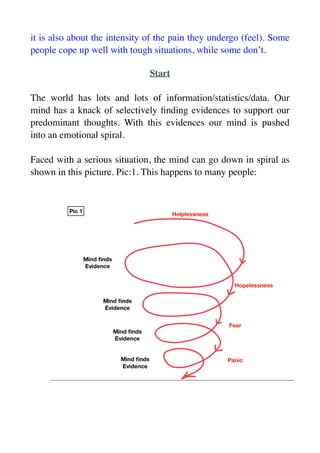
Faced with a serious situation, the mind can go down in spiral as
shown in this picture. Pic:1. This happens to many people:
Q. Can this spiral be interrupted?
A. Yes.
Q. Can this spiral be wilfully interrupted?
A. Yes.
Q. So we do not have to wait for a chance to break this downward
slide?
A. Yes, we don’t have to wait for such lucky break, instead we
can wilfully interrupt this and gain our poise back.
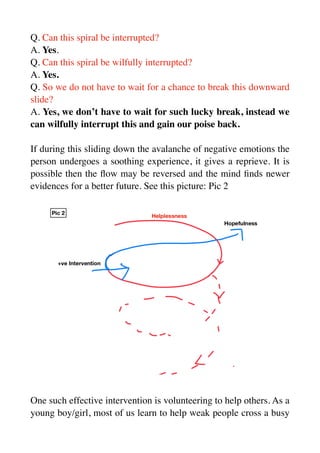
If during this sliding down the avalanche of negative emotions the
person undergoes a soothing experience, it gives a reprieve. It is
possible then the
fl
ow may be reversed and the mind
fi
nds newer
evidences for a better future. See this picture: Pic 2
One such effective intervention is volunteering to help others. As a
young boy/girl, most of us learn to help weak people cross a busy
road. The gratitude expressed on their lit face lifts our spirit that
for many days we remember that small incident. We even wait at
the same point to see if we can get another chance like that. The
rescue forces work fervently to free trapped miners. Soldiers risk
their own lives to pull away and save a wounded colleague off the
battle
fi
eld. Fire
fi
ghters and police of
fi
cers rush inside a building
inferno to help rescue trapped residents while being aware of the
danger that they are getting into. Good people stop their speeding
vehicle to help a stranded motorist or one involved in a car
accident.
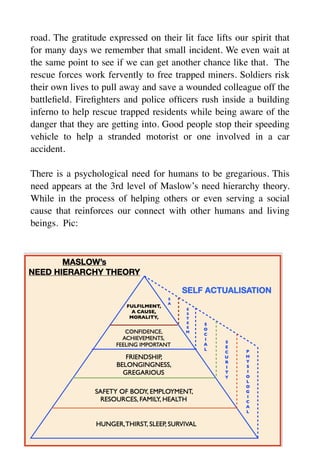
There is a psychological need for humans to be gregarious. This
need appears at the 3rd level of Maslow’s need hierarchy theory.
While in the process of helping others or even serving a social
cause that reinforces our connect with other humans and living
beings. Pic:
When we help others we are
fi
lled with positive emotions. The
reciprocating feeling of happiness, relief and gratitude act as an
emotional massage on us. Serving is a form of worship. During
this while we focus on the dif
fi
culty the other man is facing. Our
attention shifts from us to them. This shift provides that
intervention which halts our mind travel down the emotional spiral
shown in pic 1 and pic 2.
Source: https://www.psychologytoday.com/us: Marianna Pogosyan Ph.D.
Between Cultures
Research has found many examples of how doing good, in ways big or small, not only
feels good, but also does us good. For instance, the well-being-boosting and depression-
lowering bene
fi
ts of volunteering have been repeatedly documented. As has the sense of
meaning and purpose that often accompanies altruistic behaviour. Even when it comes to
money, spending it on others predicts increases in happiness compared to spending it on
ourselves. Moreover, there is now neural evidence from FMRI studies suggesting a link
between generosity and happiness in the brain. In fact, the mere intent and commitment to
generosity can stimulate neural change and make people happier.
I have been associated with a hospital in Nellore, India. This
hospital specialises in Antenatal, Gynaecological spectrum with a
special focus on Fertility support. I visit this place once in two
months and we have an open session with the doctors and other
medical team there on counselling skills and processes. We
consider a few cases that got treated at the hospital as case studies
to draw lessons for providing effective counselling support to the
patients, their relatives and also to the team in the hospital.
One such case that came up for discussion was about a lady (Mrs
Nirmala: Name changed here as to not to reveal the identity) who
had faced many painful incidents (Destiny) one after another ever
since her marriage. To the extent that she was considered as a bad
omen even by some relatives. Who at times did not hesitate to
express this to her. (Inhumanly wrong people). But the repetition
of these dialogues had pushed her into a state of despair. She
started thinking as to, if that can be true too. Her pain is beyond
any words that I can use here to express it fully. Fortunately in this
case, her husband was very supportive and kept encouraging her
not to heed to such non-sense. It helped somewhat, but not enough
to stop the emotional spiral seen above. But for that help, things
could have gone to extreme levels.
While all this was happening she had approached our hospital for
fertility treatment. Our Doctors found that she was clinically
alright. All test reports were pointing this fact. There is no issue
with the functioning of any organ of her body, but conception was
not happening. Her body is
fi
t, but her mind was not supporting.
The doctors and the medical team then started a series of
counselling process with her to improve her emotional state. Their
efforts yielded some improvement in her state of mind.
While this was happening, her sister-in-law, met with a serious
accident and had undergone multiple surgeries. Her spinal cord
was also affected in the impact and she needed good care, in
activities of daily living. She was under intensive care in a hospital
in a city about 400 kms away from this place, with no relative to
assist her there. So Nirmala went there to assist her. She had to
stay in the ward taking full care of her. She had to be cared for like
a small baby. Nirmala could empathise with her. She became a
good link between the medical team and her in caring for her.
Within almost one week of her nursing her sis-in-law, she got over
her depression. She felt an inner glow in taking the minutest care
of a female who is fully grown-up mentally but needing physical
support like a small baby. She did not even get time to think of her
miseries. This intervention broke the spiral. The thankful
expressions on the face of her sister (SIL) every time when she
assisted her like a mother caring for her baby was a big emotional
massage for her.
Then the miracle (as she says) happened. She had early symptoms
of pregnancy and on tests from the same hospital where her SIL
was there, got con
fi
rmed of her motherhood.
It may appear as a miracle to her. Or she may even feel a divine
blessing appreciating her help to another soul. While all of that
may be true, we now know how this happened.
In summary of this part of this article let me reiterate this:
When we help others we are
fi
lled with positive emotions. The
reciprocating feeling of happiness, relief and gratitude act as an
emotional massage on us. Serving is a form of worship. During
this while we focus on the dif
fi
culty the other man is facing, our
attention shifts from us to them. This shift provides that
intervention which halts our mind travel down the emotional
spiral.
The situations in life, career and business can be volatile. We can
not expect constancy in these aspects. But our Mind has to remain
stable. If it remains stable then we can handle the extremities in
life. Our inner strength should match the intensity of the event to
be capable of handling it. If our inner strength depletes, then the
circumstances can easily over power us.
In the
fi
rst part of this topic I had mentioned: Some people suffer
more from a painful incident (Loss), than others who face similar
situation. Why does this happen? It is quite logical to assume that
if the extent of the loss is the same, its impact on the emotions of
different people should be the same. But in reality it is quite
different.
Some people are pushed into a state of grief for years, while some
get out of it in few months. It is not just about the period of grief,
it is also about the intensity of the pain they undergo (feel). Some
people cope up well with tough situations, while some don’t.
This triggers some questions in our mind that,
Is this pain self in
fl
icted?
can we control its intensity?
Should we have to just wait for the time to heal the wound? Does
it happen to us, or are we causing it to happen?
In this article I will be using the word Loss to represent anything
that caused (or can cause) pain. It could be a broken relationship,
Financial Loss or an Accident that caused physical rehabilitation,
or a severe insult, or anything like that...
Such incidents that cause pain, keep happening, whether we want
it or not.
1) Can we cope up with the pain that it may create in us? Yes.
2) Is it a skill that one can get trained in? Yes.
3) Can we also teach such skills to others who are our near and
dear ones? Yes.
“That one skill that makes humans Omnipotent”: Coping up skills
So at the end of the 6th part of this article we know that an
effective way of pulling us out of stress is to serve others and
other living beings.
Next issue we will be dealing with “Reverse the bad Choices” as a
continuation of our learning the Coping up skills.
GURUS SPEAK
R.GOPINATH
Retired life, be more joyful than a youth’s life
Part-3
R.Gopinath
gopinathr@go-past.com
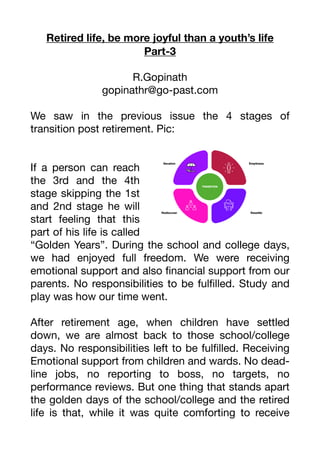
We saw in the previous issue the 4 stages of
transition post retirement. Pic:
If a person can reach
the 3rd and the 4th
stage skipping the 1st
and 2nd stage he will
start feeling that this
part of his life is called
“Golden Years”. During the school and college days,
we had enjoyed full freedom. We were receiving
emotional support and also
fi
nancial support from our
parents. No responsibilities to be ful
fi
lled. Study and
play was how our time went.
After retirement age, when children have settled
down, we are almost back to those school/college
days. No responsibilities left to be ful
fi
lled. Receiving
Emotional support from children and wards. No dead-
line jobs, no reporting to boss, no targets, no
performance reviews. But one thing that stands apart
the golden days of the school/college and the retired
life is that, while it was quite comforting to receive
fi
nancial support from parents, it is not so comforting
now, receiving
fi
nancial support from our children.
We have seen in practical life that possessing assets
can make a person wealthy, but it is his income that
makes him independent. We seen in big cities old
couples living in their sprawling bungalows, with
children working and having settled abroad. People
around keep exclaiming that that property may be
worth Crores of rupees, but if you ask the couple
about how independent they are, they may narrate as
to that a major part of their decisions on tours, travel
entertainment and all are directed by their children. Or
that they don’t seek money for such needs ( feel as if
they are luxuries). They would have been better o
ff
if
they had regular monthly income that can take care of
their minimum needs and monthly expenses.
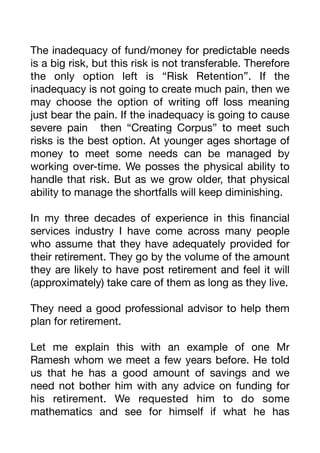
We have seen the risk management process in the
previous issues of inscriptions. Look at this picture:
The inadequacy of fund/money for predictable needs
is a big risk, but this risk is not transferable. Therefore
the only option left is “Risk Retention”. If the
inadequacy is not going to create much pain, then we
may choose the option of writing o
ff
loss meaning
just bear the pain. If the inadequacy is going to cause
severe pain then “Creating Corpus” to meet such
risks is the best option. At younger ages shortage of
money to meet some needs can be managed by
working over-time. We posses the physical ability to
handle that risk. But as we grow older, that physical
ability to manage the shortfalls will keep diminishing.
In my three decades of experience in this
fi
nancial
services industry I have come across many people
who assume that they have adequately provided for
their retirement. They go by the volume of the amount
they are likely to have post retirement and feel it will
(approximately) take care of them as long as they live.
They need a good professional advisor to help them
plan for retirement.
Let me explain this with an example of one Mr
Ramesh whom we meet a few years before. He told
us that he has a good amount of savings and we
need not bother him with any advice on funding for
his retirement. We requested him to do some
mathematics and see for himself if what he has
planned for will be adequate or not. If it works out to
be inadequate he can make good for the amount
from now on, but when he nears his retirement, he
may not be able to set right the inadequacy.
He also mentioned that the money he is planning to
save will be used by him to consume his expenses
while the balance in the bank account will keep
earning interest also.
The data provided by Mr Ramesh is as under. So let
us do our calculations and answer the questions
raised in this case study:
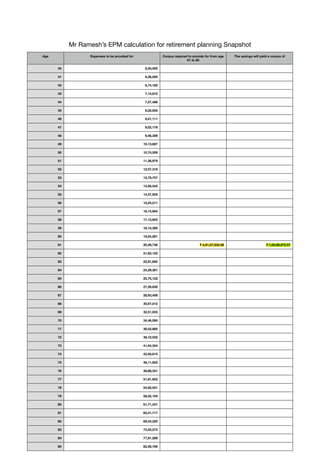
This the calculation sheet:
• Age 40
• Monthly amount required for self and spouse = 50,000
• Consider in
fl
ation @6%
• Age for retirement 60
• Longevity upto 85
• Corpus required for EPM discounting with rate 6% to arrive at NPV
• He is making a savings provision of 2,50,000 per annum that is likely
to earn 6% yield (from 40 to 60 consider 21 payments.)
• What is the estimated corpus at retirement for this arrangement?
• Use su
ffi
ciency calendar triangle to see how long the money will last if
he withdraws 15% every year and the fund growing at 6% yield
Mr Ramesh’s EPM calculation for retirement planning Snapshot
Age Expenses to be provided for Corpus required to provide for from age
61 to 85
The savings will yield a corpus of
40 6,00,000
41 6,36,000
42 6,74,160
43 7,14,610
44 7,57,486
45 8,02,935
46 8,51,111
47 9,02,178
48 9,56,309
49 10,13,687
50 10,74,509
51 11,38,979
52 12,07,318
53 12,79,757
54 13,56,542
55 14,37,935
56 15,24,211
57 16,15,664
58 17,12,603
59 18,15,360
60 19,24,281
61 20,39,738 ₹ 4,81,07,032.08 ₹ 1,05,98,072.57
62 21,62,122
63 22,91,850
64 24,29,361
65 25,75,122
66 27,29,630
67 28,93,408
68 30,67,012
69 32,51,033
70 34,46,095
71 36,52,860
72 38,72,032
73 41,04,354
74 43,50,615
75 46,11,652
76 48,88,351
77 51,81,652
78 54,92,551
79 58,22,104
80 61,71,431
81 65,41,717
82 69,34,220
83 73,50,273
84 77,91,289
85 82,58,766
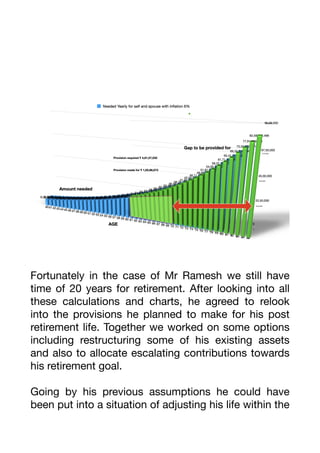
You will observe from the above that the corpus
required to provide for the expenses post age 60 till
age 85 (longevity assumed) is 4,81,00,000+ whereas
his savings plan will result in 1,07,00,000. There is a
big shortfall. This inadequacy is signi
fi
cant.
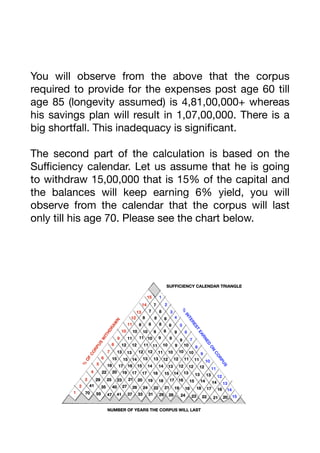
The second part of the calculation is based on the
Su
ffi
ciency calendar. Let us assume that he is going
to withdraw 15,00,000 that is 15% of the capital and
the balances will keep earning 6% yield, you will
observe from the calendar that the corpus will last
only till his age 70. Please see the chart below.
Fortunately in the case of Mr Ramesh we still have
time of 20 years for retirement. After looking into all
these calculations and charts, he agreed to relook
into the provisions he planned to make for his post
retirement life. Together we worked on some options
including restructuring some of his existing assets
and also to allocate escalating contributions towards
his retirement goal.
Going by his previous assumptions he could have
been put into a situation of adjusting his life within the
means available. That too will be a too big a level of
adjustment required almost a third of the
requirements.
A professional advisor is able to use scienti
fi
c tools
and his knowledge of the
fi
nancial planning science
combined with his awareness of the
fi
nancial
instruments available with the risk factor that go with
these instruments. This safeguards the customers
from unplanned inadequacies to meet their goals
CATERPILLAR SPACE
Mr Nayan Bhowmick
“Self-Actualization is the desire to become more and more what one is capable of becoming.”
- Abraham Maslow.
Why we do things we do? What drives our behaviour? Psychologists have proposed different ways
of thinking about motivation, including looking at whether motivation arises from outside (extrinsic)
or inside (intrinsic) an individual.
Extrinsic Motivation- motivated to perform an activity to earn a reward or avoid punishment.
Intrinsic Motivation- motivated to perform an activity for its own sake and personal rewards.
Extrinsic Motivation Intrinsic Motivation
1) Going to work to get paid.
2) Studying to get a good grade or score.
3) Working hard to get a raise or
recognition from own organisation.
1) Working because of enjoy the job.
2) Studying because I find the subject
interesting.
3) Tackling a new project because I love a
challenge.
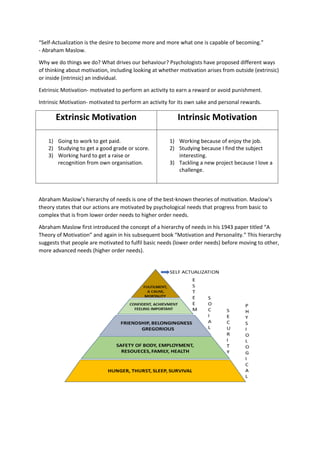
Abraham Maslow’s hierarchy of needs is one of the best-known theories of motivation. Maslow’s
theory states that our actions are motivated by psychological needs that progress from basic to
complex that is from lower order needs to higher order needs.
Abraham Maslow first introduced the concept of a hierarchy of needs in his 1943 paper titled “A
Theory of Motivation” and again in his subsequent book “Motivation and Personality.” This hierarchy
suggests that people are motivated to fulfil basic needs (lower order needs) before moving to other,
more advanced needs (higher order needs).
As a humanist, Maslow believed that people have an inborn desire to be self-actualised, that is, to be
all they can. To achieve this ultimate goal, however, a number of more basic needs (lower order)
must be met. This includes the need for food, safety, love and self-esteem.
Maslow believed that these needs are similar to instincts and play a major role in Motivating
Behaviour. There are 5(five) different levels of Maslow’s hierarchy of needs, starting at the lowest
level known as
1. Physiological needs
2. Security needs
3. Social needs
4. Esteem needs
5. Self-actualization.
Our hierarchy of financial needs-
As a financial professional we will all eventually need to engage in a conversation about developing
an income stream that lasts as long as we do and that outpaces the inflation that threatens to “rot”
our nest egg slowly but surely.
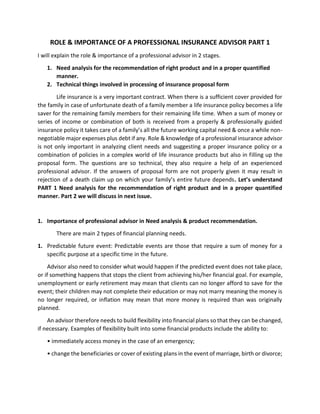
While doing retirement planning the best way to accomplish the task is to work Maslow’s Hierarchy
of needs (with money in mind) and work through the process of designing a stream of income for
life. We can develop a financial rendition of Maslow’s Hierarchy of needs for this purpose.
Maslow Linked Retirement
For the purposes of a retirement income let us take the liberty of renaming all the needs that
Maslow mentioned in the theory of human motivation like
1) Survival Income
2) Safety Income
3) Freedom Income
4) Gift Income
5) Dream Income
Survival Income: - This is the money that we have to have to make ends meet. How much do we
need simply to survive each month? While doing any goal planning our order of planning should be
first, we have to fulfil our minimum level of requirements, ‘then used to level’ and after that we have
to plan for ‘aspirational level’. Basic or ‘minimum level’ means if we stripped away the frill and thrills
and just paid the bills of survival, what would it cost? The majority of people have never taken the
time to answer this most basic financial question: what is the cost of survival? The money needed to
pay for our basic necessities is our survival income.
Safety Income: - This is the income we must have to meet life’s unexpected turns. In life, the one
thing we can predict with great assurance is that things will rarely go exactly as planned. We are
surrounded by risks – physical, financial, circumstantial and relational. Financial risks exist in every
category of our lives.
We all know the related risks involved of being disabled for a prolonged period of time. A huge
percentage of mortgage foreclosures are due to disability of the chief breadwinner verses only few
percent due to death of the breadwinner. If I am 35 years old, the chances that I will be disabled are
six times greater than the odds of my death before age 65.
A leading risk in the minds of those individuals approaching retirement is the risk of outliving their
money. Other top-of-mind risks are health and paying for health care, investments risks, loss of
income and financial needs within the family. The money needed to guard against these risks is our
safety income.
Freedom Income: - This is money to do all of the things that bring enjoyment and fulfilment of
life. What is the exact cost of activities that bring pleasure and relaxation into our life? Some people
engage in low-cost relaxation activities (like walking) and other engage in high priced activities (like
walking after a golf ball). Travel, adventure and personal growth/education are also some of the
considerations to include when calculating the amount needed to fund our freedom.
Gift Income: - This is money for the people and causes that we care deeply about. As we move up
Maslow’s pyramid – securing our survival, safety and freedom –our money can be utilized in the
higher calling of bringing blessing to those people and causes we care deeply about. Many of us
would love to do something for our parents and our children. Many of us also have aspirations to
support causes and charities that connect with our heart and purpose. The money needed to pay for
these gifts benevolent annuities is our gifting income.
Dream Income: - This is money for the things we have always dreamed of being. The cost of self-
actualization is the time it takes to do the things that bring meaning into our lives. If we do not own
enough of our own time to engage in these activities, then we must negotiate with our work
schedule and personal finances to make the time available. There is often a cost associated with
being what we want to be.
There are always costs associated with doing what we want to do and having what we want to have.
Some of us dream of owning a school in rural area and helping children for education. Some of us
dream of owning recreational vehicle and seeing the incredible India. Some of us want to do some
creative work like writing, research, music, etc. whatever dream and adventures have surfaced in
our own musings on self-actualization, there will be bills to pay in the process. The money needed to
pay these bills is own dream income.
To complete this process, we will need to examine our income sources to see how much we can
address on Maslow’s Hierarchy of Needs and determine the preparations and self-negotiation
necessary to cover every level.
“Retirement is not an exit; it is an entry.”- Sir R. Gopinath
CATERPILLAR SPACE
Mr Ankur Shah
ROLE & IMPORTANCE OF A PROFESSIONAL INSURANCE ADVISOR PART 1
I will explain the role & importance of a professional advisor in 2 stages.
1. Need analysis for the recommendation of right product and in a proper quantified
manner.
2. Technical things involved in processing of insurance proposal form
Life insurance is a very important contract. When there is a sufficient cover provided for
the family in case of unfortunate death of a family member a life insurance policy becomes a life
saver for the remaining family members for their remaining life time. When a sum of money or
series of income or combination of both is received from a properly & professionally guided
insurance policy it takes care of a family’s all the future working capital need & once a while non-
negotiable major expenses plus debt if any. Role & knowledge of a professional insurance advisor
is not only important in analyzing client needs and suggesting a proper insurance policy or a
combination of policies in a complex world of life insurance products but also in filling up the
proposal form. The questions are so technical, they also require a help of an experienced
professional advisor. If the answers of proposal form are not properly given it may result in
rejection of a death claim up on which your family’s entire future depends. Let’s understand
PART 1 Need analysis for the recommendation of right product and in a proper quantified
manner. Part 2 we will discuss in next issue.
1. Importance of professional advisor in Need analysis & product recommendation.
There are main 2 types of financial planning needs.
1. Predictable future event: Predictable events are those that require a sum of money for a
specific purpose at a specific time in the future.
Advisor also need to consider what would happen if the predicted event does not take place,
or if something happens that stops the client from achieving his/her financial goal. For example,
unemployment or early retirement may mean that clients can no longer afford to save for the
event; their children may not complete their education or may not marry meaning the money is
no longer required, or inflation may mean that more money is required than was originally
planned.
An advisor therefore needs to build flexibility into financial plans so that they can be changed,
if necessary. Examples of flexibility built into some financial products include the ability to:
• immediately access money in the case of an emergency;
• change the beneficiaries or cover of existing plans in the event of marriage, birth or divorce;
• increase, decrease or suspend contributions to plans without penalties if a client’s income
changes;
• switch investment funds to meet changing economic conditions or a client’s feelings
towards risk.
2. Unpredictable future events: An unpredictable event is one that may happen at any time in
the future – or may not happen at all. Examples include:
• long-term incapacity because of sickness, accident or disability;
• the onset of a critical illness;
• the death of a parent before children are financially independent; and
• unemployment.
There is no way of knowing who will be affected by these events, nor at what age. However,
when these events do happen, the financial consequences can be devastating. Therefore, all
individuals need to adequately protect themselves and their dependents against these events.
Identifying a client’s real financial needs: There are four main steps to take when
identifying a client's financial needs:
• distinguishing between perceived and real needs;
• distinguishing between current and future needs;
• quantifying needs; and
• prioritizing needs.
The figure here gives the hierarchy of
financial planning needs. It gives the order in
which needs must be met.
It says we must provide 1st
for unpredictable
future events as it may or may not happen at
all but if they happen, we do not know when
they will happen.
Once the unpredictable events are taken
care of only then and then we should provide
for predictable future events.
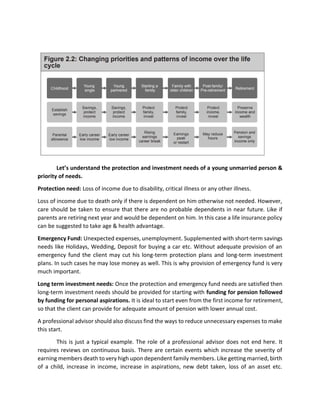
There are typically 7 life cycle stages and in each stage protection & savings requirement
do vary. The figure below provides the list of those 7 life cycle stages. A professional insurance
advisor correctly identifies client’s protection need and recommends product necessary.
Let’s understand the protection and investment needs of a young unmarried person &
priority of needs.
Protection need: Loss of income due to disability, critical illness or any other illness.
Loss of income due to death only if there is dependent on him otherwise not needed. However,
care should be taken to ensure that there are no probable dependents in near future. Like if
parents are retiring next year and would be dependent on him. In this case a life insurance policy
can be suggested to take age & health advantage.
Emergency Fund: Unexpected expenses, unemployment. Supplemented with short-term savings
needs like Holidays, Wedding, Deposit for buying a car etc. Without adequate provision of an
emergency fund the client may cut his long-term protection plans and long-term investment
plans. In such cases he may lose money as well. This is why provision of emergency fund is very
much important.
Long term investment needs: Once the protection and emergency fund needs are satisfied then
long-term investment needs should be provided for starting with funding for pension followed
by funding for personal aspirations. It is ideal to start even from the first income for retirement,
so that the client can provide for adequate amount of pension with lower annual cost.
A professional advisor should also discuss find the ways to reduce unnecessary expenses to make
this start.
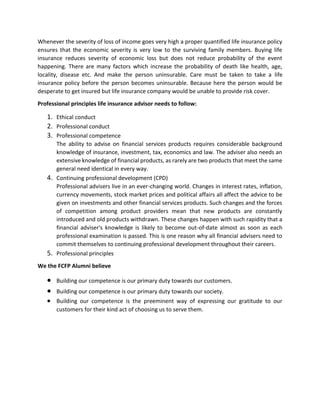
This is just a typical example. The role of a professional advisor does not end here. It
requires reviews on continuous basis. There are certain events which increase the severity of
earning members death to very high upon dependent family members. Like getting married, birth
of a child, increase in income, increase in aspirations, new debt taken, loss of an asset etc.
Whenever the severity of loss of income goes very high a proper quantified life insurance policy
ensures that the economic severity is very low to the surviving family members. Buying life
insurance reduces severity of economic loss but does not reduce probability of the event
happening. There are many factors which increase the probability of death like health, age,
locality, disease etc. And make the person uninsurable. Care must be taken to take a life
insurance policy before the person becomes uninsurable. Because here the person would be
desperate to get insured but life insurance company would be unable to provide risk cover.
Professional principles life insurance advisor needs to follow:
1. Ethical conduct
2. Professional conduct
3. Professional competence
The ability to advise on financial services products requires considerable background
knowledge of insurance, investment, tax, economics and law. The adviser also needs an
extensive knowledge of financial products, as rarely are two products that meet the same
general need identical in every way.
4. Continuing professional development (CPD)
Professional advisers live in an ever-changing world. Changes in interest rates, inflation,
currency movements, stock market prices and political affairs all affect the advice to be
given on investments and other financial services products. Such changes and the forces
of competition among product providers mean that new products are constantly
introduced and old products withdrawn. These changes happen with such rapidity that a
financial adviser's knowledge is likely to become out-of-date almost as soon as each
professional examination is passed. This is one reason why all financial advisers need to
commit themselves to continuing professional development throughout their careers.
5. Professional principles
We the FCFP Alumni believe
• Building our competence is our primary duty towards our customers.
• Building our competence is our primary duty towards our society.
• Building our competence is the preeminent way of expressing our gratitude to our
customers for their kind act of choosing us to serve them.
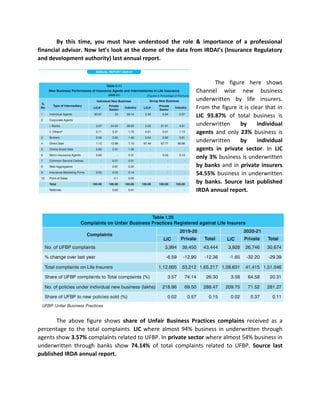
By this time, you must have understood the role & importance of a professional
financial advisor. Now let’s look at the dome of the data from IRDAI’s (Insurance Regulatory
and development authority) last annual report.
The figure here shows
Channel wise new business
underwritten by life insurers.
From the figure it is clear that in
LIC 93.87% of total business is
underwritten by individual
agents and only 23% business is
underwritten by individual
agents in private sector. In LIC
only 3% business is underwritten
by banks and in private insurers
54.55% business in underwritten
by banks. Source last published
IRDA annual report.
The above figure shows share of Unfair Business Practices complains received as a
percentage to the total complaints. LIC where almost 94% business in underwritten through
agents show 3.57% complaints related to UFBP. In private sector where almost 54% business in
underwritten through banks show 74.14% of total complaints related to UFBP. Source last
published IRDA annual report.
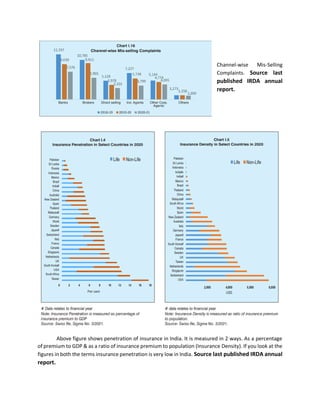
Channel-wise Mis-Selling
Complaints. Source last
published IRDA annual
report.
Above figure shows penetration of insurance in India. It is measured in 2 ways. As a percentage
of premium to GDP & as a ratio of insurance premium to population (Insurance Density). If you look at the
figures in both the terms insurance penetration is very low in India. Source last published IRDA annual
report.
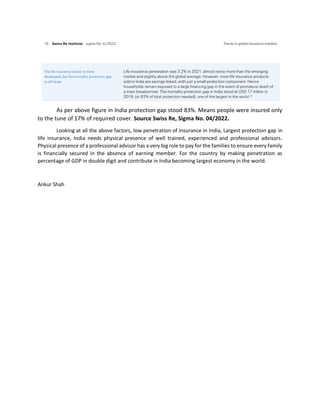
As per above figure in India protection gap stood 83%. Means people were insured only
to the tune of 17% of required cover. Source Swiss Re, Sigma No. 04/2022.
Looking at all the above factors, low penetration of insurance in India, Largest protection gap in
life insurance, India needs physical presence of well trained, experienced and professional advisors.
Physical presence of a professional advisor has a very big role to pay for the families to ensure every family
is financially secured in the absence of earning member. For the country by making penetration as
percentage of GDP in double digit and contribute in India becoming largest economy in the world.
Ankur Shah
PROUD TO BE
ASSOCIATED
Mr D Murugesan the Ambulance man
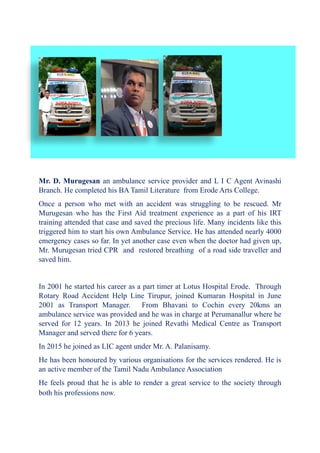
Mr. D. Murugesan an ambulance service provider and L I C Agent Avinashi
Branch. He completed his BA Tamil Literature from Erode Arts College.
Once a person who met with an accident was struggling to be rescued. Mr
Murugesan who has the First Aid treatment experience as a part of his IRT
training attended that case and saved the precious life. Many incidents like this
triggered him to start his own Ambulance Service. He has attended nearly 4000
emergency cases so far. In yet another case even when the doctor had given up,
Mr. Murugesan tried CPR and restored breathing of a road side traveller and
saved him.
In 2001 he started his career as a part timer at Lotus Hospital Erode. Through
Rotary Road Accident Help Line Tirupur, joined Kumaran Hospital in June
2001 as Transport Manager. From Bhavani to Cochin every 20kms an
ambulance service was provided and he was in charge at Perumanallur where he
served for 12 years. In 2013 he joined Revathi Medical Centre as Transport
Manager and served there for 6 years.
In 2015 he joined as LIC agent under Mr. A. Palanisamy.
He has been honoured by various organisations for the services rendered. He is
an active member of the Tamil Nadu Ambulance Association
He feels proud that he is able to render a great service to the society through
both his professions now.
NEWS AND GALLERY
EVENTS AT GOPAST
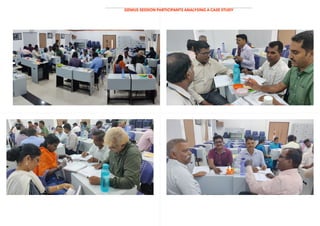
GENIUS SESSION PARTICIPANTS ANALYSING A CASE STUDY
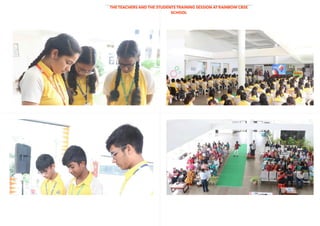
THE TEACHERS AND THE STUDENTS TRAINING SESSION AT RAINBOW CBSE
SCHOOL
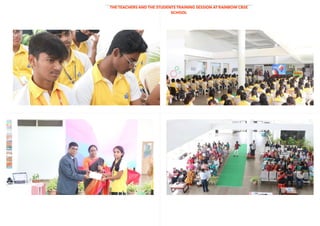
THE TEACHERS AND THE STUDENTS TRAINING SESSION AT RAINBOW CBSE
SCHOOL
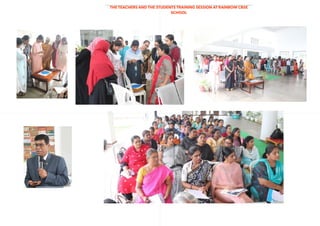
THE TEACHERS AND THE STUDENTS TRAINING SESSION AT RAINBOW CBSE
SCHOOL

Inscriptions 40 Jan2023.pdf

  • 1.
    January 2023 Inscriptions 40 AMAGAZINE FROM THE GOPAST CENTRE FOR LEARNING
  • 2.
    Inscriptions is 40 issuesold April 2013 to January 2023
  • 3.
    PAGE INDEX Page CHAPTERTopic By 3 SCULPTOR SCULPTS Coping up skills part 6 Service Eliminates Stress MR R.GOPINATH 12 GURUS SPEAK Retired life, be more joyful than a youth’s life part 3 MR R.GOPINATH 22 CATERPILLAR SPACE Maslow’s need hierarchy linked Retirement Mr Nayan Bhowmick 27 CATERPILLAR SPACE Role and importance of a professional insurance advisor Part 1 Mr Ankur Shah 35 WE ARE PROUD OF Mr D Murugesan the ambulance man 37 GALLERY Events at Gopast
  • 4.
  • 5.
    “Service eliminates stress”. Copingup Skill “That one skill that makes humans Omnipotent” Part 6 R.Gopinath gopinathr@go-past.com Let us recall a few paragraphs from the previous issues: Our emotions are the providers of energy to us. Nature’s law is that energy cannot be suppressed or eliminated, it can only be converted into another form of energy and it can also be enhanced by combining other energies. We will have our own mixture of events that give us happiness and events that creates sorrow. Some such events creates deep emotional wounds in us. Even though those incidents are momentary, the pain they cause last for a long period, sometimes even years. Some people suffer more from a painful incident (Loss), than others who face similar situation. Why does this happen? It is quite logical to assume that if the extent of the loss is the same, its impact on the emotions of different people should be the same. But in reality it is quite different. Some people are pushed into a state of grief for years, while some get out of it in few months. It is not just about the period of grief,
  • 6.
    it is alsoabout the intensity of the pain they undergo (feel). Some people cope up well with tough situations, while some don’t. Start The world has lots and lots of information/statistics/data. Our mind has a knack of selectively fi nding evidences to support our predominant thoughts. With this evidences our mind is pushed into an emotional spiral. Faced with a serious situation, the mind can go down in spiral as shown in this picture. Pic:1. This happens to many people:
  • 7.
    Q. Can thisspiral be interrupted? A. Yes. Q. Can this spiral be wilfully interrupted? A. Yes. Q. So we do not have to wait for a chance to break this downward slide? A. Yes, we don’t have to wait for such lucky break, instead we can wilfully interrupt this and gain our poise back. If during this sliding down the avalanche of negative emotions the person undergoes a soothing experience, it gives a reprieve. It is possible then the fl ow may be reversed and the mind fi nds newer evidences for a better future. See this picture: Pic 2 One such effective intervention is volunteering to help others. As a young boy/girl, most of us learn to help weak people cross a busy
  • 8.
    road. The gratitudeexpressed on their lit face lifts our spirit that for many days we remember that small incident. We even wait at the same point to see if we can get another chance like that. The rescue forces work fervently to free trapped miners. Soldiers risk their own lives to pull away and save a wounded colleague off the battle fi eld. Fire fi ghters and police of fi cers rush inside a building inferno to help rescue trapped residents while being aware of the danger that they are getting into. Good people stop their speeding vehicle to help a stranded motorist or one involved in a car accident. There is a psychological need for humans to be gregarious. This need appears at the 3rd level of Maslow’s need hierarchy theory. While in the process of helping others or even serving a social cause that reinforces our connect with other humans and living beings. Pic:
  • 9.
    When we helpothers we are fi lled with positive emotions. The reciprocating feeling of happiness, relief and gratitude act as an emotional massage on us. Serving is a form of worship. During this while we focus on the dif fi culty the other man is facing. Our attention shifts from us to them. This shift provides that intervention which halts our mind travel down the emotional spiral shown in pic 1 and pic 2. Source: https://www.psychologytoday.com/us: Marianna Pogosyan Ph.D. Between Cultures Research has found many examples of how doing good, in ways big or small, not only feels good, but also does us good. For instance, the well-being-boosting and depression- lowering bene fi ts of volunteering have been repeatedly documented. As has the sense of meaning and purpose that often accompanies altruistic behaviour. Even when it comes to money, spending it on others predicts increases in happiness compared to spending it on ourselves. Moreover, there is now neural evidence from FMRI studies suggesting a link between generosity and happiness in the brain. In fact, the mere intent and commitment to generosity can stimulate neural change and make people happier. I have been associated with a hospital in Nellore, India. This hospital specialises in Antenatal, Gynaecological spectrum with a special focus on Fertility support. I visit this place once in two months and we have an open session with the doctors and other medical team there on counselling skills and processes. We consider a few cases that got treated at the hospital as case studies to draw lessons for providing effective counselling support to the patients, their relatives and also to the team in the hospital. One such case that came up for discussion was about a lady (Mrs Nirmala: Name changed here as to not to reveal the identity) who had faced many painful incidents (Destiny) one after another ever since her marriage. To the extent that she was considered as a bad omen even by some relatives. Who at times did not hesitate to express this to her. (Inhumanly wrong people). But the repetition of these dialogues had pushed her into a state of despair. She
  • 10.
    started thinking asto, if that can be true too. Her pain is beyond any words that I can use here to express it fully. Fortunately in this case, her husband was very supportive and kept encouraging her not to heed to such non-sense. It helped somewhat, but not enough to stop the emotional spiral seen above. But for that help, things could have gone to extreme levels. While all this was happening she had approached our hospital for fertility treatment. Our Doctors found that she was clinically alright. All test reports were pointing this fact. There is no issue with the functioning of any organ of her body, but conception was not happening. Her body is fi t, but her mind was not supporting. The doctors and the medical team then started a series of counselling process with her to improve her emotional state. Their efforts yielded some improvement in her state of mind. While this was happening, her sister-in-law, met with a serious accident and had undergone multiple surgeries. Her spinal cord was also affected in the impact and she needed good care, in activities of daily living. She was under intensive care in a hospital in a city about 400 kms away from this place, with no relative to assist her there. So Nirmala went there to assist her. She had to stay in the ward taking full care of her. She had to be cared for like a small baby. Nirmala could empathise with her. She became a good link between the medical team and her in caring for her. Within almost one week of her nursing her sis-in-law, she got over her depression. She felt an inner glow in taking the minutest care of a female who is fully grown-up mentally but needing physical support like a small baby. She did not even get time to think of her miseries. This intervention broke the spiral. The thankful expressions on the face of her sister (SIL) every time when she
  • 11.
    assisted her likea mother caring for her baby was a big emotional massage for her. Then the miracle (as she says) happened. She had early symptoms of pregnancy and on tests from the same hospital where her SIL was there, got con fi rmed of her motherhood. It may appear as a miracle to her. Or she may even feel a divine blessing appreciating her help to another soul. While all of that may be true, we now know how this happened. In summary of this part of this article let me reiterate this: When we help others we are fi lled with positive emotions. The reciprocating feeling of happiness, relief and gratitude act as an emotional massage on us. Serving is a form of worship. During this while we focus on the dif fi culty the other man is facing, our attention shifts from us to them. This shift provides that intervention which halts our mind travel down the emotional spiral. The situations in life, career and business can be volatile. We can not expect constancy in these aspects. But our Mind has to remain stable. If it remains stable then we can handle the extremities in life. Our inner strength should match the intensity of the event to be capable of handling it. If our inner strength depletes, then the circumstances can easily over power us. In the fi rst part of this topic I had mentioned: Some people suffer more from a painful incident (Loss), than others who face similar situation. Why does this happen? It is quite logical to assume that if the extent of the loss is the same, its impact on the emotions of
  • 12.
    different people shouldbe the same. But in reality it is quite different. Some people are pushed into a state of grief for years, while some get out of it in few months. It is not just about the period of grief, it is also about the intensity of the pain they undergo (feel). Some people cope up well with tough situations, while some don’t. This triggers some questions in our mind that, Is this pain self in fl icted? can we control its intensity? Should we have to just wait for the time to heal the wound? Does it happen to us, or are we causing it to happen? In this article I will be using the word Loss to represent anything that caused (or can cause) pain. It could be a broken relationship, Financial Loss or an Accident that caused physical rehabilitation, or a severe insult, or anything like that... Such incidents that cause pain, keep happening, whether we want it or not. 1) Can we cope up with the pain that it may create in us? Yes. 2) Is it a skill that one can get trained in? Yes. 3) Can we also teach such skills to others who are our near and dear ones? Yes. “That one skill that makes humans Omnipotent”: Coping up skills So at the end of the 6th part of this article we know that an effective way of pulling us out of stress is to serve others and other living beings. Next issue we will be dealing with “Reverse the bad Choices” as a continuation of our learning the Coping up skills.
  • 14.
  • 15.
    Retired life, bemore joyful than a youth’s life Part-3 R.Gopinath gopinathr@go-past.com We saw in the previous issue the 4 stages of transition post retirement. Pic: If a person can reach the 3rd and the 4th stage skipping the 1st and 2nd stage he will start feeling that this part of his life is called “Golden Years”. During the school and college days, we had enjoyed full freedom. We were receiving emotional support and also fi nancial support from our parents. No responsibilities to be ful fi lled. Study and play was how our time went. After retirement age, when children have settled down, we are almost back to those school/college days. No responsibilities left to be ful fi lled. Receiving Emotional support from children and wards. No dead- line jobs, no reporting to boss, no targets, no performance reviews. But one thing that stands apart the golden days of the school/college and the retired life is that, while it was quite comforting to receive
  • 16.
    fi nancial support fromparents, it is not so comforting now, receiving fi nancial support from our children. We have seen in practical life that possessing assets can make a person wealthy, but it is his income that makes him independent. We seen in big cities old couples living in their sprawling bungalows, with children working and having settled abroad. People around keep exclaiming that that property may be worth Crores of rupees, but if you ask the couple about how independent they are, they may narrate as to that a major part of their decisions on tours, travel entertainment and all are directed by their children. Or that they don’t seek money for such needs ( feel as if they are luxuries). They would have been better o ff if they had regular monthly income that can take care of their minimum needs and monthly expenses. We have seen the risk management process in the previous issues of inscriptions. Look at this picture:
  • 17.
    The inadequacy offund/money for predictable needs is a big risk, but this risk is not transferable. Therefore the only option left is “Risk Retention”. If the inadequacy is not going to create much pain, then we may choose the option of writing o ff loss meaning just bear the pain. If the inadequacy is going to cause severe pain then “Creating Corpus” to meet such risks is the best option. At younger ages shortage of money to meet some needs can be managed by working over-time. We posses the physical ability to handle that risk. But as we grow older, that physical ability to manage the shortfalls will keep diminishing. In my three decades of experience in this fi nancial services industry I have come across many people who assume that they have adequately provided for their retirement. They go by the volume of the amount they are likely to have post retirement and feel it will (approximately) take care of them as long as they live. They need a good professional advisor to help them plan for retirement. Let me explain this with an example of one Mr Ramesh whom we meet a few years before. He told us that he has a good amount of savings and we need not bother him with any advice on funding for his retirement. We requested him to do some mathematics and see for himself if what he has
  • 18.
    planned for willbe adequate or not. If it works out to be inadequate he can make good for the amount from now on, but when he nears his retirement, he may not be able to set right the inadequacy. He also mentioned that the money he is planning to save will be used by him to consume his expenses while the balance in the bank account will keep earning interest also. The data provided by Mr Ramesh is as under. So let us do our calculations and answer the questions raised in this case study: This the calculation sheet: • Age 40 • Monthly amount required for self and spouse = 50,000 • Consider in fl ation @6% • Age for retirement 60 • Longevity upto 85 • Corpus required for EPM discounting with rate 6% to arrive at NPV • He is making a savings provision of 2,50,000 per annum that is likely to earn 6% yield (from 40 to 60 consider 21 payments.) • What is the estimated corpus at retirement for this arrangement? • Use su ffi ciency calendar triangle to see how long the money will last if he withdraws 15% every year and the fund growing at 6% yield
  • 19.
    Mr Ramesh’s EPMcalculation for retirement planning Snapshot Age Expenses to be provided for Corpus required to provide for from age 61 to 85 The savings will yield a corpus of 40 6,00,000 41 6,36,000 42 6,74,160 43 7,14,610 44 7,57,486 45 8,02,935 46 8,51,111 47 9,02,178 48 9,56,309 49 10,13,687 50 10,74,509 51 11,38,979 52 12,07,318 53 12,79,757 54 13,56,542 55 14,37,935 56 15,24,211 57 16,15,664 58 17,12,603 59 18,15,360 60 19,24,281 61 20,39,738 ₹ 4,81,07,032.08 ₹ 1,05,98,072.57 62 21,62,122 63 22,91,850 64 24,29,361 65 25,75,122 66 27,29,630 67 28,93,408 68 30,67,012 69 32,51,033 70 34,46,095 71 36,52,860 72 38,72,032 73 41,04,354 74 43,50,615 75 46,11,652 76 48,88,351 77 51,81,652 78 54,92,551 79 58,22,104 80 61,71,431 81 65,41,717 82 69,34,220 83 73,50,273 84 77,91,289 85 82,58,766
  • 20.
    You will observefrom the above that the corpus required to provide for the expenses post age 60 till age 85 (longevity assumed) is 4,81,00,000+ whereas his savings plan will result in 1,07,00,000. There is a big shortfall. This inadequacy is signi fi cant. The second part of the calculation is based on the Su ffi ciency calendar. Let us assume that he is going to withdraw 15,00,000 that is 15% of the capital and the balances will keep earning 6% yield, you will observe from the calendar that the corpus will last only till his age 70. Please see the chart below.
  • 21.
    Fortunately in thecase of Mr Ramesh we still have time of 20 years for retirement. After looking into all these calculations and charts, he agreed to relook into the provisions he planned to make for his post retirement life. Together we worked on some options including restructuring some of his existing assets and also to allocate escalating contributions towards his retirement goal. Going by his previous assumptions he could have been put into a situation of adjusting his life within the
  • 22.
    means available. Thattoo will be a too big a level of adjustment required almost a third of the requirements. A professional advisor is able to use scienti fi c tools and his knowledge of the fi nancial planning science combined with his awareness of the fi nancial instruments available with the risk factor that go with these instruments. This safeguards the customers from unplanned inadequacies to meet their goals
  • 23.
  • 24.
    “Self-Actualization is thedesire to become more and more what one is capable of becoming.” - Abraham Maslow. Why we do things we do? What drives our behaviour? Psychologists have proposed different ways of thinking about motivation, including looking at whether motivation arises from outside (extrinsic) or inside (intrinsic) an individual. Extrinsic Motivation- motivated to perform an activity to earn a reward or avoid punishment. Intrinsic Motivation- motivated to perform an activity for its own sake and personal rewards. Extrinsic Motivation Intrinsic Motivation 1) Going to work to get paid. 2) Studying to get a good grade or score. 3) Working hard to get a raise or recognition from own organisation. 1) Working because of enjoy the job. 2) Studying because I find the subject interesting. 3) Tackling a new project because I love a challenge. Abraham Maslow’s hierarchy of needs is one of the best-known theories of motivation. Maslow’s theory states that our actions are motivated by psychological needs that progress from basic to complex that is from lower order needs to higher order needs. Abraham Maslow first introduced the concept of a hierarchy of needs in his 1943 paper titled “A Theory of Motivation” and again in his subsequent book “Motivation and Personality.” This hierarchy suggests that people are motivated to fulfil basic needs (lower order needs) before moving to other, more advanced needs (higher order needs).
  • 25.
    As a humanist,Maslow believed that people have an inborn desire to be self-actualised, that is, to be all they can. To achieve this ultimate goal, however, a number of more basic needs (lower order) must be met. This includes the need for food, safety, love and self-esteem. Maslow believed that these needs are similar to instincts and play a major role in Motivating Behaviour. There are 5(five) different levels of Maslow’s hierarchy of needs, starting at the lowest level known as 1. Physiological needs 2. Security needs 3. Social needs 4. Esteem needs 5. Self-actualization. Our hierarchy of financial needs- As a financial professional we will all eventually need to engage in a conversation about developing an income stream that lasts as long as we do and that outpaces the inflation that threatens to “rot” our nest egg slowly but surely. While doing retirement planning the best way to accomplish the task is to work Maslow’s Hierarchy of needs (with money in mind) and work through the process of designing a stream of income for life. We can develop a financial rendition of Maslow’s Hierarchy of needs for this purpose. Maslow Linked Retirement For the purposes of a retirement income let us take the liberty of renaming all the needs that Maslow mentioned in the theory of human motivation like
  • 26.
    1) Survival Income 2)Safety Income 3) Freedom Income 4) Gift Income 5) Dream Income Survival Income: - This is the money that we have to have to make ends meet. How much do we need simply to survive each month? While doing any goal planning our order of planning should be first, we have to fulfil our minimum level of requirements, ‘then used to level’ and after that we have to plan for ‘aspirational level’. Basic or ‘minimum level’ means if we stripped away the frill and thrills and just paid the bills of survival, what would it cost? The majority of people have never taken the time to answer this most basic financial question: what is the cost of survival? The money needed to pay for our basic necessities is our survival income. Safety Income: - This is the income we must have to meet life’s unexpected turns. In life, the one thing we can predict with great assurance is that things will rarely go exactly as planned. We are surrounded by risks – physical, financial, circumstantial and relational. Financial risks exist in every category of our lives. We all know the related risks involved of being disabled for a prolonged period of time. A huge percentage of mortgage foreclosures are due to disability of the chief breadwinner verses only few percent due to death of the breadwinner. If I am 35 years old, the chances that I will be disabled are six times greater than the odds of my death before age 65. A leading risk in the minds of those individuals approaching retirement is the risk of outliving their money. Other top-of-mind risks are health and paying for health care, investments risks, loss of income and financial needs within the family. The money needed to guard against these risks is our safety income. Freedom Income: - This is money to do all of the things that bring enjoyment and fulfilment of life. What is the exact cost of activities that bring pleasure and relaxation into our life? Some people engage in low-cost relaxation activities (like walking) and other engage in high priced activities (like walking after a golf ball). Travel, adventure and personal growth/education are also some of the considerations to include when calculating the amount needed to fund our freedom. Gift Income: - This is money for the people and causes that we care deeply about. As we move up Maslow’s pyramid – securing our survival, safety and freedom –our money can be utilized in the higher calling of bringing blessing to those people and causes we care deeply about. Many of us would love to do something for our parents and our children. Many of us also have aspirations to support causes and charities that connect with our heart and purpose. The money needed to pay for these gifts benevolent annuities is our gifting income. Dream Income: - This is money for the things we have always dreamed of being. The cost of self- actualization is the time it takes to do the things that bring meaning into our lives. If we do not own enough of our own time to engage in these activities, then we must negotiate with our work schedule and personal finances to make the time available. There is often a cost associated with being what we want to be. There are always costs associated with doing what we want to do and having what we want to have. Some of us dream of owning a school in rural area and helping children for education. Some of us
  • 27.
    dream of owningrecreational vehicle and seeing the incredible India. Some of us want to do some creative work like writing, research, music, etc. whatever dream and adventures have surfaced in our own musings on self-actualization, there will be bills to pay in the process. The money needed to pay these bills is own dream income. To complete this process, we will need to examine our income sources to see how much we can address on Maslow’s Hierarchy of Needs and determine the preparations and self-negotiation necessary to cover every level. “Retirement is not an exit; it is an entry.”- Sir R. Gopinath
  • 28.
  • 29.
    ROLE & IMPORTANCEOF A PROFESSIONAL INSURANCE ADVISOR PART 1 I will explain the role & importance of a professional advisor in 2 stages. 1. Need analysis for the recommendation of right product and in a proper quantified manner. 2. Technical things involved in processing of insurance proposal form Life insurance is a very important contract. When there is a sufficient cover provided for the family in case of unfortunate death of a family member a life insurance policy becomes a life saver for the remaining family members for their remaining life time. When a sum of money or series of income or combination of both is received from a properly & professionally guided insurance policy it takes care of a family’s all the future working capital need & once a while non- negotiable major expenses plus debt if any. Role & knowledge of a professional insurance advisor is not only important in analyzing client needs and suggesting a proper insurance policy or a combination of policies in a complex world of life insurance products but also in filling up the proposal form. The questions are so technical, they also require a help of an experienced professional advisor. If the answers of proposal form are not properly given it may result in rejection of a death claim up on which your family’s entire future depends. Let’s understand PART 1 Need analysis for the recommendation of right product and in a proper quantified manner. Part 2 we will discuss in next issue. 1. Importance of professional advisor in Need analysis & product recommendation. There are main 2 types of financial planning needs. 1. Predictable future event: Predictable events are those that require a sum of money for a specific purpose at a specific time in the future. Advisor also need to consider what would happen if the predicted event does not take place, or if something happens that stops the client from achieving his/her financial goal. For example, unemployment or early retirement may mean that clients can no longer afford to save for the event; their children may not complete their education or may not marry meaning the money is no longer required, or inflation may mean that more money is required than was originally planned. An advisor therefore needs to build flexibility into financial plans so that they can be changed, if necessary. Examples of flexibility built into some financial products include the ability to: • immediately access money in the case of an emergency; • change the beneficiaries or cover of existing plans in the event of marriage, birth or divorce;
  • 30.
    • increase, decreaseor suspend contributions to plans without penalties if a client’s income changes; • switch investment funds to meet changing economic conditions or a client’s feelings towards risk. 2. Unpredictable future events: An unpredictable event is one that may happen at any time in the future – or may not happen at all. Examples include: • long-term incapacity because of sickness, accident or disability; • the onset of a critical illness; • the death of a parent before children are financially independent; and • unemployment. There is no way of knowing who will be affected by these events, nor at what age. However, when these events do happen, the financial consequences can be devastating. Therefore, all individuals need to adequately protect themselves and their dependents against these events. Identifying a client’s real financial needs: There are four main steps to take when identifying a client's financial needs: • distinguishing between perceived and real needs; • distinguishing between current and future needs; • quantifying needs; and • prioritizing needs. The figure here gives the hierarchy of financial planning needs. It gives the order in which needs must be met. It says we must provide 1st for unpredictable future events as it may or may not happen at all but if they happen, we do not know when they will happen. Once the unpredictable events are taken care of only then and then we should provide for predictable future events. There are typically 7 life cycle stages and in each stage protection & savings requirement do vary. The figure below provides the list of those 7 life cycle stages. A professional insurance advisor correctly identifies client’s protection need and recommends product necessary.
  • 31.
    Let’s understand theprotection and investment needs of a young unmarried person & priority of needs. Protection need: Loss of income due to disability, critical illness or any other illness. Loss of income due to death only if there is dependent on him otherwise not needed. However, care should be taken to ensure that there are no probable dependents in near future. Like if parents are retiring next year and would be dependent on him. In this case a life insurance policy can be suggested to take age & health advantage. Emergency Fund: Unexpected expenses, unemployment. Supplemented with short-term savings needs like Holidays, Wedding, Deposit for buying a car etc. Without adequate provision of an emergency fund the client may cut his long-term protection plans and long-term investment plans. In such cases he may lose money as well. This is why provision of emergency fund is very much important. Long term investment needs: Once the protection and emergency fund needs are satisfied then long-term investment needs should be provided for starting with funding for pension followed by funding for personal aspirations. It is ideal to start even from the first income for retirement, so that the client can provide for adequate amount of pension with lower annual cost. A professional advisor should also discuss find the ways to reduce unnecessary expenses to make this start. This is just a typical example. The role of a professional advisor does not end here. It requires reviews on continuous basis. There are certain events which increase the severity of earning members death to very high upon dependent family members. Like getting married, birth of a child, increase in income, increase in aspirations, new debt taken, loss of an asset etc.
  • 32.
    Whenever the severityof loss of income goes very high a proper quantified life insurance policy ensures that the economic severity is very low to the surviving family members. Buying life insurance reduces severity of economic loss but does not reduce probability of the event happening. There are many factors which increase the probability of death like health, age, locality, disease etc. And make the person uninsurable. Care must be taken to take a life insurance policy before the person becomes uninsurable. Because here the person would be desperate to get insured but life insurance company would be unable to provide risk cover. Professional principles life insurance advisor needs to follow: 1. Ethical conduct 2. Professional conduct 3. Professional competence The ability to advise on financial services products requires considerable background knowledge of insurance, investment, tax, economics and law. The adviser also needs an extensive knowledge of financial products, as rarely are two products that meet the same general need identical in every way. 4. Continuing professional development (CPD) Professional advisers live in an ever-changing world. Changes in interest rates, inflation, currency movements, stock market prices and political affairs all affect the advice to be given on investments and other financial services products. Such changes and the forces of competition among product providers mean that new products are constantly introduced and old products withdrawn. These changes happen with such rapidity that a financial adviser's knowledge is likely to become out-of-date almost as soon as each professional examination is passed. This is one reason why all financial advisers need to commit themselves to continuing professional development throughout their careers. 5. Professional principles We the FCFP Alumni believe • Building our competence is our primary duty towards our customers. • Building our competence is our primary duty towards our society. • Building our competence is the preeminent way of expressing our gratitude to our customers for their kind act of choosing us to serve them.
  • 33.
    By this time,you must have understood the role & importance of a professional financial advisor. Now let’s look at the dome of the data from IRDAI’s (Insurance Regulatory and development authority) last annual report. The figure here shows Channel wise new business underwritten by life insurers. From the figure it is clear that in LIC 93.87% of total business is underwritten by individual agents and only 23% business is underwritten by individual agents in private sector. In LIC only 3% business is underwritten by banks and in private insurers 54.55% business in underwritten by banks. Source last published IRDA annual report. The above figure shows share of Unfair Business Practices complains received as a percentage to the total complaints. LIC where almost 94% business in underwritten through agents show 3.57% complaints related to UFBP. In private sector where almost 54% business in underwritten through banks show 74.14% of total complaints related to UFBP. Source last published IRDA annual report.
  • 34.
    Channel-wise Mis-Selling Complaints. Sourcelast published IRDA annual report. Above figure shows penetration of insurance in India. It is measured in 2 ways. As a percentage of premium to GDP & as a ratio of insurance premium to population (Insurance Density). If you look at the figures in both the terms insurance penetration is very low in India. Source last published IRDA annual report.
  • 35.
    As per abovefigure in India protection gap stood 83%. Means people were insured only to the tune of 17% of required cover. Source Swiss Re, Sigma No. 04/2022. Looking at all the above factors, low penetration of insurance in India, Largest protection gap in life insurance, India needs physical presence of well trained, experienced and professional advisors. Physical presence of a professional advisor has a very big role to pay for the families to ensure every family is financially secured in the absence of earning member. For the country by making penetration as percentage of GDP in double digit and contribute in India becoming largest economy in the world. Ankur Shah
  • 36.
    PROUD TO BE ASSOCIATED MrD Murugesan the Ambulance man
  • 37.
    Mr. D. Murugesanan ambulance service provider and L I C Agent Avinashi Branch. He completed his BA Tamil Literature from Erode Arts College. Once a person who met with an accident was struggling to be rescued. Mr Murugesan who has the First Aid treatment experience as a part of his IRT training attended that case and saved the precious life. Many incidents like this triggered him to start his own Ambulance Service. He has attended nearly 4000 emergency cases so far. In yet another case even when the doctor had given up, Mr. Murugesan tried CPR and restored breathing of a road side traveller and saved him. In 2001 he started his career as a part timer at Lotus Hospital Erode. Through Rotary Road Accident Help Line Tirupur, joined Kumaran Hospital in June 2001 as Transport Manager. From Bhavani to Cochin every 20kms an ambulance service was provided and he was in charge at Perumanallur where he served for 12 years. In 2013 he joined Revathi Medical Centre as Transport Manager and served there for 6 years. In 2015 he joined as LIC agent under Mr. A. Palanisamy. He has been honoured by various organisations for the services rendered. He is an active member of the Tamil Nadu Ambulance Association He feels proud that he is able to render a great service to the society through both his professions now.
  • 38.
  • 39.
    GENIUS SESSION PARTICIPANTSANALYSING A CASE STUDY
  • 40.
    THE TEACHERS ANDTHE STUDENTS TRAINING SESSION AT RAINBOW CBSE SCHOOL
  • 41.
    THE TEACHERS ANDTHE STUDENTS TRAINING SESSION AT RAINBOW CBSE SCHOOL
  • 42.
    THE TEACHERS ANDTHE STUDENTS TRAINING SESSION AT RAINBOW CBSE SCHOOL