












Inscriptions 42
TRUTH STAYS FOREVER
JULY 2023
A MAGAZINE FROM THE GOPAST
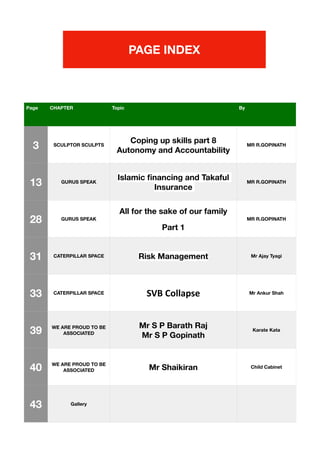
PAGE INDEX
Page CHAPTER Topic By
3 SCULPTOR SCULPTS
Coping up skills part 8
Autonomy and Accountability
MR R.GOPINATH
13 GURUS SPEAK
Islamic
fi
nancing and Takaful
Insurance
MR R.GOPINATH
28 GURUS SPEAK
All for the sake of our family
Part 1
MR R.GOPINATH
31 CATERPILLAR SPACE Risk Management Mr Ajay Tyagi
33 CATERPILLAR SPACE SVB Collapse Mr Ankur Shah
39 WE ARE PROUD TO BE
ASSOCIATED
Mr S P Barath Raj
Mr S P Gopinath
Karate Kata
40 WE ARE PROUD TO BE
ASSOCIATED Mr Shaikiran Child Cabinet
43 Gallery
SCULPTOR INSCRIBES
R.GOPINATH
Page of
1 8
Autonomy and Accountability
R.Gopinath
gopinathr@go-past.com
Autonomy and Accountability are the two sides of the
human coin. One without the other does not pass. We
derive autonomy from the power we have, called as,
“Power to make choices”.
The power to make choices provides individuals with
control over their lives and autonomy to shape their
own destinies. This has a signi
fi
cant impact on
various aspects of life, like relationships, careers and
lifestyle including small and signi
fi
cant decisions that
can shape one’s future.
We must realise that this power to make choices also
brings with it the gift of either enjoying or enduring
the consequences of such choices. We can not
separate the consequences from the acts that we
chose to do. This is how the other side of the human
coin, the Accountability is minted.
Aspects like societal norms, cultural in
fl
uences, legal
frameworks, and economic conditions can in
fl
uence
the available options and constraints within which
choices are made. Additionally, internal factors such
as personal beliefs, biases, emotions, and cognitive
limitations can also impact decision-making.
Page of
2 8
One major factor that in
fl
uences (or even control) this
autonomy of selecting from the options available is
“Habit”. At this point most of the choices exercised
by human are in a
fl
ash, re
fl
ex behaviour.
You take e
ff
orts to create a habit, by repeating that
act numerous times. Then the habit e
ff
ortlessly
repeats to create immense results.
Your conscious mind commands an action. The mind
feels the results of it, and consciously commands a
repetition of it. Then it slips into the sub-conscious
mind to auto command it. It is now called as “Habit”
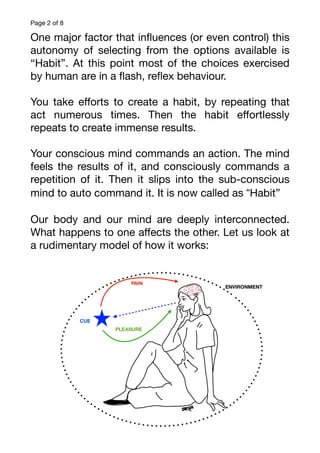
Our body and our mind are deeply interconnected.
What happens to one a
ff
ects the other. Let us look at
a rudimentary model of how it works:
Page of
3 8
Our Conscious mind delivers an instruction to the
body. The body executes the same. While it is doing
so, the sensory organs are active. They receive the
stimuli from the CUE and pass it on to the brain.
Which interprets it and stores that experience. There
can be millions of meanings that the brain will make
of it. But for the purpose of this article, to make it
simple for our understanding, let us classify the
meaning into two categories 1) Pleasure and 2) Pain.
If the signal is interpreted as Pleasure, the conscious
mind will order to repeat such actions. If the signal is
interpreted as Pain the conscious mind will order to
stop it and avoid repeating that action.
Initially the mind is watchful of the signals and
consciously interprets for every repetition of the
action. After many such repetitions the conscious
mind pushes the responsibility of instructing further
actions to the subconscious mind. We have seen
even the previous issues that our subconscious mind
acts as an autopilot. Once this border is crossed that
act (or set of actions) becomes a habit. After this
point every time such CUE appears the body acts in
the same fashion. Sometimes the body starts seeking
that CUE voluntarily so that it can increase the
pleasure felt. At this point it becomes an addiction.
The man becomes a slave of his habit.
Page of
4 8
The Brain rewires itself through a process called
neuroplasticity. With repeated engagement in a
particular behaviour, the brain establishes neural
pathways that strengthen the connections between
relevant brain regions. This makes it easier for the
habit to be activated in response to the cue.
Strong neural connections get attached to the CUE
We have seen the process of how the habits get
formed and how they start dominating our actions.
The big two questions that come to our mind is 1)
Can we change loss making (or Harmful) habits and
2) Can we create gains yielding (or Good) habits?
Yes. Both are possible. The second one is
comparatively easy. But that too, takes conscious
e
ff
orts. Meaning that it is not automatic. While the
fi
rst one is comparatively di
ffi
cult. Meaning that it
needs greater commitment to enforce it.
In enumerating the following steps I am taking simple
examples so as to make this article light reading. But
mind you, these steps are equally e
ff
ective to change
even chronic injurious habits as well.
1) Practice Mindfulness and Self-Awareness:
Develop mindfulness and self-awareness around
your habits. Pay attention to your thoughts,
Page of
5 8
emotions, and urges when the habit arises. By
becoming more conscious of your actions, you
can interrupt the automatic response and make a
deliberate choice to engage in a di
ff
erent
behaviour.
2) Change the CUE: Replace this CUE with another
CUE that can give the same signal (Pleasure). For
example: Mr Suresh is advised not to take sweets
as he is diabetic. His family (Environment) took
care to keep him away from sweets. One day they
had attended a wedding. While Suresh was
passing through the lobby, he smelt the fragrance
of Laddus getting prepared. When the family is
engaged in talking to the relatives, he sneaks out
to the dining hall where the laddus were stacked
to be served for the guests. He looks to his left
and then to the right, no one is watching, picks
one laddu and stu
ff
s it into his mouth, munches it
hurriedly and walks back to the marriage hall.
The chances are he may now feel the urge of
sneaking out again to taste the Laddus.
He can wishfully change the CUE now. He is now
aware that his mind is not seeking the laddu but
some happy feeling. Suppose he shifts his focus
on his friends whom he has met after a long time
and starts chatting with them all the shares those
nostalgic memories or even starts playing with
them some games like cards or even engage in
dancing to music at the reception.. the mind
Page of
6 8
senses this pleasure and gets him engaged in
these activities. New neural connections get
formed and get strongly wired.
3) Create Environmental Changes: Modify your
environment to support the desired habit change.
Remove or rearrange cues that trigger the old
habit, and create reminders or prompts for the
new behaviour. For instance, if you want to
exercise in the morning, set out your workout
clothes and equipment the night before as a
visual reminder. Create a buddy who will walk with
you. Buy some AirPods and select a playlist that
you would hear while you walk.
Share your habit change needs with supportive
friends, family, or a community. Having someone
to hold you accountable and provide
encouragement can greatly increase your
chances of success. Consider joining a support
group or
fi
nding an accountability partner who
shares similar goals.
4) Change the interpretation: of the signal using
your cognitive skills. You have an intelligence that
knows the di
ff
erence between the right and the
wrong. Suppose by doing a wrong thing you
became aware that you are getting a feeling of
pleasure, then short circuit that signal and
develop a feeling of pain. Or if in doing a right
thing you are feeling pain then short circuit that
Page of
7 8
signal and develop a feeling of pleasure. With
practice this can be achieved.
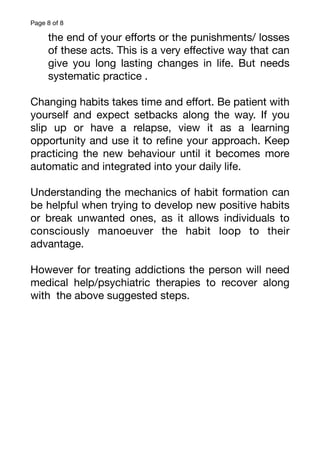
For example doing regular physical exercises.
Look at the picture of the scales down below. If
the scale tilt towards pain (more pain; little
pleasure) then the brain will rewire its neural
connections to avoid repeating that act. Or if the
scale tilt towards pleasure (more pleasure; little
pain) the brain will rewire its neural connections to
repeat that act multiple times.
You can tilt this scale to favour starting a new
habit or getting rid of an old habit in two ways. By
using logic of your education in combination with
your Conscience, which knows the di
ff
erence
between right and wrong to generate the required
will power.
Alternatively, you can use the power of
imagination to live the experience of pleasure at
Page of
8 8
the end of your e
ff
orts or the punishments/ losses
of these acts. This is a very e
ff
ective way that can
give you long lasting changes in life. But needs
systematic practice .
Changing habits takes time and e
ff
ort. Be patient with
yourself and expect setbacks along the way. If you
slip up or have a relapse, view it as a learning
opportunity and use it to re
fi
ne your approach. Keep
practicing the new behaviour until it becomes more
automatic and integrated into your daily life.
Understanding the mechanics of habit formation can
be helpful when trying to develop new positive habits
or break unwanted ones, as it allows individuals to
consciously manoeuver the habit loop to their
advantage.
However for treating addictions the person will need
medical help/psychiatric therapies to recover along
with the above suggested steps.
GURUS SPEAK
R.GOPINATH
ISLAMIC FINANCING AND TAKAFUL INSURANCE
R.GOPINATH
gopinathr@go-past.com
I have been closely associated with Takaful insurance
for almost a decade now. I held the position of
Director on the board of Al Nabooda Insurance
brokers LLC Dubai for 4 years and then I held the
position of Independent Director on the board of
Amana Takaful Life Insurance PLC Sri Lanka and also
as Independent Director on the board of Amana
Takaful General Insurance PLC Sri Lanka for almost
10 years.
During these periods I was engaged in (apart from the
policy making role at the board level) training the
operations team, marketing team. I also had the
privilege of supervising the designing the
fi
rst ULIP
product in Sri Lanka which is totally complying with
the Shariah rules.
During these days I was closely working with the
regulators and the Shariah committees
fi
ne-tuning the
features of the products, its features and the
guarantees.
Takaful life insurance, also known as Islamic life
insurance, operates based on the principles of
Islamic
fi
nance. It provides
fi
nancial protection and
bene
fi
ts to Participants (policyholders) in a manner
that complies with Islamic Shariah law.
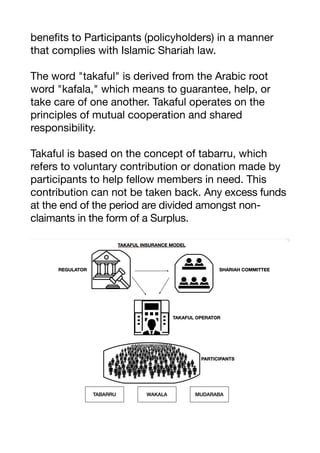
The word "takaful" is derived from the Arabic root
word "kafala," which means to guarantee, help, or
take care of one another. Takaful operates on the
principles of mutual cooperation and shared
responsibility.
Takaful is based on the concept of tabarru, which
refers to voluntary contribution or donation made by
participants to help fellow members in need. This
contribution can not be taken back. Any excess funds
at the end of the period are divided amongst non-
claimants in the form of a Surplus.
1) Participants (Policy holders):
Takaful involves participants who enter into a contract
to mutually provide financial support to one another in
case of defined losses or risks. Participants can be
individuals, businesses, or organizations seeking
insurance coverage.
Participants are provided coverage against various
risks, such as death, disability, or critical illness,
depending on the type of Takaful plan chosen. In the
event of a covered loss, the Takaful fund is used to pay
the benefits or claims to the affected participant or their
beneficiaries.
2) Operator
The insurance Company is referred to as an “Operator”,
who is contractually an agent “Wakil” of the Participant.
The Operator is only entitled to a fee from the
contributions (Wakalah fee) and / or share of the
investment returns (Mudarabah share) as remuneration.
Tabarru: A portion of the participant's contribution is
considered a charitable donation, known as Tabarru.
This amount is voluntarily given by participants to help
fellow members in times of need. Tabarru refers to the
voluntary donation or gift made by participants, which
serves as a means of solidarity and assistance within
the takaful community.
Wakala and Mudaraba: To manage the takaful fund, the
takaful operator may enter into a contract with
participants based on two models: wakala and
mudaraba.
Wakala Model: Under the wakala model, the operator
acts as an agent and charges a management fee for its
services. The fee is typically a percentage of the
contributions, covering administrative and operational
expenses.
Mudaraba Model: In the mudaraba model, the
operator acts as a mudarib (entrepreneur) on behalf of
the participants. The operator takes a share of any
surplus generated from the takaful operations, but it
also bears a portion of the losses, creating a shared-
risk partnership.
Underwriting and Risk Assessment: Takaful operators
evaluate and assess the risks associated with providing
coverage to participants. This involves underwriting
processes, such as risk profiling, determining coverage
terms, setting contribution rates, and establishing
reserves to cover potential claims
Basic Family Takaful policies involve a Participants
Investment Accounts (PIA), which is essentially a
savings made by the Operator out of the Participants
contributions. Unlike the Tabarru contributions, this
fund belongs to the Participant and plays a dual role.
a. Makes up the policy benefits in the event of a
claim, together with the payment from the Tabarru fund.
b. Drives the Maturity value of the policy, together with
the investment income share from the funds.
Though earlier days policies were not permitted to carry
a guaranteed sum assured, modern day Family Takaful
policies carry a Basic Sum Cover that is linked to the
Annual premium and tenure of the policy. However,
maturity benefits are not guaranteed.
3) Shariah Compliance:
Takaful operations must adhere to Shariah principles,
which include avoiding interest (riba), uncertainty
(gharar), and gambling (maysir). Shariah boards or
committees oversee the takaful operations to ensure
compliance with these principles.
4) Permissible Investments:
Takaful funds are to be invested in Shariah-compliant
investment avenues.
Common investment options include:
- Equity Investments: Investing in shares of
companies that meet Shariah criteria, such as avoiding
businesses related to prohibited activities.
- Sukuk: Investing in Islamic bonds that comply with
Shariah principles.
- Real Estate: Investing in income-generating
properties that comply with Shariah requirements.
- Islamic Funds: Investing in Shariah-compliant
mutual funds or investment funds managed by
specialized Islamic financial institutions.
5) The role of an actuary
The role of an actuary in Takaful insurance models is
crucial for ensuring the
fi
nancial sustainability and
stability of the takaful operations. Actuaries apply
their expertise in risk assessment, mathematical
modeling, and statistical analysis to support various
aspects of takaful operations. Here are some key
roles and responsibilities of an actuary in the context
of Takaful:
1. Risk Assessment: Actuaries assess the risks
associated with takaful coverage and determine the
appropriate pricing and contribution rates. They
analyze historical data, conduct statistical modeling,
and consider factors such as mortality, morbidity, loss
ratios, and investment returns to estimate the
likelihood and magnitude of potential losses. They
make recommendations to manage risks e
ff
ectively
steps to ensure the
fi
nancial soundness,
sustainability, and fair pricing of takaful products,
thereby ensuring the long-term viability of the takaful
operations.
2. Product Development: Actuaries play a role in the
development of takaful products and policies. They
help design and structure new coverage o
ff
erings by
considering the risk exposure,
fi
nancial implications,
and the overall viability of the product within the
takaful framework.
3. Financial Modeling: Actuaries create
fi
nancial
models to evaluate the
fi
nancial performance and
sustainability of the takaful operations. They analyze
the impact of di
ff
erent scenarios, including claims
experience, investment returns, and expense levels,
to assess the solvency, pro
fi
tability, and risk exposure
of the takaful fund.
4. Reserving and Provisioning: Actuaries determine
the appropriate reserves and provisions that need to
be set aside to cover potential claims and liabilities.
They consider factors like expected claims,
outstanding claims, and future claim development
patterns to ensure adequate funds are available for
meeting obligations.
5. Surplus Distribution: Actuaries may be involved in
determining the surplus distribution mechanisms
among takaful participants. They analyze the fund's
fi
nancial performance, surplus amounts, and
participant contribution levels to recommend fair and
equitable distribution formulas.
6. Compliance and Regulation: Actuaries ensure
compliance with regulatory requirements and Shariah
principles in the design and operation of takaful
products. They work closely with Shariah boards or
committees to ensure that actuarial practices align
with Islamic ethical standards.
6) Salient features of Islamic Financing
1. Prohibition of Riba: Islamic finance strictly prohibits
the charging or payment of interest (riba). Instead, it
emphasizes profit-sharing, equity-based arrangements,
and asset-backed transactions.
2. Risk Sharing: Islamic finance encourages the sharing
of risks and rewards between the parties involved in a
financial transaction. Instead of fixed returns, profits
and losses are shared based on the agreed-upon
terms.
3. Asset-Backed Financing: Islamic finance promotes
the concept of tangible asset backing. Financing should
be linked to real assets or economic activities, ensuring
transparency and promoting productive investment.
4. Prohibition of Prohibited Activities: Islamic finance
avoids investments in activities deemed harmful or
prohibited in Islam, Conventional banking and Riba
based businesses, Entertainment, Arms and
Ammunition, Drugs, Alcohol and brewery and Gambling
and other activities contrary to Islamic ethical
standards.
5. Compliance with Shariah Principles: Islamic financing
is guided by the principles and rulings of Shariah.
Shariah boards or committees consisting of Islamic
scholars provide guidance and ensure compliance with
Islamic ethical standards.
6. Contracts and Structures: Islamic finance utilizes
specific contracts and structures that comply with
Shariah principles. These include Mudaraba (profit-
sharing partnership), Musharaka (joint venture),
Murabaha (cost-plus financing), Ijarah (leasing), Sukuk
(Islamic bonds), and others.
7. Ethical Investment: Islamic finance promotes socially
responsible and ethical investment practices.
Investments should align with ethical and moral values,
taking into consideration environmental, social, and
governance (ESG) factors.
8. Shariah Governance: Islamic financial institutions
have dedicated Shariah boards or committees that
oversee the compliance of their products, services, and
operations with Shariah principles. These boards
provide ongoing guidance and supervision to ensure
compliance.
Islamic financing has gained recognition and popularity
globally, with Islamic banks, financial institutions, and
specialized funds offering a wide range of Shariah-
compliant products and services. The principles of
Islamic finance aim to create a just and equitable
financial system that promotes economic stability,
ethical conduct, and responsible investment practices.
Sukuk:
Sukuk, also known as Islamic bonds, are financial
instruments used in Islamic finance. Sukuk represent
ownership or beneficial interest in an underlying asset
or project rather than the traditional interest-bearing
debt instruments of conventional bonds. Here's an
overview of how sukuk work:
1. Structure: Sukuk are structured to comply with
Islamic principles, which prohibit interest (riba) and
speculative activities. Instead of earning interest, sukuk
holders receive a share in the profits generated by the
underlying assets or project.
2. Asset Ownership: Sukuk are based on the concept of
asset ownership. The issuer of sukuk (often a
government, corporation, or special purpose vehicle)
sells a proportionate ownership interest in an underlying
asset or a project to investors.
3. Asset Backing: The underlying asset can vary and
may include tangible assets such as real estate,
infrastructure projects, commodities, or even future
cash flows from specific business activities. The sukuk
holders have a share in the ownership of these assets,
which provides them with rights and entitlements.
4. Certificates: Sukuk are issued as certificates
representing the ownership interest in the underlying
asset or project. These certificates are tradable and
transferable.
5. Rental Income or Profit Sharing: Instead of interest
payments, sukuk holders receive returns in the form of
rental income, profit sharing, or other similar structures.
The returns are derived from the income generated by
the underlying asset or project.
6. Sukuk Issuance Process: The issuance process of
sukuk involves several steps:
- Identification of the underlying asset or project.
- Establishment of a special purpose vehicle (SPV) to
hold the asset or manage the project.
- Transfer of the ownership rights to the SPV.
- Issuance of sukuk certificates representing the
ownership rights and entitlements to investors.
- Sukuk are typically offered through an auction,
private placement, or public offering.
7. Periodic Income Distribution: Sukuk may provide
periodic income distributions to the sukuk holders,
depending on the structure. For example, if the
underlying asset generates rental income, the sukuk
holders may receive regular rental payments.
8. Redemption: Sukuk have a maturity date, and upon
maturity, the issuer redeems the sukuk certificates at
their face value or according to the agreed terms. The
redemption can be done through the sale of the
underlying asset, the liquidation of the project, or other
predetermined mechanisms.
It's important to note that the specific structure and
terms of sukuk can vary. The Shariah compliance and
approval of sukuk structures are overseen by Shariah
boards or committees, ensuring adherence to Islamic
principles.
Sukuk have gained popularity as an Islamic financing
instrument, allowing entities to raise capital while
complying with Islamic finance principles. They provide
investors with an opportunity to participate in income-
generating assets and projects, while offering issuers
an alternative source of funding beyond conventional
debt instruments.
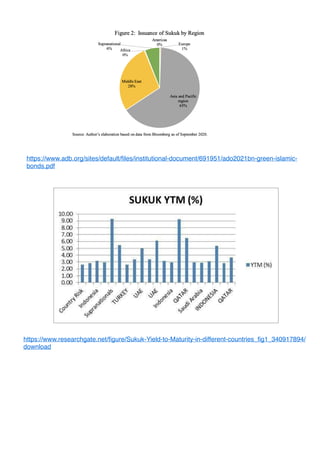
https://www.adb.org/sites/default/
fi
les/institutional-document/691951/ado2021bn-green-islamic-
bonds.pdf
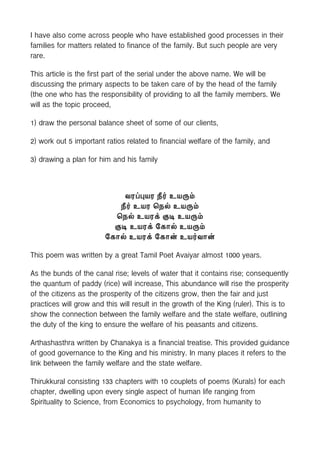
https://www.researchgate.net/
fi
gure/Sukuk-Yield-to-Maturity-in-different-countries_
fi
g1_340917894/
download
GURUS SPEAK
R.GOPINATH
“All for the sake of our family”
PART 1
R. GOPINATH
gopinathr@go-past.com
“The family should be established and run on a sound business basis. It should
be protected against needless bankruptcy”.
PROF SOLOMON. S. HUEBNER
Business and Family are like the two eyes to any businessmen. But the amount
of prudence he exercises in managing the finance of his business right from the
accounting process, budgeting, using scientific tools to arrive at conclusions are
not done in respect of the finance the family needs. But internally men feel that
it is the family for which he is working hard so much in his business.
He has a team of experts like CAs, CFOs and Analysts to support him to well
manage the financial aspects of his business, on his personal and family side it
is the financial planner who does all these roles bundled into one, the Financial
Planner.
In working with persons from various professions, holding various positions, for
the last almost 4 decades, I have understood how crucial is the role of financial
planners for them and their families. I have many time been surprised to
understand the financial acumen of such individuals when it comes to their
businesses, but haven’t used that to take care of their families. Sometimes the
apathy was very obvious. One of our client when we met him first time about 30
years before admired him for his extremely sound financial management
knowledge and also his financial discipline in running his business. But
astonishingly his family finances were in a mess. There were many investments
he had bought for his family but did not continue them to complete its term. He
was in a grave debt position. Even some of his cheques given to some service
providers including banks have bounced, for many reasons. The family doesn’t
know about their present delicate financial position.
I have also come across people who have established good processes in their
families for matters related to finance of the family. But such people are very
rare.
This article is the first part of the serial under the above name. We will be
discussing the primary aspects to be taken care of by the head of the family
(the one who has the responsibility of providing to all the family members. We
will as the topic proceed,
1) draw the personal balance sheet of some of our clients,
2) work out 5 important ratios related to financial welfare of the family, and
3) drawing a plan for him and his family
வர
ப்பு
யர
நீ
ர்
உய
ரு
ம்
நீ
ர்
உயர ெந
ல்
உய
ரு
ம்
ெந
ல்
உயர
க்
கு
டி
உய
ரு
ம்
கு
டி
உயர
க்
கோ
ல்
உய
ரு
ம்
கோ
ல்
உயர
க்
கோ
ன்
உய
ர்வா
ன்
This poem was written by a great Tamil Poet Avaiyar almost 1000 years.
As the bunds of the canal rise; levels of water that it contains rise; consequently
the quantum of paddy (rice) will increase, This abundance will rise the prosperity
of the citizens as the prosperity of the citizens grow, then the fair and just
practices will grow and this will result in the growth of the King (ruler). This is to
show the connection between the family welfare and the state welfare, outlining
the duty of the king to ensure the welfare of his peasants and citizens.
Arthashasthra written by Chanakya is a financial treatise. This provided guidance
of good governance to the King and his ministry. In many places it refers to the
link between the family welfare and the state welfare.
Thirukkural consisting 133 chapters with 10 couplets of poems (Kurals) for each
chapter, dwelling upon every single aspect of human life ranging from
Spirituality to Science, from Economics to psychology, from humanity to
governance, also enshrines the connection between Family welfare and the
state welfare in many of its Kurals.
Just like the state’s economy runs on the income generated by way of taxes,
levies and dividends, and businesses run on the income generated by way of its
sales and services, a family is run by the income generated by the earners for
the family, mostly the father and in many cases mother also. There can be other
sources of income to the family, but in most of the cases occupational income
is the biggest source (if not the only source).
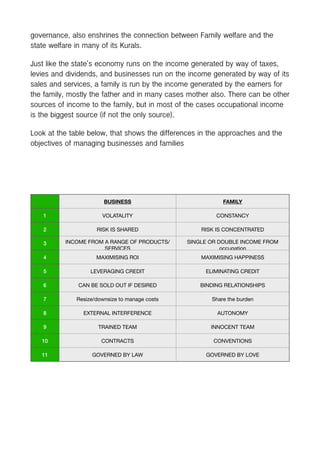
Look at the table below, that shows the differences in the approaches and the
objectives of managing businesses and families
BUSINESS FAMILY
1 VOLATALITY CONSTANCY
2 RISK IS SHARED RISK IS CONCENTRATED
3 INCOME FROM A RANGE OF PRODUCTS/
SERVICES
SINGLE OR DOUBLE INCOME FROM
occupation
4 MAXIMISING ROI MAXIMISING HAPPINESS
5 LEVERAGING CREDIT ELIMINATING CREDIT
6 CAN BE SOLD OUT IF DESIRED BINDING RELATIONSHIPS
7 Resize/downsize to manage costs Share the burden
8 EXTERNAL INTERFERENCE AUTONOMY
9 TRAINED TEAM INNOCENT TEAM
10 CONTRACTS CONVENTIONS
11 GOVERNED BY LAW GOVERNED BY LOVE
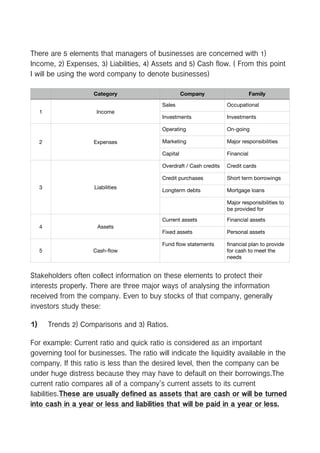
There are 5 elements that managers of businesses are concerned with 1)
Income, 2) Expenses, 3) Liabilities, 4) Assets and 5) Cash flow. ( From this point
I will be using the word company to denote businesses)
Stakeholders often collect information on these elements to protect their
interests properly. There are three major ways of analysing the information
received from the company. Even to buy stocks of that company, generally
investors study these:
1) Trends 2) Comparisons and 3) Ratios.
For example: Current ratio and quick ratio is considered as an important
governing tool for businesses. The ratio will indicate the liquidity available in the
company. If this ratio is less than the desired level, then the company can be
under huge distress because they may have to default on their borrowings.The
current ratio compares all of a company’s current assets to its current
liabilities.These are usually defined as assets that are cash or will be turned
into cash in a year or less and liabilities that will be paid in a year or less.
Category Company Family
1 Income
Sales Occupational
Investments Investments
2 Expenses
Operating On-going
Marketing Major responsibilities
Capital Financial
3 Liabilities
Overdraft / Cash credits Credit cards
Credit purchases Short term borrowings
Longterm debts Mortgage loans
Major responsibilities to
be provided for
4 Assets
Current assets Financial assets
Fixed assets Personal assets
5 Cash-
fl
ow
Fund
fl
ow statements
fi
nancial plan to provide
for cash to meet the
needs
A good current ratio is between 1.2 to 2, which means that the business has 2
times more current assets than liabilities to covers its debts. A current ratio
below 1 means that the company doesn't have enough liquid assets to cover its
short-term liabilities. ( While this is the general rule, we need to see the history
of that company and also its comparative standing in that industry)
There can be such ratios arrived for Families also so that they can avoid
distress situations or defaulting on their repayment schedule of their borrowings.
One more example of good governance by analysing the ratios involved is DTI
that is the percentage of a person’s gross monthly income that goes to paying
his monthly debt payments. This ratio is used both for Businesses and for
families as well.
This ratio will decide his and his family’s future welfare. This will indicate to the
financial planner how urgently we need to restructure the family’s debt
exposure. Look at the following examples:
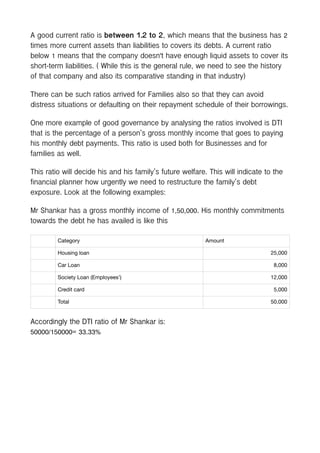
Mr Shankar has a gross monthly income of 1,50,000. His monthly commitments
towards the debt he has availed is like this
Accordingly the DTI ratio of Mr Shankar is:
50000/150000= 33.33%
Category Amount
Housing loan 25,000
Car Loan 8,000
Society Loan (Employees’) 12,000
Credit card 5,000
Total 50,000
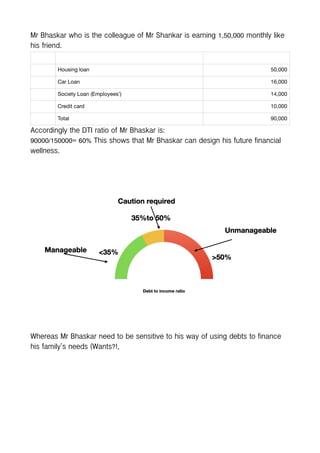
Mr Bhaskar who is the colleague of Mr Shankar is earning 1,50,000 monthly like
his friend.
Accordingly the DTI ratio of Mr Bhaskar is:
90000/150000= 60% This shows that Mr Bhaskar can design his future financial
wellness.
Whereas Mr Bhaskar need to be sensitive to his way of using debts to finance
his family’s needs (Wants?!,
Housing loan 50,000
Car Loan 16,000
Society Loan (Employees’) 14,000
Credit card 10,000
Total 90,000
CATERPILLAR SPACE
Mr Ajay Tyagi
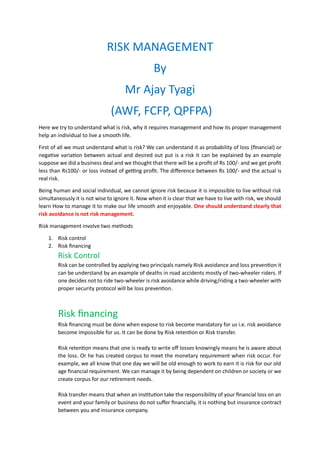
RISK MANAGEMENT
By
Mr Ajay Tyagi
(AWF, FCFP, QPFPA)
Here we try to understand what is risk, why it requires management and how its proper management
help an individual to live a smooth life.
First of all we must understand what is risk? We can understand it as probability of loss (financial) or
negative variation between actual and desired out put is a risk it can be explained by an example
suppose we did a business deal and we thought that there will be a profit of Rs 100/- and we get profit
less than Rs100/- or loss instead of getting profit. The difference between Rs 100/- and the actual is
real risk.
Being human and social individual, we cannot ignore risk because it is impossible to live without risk
simultaneously it is not wise to ignore it. Now when it is clear that we have to live with risk, we should
learn How to manage it to make our life smooth and enjoyable. One should understand clearly that
risk avoidance is not risk management.
Risk management involve two methods
1. Risk control
2. Risk financing
Risk Control
Risk can be controlled by applying two principals namely Risk avoidance and loss prevention it
can be understand by an example of deaths in road accidents mostly of two-wheeler riders. If
one decides not to ride two-wheeler is risk avoidance while driving/riding a two-wheeler with
proper security protocol will be loss prevention.
Risk financing
Risk financing must be done when expose to risk become mandatory for us i.e. risk avoidance
become impossible for us. It can be done by Risk retention or Risk transfer.
Risk retention means that one is ready to write off losses knowingly means he is aware about
the loss. Or he has created corpus to meet the monetary requirement when risk occur. For
example, we all know that one day we will be old enough to work to earn it is risk for our old
age financial requirement. We can manage it by being dependent on children or society or we
create corpus for our retirement needs.
Risk transfer means that when an institution take the responsibility of your financial loss on an
event and your family or business do not suffer financially, it is nothing but insurance contract
between you and insurance company.
On the conclusion we find that we must see the frequency and severity of the risk and manage
it accordingly. Generally, risk which are sever in nature are not frequent i.e., it happens once
or twice in life time like death, disability and critical illness. We must transfer the risk of this
category by taking adequate insurance coverage. Also, requirement like our old age provision
must be manged by creating corpus in substantial as required. Rest risk should mange by risk
avoidance and loss prevention accordingly.
CATERPILLAR SPACE
Mr Ankur Shah
SILICON VALLEY BANK COLLAPSE
Before going through Silicon Valley Bank Collapse reasons lets understand some necessary
technical things like Systemic Risk, Systematic Risk, Macaulay Duration, Modified Duration. How
does Macaulay duration and modified duration affect bonds with change in interest rates. Dodd
Frank Act.
Systemic risk is the risk of collapse of an entire financial system or entire financial market,
as opposed to risk associated with any one individual entity, group or component of a system,
that can be contained therein without harming the entire system.
Systematic risk sometimes plainly called market risk; systematic risk is the risk inherent in
the aggregate market that cannot be solved by diversification. Some common sources of market
risk are recessions, wars, interest rates and others that cannot be avoided through a diversified
portfolio. Though systematic risk cannot be fixed with diversification, it can be hedged.
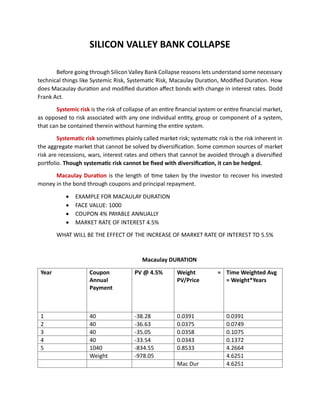
Macaulay Duration is the length of time taken by the investor to recover his invested
money in the bond through coupons and principal repayment.
• EXAMPLE FOR MACAULAY DURATION
• FACE VALUE: 1000
• COUPON 4% PAYABLE ANNUALLY
• MARKET RATE OF INTEREST 4.5%
WHAT WILL BE THE EFFECT OF THE INCREASE OF MARKET RATE OF INTEREST TO 5.5%
Macaulay DURATION
Year Coupon
Annual
Payment
PV @ 4.5% Weight =
PV/Price
Time Weighted Avg
= Weight*Years
1 40 -38.28 0.0391 0.0391
2 40 -36.63 0.0375 0.0749
3 40 -35.05 0.0358 0.1075
4 40 -33.54 0.0343 0.1372
5 1040 -834.55 0.8533 4.2664
Weight -978.05 4.6251
Mac Dur 4.6251
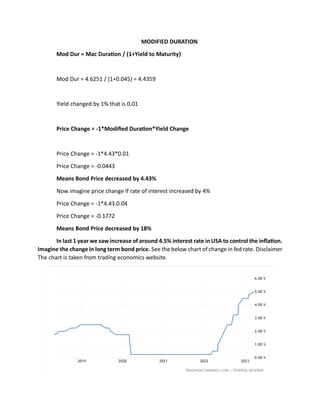
MODIFIED DURATION
Mod Dur = Mac Duration / (1+Yield to Maturity)
Mod Dur = 4.6251 / (1+0.045) = 4.4359
Yield changed by 1% that is 0.01
Price Change = -1*Modified Duration*Yield Change
Price Change = -1*4.43*0.01
Price Change = -0.0443
Means Bond Price decreased by 4.43%
Now imagine price change if rate of interest increased by 4%
Price Change = -1*4.43.0.04
Price Change = -0.1772
Means Bond Price decreased by 18%
In last 1 year we saw increase of around 4.5% interest rate in USA to control the inflation.
Imagine the change in long term bond price. See the below chart of change in fed rate. Disclaimer
The chart is taken from trading economics website.
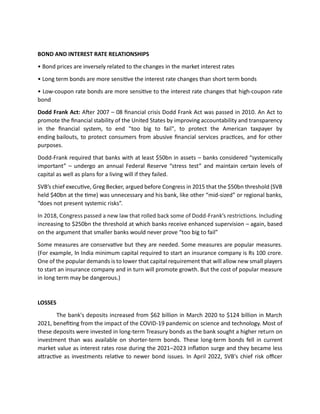
BOND AND INTEREST RATE RELATIONSHIPS
• Bond prices are inversely related to the changes in the market interest rates
• Long term bonds are more sensitive the interest rate changes than short term bonds
• Low-coupon rate bonds are more sensitive to the interest rate changes that high-coupon rate
bond
Dodd Frank Act: After 2007 – 08 financial crisis Dodd Frank Act was passed in 2010. An Act to
promote the financial stability of the United States by improving accountability and transparency
in the financial system, to end "too big to fail", to protect the American taxpayer by
ending bailouts, to protect consumers from abusive financial services practices, and for other
purposes.
Dodd-Frank required that banks with at least $50bn in assets – banks considered “systemically
important” – undergo an annual Federal Reserve “stress test” and maintain certain levels of
capital as well as plans for a living will if they failed.
SVB’s chief executive, Greg Becker, argued before Congress in 2015 that the $50bn threshold (SVB
held $40bn at the time) was unnecessary and his bank, like other “mid-sized” or regional banks,
“does not present systemic risks”.
In 2018, Congress passed a new law that rolled back some of Dodd-Frank’s restrictions. Including
increasing to $250bn the threshold at which banks receive enhanced supervision – again, based
on the argument that smaller banks would never prove “too big to fail”
Some measures are conservative but they are needed. Some measures are popular measures.
(For example, In India minimum capital required to start an insurance company is Rs 100 crore.
One of the popular demands is to lower that capital requirement that will allow new small players
to start an insurance company and in turn will promote growth. But the cost of popular measure
in long term may be dangerous.)
LOSSES
The bank's deposits increased from $62 billion in March 2020 to $124 billion in March
2021, benefiting from the impact of the COVID-19 pandemic on science and technology. Most of
these deposits were invested in long-term Treasury bonds as the bank sought a higher return on
investment than was available on shorter-term bonds. These long-term bonds fell in current
market value as interest rates rose during the 2021–2023 inflation surge and they became less
attractive as investments relative to newer bond issues. In April 2022, SVB's chief risk officer
stepped down, and a successor was not named until January 2023—a period coinciding with the
period of interest rate increases.
At the end of 2022, the bank had a $117 billion bond portfolio, divided into a $91.3 billion held-
to-maturity portfolio (meaning it was not marked to market and profits or losses would not be
realized until maturity) and a $26 billion available-for-sale portfolio (which as the name implies
was marked to market). At that point in time, its marked-to-market unrealized losses for securities
held to maturity exceeded $15 billion. The bank did not hedge against interest rate risk on that
part of its bond portfolio, apparently for the same reason that most banks do not: the hedge itself
would bounce around with the market, while the point of holding bonds to maturity is to hold
them at par. Most banks minimize interest rate risk in their held-to-maturity portfolios by buying
shorter-term bonds. The bank did hedge against interest rate risk on its available-for-sale portfolio
by building up a portfolio of $15.2 billion of interest rate swaps by the end of 2021.
At the same time, startup companies withdrew deposits from the bank to fund their operations
as private financing became harder to come by. A series of layoffs in the technology sector that
began in 2022 also caused depositors to draw down their savings. During the first half of 2022,
the bank realized $517 million in gains by unwinding $11 billion of its interest rate swaps on its
available-for-sale bond portfolio. By the end of the year, it had only $563 million in swaps
protecting that portfolio. In early 2023, to raise needed cash to fund withdrawals, the bank sold
all of its available-for-sale securities, realizing a $1.8 billion loss. The bank was criticized for timing
its announcement shortly after Silvergate Bank, which catered to cryptocurrency users, started
winding down its operations, and for not lining up private funding ahead of the announcement.
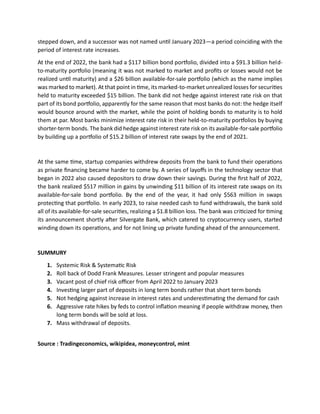
SUMMURY
1. Systemic Risk & Systematic Risk
2. Roll back of Dodd Frank Measures. Lesser stringent and popular measures
3. Vacant post of chief risk officer from April 2022 to January 2023
4. Investing larger part of deposits in long term bonds rather that short term bonds
5. Not hedging against increase in interest rates and underestimating the demand for cash
6. Aggressive rate hikes by feds to control inflation meaning if people withdraw money, then
long term bonds will be sold at loss.
7. Mass withdrawal of deposits.
Source : Tradingeconomics, wikipidea, moneycontrol, mint
PROUD TO BE
ASSOCIATED
Master SP.Barath Raj & SP.Gopinath proud children of Mr.
Pugazhnambi & Mrs. P. Sudha (LICAgents) are the students of Zenskar
Healing Martial Art developed by( Grand Master, Dr. K.P. Gunaneethi
M.D). performed Karate Kata for 1 hour continuously on the
international Yoga Day 21.06.2023 conducted by The Mahamaharishi
Foundation at YMCA, Nandanam, Chennai. and got placed in the
Golden Book of World Record.
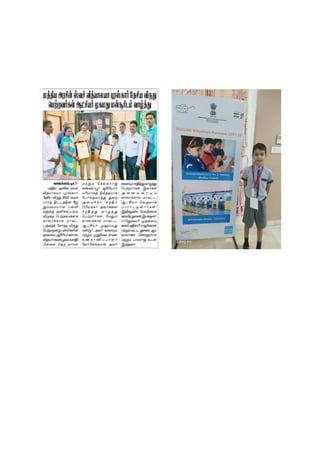
PROUD TO BE
ASSOCIATED
Master Shaikiran student & School Pupil Leader of GPS Poovam Karaikal
– Pondicherry. A proud son of Mr. Vasanthan & Mrs. Soundaranayaki (LIC
Agent ) The leadership quality within him has elevated to lead the Child Cabinet
at his school. Holding the prestigious responsibility as the Prime Minister of the
Child Cabinet he appointed Educational Minister, Minister of Youth Affairs &
Sports , Agriculture Minister, Environment Minister, Health Minister etc. By
conducting various special activities and the performance of his team made the
school to achieve the SWACHH VIDYALAYA PURASKAR 2021 22
National Award with cash prize of ₹ 60,000
Appreciating student Shaikiran who was a great help in this, have received
appreciations from the Honourable Governor, Hon'ble Chief Minister, District
Collector Education Secretary and Director of Education Department. The
Honourable Governor Dr. Tamilisai Soundarrajan was not only amazed at the
activities of the Child Cabinet led by him but also praised the student. He has
also participated in many district level competitions and won prizes for the
school.
NEWS AND GALLERY
EVENTS AT GOPAST
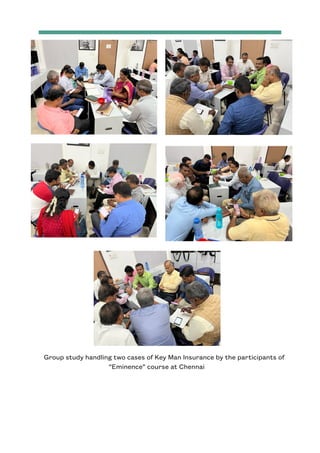
Group study handling two cases of Key Man Insurance by the participants of
“Eminence” course at Chennai
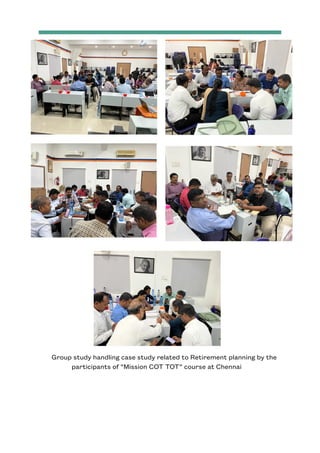
Group study handling case study related to Retirement planning by the
participants of “Mission COT TOT” course at Chennai
Group study handling two cases of Key Man Insurance by the participants of
“Transformer” course for LISC Kolkata.
Group study handling two cases of Key Man Insurance by the participants of
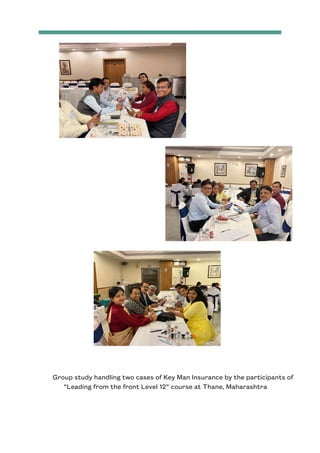
“Leading from the front Level 12” course at Thane, Maharashtra
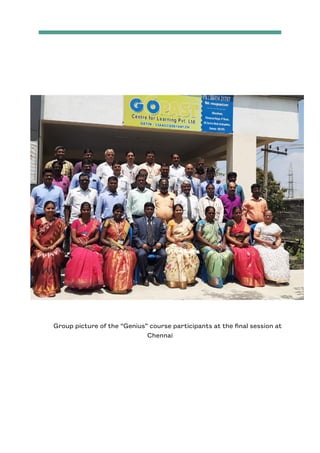
Group picture of the “Genius” course participants at the
fi
nal session at
Chennai
6
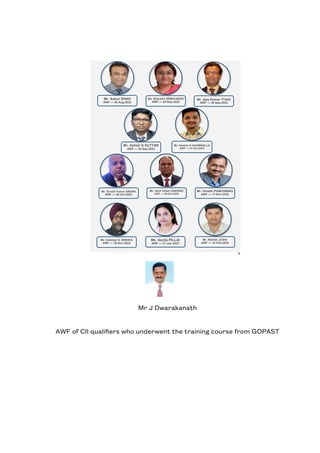
Mr. Ankur SHAH
AWF — 28-Aug-2022
Ms. Bharathi SRINIVASAN
AWF — 29-Sep-2022
Mr. Ajay Kumar TYAGI
AWF — 30-Sep-2022
Mr. Ashok G SUTTAR
AWF — 30-Sep-2022
Mr. Keshav H AGARWALLA
AWF — 07-Oct-2022
Mr. Suresh Kumar ARORA
AWF — 09-Oct-2022
Mr. Amit Uttam SARANG
AWF — 29-Oct-2022
Mr. Umesh PANCHWAG
AWF — 17-Nov-2022
Mr. Inderpal S. BINDRA
AWF — 30-Nov-2022
Ms. Savita PILLAI
AWF — 27-Jan-2023
Mr. Nishith JOSHI
AWF — 18-Feb-2023
May-Jun 2023
INGENIOUS
Mr J Dwarakanath
AWF of CII quali
fi
ers who underwent the training course from GOPAST

Inscriptions 42.pdf

  • 1.
    Inscriptions 42 TRUTH STAYSFOREVER JULY 2023 A MAGAZINE FROM THE GOPAST
  • 2.
    PAGE INDEX Page CHAPTERTopic By 3 SCULPTOR SCULPTS Coping up skills part 8 Autonomy and Accountability MR R.GOPINATH 13 GURUS SPEAK Islamic fi nancing and Takaful Insurance MR R.GOPINATH 28 GURUS SPEAK All for the sake of our family Part 1 MR R.GOPINATH 31 CATERPILLAR SPACE Risk Management Mr Ajay Tyagi 33 CATERPILLAR SPACE SVB Collapse Mr Ankur Shah 39 WE ARE PROUD TO BE ASSOCIATED Mr S P Barath Raj Mr S P Gopinath Karate Kata 40 WE ARE PROUD TO BE ASSOCIATED Mr Shaikiran Child Cabinet 43 Gallery
  • 3.
  • 4.
    Page of 1 8 Autonomyand Accountability R.Gopinath gopinathr@go-past.com Autonomy and Accountability are the two sides of the human coin. One without the other does not pass. We derive autonomy from the power we have, called as, “Power to make choices”. The power to make choices provides individuals with control over their lives and autonomy to shape their own destinies. This has a signi fi cant impact on various aspects of life, like relationships, careers and lifestyle including small and signi fi cant decisions that can shape one’s future. We must realise that this power to make choices also brings with it the gift of either enjoying or enduring the consequences of such choices. We can not separate the consequences from the acts that we chose to do. This is how the other side of the human coin, the Accountability is minted. Aspects like societal norms, cultural in fl uences, legal frameworks, and economic conditions can in fl uence the available options and constraints within which choices are made. Additionally, internal factors such as personal beliefs, biases, emotions, and cognitive limitations can also impact decision-making.
  • 5.
    Page of 2 8 Onemajor factor that in fl uences (or even control) this autonomy of selecting from the options available is “Habit”. At this point most of the choices exercised by human are in a fl ash, re fl ex behaviour. You take e ff orts to create a habit, by repeating that act numerous times. Then the habit e ff ortlessly repeats to create immense results. Your conscious mind commands an action. The mind feels the results of it, and consciously commands a repetition of it. Then it slips into the sub-conscious mind to auto command it. It is now called as “Habit” Our body and our mind are deeply interconnected. What happens to one a ff ects the other. Let us look at a rudimentary model of how it works:
  • 6.
    Page of 3 8 OurConscious mind delivers an instruction to the body. The body executes the same. While it is doing so, the sensory organs are active. They receive the stimuli from the CUE and pass it on to the brain. Which interprets it and stores that experience. There can be millions of meanings that the brain will make of it. But for the purpose of this article, to make it simple for our understanding, let us classify the meaning into two categories 1) Pleasure and 2) Pain. If the signal is interpreted as Pleasure, the conscious mind will order to repeat such actions. If the signal is interpreted as Pain the conscious mind will order to stop it and avoid repeating that action. Initially the mind is watchful of the signals and consciously interprets for every repetition of the action. After many such repetitions the conscious mind pushes the responsibility of instructing further actions to the subconscious mind. We have seen even the previous issues that our subconscious mind acts as an autopilot. Once this border is crossed that act (or set of actions) becomes a habit. After this point every time such CUE appears the body acts in the same fashion. Sometimes the body starts seeking that CUE voluntarily so that it can increase the pleasure felt. At this point it becomes an addiction. The man becomes a slave of his habit.
  • 7.
    Page of 4 8 TheBrain rewires itself through a process called neuroplasticity. With repeated engagement in a particular behaviour, the brain establishes neural pathways that strengthen the connections between relevant brain regions. This makes it easier for the habit to be activated in response to the cue. Strong neural connections get attached to the CUE We have seen the process of how the habits get formed and how they start dominating our actions. The big two questions that come to our mind is 1) Can we change loss making (or Harmful) habits and 2) Can we create gains yielding (or Good) habits? Yes. Both are possible. The second one is comparatively easy. But that too, takes conscious e ff orts. Meaning that it is not automatic. While the fi rst one is comparatively di ffi cult. Meaning that it needs greater commitment to enforce it. In enumerating the following steps I am taking simple examples so as to make this article light reading. But mind you, these steps are equally e ff ective to change even chronic injurious habits as well. 1) Practice Mindfulness and Self-Awareness: Develop mindfulness and self-awareness around your habits. Pay attention to your thoughts,
  • 8.
    Page of 5 8 emotions,and urges when the habit arises. By becoming more conscious of your actions, you can interrupt the automatic response and make a deliberate choice to engage in a di ff erent behaviour. 2) Change the CUE: Replace this CUE with another CUE that can give the same signal (Pleasure). For example: Mr Suresh is advised not to take sweets as he is diabetic. His family (Environment) took care to keep him away from sweets. One day they had attended a wedding. While Suresh was passing through the lobby, he smelt the fragrance of Laddus getting prepared. When the family is engaged in talking to the relatives, he sneaks out to the dining hall where the laddus were stacked to be served for the guests. He looks to his left and then to the right, no one is watching, picks one laddu and stu ff s it into his mouth, munches it hurriedly and walks back to the marriage hall. The chances are he may now feel the urge of sneaking out again to taste the Laddus. He can wishfully change the CUE now. He is now aware that his mind is not seeking the laddu but some happy feeling. Suppose he shifts his focus on his friends whom he has met after a long time and starts chatting with them all the shares those nostalgic memories or even starts playing with them some games like cards or even engage in dancing to music at the reception.. the mind
  • 9.
    Page of 6 8 sensesthis pleasure and gets him engaged in these activities. New neural connections get formed and get strongly wired. 3) Create Environmental Changes: Modify your environment to support the desired habit change. Remove or rearrange cues that trigger the old habit, and create reminders or prompts for the new behaviour. For instance, if you want to exercise in the morning, set out your workout clothes and equipment the night before as a visual reminder. Create a buddy who will walk with you. Buy some AirPods and select a playlist that you would hear while you walk. Share your habit change needs with supportive friends, family, or a community. Having someone to hold you accountable and provide encouragement can greatly increase your chances of success. Consider joining a support group or fi nding an accountability partner who shares similar goals. 4) Change the interpretation: of the signal using your cognitive skills. You have an intelligence that knows the di ff erence between the right and the wrong. Suppose by doing a wrong thing you became aware that you are getting a feeling of pleasure, then short circuit that signal and develop a feeling of pain. Or if in doing a right thing you are feeling pain then short circuit that
  • 10.
    Page of 7 8 signaland develop a feeling of pleasure. With practice this can be achieved. For example doing regular physical exercises. Look at the picture of the scales down below. If the scale tilt towards pain (more pain; little pleasure) then the brain will rewire its neural connections to avoid repeating that act. Or if the scale tilt towards pleasure (more pleasure; little pain) the brain will rewire its neural connections to repeat that act multiple times. You can tilt this scale to favour starting a new habit or getting rid of an old habit in two ways. By using logic of your education in combination with your Conscience, which knows the di ff erence between right and wrong to generate the required will power. Alternatively, you can use the power of imagination to live the experience of pleasure at
  • 11.
    Page of 8 8 theend of your e ff orts or the punishments/ losses of these acts. This is a very e ff ective way that can give you long lasting changes in life. But needs systematic practice . Changing habits takes time and e ff ort. Be patient with yourself and expect setbacks along the way. If you slip up or have a relapse, view it as a learning opportunity and use it to re fi ne your approach. Keep practicing the new behaviour until it becomes more automatic and integrated into your daily life. Understanding the mechanics of habit formation can be helpful when trying to develop new positive habits or break unwanted ones, as it allows individuals to consciously manoeuver the habit loop to their advantage. However for treating addictions the person will need medical help/psychiatric therapies to recover along with the above suggested steps.
  • 12.
  • 13.
    ISLAMIC FINANCING ANDTAKAFUL INSURANCE R.GOPINATH gopinathr@go-past.com I have been closely associated with Takaful insurance for almost a decade now. I held the position of Director on the board of Al Nabooda Insurance brokers LLC Dubai for 4 years and then I held the position of Independent Director on the board of Amana Takaful Life Insurance PLC Sri Lanka and also as Independent Director on the board of Amana Takaful General Insurance PLC Sri Lanka for almost 10 years. During these periods I was engaged in (apart from the policy making role at the board level) training the operations team, marketing team. I also had the privilege of supervising the designing the fi rst ULIP product in Sri Lanka which is totally complying with the Shariah rules. During these days I was closely working with the regulators and the Shariah committees fi ne-tuning the features of the products, its features and the guarantees. Takaful life insurance, also known as Islamic life insurance, operates based on the principles of Islamic fi nance. It provides fi nancial protection and
  • 14.
    bene fi ts to Participants(policyholders) in a manner that complies with Islamic Shariah law. The word "takaful" is derived from the Arabic root word "kafala," which means to guarantee, help, or take care of one another. Takaful operates on the principles of mutual cooperation and shared responsibility. Takaful is based on the concept of tabarru, which refers to voluntary contribution or donation made by participants to help fellow members in need. This contribution can not be taken back. Any excess funds at the end of the period are divided amongst non- claimants in the form of a Surplus.
  • 15.
    1) Participants (Policyholders): Takaful involves participants who enter into a contract to mutually provide financial support to one another in case of defined losses or risks. Participants can be individuals, businesses, or organizations seeking insurance coverage. Participants are provided coverage against various risks, such as death, disability, or critical illness, depending on the type of Takaful plan chosen. In the event of a covered loss, the Takaful fund is used to pay the benefits or claims to the affected participant or their beneficiaries. 2) Operator The insurance Company is referred to as an “Operator”, who is contractually an agent “Wakil” of the Participant. The Operator is only entitled to a fee from the contributions (Wakalah fee) and / or share of the investment returns (Mudarabah share) as remuneration. Tabarru: A portion of the participant's contribution is considered a charitable donation, known as Tabarru. This amount is voluntarily given by participants to help fellow members in times of need. Tabarru refers to the voluntary donation or gift made by participants, which
  • 16.
    serves as ameans of solidarity and assistance within the takaful community. Wakala and Mudaraba: To manage the takaful fund, the takaful operator may enter into a contract with participants based on two models: wakala and mudaraba. Wakala Model: Under the wakala model, the operator acts as an agent and charges a management fee for its services. The fee is typically a percentage of the contributions, covering administrative and operational expenses. Mudaraba Model: In the mudaraba model, the operator acts as a mudarib (entrepreneur) on behalf of the participants. The operator takes a share of any surplus generated from the takaful operations, but it also bears a portion of the losses, creating a shared- risk partnership. Underwriting and Risk Assessment: Takaful operators evaluate and assess the risks associated with providing coverage to participants. This involves underwriting processes, such as risk profiling, determining coverage terms, setting contribution rates, and establishing reserves to cover potential claims Basic Family Takaful policies involve a Participants Investment Accounts (PIA), which is essentially a
  • 17.
    savings made bythe Operator out of the Participants contributions. Unlike the Tabarru contributions, this fund belongs to the Participant and plays a dual role. a. Makes up the policy benefits in the event of a claim, together with the payment from the Tabarru fund. b. Drives the Maturity value of the policy, together with the investment income share from the funds. Though earlier days policies were not permitted to carry a guaranteed sum assured, modern day Family Takaful policies carry a Basic Sum Cover that is linked to the Annual premium and tenure of the policy. However, maturity benefits are not guaranteed. 3) Shariah Compliance: Takaful operations must adhere to Shariah principles, which include avoiding interest (riba), uncertainty (gharar), and gambling (maysir). Shariah boards or committees oversee the takaful operations to ensure compliance with these principles. 4) Permissible Investments: Takaful funds are to be invested in Shariah-compliant investment avenues. Common investment options include:
  • 18.
    - Equity Investments:Investing in shares of companies that meet Shariah criteria, such as avoiding businesses related to prohibited activities. - Sukuk: Investing in Islamic bonds that comply with Shariah principles. - Real Estate: Investing in income-generating properties that comply with Shariah requirements. - Islamic Funds: Investing in Shariah-compliant mutual funds or investment funds managed by specialized Islamic financial institutions. 5) The role of an actuary The role of an actuary in Takaful insurance models is crucial for ensuring the fi nancial sustainability and stability of the takaful operations. Actuaries apply their expertise in risk assessment, mathematical modeling, and statistical analysis to support various aspects of takaful operations. Here are some key roles and responsibilities of an actuary in the context of Takaful: 1. Risk Assessment: Actuaries assess the risks associated with takaful coverage and determine the appropriate pricing and contribution rates. They analyze historical data, conduct statistical modeling, and consider factors such as mortality, morbidity, loss ratios, and investment returns to estimate the likelihood and magnitude of potential losses. They
  • 19.
    make recommendations tomanage risks e ff ectively steps to ensure the fi nancial soundness, sustainability, and fair pricing of takaful products, thereby ensuring the long-term viability of the takaful operations. 2. Product Development: Actuaries play a role in the development of takaful products and policies. They help design and structure new coverage o ff erings by considering the risk exposure, fi nancial implications, and the overall viability of the product within the takaful framework. 3. Financial Modeling: Actuaries create fi nancial models to evaluate the fi nancial performance and sustainability of the takaful operations. They analyze the impact of di ff erent scenarios, including claims experience, investment returns, and expense levels, to assess the solvency, pro fi tability, and risk exposure of the takaful fund. 4. Reserving and Provisioning: Actuaries determine the appropriate reserves and provisions that need to be set aside to cover potential claims and liabilities. They consider factors like expected claims, outstanding claims, and future claim development patterns to ensure adequate funds are available for meeting obligations.
  • 20.
    5. Surplus Distribution:Actuaries may be involved in determining the surplus distribution mechanisms among takaful participants. They analyze the fund's fi nancial performance, surplus amounts, and participant contribution levels to recommend fair and equitable distribution formulas. 6. Compliance and Regulation: Actuaries ensure compliance with regulatory requirements and Shariah principles in the design and operation of takaful products. They work closely with Shariah boards or committees to ensure that actuarial practices align with Islamic ethical standards. 6) Salient features of Islamic Financing 1. Prohibition of Riba: Islamic finance strictly prohibits the charging or payment of interest (riba). Instead, it emphasizes profit-sharing, equity-based arrangements, and asset-backed transactions. 2. Risk Sharing: Islamic finance encourages the sharing of risks and rewards between the parties involved in a financial transaction. Instead of fixed returns, profits and losses are shared based on the agreed-upon terms. 3. Asset-Backed Financing: Islamic finance promotes the concept of tangible asset backing. Financing should
  • 21.
    be linked toreal assets or economic activities, ensuring transparency and promoting productive investment. 4. Prohibition of Prohibited Activities: Islamic finance avoids investments in activities deemed harmful or prohibited in Islam, Conventional banking and Riba based businesses, Entertainment, Arms and Ammunition, Drugs, Alcohol and brewery and Gambling and other activities contrary to Islamic ethical standards. 5. Compliance with Shariah Principles: Islamic financing is guided by the principles and rulings of Shariah. Shariah boards or committees consisting of Islamic scholars provide guidance and ensure compliance with Islamic ethical standards. 6. Contracts and Structures: Islamic finance utilizes specific contracts and structures that comply with Shariah principles. These include Mudaraba (profit- sharing partnership), Musharaka (joint venture), Murabaha (cost-plus financing), Ijarah (leasing), Sukuk (Islamic bonds), and others. 7. Ethical Investment: Islamic finance promotes socially responsible and ethical investment practices. Investments should align with ethical and moral values, taking into consideration environmental, social, and governance (ESG) factors.
  • 22.
    8. Shariah Governance:Islamic financial institutions have dedicated Shariah boards or committees that oversee the compliance of their products, services, and operations with Shariah principles. These boards provide ongoing guidance and supervision to ensure compliance. Islamic financing has gained recognition and popularity globally, with Islamic banks, financial institutions, and specialized funds offering a wide range of Shariah- compliant products and services. The principles of Islamic finance aim to create a just and equitable financial system that promotes economic stability, ethical conduct, and responsible investment practices. Sukuk: Sukuk, also known as Islamic bonds, are financial instruments used in Islamic finance. Sukuk represent ownership or beneficial interest in an underlying asset or project rather than the traditional interest-bearing debt instruments of conventional bonds. Here's an overview of how sukuk work: 1. Structure: Sukuk are structured to comply with Islamic principles, which prohibit interest (riba) and speculative activities. Instead of earning interest, sukuk holders receive a share in the profits generated by the underlying assets or project.
  • 23.
    2. Asset Ownership:Sukuk are based on the concept of asset ownership. The issuer of sukuk (often a government, corporation, or special purpose vehicle) sells a proportionate ownership interest in an underlying asset or a project to investors. 3. Asset Backing: The underlying asset can vary and may include tangible assets such as real estate, infrastructure projects, commodities, or even future cash flows from specific business activities. The sukuk holders have a share in the ownership of these assets, which provides them with rights and entitlements. 4. Certificates: Sukuk are issued as certificates representing the ownership interest in the underlying asset or project. These certificates are tradable and transferable. 5. Rental Income or Profit Sharing: Instead of interest payments, sukuk holders receive returns in the form of rental income, profit sharing, or other similar structures. The returns are derived from the income generated by the underlying asset or project. 6. Sukuk Issuance Process: The issuance process of sukuk involves several steps: - Identification of the underlying asset or project. - Establishment of a special purpose vehicle (SPV) to hold the asset or manage the project. - Transfer of the ownership rights to the SPV.
  • 24.
    - Issuance ofsukuk certificates representing the ownership rights and entitlements to investors. - Sukuk are typically offered through an auction, private placement, or public offering. 7. Periodic Income Distribution: Sukuk may provide periodic income distributions to the sukuk holders, depending on the structure. For example, if the underlying asset generates rental income, the sukuk holders may receive regular rental payments. 8. Redemption: Sukuk have a maturity date, and upon maturity, the issuer redeems the sukuk certificates at their face value or according to the agreed terms. The redemption can be done through the sale of the underlying asset, the liquidation of the project, or other predetermined mechanisms. It's important to note that the specific structure and terms of sukuk can vary. The Shariah compliance and approval of sukuk structures are overseen by Shariah boards or committees, ensuring adherence to Islamic principles. Sukuk have gained popularity as an Islamic financing instrument, allowing entities to raise capital while complying with Islamic finance principles. They provide investors with an opportunity to participate in income- generating assets and projects, while offering issuers an alternative source of funding beyond conventional debt instruments.
  • 25.
  • 26.
  • 27.
    “All for thesake of our family” PART 1 R. GOPINATH gopinathr@go-past.com “The family should be established and run on a sound business basis. It should be protected against needless bankruptcy”. PROF SOLOMON. S. HUEBNER Business and Family are like the two eyes to any businessmen. But the amount of prudence he exercises in managing the finance of his business right from the accounting process, budgeting, using scientific tools to arrive at conclusions are not done in respect of the finance the family needs. But internally men feel that it is the family for which he is working hard so much in his business. He has a team of experts like CAs, CFOs and Analysts to support him to well manage the financial aspects of his business, on his personal and family side it is the financial planner who does all these roles bundled into one, the Financial Planner. In working with persons from various professions, holding various positions, for the last almost 4 decades, I have understood how crucial is the role of financial planners for them and their families. I have many time been surprised to understand the financial acumen of such individuals when it comes to their businesses, but haven’t used that to take care of their families. Sometimes the apathy was very obvious. One of our client when we met him first time about 30 years before admired him for his extremely sound financial management knowledge and also his financial discipline in running his business. But astonishingly his family finances were in a mess. There were many investments he had bought for his family but did not continue them to complete its term. He was in a grave debt position. Even some of his cheques given to some service providers including banks have bounced, for many reasons. The family doesn’t know about their present delicate financial position.
  • 28.
    I have alsocome across people who have established good processes in their families for matters related to finance of the family. But such people are very rare. This article is the first part of the serial under the above name. We will be discussing the primary aspects to be taken care of by the head of the family (the one who has the responsibility of providing to all the family members. We will as the topic proceed, 1) draw the personal balance sheet of some of our clients, 2) work out 5 important ratios related to financial welfare of the family, and 3) drawing a plan for him and his family வர ப்பு யர நீ ர் உய ரு ம் நீ ர் உயர ெந ல் உய ரு ம் ெந ல் உயர க் கு டி உய ரு ம் கு டி உயர க் கோ ல் உய ரு ம் கோ ல் உயர க் கோ ன் உய ர்வா ன் This poem was written by a great Tamil Poet Avaiyar almost 1000 years. As the bunds of the canal rise; levels of water that it contains rise; consequently the quantum of paddy (rice) will increase, This abundance will rise the prosperity of the citizens as the prosperity of the citizens grow, then the fair and just practices will grow and this will result in the growth of the King (ruler). This is to show the connection between the family welfare and the state welfare, outlining the duty of the king to ensure the welfare of his peasants and citizens. Arthashasthra written by Chanakya is a financial treatise. This provided guidance of good governance to the King and his ministry. In many places it refers to the link between the family welfare and the state welfare. Thirukkural consisting 133 chapters with 10 couplets of poems (Kurals) for each chapter, dwelling upon every single aspect of human life ranging from Spirituality to Science, from Economics to psychology, from humanity to
  • 29.
    governance, also enshrinesthe connection between Family welfare and the state welfare in many of its Kurals. Just like the state’s economy runs on the income generated by way of taxes, levies and dividends, and businesses run on the income generated by way of its sales and services, a family is run by the income generated by the earners for the family, mostly the father and in many cases mother also. There can be other sources of income to the family, but in most of the cases occupational income is the biggest source (if not the only source). Look at the table below, that shows the differences in the approaches and the objectives of managing businesses and families BUSINESS FAMILY 1 VOLATALITY CONSTANCY 2 RISK IS SHARED RISK IS CONCENTRATED 3 INCOME FROM A RANGE OF PRODUCTS/ SERVICES SINGLE OR DOUBLE INCOME FROM occupation 4 MAXIMISING ROI MAXIMISING HAPPINESS 5 LEVERAGING CREDIT ELIMINATING CREDIT 6 CAN BE SOLD OUT IF DESIRED BINDING RELATIONSHIPS 7 Resize/downsize to manage costs Share the burden 8 EXTERNAL INTERFERENCE AUTONOMY 9 TRAINED TEAM INNOCENT TEAM 10 CONTRACTS CONVENTIONS 11 GOVERNED BY LAW GOVERNED BY LOVE
  • 30.
    There are 5elements that managers of businesses are concerned with 1) Income, 2) Expenses, 3) Liabilities, 4) Assets and 5) Cash flow. ( From this point I will be using the word company to denote businesses) Stakeholders often collect information on these elements to protect their interests properly. There are three major ways of analysing the information received from the company. Even to buy stocks of that company, generally investors study these: 1) Trends 2) Comparisons and 3) Ratios. For example: Current ratio and quick ratio is considered as an important governing tool for businesses. The ratio will indicate the liquidity available in the company. If this ratio is less than the desired level, then the company can be under huge distress because they may have to default on their borrowings.The current ratio compares all of a company’s current assets to its current liabilities.These are usually defined as assets that are cash or will be turned into cash in a year or less and liabilities that will be paid in a year or less. Category Company Family 1 Income Sales Occupational Investments Investments 2 Expenses Operating On-going Marketing Major responsibilities Capital Financial 3 Liabilities Overdraft / Cash credits Credit cards Credit purchases Short term borrowings Longterm debts Mortgage loans Major responsibilities to be provided for 4 Assets Current assets Financial assets Fixed assets Personal assets 5 Cash- fl ow Fund fl ow statements fi nancial plan to provide for cash to meet the needs
  • 31.
    A good currentratio is between 1.2 to 2, which means that the business has 2 times more current assets than liabilities to covers its debts. A current ratio below 1 means that the company doesn't have enough liquid assets to cover its short-term liabilities. ( While this is the general rule, we need to see the history of that company and also its comparative standing in that industry) There can be such ratios arrived for Families also so that they can avoid distress situations or defaulting on their repayment schedule of their borrowings. One more example of good governance by analysing the ratios involved is DTI that is the percentage of a person’s gross monthly income that goes to paying his monthly debt payments. This ratio is used both for Businesses and for families as well. This ratio will decide his and his family’s future welfare. This will indicate to the financial planner how urgently we need to restructure the family’s debt exposure. Look at the following examples: Mr Shankar has a gross monthly income of 1,50,000. His monthly commitments towards the debt he has availed is like this Accordingly the DTI ratio of Mr Shankar is: 50000/150000= 33.33% Category Amount Housing loan 25,000 Car Loan 8,000 Society Loan (Employees’) 12,000 Credit card 5,000 Total 50,000
  • 32.
    Mr Bhaskar whois the colleague of Mr Shankar is earning 1,50,000 monthly like his friend. Accordingly the DTI ratio of Mr Bhaskar is: 90000/150000= 60% This shows that Mr Bhaskar can design his future financial wellness. Whereas Mr Bhaskar need to be sensitive to his way of using debts to finance his family’s needs (Wants?!, Housing loan 50,000 Car Loan 16,000 Society Loan (Employees’) 14,000 Credit card 10,000 Total 90,000
  • 33.
  • 34.
    RISK MANAGEMENT By Mr AjayTyagi (AWF, FCFP, QPFPA) Here we try to understand what is risk, why it requires management and how its proper management help an individual to live a smooth life. First of all we must understand what is risk? We can understand it as probability of loss (financial) or negative variation between actual and desired out put is a risk it can be explained by an example suppose we did a business deal and we thought that there will be a profit of Rs 100/- and we get profit less than Rs100/- or loss instead of getting profit. The difference between Rs 100/- and the actual is real risk. Being human and social individual, we cannot ignore risk because it is impossible to live without risk simultaneously it is not wise to ignore it. Now when it is clear that we have to live with risk, we should learn How to manage it to make our life smooth and enjoyable. One should understand clearly that risk avoidance is not risk management. Risk management involve two methods 1. Risk control 2. Risk financing Risk Control Risk can be controlled by applying two principals namely Risk avoidance and loss prevention it can be understand by an example of deaths in road accidents mostly of two-wheeler riders. If one decides not to ride two-wheeler is risk avoidance while driving/riding a two-wheeler with proper security protocol will be loss prevention. Risk financing Risk financing must be done when expose to risk become mandatory for us i.e. risk avoidance become impossible for us. It can be done by Risk retention or Risk transfer. Risk retention means that one is ready to write off losses knowingly means he is aware about the loss. Or he has created corpus to meet the monetary requirement when risk occur. For example, we all know that one day we will be old enough to work to earn it is risk for our old age financial requirement. We can manage it by being dependent on children or society or we create corpus for our retirement needs. Risk transfer means that when an institution take the responsibility of your financial loss on an event and your family or business do not suffer financially, it is nothing but insurance contract between you and insurance company.
  • 35.
    On the conclusionwe find that we must see the frequency and severity of the risk and manage it accordingly. Generally, risk which are sever in nature are not frequent i.e., it happens once or twice in life time like death, disability and critical illness. We must transfer the risk of this category by taking adequate insurance coverage. Also, requirement like our old age provision must be manged by creating corpus in substantial as required. Rest risk should mange by risk avoidance and loss prevention accordingly.
  • 36.
  • 37.
    SILICON VALLEY BANKCOLLAPSE Before going through Silicon Valley Bank Collapse reasons lets understand some necessary technical things like Systemic Risk, Systematic Risk, Macaulay Duration, Modified Duration. How does Macaulay duration and modified duration affect bonds with change in interest rates. Dodd Frank Act. Systemic risk is the risk of collapse of an entire financial system or entire financial market, as opposed to risk associated with any one individual entity, group or component of a system, that can be contained therein without harming the entire system. Systematic risk sometimes plainly called market risk; systematic risk is the risk inherent in the aggregate market that cannot be solved by diversification. Some common sources of market risk are recessions, wars, interest rates and others that cannot be avoided through a diversified portfolio. Though systematic risk cannot be fixed with diversification, it can be hedged. Macaulay Duration is the length of time taken by the investor to recover his invested money in the bond through coupons and principal repayment. • EXAMPLE FOR MACAULAY DURATION • FACE VALUE: 1000 • COUPON 4% PAYABLE ANNUALLY • MARKET RATE OF INTEREST 4.5% WHAT WILL BE THE EFFECT OF THE INCREASE OF MARKET RATE OF INTEREST TO 5.5% Macaulay DURATION Year Coupon Annual Payment PV @ 4.5% Weight = PV/Price Time Weighted Avg = Weight*Years 1 40 -38.28 0.0391 0.0391 2 40 -36.63 0.0375 0.0749 3 40 -35.05 0.0358 0.1075 4 40 -33.54 0.0343 0.1372 5 1040 -834.55 0.8533 4.2664 Weight -978.05 4.6251 Mac Dur 4.6251
  • 38.
    MODIFIED DURATION Mod Dur= Mac Duration / (1+Yield to Maturity) Mod Dur = 4.6251 / (1+0.045) = 4.4359 Yield changed by 1% that is 0.01 Price Change = -1*Modified Duration*Yield Change Price Change = -1*4.43*0.01 Price Change = -0.0443 Means Bond Price decreased by 4.43% Now imagine price change if rate of interest increased by 4% Price Change = -1*4.43.0.04 Price Change = -0.1772 Means Bond Price decreased by 18% In last 1 year we saw increase of around 4.5% interest rate in USA to control the inflation. Imagine the change in long term bond price. See the below chart of change in fed rate. Disclaimer The chart is taken from trading economics website.
  • 39.
    BOND AND INTERESTRATE RELATIONSHIPS • Bond prices are inversely related to the changes in the market interest rates • Long term bonds are more sensitive the interest rate changes than short term bonds • Low-coupon rate bonds are more sensitive to the interest rate changes that high-coupon rate bond Dodd Frank Act: After 2007 – 08 financial crisis Dodd Frank Act was passed in 2010. An Act to promote the financial stability of the United States by improving accountability and transparency in the financial system, to end "too big to fail", to protect the American taxpayer by ending bailouts, to protect consumers from abusive financial services practices, and for other purposes. Dodd-Frank required that banks with at least $50bn in assets – banks considered “systemically important” – undergo an annual Federal Reserve “stress test” and maintain certain levels of capital as well as plans for a living will if they failed. SVB’s chief executive, Greg Becker, argued before Congress in 2015 that the $50bn threshold (SVB held $40bn at the time) was unnecessary and his bank, like other “mid-sized” or regional banks, “does not present systemic risks”. In 2018, Congress passed a new law that rolled back some of Dodd-Frank’s restrictions. Including increasing to $250bn the threshold at which banks receive enhanced supervision – again, based on the argument that smaller banks would never prove “too big to fail” Some measures are conservative but they are needed. Some measures are popular measures. (For example, In India minimum capital required to start an insurance company is Rs 100 crore. One of the popular demands is to lower that capital requirement that will allow new small players to start an insurance company and in turn will promote growth. But the cost of popular measure in long term may be dangerous.) LOSSES The bank's deposits increased from $62 billion in March 2020 to $124 billion in March 2021, benefiting from the impact of the COVID-19 pandemic on science and technology. Most of these deposits were invested in long-term Treasury bonds as the bank sought a higher return on investment than was available on shorter-term bonds. These long-term bonds fell in current market value as interest rates rose during the 2021–2023 inflation surge and they became less attractive as investments relative to newer bond issues. In April 2022, SVB's chief risk officer
  • 40.
    stepped down, anda successor was not named until January 2023—a period coinciding with the period of interest rate increases. At the end of 2022, the bank had a $117 billion bond portfolio, divided into a $91.3 billion held- to-maturity portfolio (meaning it was not marked to market and profits or losses would not be realized until maturity) and a $26 billion available-for-sale portfolio (which as the name implies was marked to market). At that point in time, its marked-to-market unrealized losses for securities held to maturity exceeded $15 billion. The bank did not hedge against interest rate risk on that part of its bond portfolio, apparently for the same reason that most banks do not: the hedge itself would bounce around with the market, while the point of holding bonds to maturity is to hold them at par. Most banks minimize interest rate risk in their held-to-maturity portfolios by buying shorter-term bonds. The bank did hedge against interest rate risk on its available-for-sale portfolio by building up a portfolio of $15.2 billion of interest rate swaps by the end of 2021. At the same time, startup companies withdrew deposits from the bank to fund their operations as private financing became harder to come by. A series of layoffs in the technology sector that began in 2022 also caused depositors to draw down their savings. During the first half of 2022, the bank realized $517 million in gains by unwinding $11 billion of its interest rate swaps on its available-for-sale bond portfolio. By the end of the year, it had only $563 million in swaps protecting that portfolio. In early 2023, to raise needed cash to fund withdrawals, the bank sold all of its available-for-sale securities, realizing a $1.8 billion loss. The bank was criticized for timing its announcement shortly after Silvergate Bank, which catered to cryptocurrency users, started winding down its operations, and for not lining up private funding ahead of the announcement. SUMMURY 1. Systemic Risk & Systematic Risk 2. Roll back of Dodd Frank Measures. Lesser stringent and popular measures 3. Vacant post of chief risk officer from April 2022 to January 2023 4. Investing larger part of deposits in long term bonds rather that short term bonds 5. Not hedging against increase in interest rates and underestimating the demand for cash 6. Aggressive rate hikes by feds to control inflation meaning if people withdraw money, then long term bonds will be sold at loss. 7. Mass withdrawal of deposits. Source : Tradingeconomics, wikipidea, moneycontrol, mint
  • 41.
  • 42.
    Master SP.Barath Raj& SP.Gopinath proud children of Mr. Pugazhnambi & Mrs. P. Sudha (LICAgents) are the students of Zenskar Healing Martial Art developed by( Grand Master, Dr. K.P. Gunaneethi M.D). performed Karate Kata for 1 hour continuously on the international Yoga Day 21.06.2023 conducted by The Mahamaharishi Foundation at YMCA, Nandanam, Chennai. and got placed in the Golden Book of World Record.
  • 43.
  • 44.
    Master Shaikiran student& School Pupil Leader of GPS Poovam Karaikal – Pondicherry. A proud son of Mr. Vasanthan & Mrs. Soundaranayaki (LIC Agent ) The leadership quality within him has elevated to lead the Child Cabinet at his school. Holding the prestigious responsibility as the Prime Minister of the Child Cabinet he appointed Educational Minister, Minister of Youth Affairs & Sports , Agriculture Minister, Environment Minister, Health Minister etc. By conducting various special activities and the performance of his team made the school to achieve the SWACHH VIDYALAYA PURASKAR 2021 22 National Award with cash prize of ₹ 60,000 Appreciating student Shaikiran who was a great help in this, have received appreciations from the Honourable Governor, Hon'ble Chief Minister, District Collector Education Secretary and Director of Education Department. The Honourable Governor Dr. Tamilisai Soundarrajan was not only amazed at the activities of the Child Cabinet led by him but also praised the student. He has also participated in many district level competitions and won prizes for the school.
  • 46.
  • 47.
    Group study handlingtwo cases of Key Man Insurance by the participants of “Eminence” course at Chennai
  • 48.
    Group study handlingcase study related to Retirement planning by the participants of “Mission COT TOT” course at Chennai
  • 49.
    Group study handlingtwo cases of Key Man Insurance by the participants of “Transformer” course for LISC Kolkata.
  • 50.
    Group study handlingtwo cases of Key Man Insurance by the participants of “Leading from the front Level 12” course at Thane, Maharashtra
  • 51.
    Group picture ofthe “Genius” course participants at the fi nal session at Chennai
  • 52.
    6 Mr. Ankur SHAH AWF— 28-Aug-2022 Ms. Bharathi SRINIVASAN AWF — 29-Sep-2022 Mr. Ajay Kumar TYAGI AWF — 30-Sep-2022 Mr. Ashok G SUTTAR AWF — 30-Sep-2022 Mr. Keshav H AGARWALLA AWF — 07-Oct-2022 Mr. Suresh Kumar ARORA AWF — 09-Oct-2022 Mr. Amit Uttam SARANG AWF — 29-Oct-2022 Mr. Umesh PANCHWAG AWF — 17-Nov-2022 Mr. Inderpal S. BINDRA AWF — 30-Nov-2022 Ms. Savita PILLAI AWF — 27-Jan-2023 Mr. Nishith JOSHI AWF — 18-Feb-2023 May-Jun 2023 INGENIOUS Mr J Dwarakanath AWF of CII quali fi ers who underwent the training course from GOPAST